Short Multiplication 06.10.20
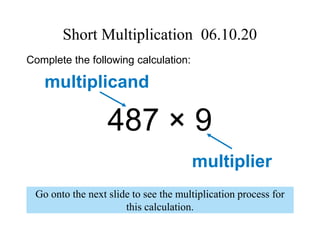
Complete the following calculation:
Go onto the next slide to see the multiplication process for
this calculation.
487 × 9
multiplicand
multiplier
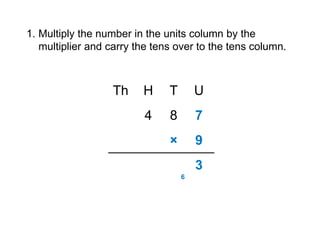
1. Multiply the number in the units column by the
multiplier and carry the tens over to the tens column.
4 8 7
U
T
H
Th
9
×
3
6
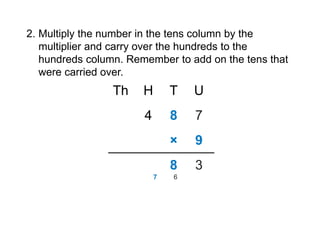
2. Multiply the number in the tens column by the
multiplier and carry over the hundreds to the
hundreds column. Remember to add on the tens that
were carried over.
4 8 7
U
T
H
Th
9
×
3
8
6
7
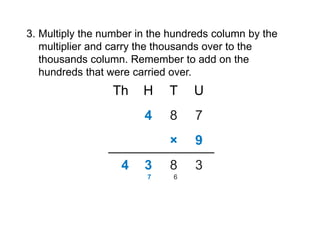
3. Multiply the number in the hundreds column by the
multiplier and carry the thousands over to the
thousands column. Remember to add on the
hundreds that were carried over.
4 8 7
U
T
H
Th
9
×
3
8
6
7
3
4
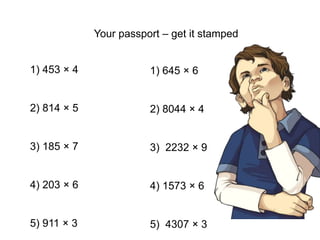
Your passport – get it stamped
1) 453 × 4
2) 814 × 5
3) 185 × 7
4) 203 × 6
5) 911 × 3
1) 645 × 6
2) 8044 × 4
3) 2232 × 9
4) 1573 × 6
5) 4307 × 3
Long Multiplication
07.10.20
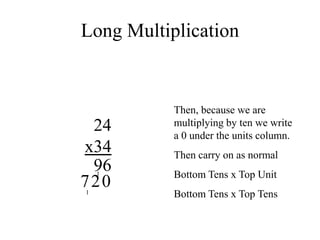
Long Multiplication
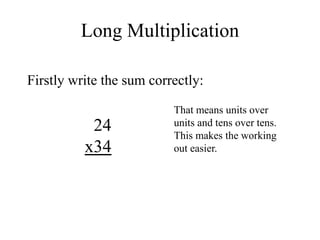
Firstly write the sum correctly:
24
x34
That means units over
units and tens over tens.
This makes the working
out easier.
Long Multiplication
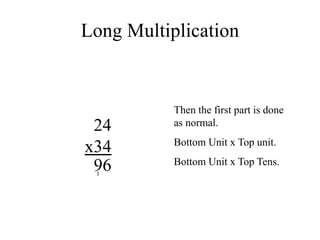
24
x34
Then the first part is done
as normal.
Bottom Unit x Top unit.
Bottom Unit x Top Tens.
96
1
Long Multiplication
24
x34
Then, because we are
multiplying by ten we write
a 0 under the units column.
Then carry on as normal
Bottom Tens x Top Unit
Bottom Tens x Top Tens
96
1
0
2
1
7
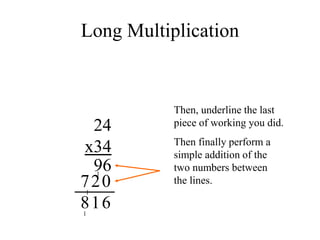
Long Multiplication
24
x34
Then, underline the last
piece of working you did.
96
1
0
2
1
7
Then finally perform a
simple addition of the
two numbers between
the lines.
6
1
1
8
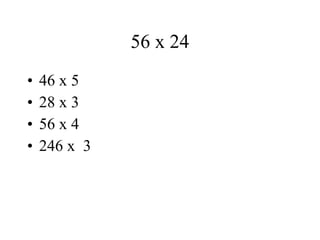
56 x 24
• 46 x 5
• 28 x 3
• 56 x 4
• 246 x 3
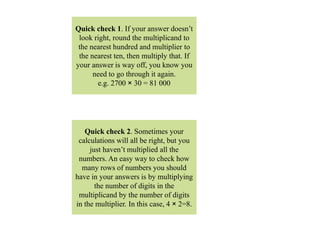
Quick check 1. If your answer doesn’t
look right, round the multiplicand to
the nearest hundred and multiplier to
the nearest ten, then multiply that. If
your answer is way off, you know you
need to go through it again.
e.g. 2700 × 30 = 81 000
Quick check 2. Sometimes your
calculations will all be right, but you
just haven’t multiplied all the
numbers. An easy way to check how
many rows of numbers you should
have in your answers is by multiplying
the number of digits in the
multiplicand by the number of digits
in the multiplier. In this case, 4 × 2=8.
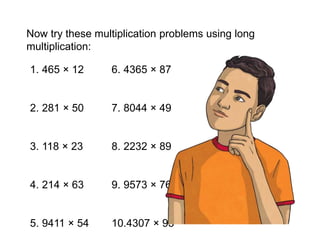
Now try these multiplication problems using long
multiplication:
1. 465 × 12
2. 281 × 50
3. 118 × 23
4. 214 × 63
5. 9411 × 54
6. 4365 × 87
7. 8044 × 49
8. 2232 × 89
9. 9573 × 76
10.4307 × 93

Multiplication basics and by column213452094.ppt

  • 1.
    Short Multiplication 06.10.20 Completethe following calculation: Go onto the next slide to see the multiplication process for this calculation. 487 × 9 multiplicand multiplier
  • 2.
    1. Multiply thenumber in the units column by the multiplier and carry the tens over to the tens column. 4 8 7 U T H Th 9 × 3 6
  • 3.
    2. Multiply thenumber in the tens column by the multiplier and carry over the hundreds to the hundreds column. Remember to add on the tens that were carried over. 4 8 7 U T H Th 9 × 3 8 6 7
  • 4.
    3. Multiply thenumber in the hundreds column by the multiplier and carry the thousands over to the thousands column. Remember to add on the hundreds that were carried over. 4 8 7 U T H Th 9 × 3 8 6 7 3 4
  • 5.
    Your passport –get it stamped 1) 453 × 4 2) 814 × 5 3) 185 × 7 4) 203 × 6 5) 911 × 3 1) 645 × 6 2) 8044 × 4 3) 2232 × 9 4) 1573 × 6 5) 4307 × 3
  • 6.
  • 7.
    Long Multiplication Firstly writethe sum correctly: 24 x34 That means units over units and tens over tens. This makes the working out easier.
  • 8.
    Long Multiplication 24 x34 Then thefirst part is done as normal. Bottom Unit x Top unit. Bottom Unit x Top Tens. 96 1
  • 9.
    Long Multiplication 24 x34 Then, becausewe are multiplying by ten we write a 0 under the units column. Then carry on as normal Bottom Tens x Top Unit Bottom Tens x Top Tens 96 1 0 2 1 7
  • 10.
    Long Multiplication 24 x34 Then, underlinethe last piece of working you did. 96 1 0 2 1 7 Then finally perform a simple addition of the two numbers between the lines. 6 1 1 8
  • 11.
    56 x 24 •46 x 5 • 28 x 3 • 56 x 4 • 246 x 3
  • 12.
    Quick check 1.If your answer doesn’t look right, round the multiplicand to the nearest hundred and multiplier to the nearest ten, then multiply that. If your answer is way off, you know you need to go through it again. e.g. 2700 × 30 = 81 000 Quick check 2. Sometimes your calculations will all be right, but you just haven’t multiplied all the numbers. An easy way to check how many rows of numbers you should have in your answers is by multiplying the number of digits in the multiplicand by the number of digits in the multiplier. In this case, 4 × 2=8.
  • 13.
    Now try thesemultiplication problems using long multiplication: 1. 465 × 12 2. 281 × 50 3. 118 × 23 4. 214 × 63 5. 9411 × 54 6. 4365 × 87 7. 8044 × 49 8. 2232 × 89 9. 9573 × 76 10.4307 × 93