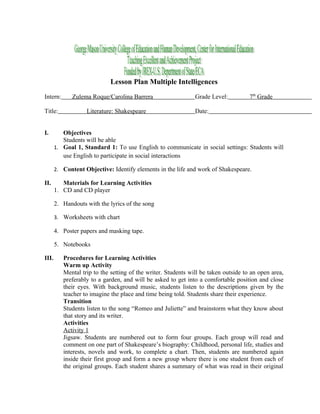
Lesson Plan Multiple Intelligences

Intern:       Zulema Roque/Carolina Barrera                    Grade Level:          7th Grade

Title:             Literature: Shakespeare                     Date:


I.        Objectives
          Students will be able
       1. Goal 1, Standard 1: To use English to communicate in social settings: Students will
          use English to participate in social interactions

       2. Content Objective: Identify elements in the life and work of Shakespeare.

II.       Materials for Learning Activities
       1. CD and CD player

       2. Handouts with the lyrics of the song

       3. Worksheets with chart

       4. Poster papers and masking tape.

       5. Notebooks

III.      Procedures for Learning Activities
          Warm up Activity
          Mental trip to the setting of the writer. Students will be taken outside to an open area,
          preferably to a garden, and will be asked to get into a comfortable position and close
          their eyes. With background music, students listen to the descriptions given by the
          teacher to imagine the place and time being told. Students share their experience.
          Transition
          Students listen to the song “Romeo and Juliette” and brainstorm what they know about
          that story and its writer.
          Activities
          Activity 1
          Jigsaw. Students are numbered out to form four groups. Each group will read and
          comment on one part of Shakespeare’s biography: Childhood, personal life, studies and
          interests, novels and work, to complete a chart. Then, students are numbered again
          inside their first group and form a new group where there is one student from each of
          the original groups. Each student shares a summary of what was read in their original
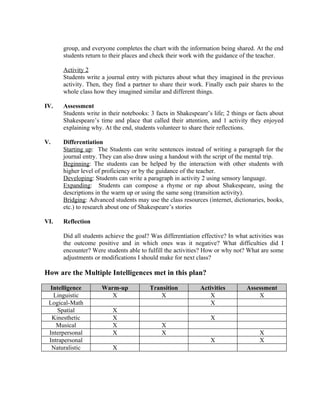
group, and everyone completes the chart with the information being shared. At the end
      students return to their places and check their work with the guidance of the teacher.

      Activity 2
      Students write a journal entry with pictures about what they imagined in the previous
      activity. Then, they find a partner to share their work. Finally each pair shares to the
      whole class how they imagined similar and different things.

IV.   Assessment
      Students write in their notebooks: 3 facts in Shakespeare’s life; 2 things or facts about
      Shakespeare’s time and place that called their attention, and 1 activity they enjoyed
      explaining why. At the end, students volunteer to share their reflections.

V.    Differentiation
      Starting up: The Students can write sentences instead of writing a paragraph for the
      journal entry. They can also draw using a handout with the script of the mental trip.
      Beginning: The students can be helped by the interaction with other students with
      higher level of proficiency or by the guidance of the teacher.
      Developing: Students can write a paragraph in activity 2 using sensory language.
      Expanding: Students can compose a rhyme or rap about Shakespeare, using the
      descriptions in the warm up or using the same song (transition activity).
      Bridging: Advanced students may use the class resources (internet, dictionaries, books,
      etc.) to research about one of Shakespeare’s stories

VI.   Reflection

      Did all students achieve the goal? Was differentiation effective? In what activities was
      the outcome positive and in which ones was it negative? What difficulties did I
      encounter? Were students able to fulfill the activities? How or why not? What are some
      adjustments or modifications I should make for next class?

How are the Multiple Intelligences met in this plan?

  Intelligence       Warm-up            Transition           Activities         Assessment
   Linguistic           X                   X                    X                  X
 Logical-Math                                                    X
     Spatial             X
   Kinesthetic           X                                       X
    Musical              X                   X
 Interpersonal           X                   X                                       X
 Intrapersonal                                                   X                   X
  Naturalistic           X

Multiple Intelligences Plan

  • 1.
    Lesson Plan MultipleIntelligences Intern: Zulema Roque/Carolina Barrera Grade Level: 7th Grade Title: Literature: Shakespeare Date: I. Objectives Students will be able 1. Goal 1, Standard 1: To use English to communicate in social settings: Students will use English to participate in social interactions 2. Content Objective: Identify elements in the life and work of Shakespeare. II. Materials for Learning Activities 1. CD and CD player 2. Handouts with the lyrics of the song 3. Worksheets with chart 4. Poster papers and masking tape. 5. Notebooks III. Procedures for Learning Activities Warm up Activity Mental trip to the setting of the writer. Students will be taken outside to an open area, preferably to a garden, and will be asked to get into a comfortable position and close their eyes. With background music, students listen to the descriptions given by the teacher to imagine the place and time being told. Students share their experience. Transition Students listen to the song “Romeo and Juliette” and brainstorm what they know about that story and its writer. Activities Activity 1 Jigsaw. Students are numbered out to form four groups. Each group will read and comment on one part of Shakespeare’s biography: Childhood, personal life, studies and interests, novels and work, to complete a chart. Then, students are numbered again inside their first group and form a new group where there is one student from each of the original groups. Each student shares a summary of what was read in their original
  • 2.
    group, and everyonecompletes the chart with the information being shared. At the end students return to their places and check their work with the guidance of the teacher. Activity 2 Students write a journal entry with pictures about what they imagined in the previous activity. Then, they find a partner to share their work. Finally each pair shares to the whole class how they imagined similar and different things. IV. Assessment Students write in their notebooks: 3 facts in Shakespeare’s life; 2 things or facts about Shakespeare’s time and place that called their attention, and 1 activity they enjoyed explaining why. At the end, students volunteer to share their reflections. V. Differentiation Starting up: The Students can write sentences instead of writing a paragraph for the journal entry. They can also draw using a handout with the script of the mental trip. Beginning: The students can be helped by the interaction with other students with higher level of proficiency or by the guidance of the teacher. Developing: Students can write a paragraph in activity 2 using sensory language. Expanding: Students can compose a rhyme or rap about Shakespeare, using the descriptions in the warm up or using the same song (transition activity). Bridging: Advanced students may use the class resources (internet, dictionaries, books, etc.) to research about one of Shakespeare’s stories VI. Reflection Did all students achieve the goal? Was differentiation effective? In what activities was the outcome positive and in which ones was it negative? What difficulties did I encounter? Were students able to fulfill the activities? How or why not? What are some adjustments or modifications I should make for next class? How are the Multiple Intelligences met in this plan? Intelligence Warm-up Transition Activities Assessment Linguistic X X X X Logical-Math X Spatial X Kinesthetic X X Musical X X Interpersonal X X X Intrapersonal X X Naturalistic X