Multiple Dosage Regimens
Submitted by,
Chandon Chakma
PHA-16038
Session:2015-16
MBSTU
Submitted to,
A.H.M. Mazbah Uddin
Lecturer,
Department of Pharmacy
MBSTU
Course: Biopharmaceutics & Pharmacokinetics II
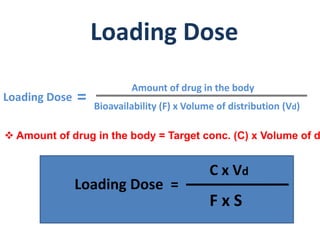
Loading Dose
Loading Dose
Amount of drug in the body
Bioavailability (F) x Volume of distribution (Vd)
=
 Amount of drug in the body = Target conc. (C) x Volume of d
Loading Dose =
C x Vd
F x S
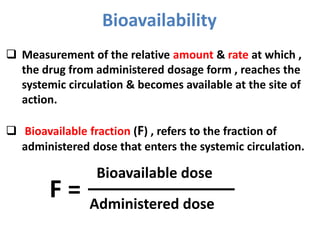
Bioavailability
Bioavailable dose
Administered dose
F =
 Measurement of the relative amount & rate at which ,
the drug from administered dosage form , reaches the
systemic circulation & becomes available at the site of
action.
 Bioavailable fraction (F) , refers to the fraction of
administered dose that enters the systemic circulation.
Types of Bioavailability
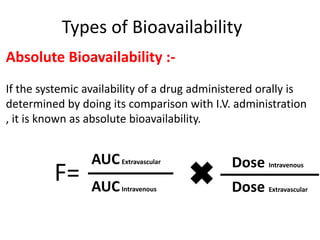
Absolute Bioavailability :-
If the systemic availability of a drug administered orally is
determined by doing its comparison with I.V. administration
, it is known as absolute bioavailability.
F=
AUCExtravascular
Dose Extravascular
Dose Intravenous
AUCIntravenous
Types of Bioavailability
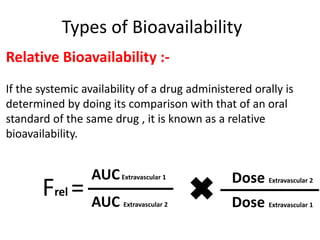
Relative Bioavailability :-
If the systemic availability of a drug administered orally is
determined by doing its comparison with that of an oral
standard of the same drug , it is known as a relative
bioavailability.
Frel =
AUCExtravascular 1
Dose Extravascular 1
Dose Extravascular 2
AUC Extravascular 2
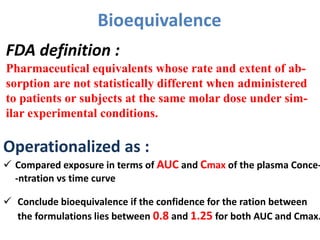
Bioequivalence
Operationalized as :
 Compared exposure in terms of AUC and Cmax of the plasma Conce-
-ntration vs time curve
 Conclude bioequivalence if the confidence for the ration between
the formulations lies between 0.8 and 1.25 for both AUC and Cmax.
FDA definition :
Pharmaceutical equivalents whose rate and extent of ab-
sorption are not statistically different when administered
to patients or subjects at the same molar dose under sim-
ilar experimental conditions.
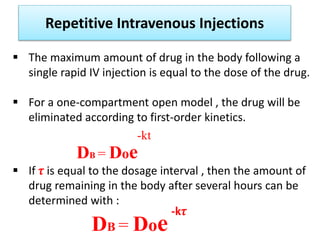
-kt
 The maximum amount of drug in the body following a
single rapid IV injection is equal to the dose of the drug.
 For a one-compartment open model , the drug will be
eliminated according to first-order kinetics.
DB = Doe
 If 𝜏 is equal to the dosage interval , then the amount of
drug remaining in the body after several hours can be
determined with :
DB = Doe
-k𝜏
Repetitive Intravenous Injections
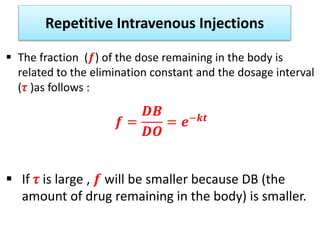
 The fraction (𝒇) of the dose remaining in the body is
related to the elimination constant and the dosage interval
(𝜏 )as follows :
𝒇 =
𝑫𝑩
𝑫𝑶
= 𝒆−𝒌𝒕
 If 𝜏 is large , 𝒇 will be smaller because DB (the
amount of drug remaining in the body) is smaller.
Repetitive Intravenous Injections
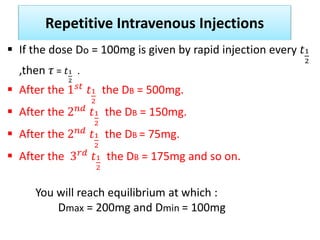
 If the dose Do = 100mg is given by rapid injection every 𝑡1
2
,then 𝜏 = 𝑡1
2
.
 After the 1𝑠𝑡
𝑡1
2
the DB = 500mg.
 After the 2𝑛𝑑 𝑡1
2
the DB = 150mg.
 After the 2𝑛𝑑
𝑡1
2
the DB = 75mg.
 After the 3𝑟𝑑 𝑡1
2
the DB = 175mg and so on.
You will reach equilibrium at which :
Dmax = 200mg and Dmin = 100mg

Multiple Dosage Regimens

  • 1.
    Multiple Dosage Regimens Submittedby, Chandon Chakma PHA-16038 Session:2015-16 MBSTU Submitted to, A.H.M. Mazbah Uddin Lecturer, Department of Pharmacy MBSTU Course: Biopharmaceutics & Pharmacokinetics II
  • 2.
    Loading Dose Loading Dose Amountof drug in the body Bioavailability (F) x Volume of distribution (Vd) =  Amount of drug in the body = Target conc. (C) x Volume of d Loading Dose = C x Vd F x S
  • 3.
    Bioavailability Bioavailable dose Administered dose F=  Measurement of the relative amount & rate at which , the drug from administered dosage form , reaches the systemic circulation & becomes available at the site of action.  Bioavailable fraction (F) , refers to the fraction of administered dose that enters the systemic circulation.
  • 4.
    Types of Bioavailability AbsoluteBioavailability :- If the systemic availability of a drug administered orally is determined by doing its comparison with I.V. administration , it is known as absolute bioavailability. F= AUCExtravascular Dose Extravascular Dose Intravenous AUCIntravenous
  • 5.
    Types of Bioavailability RelativeBioavailability :- If the systemic availability of a drug administered orally is determined by doing its comparison with that of an oral standard of the same drug , it is known as a relative bioavailability. Frel = AUCExtravascular 1 Dose Extravascular 1 Dose Extravascular 2 AUC Extravascular 2
  • 6.
    Bioequivalence Operationalized as : Compared exposure in terms of AUC and Cmax of the plasma Conce- -ntration vs time curve  Conclude bioequivalence if the confidence for the ration between the formulations lies between 0.8 and 1.25 for both AUC and Cmax. FDA definition : Pharmaceutical equivalents whose rate and extent of ab- sorption are not statistically different when administered to patients or subjects at the same molar dose under sim- ilar experimental conditions.
  • 7.
    -kt  The maximumamount of drug in the body following a single rapid IV injection is equal to the dose of the drug.  For a one-compartment open model , the drug will be eliminated according to first-order kinetics. DB = Doe  If 𝜏 is equal to the dosage interval , then the amount of drug remaining in the body after several hours can be determined with : DB = Doe -k𝜏 Repetitive Intravenous Injections
  • 8.
    Repetitive Intravenous Injections The fraction (𝒇) of the dose remaining in the body is related to the elimination constant and the dosage interval (𝜏 )as follows : 𝒇 = 𝑫𝑩 𝑫𝑶 = 𝒆−𝒌𝒕  If 𝜏 is large , 𝒇 will be smaller because DB (the amount of drug remaining in the body) is smaller.
  • 9.
    Repetitive Intravenous Injections If the dose Do = 100mg is given by rapid injection every 𝑡1 2 ,then 𝜏 = 𝑡1 2 .  After the 1𝑠𝑡 𝑡1 2 the DB = 500mg.  After the 2𝑛𝑑 𝑡1 2 the DB = 150mg.  After the 2𝑛𝑑 𝑡1 2 the DB = 75mg.  After the 3𝑟𝑑 𝑡1 2 the DB = 175mg and so on. You will reach equilibrium at which : Dmax = 200mg and Dmin = 100mg