Managing Internet Traffic using LBMP Protocol
Introduction Area of Interest Parallel and Distributed Systems My Contribution-Internet Traffic Management 1. Internet traffic management, also known as application traffic management, refers to tools that monitor the flow of Web application traffic over a network.  2. These tools route traffic among multiple devices within a network, limiting delays and freeing bandwidth.
Abstract The Internet has evolved into an ultra large and complex system interconnecting diverse end-hosts and transmission links, with numerous applications running over it.  Traffic management thus becomes a critical challenge to the healthy operation of the Internet.  To do this , various traffic management tools have been developed, including  TCP congestion control  at end-hosts,  traffic engineering  by network operators, and  adaptive routing algorithms  per- formed by routers. They all target efficient utilization of network resources and quality service to end users. Unfortunately, the collaboration among them is far from being perfect.
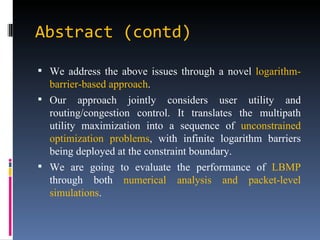
Abstract (contd) We address the above issues through a novel  logarithm-barrier-based approach . Our approach jointly considers user utility and routing/congestion control. It translates the multipath utility maximization into a sequence of  unconstrained optimization problems , with infinite logarithm barriers being deployed at the constraint boundary. We are going to evaluate the performance of  LBMP  through both  numerical analysis and packet-level simulations .
Existing System TR affic-management  U sing  M ultipath  P rotocol ( TRUMP ) Dual Based Utitlity Maximizing Protocol (DUMP) Distributed  Adaptive Traffic  Engineering(DATE) DUMP It’s utility is mainly based on  throughput If there is a packet loss,then only it  wil reduce the sending rates  some links will operate to full capacity ,so that the result will  be  long  delays  particularly  with  traffic  bursts. DATE It is distributed,optimal,stable,implementable,efficient
Existing System(contd) It satisfy the needs of user and internet service provider TRUMP Advantage A new traffic management protocol that is distributed, adaptive, robust, flexible and easy to manage. Packet-level simulations show TRUMP behaves well with realistic topologies, feedback delays, capacities, and traffic loads.  Disadvantage   1. They are also inflexible in differentiating the control at different links. 2.  Convergence is not guaranteed 3. Numerical  level simulation is not possible.
Proposed System We address the above issues through a novel  logarithm-barrier-based approach . Our approach jointly considers user utility and routing/congestion control. It translates the multipath utility maximization into a sequence of  unconstrained optimization problems , with infinite logarithm barriers being deployed at the constraint boundary. We are going to evaluate the performance of  LBMP  through both  numerical analysis and packet-level simulations .
Software Requirements Front End : Java Swing Back End : Microsoft Sql Server Network Manager : Wire Shark

Multipath Routing

  • 1.
    Managing Internet Trafficusing LBMP Protocol
  • 2.
    Introduction Area ofInterest Parallel and Distributed Systems My Contribution-Internet Traffic Management 1. Internet traffic management, also known as application traffic management, refers to tools that monitor the flow of Web application traffic over a network. 2. These tools route traffic among multiple devices within a network, limiting delays and freeing bandwidth.
  • 3.
    Abstract The Internethas evolved into an ultra large and complex system interconnecting diverse end-hosts and transmission links, with numerous applications running over it. Traffic management thus becomes a critical challenge to the healthy operation of the Internet. To do this , various traffic management tools have been developed, including TCP congestion control at end-hosts, traffic engineering by network operators, and adaptive routing algorithms per- formed by routers. They all target efficient utilization of network resources and quality service to end users. Unfortunately, the collaboration among them is far from being perfect.
  • 4.
    Abstract (contd) Weaddress the above issues through a novel logarithm-barrier-based approach . Our approach jointly considers user utility and routing/congestion control. It translates the multipath utility maximization into a sequence of unconstrained optimization problems , with infinite logarithm barriers being deployed at the constraint boundary. We are going to evaluate the performance of LBMP through both numerical analysis and packet-level simulations .
  • 5.
    Existing System TRaffic-management U sing M ultipath P rotocol ( TRUMP ) Dual Based Utitlity Maximizing Protocol (DUMP) Distributed Adaptive Traffic Engineering(DATE) DUMP It’s utility is mainly based on throughput If there is a packet loss,then only it wil reduce the sending rates some links will operate to full capacity ,so that the result will be long delays particularly with traffic bursts. DATE It is distributed,optimal,stable,implementable,efficient
  • 6.
    Existing System(contd) Itsatisfy the needs of user and internet service provider TRUMP Advantage A new traffic management protocol that is distributed, adaptive, robust, flexible and easy to manage. Packet-level simulations show TRUMP behaves well with realistic topologies, feedback delays, capacities, and traffic loads. Disadvantage 1. They are also inflexible in differentiating the control at different links. 2. Convergence is not guaranteed 3. Numerical level simulation is not possible.
  • 7.
    Proposed System Weaddress the above issues through a novel logarithm-barrier-based approach . Our approach jointly considers user utility and routing/congestion control. It translates the multipath utility maximization into a sequence of unconstrained optimization problems , with infinite logarithm barriers being deployed at the constraint boundary. We are going to evaluate the performance of LBMP through both numerical analysis and packet-level simulations .
  • 8.
    Software Requirements FrontEnd : Java Swing Back End : Microsoft Sql Server Network Manager : Wire Shark