MULTIMODAL QUESTION ANSWERING
IN THE MEDICAL DOMAIN
Friday, April 24, 2020
Dr. Asma Ben Abacha
Artificial intelligence (AI) is playing an increasingly important role in our access to information. However,
a one-fits-all approach is suboptimal, especially in the medical domain where health-related information
is more sensitive due to its potential impact on public health, and where domain-specific aspects such
as technical language and case or context-based interpretation have to be taken into account. Bridging
the gap between several research areas such as AI, NLP, medical informatics, and computer vision is a
promising way to achieve reliable and efficient access to medical information.
In this talk, I will discuss some of my recent projects on multimodal question answering (QA) including
NLP methods for textual QA and visual question answering (VQA). In particular, I will present the lessons
learned from working on QA from trusted answer sources and alternative NLP approaches such as
recognizing question entailment and question summarization. In a second part, I will address the task of
VQA from radiology images and potential solutions to support the creation of large-scale training data
through visual question generation. Throughout the talk, I will present our recent efforts in creating
relevant datasets and new approaches as well as the challenges that we organized to promote research
in multimodal question answering.
Abstract
Disclaimer
The views and opinions expressed do not necessarily state or reflect
those of the U.S. Government, and they may not be used for
advertising or product endorsement purposes.
4
Plan
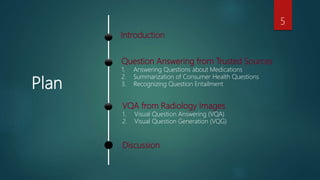
Introduction
Question Answering from Trusted Sources
1. Answering Questions about Medications
2. Summarization of Consumer Health Questions
3. Recognizing Question Entailment
VQA from Radiology Images
1. Visual Question Answering (VQA)
2. Visual Question Generation (VQG)
Discussion
5
INTRODUCTION
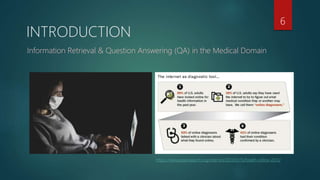
Information Retrieval & Question Answering (QA) in the Medical Domain
6
https://www.pewresearch.org/internet/2013/01/15/health-online-2013/
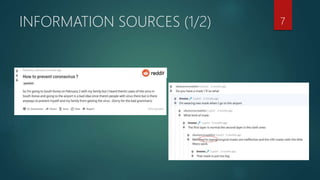
INFORMATION SOURCES (1/2) 7
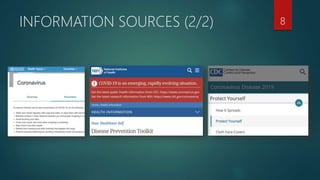
INFORMATION SOURCES (2/2) 8
Problem
Methods & Results
Lessons Learned
Part I:
QA from Trusted
Answer Sources
9
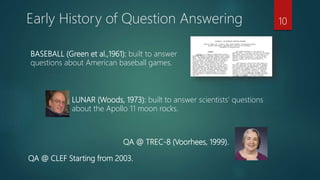
Early History of Question Answering
BASEBALL (Green et al.,1961): built to answer
questions about American baseball games.
LUNAR (Woods, 1973): built to answer scientists’ questions
about the Apollo 11 moon rocks.
QA @ TREC-8 (Voorhees, 1999).
10
QA @ CLEF Starting from 2003.
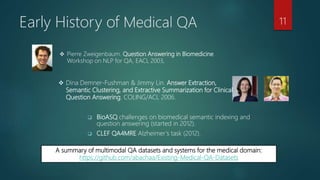
Early History of Medical QA
 BioASQ challenges on biomedical semantic indexing and
question answering (started in 2012).
 CLEF QA4MRE Alzheimer’s task (2012).
A summary of multimodal QA datasets and systems for the medical domain:
https://github.com/abachaa/Existing-Medical-QA-Datasets
 Pierre Zweigenbaum. Question Answering in Biomedicine.
Workshop on NLP for QA, EACL 2003,
11
 Dina Demner-Fushman & Jimmy Lin. Answer Extraction,
Semantic Clustering, and Extractive Summarization for Clinical
Question Answering. COLING/ACL 2006.
Part I: QA from Trusted Answer Sources 12
1) Answering Questions about Medications
13
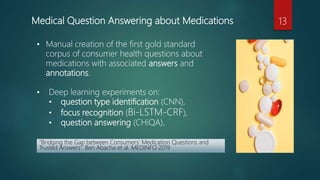
“Bridging the Gap between Consumers’ Medication Questions and
Trusted Answers”. Ben Abacha et al. MEDINFO 2019
Medical Question Answering about Medications
• Manual creation of the first gold standard
corpus of consumer health questions about
medications with associated answers and
annotations.
• Deep learning experiments on:
• question type identification (CNN),
• focus recognition (Bi-LSTM-CRF),
• question answering (CHiQA).
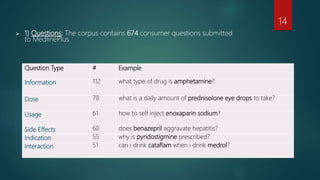
 1) Questions: The corpus contains 674 consumer questions submitted
to MedlinePlus.
14
Question Type # Example
Information 112 what type of drug is amphetamine?
Dose 70 what is a daily amount of prednisolone eye drops to take?
Usage 61 how to self inject enoxaparin sodium?
Side Effects 60 does benazepril aggravate hepatitis?
Indication 55 why is pyridostigmine prescribed?
Interaction 51 can i drink cataflam when i drink medrol?
15
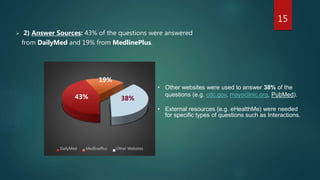
43%
19%
38%
DailyMed MedlinePlus Other Websites
 2) Answer Sources: 43% of the questions were answered
from DailyMed and 19% from MedlinePlus.
• Other websites were used to answer 38% of the
questions (e.g. cdc.gov, mayoclinic.org, PubMed).
• External resources (e.g. eHealthMe) were needed
for specific types of questions such as Interactions.
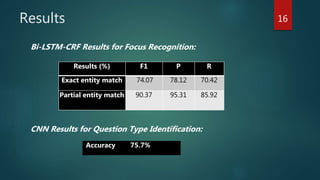
Results
Results (%) F1 P R
Exact entity match 74.07 78.12 70.42
Partial entity match 90.37 95.31 85.92
Bi-LSTM-CRF Results for Focus Recognition:
CNN Results for Question Type Identification:
Accuracy 75.7%
16
Results
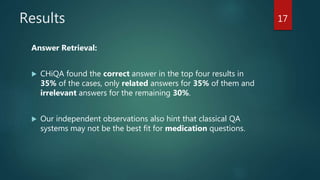
Answer Retrieval:
 CHiQA found the correct answer in the top four results in
35% of the cases, only related answers for 35% of them and
irrelevant answers for the remaining 30%.
 Our independent observations also hint that classical QA
systems may not be the best fit for medication questions.
17
18
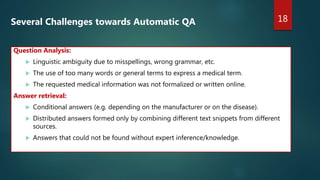
Several Challenges towards Automatic QA
Question Analysis:
 Linguistic ambiguity due to misspellings, wrong grammar, etc.
 The use of too many words or general terms to express a medical term.
 The requested medical information was not formalized or written online.
Answer retrieval:
 Conditional answers (e.g. depending on the manufacturer or on the disease).
 Distributed answers formed only by combining different text snippets from different
sources.
 Answers that could not be found without expert inference/knowledge.
 Medical text translation, simplification, and inference are often needed to find relevant
answers and/or make the answers readable for non-expert users.
 More data and resources are needed to cover information about drug interactions and
usage guidelines (e.g. scientific literature).
 Conditional answers require different solutions such as providing a list of answers or
interacting with the user in a dialogue-based approach.
19
Solutions for the Automation of Medication QA
“Bridging the Gap between Consumers’ Medication Questions and
Trusted Answers”. Ben Abacha et al. MEDINFO 2019
Part I: QA from Trusted Answer Sources 20
2) Summarization of consumer health questions
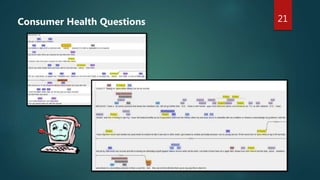
Consumer Health Questions 21
22
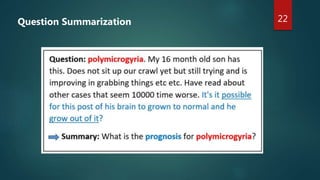
Question Summarization
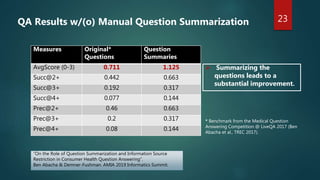
23
“On the Role of Question Summarization and Information Source
Restriction in Consumer Health Question Answering”.
Ben Abacha & Demner-Fushman. AMIA 2019 Informatics Summit.
Measures Original*
Questions
Question
Summaries
AvgScore (0-3) 0.711 1.125
Succ@2+ 0.442 0.663
Succ@3+ 0.192 0.317
Succ@4+ 0.077 0.144
Prec@2+ 0.46 0.663
Prec@3+ 0.2 0.317
Prec@4+ 0.08 0.144
QA Results w/(o) Manual Question Summarization
* Benchmark from the Medical Question
Answering Competition @ LiveQA 2017 (Ben
Abacha et al., TREC 2017).
 Summarizing the
questions leads to a
substantial improvement.
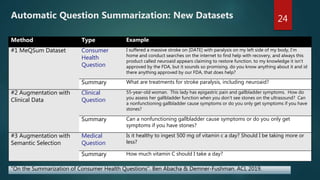
Automatic Question Summarization: New Datasets
Method Type Example
#1 MeQSum Dataset Consumer
Health
Question
I suffered a massive stroke on [DATE] with paralysis on my left side of my body, I'm
home and conduct searches on the internet to find help with recovery, and always this
product called neuroaid appears claiming to restore function. to my knowledge it isn't
approved by the FDA, but it sounds so promising. do you know anything about it and id
there anything approved by our FDA, that does help?
Summary What are treatments for stroke paralysis, including neuroaid?
#2 Augmentation with
Clinical Data
Clinical
Question
55-year-old woman. This lady has epigastric pain and gallbladder symptoms. How do
you assess her gallbladder function when you don't see stones on the ultrasound? Can
a nonfunctioning gallbladder cause symptoms or do you only get symptoms if you have
stones?
Summary Can a nonfunctioning gallbladder cause symptoms or do you only get
symptoms if you have stones?
#3 Augmentation with
Semantic Selection
Medical
Question
Is it healthy to ingest 500 mg of vitamin c a day? Should I be taking more or
less?
Summary How much vitamin C should I take a day?
24
“On the Summarization of Consumer Health Questions”. Ben Abacha & Demner-Fushman. ACL 2019.
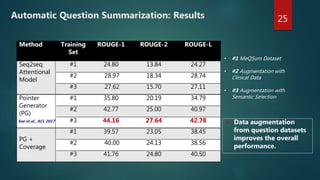
25
Method Training
Set
ROUGE-1 ROUGE-2 ROUGE-L
Seq2seq
Attentional
Model
#1 24.80 13.84 24.27
#2 28.97 18.34 28.74
#3 27.62 15.70 27.11
Pointer
Generator
(PG)
#1 35.80 20.19 34.79
#2 42.77 25.00 40.97
#3 44.16 27.64 42.78
PG +
Coverage
#1 39.57 23.05 38.45
#2 40.00 24.13 38.56
#3 41.76 24.80 40.50
• #1 MeQSum Dataset
• #2 Augmentation with
Clinical Data
• #3 Augmentation with
Semantic Selection
 Data augmentation
from question datasets
improves the overall
performance.
See et al., ACL 2017
Automatic Question Summarization: Results
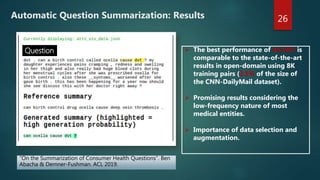
26
Question  The best performance of 44.16% is
comparable to the state-of-the-art
results in open-domain using 8K
training pairs (2.5% of the size of
the CNN-DailyMail dataset).
 Promising results considering the
low-frequency nature of most
medical entities.
 Importance of data selection and
augmentation.
“On the Summarization of Consumer Health Questions”. Ben
Abacha & Demner-Fushman. ACL 2019.
Automatic Question Summarization: Results
Part I: QA from Trusted Answer Sources 27
3) Recognizing Question Entailment
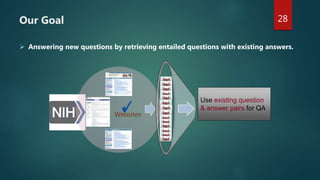
Our Goal
Use existing question
& answer pairs for QA
Websites
 Answering new questions by retrieving entailed questions with existing answers.
28
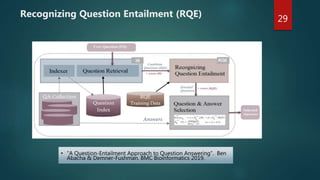
Recognizing Question Entailment (RQE) 29
• “A Question-Entailment Approach to Question Answering”. Ben
Abacha & Demner-Fushman. BMC Bioinformatics 2019.
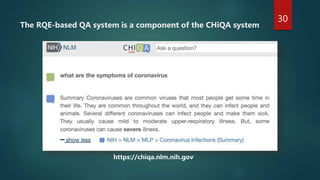
The RQE-based QA system is a component of the CHiQA system
30
https://chiqa.nlm.nih.gov
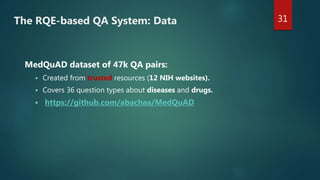
MedQuAD dataset of 47k QA pairs:
 Created from trusted resources (12 NIH websites).
 Covers 36 question types about diseases and drugs.
 https://github.com/abachaa/MedQuAD
31
The RQE-based QA System: Data
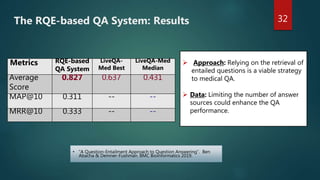
The RQE-based QA System: Results 32
Metrics RQE-based
QA System
LiveQA-
Med Best
LiveQA-Med
Median
Average
Score
0.827 0.637 0.431
MAP@10 0.311 -- --
MRR@10 0.333 -- --
 Approach: Relying on the retrieval of
entailed questions is a viable strategy
to medical QA.
 Data: Limiting the number of answer
sources could enhance the QA
performance.
• “A Question-Entailment Approach to Question Answering”. Ben
Abacha & Demner-Fushman. BMC Bioinformatics 2019.
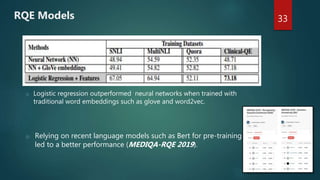
o Logistic regression outperformed neural networks when trained with
traditional word embeddings such as glove and word2vec.
o Relying on recent language models such as Bert for pre-training
led to a better performance (MEDIQA-RQE 2019).
33
RQE Models
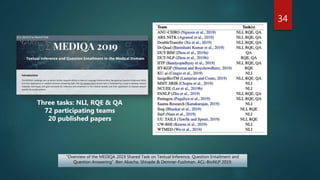
34
“Overview of the MEDIQA 2019 Shared Task on Textual Inference, Question Entailment and
Question Answering”. Ben Abacha, Shivade & Demner-Fushman. ACL-BioNLP 2019.
Three tasks: NLI, RQE & QA
72 participating teams
20 published papers
MEDIQA – Post Challenge Round
https://www.aicrowd.com/organizers/mediqa-acl-bionlp
35
Submission open
To Sum up:
 Relying on the retrieval of entailed questions is a viable strategy to answer
consumer health questions
 Limiting the number of answer sources by using only trusted sources could
enhance the QA performance.
 Transfer learning & multi-task learning improve the performance of RQE, NLI and
QA models in the medical domain.
 Summarizing the questions leads to a substantial improvement.
 More efforts are needed for building large datasets (for training and testing) and
efficient methods (e.g. medical text understanding and simplification).
36
37
Part II:
VQA & VQG from
Radiology Images
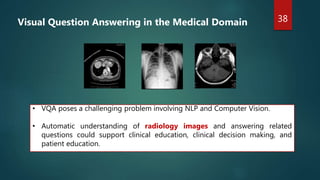
38
• VQA poses a challenging problem involving NLP and Computer Vision.
• Automatic understanding of radiology images and answering related
questions could support clinical education, clinical decision making, and
patient education.
Visual Question Answering in the Medical Domain
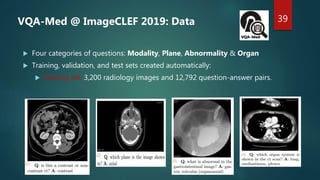
 Four categories of questions: Modality, Plane, Abnormality & Organ
 Training, validation, and test sets created automatically:
 Training set: 3,200 radiology images and 12,792 question-answer pairs.
VQA-Med @ ImageCLEF 2019: Data 39
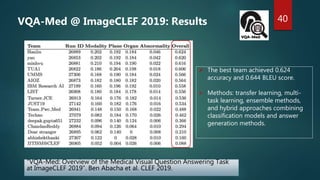
 The best team achieved 0.624
accuracy and 0.644 BLEU score.
 Methods: transfer learning, multi-
task learning, ensemble methods,
and hybrid approaches combining
classification models and answer
generation methods.
40
“VQA-Med: Overview of the Medical Visual Question Answering Task
at ImageCLEF 2019”. Ben Abacha et al. CLEF 2019.
VQA-Med @ ImageCLEF 2019: Results
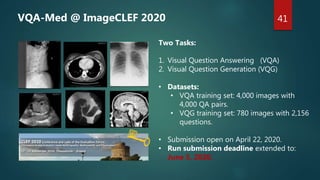
Two Tasks:
1. Visual Question Answering (VQA)
2. Visual Question Generation (VQG)
• Datasets:
• VQA training set: 4,000 images with
4,000 QA pairs.
• VQG training set: 780 images with 2,156
questions.
• Submission open on April 22, 2020.
• Run submission deadline extended to:
June 5, 2020.
41
VQA-Med @ ImageCLEF 2020
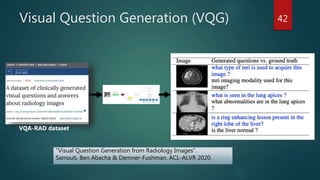
Visual Question Generation (VQG)
“Visual Question Generation from Radiology Images”.
Sarrouti, Ben Abacha & Demner-Fushman. ACL-ALVR 2020.
42
VQA-RAD dataset
Neuroimaging Collection (Ongoing)
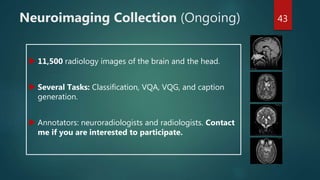
 11,500 radiology images of the brain and the head.
 Several Tasks: Classification, VQA, VQG, and caption
generation.
 Annotators: neuroradiologists and radiologists. Contact
me if you are interested to participate.
43
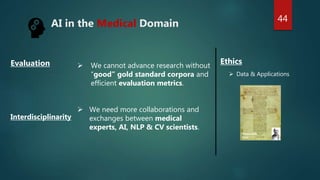
AI in the Medical Domain
Hippocratic
Oath
 We cannot advance research without
“good” gold standard corpora and
efficient evaluation metrics.
 We need more collaborations and
exchanges between medical
experts, AI, NLP & CV scientists.
Ethics
Evaluation
Interdisciplinarity
44
 Data & Applications
Thank you for your Attention!
Email: asma.benabacha@nih.gov
Twitter: @AsmaBenAbacha
GitHub: abachaa
References
1. Asma Ben Abacha & Dina Demner-Fushman. On the Summarization of Consumer
Health Questions. ACL 2019.
2. Asma Ben Abacha, Chaitanya Shivade & Dina Demner-Fushman. Overview of the
MEDIQA 2019 Shared Task on Textual Inference, Question Entailment and Question
Answering. ACL-BioNLP 2019.
3. Asma Ben Abacha & Dina Demner-Fushman. On the Role of Question
Summarization and Information Source Restriction in Consumer Health Question
Answering. AMIA 2019 Informatics Summit.
4. Asma Ben Abacha, Eugene Agichtein, Yuval Pinter & Dina Demner-Fushman.
Overview of the Medical QA Task @ TREC 2017 LiveQA Track. TREC 2017.
5. Asma Ben Abacha & Dina Demner-Fushman. Recognizing Question Entailment for
Medical Question Answering. AMIA 2016.
6. Asma Ben Abacha & Dina Demner-Fushman. A Question-Entailment Approach to
Question Answering. BMC Bioinformatics 2019.
7. Asma Ben Abacha, Yassine Mrabet, Mark Sharp, Travis Goodwin, Sonya E. Shooshan
& Dina Demner-Fushman. Bridging the Gap between Consumers’ Medication
Questions and Trusted Answers. MEDINFO 2019.
8. Jason J. Lau, Soumya Gayen, Asma Ben Abacha & Dina Demner-Fushman. A dataset
of clinically generated visual questions and answers about radiology images.
Scientific Data, Nature, 2018.
9. Asma Ben Abacha, Sadid A. Hasan, Vivek V. Datla, Joey Liu, Dina Demner-Fushman
& Henning Müller. VQA-Med: Overview of the Medical Visual Question Answering
Task at ImageCLEF 2019. CLEF 2019.
10. Visual Question Generation from Radiology Images. Mourad Sarrouti, Asma Ben
Abacha & Dina Demner-Fushman. ACL-ALVR 2020.
45