Multimedia Answer Generation for
Community Question Answering
Problem Statement
• Textual Answers
• Multimedia Answers
Literature Survey
Sr. No Author Year Contribution
1. Trec: Text Retrieval Conference
[http://trec.nist.gov ]
1990 Text based QA
2. S.A. Quarteroni, S. Manandhar 2008 Text based QA based on type of
questions
Open Domain QA
3. D. Molla & J.L Vicedo 2007 Restricted Domain QA
4. H. Cui, M.Y. Kan 2007 Definitional QA
5. R.C.Wang, W.W. Cohen, E.
Nyberg
2008 List QA
6. H. Yang, T S chua, S. Wang 2003 Video QA
7. J.Cao, Y-C- Wu, Y-S Lee 2004-
2009
Video QA using OCR & ASR
8. Lot of authors 2003-
2013
Content Based Retrieval
System Decomposition
• Answer medium selection,
• Query generation
• Multimedia data selection and
presentation.
Pre-requisites
• Datasets
• Image & Video Mining API
– Flickr, Picasaweb, Youtube, etc.
Process Flow
Dataset
collection
Classification
(Conversational & Informational)
The answer medium selection and
query selection components
Query Generation for Multimedia
Retrieval
Multimedia Data
Duplicate Removal
Result Re-ranking
Answer Medium Selection
• Classification
– only text,
– Text + image
– text + video
– text + image + video
• Approach:
– Question Based Classification
– Answer Based Classification
– Media Resource Analysis
Query Extraction
For each QA pair, we generate three queries.
1. Convert the question to a query,
2. Identify several key concepts from verbose answer which will
have the major impact on effectiveness.
3. Finally, we combine the two queries that are generated from
the question and the answer respectively.
Query Generation for Multimedia
Search
• Query Extraction
• The second step is query selection.
Query Selection
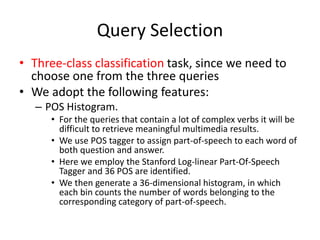
• Three-class classification task, since we need to
choose one from the three queries
• We adopt the following features:
– POS Histogram.
• For the queries that contain a lot of complex verbs it will be
difficult to retrieve meaningful multimedia results.
• We use POS tagger to assign part-of-speech to each word of
both question and answer.
• Here we employ the Stanford Log-linear Part-Of-Speech
Tagger and 36 POS are identified.
• We then generate a 36-dimensional histogram, in which
each bin counts the number of words belonging to the
corresponding category of part-of-speech.
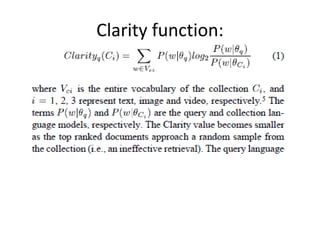
(2) Search performance prediction.
– Clarity score for each query based on the KL divergence
between the query and collection language models.
– We can generate 6-dimensional search performance
prediction features in all (there are three queries and
search is performed on both image and video search
engines).
• Therefore, for each QA pair, we can generate 42-
dimensional features.
• Based on the extracted features, we train an SVM
classifier with a labeled training set for classification
• i.e., selecting one from the three queries.
Clarity function:
Multimedia Data Selection &
Prediction
• We perform search using the generated queries
to collect image and video data with Google
image and video search engines respectively.
• Most of the current commercial search engines
are built upon text-based indexing and usually
return a lot of irrelevant results.
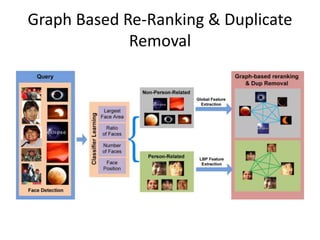
• Therefore,
– Re-ranking by exploring visual information is essential
to reorder the initial text-based search results.
– Here we adopt the graph-based re-ranking method.
Graph Based Re-Ranking & Duplicate
Removal
List of Algorithms
• Core sentence extraction from question
• Stemming & stop-words removal on answers
• Question Type based on Answer Medium ( Naïve Bayes)
• Head word extraction
• Media Resource Analysis
– Clarity score based on KL Divergence
• Query Generation
• Query Selection
– POS Feature Extraction
– Search Performance Prediction
• Multimedia Data selection & presentation
– Graph based ranking
– Face Detection Algorithms
– Feature Extraction from images
– Key frame identification & extraction
References
1. M. Surdeanu, M. Ciaramita, and H. Zaragoza,
“Learning to rank answers on large online QA
collections,” in Proc. Association for Computational
Linguistics, 2008
2. S. Cronen-Townsend, Y. Zhou, andW. B. Croft,
“Predicting query performance,” in Proc. ACM Int.
SIGIR Conf., 2002.
3. Liqiang Nie, Meng Wang, Yue Gao, Zheng-Jun Zha,
and Tat-Seng Chua “Beyond Text QA: Multimedia
Answer Generation by Harvesting Web Information”
IEEE Multimedia Transaction 2013
Thank You….

Multimedia Answer Generation for Community Question Answering

  • 1.
    Multimedia Answer Generationfor Community Question Answering
  • 2.
    Problem Statement • TextualAnswers • Multimedia Answers
  • 3.
    Literature Survey Sr. NoAuthor Year Contribution 1. Trec: Text Retrieval Conference [http://trec.nist.gov ] 1990 Text based QA 2. S.A. Quarteroni, S. Manandhar 2008 Text based QA based on type of questions Open Domain QA 3. D. Molla & J.L Vicedo 2007 Restricted Domain QA 4. H. Cui, M.Y. Kan 2007 Definitional QA 5. R.C.Wang, W.W. Cohen, E. Nyberg 2008 List QA 6. H. Yang, T S chua, S. Wang 2003 Video QA 7. J.Cao, Y-C- Wu, Y-S Lee 2004- 2009 Video QA using OCR & ASR 8. Lot of authors 2003- 2013 Content Based Retrieval
  • 4.
    System Decomposition • Answermedium selection, • Query generation • Multimedia data selection and presentation.
  • 5.
    Pre-requisites • Datasets • Image& Video Mining API – Flickr, Picasaweb, Youtube, etc.
  • 6.
    Process Flow Dataset collection Classification (Conversational &Informational) The answer medium selection and query selection components Query Generation for Multimedia Retrieval Multimedia Data Duplicate Removal Result Re-ranking
  • 7.
    Answer Medium Selection •Classification – only text, – Text + image – text + video – text + image + video • Approach: – Question Based Classification – Answer Based Classification – Media Resource Analysis
  • 8.
    Query Extraction For eachQA pair, we generate three queries. 1. Convert the question to a query, 2. Identify several key concepts from verbose answer which will have the major impact on effectiveness. 3. Finally, we combine the two queries that are generated from the question and the answer respectively.
  • 9.
    Query Generation forMultimedia Search • Query Extraction • The second step is query selection.
  • 10.
    Query Selection • Three-classclassification task, since we need to choose one from the three queries • We adopt the following features: – POS Histogram. • For the queries that contain a lot of complex verbs it will be difficult to retrieve meaningful multimedia results. • We use POS tagger to assign part-of-speech to each word of both question and answer. • Here we employ the Stanford Log-linear Part-Of-Speech Tagger and 36 POS are identified. • We then generate a 36-dimensional histogram, in which each bin counts the number of words belonging to the corresponding category of part-of-speech.
  • 11.
    (2) Search performanceprediction. – Clarity score for each query based on the KL divergence between the query and collection language models. – We can generate 6-dimensional search performance prediction features in all (there are three queries and search is performed on both image and video search engines). • Therefore, for each QA pair, we can generate 42- dimensional features. • Based on the extracted features, we train an SVM classifier with a labeled training set for classification • i.e., selecting one from the three queries.
  • 12.
  • 13.
    Multimedia Data Selection& Prediction • We perform search using the generated queries to collect image and video data with Google image and video search engines respectively. • Most of the current commercial search engines are built upon text-based indexing and usually return a lot of irrelevant results. • Therefore, – Re-ranking by exploring visual information is essential to reorder the initial text-based search results. – Here we adopt the graph-based re-ranking method.
  • 14.
    Graph Based Re-Ranking& Duplicate Removal
  • 15.
    List of Algorithms •Core sentence extraction from question • Stemming & stop-words removal on answers • Question Type based on Answer Medium ( Naïve Bayes) • Head word extraction • Media Resource Analysis – Clarity score based on KL Divergence • Query Generation • Query Selection – POS Feature Extraction – Search Performance Prediction • Multimedia Data selection & presentation – Graph based ranking – Face Detection Algorithms – Feature Extraction from images – Key frame identification & extraction
  • 16.
    References 1. M. Surdeanu,M. Ciaramita, and H. Zaragoza, “Learning to rank answers on large online QA collections,” in Proc. Association for Computational Linguistics, 2008 2. S. Cronen-Townsend, Y. Zhou, andW. B. Croft, “Predicting query performance,” in Proc. ACM Int. SIGIR Conf., 2002. 3. Liqiang Nie, Meng Wang, Yue Gao, Zheng-Jun Zha, and Tat-Seng Chua “Beyond Text QA: Multimedia Answer Generation by Harvesting Web Information” IEEE Multimedia Transaction 2013
  • 17.