Why Treasurers Should
Adopt Multilateral Netting
Learnings from Diversey
Webinar Logistics
• Listen only mode during the webinar
• Questions can be submitted at any time via the webinar console
We will do our best to address all of the questions at the end of the session
• Any technical issues, please place in the ‘chat’ via the webinar console
• The webinar is recorded and we will send it to all registrants after the event
Today’s Presenters
MARK LAYTON
Global Treasury
Manager, Diversey
CRAIG CHAPMAN
Manager, Treasury &
Capital Markets,
Actualize Consulting
SAMUEL GUILLON
SVP Strategy,
Kyriba
Our Partnership
Actualize Consulting is
a long term Kyriba
implementation
partner that are well
skilled in treasury
management &
payments
Kyriba’s Multilateral
Netting Modul
Implementation
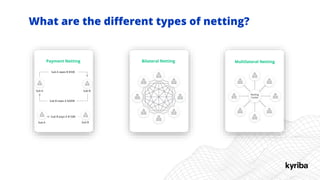
What are the different types of netting?
Bilateral Netting Multilateral Netting
Payment Netting
Sub A owes B $50K
Sub A Sub B
Sub B owes A $200K
Sub A Sub B
Sub B pays A $150K
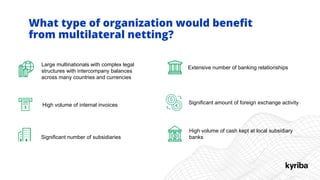
What type of organization would benefit
from multilateral netting?
Large multinationals with complex legal
structures with intercompany balances
across many countries and currencies
High volume of internal invoices
Significant number of subsidiaries
Extensive number of banking relationships
Significant amount of foreign exchange activity
High volume of cash kept at local subsidiary
banks
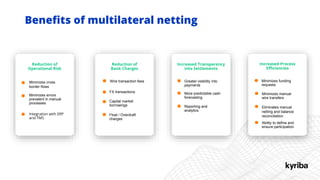
Benefits of multilateral netting
Reduction of
Operational Risk
Reduction of
Bank Charges
Increased Transparency
into Settlements
Increased Process
Efficiencies
Minimizes cross
border flows
Minimizes errors
prevalent in manual
processes
Integration with ERP
and TMS
Wire transaction fees
FX transactions
Capital market
borrowings
Float / Overdraft
charges
Greater visibility into
payments
More predictable cash
forecasting
Reporting and
analytics
Minimizes funding
requests
Minimizes manual
wire transfers
Eliminates manual
netting and balance
reconciliation
Ability to define and
ensure participation
POLL Q1
Common challenges prior to implementing netting
Large payment
volumes
Inefficient use
of resources
Tax and legal
compliance
High bank
transaction fees
Settlement risk
FX payment costs
High manual effort to
enter and release
payments
Time consuming GL
posting
Error prone
Intercompany invoices
not settled within
payment terms
FX payment costs
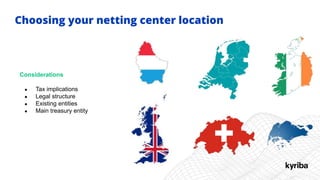
Choosing your netting center location
Considerations
● Tax implications
● Legal structure
● Existing entities
● Main treasury entity
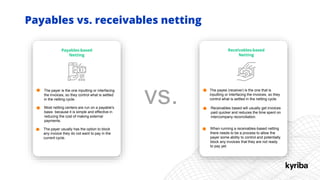
Payables vs. receivables netting
Payables-based
Netting
Most netting centers are run on a payable's
basis because it is simple and effective in
reducing the cost of making external
payments.
The payer usually has the option to block
any invoice they do not want to pay in the
current cycle.
Receivables-based
Netting
The payer is the one inputting or interfacing
the invoices, so they control what is settled
in the netting cycle.
Receivables based will usually get invoices
paid quicker and reduces the time spent on
intercompany reconciliation.
When running a receivables-based netting
there needs to be a process to allow the
payer some ability to control and potentially
block any invoices that they are not ready
to pay yet.
vs. The payee (receiver) is the one that is
inputting or interfacing the invoices, so they
control what is settled in the netting cycle.
Internal or External settlement?
Special circumstances for
Mexico, Taiwan, Singapore and
China
A number of entities do not
permit settlement on the in-house
bank accounts. In these cases
the payment must be made
physically. Kyriba supports this
functionality.
We are reviewing the list of non-
participating entities to determine
if they can be included.
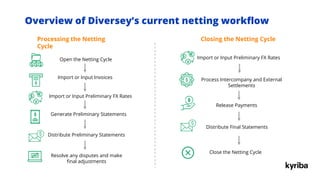
Overview of Diversey’s current netting workflow
Open the Netting Cycle
Import or Input Invoices
Import or Input Preliminary FX Rates
Generate Preliminary Statements
Distribute Preliminary Statements
Resolve any disputes and make
final adjustments
Process Intercompany and External
Settlements
Import or Input Preliminary FX Rates
Release Payments
Distribute Final Statements
Close the Netting Cycle
Processing the Netting
Cycle
Closing the Netting Cycle
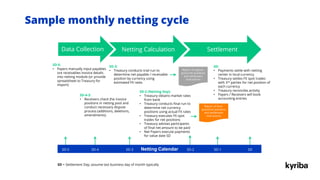
Sample monthly netting cycle
Data Collection Netting Calculation Settlement
SD-5:
• Payers manually input payables
ore receivables invoice details
into netting module (or provide
spreadsheet to Treasury for
import)
Netting Calendar
SD = Settlement Day; assume last business day of month typically
SD-3:
• Treasury conducts trial run to
determine net payable / receivable
position by currency using
estimated FX rates
SD:
• Payments settle with netting
center in local currency
• Treasury settles FX spot trades
with 3rd parties for net position of
each currency
• Treasury reconciles activity
• Payers / Receivers will book
accounting entries
Report of approx.
gross/net positions
and settlement
instructions
Report of final.
gross/net positions
and settlement
instructions
SD-4-3:
• Receivers check the invoice
positions in netting pool and
conduct necessary dispute
process (additions, deletions,
amendments)
SD-2 (Netting Day):
• Treasury obtains market rates
from bank
• Treasury conducts final run to
determine net currency
positions using actual FX rates
• Treasury executes FX spot
trades for net positions
• Treasury advises participants
of final net amount to be paid
• Net Payers execute payments
for value date SD
SD-5 SD-4 SD-3 SD-2 SD-1 SD
POLL Q2
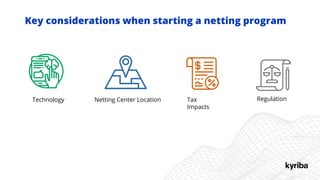
Key considerations when starting a netting program
Technology Netting Center Location Tax
Impacts
Regulation
POLL Q3
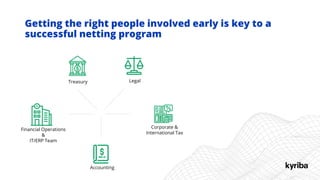
Getting the right people involved early is key to a
successful netting program
Treasury
Accounting
Legal
Corporate &
International Tax
Financial Operations
&
IT/ERP Team
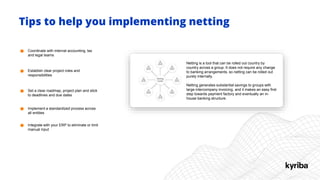
Tips to help you implementing netting
Coordinate with internal accounting, tax
and legal teams
Establish clear project roles and
responsibilities
Set a clear roadmap, project plan and stick
to deadlines and due dates
Implement a standardized process across
all entities
Integrate with your ERP to eliminate or limit
manual input
Netting is a tool that can be rolled out country by
country across a group. It does not require any change
to banking arrangements, so netting can be rolled out
purely internally.
Netting generates substantial savings to groups with
large intercompany invoicing, and it makes an easy first
step towards payment factory and eventually an in-
house banking structure.
Key decisions and actions to get started
Tax and Legal Technology Structure Operational
Involve tax and legal
early in the process
Evaluate netting
participants allowed
Internal or External
Settlement
Gather business
requirements
Evaluate netting
system vendors
Perform final vendor
selection
Decide on netting
driver: Payables vs.
Receivables
Third-party or strictly
internal participants
Finalize participants
and location
Develop netting
calendar
Establish settlement
accounts
Any restricted
currencies?
Will disputes be
managed in the netting
software or externally
Determine Location
of the Netting Center
Determine functional
currency of the
Center
Finalize functional
currency for all
participants
Q&A
Thank you!
www.kyriba.uk
contactus@kyriba.com

Why Treasurers Should Adopt Multilateral Netting

  • 1.
    Why Treasurers Should AdoptMultilateral Netting Learnings from Diversey
  • 2.
    Webinar Logistics • Listenonly mode during the webinar • Questions can be submitted at any time via the webinar console We will do our best to address all of the questions at the end of the session • Any technical issues, please place in the ‘chat’ via the webinar console • The webinar is recorded and we will send it to all registrants after the event
  • 3.
    Today’s Presenters MARK LAYTON GlobalTreasury Manager, Diversey CRAIG CHAPMAN Manager, Treasury & Capital Markets, Actualize Consulting SAMUEL GUILLON SVP Strategy, Kyriba
  • 4.
    Our Partnership Actualize Consultingis a long term Kyriba implementation partner that are well skilled in treasury management & payments Kyriba’s Multilateral Netting Modul Implementation
  • 5.
    What are thedifferent types of netting? Bilateral Netting Multilateral Netting Payment Netting Sub A owes B $50K Sub A Sub B Sub B owes A $200K Sub A Sub B Sub B pays A $150K
  • 6.
    What type oforganization would benefit from multilateral netting? Large multinationals with complex legal structures with intercompany balances across many countries and currencies High volume of internal invoices Significant number of subsidiaries Extensive number of banking relationships Significant amount of foreign exchange activity High volume of cash kept at local subsidiary banks
  • 7.
    Benefits of multilateralnetting Reduction of Operational Risk Reduction of Bank Charges Increased Transparency into Settlements Increased Process Efficiencies Minimizes cross border flows Minimizes errors prevalent in manual processes Integration with ERP and TMS Wire transaction fees FX transactions Capital market borrowings Float / Overdraft charges Greater visibility into payments More predictable cash forecasting Reporting and analytics Minimizes funding requests Minimizes manual wire transfers Eliminates manual netting and balance reconciliation Ability to define and ensure participation
  • 8.
  • 9.
    Common challenges priorto implementing netting Large payment volumes Inefficient use of resources Tax and legal compliance High bank transaction fees Settlement risk FX payment costs High manual effort to enter and release payments Time consuming GL posting Error prone Intercompany invoices not settled within payment terms FX payment costs
  • 10.
    Choosing your nettingcenter location Considerations ● Tax implications ● Legal structure ● Existing entities ● Main treasury entity
  • 11.
    Payables vs. receivablesnetting Payables-based Netting Most netting centers are run on a payable's basis because it is simple and effective in reducing the cost of making external payments. The payer usually has the option to block any invoice they do not want to pay in the current cycle. Receivables-based Netting The payer is the one inputting or interfacing the invoices, so they control what is settled in the netting cycle. Receivables based will usually get invoices paid quicker and reduces the time spent on intercompany reconciliation. When running a receivables-based netting there needs to be a process to allow the payer some ability to control and potentially block any invoices that they are not ready to pay yet. vs. The payee (receiver) is the one that is inputting or interfacing the invoices, so they control what is settled in the netting cycle.
  • 12.
    Internal or Externalsettlement? Special circumstances for Mexico, Taiwan, Singapore and China A number of entities do not permit settlement on the in-house bank accounts. In these cases the payment must be made physically. Kyriba supports this functionality. We are reviewing the list of non- participating entities to determine if they can be included.
  • 13.
    Overview of Diversey’scurrent netting workflow Open the Netting Cycle Import or Input Invoices Import or Input Preliminary FX Rates Generate Preliminary Statements Distribute Preliminary Statements Resolve any disputes and make final adjustments Process Intercompany and External Settlements Import or Input Preliminary FX Rates Release Payments Distribute Final Statements Close the Netting Cycle Processing the Netting Cycle Closing the Netting Cycle
  • 14.
    Sample monthly nettingcycle Data Collection Netting Calculation Settlement SD-5: • Payers manually input payables ore receivables invoice details into netting module (or provide spreadsheet to Treasury for import) Netting Calendar SD = Settlement Day; assume last business day of month typically SD-3: • Treasury conducts trial run to determine net payable / receivable position by currency using estimated FX rates SD: • Payments settle with netting center in local currency • Treasury settles FX spot trades with 3rd parties for net position of each currency • Treasury reconciles activity • Payers / Receivers will book accounting entries Report of approx. gross/net positions and settlement instructions Report of final. gross/net positions and settlement instructions SD-4-3: • Receivers check the invoice positions in netting pool and conduct necessary dispute process (additions, deletions, amendments) SD-2 (Netting Day): • Treasury obtains market rates from bank • Treasury conducts final run to determine net currency positions using actual FX rates • Treasury executes FX spot trades for net positions • Treasury advises participants of final net amount to be paid • Net Payers execute payments for value date SD SD-5 SD-4 SD-3 SD-2 SD-1 SD
  • 15.
  • 16.
    Key considerations whenstarting a netting program Technology Netting Center Location Tax Impacts Regulation
  • 17.
  • 18.
    Getting the rightpeople involved early is key to a successful netting program Treasury Accounting Legal Corporate & International Tax Financial Operations & IT/ERP Team
  • 19.
    Tips to helpyou implementing netting Coordinate with internal accounting, tax and legal teams Establish clear project roles and responsibilities Set a clear roadmap, project plan and stick to deadlines and due dates Implement a standardized process across all entities Integrate with your ERP to eliminate or limit manual input Netting is a tool that can be rolled out country by country across a group. It does not require any change to banking arrangements, so netting can be rolled out purely internally. Netting generates substantial savings to groups with large intercompany invoicing, and it makes an easy first step towards payment factory and eventually an in- house banking structure.
  • 20.
    Key decisions andactions to get started Tax and Legal Technology Structure Operational Involve tax and legal early in the process Evaluate netting participants allowed Internal or External Settlement Gather business requirements Evaluate netting system vendors Perform final vendor selection Decide on netting driver: Payables vs. Receivables Third-party or strictly internal participants Finalize participants and location Develop netting calendar Establish settlement accounts Any restricted currencies? Will disputes be managed in the netting software or externally Determine Location of the Netting Center Determine functional currency of the Center Finalize functional currency for all participants
  • 21.
  • 22.

Editor's Notes

  • #3 Erna
  • #4 Erna
  • #5 Craig Actualize Consulting is a professional services firm specializing in business process engineering and technology implementations for financial institutions One of the key enablers for treasury functions in this digital era are treasury management systems, and for that reason we entered into a partnership with Kyriba, a cloud-cased treasury management solution provider One of the project we’ve been working with our client, Diversey who is leader in providing smart sustainable solutions for cleaning and hygiene, was the implementation of Kyriba’s multilateral netting module. As part of this webinar, we would like to give you Mark’s first hand experience about his choice of implementing multilateral netting and the benefits he gained from having Kyriba’s module within his Treasury department But fist, let’s hear from Samuel a bit of introduction on Multilateral netting
  • #6 Samuel
  • #7 Samuel
  • #8 Samuel
  • #9 Erna
  • #10 Craig & Mark
  • #11 Craig & Mark
  • #12 Craig & Mark
  • #13 Craig & Mark
  • #14 Craig & Mark
  • #15 Craig & Mark
  • #16 Erna
  • #17 Craig – With comments from Samuel
  • #18 Erna
  • #19 Craig – With comments from Samuel
  • #20 Craig – With comments from Samuel
  • #21 Craig – With comments from Samuel