ESB’s-MuleESB
                 Swati Bansal                   05-April-2012


© 2011 GrapeCity inc.
Agenda
•   Need for ESB
•   ESB Overview
•   When use ESB?
•   Open Source ESB-MuleESB
•   MuleESB in Lifeway.com


         © 2011 GrapeCity inc.   2
A Typical SOA Application


© 2011 GrapeCity inc.
SOA without ESB

Implies Point-to-point
application integration

• Troubleshooting
deployments is painful.
•Changing/adding new
components is tedious.
•No consistent
mechanism to react to
failures.


       © 2011 GrapeCity inc.                     4
ESB’s-Enterprise Service Bus
Use ESB as the backbone of all communications of SOA deployment


     © 2011 GrapeCity inc.
What is ESB?
•   Software
    architecture model used
    for designing and
    implementing the
    interaction and
    communication between
    mutually interacting
    software applications in
    Service Oriented
    Architecture.
•   SOA with ESB = Hub
    and Spoke Architecture
    (acts as central
    "bridge" or "gateway"
    to all applications
    exposing services
    underneath it)

              © 2011 GrapeCity inc.   6
Key Terms:
•   Bus: Analogous to a computer hardware bus, allows applications to plug in and out
    with ease, without any need of a system restart. Allows for:
     – Message Routing
     – Message Monitoring
     – Logging traffic
•   ESB Commodity Services:
     – Protocol conversion
     – Mapping: between data formats
     – Translation and transformation: Change data content based on rules.
     – Event handling
•   Message Queueing: Message queue is required to cope with differing handling speed
    and temporary failure of services.


             © 2011 GrapeCity inc.                                                      7
ESB Acts As:


© 2011 GrapeCity inc.                  8
ESB Acts As:

•Single Point of Access: Look for services in a single location. Change in
deployment simplified.
•Transaction Manager: Coordinate distributed transactions which multiple
services participate in, hence taking the load off the client.
•Security Manager: Security aspects like authentication and authorization
can be centralized.
•Service Proxy: Function as a proxy for appliations that do not expose a
standardized service interface to the world.
•Gateway to the World: For service running in the outside world.


           © 2011 GrapeCity inc.
ESB Flavours
    Product                           Vendor           Connects with...
Matrix                     TIBCO               SOAP, EMS, JMS, Rendezvous,
BusinessWorks                                  MQ, BPEL
Mule ESB                   Open-source,        SOAP, REST, JMS, MQ, JBI, AQ,
                           MuleSource, Inc.    Caching, JavaSpaces, GigaSpaces,
                                               Email, IM, JCA, AS400 Data
                                               Queues, System I/O.
OpenESB                    Open-source, Sun    JBI, JCA, JAX-RPC, JAX-WS
                           Microsystems
Sonic ESB                  Progress Software   JMS, SOAP, JMX
Websphere ESB              IBM                 JMS, MQ, SOAP; requires
                                               additional adapters to interface
                                               with other products and legacy
                                               protocols; requires Websphere to
                                               work
              © 2011 GrapeCity inc.                                               10
Benefits of ESB:
•   Increased flexibility; easier to change as requirements
    change.
•   Scales from point-solutions to enterprise-wide
    deployment (distributed bus).
•   More configuration rather than integration coding.
•   No central rules-engine, no central broker.
•   Incremental patching with zero down-time; enterprise
    becomes "refactorable".


          © 2011 GrapeCity inc.                               11
MuleESB


    © 2011 GrapeCity inc.   12
What is MuleESB?
•   Mule ESB is a lightweight Java-based enterprise service
    bus (ESB) and integration platform.
•   Adaptive integration :
    –   Standards-based and vendor-neutral
    –   Seamless integration with existing infrastructure
    –   Plug-in architecture allows for building block approach
    –   Use with any application server or standalone

•   Development simplicity:
    –   Simplified programming model
    –   Ease of use through configuration and control
    –   Rapid development and deployment through code reuse

•   Open source advantage:
    –   No expensive up-front license commitments
    –   Access to source code allows customization and lowers risk
    –   Vibrant developer community

                © 2011 GrapeCity inc.                                13
Mule ESB Architecture
•   Architecture is based on concepts discussed in Enterprise
    Integration Patterns


          © 2011 GrapeCity inc.                                 14
Mule Components
  Endpoint
– Channel, MessageReceiver, Connector
 Transformer
– Message transformation / enhancement
 Router
– Message flow control (inbound/outbound)
 Service Component
– Your integration logic lives here


        © 2011 GrapeCity inc.               15
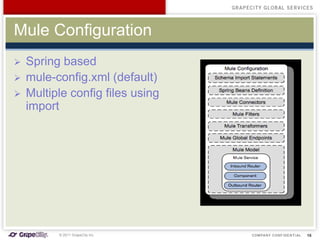
Mule Configuration
   Spring based
   mule-config.xml (default)
   Multiple config files using
    import


          © 2011 GrapeCity inc.   16
Mule Example
•   http://www.youtube.com/watch?v=PXj48XoMalg&fea
    ture=relmfu


         © 2011 GrapeCity inc.                       17
Mule ESB in Lifeway


     © 2011 GrapeCity inc.   18
Why Choose Mule?
   No prescribed message format
– XML, CSV, Binary, Streams, Record, Java Objects
– Mix and match
 Zero code intrusion
– Mule does not impose an API on service objects
– Objects are fully portable
 Existing objects can be managed
– POJOs, IoC Objects, EJB Session Beans, Remote Objects
– REST & Web Services
 Easy to test
– Mule can be run easily from a JUnit test case
– Framework provides a Test compatibility kit
– Scales down as well as up


            © 2011 GrapeCity inc.                         19
Questions


     © 2011 GrapeCity inc.   20
Thank You


© 2011 GrapeCity inc.

ESB and Mule ESB solution

  • 1.
    ESB’s-MuleESB Swati Bansal 05-April-2012 © 2011 GrapeCity inc.
  • 2.
    Agenda • Need for ESB • ESB Overview • When use ESB? • Open Source ESB-MuleESB • MuleESB in Lifeway.com © 2011 GrapeCity inc. 2
  • 3.
    A Typical SOAApplication © 2011 GrapeCity inc.
  • 4.
    SOA without ESB ImpliesPoint-to-point application integration • Troubleshooting deployments is painful. •Changing/adding new components is tedious. •No consistent mechanism to react to failures. © 2011 GrapeCity inc. 4
  • 5.
    ESB’s-Enterprise Service Bus UseESB as the backbone of all communications of SOA deployment © 2011 GrapeCity inc.
  • 6.
    What is ESB? • Software architecture model used for designing and implementing the interaction and communication between mutually interacting software applications in Service Oriented Architecture. • SOA with ESB = Hub and Spoke Architecture (acts as central "bridge" or "gateway" to all applications exposing services underneath it) © 2011 GrapeCity inc. 6
  • 7.
    Key Terms: • Bus: Analogous to a computer hardware bus, allows applications to plug in and out with ease, without any need of a system restart. Allows for: – Message Routing – Message Monitoring – Logging traffic • ESB Commodity Services: – Protocol conversion – Mapping: between data formats – Translation and transformation: Change data content based on rules. – Event handling • Message Queueing: Message queue is required to cope with differing handling speed and temporary failure of services. © 2011 GrapeCity inc. 7
  • 8.
    ESB Acts As: ©2011 GrapeCity inc. 8
  • 9.
    ESB Acts As: •SinglePoint of Access: Look for services in a single location. Change in deployment simplified. •Transaction Manager: Coordinate distributed transactions which multiple services participate in, hence taking the load off the client. •Security Manager: Security aspects like authentication and authorization can be centralized. •Service Proxy: Function as a proxy for appliations that do not expose a standardized service interface to the world. •Gateway to the World: For service running in the outside world. © 2011 GrapeCity inc.
  • 10.
    ESB Flavours Product Vendor Connects with... Matrix TIBCO SOAP, EMS, JMS, Rendezvous, BusinessWorks MQ, BPEL Mule ESB Open-source, SOAP, REST, JMS, MQ, JBI, AQ, MuleSource, Inc. Caching, JavaSpaces, GigaSpaces, Email, IM, JCA, AS400 Data Queues, System I/O. OpenESB Open-source, Sun JBI, JCA, JAX-RPC, JAX-WS Microsystems Sonic ESB Progress Software JMS, SOAP, JMX Websphere ESB IBM JMS, MQ, SOAP; requires additional adapters to interface with other products and legacy protocols; requires Websphere to work © 2011 GrapeCity inc. 10
  • 11.
    Benefits of ESB: • Increased flexibility; easier to change as requirements change. • Scales from point-solutions to enterprise-wide deployment (distributed bus). • More configuration rather than integration coding. • No central rules-engine, no central broker. • Incremental patching with zero down-time; enterprise becomes "refactorable". © 2011 GrapeCity inc. 11
  • 12.
    MuleESB © 2011 GrapeCity inc. 12
  • 13.
    What is MuleESB? • Mule ESB is a lightweight Java-based enterprise service bus (ESB) and integration platform. • Adaptive integration : – Standards-based and vendor-neutral – Seamless integration with existing infrastructure – Plug-in architecture allows for building block approach – Use with any application server or standalone • Development simplicity: – Simplified programming model – Ease of use through configuration and control – Rapid development and deployment through code reuse • Open source advantage: – No expensive up-front license commitments – Access to source code allows customization and lowers risk – Vibrant developer community © 2011 GrapeCity inc. 13
  • 14.
    Mule ESB Architecture • Architecture is based on concepts discussed in Enterprise Integration Patterns © 2011 GrapeCity inc. 14
  • 15.
    Mule Components  Endpoint – Channel, MessageReceiver, Connector  Transformer – Message transformation / enhancement  Router – Message flow control (inbound/outbound)  Service Component – Your integration logic lives here © 2011 GrapeCity inc. 15
  • 16.
    Mule Configuration  Spring based  mule-config.xml (default)  Multiple config files using import © 2011 GrapeCity inc. 16
  • 17.
    Mule Example • http://www.youtube.com/watch?v=PXj48XoMalg&fea ture=relmfu © 2011 GrapeCity inc. 17
  • 18.
    Mule ESB inLifeway © 2011 GrapeCity inc. 18
  • 19.
    Why Choose Mule?  No prescribed message format – XML, CSV, Binary, Streams, Record, Java Objects – Mix and match  Zero code intrusion – Mule does not impose an API on service objects – Objects are fully portable  Existing objects can be managed – POJOs, IoC Objects, EJB Session Beans, Remote Objects – REST & Web Services  Easy to test – Mule can be run easily from a JUnit test case – Framework provides a Test compatibility kit – Scales down as well as up © 2011 GrapeCity inc. 19
  • 20.
    Questions © 2011 GrapeCity inc. 20
  • 21.
    Thank You © 2011GrapeCity inc.