VASANTRAO NAIK MARATHWADA KRISHI VIDYAPEETH, PARBHANI
QUEEN’S COLLEGE OF FOOD TECHNOLOGY AND RESEARCH
FOUNDATION, AURANGABAD
ELP TOPIC: “STUDY ON PREPARATION AND MARKETING OF
MULTIGRAIN MUFFINS”
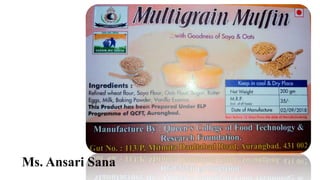
Ms. Ansari Sana
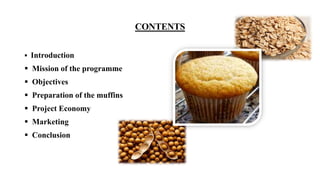
CONTENTS
 Introduction
 Mission of the programme
 Objectives
 Preparation of the muffins
 Project Economy
 Marketing
 Conclusion
INTRODUCTION
• “A muffin is an individual sized quick bread”
• The derivation of the word “muffin” comes from the French word, “Moufflet”,
which is often times applied to bread which means ‘soft’.
• The Oat (Avena sativa),sometimes called the common oats, is a species of cereal
gain grown for its seed.
• Oats are generally considered healthy due to their rich content of several essential
nutrients like high in dietary fibers, proteins, B vitamins, carbohydrates &
minerals.
• The Soyabean (Glycine max) is a species of legume native to East Asia.
• Soyabean can be produce at least twice as much as protein as any other major
vegetable or grain crop.
• In 1970-1971 Narayanswamy and coworkers at CFTRI in Mysore developed a
method for making whole soy flour in India and created low cost protein food
based on a blend of Oats and Soya flour, means to supplement for low protein and
fiber diets.
MISSION OF THE PROGRAMME
• To acquire skills and knowledge for diverse methods of food preservation, value
addition and agro-processing that is applicable and practical at household level.
• To get an experience about production of food products.
• To provide a background for development of traditional product on a small cottage
and large scale.
• To learn about production, storage, dispatch and marketing of food product.
OBJECTIVES
• To standardize the process for preparation of Multigrain muffins.
• To evaluate overall acceptability of Multigrain muffins.
• To study the shelf life and market potential of Multigrain muffins.
• To make people more aware about the nutritive value of Soya & Oats.
• To study techno-economic feasibility of product.
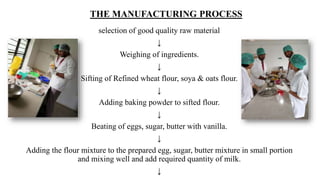
THE MANUFACTURING PROCESS
selection of good quality raw material
↓
Weighing of ingredients.
↓
Sifting of Refined wheat flour, soya & oats flour.
↓
Adding baking powder to sifted flour.
↓
Beating of eggs, sugar, butter with vanilla.
↓
Adding the flour mixture to the prepared egg, sugar, butter mixture in small portion
and mixing well and add required quantity of milk.
↓
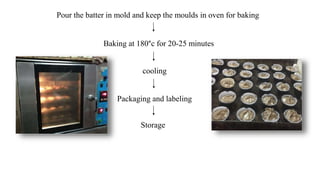
Pour the batter in mold and keep the moulds in oven for baking
Baking at 180°c for 20-25 minutes
cooling
Packaging and labeling
Storage
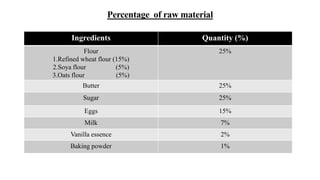
Percentage of raw material
Ingredients Quantity (%)
Flour
1.Refined wheat flour (15%)
2.Soya flour (5%)
3.Oats flour (5%)
25%
Butter 25%
Sugar 25%
Eggs 15%
Milk 7%
Vanilla essence 2%
Baking powder 1%
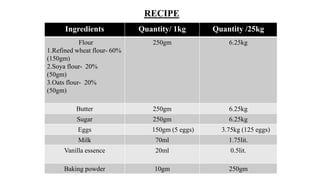
RECIPE
Ingredients Quantity/ 1kg Quantity /25kg
Flour
1.Refined wheat flour- 60%
(150gm)
2.Soya flour- 20%
(50gm)
3.Oats flour- 20%
(50gm)
250gm 6.25kg
Butter 250gm 6.25kg
Sugar 250gm 6.25kg
Eggs 150gm (5 eggs) 3.75kg (125 eggs)
Milk 70ml 1.75lit.
Vanilla essence 20ml 0.5lit.
Baking powder 10gm 250gm
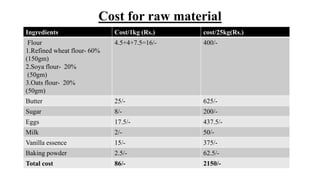
Cost for raw material
Ingredients Cost/1kg (Rs.) cost/25kg(Rs.)
Flour
1.Refined wheat flour- 60%
(150gm)
2.Soya flour- 20%
(50gm)
3.Oats flour- 20%
(50gm)
4.5+4+7.5=16/- 400/-
Butter 25/- 625/-
Sugar 8/- 200/-
Eggs 17.5/- 437.5/-
Milk 2/- 50/-
Vanilla essence 15/- 375/-
Baking powder 2.5/- 62.5/-
Total cost 86/- 2150/-
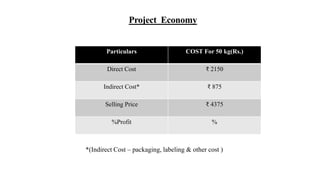
Project Economy
Particulars COST For 50 kg(Rs.)
Direct Cost ₹ 2150
Indirect Cost* ₹ 875
Selling Price ₹ 4375
%Profit %
*(Indirect Cost – packaging, labeling & other cost )
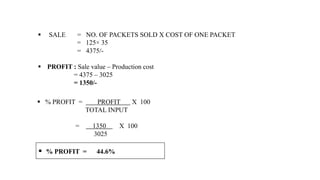
 SALE = NO. OF PACKETS SOLD X COST OF ONE PACKET
= 125× 35
= 4375/-
 PROFIT : Sale value – Production cost
= 4375 – 3025
= 1350/-
 % PROFIT = PROFIT X 100
TOTAL INPUT
= 1350 X 100
3025
 % PROFIT = 44.6%
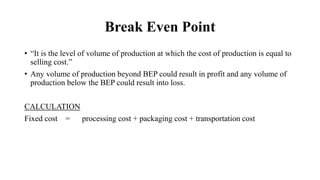
Break Even Point
• “It is the level of volume of production at which the cost of production is equal to
selling cost.”
• Any volume of production beyond BEP could result in profit and any volume of
production below the BEP could result into loss.
CALCULATION
Fixed cost = processing cost + packaging cost + transportation cost
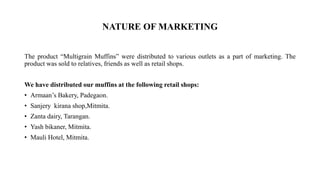
NATURE OF MARKETING
The product “Multigrain Muffins” were distributed to various outlets as a part of marketing. The
product was sold to relatives, friends as well as retail shops.
We have distributed our muffins at the following retail shops:
• Armaan’s Bakery, Padegaon.
• Sanjery kirana shop,Mitmita.
• Zanta dairy, Tarangan.
• Yash bikaner, Mitmita.
• Mauli Hotel, Mitmita.
CONCLUSION
“Multigrain muffin” has high nutritive value as well as excellent sensory
parameter. It also has good shelf life and storage period .Thus by looking at
consumer’s acceptability and economic feasibility of the product we decided to
make “Multigrain muffin”.
These project is techno-economically feasible.
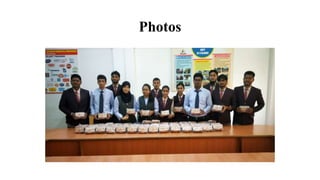
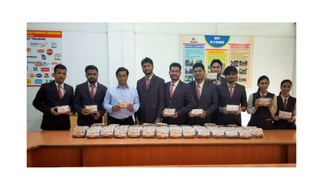
Photos
MULTI GRAIN MUFFINS (OATS AND SOYABEAN)STANDARD RECIPE AND PROCEDURE.

MULTI GRAIN MUFFINS (OATS AND SOYABEAN)STANDARD RECIPE AND PROCEDURE.

  • 1.
    VASANTRAO NAIK MARATHWADAKRISHI VIDYAPEETH, PARBHANI QUEEN’S COLLEGE OF FOOD TECHNOLOGY AND RESEARCH FOUNDATION, AURANGABAD ELP TOPIC: “STUDY ON PREPARATION AND MARKETING OF MULTIGRAIN MUFFINS”
  • 2.
  • 3.
    CONTENTS  Introduction  Missionof the programme  Objectives  Preparation of the muffins  Project Economy  Marketing  Conclusion
  • 4.
    INTRODUCTION • “A muffinis an individual sized quick bread” • The derivation of the word “muffin” comes from the French word, “Moufflet”, which is often times applied to bread which means ‘soft’. • The Oat (Avena sativa),sometimes called the common oats, is a species of cereal gain grown for its seed. • Oats are generally considered healthy due to their rich content of several essential nutrients like high in dietary fibers, proteins, B vitamins, carbohydrates & minerals. • The Soyabean (Glycine max) is a species of legume native to East Asia. • Soyabean can be produce at least twice as much as protein as any other major vegetable or grain crop. • In 1970-1971 Narayanswamy and coworkers at CFTRI in Mysore developed a method for making whole soy flour in India and created low cost protein food based on a blend of Oats and Soya flour, means to supplement for low protein and fiber diets.
  • 5.
    MISSION OF THEPROGRAMME • To acquire skills and knowledge for diverse methods of food preservation, value addition and agro-processing that is applicable and practical at household level. • To get an experience about production of food products. • To provide a background for development of traditional product on a small cottage and large scale. • To learn about production, storage, dispatch and marketing of food product.
  • 6.
    OBJECTIVES • To standardizethe process for preparation of Multigrain muffins. • To evaluate overall acceptability of Multigrain muffins. • To study the shelf life and market potential of Multigrain muffins. • To make people more aware about the nutritive value of Soya & Oats. • To study techno-economic feasibility of product.
  • 7.
    THE MANUFACTURING PROCESS selectionof good quality raw material ↓ Weighing of ingredients. ↓ Sifting of Refined wheat flour, soya & oats flour. ↓ Adding baking powder to sifted flour. ↓ Beating of eggs, sugar, butter with vanilla. ↓ Adding the flour mixture to the prepared egg, sugar, butter mixture in small portion and mixing well and add required quantity of milk. ↓
  • 8.
    Pour the batterin mold and keep the moulds in oven for baking Baking at 180°c for 20-25 minutes cooling Packaging and labeling Storage
  • 9.
    Percentage of rawmaterial Ingredients Quantity (%) Flour 1.Refined wheat flour (15%) 2.Soya flour (5%) 3.Oats flour (5%) 25% Butter 25% Sugar 25% Eggs 15% Milk 7% Vanilla essence 2% Baking powder 1%
  • 10.
    RECIPE Ingredients Quantity/ 1kgQuantity /25kg Flour 1.Refined wheat flour- 60% (150gm) 2.Soya flour- 20% (50gm) 3.Oats flour- 20% (50gm) 250gm 6.25kg Butter 250gm 6.25kg Sugar 250gm 6.25kg Eggs 150gm (5 eggs) 3.75kg (125 eggs) Milk 70ml 1.75lit. Vanilla essence 20ml 0.5lit. Baking powder 10gm 250gm
  • 11.
    Cost for rawmaterial Ingredients Cost/1kg (Rs.) cost/25kg(Rs.) Flour 1.Refined wheat flour- 60% (150gm) 2.Soya flour- 20% (50gm) 3.Oats flour- 20% (50gm) 4.5+4+7.5=16/- 400/- Butter 25/- 625/- Sugar 8/- 200/- Eggs 17.5/- 437.5/- Milk 2/- 50/- Vanilla essence 15/- 375/- Baking powder 2.5/- 62.5/- Total cost 86/- 2150/-
  • 12.
    Project Economy Particulars COSTFor 50 kg(Rs.) Direct Cost ₹ 2150 Indirect Cost* ₹ 875 Selling Price ₹ 4375 %Profit % *(Indirect Cost – packaging, labeling & other cost )
  • 13.
     SALE =NO. OF PACKETS SOLD X COST OF ONE PACKET = 125× 35 = 4375/-  PROFIT : Sale value – Production cost = 4375 – 3025 = 1350/-  % PROFIT = PROFIT X 100 TOTAL INPUT = 1350 X 100 3025  % PROFIT = 44.6%
  • 14.
    Break Even Point •“It is the level of volume of production at which the cost of production is equal to selling cost.” • Any volume of production beyond BEP could result in profit and any volume of production below the BEP could result into loss. CALCULATION Fixed cost = processing cost + packaging cost + transportation cost
  • 15.
    NATURE OF MARKETING Theproduct “Multigrain Muffins” were distributed to various outlets as a part of marketing. The product was sold to relatives, friends as well as retail shops. We have distributed our muffins at the following retail shops: • Armaan’s Bakery, Padegaon. • Sanjery kirana shop,Mitmita. • Zanta dairy, Tarangan. • Yash bikaner, Mitmita. • Mauli Hotel, Mitmita.
  • 16.
    CONCLUSION “Multigrain muffin” hashigh nutritive value as well as excellent sensory parameter. It also has good shelf life and storage period .Thus by looking at consumer’s acceptability and economic feasibility of the product we decided to make “Multigrain muffin”. These project is techno-economically feasible.
  • 17.