MULTIGRADE
TEACHING IN THE
PHILIPPINES
“The multigrade program in Philippine education aims to serve the
right of school age children living in remote, far-flung and
disadvantaged areas in the country.” (SEAMEO INNOTECH & DepEd,
2013)
Multigrade teaching in the Philippines
Multigrade schools have become an integral part of the Philippine education,
making a real and significant contribution to the Education for All (EFA) goals of
access and equity.
As of 2009, close to a third of the public elementary schools in the country have
some form of multigrade instruction. Out of a total of 38,351 public elementary
schools, there are 12,799 multigrade schools. Recent data (SY 2017-2018)
indicate a decline in the ratio of multigrade schools to total public elementary
schools (DepEd, UNICEF, and SEAMEO INNOTECH, 2020).
According to DepEd Secretary Leonor M. Briones (2020), the adoption of the
multigrade schooling strategy is based on international research findings that
such strategy is a cost-effective means of raising students’ participation in
school and in boosting their learning achievement, especially in poor, remote
areas. The approach potentially brings education closer to remote and
marginalized communities.
Types of Philippine Multigrade Schools
Based on the recent survey jointly conducted by DepEd, SEAMEO
INNOTECH, and UNICEF (2020), there are two typologies of
Philippine multigrade schools:
1.Based on the nature of classes
Pure – all classes are combined classes.
Mixed – some classes are combined and some are single-grade
classes.
2.2. Based on the availability of grade levels offered
Complete – offer complete elementary education from
Kindergarten to Grade 6.
Incomplete schools – one or more grades/levels is/are not
being offered
History of Multigrade Teaching in the
Philippines
◦ The first mission schools were organized as multigrade schools in the country while the
single grade schooling was introduced during the early 1990s by the Americans.
◦ The multigrade system has been integrated in Philippine education since the 1920’s.
According to Cervantes (2013), although the multigrade system has long been implemented,
it was not regarded as a very viable alternative delivery system of providing access to basic
quality education. It was always covered by policies of monograde class organization.
◦ In 1993, DepEd Secretary Armand Fabella recognized the viability of multigrade program in
meeting the goal of providing education for all by instituting DECS Order No.38, s.1993
which provides for the organization of combination and/or multigrade classes for schools as
a response to teacher shortage and lack of facilities. This thrust was the start of what was
later called the Multigrade Program in Philippine Education (MPPE).
Multigrade Program in Philippines
Education (MMPE)
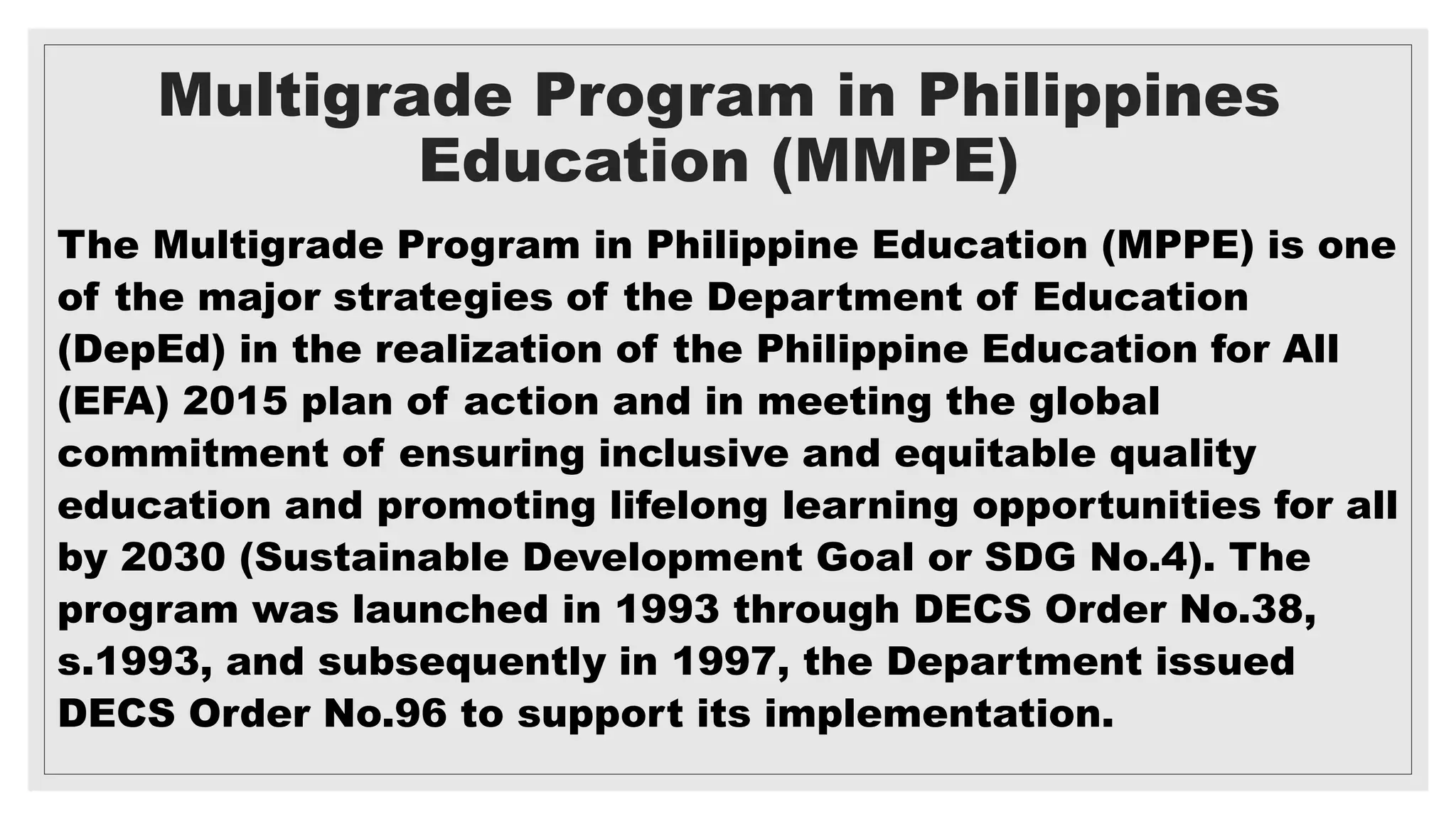
The Multigrade Program in Philippine Education (MPPE) is one
of the major strategies of the Department of Education
(DepEd) in the realization of the Philippine Education for All
(EFA) 2015 plan of action and in meeting the global
commitment of ensuring inclusive and equitable quality
education and promoting lifelong learning opportunities for all
by 2030 (Sustainable Development Goal or SDG No.4). The
program was launched in 1993 through DECS Order No.38,
s.1993, and subsequently in 1997, the Department issued
DECS Order No.96 to support its implementation.
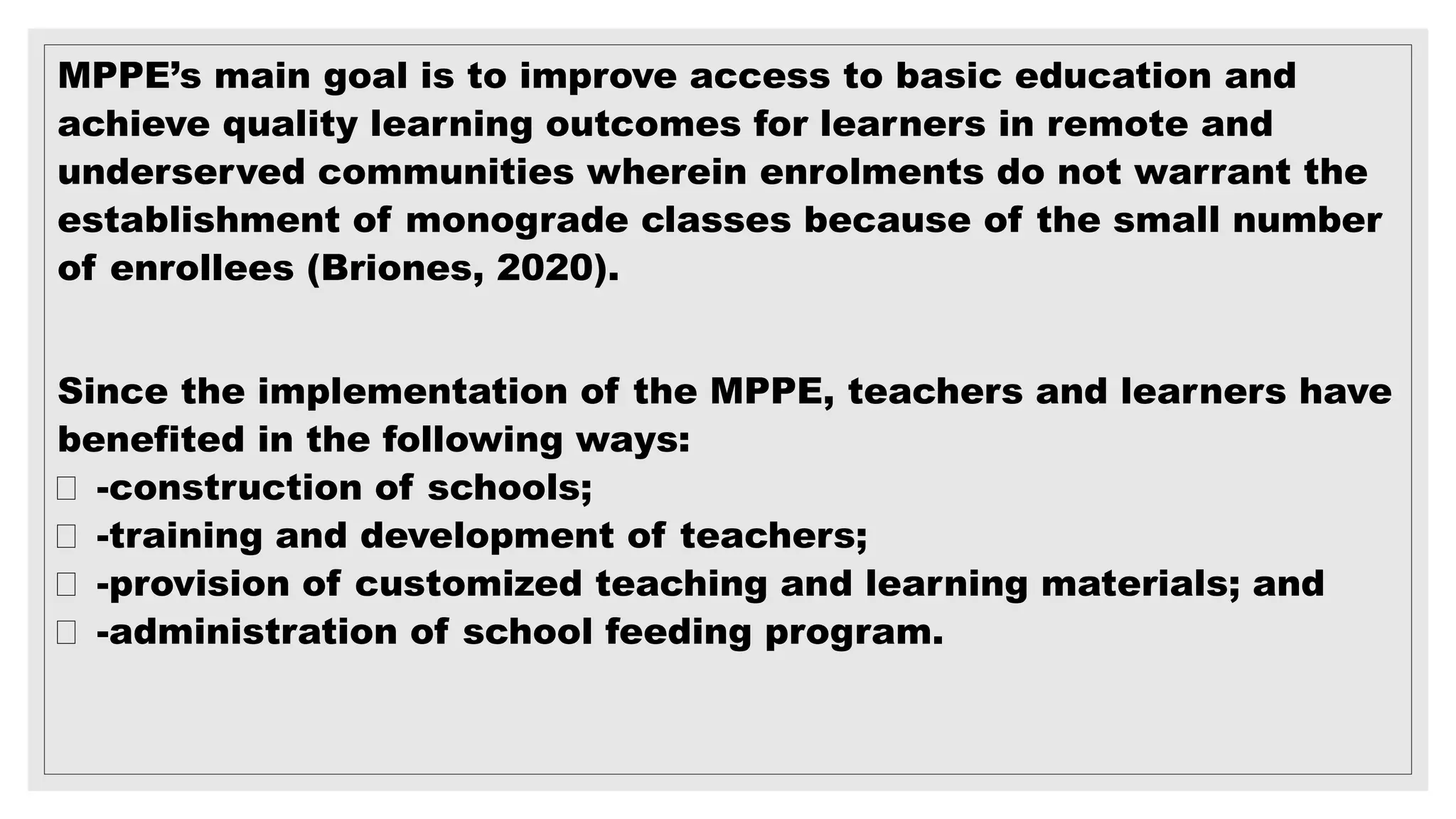
MPPE’s main goal is to improve access to basic education and
achieve quality learning outcomes for learners in remote and
underserved communities wherein enrolments do not warrant the
establishment of monograde classes because of the small number
of enrollees (Briones, 2020).
Since the implementation of the MPPE, teachers and learners have
benefited in the following ways:
-construction of schools;
-training and development of teachers;
-provision of customized teaching and learning materials; and
-administration of school feeding program.
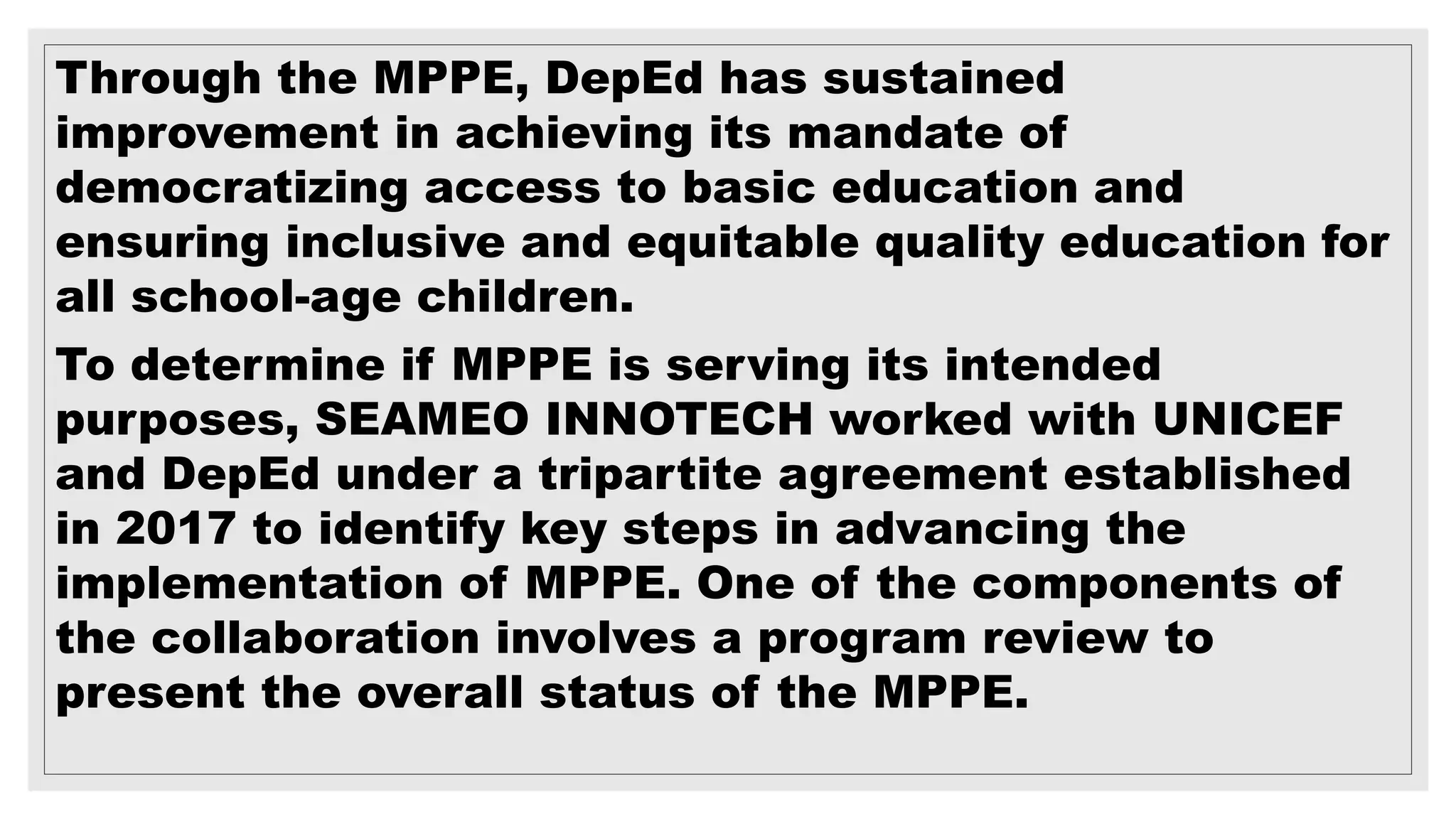
Through the MPPE, DepEd has sustained
improvement in achieving its mandate of
democratizing access to basic education and
ensuring inclusive and equitable quality education for
all school-age children.
To determine if MPPE is serving its intended
purposes, SEAMEO INNOTECH worked with UNICEF
and DepEd under a tripartite agreement established
in 2017 to identify key steps in advancing the
implementation of MPPE. One of the components of
the collaboration involves a program review to
present the overall status of the MPPE.
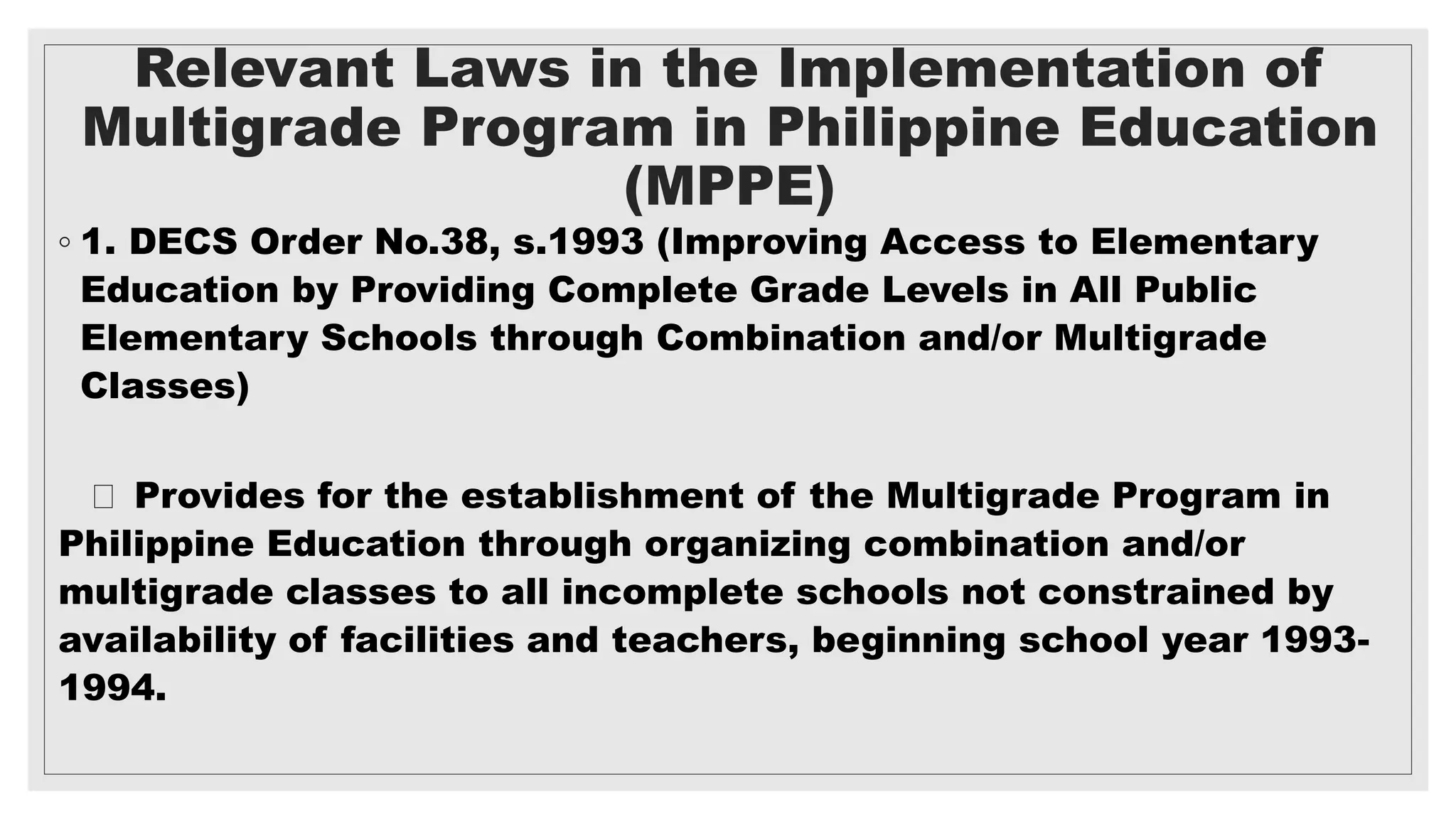
Relevant Laws in the Implementation of
Multigrade Program in Philippine Education
(MPPE)
◦ 1. DECS Order No.38, s.1993 (Improving Access to Elementary
Education by Providing Complete Grade Levels in All Public
Elementary Schools through Combination and/or Multigrade
Classes)
Provides for the establishment of the Multigrade Program in
Philippine Education through organizing combination and/or
multigrade classes to all incomplete schools not constrained by
availability of facilities and teachers, beginning school year 1993-
1994.
2. DECS Order No.96, s.1997 (Policies and Guidelines in
the Organization and Operation of Multigrade [MG]
Classes)
Provides the policies and guidelines in the
organization and operation of multigrade classes in
terms of the following areas:
- Definition;
- Organization of multigrade classes;
- School plant, facilities, and furniture of multigrade
classes;
- Multigrade curriculum and program; and
- Support, welfare and incentive program for multigrade
teachers
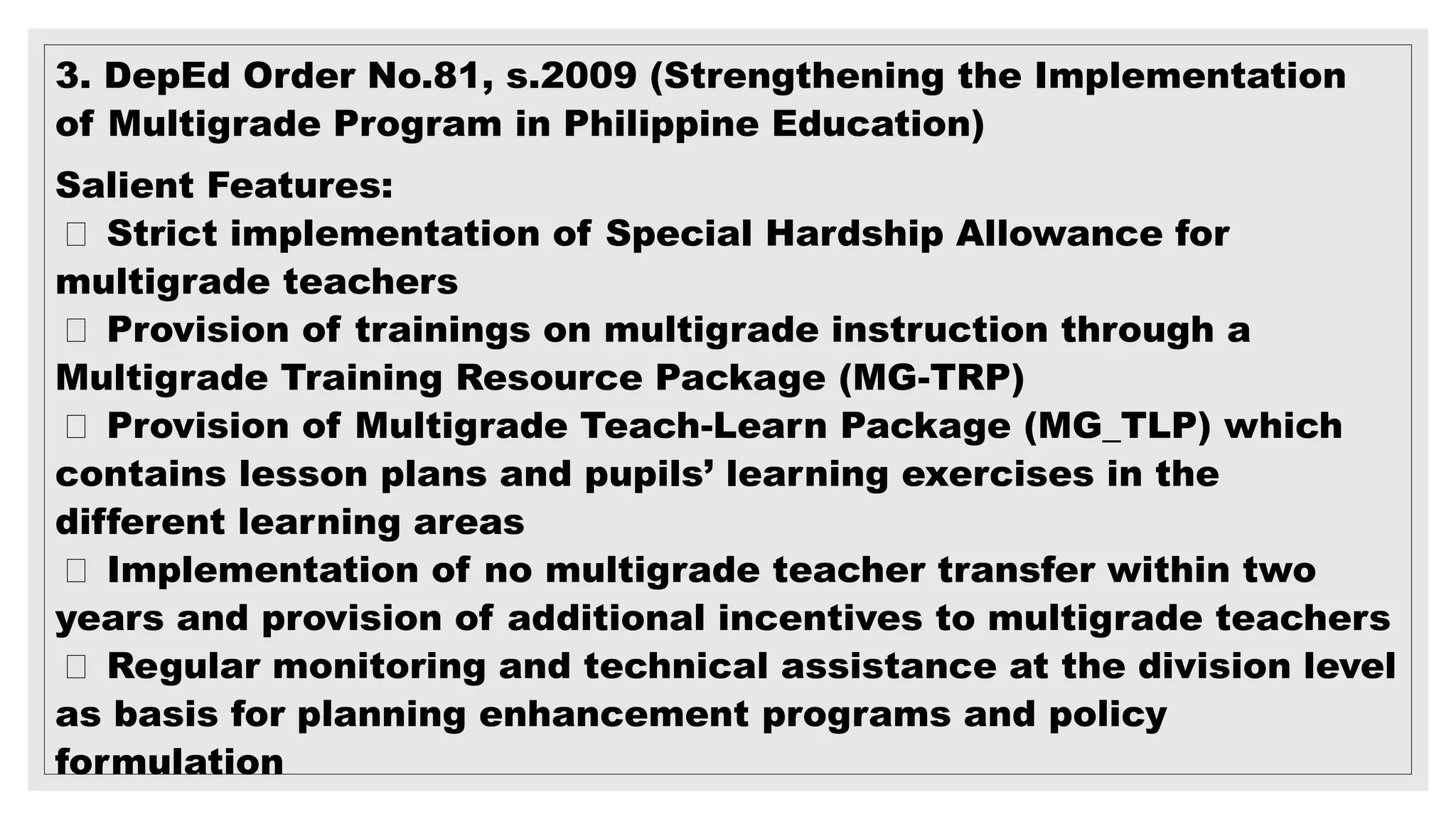
3. DepEd Order No.81, s.2009 (Strengthening the Implementation
of Multigrade Program in Philippine Education)
Salient Features:
Strict implementation of Special Hardship Allowance for
multigrade teachers
Provision of trainings on multigrade instruction through a
Multigrade Training Resource Package (MG-TRP)
Provision of Multigrade Teach-Learn Package (MG_TLP) which
contains lesson plans and pupils’ learning exercises in the
different learning areas
Implementation of no multigrade teacher transfer within two
years and provision of additional incentives to multigrade teachers
Regular monitoring and technical assistance at the division level
as basis for planning enhancement programs and policy
formulation
End of Presentation

Multigrade-teaching-in-the-philippines.pptx

  • 1.
    MULTIGRADE TEACHING IN THE PHILIPPINES “Themultigrade program in Philippine education aims to serve the right of school age children living in remote, far-flung and disadvantaged areas in the country.” (SEAMEO INNOTECH & DepEd, 2013)
  • 2.
    Multigrade teaching inthe Philippines Multigrade schools have become an integral part of the Philippine education, making a real and significant contribution to the Education for All (EFA) goals of access and equity. As of 2009, close to a third of the public elementary schools in the country have some form of multigrade instruction. Out of a total of 38,351 public elementary schools, there are 12,799 multigrade schools. Recent data (SY 2017-2018) indicate a decline in the ratio of multigrade schools to total public elementary schools (DepEd, UNICEF, and SEAMEO INNOTECH, 2020). According to DepEd Secretary Leonor M. Briones (2020), the adoption of the multigrade schooling strategy is based on international research findings that such strategy is a cost-effective means of raising students’ participation in school and in boosting their learning achievement, especially in poor, remote areas. The approach potentially brings education closer to remote and marginalized communities.
  • 3.
    Types of PhilippineMultigrade Schools Based on the recent survey jointly conducted by DepEd, SEAMEO INNOTECH, and UNICEF (2020), there are two typologies of Philippine multigrade schools: 1.Based on the nature of classes Pure – all classes are combined classes. Mixed – some classes are combined and some are single-grade classes. 2.2. Based on the availability of grade levels offered Complete – offer complete elementary education from Kindergarten to Grade 6. Incomplete schools – one or more grades/levels is/are not being offered
  • 4.
    History of MultigradeTeaching in the Philippines ◦ The first mission schools were organized as multigrade schools in the country while the single grade schooling was introduced during the early 1990s by the Americans. ◦ The multigrade system has been integrated in Philippine education since the 1920’s. According to Cervantes (2013), although the multigrade system has long been implemented, it was not regarded as a very viable alternative delivery system of providing access to basic quality education. It was always covered by policies of monograde class organization. ◦ In 1993, DepEd Secretary Armand Fabella recognized the viability of multigrade program in meeting the goal of providing education for all by instituting DECS Order No.38, s.1993 which provides for the organization of combination and/or multigrade classes for schools as a response to teacher shortage and lack of facilities. This thrust was the start of what was later called the Multigrade Program in Philippine Education (MPPE).
  • 5.
    Multigrade Program inPhilippines Education (MMPE) The Multigrade Program in Philippine Education (MPPE) is one of the major strategies of the Department of Education (DepEd) in the realization of the Philippine Education for All (EFA) 2015 plan of action and in meeting the global commitment of ensuring inclusive and equitable quality education and promoting lifelong learning opportunities for all by 2030 (Sustainable Development Goal or SDG No.4). The program was launched in 1993 through DECS Order No.38, s.1993, and subsequently in 1997, the Department issued DECS Order No.96 to support its implementation.
  • 6.
    MPPE’s main goalis to improve access to basic education and achieve quality learning outcomes for learners in remote and underserved communities wherein enrolments do not warrant the establishment of monograde classes because of the small number of enrollees (Briones, 2020). Since the implementation of the MPPE, teachers and learners have benefited in the following ways: -construction of schools; -training and development of teachers; -provision of customized teaching and learning materials; and -administration of school feeding program.
  • 7.
    Through the MPPE,DepEd has sustained improvement in achieving its mandate of democratizing access to basic education and ensuring inclusive and equitable quality education for all school-age children. To determine if MPPE is serving its intended purposes, SEAMEO INNOTECH worked with UNICEF and DepEd under a tripartite agreement established in 2017 to identify key steps in advancing the implementation of MPPE. One of the components of the collaboration involves a program review to present the overall status of the MPPE.
  • 8.
    Relevant Laws inthe Implementation of Multigrade Program in Philippine Education (MPPE) ◦ 1. DECS Order No.38, s.1993 (Improving Access to Elementary Education by Providing Complete Grade Levels in All Public Elementary Schools through Combination and/or Multigrade Classes) Provides for the establishment of the Multigrade Program in Philippine Education through organizing combination and/or multigrade classes to all incomplete schools not constrained by availability of facilities and teachers, beginning school year 1993- 1994.
  • 9.
    2. DECS OrderNo.96, s.1997 (Policies and Guidelines in the Organization and Operation of Multigrade [MG] Classes) Provides the policies and guidelines in the organization and operation of multigrade classes in terms of the following areas: - Definition; - Organization of multigrade classes; - School plant, facilities, and furniture of multigrade classes; - Multigrade curriculum and program; and - Support, welfare and incentive program for multigrade teachers
  • 10.
    3. DepEd OrderNo.81, s.2009 (Strengthening the Implementation of Multigrade Program in Philippine Education) Salient Features: Strict implementation of Special Hardship Allowance for multigrade teachers Provision of trainings on multigrade instruction through a Multigrade Training Resource Package (MG-TRP) Provision of Multigrade Teach-Learn Package (MG_TLP) which contains lesson plans and pupils’ learning exercises in the different learning areas Implementation of no multigrade teacher transfer within two years and provision of additional incentives to multigrade teachers Regular monitoring and technical assistance at the division level as basis for planning enhancement programs and policy formulation
  • 11.