M S Swaminathan Research Foundation
www.mssrf.org
Centre for Research on Sustainable Agriculture and Rural Development
•Inaugural Session
•Four Technical Sessions
•Two Special Lectures
•Concluding Session
M S Swaminathan Research Foundation
www.mssrf.org
Centre for Research on Sustainable Agriculture and Rural Development
Key takeaways from deliberations so far:
 Inaugural Session – Vice President of India
 Performance of farmers to be saluted - record foodgrain production in spite of distress
 Malnutrition in India – an issue of great concern: Leveraging agriculture for Nutrition - an
important pathway to address the problem
 Women farmers need recognition and equal land and property rights just like men
 Steps needed to make agriculture more viable and profitable – science has an important role in
this
 Anticipatory research and transfer of technology important for building resilience among India’s
farmers
 Appropriate market mechanisms have to be ensured
www.mssrf.org
Sustainable intensification of agriculture interventions and mainstreaming
agrobiodiversity in production and consumption to improve nutrition, health and
address climate related vulnerabilities.
Extend support to interventions that are S&T and evidence- based and operate
with robust policy levers for a sustainable food system approach for the
restoration of the agroecosystem health and diversity of diets.
 Orient R&D partnerships to support product development leveraging trans-
disciplinary research and controlled use of advances in data science for achieving
“Mass Personalization of Nutrition”.
Agrobiodiversity and Sustainable
Production Systems
www.mssrf.org
www.mssrf.org
Climate Change and Resilient Tamil Nadu
 Tamil Nadu has shown considerable "autonomous" adaptation to the impact
of climate variability on crop production. However, with existing
technologies and management practices, their limits are already being
tested. For sustainable enhancement of productivity, require:
a) further varietal development, including GM/CRISPR technologies for
abiotic stress mana
b) gement,
c) significant improvement in soil health that will require substantial
investment
d) continued efforts to rationalise input use.
Climate Change and Resilient Tamil Nadu contd..
 The Cauvery delta region needs to cope with the transition to semi-arid conditions,
with increased exposure to reduced water availability; there is also strong exposure to
cyclones. The declaration of the Protected Special Agriculture Zone, requires new
initiatives with focus on (a) coping with water management, (b) renewed emphasis on
agriculture, including livestock and fisheries, for livelihoods, iii) specific tailor-made
approaches for different sub-regions of the delta, iv) integration with other service
sector opportunities such as tourism.
 Several methods of ecosystem-based adaptation have been successfully piloted and
their validity established, e.g. mangrove restoration, formation of artificial reefs to
enhance species abundance and productivity, timely weather and catch availability
information to fishers. These need to be scaled up throughout the coastal ecosystem
of Tamil Nadu
www.mssrf.org
Gendered Response to COVID-19
 Need for disaggregated data by sex and other intersecting socio-economic and
demographic status to understand the gendered impacts of lockdown in COVID-19
crisis.
 Recognize women’s increasing care / work burden and provide access to special
services for their needs.
 Increasing Gender based domestic violence in terms of intensity and severity across
groups and sectors should be addressed on high priority; in addition, during such
lockdowns, strategies to combat, redistribution of women’s work and reducing food
related violence at home need special attention
 Ensure uninterrupted reproductive and health services especially for women and
adolescent girls
 Harness local institutions like Gram panchayats to understand and address
community-level issues and develop decentralised support systems and governance
www.mssrf.org
Gendered Response to COVID-19 contd..
 Put in place adequate and appropriate measures for necessary resource access for
women to recover and rebuild livelihoods
 Immediate restoration of services for ECD and care and community health systems
required; frontline workers (Anganwadi workers, ASHAs, village health nurses etc.) to
be relieved of their COVID-related responsibilities
 Build capacities of frontline workers to engage with and provide necessary access and
support to digital infrastructure such as smart phones/tabs etc
 Improved distribution of dry rations and entitlements including more nutritious food to
be implemented with direct access to women.
 Ensure adequate strategies to facilitate inclusiveness in access to education especially
for the social & economically vulnerable households
 Government and research institutions should invest in quality gender-responsive
research
www.mssrf.org
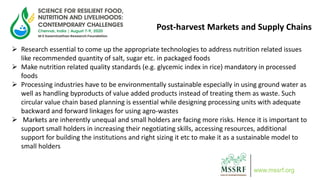
Post-harvest Markets and Supply Chains
 Research essential to come up the appropriate technologies to address nutrition related issues
like recommended quantity of salt, sugar etc. in packaged foods
 Make nutrition related quality standards (e.g. glycemic index in rice) mandatory in processed
foods
 Processing industries have to be environmentally sustainable especially in using ground water as
well as handling byproducts of value added products instead of treating them as waste. Such
circular value chain based planning is essential while designing processing units with adequate
backward and forward linkages for using agro-wastes
 Markets are inherently unequal and small holders are facing more risks. Hence it is important to
support small holders in increasing their negotiating skills, accessing resources, additional
support for building the institutions and right sizing it etc to make it as a sustainable model to
small holders
www.mssrf.org
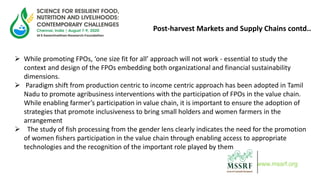
Post-harvest Markets and Supply Chains contd..
 While promoting FPOs, ‘one size fit for all’ approach will not work - essential to study the
context and design of the FPOs embedding both organizational and financial sustainability
dimensions.
 Paradigm shift from production centric to income centric approach has been adopted in Tamil
Nadu to promote agribusiness interventions with the participation of FPOs in the value chain.
While enabling farmer’s participation in value chain, it is important to ensure the adoption of
strategies that promote inclusiveness to bring small holders and women farmers in the
arrangement
 The study of fish processing from the gender lens clearly indicates the need for the promotion
of women fishers participation in the value chain through enabling access to appropriate
technologies and the recognition of the important role played by them
www.mssrf.org
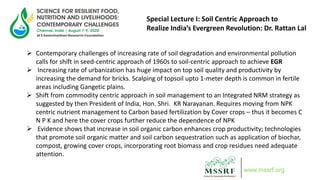
Special Lecture I: Soil Centric Approach to
Realize India’s Evergreen Revolution: Dr. Rattan Lal
 Contemporary challenges of increasing rate of soil degradation and environmental pollution
calls for shift in seed-centric approach of 1960s to soil-centric approach to achieve EGR
 Increasing rate of urbanization has huge impact on top soil quality and productivity by
increasing the demand for bricks. Scalping of topsoil upto 1-meter depth is common in fertile
areas including Gangetic plains.
 Shift from commodity centric approach in soil management to an Integrated NRM strategy as
suggested by then President of India, Hon. Shri. KR Narayanan. Requires moving from NPK
centric nutrient management to Carbon based fertilization by Cover crops – thus it becomes C
N P K and here the cover crops further reduce the dependence of NPK
 Evidence shows that increase in soil organic carbon enhances crop productivity; technologies
that promote soil organic matter and soil carbon sequestration such as application of biochar,
compost, growing cover crops, incorporating root biomass and crop residues need adequate
attention.
www.mssrf.org
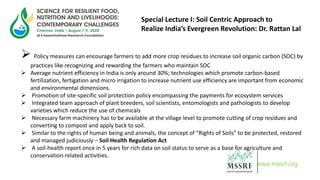
Special Lecture I: Soil Centric Approach to
Realize India’s Evergreen Revolution: Dr. Rattan Lal
 Policy measures can encourage farmers to add more crop residues to increase soil organic carbon (SOC) by
practices like recognizing and rewarding the farmers who maintain SOC
 Average nutrient efficiency in India is only around 30%; technologies which promote carbon-based
fertilization, fertigation and micro irrigation to increase nutrient use efficiency are important from economic
and environmental dimensions.
 Promotion of site-specific soil protection policy encompassing the payments for ecosystem services
 Integrated team approach of plant breeders, soil scientists, entomologists and pathologists to develop
varieties which reduce the use of chemicals
 Necessary farm machinery has to be available at the village level to promote cutting of crop residues and
converting to compost and apply back to soil.
 Similar to the rights of human being and animals, the concept of “Rights of Soils” to be protected, restored
and managed judiciously – Soil Health Regulation Act
 A soil-health report once in 5 years for rich data on soil status to serve as a base for agriculture and
conservation-related activities.
www.mssrf.org
Special Lecture II: Science communication is more
important than ever before: scientific journals and
much more: Prof Bruce Alberts
 Creativity, rationality, openness and tolerance and are crucial for science...as is developing a scientific
temper for all nations.
 Honesty, Generosity, a strong demand for evidence, with openness to all ideas and opinions
irrespective of their source are the some of the ‘Values of Science’
 Improving scientific publication will also require making such publications more rapidly accessible and
hence to expand the use of preprint servers. Also require improving standards for peer review and it is
important to stop Predatory Scientific Journals
 Success of Science over the past three centuries has enabled our lives be much more stable &
predictable
 “Inquiry Based” Science Education will develop children as great problem solvers in the workplace and
help them to make wise judgments for their family, community, and nation
 An important tool for strengthening science – both in each nation and across the globe – is the
formation of “Young Academicians”; India has one thanks to the efforts of Prof MSS
www.mssrf.org

MSSRF - Final presentation

  • 1.
    M S SwaminathanResearch Foundation www.mssrf.org Centre for Research on Sustainable Agriculture and Rural Development •Inaugural Session •Four Technical Sessions •Two Special Lectures •Concluding Session
  • 2.
    M S SwaminathanResearch Foundation www.mssrf.org Centre for Research on Sustainable Agriculture and Rural Development Key takeaways from deliberations so far:
  • 3.
     Inaugural Session– Vice President of India  Performance of farmers to be saluted - record foodgrain production in spite of distress  Malnutrition in India – an issue of great concern: Leveraging agriculture for Nutrition - an important pathway to address the problem  Women farmers need recognition and equal land and property rights just like men  Steps needed to make agriculture more viable and profitable – science has an important role in this  Anticipatory research and transfer of technology important for building resilience among India’s farmers  Appropriate market mechanisms have to be ensured www.mssrf.org
  • 4.
    Sustainable intensification ofagriculture interventions and mainstreaming agrobiodiversity in production and consumption to improve nutrition, health and address climate related vulnerabilities. Extend support to interventions that are S&T and evidence- based and operate with robust policy levers for a sustainable food system approach for the restoration of the agroecosystem health and diversity of diets.  Orient R&D partnerships to support product development leveraging trans- disciplinary research and controlled use of advances in data science for achieving “Mass Personalization of Nutrition”. Agrobiodiversity and Sustainable Production Systems www.mssrf.org
  • 5.
    www.mssrf.org Climate Change andResilient Tamil Nadu  Tamil Nadu has shown considerable "autonomous" adaptation to the impact of climate variability on crop production. However, with existing technologies and management practices, their limits are already being tested. For sustainable enhancement of productivity, require: a) further varietal development, including GM/CRISPR technologies for abiotic stress mana b) gement, c) significant improvement in soil health that will require substantial investment d) continued efforts to rationalise input use.
  • 6.
    Climate Change andResilient Tamil Nadu contd..  The Cauvery delta region needs to cope with the transition to semi-arid conditions, with increased exposure to reduced water availability; there is also strong exposure to cyclones. The declaration of the Protected Special Agriculture Zone, requires new initiatives with focus on (a) coping with water management, (b) renewed emphasis on agriculture, including livestock and fisheries, for livelihoods, iii) specific tailor-made approaches for different sub-regions of the delta, iv) integration with other service sector opportunities such as tourism.  Several methods of ecosystem-based adaptation have been successfully piloted and their validity established, e.g. mangrove restoration, formation of artificial reefs to enhance species abundance and productivity, timely weather and catch availability information to fishers. These need to be scaled up throughout the coastal ecosystem of Tamil Nadu www.mssrf.org
  • 7.
    Gendered Response toCOVID-19  Need for disaggregated data by sex and other intersecting socio-economic and demographic status to understand the gendered impacts of lockdown in COVID-19 crisis.  Recognize women’s increasing care / work burden and provide access to special services for their needs.  Increasing Gender based domestic violence in terms of intensity and severity across groups and sectors should be addressed on high priority; in addition, during such lockdowns, strategies to combat, redistribution of women’s work and reducing food related violence at home need special attention  Ensure uninterrupted reproductive and health services especially for women and adolescent girls  Harness local institutions like Gram panchayats to understand and address community-level issues and develop decentralised support systems and governance www.mssrf.org
  • 8.
    Gendered Response toCOVID-19 contd..  Put in place adequate and appropriate measures for necessary resource access for women to recover and rebuild livelihoods  Immediate restoration of services for ECD and care and community health systems required; frontline workers (Anganwadi workers, ASHAs, village health nurses etc.) to be relieved of their COVID-related responsibilities  Build capacities of frontline workers to engage with and provide necessary access and support to digital infrastructure such as smart phones/tabs etc  Improved distribution of dry rations and entitlements including more nutritious food to be implemented with direct access to women.  Ensure adequate strategies to facilitate inclusiveness in access to education especially for the social & economically vulnerable households  Government and research institutions should invest in quality gender-responsive research www.mssrf.org
  • 9.
    Post-harvest Markets andSupply Chains  Research essential to come up the appropriate technologies to address nutrition related issues like recommended quantity of salt, sugar etc. in packaged foods  Make nutrition related quality standards (e.g. glycemic index in rice) mandatory in processed foods  Processing industries have to be environmentally sustainable especially in using ground water as well as handling byproducts of value added products instead of treating them as waste. Such circular value chain based planning is essential while designing processing units with adequate backward and forward linkages for using agro-wastes  Markets are inherently unequal and small holders are facing more risks. Hence it is important to support small holders in increasing their negotiating skills, accessing resources, additional support for building the institutions and right sizing it etc to make it as a sustainable model to small holders www.mssrf.org
  • 10.
    Post-harvest Markets andSupply Chains contd..  While promoting FPOs, ‘one size fit for all’ approach will not work - essential to study the context and design of the FPOs embedding both organizational and financial sustainability dimensions.  Paradigm shift from production centric to income centric approach has been adopted in Tamil Nadu to promote agribusiness interventions with the participation of FPOs in the value chain. While enabling farmer’s participation in value chain, it is important to ensure the adoption of strategies that promote inclusiveness to bring small holders and women farmers in the arrangement  The study of fish processing from the gender lens clearly indicates the need for the promotion of women fishers participation in the value chain through enabling access to appropriate technologies and the recognition of the important role played by them www.mssrf.org
  • 11.
    Special Lecture I:Soil Centric Approach to Realize India’s Evergreen Revolution: Dr. Rattan Lal  Contemporary challenges of increasing rate of soil degradation and environmental pollution calls for shift in seed-centric approach of 1960s to soil-centric approach to achieve EGR  Increasing rate of urbanization has huge impact on top soil quality and productivity by increasing the demand for bricks. Scalping of topsoil upto 1-meter depth is common in fertile areas including Gangetic plains.  Shift from commodity centric approach in soil management to an Integrated NRM strategy as suggested by then President of India, Hon. Shri. KR Narayanan. Requires moving from NPK centric nutrient management to Carbon based fertilization by Cover crops – thus it becomes C N P K and here the cover crops further reduce the dependence of NPK  Evidence shows that increase in soil organic carbon enhances crop productivity; technologies that promote soil organic matter and soil carbon sequestration such as application of biochar, compost, growing cover crops, incorporating root biomass and crop residues need adequate attention. www.mssrf.org
  • 12.
    Special Lecture I:Soil Centric Approach to Realize India’s Evergreen Revolution: Dr. Rattan Lal  Policy measures can encourage farmers to add more crop residues to increase soil organic carbon (SOC) by practices like recognizing and rewarding the farmers who maintain SOC  Average nutrient efficiency in India is only around 30%; technologies which promote carbon-based fertilization, fertigation and micro irrigation to increase nutrient use efficiency are important from economic and environmental dimensions.  Promotion of site-specific soil protection policy encompassing the payments for ecosystem services  Integrated team approach of plant breeders, soil scientists, entomologists and pathologists to develop varieties which reduce the use of chemicals  Necessary farm machinery has to be available at the village level to promote cutting of crop residues and converting to compost and apply back to soil.  Similar to the rights of human being and animals, the concept of “Rights of Soils” to be protected, restored and managed judiciously – Soil Health Regulation Act  A soil-health report once in 5 years for rich data on soil status to serve as a base for agriculture and conservation-related activities. www.mssrf.org
  • 13.
    Special Lecture II:Science communication is more important than ever before: scientific journals and much more: Prof Bruce Alberts  Creativity, rationality, openness and tolerance and are crucial for science...as is developing a scientific temper for all nations.  Honesty, Generosity, a strong demand for evidence, with openness to all ideas and opinions irrespective of their source are the some of the ‘Values of Science’  Improving scientific publication will also require making such publications more rapidly accessible and hence to expand the use of preprint servers. Also require improving standards for peer review and it is important to stop Predatory Scientific Journals  Success of Science over the past three centuries has enabled our lives be much more stable & predictable  “Inquiry Based” Science Education will develop children as great problem solvers in the workplace and help them to make wise judgments for their family, community, and nation  An important tool for strengthening science – both in each nation and across the globe – is the formation of “Young Academicians”; India has one thanks to the efforts of Prof MSS www.mssrf.org

Editor's Notes