MSP® Programme Management
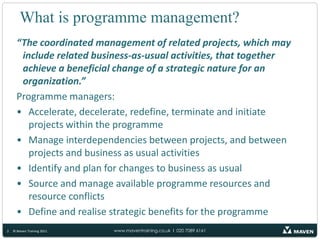
What is programme management?2© Maven Training 2011“The coordinated management of related projects, which may include related business-as-usual activities, that together achieve a beneficial change of a strategic nature for an organization.”Programme managers:Accelerate, decelerate, redefine, terminate and initiate projects within the programme
Manage interdependencies between projects, and between projects and business as usual activities
Identify and plan for changes to business as usual
Source and manage available programme resources and resource conflicts
Define and realise strategic benefits for the programmeWhat does MSP® offer?Has seven principles of effective programme management which provide a framework for the behaviour of those managing programmesHas governance themes that control how a programme is run:Creation of the vision of what the programme will deliverCreation of the plans and strategies that will ensure that all projects within the programme are managed on the same basisRoles and responsibilities for those working within the programme (programme and project team members) and those that are impacted by what it delivers (business change managers and change teams)Has six processes that form the programme lifecycle, taking the work from initial idea to successful business change and realisation of benefitsMSP® is a Registered Trade Mark of the Office of Government Commerce in the United Kingdom and other countries
What are the benefits of MSP®?Provides an easy to understand, robust structure for translating strategic objectives into actions, plans and resource needsEnsures changes that result from the programme are managed as carefully as the projects that deliver the changesEnables co-ordinated management of multiple projects and business changes to ensure:Resource requirements are known for the whole programme and resources can be shared and transferred according to needRisks and issues impacting more than one project can be clearly understood and communicated to other projects for analysis and actionProjects that provide the foundation for other project deliverables but do not deliver benefits in their own right can still be undertaken as they deliver benefits for the programmeProvides a governance structure that clearly defines at what points decisions will be need to be taken, by whom and provides an escalation process to higher levels of management for exceptional situations4© Maven Training 2011
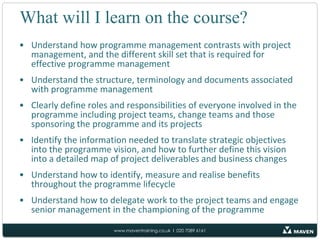
What will I learn on the course?Understand how programme management contrasts with project management, and the different skill set that is required for effective programme managementUnderstand the structure, terminology and documents associated with programme managementClearly define roles and responsibilities of everyone involved in the programme including project teams, change teams and those sponsoring the programme and its projectsIdentify the information needed to translate strategic objectives into the programme vision, and how to further define this vision into a detailed map of project deliverables and business changesUnderstand how to identify, measure and realise benefits throughout the programme lifecycleUnderstand how to delegate work to the project teams and engage senior management in the championing of the programme
MSP® QualificationsFoundationChecks your understanding of the terminology, structure, documentation and roles and responsibilities within MSP50 question multiple-choice examination in 40 minutesMust get 30 or more marks to passPractitionerChecks your ability to apply MSP to a variety of project situations including how to evaluate risks and issues, how to assess benefits and how to select project team memberseight questions per paper in 2 ½ hours40 marks required to pass - 50%6© Maven Training 2011
What do people say about the course?“I went on the course several months after I had started my programme so I spent a lot of time feeling frustrated about what I had missed out. I went back to work with a long list of things to do, and I am still using my book now to get ideas for what we need to do next. Biggest learning point was the strategies as I hadn’t put many of these ‘rules’ into my programme brief.”“I wasn’t sure if this was the right course for me because I wasn’t sure if I really had a programme, but by the time the trainer had finished the first day I knew what parts of my work were a programme and what to get rid of so I could concentrate on being the programme manager. I spent the next two weeks reorganising my work and I feel a lot more confident about what I am doing now.”“I have been asked to support our project and programme teams, and this course really helped me understand the terminology that they are all using. I definitely feel less excluded in meetings now.”“Stakeholder Engagement meant nothing to me until my trainer showed me that even groups and individuals outside the Programme can have a big effect on the programme and that there is a need  to consider how to communicate with them as well as the programme team.”
Is a qualification important?MSP is internationally recognised “best practice” for managing programmes and is clear evidence that you understand the structure, processes, roles and responsibilities of effective programme managementThe MSP qualification is required by recruiters as it is an important in helping them differentiate between those who can project manage and those who really understand how a programme is a different entity requiring different skillsProgramme management is a logical step for experienced project managers who are involved in delivering complex solutions where they find themselves responsible for more than one work stream, which needs a different type of control to that offered within project management. Programme management is also relevant for those managers who are responsible for identifying what activities their organisation will commit to in the annual business plan to realise the strategic objectives 8© Maven Training 2011

MSP Quick Guide

  • 1.
  • 2.
    What is programmemanagement?2© Maven Training 2011“The coordinated management of related projects, which may include related business-as-usual activities, that together achieve a beneficial change of a strategic nature for an organization.”Programme managers:Accelerate, decelerate, redefine, terminate and initiate projects within the programme
  • 3.
    Manage interdependencies betweenprojects, and between projects and business as usual activities
  • 4.
    Identify and planfor changes to business as usual
  • 5.
    Source and manageavailable programme resources and resource conflicts
  • 6.
    Define and realisestrategic benefits for the programmeWhat does MSP® offer?Has seven principles of effective programme management which provide a framework for the behaviour of those managing programmesHas governance themes that control how a programme is run:Creation of the vision of what the programme will deliverCreation of the plans and strategies that will ensure that all projects within the programme are managed on the same basisRoles and responsibilities for those working within the programme (programme and project team members) and those that are impacted by what it delivers (business change managers and change teams)Has six processes that form the programme lifecycle, taking the work from initial idea to successful business change and realisation of benefitsMSP® is a Registered Trade Mark of the Office of Government Commerce in the United Kingdom and other countries
  • 7.
    What are thebenefits of MSP®?Provides an easy to understand, robust structure for translating strategic objectives into actions, plans and resource needsEnsures changes that result from the programme are managed as carefully as the projects that deliver the changesEnables co-ordinated management of multiple projects and business changes to ensure:Resource requirements are known for the whole programme and resources can be shared and transferred according to needRisks and issues impacting more than one project can be clearly understood and communicated to other projects for analysis and actionProjects that provide the foundation for other project deliverables but do not deliver benefits in their own right can still be undertaken as they deliver benefits for the programmeProvides a governance structure that clearly defines at what points decisions will be need to be taken, by whom and provides an escalation process to higher levels of management for exceptional situations4© Maven Training 2011
  • 8.
    What will Ilearn on the course?Understand how programme management contrasts with project management, and the different skill set that is required for effective programme managementUnderstand the structure, terminology and documents associated with programme managementClearly define roles and responsibilities of everyone involved in the programme including project teams, change teams and those sponsoring the programme and its projectsIdentify the information needed to translate strategic objectives into the programme vision, and how to further define this vision into a detailed map of project deliverables and business changesUnderstand how to identify, measure and realise benefits throughout the programme lifecycleUnderstand how to delegate work to the project teams and engage senior management in the championing of the programme
  • 9.
    MSP® QualificationsFoundationChecks yourunderstanding of the terminology, structure, documentation and roles and responsibilities within MSP50 question multiple-choice examination in 40 minutesMust get 30 or more marks to passPractitionerChecks your ability to apply MSP to a variety of project situations including how to evaluate risks and issues, how to assess benefits and how to select project team memberseight questions per paper in 2 ½ hours40 marks required to pass - 50%6© Maven Training 2011
  • 10.
    What do peoplesay about the course?“I went on the course several months after I had started my programme so I spent a lot of time feeling frustrated about what I had missed out. I went back to work with a long list of things to do, and I am still using my book now to get ideas for what we need to do next. Biggest learning point was the strategies as I hadn’t put many of these ‘rules’ into my programme brief.”“I wasn’t sure if this was the right course for me because I wasn’t sure if I really had a programme, but by the time the trainer had finished the first day I knew what parts of my work were a programme and what to get rid of so I could concentrate on being the programme manager. I spent the next two weeks reorganising my work and I feel a lot more confident about what I am doing now.”“I have been asked to support our project and programme teams, and this course really helped me understand the terminology that they are all using. I definitely feel less excluded in meetings now.”“Stakeholder Engagement meant nothing to me until my trainer showed me that even groups and individuals outside the Programme can have a big effect on the programme and that there is a need  to consider how to communicate with them as well as the programme team.”
  • 11.
    Is a qualificationimportant?MSP is internationally recognised “best practice” for managing programmes and is clear evidence that you understand the structure, processes, roles and responsibilities of effective programme managementThe MSP qualification is required by recruiters as it is an important in helping them differentiate between those who can project manage and those who really understand how a programme is a different entity requiring different skillsProgramme management is a logical step for experienced project managers who are involved in delivering complex solutions where they find themselves responsible for more than one work stream, which needs a different type of control to that offered within project management. Programme management is also relevant for those managers who are responsible for identifying what activities their organisation will commit to in the annual business plan to realise the strategic objectives 8© Maven Training 2011