PROTECTION OF PLANT VARIETIES AND
FARMER’S RIGHTS
Registration of Plant Varieties under
PPV&FR
PPV & FR ACT, 2001 and
Farmers’ Rights
PPV & FR ACT, 2001 and
Farmers’ Rights
• To protect the intellectual property associated with the development of
plant varieties in fulfilment of an agreement signed by India under the
World Trade Organization (WTO).
• To recognize the rights of farmers arising from their contribution in
conserving, improving and making available plant genetic resources to
develop new plant varieties.
• To stimulate public and private investment in plant breeding to
accelerate agricultural Development and
• To ensure high quality seed and planting material to farmers by
promoting the seed industry.
Why Protect Plant Varieties?Why Protect Plant Varieties?
• India is an observer in “International
Union for the Protection of New
Varieties of Plants” (UPOV)
• Under UPOV system, rights are granted
to the breeders and not to the farmers.
India and UPOVIndia and UPOV
PPV& FR Act, 2001PPV& FR Act, 2001
 India is a Member of the World Trade Organization and also signed the agreement on
Trade Related Aspects of the Intellectual Property Rights (TRIPS)
 Article 27.3 (b) of the TRIPS requires that member states have to protect the plant
varieties either by patents, or by an effective sui generis system or by combination of
both.
 India opted for the sui generis system for the protection of plant varieties giving
importance to the farmers' rights, as enjoyed by them over centuries.
 India enacted the Protection of Plant Varieties and Farmers Right Act, 2001
 PPV& FR Authority has been established under section 3 of the Act in November,
2005 to implement the provision of PPV & FR Act, 2001
 The PPV& FR Act is in conformity with the provision of ITPGRFA and also UPOV
1978 Convention.
 In tune with the concept enshrined in the Treaty, the Indian legislation on Protection of
Plant Varieties & Farmers' rights, recognizes and protects the rights of the farmers for
their contribution in conserving, improving and making available plant genetic
resources for the development of new plant varieties.
 The Act tries to balance farmers' rights and breeders' rights.
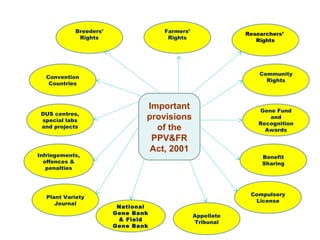
Convention
Countries
Important
provisions
of the
PPV&FR
Act, 2001
National
Gene Bank
& Field
Gene Bank
Appellate
Tribunal
Plant Variety
Journal
Infringements,
offences &
penalties
Farmers’
Rights
Breeders’
Rights
Researchers’
Rights
Community
Rights
Compulsory
License
DUS centres,
special labs
and projects
Gene Fund
and
Recognition
Awards
Benefit
Sharing
“farmers” means any person who-
•cultivates crops by cultivating the land himself; or
•cultivates crops by directly supervising the cultivation of
land through any other person; or
•conserves and preserves, severally or jointly, with any other
person any wild species or traditional varieties or adds value
to such wild species or traditional varieties through selection
and identification of their useful properties;
Who is farmer?Who is farmer?
Farmers’
variety
Farmers’
variety
• Has been traditionally cultivated
and evolved by the farmers in
their fields; or
• Is a wild relative or land race or a
variety about which the farmers
possess the common knowledge.
New Variety
Extant Variety
• Notified under Seeds Act, 1966
• Farmers Variety
• Variety of Common Knowledge
Essentially Derived Variety
Varieties that can be protectedVarieties that can be protected
Breeders Rights (Section 28)Breeders Rights (Section 28)
 An exclusive right on the breeder or his
successor, his agent or licensee, to produce,
sell, market, distribute, import or export the
variety.
 A breeder may authorize any person to produce,
sell, market or otherwise deal with the variety
registered under this Act.
 Breeder shall enjoy provisional protection of his
variety against any abusive act committed by
any third party during the period between filling
of application for registration and decision taken
by Authority.
Researcher’s Rights (Sec 30)Researcher’s Rights (Sec 30)
Section 30 states that:
Nothing contained in this Act shall prevent-
(a)The use of any variety registered under this Act by any
person using such variety for conducting experiment or
research
(b)The use of a variety as an initial source of variety for
the purpose of creating of other varieties:
Provided that the authorization of the breeder of a
registered variety is required where the repeated use of
such variety as a parental line is necessary for
commercial production of such other newly developed
variety.
Farmers’ Rights (Section 39)Farmers’ Rights (Section 39)
Farmers right on seed :
To save their own seed from their crop and use it for sowing,
re-sowing, exchanging, sharing and selling to other farmers
provided that Farmer will not be entitled to sell branded seed
of a protected variety.
Right to register traditional varieties :
Traditional varieties developed or conserved by farmers and
new varieties developed by them are eligible for registration.
Farmers right for reward and recognition :
Important role played by farmers individually or collectively
as community for conservation of varietal wealth of crop
plants, now being recognized.
Right to compensation:
In the event a farmer is unable to achieve the claimed performance of new
variety, PBR holder will be liable to pay compensation to the affected
farmers.
Farmers Right for protection against infringement :
Considering poor legal literacy prevailing among Farmers and to
discourage legal harassment through infringement proceeding a safeguard
to farmers against innocent infringement is provided in the Act.
Farmers Right for receiving free services :
Farmers are exempted from any fee in any proceeding before Registrar or
Authority or Tribunal or High Court.
Farmers’ Rights (Section 39)Farmers’ Rights (Section 39)
• Farmer’s variety application exempt from filing
GURT affidavit. Farmers are also exempted from
filing “affidavit sworn by the applicant that such
variety does not contain any gene or gene
sequence involving terminator technology”.
Farmers’ Rights (Section 39)Farmers’ Rights (Section 39)
Benefit Sharing (Section 26)Benefit Sharing (Section 26)
• The claims under benefit sharing can be submitted by
Citizens of India or Firms/ NGOs formed or established in
India.
• Such claims after due examination and after receiving
counter-claims will be disposed by the Authority.
• The amount thus determined shall be deposited by the
breeder in the manner referred to in clause (a) of sub-
section (1) of section 45 in the National Gene Fund.
Rights of Communities (Sec 41)Rights of Communities (Sec 41)
• This Section provides for settlement of any
claim attributable to the contribution of the
people of that village or local community,
in the evolution of any variety registered
under this Act.
• Compensation to be determined by
PPV&FRA and deposited in Gene Fund
Compulsory Licensing (Sec 47)Compulsory Licensing (Sec 47)
After the expiry of 3 years of issue of certificate of
registration , any person can appeal on ground of inadequate
seed supply/ not reasonable price from the breeder to
undertake production, distribution and sale of seed
Authority will hear both parties and in public interest, may
order breeder to grant a license to the applicant on payment of
a fee
Period of compulsory license will be maximum up to period
of protection
Authority can settle terms and conditions, revoke or modify
compulsory license
InfringementInfringement
• Not being a Breeder sells, exports, imports or produces
such variety having identical or deceptive denomination
without permission of Breeder.
• Provisions of Penalty has been provided under the Act for
applying / selling a variety with false denomination or
falsely representing a variety as a registered variety.
Penalty is non cognizable – bailable – compoundable-
triable by any Magistrate. Provisions for penalty for
subsequent offence has also been provided.
PenaltyPenalty
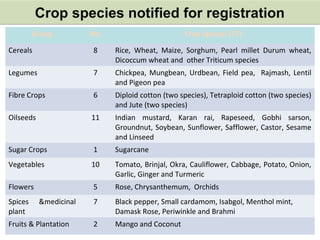
Crop species notified for registrationCrop species notified for registration
Group No. Crop Species (57)
Cereals 8 Rice, Wheat, Maize, Sorghum, Pearl millet Durum wheat,
Dicoccum wheat and other Triticum species
Legumes 7 Chickpea, Mungbean, Urdbean, Field pea, Rajmash, Lentil
and Pigeon pea
Fibre Crops 6 Diploid cotton (two species), Tetraploid cotton (two species)
and Jute (two species)
Oilseeds 11 Indian mustard, Karan rai, Rapeseed, Gobhi sarson,
Groundnut, Soybean, Sunflower, Safflower, Castor, Sesame
and Linseed
Sugar Crops 1 Sugarcane
Vegetables 10 Tomato, Brinjal, Okra, Cauliflower, Cabbage, Potato, Onion,
Garlic, Ginger and Turmeric
Flowers 5 Rose, Chrysanthemum, Orchids
Spices &medicinal
plant
7 Black pepper, Small cardamom, Isabgol, Menthol mint,
Damask Rose, Periwinkle and Brahmi
Fruits & Plantation 2 Mango and Coconut
Annual feeAnnual fee
Benefit sharing
amount
deposited
Benefit sharing
amount
deposited
Contributions
from National &
International
Organizations
Contributions
from National &
International
Organizations
Any other activity
indicated in the Act
Any other activity
indicated in the Act
Reimbursement of
compensation
Reimbursement of
compensation
Supporting
conservation
Supporting
conservation
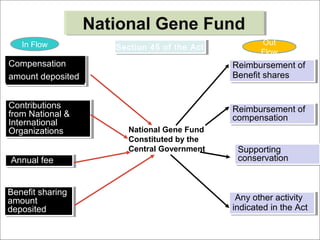
National Gene FundNational Gene Fund
Compensation
amount deposited
Reimbursement of
Benefit shares
Reimbursement of
Benefit shares
Section 45 of the ActSection 45 of the Act
National Gene Fund
Constituted by the
Central Government
In Flow Out
Flow
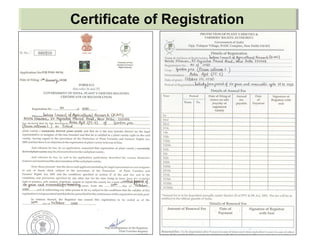
Certificate of RegistrationCertificate of Registration
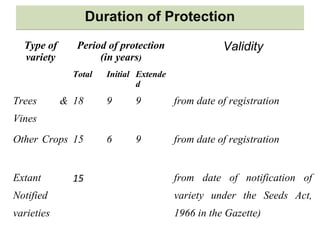
Duration of ProtectionDuration of Protection
Type of
variety
Period of protection
(in years)
Validity
Total Initial Extende
d
Trees &
Vines
18 9 9 from date of registration
Other Crops 15 6 9 from date of registration
Extant
Notified
varieties
15 from date of notification of
variety under the Seeds Act,
1966 in the Gazette)
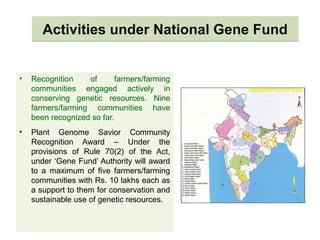
Activities under National Gene FundActivities under National Gene Fund
• Recognition of farmers/farming
communities engaged actively in
conserving genetic resources. Nine
farmers/farming communities have
been recognized so far.
• Plant Genome Savior Community
Recognition Award – Under the
provisions of Rule 70(2) of the Act,
under ‘Gene Fund’ Authority will award
to a maximum of five farmers/farming
communities with Rs. 10 lakhs each as
a support to them for conservation and
sustainable use of genetic resources.
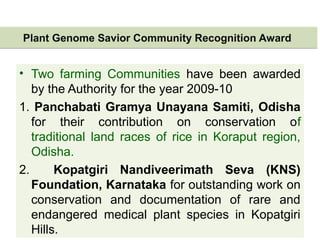
Plant Genome Savior Community Recognition AwardPlant Genome Savior Community Recognition Award
• Two farming Communities have been awarded
by the Authority for the year 2009-10
1. Panchabati Gramya Unayana Samiti, Odisha
for their contribution on conservation of
traditional land races of rice in Koraput region,
Odisha.
2. Kopatgiri Nandiveerimath Seva (KNS)
Foundation, Karnataka for outstanding work on
conservation and documentation of rare and
endangered medical plant species in Kopatgiri
Hills.
PROTECTION OF PLANT VARIETIES AND
FARMER’S RIGHTS
INDIAN AGRICULTURE:
STRENGTHS & WEAKNESSES
•INDIA IS RICH IN AGRO-BIODIVERSITY;
•SUBSISTENCE AND MARGINAL FARMING
WITH SMALL LAND HOLDINGS;
•LARGE POPULATION DEPENDS ON
AGRICULTURE;
•SEED REQUIREMENT MAINLY THROUGH
INFORMAL SYSTEM-FARMERS SAVED
SEED;
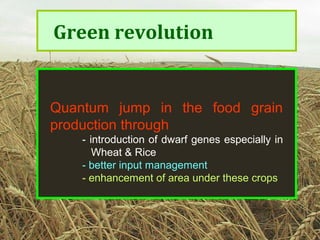
Quantum jump in the food grain
production through
- introduction of dwarf genes especially in
Wheat & Rice
- better input management
- enhancement of area under these crops
Green revolution
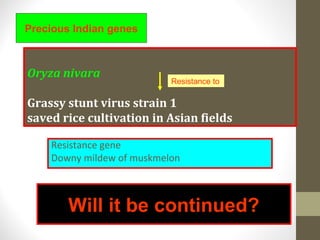
Oryza nivara
Grassy stunt virus strain 1
saved rice cultivation in Asian fields
Resistance gene
Downy mildew of muskmelon
Precious Indian genes
Resistance to
Will it be continued?
ISSUES REQUIRING ATTENTION
•TRADITIONAL USE OF PLANT GENETIC RESOURCES IS
SOCIO-CULTURALLY AND ECONOMICALLY CRUCIAL;
•ESSENTIAL TO AVOID UNREGULATED EXPLOITATION OF
BIODIVERSITY & RELATED KNOWLEDGE;
•AS PLANT VARIETIES DECIDE UPPER BOUNDARY OF
PRODUCTIVITY, OWNERSHIP AND CONTRIBUTION OFPGR-
VITAL ISSUE;
•RECOGNITION OF FARMERS AS A CULTIVATOR, BREEDER
AND CONSERVER, TO PROTECT:
-RIGHTS OF FARMERS
-RIGHTS OF VILLAGE AND LOCAL COMMUNITIES
CONCEPT OF IPRs IN
AGRICULTURE
•NEED TO PROVIDE:
-INCENTIVES TO INSTITUTIONS/INDIVIDUALS/ORGANISATIONS
ENGAGED IN CREATIVE WORK
-MONITORY RETURN ON INVESTMENT IN RESEARCH
-PLANT BREEDERS’ RIGHTS FOR SUSTAINING PLANT BREEDING
ACTIVITY.
•ADEQUATE PROTECTION AND RECOGNITION OF FARMERS AS
SUPPLIERS OF GERMPLASM;
•PLANT BREEDEERS’ RIGHTS WILL HELP IN:
-STIMULATING RESERCH AND DEVELOPING NEW VARIETIES OF
PLANTS.
-FACILITATING GROWTH OF SEED INDUSTRY.
-ENSURING HIGH QUALITY SEED TO FARMERS.
-ACCELERATING AGRICULTURE GROWTH.
UPOV Convention
(UPOV derived from French name of the organization
Union Internationale pour la Protection des Obtentions
Vegetales)
Paris, 1961
International Convention for the
Protection of New Varieties of
Plants
Mission of UPOV
To
provide and promote an effective system of plant
variety protection with the aim of encouraging
the development of new varieties of plants for the
benefit of society
•Convention entered into force in
1968
•Revised in Geneva in 1972, 1978
and 1991
•Act entered into force as
1978 Act
1991 Act
How to achieve the mission
Acknowledging the achievements of breeders of new varieties of
plants by granting intellectual property right (PBR) on the basis of
a set of clearly defined principles
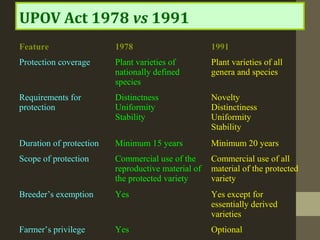
UPOV Act 1978 vs 1991
Feature 1978 1991
Protection coverage Plant varieties of
nationally defined
species
Plant varieties of all
genera and species
Requirements for
protection
Distinctness
Uniformity
Stability
Novelty
Distinctiness
Uniformity
Stability
Duration of protection Minimum 15 years Minimum 20 years
Scope of protection Commercial use of the
reproductive material of
the protected variety
Commercial use of all
material of the protected
variety
Breeder’s exemption Yes Yes except for
essentially derived
varieties
Farmer’s privilege Yes Optional
Farmer’s Privilege
As per UPOV Act (1978)
• Farmers can use their own produce from a
protected variety without any obligation to
PBR title holder
• No exchange of seeds between farmers
As per UPOV Act (1991)
• Left it to the National laws
Situation is different from that
in the developed countries as
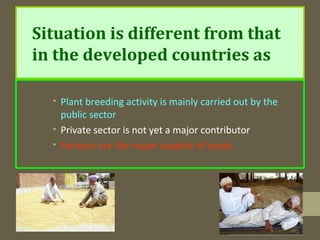
• Plant breeding activity is mainly carried out by the
public sector
• Private sector is not yet a major contributor
• Farmers are the major supplier of seeds
STATUS OF IPRs IN INDIA FOR
PROTECTING PLANT VARIETIES
•PRESENTLY INDIA DOES NOT HAVE ANY PLANT
VARIETIES PROTECTION LAW;
•NO EXISTING SYSTEM OF REGISTRATION OF PLANT
VARIETIES FOR PROTECTION OF PLANT BREEDERS;
•AGRICULTURAL RESEARCH & VARIETAL DEVELOPMENT
HAS MAINLY BEEN THE CONCERN OF GOVT. & PUBLIC
INSTITUTIONS;
•NEWLY DEVELOPED PLANT VARIETIES ARE NOTIFIED
AND RELEASED UNDER THE SEEDS ACT, 1966;
INDIA’S CHOICE FOR A
‘SUI GENERIS’ REGIME
•ARTICLE 27.3(b) OF TRIPS AGREEMENT PROVIDES
FREEDOM TO MEMBER COUNTRIES IN FRAMING THEIR
OWN SYSTEM-PATENT OR EFFECTIVE SUI GENERIS;
•INDIAN PATENTS ACT, 1970 EXCLUDES AGRICULTURE
AND HORTICULTURE METHODS OF PRODUCTION FROM
PATENTABILITY;
•THE INDIAN SUI GENESIS SYTEM SATISFIES:
-NATIONAL INTEREST – SUSTAINABLE
AGRICULTURE DEVELOPMENT
-BALANCE BETWEEN PBR, FARMERS’ RIGHTS &
RESEARCHER’S RIGHTS
India is obliged under TRIPs to
adopt UPOV Act (1991)
- either allow patents or
- enact a sui generis PBR system affords protection
equivalent to UPOV ACT (1991)
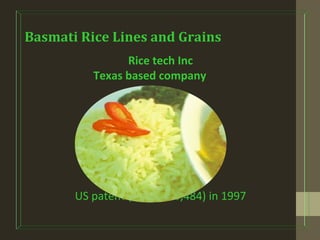
Basmati Rice Lines and Grains
Rice tech Inc
Texas based company
US patent (No. 5,663,484) in 1997
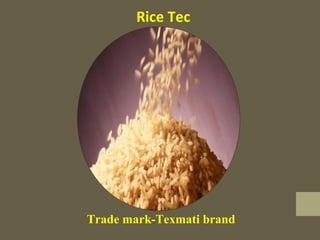
Rice Tec
Trade mark-Texmati brand
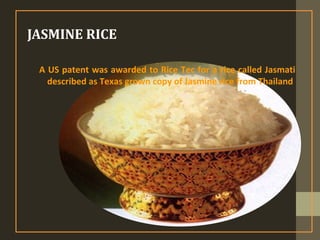
JASMINE RICE
A US patent was awarded to Rice Tec for a rice called Jasmati
described as Texas grown copy of Jasmine rice from Thailand
TURMERIC PATENT
US patent No.5401504
to two NRI researchers from university
of Mississippi in March 1995
a re-examination of the patent
CSIR On 28 th
October 1996
RATIONALE FOR SUI-GENERIS SYSTEM
•INDIA HAS DECIDED TO ADOPT SUI GENERIS’S SYSTEM
ON ACCOUNT OF:
–NEED TO INCORPORATE EQUITY CONCERNS
–RIGHTS OF FARMERS
–RIGHTS OF VILLAGE COMMUNITY
–RIGHTS OF RESEARCHERS
•GREATER FLEXIBILITY IN REGARD TO:
–PROTECTED GENERA/SPECIES OF VARIETIES
–LEVEL AND PERIOD OF PROTECTION
–SUSTAINABLE DEVELOPMENT OF AGRO BIO-DIVESITY.
•BENEFIT SHARING ARRANGEMENT.
–
INDIA’S APPROACH TO PROTECTION OF
PLANT VARIETIES
•FORMULATED THROUGH A PROCESS OF
BROAD BASED CONSULTATION WITH THE
STAKEHOLDERS AND E XTENSIVE PUBLIC
DEBATE;
•INTERFACE WITH RELATED IPRs;
•NATIONAL TREATMENT TO BREEDERS OF
CONVENTION COUNTRIES;
•IN CONFORMITY WITH UPOV CONVENTION 1978
ACT.
The Protection of Plant Varieties and
Farmers’ Rights Act,2001
Act 53 of 2001
30th
Oct.,2001
An Act to
- establish effective system for protection of
plant varieties
rights of farmers
rights of breeders
- encourage development of new varieties
- facilitate growth of seed industry and ensure
high quality seeds
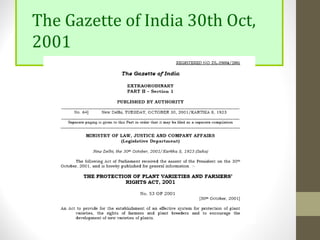
The Gazette of India 30th Oct,
2001
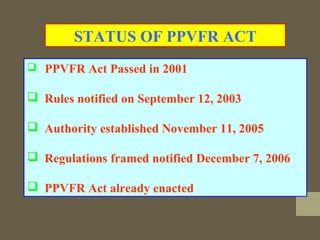
 PPVFR Act Passed in 2001
 Rules notified on September 12, 2003
 Authority established November 11, 2005
 Regulations framed notified December 7, 2006
 PPVFR Act already enacted
STATUS OF PPVFR ACT
THE PROTECTION OF PLANT VARITIES AND
FARMERS’ RIGHTS ACT 2001 – INDIA
• Objectives:
• Protection of the rights of farmers for their contribution
made at any time in conserving, improving and making
available plant genetic resources for the development of
new plant varieties.
• Protection of Plant Breeders Rights to stimulate investment
for research and development, both in the public and
private sector for development of new plant varieties.
• Giving effect to Article 27.3(b)of the TRIPs Agreement.
PLANT GENE
SAVIOR COMMUNITY
RECOGNITION
KISAN PURUSKAR – KISAN
SAMMAN
Coverage of varieties
New Varieties (genera and species which can be
registered will be notified subsequently)
Extant varieties
Farmers varieties
Breeders can exercise their rights over any variety that is
essentially derived from the protected variety. Provided
that the authorisation by the breeder of the initial variety
to the breeder of edv is on mutually agreed upon terms
and conditions.
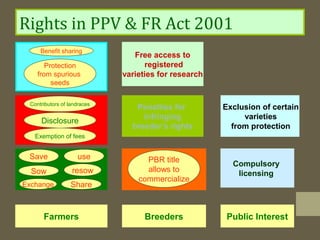
Rights in PPV & FR Act 2001
PBR title
allows to
commercialize
Free access to
registered
varieties for research
Penalties for
infringing
breeder’s rights
Compulsory
licensing
Exclusion of certain
varieties
from protection
Farmers Breeders Public Interest
Benefit sharing
Protection
from spurious
seeds
Contributors of landraces
Exemption of fees
Disclosure
Save
Exchange
resow
use
Sow
Share
PBR title
allows to
commercialize
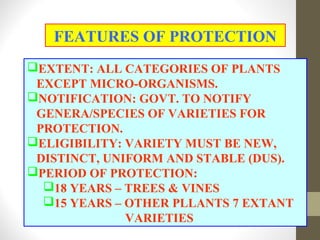
EXTENT: ALL CATEGORIES OF PLANTS
EXCEPT MICRO-ORGANISMS.
NOTIFICATION: GOVT. TO NOTIFY
GENERA/SPECIES OF VARIETIES FOR
PROTECTION.
ELIGIBILITY: VARIETY MUST BE NEW,
DISTINCT, UNIFORM AND STABLE (DUS).
PERIOD OF PROTECTION:
18 YEARS – TREES & VINES
15 YEARS – OTHER PLLANTS 7 EXTANT
VARIETIES
FEATURES OF PROTECTION
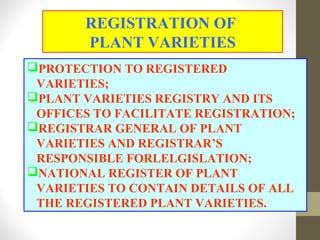
PROTECTION TO REGISTERED
VARIETIES;
PLANT VARIETIES REGISTRY AND ITS
OFFICES TO FACILITATE REGISTRATION;
REGISTRAR GENERAL OF PLANT
VARIETIES AND REGISTRAR’S
RESPONSIBLE FORLELGISLATION;
NATIONAL REGISTER OF PLANT
VARIETIES TO CONTAIN DETAILS OF ALL
THE REGISTERED PLANT VARIETIES.
REGISTRATION OF
PLANT VARIETIES
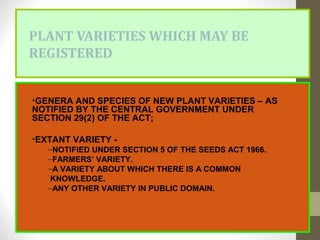
PLANT VARIETIES WHICH MAY BE
REGISTERED
•GENERA AND SPECIES OF NEW PLANT VARIETIES – AS
NOTIFIED BY THE CENTRAL GOVERNMENT UNDER
SECTION 29(2) OF THE ACT;
•EXTANT VARIETY -
–NOTIFIED UNDER SECTION 5 OF THE SEEDS ACT 1966.
–FARMERS’ VARIETY.
–A VARIETY ABOUT WHICH THERE IS A COMMON
KNOWLEDGE.
–ANY OTHER VARIETY IN PUBLIC DOMAIN.
CRITERIA FOR REGISTRATION
•NEW PLANT VARIETIES -
–NOVELTY, DISTINCTNESS, UNIFORMITY AND STABILITY.
•EXTANT VARIETIES -
–DISTINCTNESS, UNIORMITY AND STABILITY AS
PRESCRIBED.
BREEDERS OR THEIR SUCCESSORS OR
ASSIGNEES;
FARMER OR GROUP/COMMUNITY OF
FARMERS WHO HAVE BRED OR
CULTIVATED OR CONSERVED THE
VARIETY;
UNIVERSITY OR PUBLIC FUNDED
AGRICULTURAL INSTITUTION WHO HAS
BRED THE VARIETY.
REGISTRATION BY
BREEDER TO FURNISH INFORMATION ON
GEOGRAPHICAL LOCATION OF PLANT GENETIC
MATERIAL FOR DEVELOPMENT OF THE NEW
VARIETY;
CERTIFICATE OF REGISTRATION TO PRESCRIBE
THE CONDITIONS OF ENTITLEMENT.
ONE TIME RENEWAL, AT THE END OF SIX YEARS
IN CASE OF ANNUAL CROPS AND 9 YEARS IN CASE
OF TREES AND VINES, ON PAYMENT OF
PRESCRIBED FEE;
REGISTRATION WILL BE FOREFEITED IF ANNUAL
FEE IS NOT PAID.
REGISTRATION
PREVENTION OF THEIR COMMERCIAL
EXPLOITATION TO PROTECT PUBLIC
ORDER OR PUBLIC MORALITY OR HUMAN,
ANIMAL AND PLANT LIFE AND HEALTH
OR TO AVOID SERIOUS PREJUDICE TO
THE ENVIRONMENT;
VARIETY IN QUESTION INVOLVES ANY
TECHNOLOGY SUCH AS ‘GENETIC USE
RESTRITION TECHNOLOGY’, WHICH IS
INJURIOUS TO THE LIFE OR HEALTH OF
HUMAN BEINGS, ANIMALS OR PLANTS;
EXCLUSION FROM
REGISTRATION
BREEDERS RIGHTS
•RIGHTS TO -
–PRODUCE,
–SELL, MARKET, DISTRIBUTE,
–IMPLORT/EXPORT SEEDS OF THE PROTECTED VARIETY,
•BREEDERS AUTHORISATION FOR PRODUCTION &
COMMERCIAL EXPLOITATION OF THE PROTECTED
VARIETY.
RIGHTS TO SAVE, USE, EXCHANGE, SHARE AND
SELL FARM PRODUCE OF A PROTECTED
VARIETY, EXCEPT SALE OF BRANDED SEED;
FARMERS RECOGNIZED AS BREEDERS,
CONSERVORS, PRESERVORS AND CULTIVATORS
OF TRADITIONAL VARIETIES;
RECOGNITION AND REWARD FROM NATIONAL
GENE FUND;
REGISTRATION OF EXTENT VARIETIES
INCLUDING FARMERS’ VARIETIES;
FARMERS TO BE COMPENSSATED FOR LOWER
THAN SPECIFIED YIELD;
FARMERS EXEMPTED FROM PAYMENT OF FEES;
FARMRS TO BE PROTECTED FROM ACTS OF
INNOCENT INFRINGEMENT.
FARMERS’ RIGHTS
RECOGNITION OF THE ROLE OF
TRADITIONAL COMMUNITIES IN
CONSERVING AND PRESERVING GENETIC
RESOURCES OF LAND RACES AND WILD
RELATIVES;
COMEPNSATION FOR CONTRIBUTION OF
VILLAGE OR LOCAL COMMUNITIES IN
EVOLUTION OF A V ARIETY;
COMPENSATION TO BE DETERMINED BY
PVP AUTHORITY AND DEPOSITED IN GENE
FUND.
COMMUNITIES’ RIGHTS
SHARING OF BENEFITS ACCRUING TO A
BREEDER
•FROM A VARIETY DEVELOPED FROM INDEGENOUSLY
DERIVED PLANT GENETIC RESOURCES;
•ANY PERSON/GROUP OF PERSONS OR
GOVERNMENTAL/NON-GOVERNMENTAL ORGANISATIONS
CAN FILE CLAIM FOR BENEFIT SHARING FOR THEIR
CONTRIBUTION IN EVOLUTION OF VARIETY REGISTERED
UNDER THE ACT;
•THE CLAIM TO BE CONFIEND TO CITIZEN(S) OF INDIA OR
ORGANISATIOSN ESTABLISHED IN INDIA;
•QUANTUM OF AWARD TO BE DETERMINED BY PVP
AUTHORITY.
NATIONAL GENE FUND
•TO BE CONSTITUTED FROM -
–BEBEFIT SHARING PROCEED,
–ROYALTIES AND FEES,
–COMMUNITIES’ COMPENSATION, &
–CONTRIBUTIONS,
•TO BE UTILISED FOR -
–COMPENSATION TO BREEDERS, FARMERS, COMMUNITIES.
–CONSERVATION OF GENETIC RESOURCES FOR
SUSTAINABLE USE.
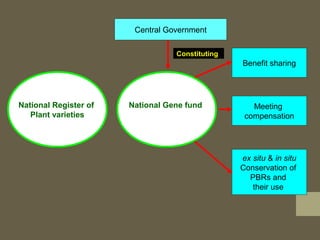
National Register of
Plant varieties
National Gene fund
Central Government
Benefit sharing
Meeting
compensation
ex situ & in situ
Conservation of
PBRs and
their use
Constituting
RESEARCHERS’ RIGHT
•FREE ACCESSTO PROTECTED VARIETIES FOR BONAFIDE
RESERCH PURPOSES.
COMPULSORY LICENCING
•IF SEEDS OF A PROTECTED VARIETY ARE NOT
AVAILABLE -
–IN ADEQUATE QUANTITY.
–AT REASONABLE PRICE.
•AUTHORITY MAY GRANT LICENCE TO A THIRD PARTY TO -
–UNDERTAKE PRODUCTION,
–DISTRIBUTION AND SALE OF THE SEED.
AUTHORITY FOR PROTECTION OF
PLANT VARIETIES & FARMERS’ RIGHTS
•INDEPENDENT AND PERMANENT BODY VESTED WITH
EXCLUSIVE AUTHORITY FOR IMPLEMENTATION OF THE
ACT;
•BROAD-BASED COMPOSITION: SCIENTISTS, STATE
REPRESENTATIVES, FARMERS/TRIBAL/WOMEN’S
ORGANISATIONS ETC.;
•STANDING COMMITTEE RO ADVISE THE AUTHORITY ON
ALL ISSUES INCLUDING FARMERS’ RIGHTS.
Indian
Plant Variety Protection law
- Progressive
- Pro-developing country
legislation
- Strong and proactive
farmer’s Rights
- Well defined Breeder’s Rights
- Balanced the breeder’s
-farmer’s rights exploiting
the flexibility granted in
TRIPs
- Incorporate principles laid
down in the 1992 convention
on Biological Diversity (CBD)
recognizes farmers’ role as
- Conservers
- Breeders
- Cultivators
Indian PVP law is the
- Ist law in the world to grant formal and legal rights to the
farmers
- Act as an alternative to the UPOV model
PVPPVP
 ENCOURAGE INNOVATION, SOCIETAL
BENEFITS, PLATFORM FOR R&D
 EFFECTIVE IMPLIMENTATION AND
ENFORCEMENT TO ACHIEVE THESE GOALS
“You Cannot
Build Peace
on Empty
Stomachs.”
John Boyd Orr
Nobel Peace Laureate
First FAO Director
General
Registration of Plant Varieties
GOALS OF PPV&FR Act, 2001
• To encourage the development of new varieties.
• To protect Plant Breeders’ Rights (PBR).
• To stimulate the growth of seed industry.
• To recognize and protect rights of farmers.
•
The PPV&FRA 2001, covers all
plants except micro organism
09/23/18 75
Registration of Plant Varieties
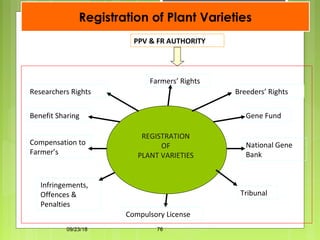
09/23/18 76
PPV & FR AUTHORITY
REGISTRATION
OF
PLANT VARIETIES
Farmers’ Rights
Gene Fund
National Gene
Bank
Benefit Sharing
Compensation to
Farmer’s
Compulsory License
Tribunal
Infringements,
Offences &
Penalties
Breeders’ RightsResearchers Rights
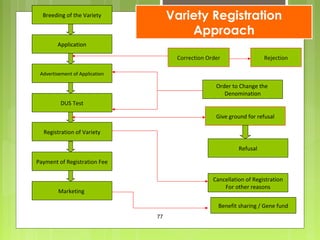
77
Breeding of the Variety
Application
Advertisement of Application
DUS Test
Registration of Variety
Payment of Registration Fee
Marketing
RejectionCorrection Order
Order to Change the
Denomination
Give ground for refusal
Refusal
Cancellation of Registration
For other reasons
Variety Registration
Approach
Benefit sharing / Gene fund
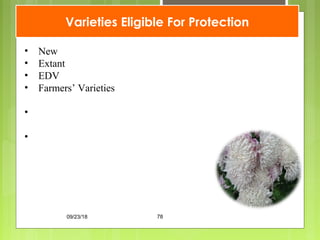
Varieties Eligible For Protection
• New
• Extant
• EDV
• Farmers’ Varieties
•
•
09/23/18 78
Criteria for Registration
• A new variety shall be registered for Breeders’ Rights if it
conforms to the criteria of
• (i) Novelty
• (ii) Distinctiveness
• (iii) Uniformity
• (iv) Stability
• The variety should also has a denomination in accordance with
the provisions of PPV&FR Act, 2001.
Essentially Derived Variety (EDV)
• EDV is predominantly derived from another variety or initial
variety, or from a variety that is predominantly derived from the
initial variety, retaining the expression of the essential
characteristics that result from the genotype or a combination of
genotypes of the initial variety. And is clearly distinguishable from
the initial variety except for differences that result from the act of
derivation, confirms to the initial variety.
• The plant variety developed from a initial variety through
transgenic approach, backcross derivative, mutants, chimera,
somaclonal variants, chimera and alike can come under the EDV.
09/23/18
80
Other Provisions under the Act
• Convention Country and Reciprocity
• Community Rights.
• Benefit Sharing.
• Gene fund.
• Compulsory License.
• Plant Varieties Protection Appellate Tribunal.
• Infringement.
• Penal Provisions.
•
09/23/18
81
• Considerations while filing an application for registration of Plant
Varieties under Protection of Plant Varieties and Farmers’ Rights Act,
2001
09/23/18
82
Documents to be attached with
the application
• PV-1: In cases where the applicant authorizes a person to
register a variety on behalf of the applicant and is to be
signed by the applicant.
• PV-2: As a documentary proof in cases of assignment or
succession, to be furnished in the manner specified in the
Form with supporting documents such as succession
certificate and / or assignment deed to be given.
• The name(s) and signature of the breeder(s) involved
should be made in PV-2 and should be countersigned by
the applicant.
09/23/18
83
Identity of applicant
• Institutional application will cover only applicants
from Public sector.
• Assignee of Breeder or Successor or institution or
farmers will be considered as legal representative of
applicant who will submit required proof of the right
for making the application in accordance with the
Rule.
• Others applicant can be considered for material
developed by participatory plant breeding
09/23/18
84
• The Individual breeder / farmer applying the application
independently will fill in their name and address in Column no. 2
(a) of the application form.
• Society, Institution, Community, NGOs, etc. registered under any
Act shall be treated as legal person and will fill Column no. 2(b)
of the application form.
09/23/18
85
Denomination of candidate variety
• Denomination should be clear and distinctive and
should be expressed by means of letters or a
combination of letters and figures written in any
language. Uniformity of denomination should be
maintained throughout the application and technical
questionnaire.
• In case of extant varieties, the denomination
published in the Gazette notification of Government
of India should be mentioned while applying for
registration of extant varieties.
09/23/18
86
Pedigree / genealogy/parental
material
• Complete information of development of the
candidate variety along with the stage of selection,
method of selection etc. should be mentioned.
• Distinctive characteristics of the parental material
involved in the development of the candidate variety
should be provided
09/23/18
87
Declarations
• A declaration that the genetic or parental material acquired for
breeding, evolving or developing the variety has been lawfully
acquired.
• Complete passport data of the parental lines from which the
variety has been derived along with the geographical location in
India from where the genetic material has been taken and all
such information relating to the contribution, if any , of any
farmer, village community, institution or organization in
breeding, evolving or developing the variety.
09/23/18
88
• The applicant should provide the particulars of the comparative
trials conducted by the applicant with reference to the DUS
characteristics along with the reference variety with the detail of
the technical programme of the trial.
• Methods of maintaining the candidate variety along with the
place where it will be maintained should be provided.
• The state / notes of the characteristics should be in accordance
to the specific guidelines of the respective crops as published in
the Plant Variety Journal of India Vol. 1 No. 1.
09/23/18
89
Commercial Exploitation of Candidate
Variety
• Date of first sale of candidate variety should be
clearly indicated in the specified column of the
application.
• Information regarding agronomic package practice
and protective measures for growing candidate
variety.
09/23/18
90
Applications for Transgenic varieties
• GEAC approval for commercialization of candidate
variety and bio safety clearance should be attached
along with the application.
09/23/18
91
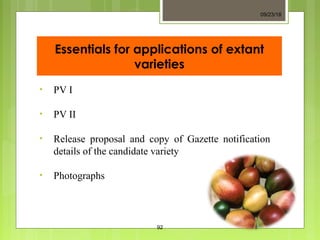
Essentials for applications of extant
varieties
• PV I
• PV II
• Release proposal and copy of Gazette notification
details of the candidate variety
• Photographs
09/23/18
92
General considerations
• Every page of the application should be signed at the bottom of the page
by the applicant and the Technical Questionnaire to be signed by the
applicant.
• The sequence of columns should be same as in the application published
by the Authority.
• Always tick mark the attachments enclosed with the application in the
list of enclosures.
• No column should be left blank in the application form.
• The bank draft enclosed with the application should not be older than
two months.
• Photographs of the specific distinct traits for which candidate variety is
derived should be provided as per the dimensions and other
specifications notified in the Plant Variety Journal of India Vol. 1 No. 3.
09/23/18
93
Implementation of Act
• PPV&FR Rules were notified in 2003.
• PPV&FR Authority established on 11th November, 2005.
• PPV&FR Regulations were notified in 2006.
• Publication of Plant Variety Journal of India was started from
February - March , 2007.
• General guidelines for DUS testing were published and released on
20th February, 2007.
• Crop specific DUS test guidelines for 12 crops were published and
released on 20th February, 2007.
• Registration for 12 crop species namely Rice, Bread wheat, Maize,
Sorghum, Pearlmillet, Chickpea, Green gram (Mungbean), Black
gram (Urdbean), Field pea/Garden pea, Kidney bean/French bean
(Rajmash), Lentil, Pigeon pea was started from 21st May, 2007.
• Specific DUS test guidelines for Cotton and Jute were published
and released in December, 2007.
09/23/18
94
• Registration for 6 species of 2 more crops namely Cotton and Jute
was started from 1st April, 2008.
• So far 1043 applications have been received for registration out of
which 257 are New , 779 Extant and 7 are Farmers’ Variety.
• The total numbers of applications received from Public sector are
637, private sector are 399, and Farmers’ are 7.
• 58 new varieties have been sent for DUS testing.
• Registration certificate has been issued for 40 extant varieties.
•
09/23/18
95
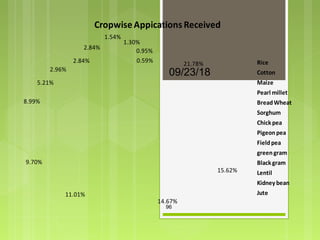
21.78%
15.62%
14.67%
11.01%
9.70%
8.99%
5.21%
2.96%
2.84%
2.84%
1.54%
1.30%
0.95%
0.59%
Cropwise Appications Received
Rice
Cotton
Maize
Pearl millet
BreadWheat
Sorghum
Chick pea
Pigeonpea
Fieldpea
greengram
Black gram
Lentil
Kidney bean
Jute
09/23/18
96
• More than 200 Extant Varieties notified under seed Act 1966 have
been recommended by EVRC for registration. Before registration
they are being published in PVJI for seeking opposition if any from
interested persons.
• National Gene Bank of the Authority was established in the
designated space provided by the NBPGR.
• 7 Task Force for finalizing DUS guidelines for Fruit crops,
Vegetable crops, Tea, Coffee and Rubber, Ornamental plants,
Medicinal and Aromatic plants, Spices and Tuber crops were
established.
09/23/18
97
Applications for Transgenic varieties• GEAC approval for commercialization of candidate variety and
bio safety clearance should be attached along with the
application.
• Information regarding agronomic package practice and
protective measures for growing candidate variety.
09/23/18
98
Essentials for applications of extant
varieties
• PVI
• PVII
• Release proposal and copy of Gazette notification
details of the candidate variety
• Photographs
09/23/18
99
Legal Aspects of
PPV&FR Act, 2001
09/23/18
100
Statutory Organs
• Plant Varieties Protection appellate tribunal
• Protection of Plant Varieties and Farmers Right
Authority
• Plant Varieties Registry
09/23/18101
Definition of Breeder
• Section 2 (C) of Act defines Breeder as follows : -
• “A person or group of persons or a farmer or
group of farmers or any institution which has bred,
evolved or developed any variety”
09/23/18102
Registerable Varieties
• New Variety
• Essentially Derived Variety
• Extant Variety
• Farmers’ Variety
09/23/18103
New Variety
• Novelty
• Based on Marketing
• In India – 1 Year
• Outside India – Trees and Vines 6 Years and other
case 4 years
09/23/18104
Extant Variety
• Notified under Seeds Act
• Farmers’ Variety
• Common Knowledge Variety
• Public Domain Variety
09/23/18105
Farmers’ Variety
• May be extant
• May be new
• May be EDV
09/23/18106
Criteria for Registration
• Distinct
• Uniform
• Stable
09/23/18107
Denomination
• Single and Distinct
• Should not be a Trade Mark
09/23/18108
Procedure for Registration
• Acceptance of Registrar:- Require to amend or
reject.
• Advertisement
• Opposition within 3 Months from the date of
advertisement
09/23/18109
Opposition
• Opponent entitled to Breeder Rights
• Public interest
• Adverse effect on environment
09/23/18110
Counter Statement
• Within 2 Months from the receipt of notice of
opposition
• Failing to file – Applicant deemed to have
abandoned the application
• Final Opposition- 30 days – C.S.
• Evidence – 1 Month – C.S. – Opponent
• Evidence – Applicant 30 days – O.E.
• Hearing and Judgment
09/23/18111
Rights of Breeder
• To Produce
• To Sell
• To Market
• To Distribute
• To import or export
09/23/18112
Benefit Sharing
• After registration Authority shall publish certificate
inviting claims
• Six months from the date of publication
09/23/18113
Assignment and Transmission
• Plant Breeder may assign his rights
• Rights of Plant Breeder may also be transmitted by
operation of law
09/23/18114
Assignment and Transmission
• Assignment – created by act of parties (ex., sale,
transfer etc.,)
• Transmission by operation of law (ex., death,
insolvency, winding-up, lunacy etc.,)
09/23/18115
Agent and Licensee
• Plant Breeder may Authorise Regd. Agent or Regd.
Licencee
• When terms of agreement are not followed by Regd.
Agent or Regd. Licensee then Plant Breeder can
apply to the Registrar for cancellation of agreement
09/23/18116
Application in a Convention Country
• When a Breeder has made an application in a
Convention Country and within 12 months makes an
application in India then if the variety is registered
then it shall be registered as on the date on which the
application was made in Convention Country.
09/23/18117
Application made in 2 or more
Convention Countries
• When application is made in 2 or more Convention
Countries then period of 12 months shall be counted
from the date on which the earliest of application
was made.
09/23/18118
Surrender of Registration Certificate
• A Breeder of variety Regd. under the Act may give
notice to Registrar to surrender registration
certificate.
• Notice to Agent or Licensee
• Opposition
• Hearing
• Decision by Registrar
09/23/18119
09/23/18120
Duration of registration
initial period of registration
• Nine years in case of trees and vines
• Six years in case of other crops
Renewal
• Trees and Vines – 18 years from the date of
registration of variety – Extd. period 9 yrs
• Extant Varieties 15 years from date of notification of
variety by central govt.
• Other Cases – 15 years – Extd. period 9 years
09/23/18121
Annual Fee
• Determined by Authority on basis of benefit or
royalty gained by the Breeder
• Breeder fails to pay Annual fee upto two
consecutive years – protection will be forfeited.
• Annual fee has to be paid every year for full
protection period
• Renewal fee for extended period
09/23/18122
Breeder’s Option - Renewal
• First Option – Breeder may renew it for remaining
period of total aggregate duration of validity
• Second Option – Breeder may renew it for a period
less than total aggregate duration
• Second Option – No further renewal
09/23/18123
Correction of any error in the register
• Correct name or address
• Change of name or address
09/23/18124
Farmers who has developed a new
Variety
• Entitled to registration and protection
09/23/18125
Reasonable Compensation
• When compulsory Licence is granted in respect of a
Breeder of a variety registered under the Act. the
Breeder is entitled to reasonable compensation
09/23/18126
Adjournment of Application for 12
Months
• Compulsory Licence application can be adjourned
for 12 months if Breeder shows reasonable cause for
not producing and making available the variety
09/23/18127
Appeals to Plant Varieties Protection Appellate
Tribunal (PVPAT)
• Breeder aggrieved by the decision of Registrar or
Authority may prefer appeal to PVPAT
• Transitional provision – IPAT
09/23/18128
Infringement
• Not being a Breeder sells, exports, imports or
produces such variety without permission of Breeder
• Uses, sells exports or imports any variety giving
such variety the denomination identical or
deceptively similar to denomination of variety Regd.
under Act
09/23/18129
Penalties
• Penalty for applying false denomination
• Penalty for selling varieties to which false
denomination is applied
• Penalty for falsely representing a variety as
registered
• Non Cognizable – Bailable – Any Magistrate
09/23/18130
Sec. 2 (k) defines a Farmer
• Cultivates crops by cultivating the land himself or
• Cultivates crop by directly supervising the cultivation of
land through any other person or
• Conserves and preserves, severally or jointly, with any
person any wild species or traditional varieties, or adds
value to such wild species of traditional varieties through
selection and identification of their useful properties
• and a farmers’ variety means a variety which
• has been traditionally cultivated and evolved by farmers
in their fields
• is a wild relative or land race of a variety about which the
farmers possess the common knowledge
09/23/18131
• Farmers’ Variety can also be registered as an extant variety.
• A farmer can save, use, sow, exchange, share or sell his farm
produce including seed of a variety protected under the PPV&FR
Act, 2001 in the same manner as he was entitled before the coming
into force of this Act provided the farmer shall not be entitled to sell
branded seed of a variety protected under the PPV&FR Act, 2001.
• Farmers who conserve Genetic Resources of Land races and wild
relatives of economic plants shall be rewarded from the “Gene
Fund”.
• There is also a provision for compensation to the farmers for non-
performance of variety under Section 39 (2) of the Act, 2001.
• Exempted from all fees.
Farmers' Right 09/23/18132
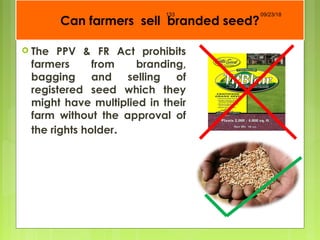
Can farmers sell branded seed?
 The PPV & FR Act prohibits
farmers from branding,
bagging and selling of
registered seed which they
might have multiplied in their
farm without the approval of
the rights holder.
09/23/18133
Researcher’s Rights
Researcher's can
 Use any variety registered under this Act for
conducting experiment or research.
 Use any variety registered under this Act as an
initial source for the purpose of creating other
varieties.
Provided that the authorisation of the breeder of a
registered variety is required where the repeated use
of such variety as a parental line is necessary for
commercial production of such other newly
developed variety.
09/23/18134
Thanks

Ppvr & farmers right

  • 1.
    PROTECTION OF PLANTVARIETIES AND FARMER’S RIGHTS Registration of Plant Varieties under PPV&FR PPV & FR ACT, 2001 and Farmers’ Rights PPV & FR ACT, 2001 and Farmers’ Rights
  • 2.
    • To protectthe intellectual property associated with the development of plant varieties in fulfilment of an agreement signed by India under the World Trade Organization (WTO). • To recognize the rights of farmers arising from their contribution in conserving, improving and making available plant genetic resources to develop new plant varieties. • To stimulate public and private investment in plant breeding to accelerate agricultural Development and • To ensure high quality seed and planting material to farmers by promoting the seed industry. Why Protect Plant Varieties?Why Protect Plant Varieties?
  • 3.
    • India isan observer in “International Union for the Protection of New Varieties of Plants” (UPOV) • Under UPOV system, rights are granted to the breeders and not to the farmers. India and UPOVIndia and UPOV
  • 4.
    PPV& FR Act,2001PPV& FR Act, 2001  India is a Member of the World Trade Organization and also signed the agreement on Trade Related Aspects of the Intellectual Property Rights (TRIPS)  Article 27.3 (b) of the TRIPS requires that member states have to protect the plant varieties either by patents, or by an effective sui generis system or by combination of both.  India opted for the sui generis system for the protection of plant varieties giving importance to the farmers' rights, as enjoyed by them over centuries.  India enacted the Protection of Plant Varieties and Farmers Right Act, 2001  PPV& FR Authority has been established under section 3 of the Act in November, 2005 to implement the provision of PPV & FR Act, 2001  The PPV& FR Act is in conformity with the provision of ITPGRFA and also UPOV 1978 Convention.  In tune with the concept enshrined in the Treaty, the Indian legislation on Protection of Plant Varieties & Farmers' rights, recognizes and protects the rights of the farmers for their contribution in conserving, improving and making available plant genetic resources for the development of new plant varieties.  The Act tries to balance farmers' rights and breeders' rights.
  • 5.
    Convention Countries Important provisions of the PPV&FR Act, 2001 National GeneBank & Field Gene Bank Appellate Tribunal Plant Variety Journal Infringements, offences & penalties Farmers’ Rights Breeders’ Rights Researchers’ Rights Community Rights Compulsory License DUS centres, special labs and projects Gene Fund and Recognition Awards Benefit Sharing
  • 6.
    “farmers” means anyperson who- •cultivates crops by cultivating the land himself; or •cultivates crops by directly supervising the cultivation of land through any other person; or •conserves and preserves, severally or jointly, with any other person any wild species or traditional varieties or adds value to such wild species or traditional varieties through selection and identification of their useful properties; Who is farmer?Who is farmer?
  • 7.
    Farmers’ variety Farmers’ variety • Has beentraditionally cultivated and evolved by the farmers in their fields; or • Is a wild relative or land race or a variety about which the farmers possess the common knowledge.
  • 8.
    New Variety Extant Variety •Notified under Seeds Act, 1966 • Farmers Variety • Variety of Common Knowledge Essentially Derived Variety Varieties that can be protectedVarieties that can be protected
  • 9.
    Breeders Rights (Section28)Breeders Rights (Section 28)  An exclusive right on the breeder or his successor, his agent or licensee, to produce, sell, market, distribute, import or export the variety.  A breeder may authorize any person to produce, sell, market or otherwise deal with the variety registered under this Act.  Breeder shall enjoy provisional protection of his variety against any abusive act committed by any third party during the period between filling of application for registration and decision taken by Authority.
  • 10.
    Researcher’s Rights (Sec30)Researcher’s Rights (Sec 30) Section 30 states that: Nothing contained in this Act shall prevent- (a)The use of any variety registered under this Act by any person using such variety for conducting experiment or research (b)The use of a variety as an initial source of variety for the purpose of creating of other varieties: Provided that the authorization of the breeder of a registered variety is required where the repeated use of such variety as a parental line is necessary for commercial production of such other newly developed variety.
  • 11.
    Farmers’ Rights (Section39)Farmers’ Rights (Section 39) Farmers right on seed : To save their own seed from their crop and use it for sowing, re-sowing, exchanging, sharing and selling to other farmers provided that Farmer will not be entitled to sell branded seed of a protected variety. Right to register traditional varieties : Traditional varieties developed or conserved by farmers and new varieties developed by them are eligible for registration. Farmers right for reward and recognition : Important role played by farmers individually or collectively as community for conservation of varietal wealth of crop plants, now being recognized.
  • 12.
    Right to compensation: Inthe event a farmer is unable to achieve the claimed performance of new variety, PBR holder will be liable to pay compensation to the affected farmers. Farmers Right for protection against infringement : Considering poor legal literacy prevailing among Farmers and to discourage legal harassment through infringement proceeding a safeguard to farmers against innocent infringement is provided in the Act. Farmers Right for receiving free services : Farmers are exempted from any fee in any proceeding before Registrar or Authority or Tribunal or High Court. Farmers’ Rights (Section 39)Farmers’ Rights (Section 39)
  • 13.
    • Farmer’s varietyapplication exempt from filing GURT affidavit. Farmers are also exempted from filing “affidavit sworn by the applicant that such variety does not contain any gene or gene sequence involving terminator technology”. Farmers’ Rights (Section 39)Farmers’ Rights (Section 39)
  • 14.
    Benefit Sharing (Section26)Benefit Sharing (Section 26) • The claims under benefit sharing can be submitted by Citizens of India or Firms/ NGOs formed or established in India. • Such claims after due examination and after receiving counter-claims will be disposed by the Authority. • The amount thus determined shall be deposited by the breeder in the manner referred to in clause (a) of sub- section (1) of section 45 in the National Gene Fund.
  • 15.
    Rights of Communities(Sec 41)Rights of Communities (Sec 41) • This Section provides for settlement of any claim attributable to the contribution of the people of that village or local community, in the evolution of any variety registered under this Act. • Compensation to be determined by PPV&FRA and deposited in Gene Fund
  • 16.
    Compulsory Licensing (Sec47)Compulsory Licensing (Sec 47) After the expiry of 3 years of issue of certificate of registration , any person can appeal on ground of inadequate seed supply/ not reasonable price from the breeder to undertake production, distribution and sale of seed Authority will hear both parties and in public interest, may order breeder to grant a license to the applicant on payment of a fee Period of compulsory license will be maximum up to period of protection Authority can settle terms and conditions, revoke or modify compulsory license
  • 17.
    InfringementInfringement • Not beinga Breeder sells, exports, imports or produces such variety having identical or deceptive denomination without permission of Breeder. • Provisions of Penalty has been provided under the Act for applying / selling a variety with false denomination or falsely representing a variety as a registered variety. Penalty is non cognizable – bailable – compoundable- triable by any Magistrate. Provisions for penalty for subsequent offence has also been provided. PenaltyPenalty
  • 18.
    Crop species notifiedfor registrationCrop species notified for registration Group No. Crop Species (57) Cereals 8 Rice, Wheat, Maize, Sorghum, Pearl millet Durum wheat, Dicoccum wheat and other Triticum species Legumes 7 Chickpea, Mungbean, Urdbean, Field pea, Rajmash, Lentil and Pigeon pea Fibre Crops 6 Diploid cotton (two species), Tetraploid cotton (two species) and Jute (two species) Oilseeds 11 Indian mustard, Karan rai, Rapeseed, Gobhi sarson, Groundnut, Soybean, Sunflower, Safflower, Castor, Sesame and Linseed Sugar Crops 1 Sugarcane Vegetables 10 Tomato, Brinjal, Okra, Cauliflower, Cabbage, Potato, Onion, Garlic, Ginger and Turmeric Flowers 5 Rose, Chrysanthemum, Orchids Spices &medicinal plant 7 Black pepper, Small cardamom, Isabgol, Menthol mint, Damask Rose, Periwinkle and Brahmi Fruits & Plantation 2 Mango and Coconut

  • 19.
    Annual feeAnnual fee Benefitsharing amount deposited Benefit sharing amount deposited Contributions from National & International Organizations Contributions from National & International Organizations Any other activity indicated in the Act Any other activity indicated in the Act Reimbursement of compensation Reimbursement of compensation Supporting conservation Supporting conservation National Gene FundNational Gene Fund Compensation amount deposited Reimbursement of Benefit shares Reimbursement of Benefit shares Section 45 of the ActSection 45 of the Act National Gene Fund Constituted by the Central Government In Flow Out Flow
  • 20.
  • 21.
    Duration of ProtectionDurationof Protection Type of variety Period of protection (in years) Validity Total Initial Extende d Trees & Vines 18 9 9 from date of registration Other Crops 15 6 9 from date of registration Extant Notified varieties 15 from date of notification of variety under the Seeds Act, 1966 in the Gazette)
  • 22.
    Activities under NationalGene FundActivities under National Gene Fund • Recognition of farmers/farming communities engaged actively in conserving genetic resources. Nine farmers/farming communities have been recognized so far. • Plant Genome Savior Community Recognition Award – Under the provisions of Rule 70(2) of the Act, under ‘Gene Fund’ Authority will award to a maximum of five farmers/farming communities with Rs. 10 lakhs each as a support to them for conservation and sustainable use of genetic resources.
  • 23.
    Plant Genome SaviorCommunity Recognition AwardPlant Genome Savior Community Recognition Award • Two farming Communities have been awarded by the Authority for the year 2009-10 1. Panchabati Gramya Unayana Samiti, Odisha for their contribution on conservation of traditional land races of rice in Koraput region, Odisha. 2. Kopatgiri Nandiveerimath Seva (KNS) Foundation, Karnataka for outstanding work on conservation and documentation of rare and endangered medical plant species in Kopatgiri Hills.
  • 24.
    PROTECTION OF PLANTVARIETIES AND FARMER’S RIGHTS
  • 25.
    INDIAN AGRICULTURE: STRENGTHS &WEAKNESSES •INDIA IS RICH IN AGRO-BIODIVERSITY; •SUBSISTENCE AND MARGINAL FARMING WITH SMALL LAND HOLDINGS; •LARGE POPULATION DEPENDS ON AGRICULTURE; •SEED REQUIREMENT MAINLY THROUGH INFORMAL SYSTEM-FARMERS SAVED SEED;
  • 26.
    Quantum jump inthe food grain production through - introduction of dwarf genes especially in Wheat & Rice - better input management - enhancement of area under these crops Green revolution
  • 28.
    Oryza nivara Grassy stuntvirus strain 1 saved rice cultivation in Asian fields Resistance gene Downy mildew of muskmelon Precious Indian genes Resistance to Will it be continued?
  • 29.
    ISSUES REQUIRING ATTENTION •TRADITIONALUSE OF PLANT GENETIC RESOURCES IS SOCIO-CULTURALLY AND ECONOMICALLY CRUCIAL; •ESSENTIAL TO AVOID UNREGULATED EXPLOITATION OF BIODIVERSITY & RELATED KNOWLEDGE; •AS PLANT VARIETIES DECIDE UPPER BOUNDARY OF PRODUCTIVITY, OWNERSHIP AND CONTRIBUTION OFPGR- VITAL ISSUE; •RECOGNITION OF FARMERS AS A CULTIVATOR, BREEDER AND CONSERVER, TO PROTECT: -RIGHTS OF FARMERS -RIGHTS OF VILLAGE AND LOCAL COMMUNITIES
  • 30.
    CONCEPT OF IPRsIN AGRICULTURE •NEED TO PROVIDE: -INCENTIVES TO INSTITUTIONS/INDIVIDUALS/ORGANISATIONS ENGAGED IN CREATIVE WORK -MONITORY RETURN ON INVESTMENT IN RESEARCH -PLANT BREEDERS’ RIGHTS FOR SUSTAINING PLANT BREEDING ACTIVITY. •ADEQUATE PROTECTION AND RECOGNITION OF FARMERS AS SUPPLIERS OF GERMPLASM; •PLANT BREEDEERS’ RIGHTS WILL HELP IN: -STIMULATING RESERCH AND DEVELOPING NEW VARIETIES OF PLANTS. -FACILITATING GROWTH OF SEED INDUSTRY. -ENSURING HIGH QUALITY SEED TO FARMERS. -ACCELERATING AGRICULTURE GROWTH.
  • 31.
    UPOV Convention (UPOV derivedfrom French name of the organization Union Internationale pour la Protection des Obtentions Vegetales) Paris, 1961 International Convention for the Protection of New Varieties of Plants
  • 32.
    Mission of UPOV To provideand promote an effective system of plant variety protection with the aim of encouraging the development of new varieties of plants for the benefit of society
  • 33.
    •Convention entered intoforce in 1968 •Revised in Geneva in 1972, 1978 and 1991 •Act entered into force as 1978 Act 1991 Act
  • 34.
    How to achievethe mission Acknowledging the achievements of breeders of new varieties of plants by granting intellectual property right (PBR) on the basis of a set of clearly defined principles
  • 35.
    UPOV Act 1978vs 1991 Feature 1978 1991 Protection coverage Plant varieties of nationally defined species Plant varieties of all genera and species Requirements for protection Distinctness Uniformity Stability Novelty Distinctiness Uniformity Stability Duration of protection Minimum 15 years Minimum 20 years Scope of protection Commercial use of the reproductive material of the protected variety Commercial use of all material of the protected variety Breeder’s exemption Yes Yes except for essentially derived varieties Farmer’s privilege Yes Optional
  • 36.
    Farmer’s Privilege As perUPOV Act (1978) • Farmers can use their own produce from a protected variety without any obligation to PBR title holder • No exchange of seeds between farmers As per UPOV Act (1991) • Left it to the National laws
  • 37.
    Situation is differentfrom that in the developed countries as • Plant breeding activity is mainly carried out by the public sector • Private sector is not yet a major contributor • Farmers are the major supplier of seeds
  • 38.
    STATUS OF IPRsIN INDIA FOR PROTECTING PLANT VARIETIES •PRESENTLY INDIA DOES NOT HAVE ANY PLANT VARIETIES PROTECTION LAW; •NO EXISTING SYSTEM OF REGISTRATION OF PLANT VARIETIES FOR PROTECTION OF PLANT BREEDERS; •AGRICULTURAL RESEARCH & VARIETAL DEVELOPMENT HAS MAINLY BEEN THE CONCERN OF GOVT. & PUBLIC INSTITUTIONS; •NEWLY DEVELOPED PLANT VARIETIES ARE NOTIFIED AND RELEASED UNDER THE SEEDS ACT, 1966;
  • 39.
    INDIA’S CHOICE FORA ‘SUI GENERIS’ REGIME •ARTICLE 27.3(b) OF TRIPS AGREEMENT PROVIDES FREEDOM TO MEMBER COUNTRIES IN FRAMING THEIR OWN SYSTEM-PATENT OR EFFECTIVE SUI GENERIS; •INDIAN PATENTS ACT, 1970 EXCLUDES AGRICULTURE AND HORTICULTURE METHODS OF PRODUCTION FROM PATENTABILITY; •THE INDIAN SUI GENESIS SYTEM SATISFIES: -NATIONAL INTEREST – SUSTAINABLE AGRICULTURE DEVELOPMENT -BALANCE BETWEEN PBR, FARMERS’ RIGHTS & RESEARCHER’S RIGHTS
  • 40.
    India is obligedunder TRIPs to adopt UPOV Act (1991) - either allow patents or - enact a sui generis PBR system affords protection equivalent to UPOV ACT (1991)
  • 41.
    Basmati Rice Linesand Grains Rice tech Inc Texas based company US patent (No. 5,663,484) in 1997
  • 42.
  • 43.
    JASMINE RICE A USpatent was awarded to Rice Tec for a rice called Jasmati described as Texas grown copy of Jasmine rice from Thailand
  • 44.
    TURMERIC PATENT US patentNo.5401504 to two NRI researchers from university of Mississippi in March 1995 a re-examination of the patent CSIR On 28 th October 1996
  • 45.
    RATIONALE FOR SUI-GENERISSYSTEM •INDIA HAS DECIDED TO ADOPT SUI GENERIS’S SYSTEM ON ACCOUNT OF: –NEED TO INCORPORATE EQUITY CONCERNS –RIGHTS OF FARMERS –RIGHTS OF VILLAGE COMMUNITY –RIGHTS OF RESEARCHERS •GREATER FLEXIBILITY IN REGARD TO: –PROTECTED GENERA/SPECIES OF VARIETIES –LEVEL AND PERIOD OF PROTECTION –SUSTAINABLE DEVELOPMENT OF AGRO BIO-DIVESITY. •BENEFIT SHARING ARRANGEMENT. –
  • 46.
    INDIA’S APPROACH TOPROTECTION OF PLANT VARIETIES •FORMULATED THROUGH A PROCESS OF BROAD BASED CONSULTATION WITH THE STAKEHOLDERS AND E XTENSIVE PUBLIC DEBATE; •INTERFACE WITH RELATED IPRs; •NATIONAL TREATMENT TO BREEDERS OF CONVENTION COUNTRIES; •IN CONFORMITY WITH UPOV CONVENTION 1978 ACT.
  • 47.
    The Protection ofPlant Varieties and Farmers’ Rights Act,2001 Act 53 of 2001 30th Oct.,2001 An Act to - establish effective system for protection of plant varieties rights of farmers rights of breeders - encourage development of new varieties - facilitate growth of seed industry and ensure high quality seeds
  • 48.
    The Gazette ofIndia 30th Oct, 2001
  • 49.
     PPVFR ActPassed in 2001  Rules notified on September 12, 2003  Authority established November 11, 2005  Regulations framed notified December 7, 2006  PPVFR Act already enacted STATUS OF PPVFR ACT
  • 50.
    THE PROTECTION OFPLANT VARITIES AND FARMERS’ RIGHTS ACT 2001 – INDIA • Objectives: • Protection of the rights of farmers for their contribution made at any time in conserving, improving and making available plant genetic resources for the development of new plant varieties. • Protection of Plant Breeders Rights to stimulate investment for research and development, both in the public and private sector for development of new plant varieties. • Giving effect to Article 27.3(b)of the TRIPs Agreement.
  • 51.
  • 52.
    Coverage of varieties NewVarieties (genera and species which can be registered will be notified subsequently) Extant varieties Farmers varieties Breeders can exercise their rights over any variety that is essentially derived from the protected variety. Provided that the authorisation by the breeder of the initial variety to the breeder of edv is on mutually agreed upon terms and conditions.
  • 53.
    Rights in PPV& FR Act 2001 PBR title allows to commercialize Free access to registered varieties for research Penalties for infringing breeder’s rights Compulsory licensing Exclusion of certain varieties from protection Farmers Breeders Public Interest Benefit sharing Protection from spurious seeds Contributors of landraces Exemption of fees Disclosure Save Exchange resow use Sow Share PBR title allows to commercialize
  • 54.
    EXTENT: ALL CATEGORIESOF PLANTS EXCEPT MICRO-ORGANISMS. NOTIFICATION: GOVT. TO NOTIFY GENERA/SPECIES OF VARIETIES FOR PROTECTION. ELIGIBILITY: VARIETY MUST BE NEW, DISTINCT, UNIFORM AND STABLE (DUS). PERIOD OF PROTECTION: 18 YEARS – TREES & VINES 15 YEARS – OTHER PLLANTS 7 EXTANT VARIETIES FEATURES OF PROTECTION
  • 55.
    PROTECTION TO REGISTERED VARIETIES; PLANTVARIETIES REGISTRY AND ITS OFFICES TO FACILITATE REGISTRATION; REGISTRAR GENERAL OF PLANT VARIETIES AND REGISTRAR’S RESPONSIBLE FORLELGISLATION; NATIONAL REGISTER OF PLANT VARIETIES TO CONTAIN DETAILS OF ALL THE REGISTERED PLANT VARIETIES. REGISTRATION OF PLANT VARIETIES
  • 56.
    PLANT VARIETIES WHICHMAY BE REGISTERED •GENERA AND SPECIES OF NEW PLANT VARIETIES – AS NOTIFIED BY THE CENTRAL GOVERNMENT UNDER SECTION 29(2) OF THE ACT; •EXTANT VARIETY - –NOTIFIED UNDER SECTION 5 OF THE SEEDS ACT 1966. –FARMERS’ VARIETY. –A VARIETY ABOUT WHICH THERE IS A COMMON KNOWLEDGE. –ANY OTHER VARIETY IN PUBLIC DOMAIN.
  • 57.
    CRITERIA FOR REGISTRATION •NEWPLANT VARIETIES - –NOVELTY, DISTINCTNESS, UNIFORMITY AND STABILITY. •EXTANT VARIETIES - –DISTINCTNESS, UNIORMITY AND STABILITY AS PRESCRIBED.
  • 58.
    BREEDERS OR THEIRSUCCESSORS OR ASSIGNEES; FARMER OR GROUP/COMMUNITY OF FARMERS WHO HAVE BRED OR CULTIVATED OR CONSERVED THE VARIETY; UNIVERSITY OR PUBLIC FUNDED AGRICULTURAL INSTITUTION WHO HAS BRED THE VARIETY. REGISTRATION BY
  • 59.
    BREEDER TO FURNISHINFORMATION ON GEOGRAPHICAL LOCATION OF PLANT GENETIC MATERIAL FOR DEVELOPMENT OF THE NEW VARIETY; CERTIFICATE OF REGISTRATION TO PRESCRIBE THE CONDITIONS OF ENTITLEMENT. ONE TIME RENEWAL, AT THE END OF SIX YEARS IN CASE OF ANNUAL CROPS AND 9 YEARS IN CASE OF TREES AND VINES, ON PAYMENT OF PRESCRIBED FEE; REGISTRATION WILL BE FOREFEITED IF ANNUAL FEE IS NOT PAID. REGISTRATION
  • 60.
    PREVENTION OF THEIRCOMMERCIAL EXPLOITATION TO PROTECT PUBLIC ORDER OR PUBLIC MORALITY OR HUMAN, ANIMAL AND PLANT LIFE AND HEALTH OR TO AVOID SERIOUS PREJUDICE TO THE ENVIRONMENT; VARIETY IN QUESTION INVOLVES ANY TECHNOLOGY SUCH AS ‘GENETIC USE RESTRITION TECHNOLOGY’, WHICH IS INJURIOUS TO THE LIFE OR HEALTH OF HUMAN BEINGS, ANIMALS OR PLANTS; EXCLUSION FROM REGISTRATION
  • 61.
    BREEDERS RIGHTS •RIGHTS TO- –PRODUCE, –SELL, MARKET, DISTRIBUTE, –IMPLORT/EXPORT SEEDS OF THE PROTECTED VARIETY, •BREEDERS AUTHORISATION FOR PRODUCTION & COMMERCIAL EXPLOITATION OF THE PROTECTED VARIETY.
  • 62.
    RIGHTS TO SAVE,USE, EXCHANGE, SHARE AND SELL FARM PRODUCE OF A PROTECTED VARIETY, EXCEPT SALE OF BRANDED SEED; FARMERS RECOGNIZED AS BREEDERS, CONSERVORS, PRESERVORS AND CULTIVATORS OF TRADITIONAL VARIETIES; RECOGNITION AND REWARD FROM NATIONAL GENE FUND; REGISTRATION OF EXTENT VARIETIES INCLUDING FARMERS’ VARIETIES; FARMERS TO BE COMPENSSATED FOR LOWER THAN SPECIFIED YIELD; FARMERS EXEMPTED FROM PAYMENT OF FEES; FARMRS TO BE PROTECTED FROM ACTS OF INNOCENT INFRINGEMENT. FARMERS’ RIGHTS
  • 63.
    RECOGNITION OF THEROLE OF TRADITIONAL COMMUNITIES IN CONSERVING AND PRESERVING GENETIC RESOURCES OF LAND RACES AND WILD RELATIVES; COMEPNSATION FOR CONTRIBUTION OF VILLAGE OR LOCAL COMMUNITIES IN EVOLUTION OF A V ARIETY; COMPENSATION TO BE DETERMINED BY PVP AUTHORITY AND DEPOSITED IN GENE FUND. COMMUNITIES’ RIGHTS
  • 64.
    SHARING OF BENEFITSACCRUING TO A BREEDER •FROM A VARIETY DEVELOPED FROM INDEGENOUSLY DERIVED PLANT GENETIC RESOURCES; •ANY PERSON/GROUP OF PERSONS OR GOVERNMENTAL/NON-GOVERNMENTAL ORGANISATIONS CAN FILE CLAIM FOR BENEFIT SHARING FOR THEIR CONTRIBUTION IN EVOLUTION OF VARIETY REGISTERED UNDER THE ACT; •THE CLAIM TO BE CONFIEND TO CITIZEN(S) OF INDIA OR ORGANISATIOSN ESTABLISHED IN INDIA; •QUANTUM OF AWARD TO BE DETERMINED BY PVP AUTHORITY.
  • 65.
    NATIONAL GENE FUND •TOBE CONSTITUTED FROM - –BEBEFIT SHARING PROCEED, –ROYALTIES AND FEES, –COMMUNITIES’ COMPENSATION, & –CONTRIBUTIONS, •TO BE UTILISED FOR - –COMPENSATION TO BREEDERS, FARMERS, COMMUNITIES. –CONSERVATION OF GENETIC RESOURCES FOR SUSTAINABLE USE.
  • 66.
    National Register of Plantvarieties National Gene fund Central Government Benefit sharing Meeting compensation ex situ & in situ Conservation of PBRs and their use Constituting
  • 67.
    RESEARCHERS’ RIGHT •FREE ACCESSTOPROTECTED VARIETIES FOR BONAFIDE RESERCH PURPOSES.
  • 68.
    COMPULSORY LICENCING •IF SEEDSOF A PROTECTED VARIETY ARE NOT AVAILABLE - –IN ADEQUATE QUANTITY. –AT REASONABLE PRICE. •AUTHORITY MAY GRANT LICENCE TO A THIRD PARTY TO - –UNDERTAKE PRODUCTION, –DISTRIBUTION AND SALE OF THE SEED.
  • 69.
    AUTHORITY FOR PROTECTIONOF PLANT VARIETIES & FARMERS’ RIGHTS •INDEPENDENT AND PERMANENT BODY VESTED WITH EXCLUSIVE AUTHORITY FOR IMPLEMENTATION OF THE ACT; •BROAD-BASED COMPOSITION: SCIENTISTS, STATE REPRESENTATIVES, FARMERS/TRIBAL/WOMEN’S ORGANISATIONS ETC.; •STANDING COMMITTEE RO ADVISE THE AUTHORITY ON ALL ISSUES INCLUDING FARMERS’ RIGHTS.
  • 70.
    Indian Plant Variety Protectionlaw - Progressive - Pro-developing country legislation - Strong and proactive farmer’s Rights - Well defined Breeder’s Rights - Balanced the breeder’s -farmer’s rights exploiting the flexibility granted in TRIPs - Incorporate principles laid down in the 1992 convention on Biological Diversity (CBD) recognizes farmers’ role as - Conservers - Breeders - Cultivators
  • 71.
    Indian PVP lawis the - Ist law in the world to grant formal and legal rights to the farmers - Act as an alternative to the UPOV model
  • 72.
    PVPPVP  ENCOURAGE INNOVATION,SOCIETAL BENEFITS, PLATFORM FOR R&D  EFFECTIVE IMPLIMENTATION AND ENFORCEMENT TO ACHIEVE THESE GOALS
  • 73.
    “You Cannot Build Peace onEmpty Stomachs.” John Boyd Orr Nobel Peace Laureate First FAO Director General
  • 74.
    Registration of PlantVarieties GOALS OF PPV&FR Act, 2001 • To encourage the development of new varieties. • To protect Plant Breeders’ Rights (PBR). • To stimulate the growth of seed industry. • To recognize and protect rights of farmers. •
  • 75.
    The PPV&FRA 2001,covers all plants except micro organism 09/23/18 75
  • 76.
    Registration of PlantVarieties 09/23/18 76 PPV & FR AUTHORITY REGISTRATION OF PLANT VARIETIES Farmers’ Rights Gene Fund National Gene Bank Benefit Sharing Compensation to Farmer’s Compulsory License Tribunal Infringements, Offences & Penalties Breeders’ RightsResearchers Rights
  • 77.
    77 Breeding of theVariety Application Advertisement of Application DUS Test Registration of Variety Payment of Registration Fee Marketing RejectionCorrection Order Order to Change the Denomination Give ground for refusal Refusal Cancellation of Registration For other reasons Variety Registration Approach Benefit sharing / Gene fund
  • 78.
    Varieties Eligible ForProtection • New • Extant • EDV • Farmers’ Varieties • • 09/23/18 78
  • 79.
    Criteria for Registration •A new variety shall be registered for Breeders’ Rights if it conforms to the criteria of • (i) Novelty • (ii) Distinctiveness • (iii) Uniformity • (iv) Stability • The variety should also has a denomination in accordance with the provisions of PPV&FR Act, 2001.
  • 80.
    Essentially Derived Variety(EDV) • EDV is predominantly derived from another variety or initial variety, or from a variety that is predominantly derived from the initial variety, retaining the expression of the essential characteristics that result from the genotype or a combination of genotypes of the initial variety. And is clearly distinguishable from the initial variety except for differences that result from the act of derivation, confirms to the initial variety. • The plant variety developed from a initial variety through transgenic approach, backcross derivative, mutants, chimera, somaclonal variants, chimera and alike can come under the EDV. 09/23/18 80
  • 81.
    Other Provisions underthe Act • Convention Country and Reciprocity • Community Rights. • Benefit Sharing. • Gene fund. • Compulsory License. • Plant Varieties Protection Appellate Tribunal. • Infringement. • Penal Provisions. • 09/23/18 81
  • 82.
    • Considerations whilefiling an application for registration of Plant Varieties under Protection of Plant Varieties and Farmers’ Rights Act, 2001 09/23/18 82
  • 83.
    Documents to beattached with the application • PV-1: In cases where the applicant authorizes a person to register a variety on behalf of the applicant and is to be signed by the applicant. • PV-2: As a documentary proof in cases of assignment or succession, to be furnished in the manner specified in the Form with supporting documents such as succession certificate and / or assignment deed to be given. • The name(s) and signature of the breeder(s) involved should be made in PV-2 and should be countersigned by the applicant. 09/23/18 83
  • 84.
    Identity of applicant •Institutional application will cover only applicants from Public sector. • Assignee of Breeder or Successor or institution or farmers will be considered as legal representative of applicant who will submit required proof of the right for making the application in accordance with the Rule. • Others applicant can be considered for material developed by participatory plant breeding 09/23/18 84
  • 85.
    • The Individualbreeder / farmer applying the application independently will fill in their name and address in Column no. 2 (a) of the application form. • Society, Institution, Community, NGOs, etc. registered under any Act shall be treated as legal person and will fill Column no. 2(b) of the application form. 09/23/18 85
  • 86.
    Denomination of candidatevariety • Denomination should be clear and distinctive and should be expressed by means of letters or a combination of letters and figures written in any language. Uniformity of denomination should be maintained throughout the application and technical questionnaire. • In case of extant varieties, the denomination published in the Gazette notification of Government of India should be mentioned while applying for registration of extant varieties. 09/23/18 86
  • 87.
    Pedigree / genealogy/parental material •Complete information of development of the candidate variety along with the stage of selection, method of selection etc. should be mentioned. • Distinctive characteristics of the parental material involved in the development of the candidate variety should be provided 09/23/18 87
  • 88.
    Declarations • A declarationthat the genetic or parental material acquired for breeding, evolving or developing the variety has been lawfully acquired. • Complete passport data of the parental lines from which the variety has been derived along with the geographical location in India from where the genetic material has been taken and all such information relating to the contribution, if any , of any farmer, village community, institution or organization in breeding, evolving or developing the variety. 09/23/18 88
  • 89.
    • The applicantshould provide the particulars of the comparative trials conducted by the applicant with reference to the DUS characteristics along with the reference variety with the detail of the technical programme of the trial. • Methods of maintaining the candidate variety along with the place where it will be maintained should be provided. • The state / notes of the characteristics should be in accordance to the specific guidelines of the respective crops as published in the Plant Variety Journal of India Vol. 1 No. 1. 09/23/18 89
  • 90.
    Commercial Exploitation ofCandidate Variety • Date of first sale of candidate variety should be clearly indicated in the specified column of the application. • Information regarding agronomic package practice and protective measures for growing candidate variety. 09/23/18 90
  • 91.
    Applications for Transgenicvarieties • GEAC approval for commercialization of candidate variety and bio safety clearance should be attached along with the application. 09/23/18 91
  • 92.
    Essentials for applicationsof extant varieties • PV I • PV II • Release proposal and copy of Gazette notification details of the candidate variety • Photographs 09/23/18 92
  • 93.
    General considerations • Everypage of the application should be signed at the bottom of the page by the applicant and the Technical Questionnaire to be signed by the applicant. • The sequence of columns should be same as in the application published by the Authority. • Always tick mark the attachments enclosed with the application in the list of enclosures. • No column should be left blank in the application form. • The bank draft enclosed with the application should not be older than two months. • Photographs of the specific distinct traits for which candidate variety is derived should be provided as per the dimensions and other specifications notified in the Plant Variety Journal of India Vol. 1 No. 3. 09/23/18 93
  • 94.
    Implementation of Act •PPV&FR Rules were notified in 2003. • PPV&FR Authority established on 11th November, 2005. • PPV&FR Regulations were notified in 2006. • Publication of Plant Variety Journal of India was started from February - March , 2007. • General guidelines for DUS testing were published and released on 20th February, 2007. • Crop specific DUS test guidelines for 12 crops were published and released on 20th February, 2007. • Registration for 12 crop species namely Rice, Bread wheat, Maize, Sorghum, Pearlmillet, Chickpea, Green gram (Mungbean), Black gram (Urdbean), Field pea/Garden pea, Kidney bean/French bean (Rajmash), Lentil, Pigeon pea was started from 21st May, 2007. • Specific DUS test guidelines for Cotton and Jute were published and released in December, 2007. 09/23/18 94
  • 95.
    • Registration for6 species of 2 more crops namely Cotton and Jute was started from 1st April, 2008. • So far 1043 applications have been received for registration out of which 257 are New , 779 Extant and 7 are Farmers’ Variety. • The total numbers of applications received from Public sector are 637, private sector are 399, and Farmers’ are 7. • 58 new varieties have been sent for DUS testing. • Registration certificate has been issued for 40 extant varieties. • 09/23/18 95
  • 96.
    21.78% 15.62% 14.67% 11.01% 9.70% 8.99% 5.21% 2.96% 2.84% 2.84% 1.54% 1.30% 0.95% 0.59% Cropwise Appications Received Rice Cotton Maize Pearlmillet BreadWheat Sorghum Chick pea Pigeonpea Fieldpea greengram Black gram Lentil Kidney bean Jute 09/23/18 96
  • 97.
    • More than200 Extant Varieties notified under seed Act 1966 have been recommended by EVRC for registration. Before registration they are being published in PVJI for seeking opposition if any from interested persons. • National Gene Bank of the Authority was established in the designated space provided by the NBPGR. • 7 Task Force for finalizing DUS guidelines for Fruit crops, Vegetable crops, Tea, Coffee and Rubber, Ornamental plants, Medicinal and Aromatic plants, Spices and Tuber crops were established. 09/23/18 97
  • 98.
    Applications for Transgenicvarieties• GEAC approval for commercialization of candidate variety and bio safety clearance should be attached along with the application. • Information regarding agronomic package practice and protective measures for growing candidate variety. 09/23/18 98
  • 99.
    Essentials for applicationsof extant varieties • PVI • PVII • Release proposal and copy of Gazette notification details of the candidate variety • Photographs 09/23/18 99
  • 100.
    Legal Aspects of PPV&FRAct, 2001 09/23/18 100
  • 101.
    Statutory Organs • PlantVarieties Protection appellate tribunal • Protection of Plant Varieties and Farmers Right Authority • Plant Varieties Registry 09/23/18101
  • 102.
    Definition of Breeder •Section 2 (C) of Act defines Breeder as follows : - • “A person or group of persons or a farmer or group of farmers or any institution which has bred, evolved or developed any variety” 09/23/18102
  • 103.
    Registerable Varieties • NewVariety • Essentially Derived Variety • Extant Variety • Farmers’ Variety 09/23/18103
  • 104.
    New Variety • Novelty •Based on Marketing • In India – 1 Year • Outside India – Trees and Vines 6 Years and other case 4 years 09/23/18104
  • 105.
    Extant Variety • Notifiedunder Seeds Act • Farmers’ Variety • Common Knowledge Variety • Public Domain Variety 09/23/18105
  • 106.
    Farmers’ Variety • Maybe extant • May be new • May be EDV 09/23/18106
  • 107.
    Criteria for Registration •Distinct • Uniform • Stable 09/23/18107
  • 108.
    Denomination • Single andDistinct • Should not be a Trade Mark 09/23/18108
  • 109.
    Procedure for Registration •Acceptance of Registrar:- Require to amend or reject. • Advertisement • Opposition within 3 Months from the date of advertisement 09/23/18109
  • 110.
    Opposition • Opponent entitledto Breeder Rights • Public interest • Adverse effect on environment 09/23/18110
  • 111.
    Counter Statement • Within2 Months from the receipt of notice of opposition • Failing to file – Applicant deemed to have abandoned the application • Final Opposition- 30 days – C.S. • Evidence – 1 Month – C.S. – Opponent • Evidence – Applicant 30 days – O.E. • Hearing and Judgment 09/23/18111
  • 112.
    Rights of Breeder •To Produce • To Sell • To Market • To Distribute • To import or export 09/23/18112
  • 113.
    Benefit Sharing • Afterregistration Authority shall publish certificate inviting claims • Six months from the date of publication 09/23/18113
  • 114.
    Assignment and Transmission •Plant Breeder may assign his rights • Rights of Plant Breeder may also be transmitted by operation of law 09/23/18114
  • 115.
    Assignment and Transmission •Assignment – created by act of parties (ex., sale, transfer etc.,) • Transmission by operation of law (ex., death, insolvency, winding-up, lunacy etc.,) 09/23/18115
  • 116.
    Agent and Licensee •Plant Breeder may Authorise Regd. Agent or Regd. Licencee • When terms of agreement are not followed by Regd. Agent or Regd. Licensee then Plant Breeder can apply to the Registrar for cancellation of agreement 09/23/18116
  • 117.
    Application in aConvention Country • When a Breeder has made an application in a Convention Country and within 12 months makes an application in India then if the variety is registered then it shall be registered as on the date on which the application was made in Convention Country. 09/23/18117
  • 118.
    Application made in2 or more Convention Countries • When application is made in 2 or more Convention Countries then period of 12 months shall be counted from the date on which the earliest of application was made. 09/23/18118
  • 119.
    Surrender of RegistrationCertificate • A Breeder of variety Regd. under the Act may give notice to Registrar to surrender registration certificate. • Notice to Agent or Licensee • Opposition • Hearing • Decision by Registrar 09/23/18119
  • 120.
    09/23/18120 Duration of registration initialperiod of registration • Nine years in case of trees and vines • Six years in case of other crops
  • 121.
    Renewal • Trees andVines – 18 years from the date of registration of variety – Extd. period 9 yrs • Extant Varieties 15 years from date of notification of variety by central govt. • Other Cases – 15 years – Extd. period 9 years 09/23/18121
  • 122.
    Annual Fee • Determinedby Authority on basis of benefit or royalty gained by the Breeder • Breeder fails to pay Annual fee upto two consecutive years – protection will be forfeited. • Annual fee has to be paid every year for full protection period • Renewal fee for extended period 09/23/18122
  • 123.
    Breeder’s Option -Renewal • First Option – Breeder may renew it for remaining period of total aggregate duration of validity • Second Option – Breeder may renew it for a period less than total aggregate duration • Second Option – No further renewal 09/23/18123
  • 124.
    Correction of anyerror in the register • Correct name or address • Change of name or address 09/23/18124
  • 125.
    Farmers who hasdeveloped a new Variety • Entitled to registration and protection 09/23/18125
  • 126.
    Reasonable Compensation • Whencompulsory Licence is granted in respect of a Breeder of a variety registered under the Act. the Breeder is entitled to reasonable compensation 09/23/18126
  • 127.
    Adjournment of Applicationfor 12 Months • Compulsory Licence application can be adjourned for 12 months if Breeder shows reasonable cause for not producing and making available the variety 09/23/18127
  • 128.
    Appeals to PlantVarieties Protection Appellate Tribunal (PVPAT) • Breeder aggrieved by the decision of Registrar or Authority may prefer appeal to PVPAT • Transitional provision – IPAT 09/23/18128
  • 129.
    Infringement • Not beinga Breeder sells, exports, imports or produces such variety without permission of Breeder • Uses, sells exports or imports any variety giving such variety the denomination identical or deceptively similar to denomination of variety Regd. under Act 09/23/18129
  • 130.
    Penalties • Penalty forapplying false denomination • Penalty for selling varieties to which false denomination is applied • Penalty for falsely representing a variety as registered • Non Cognizable – Bailable – Any Magistrate 09/23/18130
  • 131.
    Sec. 2 (k)defines a Farmer • Cultivates crops by cultivating the land himself or • Cultivates crop by directly supervising the cultivation of land through any other person or • Conserves and preserves, severally or jointly, with any person any wild species or traditional varieties, or adds value to such wild species of traditional varieties through selection and identification of their useful properties • and a farmers’ variety means a variety which • has been traditionally cultivated and evolved by farmers in their fields • is a wild relative or land race of a variety about which the farmers possess the common knowledge 09/23/18131
  • 132.
    • Farmers’ Varietycan also be registered as an extant variety. • A farmer can save, use, sow, exchange, share or sell his farm produce including seed of a variety protected under the PPV&FR Act, 2001 in the same manner as he was entitled before the coming into force of this Act provided the farmer shall not be entitled to sell branded seed of a variety protected under the PPV&FR Act, 2001. • Farmers who conserve Genetic Resources of Land races and wild relatives of economic plants shall be rewarded from the “Gene Fund”. • There is also a provision for compensation to the farmers for non- performance of variety under Section 39 (2) of the Act, 2001. • Exempted from all fees. Farmers' Right 09/23/18132
  • 133.
    Can farmers sellbranded seed?  The PPV & FR Act prohibits farmers from branding, bagging and selling of registered seed which they might have multiplied in their farm without the approval of the rights holder. 09/23/18133
  • 134.
    Researcher’s Rights Researcher's can Use any variety registered under this Act for conducting experiment or research.  Use any variety registered under this Act as an initial source for the purpose of creating other varieties. Provided that the authorisation of the breeder of a registered variety is required where the repeated use of such variety as a parental line is necessary for commercial production of such other newly developed variety. 09/23/18134
  • 135.