McCulloch-Pitts Neuron
The first computational model of a neuron was proposed by Warren
MuCulloch (neuroscientist) and Walter Pitts (logician) in 1943.
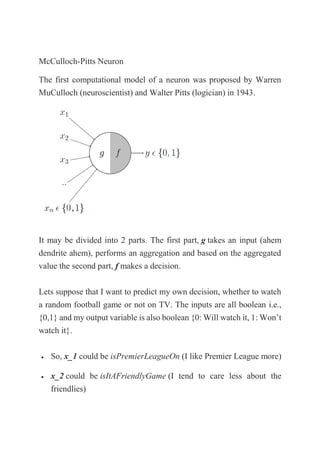
It may be divided into 2 parts. The first part, g takes an input (ahem
dendrite ahem), performs an aggregation and based on the aggregated
value the second part, f makes a decision.
Lets suppose that I want to predict my own decision, whether to watch
a random football game or not on TV. The inputs are all boolean i.e.,
{0,1} and my output variable is also boolean {0: Will watch it, 1: Won’t
watch it}.
 So, x_1 could be isPremierLeagueOn (I like Premier League more)
 x_2 could be isItAFriendlyGame (I tend to care less about the
friendlies)
 x_3 could be isNotHome (Can’t watch it when I’m running errands.
Can I?)
 x_4 could be isManUnitedPlaying (I am a big Man United fan.
GGMU!) and so on.
These inputs can either be excitatory or inhibitory. Inhibitory inputs are
those that have maximum effect on the decision making irrespective of
other inputs i.e., if x_3 is 1 (not home) then my output will always be 0
i.e., the neuron will never fire, so x_3 is an inhibitory input. Excitatory
inputs are NOT the ones that will make the neuron fire on their own but
they might fire it when combined together. Formally, this is what is
going on:
We can see that g(x) is just doing a sum of the inputs — a simple
aggregation. And theta here is called thresholding parameter. For
example, if I always watch the game when the sum turns out to be 2 or
more, the theta is 2 here. This is called the Thresholding Logic.
Boolean Functions Using M-P Neuron
So far we have seen how the M-P neuron works. Now lets look at how
this very neuron can be used to represent a few boolean functions. Mind
you that our inputs are all boolean and the output is also boolean so
essentially, the neuron is just trying to learn a boolean function. A lot of
boolean decision problems can be cast into this, based on appropriate
input variables— like whether to continue reading this post, whether to
watch Friends after reading this post etc. can be represented by the M-
P neuron.
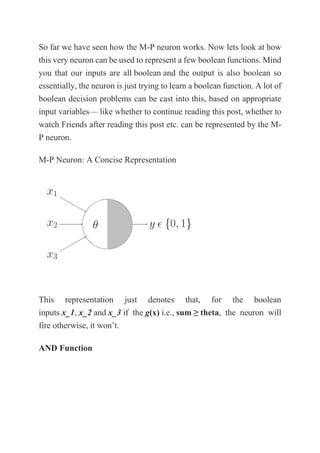
M-P Neuron: A Concise Representation
This representation just denotes that, for the boolean
inputs x_1, x_2 and x_3 if the g(x) i.e., sum ≥ theta, the neuron will
fire otherwise, it won’t.
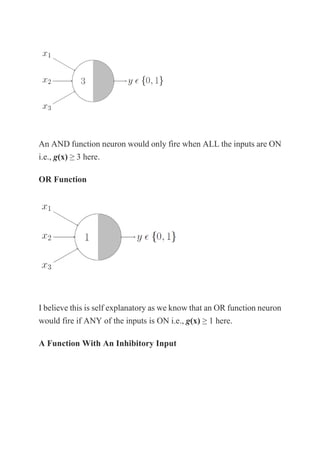
AND Function
An AND function neuron would only fire when ALL the inputs are ON
i.e., g(x) ≥ 3 here.
OR Function
I believe this is self explanatory as we know that an OR function neuron
would fire if ANY of the inputs is ON i.e., g(x) ≥ 1 here.
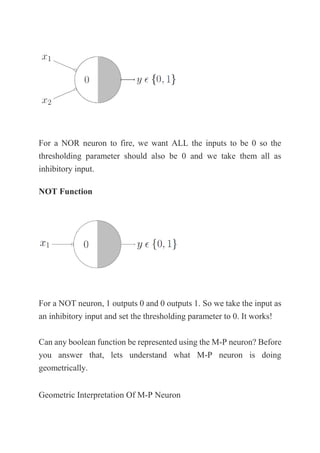
A Function With An Inhibitory Input
Now this might look like a tricky one but it’s really not. Here, we have
an inhibitory input i.e., x_2 so whenever x_2 is 1, the output will be 0.
Keeping that in mind, we know that x_1 AND !x_2 would output 1 only
when x_1 is 1 and x_2 is 0 so it is obvious that the threshold parameter
should be 1.
Lets verify that, the g(x) i.e., x_1 + x_2 would be ≥ 1 in only 3 cases:
Case 1: when x_1 is 1 and x_2 is 0
Case 2: when x_1 is 1 and x_2 is 1
Case 3: when x_1 is 0 and x_2 is 1
But in both Case 2 and Case 3, we know that the output will be 0
because x_2 is 1 in both of them, thanks to the inhibition. And we also
know that x_1 AND !x_2 would output 1 for Case 1 (above) so our
thresholding parameter holds good for the given function.
NOR Function
For a NOR neuron to fire, we want ALL the inputs to be 0 so the
thresholding parameter should also be 0 and we take them all as
inhibitory input.
NOT Function
For a NOT neuron, 1 outputs 0 and 0 outputs 1. So we take the input as
an inhibitory input and set the thresholding parameter to 0. It works!
Can any boolean function be represented using the M-P neuron? Before
you answer that, lets understand what M-P neuron is doing
geometrically.
Geometric Interpretation Of M-P Neuron
This is the best part of the post according to me. Lets start with the OR
function.
OR Function
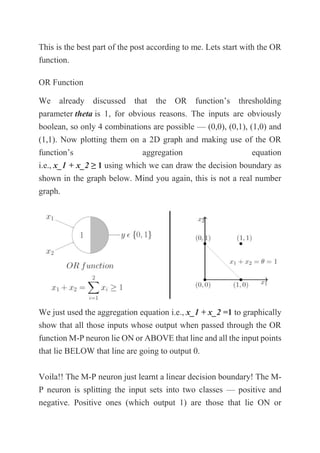
We already discussed that the OR function’s thresholding
parameter theta is 1, for obvious reasons. The inputs are obviously
boolean, so only 4 combinations are possible — (0,0), (0,1), (1,0) and
(1,1). Now plotting them on a 2D graph and making use of the OR
function’s aggregation equation
i.e., x_1 + x_2 ≥ 1 using which we can draw the decision boundary as
shown in the graph below. Mind you again, this is not a real number
graph.
We just used the aggregation equation i.e., x_1 + x_2 =1 to graphically
show that all those inputs whose output when passed through the OR
function M-P neuron lie ON or ABOVE that line and all the input points
that lie BELOW that line are going to output 0.
Voila!! The M-P neuron just learnt a linear decision boundary! The M-
P neuron is splitting the input sets into two classes — positive and
negative. Positive ones (which output 1) are those that lie ON or
ABOVE the decision boundary and negative ones (which output 0) are
those that lie BELOW the decision boundary.
Lets convince ourselves that the M-P unit is doing the same for all the
boolean functions by looking at more examples (if it is not already clear
from the math).
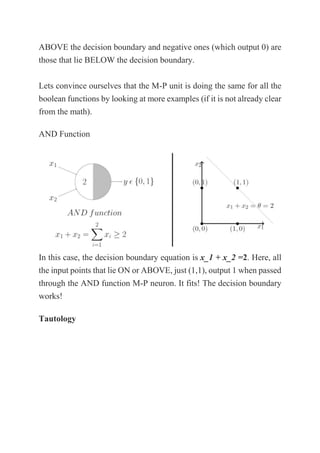
AND Function
In this case, the decision boundary equation is x_1 + x_2 =2. Here, all
the input points that lie ON or ABOVE, just (1,1), output 1 when passed
through the AND function M-P neuron. It fits! The decision boundary
works!
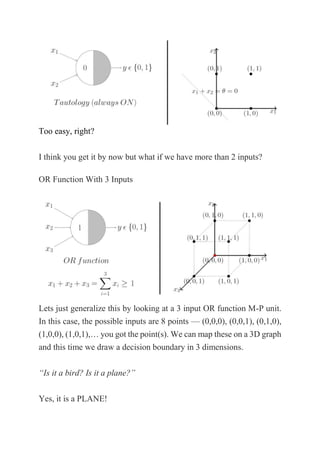
Tautology
Too easy, right?
I think you get it by now but what if we have more than 2 inputs?
OR Function With 3 Inputs
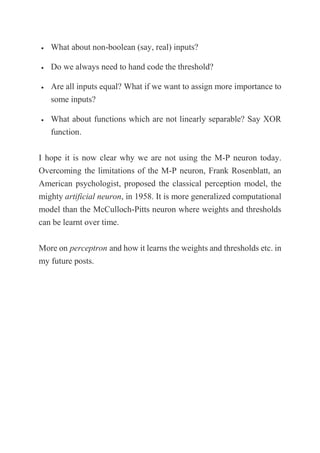
Lets just generalize this by looking at a 3 input OR function M-P unit.
In this case, the possible inputs are 8 points — (0,0,0), (0,0,1), (0,1,0),
(1,0,0), (1,0,1),… you got the point(s). We can map these on a 3D graph
and this time we draw a decision boundary in 3 dimensions.
“Is it a bird? Is it a plane?”
Yes, it is a PLANE!
The plane that satisfies the decision boundary equation x_1 + x_2 + x_3
= 1 is shown below:
Take your time and convince yourself by looking at the above plot that
all the points that lie ON or ABOVE that plane (positive half space) will
result in output 1 when passed through the OR function M-P unit and
all the points that lie BELOW that plane (negative half space) will result
in output 0.
Just by hand coding a thresholding parameter, M-P neuron is able to
conveniently represent the boolean functions which are linearly
separable.
Linear separability (for boolean functions): There exists a line (plane)
such that all inputs which produce a 1 lie on one side of the line (plane)
and all inputs which produce a 0 lie on other side of the line (plane).
Limitations Of M-P Neuron
 What about non-boolean (say, real) inputs?
 Do we always need to hand code the threshold?
 Are all inputs equal? What if we want to assign more importance to
some inputs?
 What about functions which are not linearly separable? Say XOR
function.
I hope it is now clear why we are not using the M-P neuron today.
Overcoming the limitations of the M-P neuron, Frank Rosenblatt, an
American psychologist, proposed the classical perception model, the
mighty artificial neuron, in 1958. It is more generalized computational
model than the McCulloch-Pitts neuron where weights and thresholds
can be learnt over time.
More on perceptron and how it learns the weights and thresholds etc. in
my future posts.

Mp neuron

  • 1.
    McCulloch-Pitts Neuron The firstcomputational model of a neuron was proposed by Warren MuCulloch (neuroscientist) and Walter Pitts (logician) in 1943. It may be divided into 2 parts. The first part, g takes an input (ahem dendrite ahem), performs an aggregation and based on the aggregated value the second part, f makes a decision. Lets suppose that I want to predict my own decision, whether to watch a random football game or not on TV. The inputs are all boolean i.e., {0,1} and my output variable is also boolean {0: Will watch it, 1: Won’t watch it}.  So, x_1 could be isPremierLeagueOn (I like Premier League more)  x_2 could be isItAFriendlyGame (I tend to care less about the friendlies)
  • 2.
     x_3 couldbe isNotHome (Can’t watch it when I’m running errands. Can I?)  x_4 could be isManUnitedPlaying (I am a big Man United fan. GGMU!) and so on. These inputs can either be excitatory or inhibitory. Inhibitory inputs are those that have maximum effect on the decision making irrespective of other inputs i.e., if x_3 is 1 (not home) then my output will always be 0 i.e., the neuron will never fire, so x_3 is an inhibitory input. Excitatory inputs are NOT the ones that will make the neuron fire on their own but they might fire it when combined together. Formally, this is what is going on: We can see that g(x) is just doing a sum of the inputs — a simple aggregation. And theta here is called thresholding parameter. For example, if I always watch the game when the sum turns out to be 2 or more, the theta is 2 here. This is called the Thresholding Logic. Boolean Functions Using M-P Neuron
  • 3.
    So far wehave seen how the M-P neuron works. Now lets look at how this very neuron can be used to represent a few boolean functions. Mind you that our inputs are all boolean and the output is also boolean so essentially, the neuron is just trying to learn a boolean function. A lot of boolean decision problems can be cast into this, based on appropriate input variables— like whether to continue reading this post, whether to watch Friends after reading this post etc. can be represented by the M- P neuron. M-P Neuron: A Concise Representation This representation just denotes that, for the boolean inputs x_1, x_2 and x_3 if the g(x) i.e., sum ≥ theta, the neuron will fire otherwise, it won’t. AND Function
  • 4.
    An AND functionneuron would only fire when ALL the inputs are ON i.e., g(x) ≥ 3 here. OR Function I believe this is self explanatory as we know that an OR function neuron would fire if ANY of the inputs is ON i.e., g(x) ≥ 1 here. A Function With An Inhibitory Input
  • 5.
    Now this mightlook like a tricky one but it’s really not. Here, we have an inhibitory input i.e., x_2 so whenever x_2 is 1, the output will be 0. Keeping that in mind, we know that x_1 AND !x_2 would output 1 only when x_1 is 1 and x_2 is 0 so it is obvious that the threshold parameter should be 1. Lets verify that, the g(x) i.e., x_1 + x_2 would be ≥ 1 in only 3 cases: Case 1: when x_1 is 1 and x_2 is 0 Case 2: when x_1 is 1 and x_2 is 1 Case 3: when x_1 is 0 and x_2 is 1 But in both Case 2 and Case 3, we know that the output will be 0 because x_2 is 1 in both of them, thanks to the inhibition. And we also know that x_1 AND !x_2 would output 1 for Case 1 (above) so our thresholding parameter holds good for the given function. NOR Function
  • 6.
    For a NORneuron to fire, we want ALL the inputs to be 0 so the thresholding parameter should also be 0 and we take them all as inhibitory input. NOT Function For a NOT neuron, 1 outputs 0 and 0 outputs 1. So we take the input as an inhibitory input and set the thresholding parameter to 0. It works! Can any boolean function be represented using the M-P neuron? Before you answer that, lets understand what M-P neuron is doing geometrically. Geometric Interpretation Of M-P Neuron
  • 7.
    This is thebest part of the post according to me. Lets start with the OR function. OR Function We already discussed that the OR function’s thresholding parameter theta is 1, for obvious reasons. The inputs are obviously boolean, so only 4 combinations are possible — (0,0), (0,1), (1,0) and (1,1). Now plotting them on a 2D graph and making use of the OR function’s aggregation equation i.e., x_1 + x_2 ≥ 1 using which we can draw the decision boundary as shown in the graph below. Mind you again, this is not a real number graph. We just used the aggregation equation i.e., x_1 + x_2 =1 to graphically show that all those inputs whose output when passed through the OR function M-P neuron lie ON or ABOVE that line and all the input points that lie BELOW that line are going to output 0. Voila!! The M-P neuron just learnt a linear decision boundary! The M- P neuron is splitting the input sets into two classes — positive and negative. Positive ones (which output 1) are those that lie ON or
  • 8.
    ABOVE the decisionboundary and negative ones (which output 0) are those that lie BELOW the decision boundary. Lets convince ourselves that the M-P unit is doing the same for all the boolean functions by looking at more examples (if it is not already clear from the math). AND Function In this case, the decision boundary equation is x_1 + x_2 =2. Here, all the input points that lie ON or ABOVE, just (1,1), output 1 when passed through the AND function M-P neuron. It fits! The decision boundary works! Tautology
  • 9.
    Too easy, right? Ithink you get it by now but what if we have more than 2 inputs? OR Function With 3 Inputs Lets just generalize this by looking at a 3 input OR function M-P unit. In this case, the possible inputs are 8 points — (0,0,0), (0,0,1), (0,1,0), (1,0,0), (1,0,1),… you got the point(s). We can map these on a 3D graph and this time we draw a decision boundary in 3 dimensions. “Is it a bird? Is it a plane?” Yes, it is a PLANE!
  • 10.
    The plane thatsatisfies the decision boundary equation x_1 + x_2 + x_3 = 1 is shown below: Take your time and convince yourself by looking at the above plot that all the points that lie ON or ABOVE that plane (positive half space) will result in output 1 when passed through the OR function M-P unit and all the points that lie BELOW that plane (negative half space) will result in output 0. Just by hand coding a thresholding parameter, M-P neuron is able to conveniently represent the boolean functions which are linearly separable. Linear separability (for boolean functions): There exists a line (plane) such that all inputs which produce a 1 lie on one side of the line (plane) and all inputs which produce a 0 lie on other side of the line (plane). Limitations Of M-P Neuron
  • 11.
     What aboutnon-boolean (say, real) inputs?  Do we always need to hand code the threshold?  Are all inputs equal? What if we want to assign more importance to some inputs?  What about functions which are not linearly separable? Say XOR function. I hope it is now clear why we are not using the M-P neuron today. Overcoming the limitations of the M-P neuron, Frank Rosenblatt, an American psychologist, proposed the classical perception model, the mighty artificial neuron, in 1958. It is more generalized computational model than the McCulloch-Pitts neuron where weights and thresholds can be learnt over time. More on perceptron and how it learns the weights and thresholds etc. in my future posts.