Skeleton process that includes a set of practices and predefined roles Main roles Scrum Master: Maintains the processes and works similar to Project Manager Product Owner: Represent the stakeholders Team: The DEVELOPERS.
 
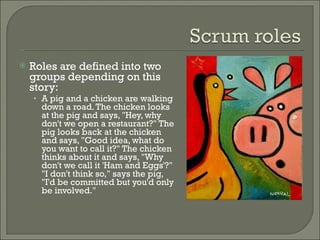
Roles are defined into two groups depending on this story: A pig and a chicken are walking down a road. The chicken looks at the pig and says, "Hey, why don't we open a restaurant?" The pig looks back at the chicken and says, "Good idea, what do you want to call it?" The chicken thinks about it and says, "Why don't we call it 'Ham and Eggs'?" "I don't think so," says the pig, "I'd be committed but you'd only be involved."
Pigs  are the ones committed to the project and the Scrum process Product Owner: Represents the voice of the customer Scrum Master: Primary job is to remove impediments to the ability of the team to deliver the sprint goal. Not leader of the team but enforcer of rules. Team: A small team of 5-9 people with cross-functional skills to do the actual work
Chicken roles are not part of the actual Scrum process, but must be taken into account. Users: The software is being built for someone! Stakeholders (Customers, Vendors): The people that will enable the project, but are only directly involved in the process at sprint reviews. Managers: People that will set up the environment for the product development organization.
Each day during the sprint, a project status meeting occurs. The meeting starts precisely on time. Often there are team-decided punishments for tardiness (e.g. money, push-ups, hanging a rubber chicken around your neck) All are welcome, but only "pigs" may speak The meeting is timeboxed at 15 minutes regardless of the team's size. All attendees should stand (it helps to keep meeting short) The meeting should happen at the same location and same time every day
What have you done since yesterday? What are you planning to do by tomorrow? Do you have any problems preventing you from accomplishing your goal?
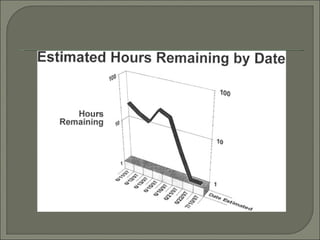
Product Backlog: Contains broad descriptions of all required features, wish-list items, etc. Spring Backlog: Detailed document containing information about  how  the team is going to implement the requirements for the upcoming sprint. Burn down chart: Graphical representation of work left to do vs. time.
 
Scrum is often viewed as an iterative, incremental process for developing any product or managing any work. Except Vantage team I manage my Chhobi.net team using Scrum too.
?

Mozammel Haque: Scrum

  • 1.
  • 2.
    Skeleton process thatincludes a set of practices and predefined roles Main roles Scrum Master: Maintains the processes and works similar to Project Manager Product Owner: Represent the stakeholders Team: The DEVELOPERS.
  • 3.
  • 4.
    Roles are definedinto two groups depending on this story: A pig and a chicken are walking down a road. The chicken looks at the pig and says, "Hey, why don't we open a restaurant?" The pig looks back at the chicken and says, "Good idea, what do you want to call it?" The chicken thinks about it and says, "Why don't we call it 'Ham and Eggs'?" "I don't think so," says the pig, "I'd be committed but you'd only be involved."
  • 5.
    Pigs arethe ones committed to the project and the Scrum process Product Owner: Represents the voice of the customer Scrum Master: Primary job is to remove impediments to the ability of the team to deliver the sprint goal. Not leader of the team but enforcer of rules. Team: A small team of 5-9 people with cross-functional skills to do the actual work
  • 6.
    Chicken roles arenot part of the actual Scrum process, but must be taken into account. Users: The software is being built for someone! Stakeholders (Customers, Vendors): The people that will enable the project, but are only directly involved in the process at sprint reviews. Managers: People that will set up the environment for the product development organization.
  • 7.
    Each day duringthe sprint, a project status meeting occurs. The meeting starts precisely on time. Often there are team-decided punishments for tardiness (e.g. money, push-ups, hanging a rubber chicken around your neck) All are welcome, but only "pigs" may speak The meeting is timeboxed at 15 minutes regardless of the team's size. All attendees should stand (it helps to keep meeting short) The meeting should happen at the same location and same time every day
  • 8.
    What have youdone since yesterday? What are you planning to do by tomorrow? Do you have any problems preventing you from accomplishing your goal?
  • 9.
    Product Backlog: Containsbroad descriptions of all required features, wish-list items, etc. Spring Backlog: Detailed document containing information about how the team is going to implement the requirements for the upcoming sprint. Burn down chart: Graphical representation of work left to do vs. time.
  • 10.
  • 11.
    Scrum is oftenviewed as an iterative, incremental process for developing any product or managing any work. Except Vantage team I manage my Chhobi.net team using Scrum too.
  • 12.