Moving from

Programs of Study
to

Rigorous Programs of Study
in Oklahoma

NCPN Conference 2013
Innovation in Career Pathways
National Award
National Association of Career
Pathways Leadership
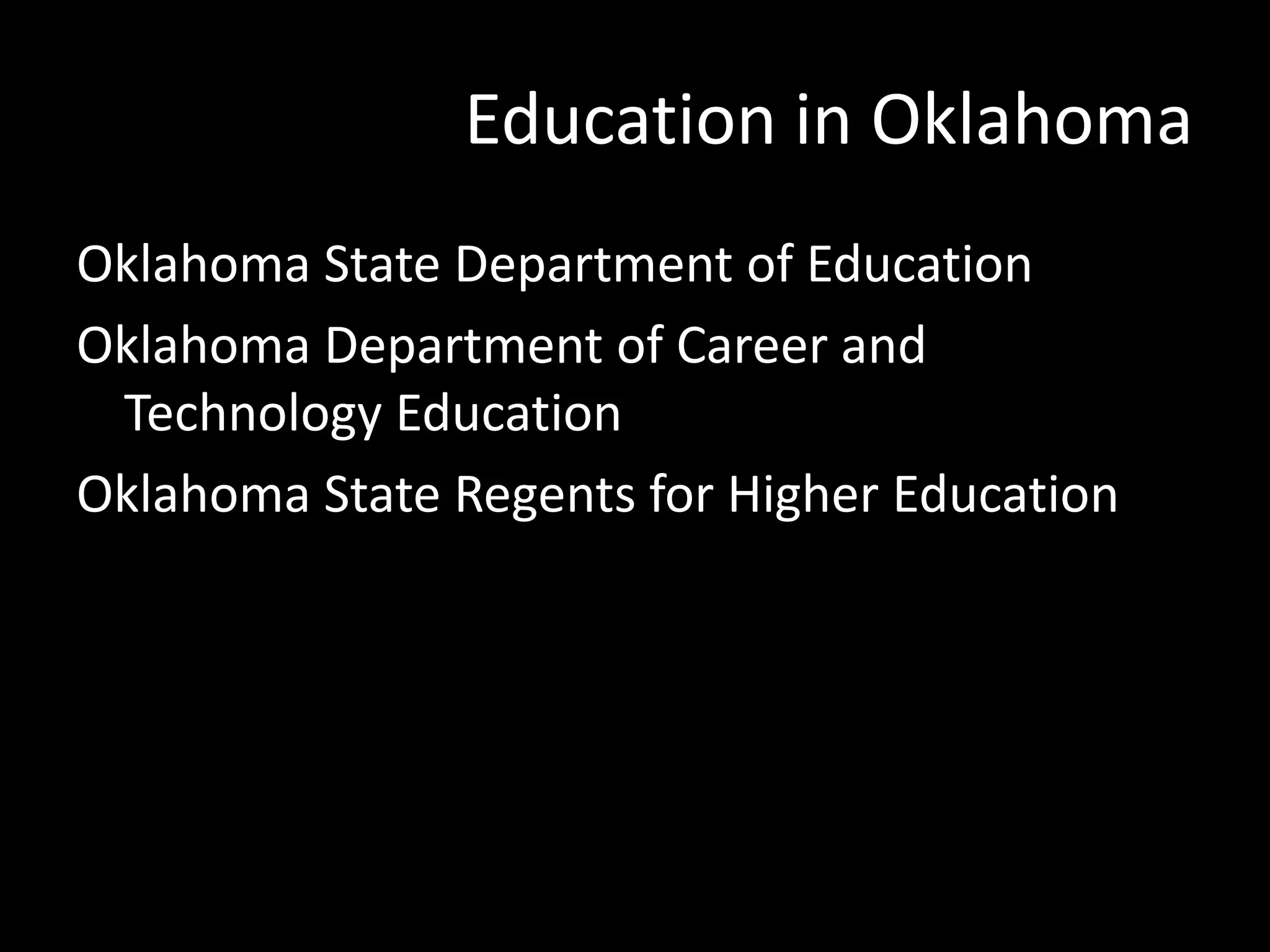
Education in Oklahoma
Oklahoma State Department of Education
Oklahoma Department of Career and
Technology Education
Oklahoma State Regents for Higher Education
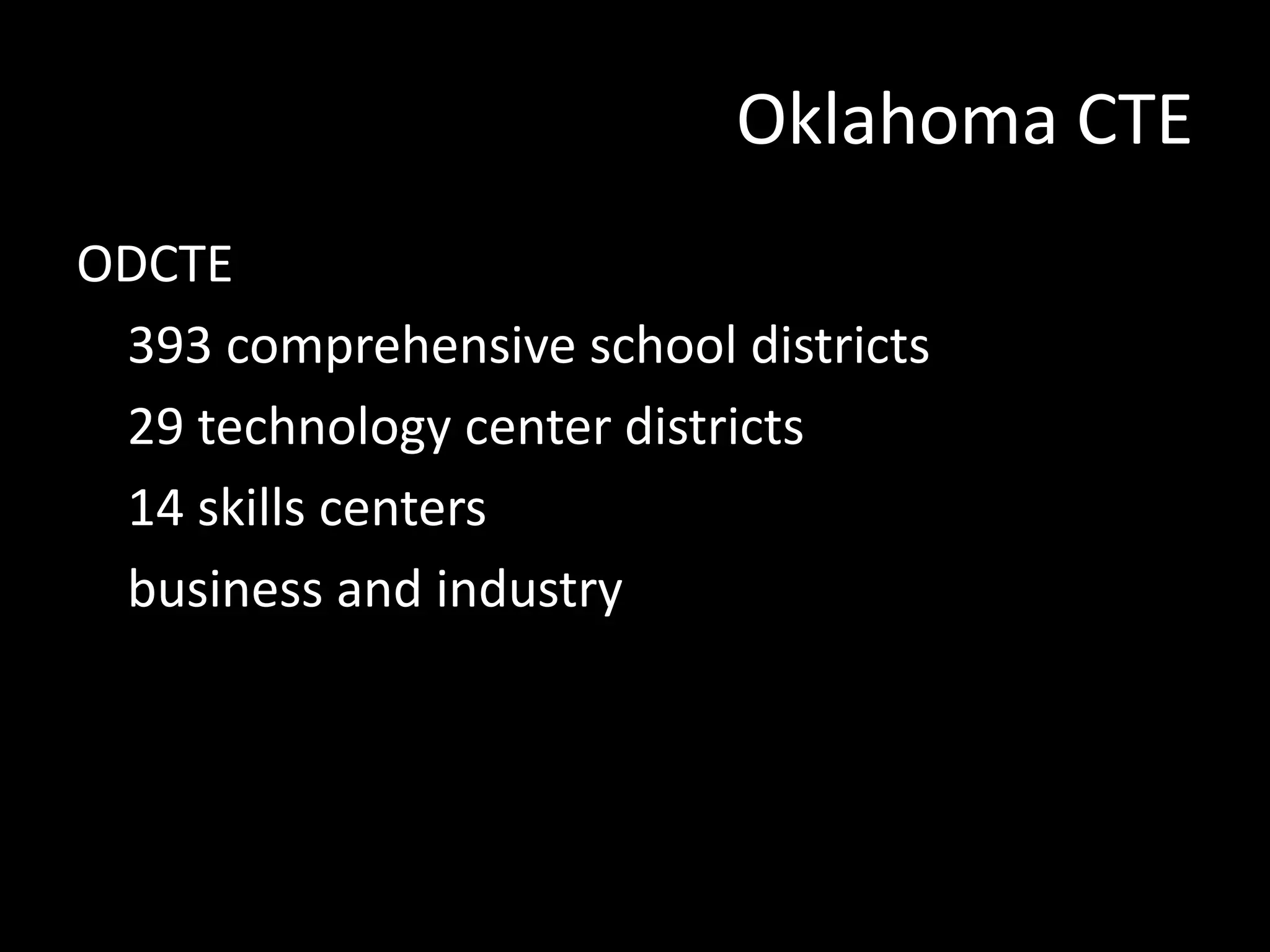
Oklahoma CTE
ODCTE
393 comprehensive school districts
29 technology center districts
14 skills centers
business and industry
Oklahoma CTE
135,372 comprehensive school enrollments
28,658 high school and adult technology center
enrollments
CTE Partners
18 colleges and universities (AAS degree
granting)
business and industry
Innovation in CTE
Tech Prep
Rigorous Programs of Study
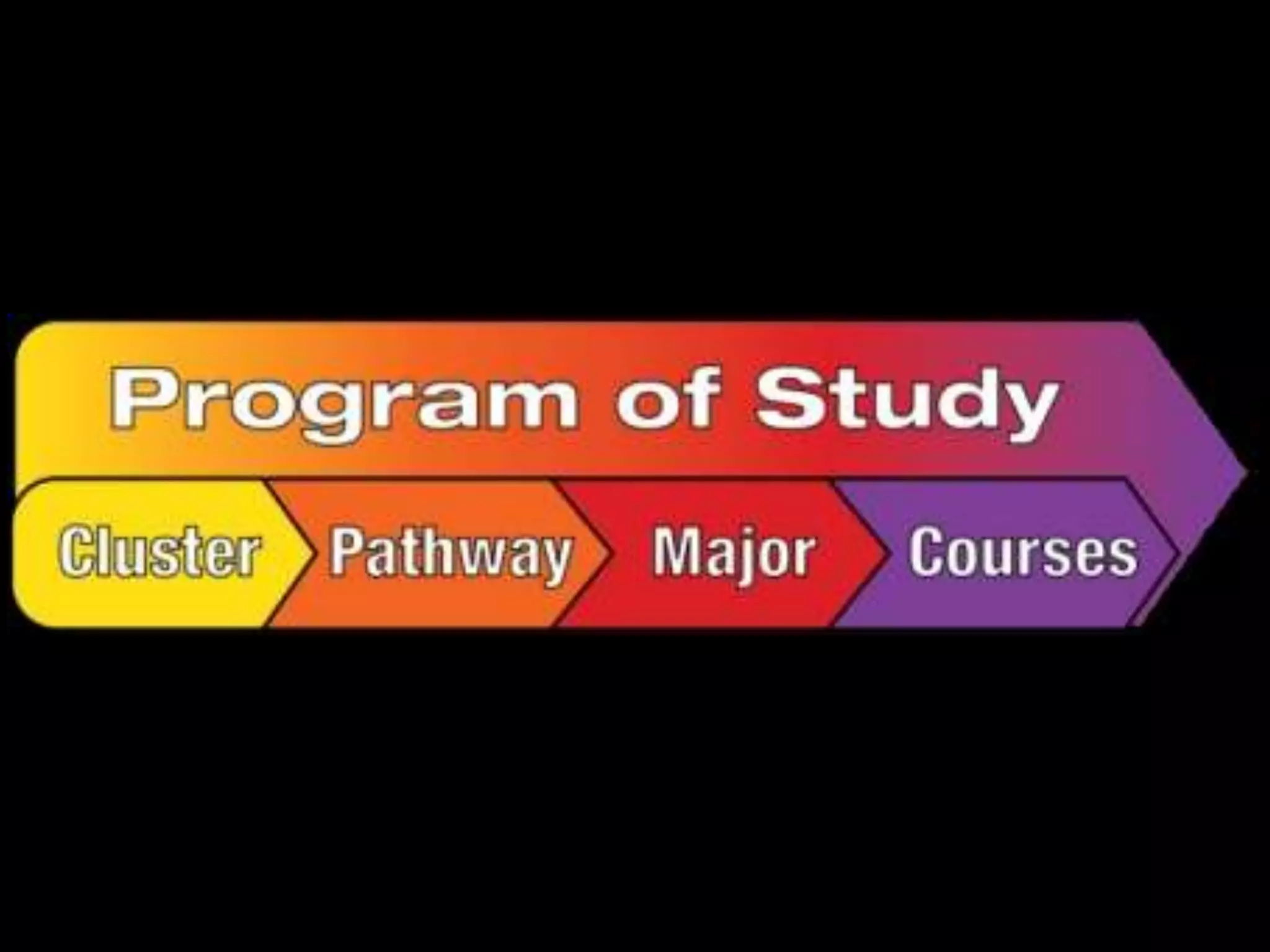
What is RPOS?
A Program of Study is a
comprehensive, structured
approach for delivering academic
and CTE to prepare students for
postsecondary education and
career success
Framing RPOS
Technology Centers That Work
High Schools That Work
Pathways to Prosperity
Reflect, Transform, Lead: A New Vision for
Career Technical Education
Carl D. Perkins Career and Technical Education
Act of 2006
Where are we?
Carl Perkins IV &
Programs of Study
Incorporate and align secondary
and postsecondary education
elements

http://www.flickr.com/photos/mgstyer/4661387399/
Include academic and CTE content
in a coordinated, non-duplicative
progression of courses
Offer the opportunity, where
appropriate, for secondary
students to acquire postsecondary
credits, and
Lead to an industry-recognized
credential or certificate at the
postsecondary level, or an
associate or baccalaureate degree
Where are we going?
Investing in America's
Future: A Blueprint for
Transforming Career
and Technical
Education
Effective ALIGNMENT between CTE and labor
market needs to equip students with 21stcentury skills and prepare them for in-demand
occupations in high-growth industry sectors
Strong COLLABORATION among secondary and
postsecondary institutions, employers, and
industry partners to improve the quality of
CTE programs
Meaningful ACCOUNTABILITY for improving
academic outcomes and building technical
and employability skills in CTE
programs, based upon common definitions
and clear metrics for performance
Increased emphasis on INNOVATION supported
by systemic reform of state policies and
practices to support CTE implementation of
effective practices at the local level.
Carl Perkins V &
Rigorous
Programs of Study
RPOS
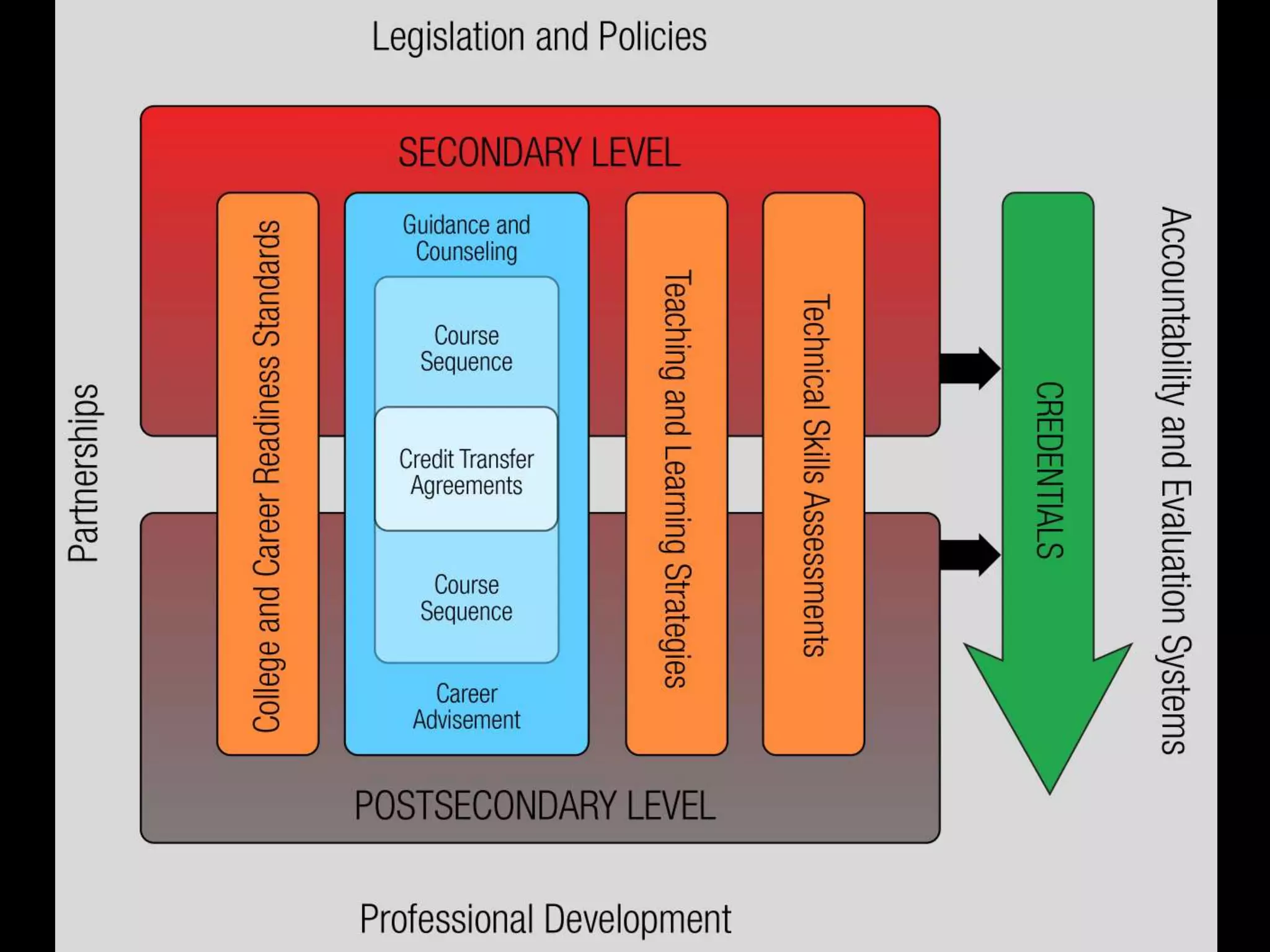
Decision Marking Framework
1 framework piece ≠ 10%
Doing a lot of things right!
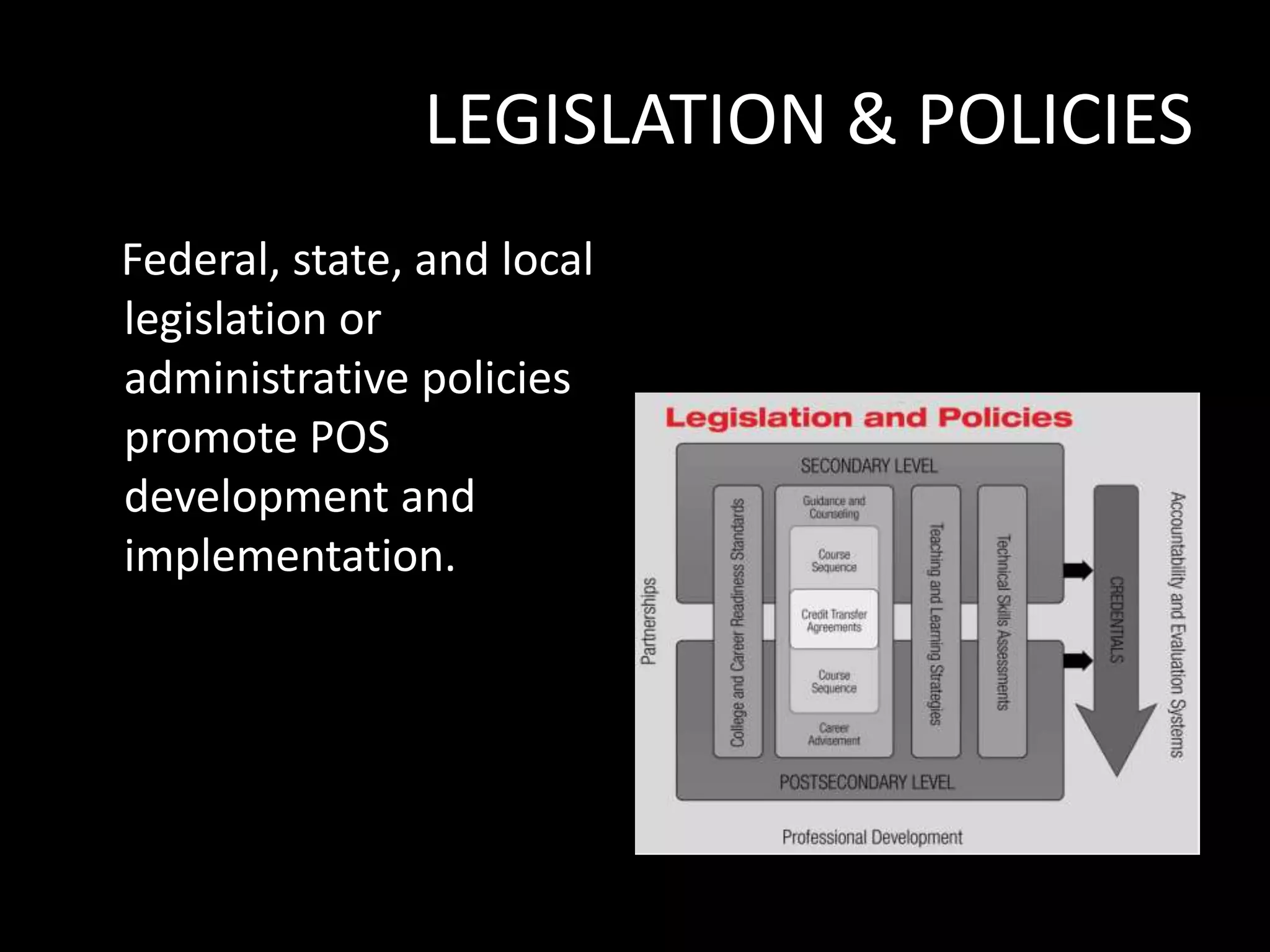
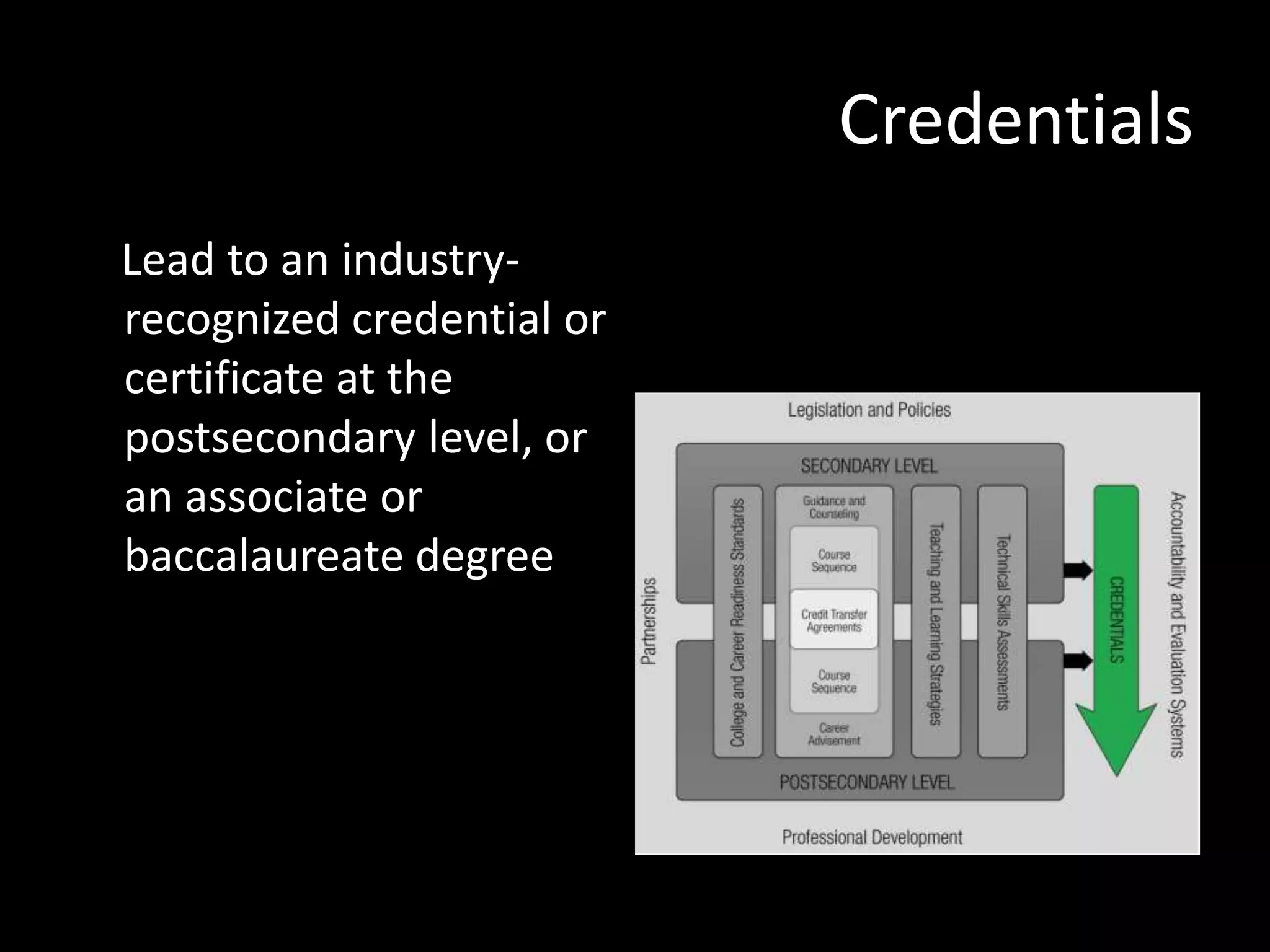
LEGISLATION & POLICIES
Federal, state, and local
legislation or
administrative policies
promote POS
development and
implementation.
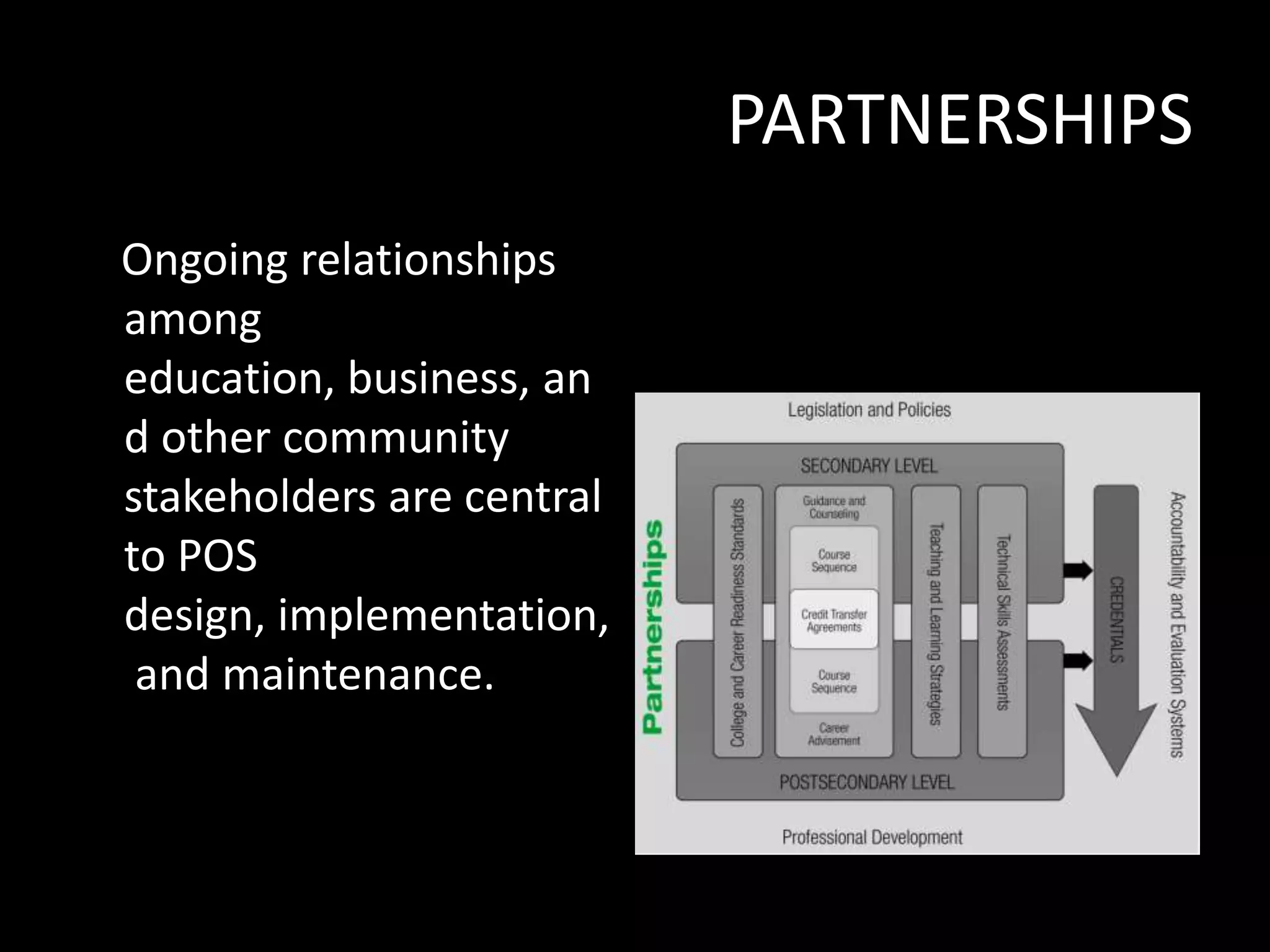
PARTNERSHIPS
Ongoing relationships
among
education, business, an
d other community
stakeholders are central
to POS
design, implementation,
and maintenance.
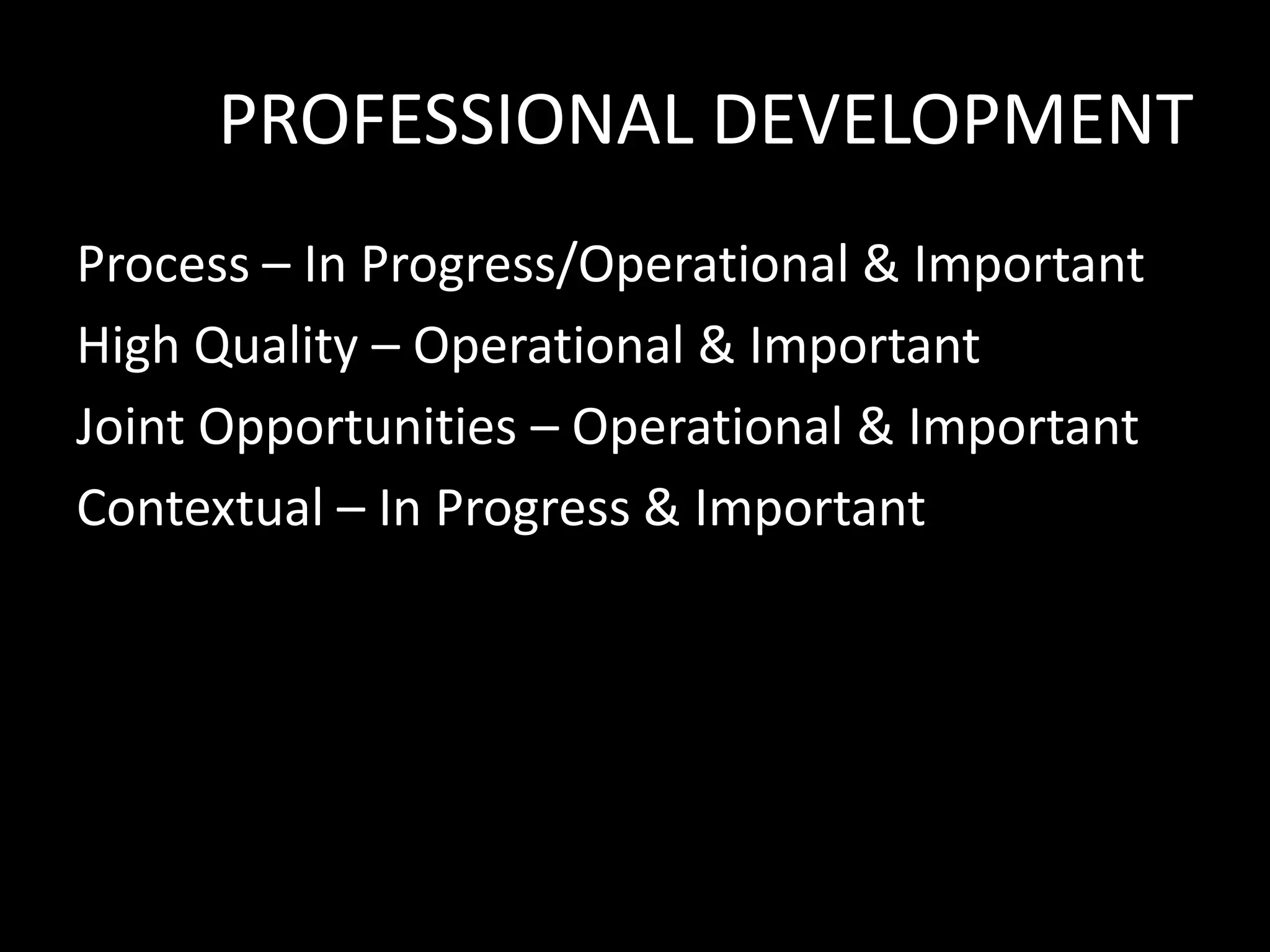
PROFESSIONAL DEVELOPMENT
Sustained, intensive, an
d focused opportunities
for
administrators, teachers
, and faculty foster POS
design, implementation,
and maintenance.
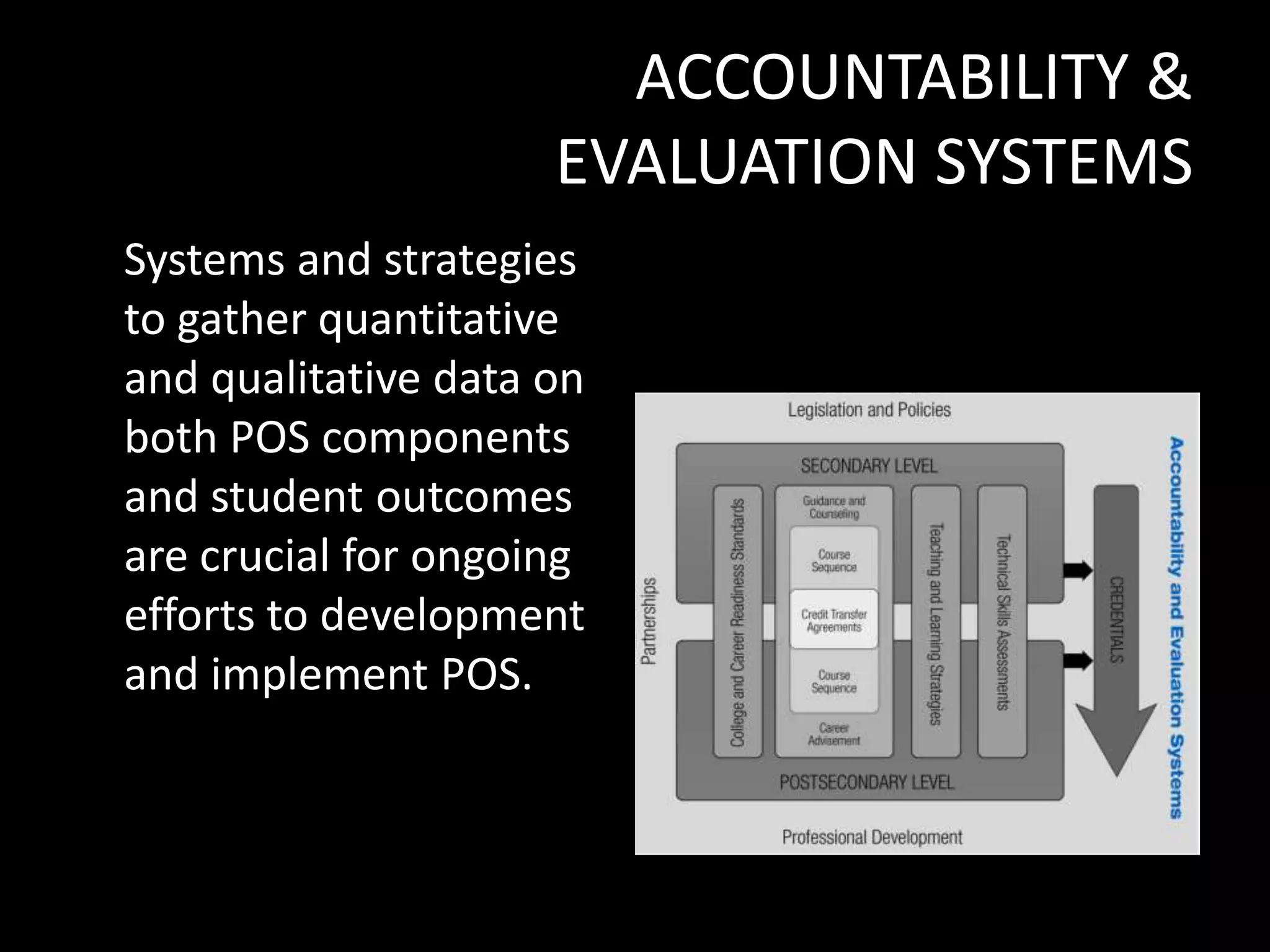
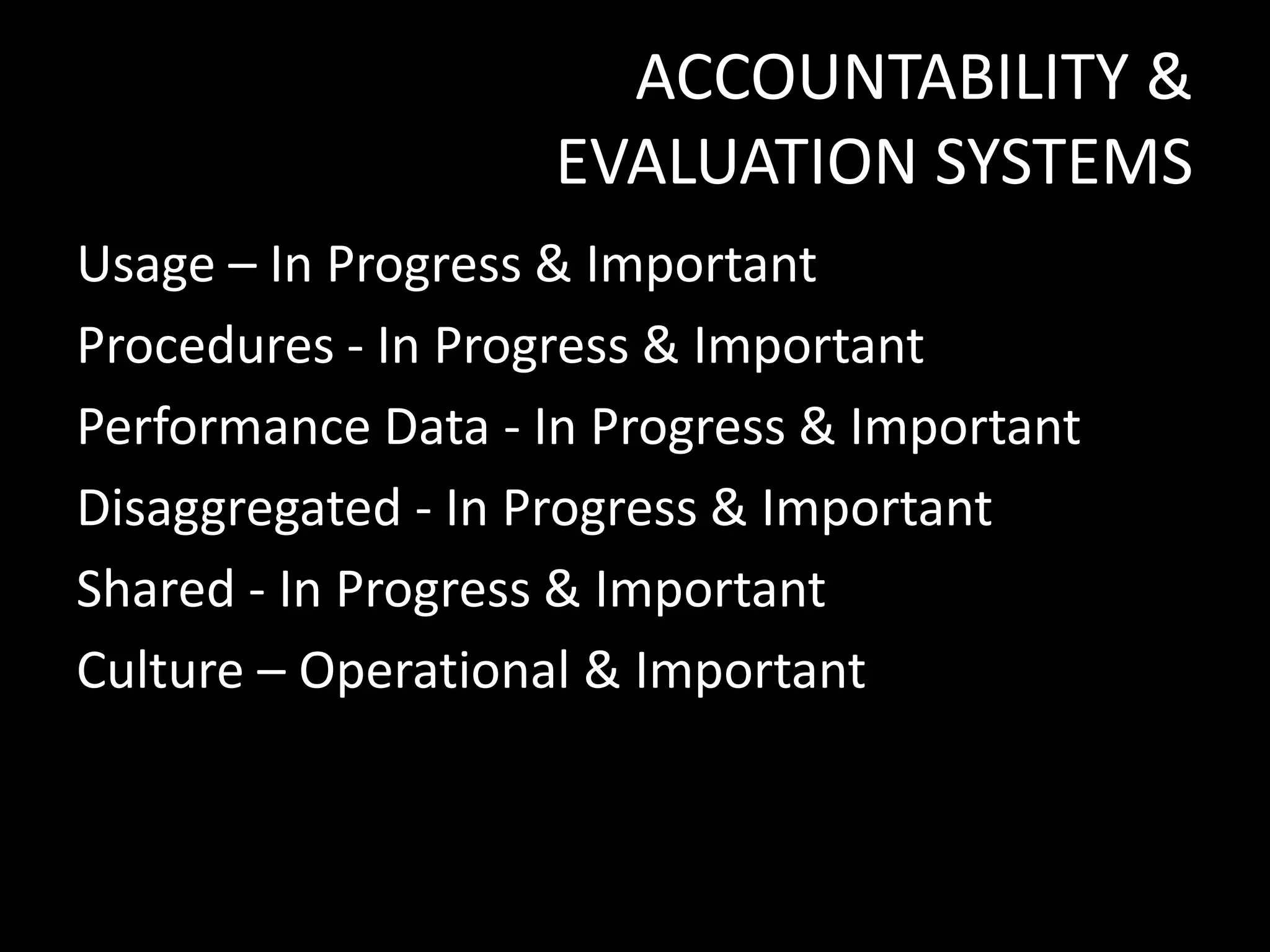
ACCOUNTABILITY &
EVALUATION SYSTEMS
Systems and strategies
to gather quantitative
and qualitative data on
both POS components
and student outcomes
are crucial for ongoing
efforts to development
and implement POS.
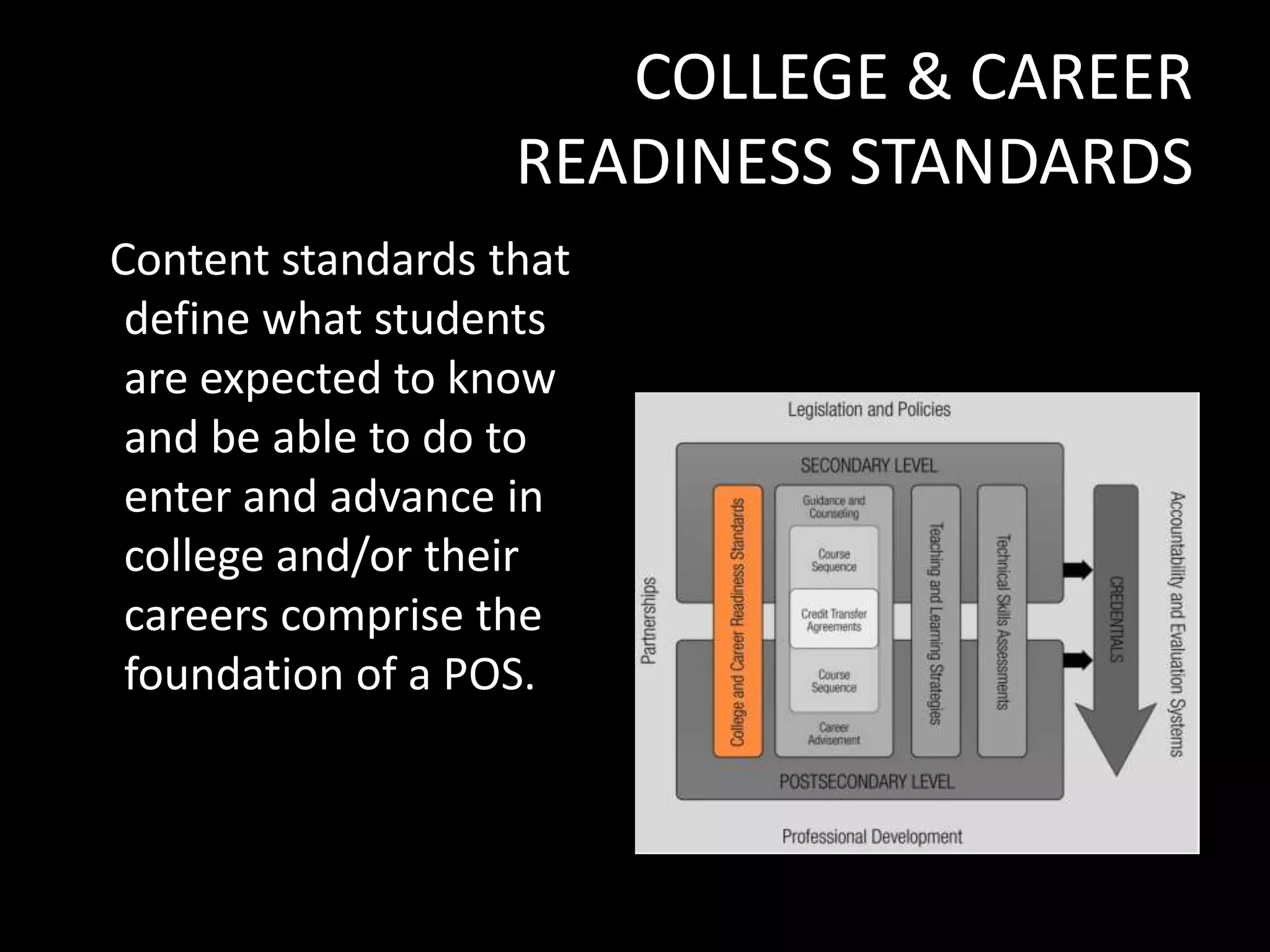
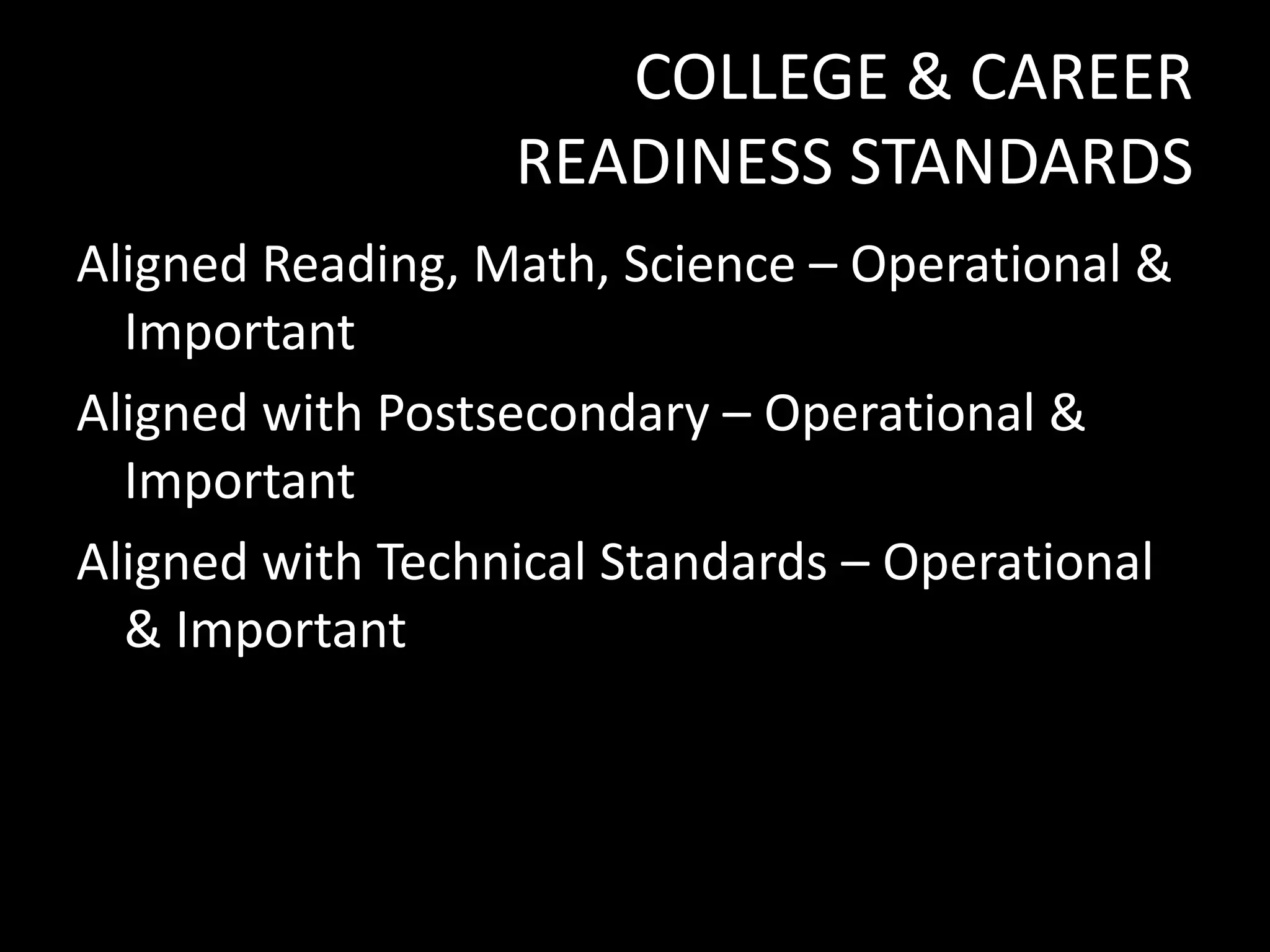
COLLEGE & CAREER
READINESS STANDARDS
Content standards that
define what students
are expected to know
and be able to do to
enter and advance in
college and/or their
careers comprise the
foundation of a POS.
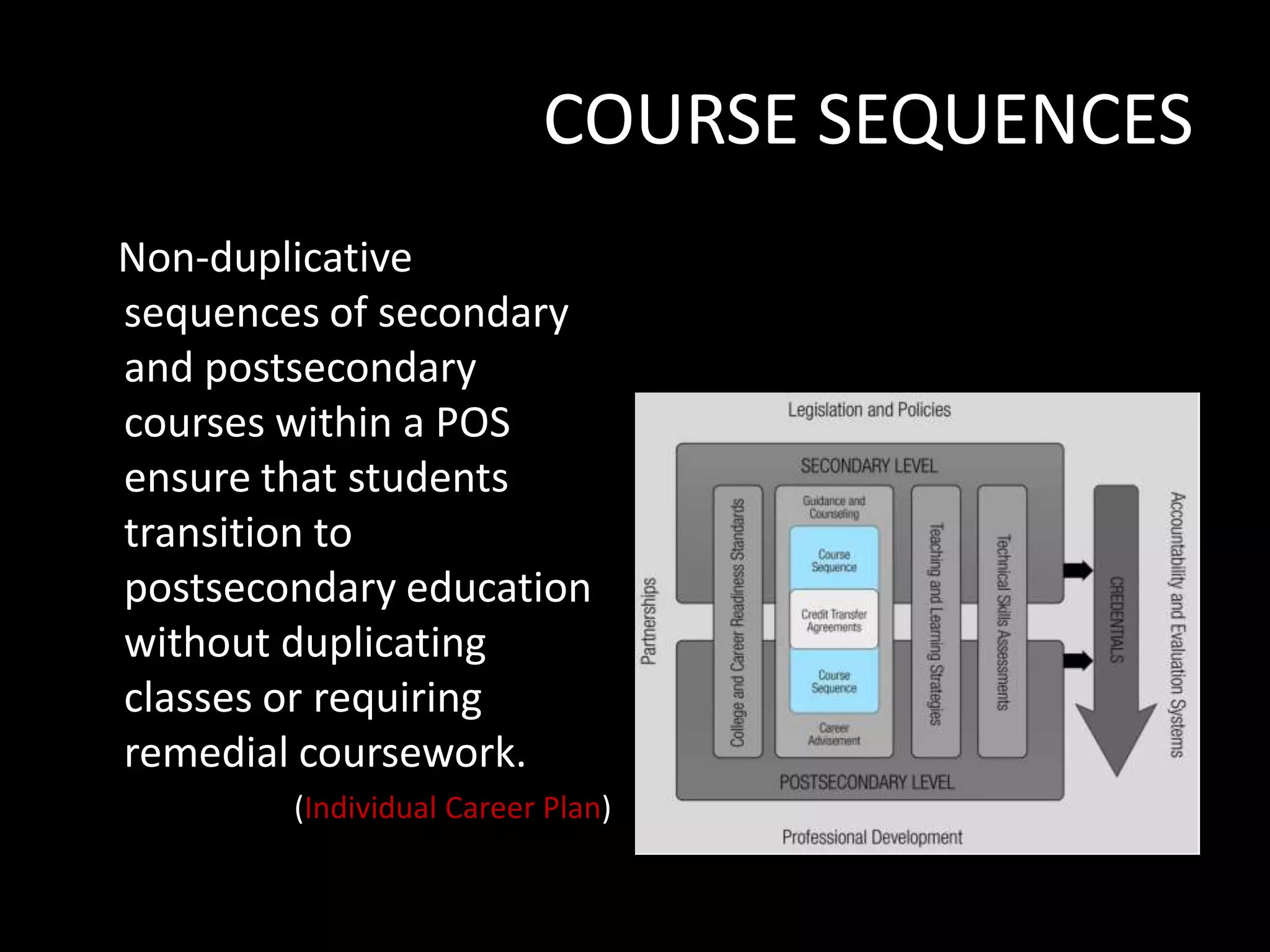
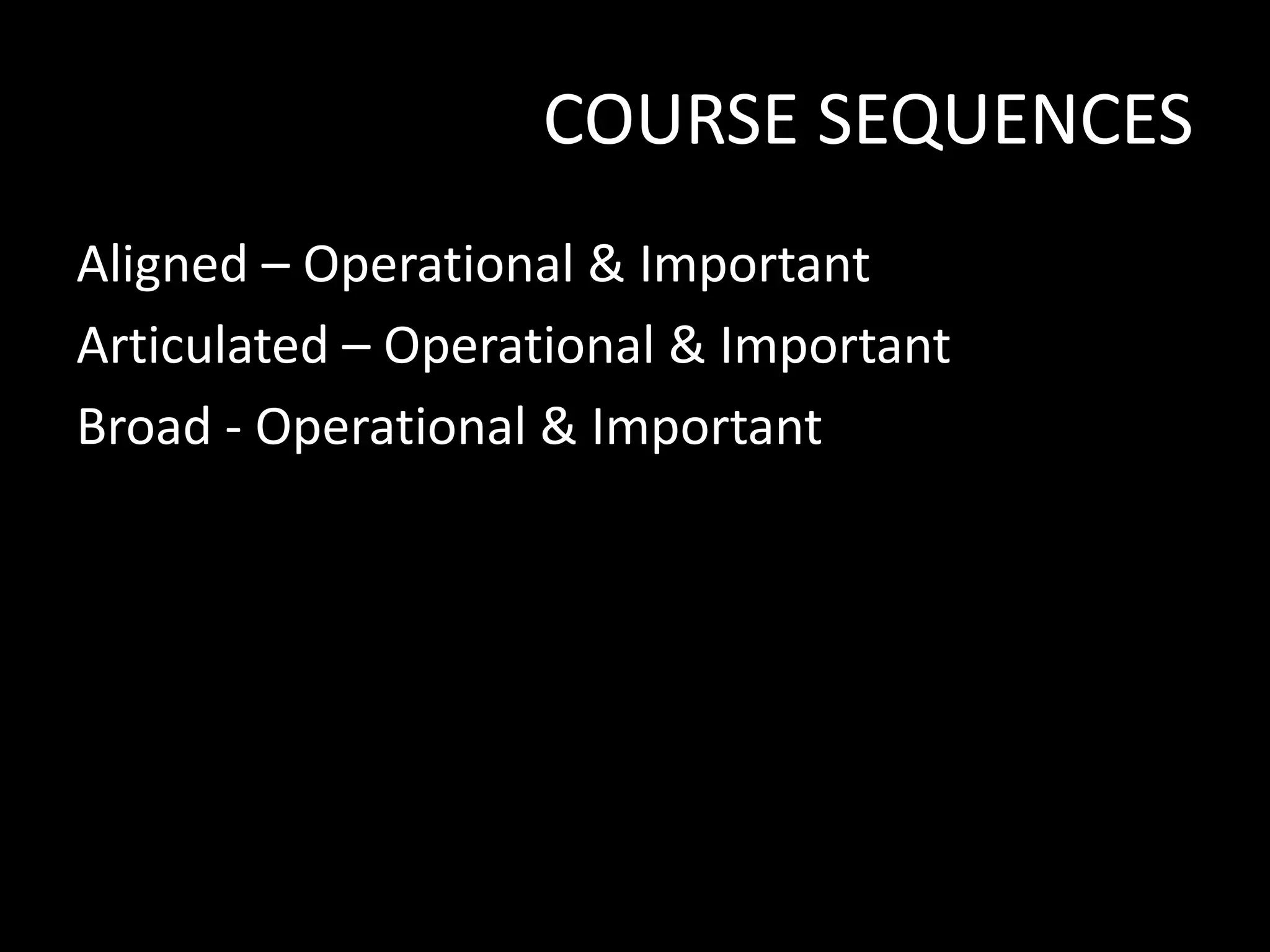
COURSE SEQUENCES
Non-duplicative
sequences of secondary
and postsecondary
courses within a POS
ensure that students
transition to
postsecondary education
without duplicating
classes or requiring
remedial coursework.
(Individual Career Plan)
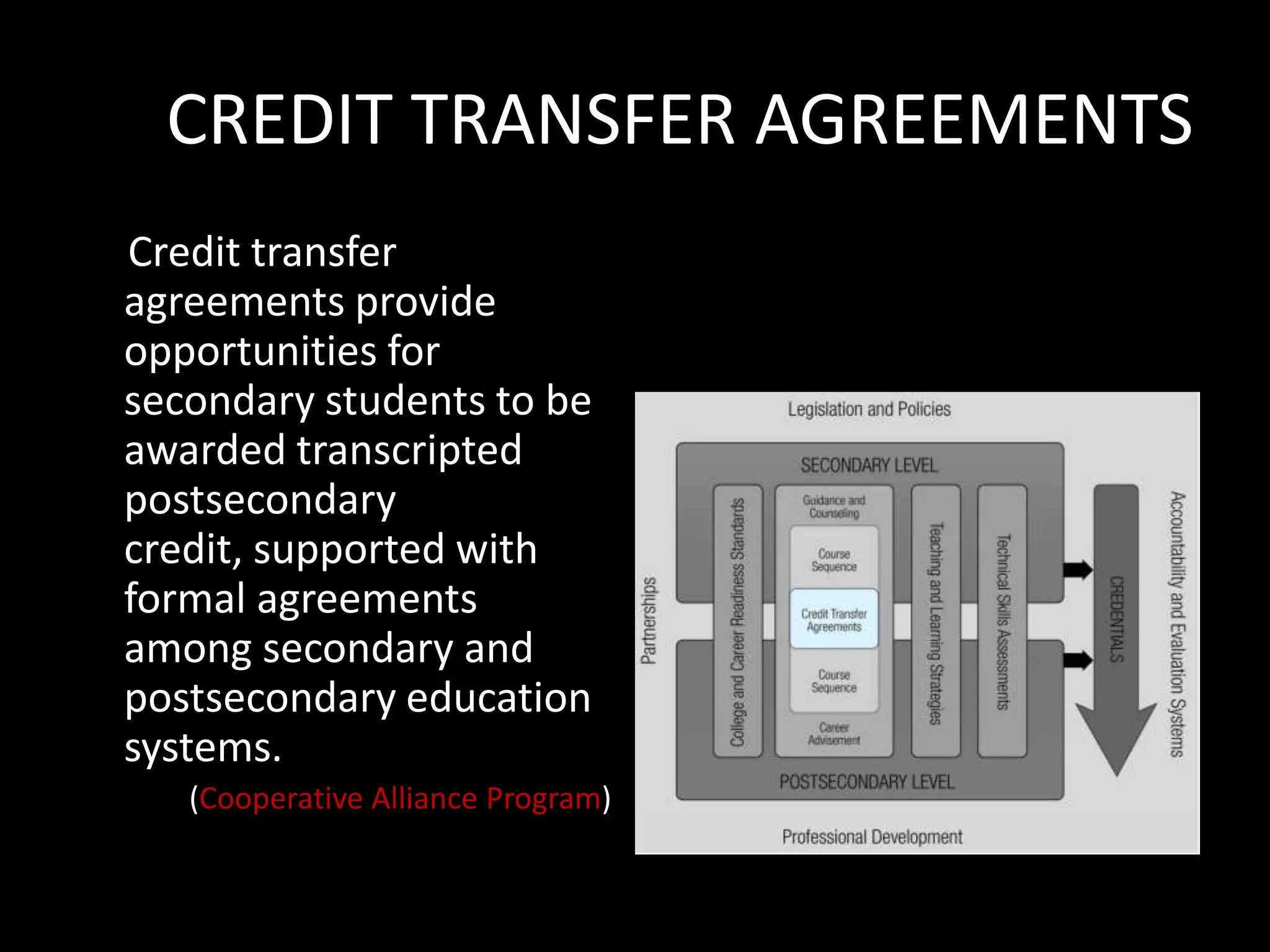
CREDIT TRANSFER AGREEMENTS
Credit transfer
agreements provide
opportunities for
secondary students to be
awarded transcripted
postsecondary
credit, supported with
formal agreements
among secondary and
postsecondary education
systems.
(Cooperative Alliance Program)
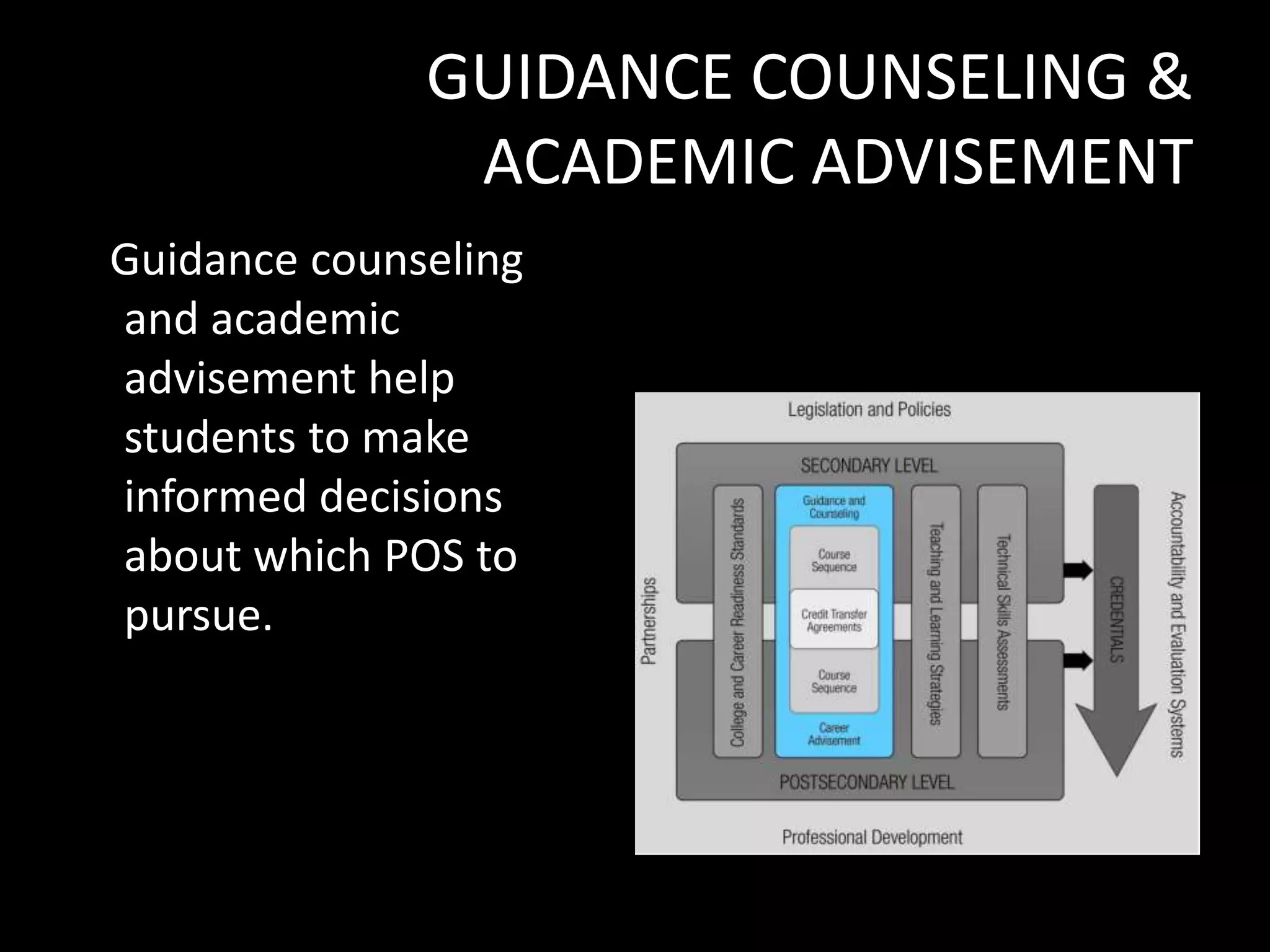
GUIDANCE COUNSELING &
ACADEMIC ADVISEMENT
Guidance counseling
and academic
advisement help
students to make
informed decisions
about which POS to
pursue.
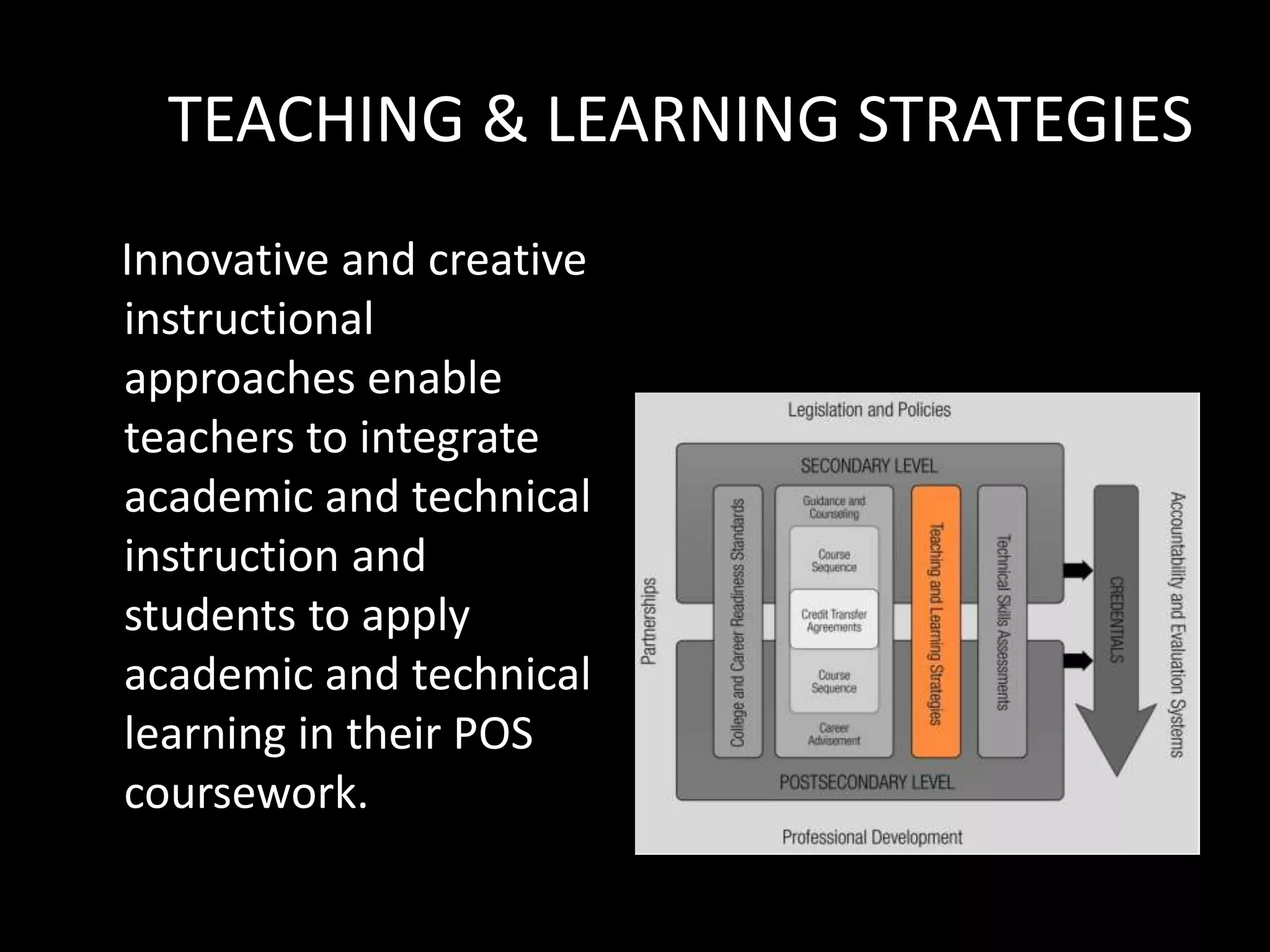
TEACHING & LEARNING STRATEGIES
Innovative and creative
instructional
approaches enable
teachers to integrate
academic and technical
instruction and
students to apply
academic and technical
learning in their POS
coursework.
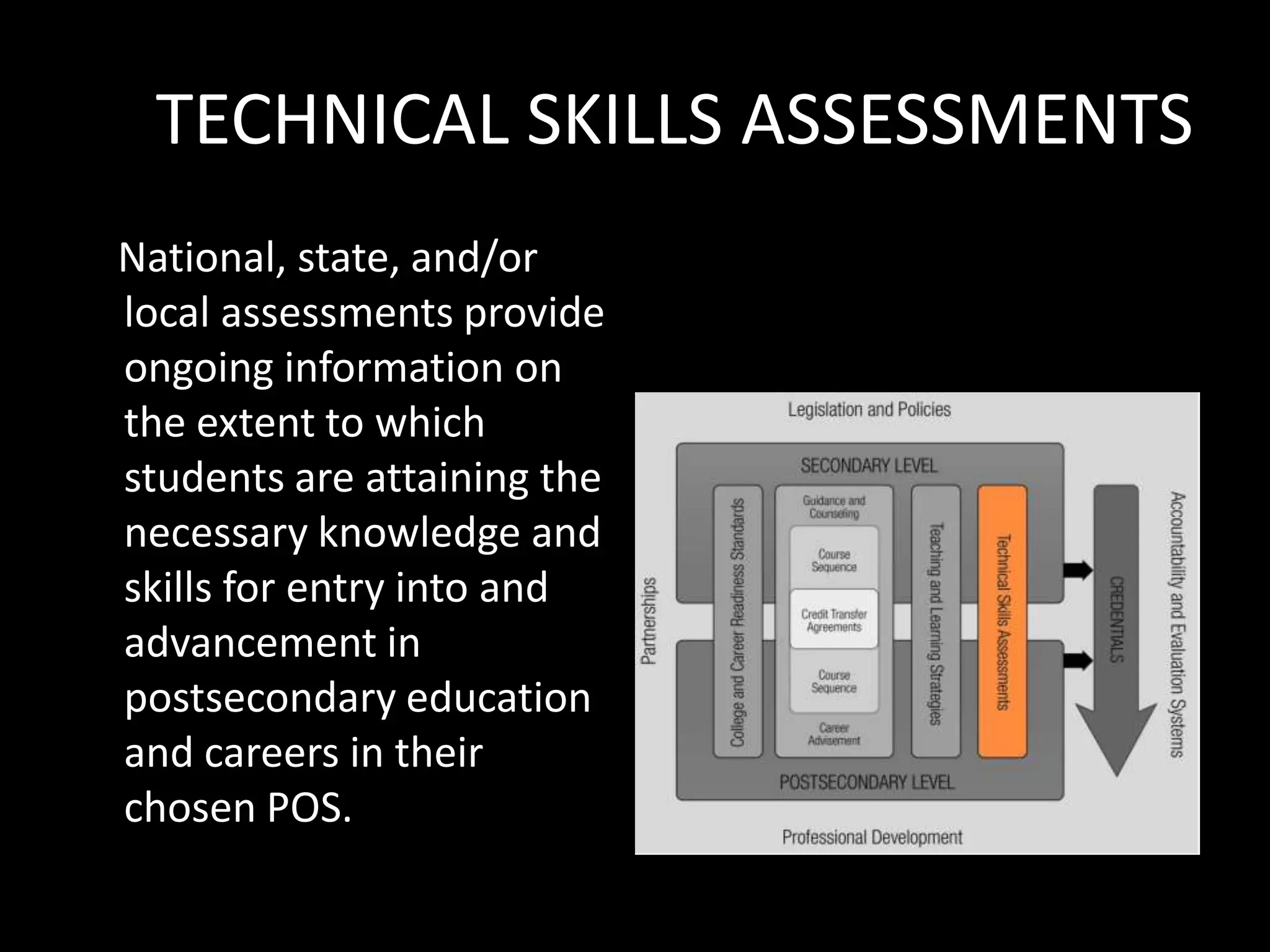
TECHNICAL SKILLS ASSESSMENTS
National, state, and/or
local assessments provide
ongoing information on
the extent to which
students are attaining the
necessary knowledge and
skills for entry into and
advancement in
postsecondary education
and careers in their
chosen POS.
Credentials
Lead to an industryrecognized credential or
certificate at the
postsecondary level, or
an associate or
baccalaureate degree
How we are getting there?
“Introduction Phase”
National
Programs of Study
Institute
Creating a Common Language
Analysis of Stakeholder
Interpretations of Programs of
Study in Oklahoma
Individual Career Plan
Oklahoma
Programs of Study
Institute
Caddo-Kiowa Technology Center
Choctaw High School
Claremore High School
Meridian Technology Center
Mid America Technology Center
Oklahoma State University Institute of Technology
Redlands Community College
Tulsa Community College
Tulsa Public Schools
The Project
Action plan for addressing one or more
implementation barriers
Oklahoma
Programs of Study
Summit
Caddo Kiowa Technology Center
Take a closer look at its Visual Design Program of
Study to be better able to align programs and
policies and make changes necessary to
integrate RPOS Study into Oklahoma’s Career
Pathways system, to align partner school
offerings and CareerTech programs with the
needs of business and industry and to begin
addressing the skills gap and contributing to
state and local economic growth and
development.
Choctaw High School
Enhance and improve all Career Academy
curricula including Program of Study
materials, partner participation, curriculum
presentation and resources/materials
availability.
Claremore High School
Enhance its Zebra Advisement Program. The
program enhances students’ awareness of
educational and career opportunities and helps
students make meaningful and informed choices
regarding their preparation for the future. The
programs uses consistent individualized guidance
and joint student/parent/teacher comprehensive
planning. In the last 14 years, ZAP has averaged a
95 percent participation rate of
parents/guardians at ZAP enrollment time.
Meridian Technology Center
Working to create awareness of the Oklahoma
A‐F Report Card, industry credentials and
postsecondary opportunities through the
Cooperative Alliance Program.
Mid America Technology Center
Mid‐America is working to improve
communication with its sending schools and
how it uses data across its campus. The
technology center will work to use existing
and emerging technology to enhance the
process by collecting accurate and timely data
relating to course work, assessments and
guidance/counseling plans.
OSUIT
OSUIT will work to evaluate college readiness in
Oklahoma’s Cooperative Alliance students. OSUIT
established college credit articulation agreements with
many of Oklahoma’s CareerTech centers in the 1980s.
Since then, these agreements have grown and
developed into the Cooperative Alliance agreements.
OSUIT has Cooperative Alliance agreements with more
than 50 technology center campuses. Approximately
10 percent to 15 percent of OSUIT students enter
college with Cooperative Alliance credit. Many
foundation courses for OSUIT’s degree programs are
offered at CareerTech centers through these
agreements.
Redlands Community College
Redlands will work to further enhance the child
development programs that it has developed
in partnership with Caddo Kiowa Technology
Center.
Tulsa Community College
TCC is working toward improving high school
transitions in manufacturing and aerospace.
The college is looking at the technical
components and aligning them with national
credentials.
Tulsa Public Schools
The project for Tulsa Public Schools consisted of
taking a look at professional development
through Teacher Leader Effectiveness.
Rigorous Programs of Study
Implementation Self-Study
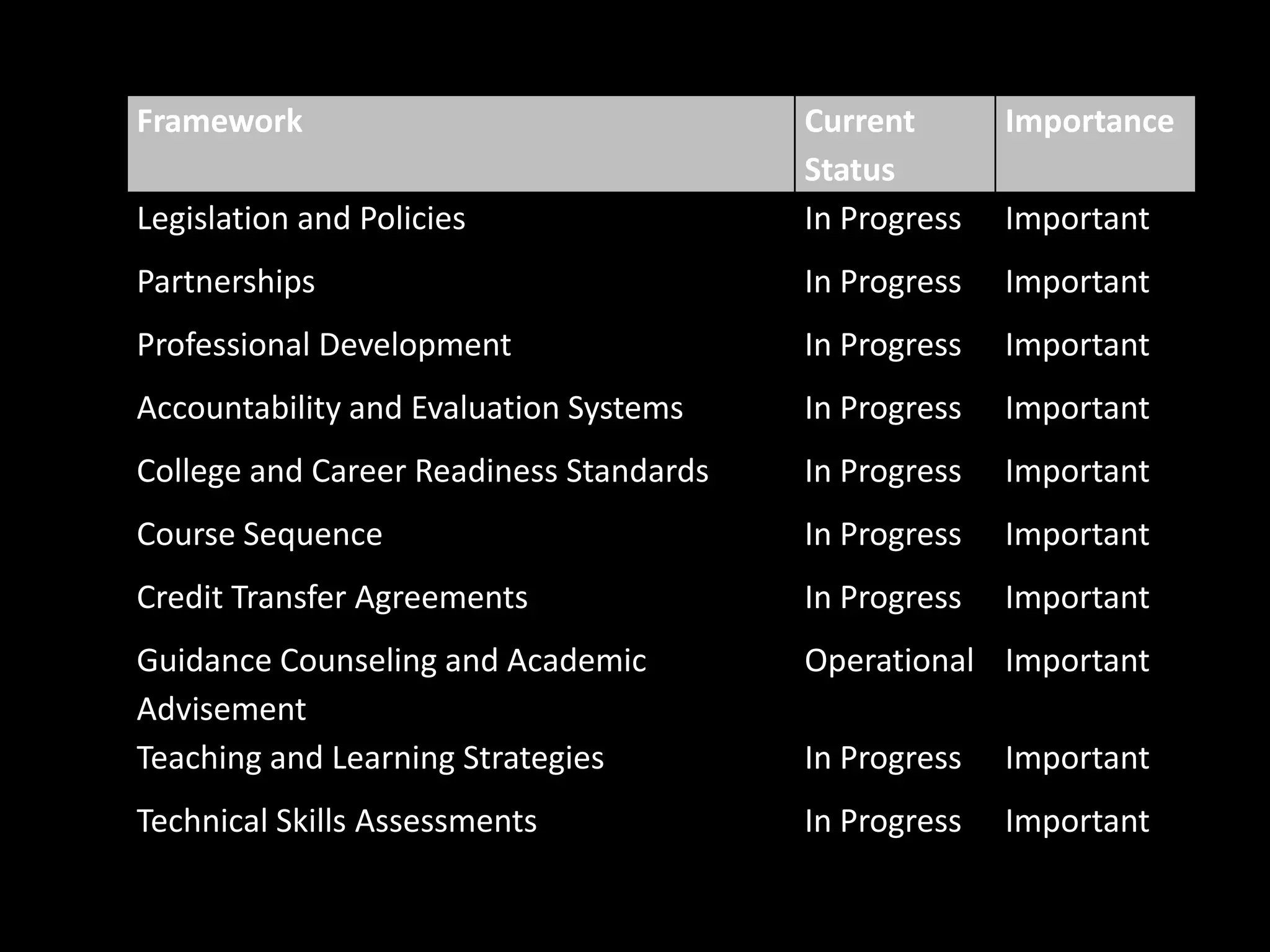
Framework

Importance

Legislation and Policies

Current
Status
In Progress

Partnerships

In Progress

Important

Professional Development

In Progress

Important

Accountability and Evaluation Systems

In Progress

Important

College and Career Readiness Standards

In Progress

Important

Course Sequence

In Progress

Important

Credit Transfer Agreements

In Progress

Important

Guidance Counseling and Academic
Advisement
Teaching and Learning Strategies

Operational Important
In Progress

Important

Technical Skills Assessments

In Progress

Important

Important
LEGISLATION & POLICIES
Resources – In Progress & Important
Access – Operational & Important
Advisory Committees – Operational & Important
Graduation Requirement – Operational &
Important
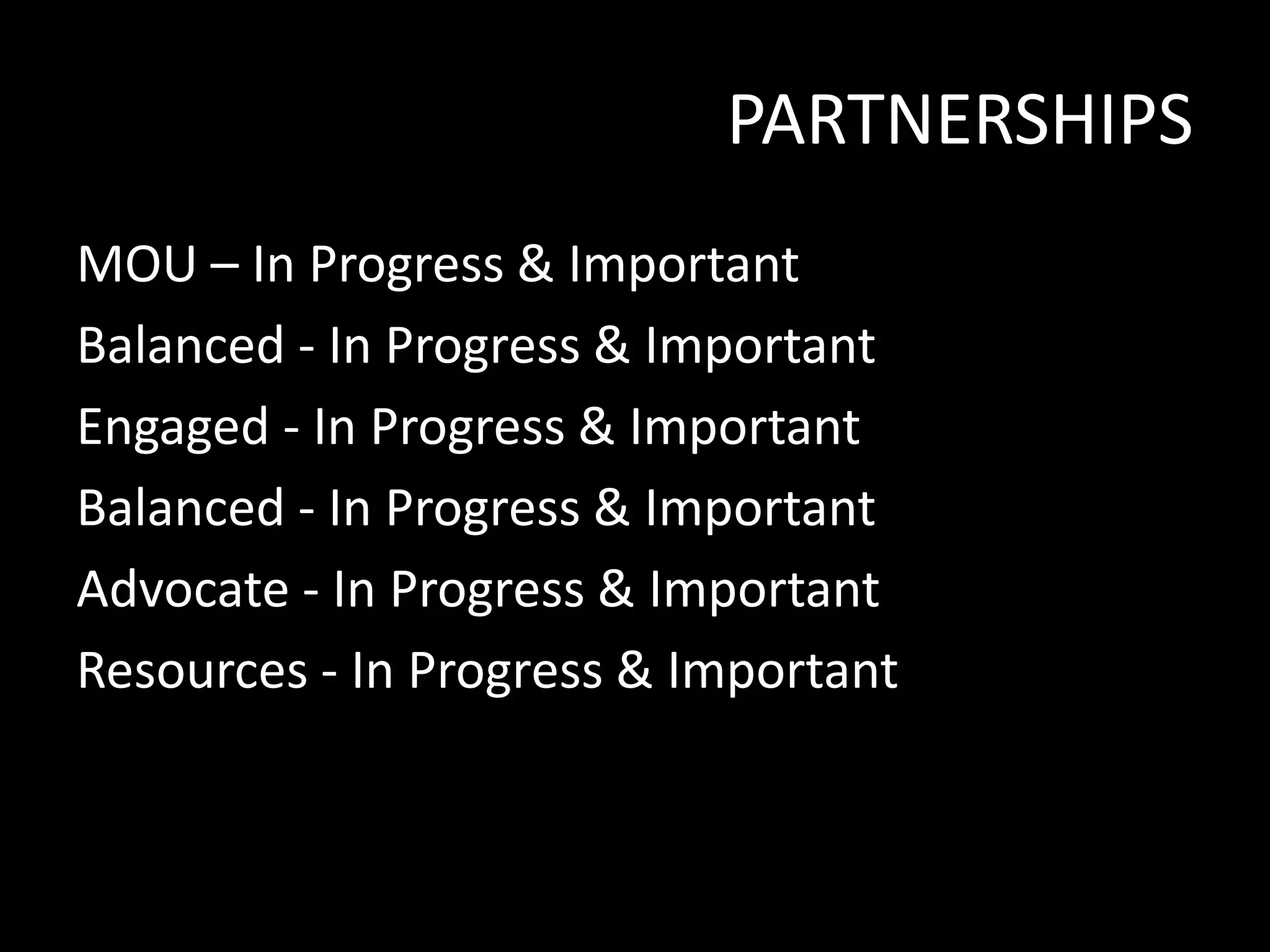
PARTNERSHIPS
MOU – In Progress & Important
Balanced - In Progress & Important
Engaged - In Progress & Important
Balanced - In Progress & Important
Advocate - In Progress & Important
Resources - In Progress & Important
PROFESSIONAL DEVELOPMENT
Process – In Progress/Operational & Important
High Quality – Operational & Important
Joint Opportunities – Operational & Important
Contextual – In Progress & Important
ACCOUNTABILITY &
EVALUATION SYSTEMS
Usage – In Progress & Important
Procedures - In Progress & Important
Performance Data - In Progress & Important
Disaggregated - In Progress & Important
Shared - In Progress & Important
Culture – Operational & Important
COLLEGE & CAREER
READINESS STANDARDS
Aligned Reading, Math, Science – Operational &
Important
Aligned with Postsecondary – Operational &
Important
Aligned with Technical Standards – Operational
& Important
COURSE SEQUENCES
Aligned – Operational & Important
Articulated – Operational & Important
Broad - Operational & Important
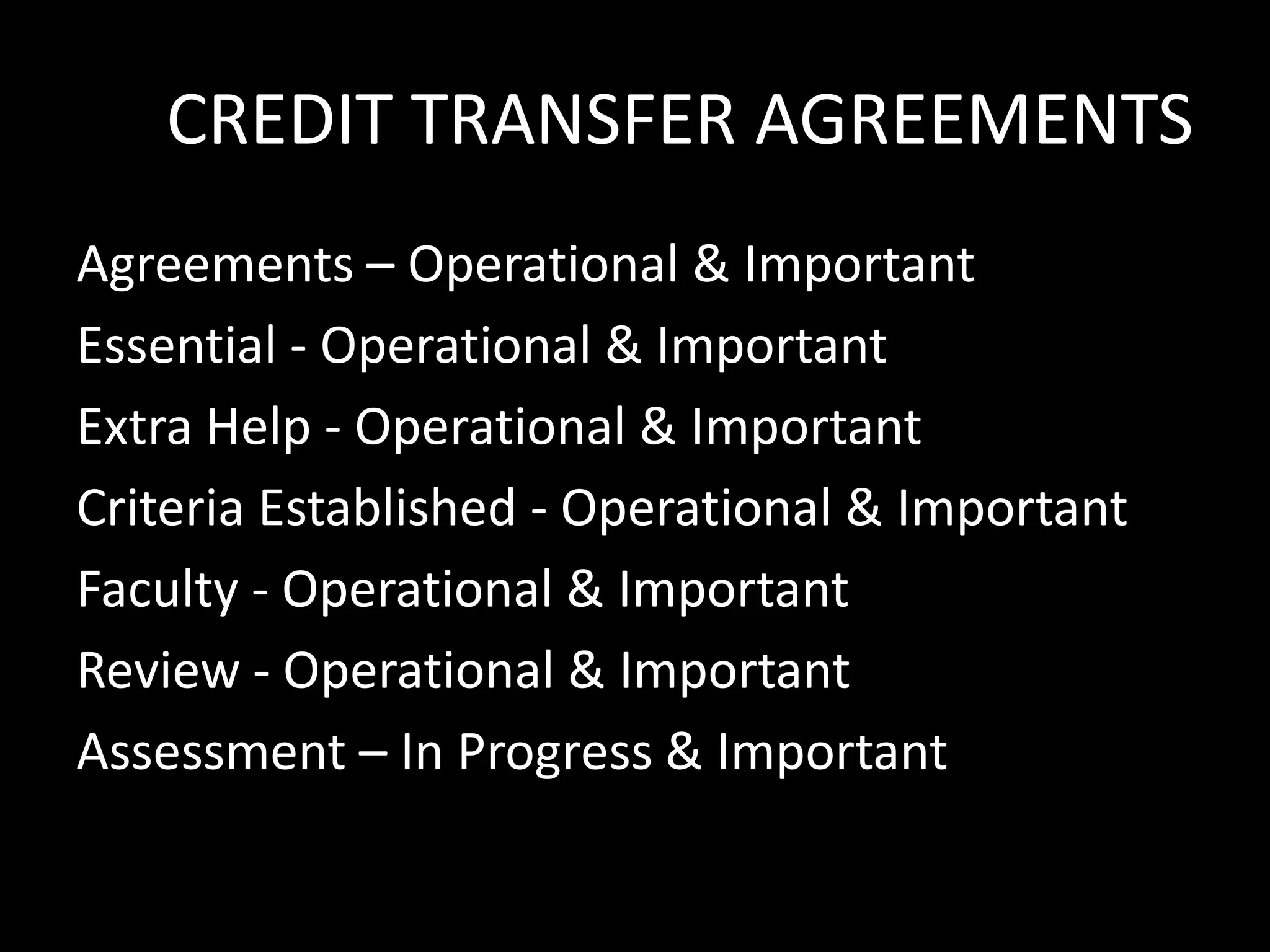
CREDIT TRANSFER AGREEMENTS
Agreements – Operational & Important
Essential - Operational & Important
Extra Help - Operational & Important
Criteria Established - Operational & Important
Faculty - Operational & Important
Review - Operational & Important
Assessment – In Progress & Important
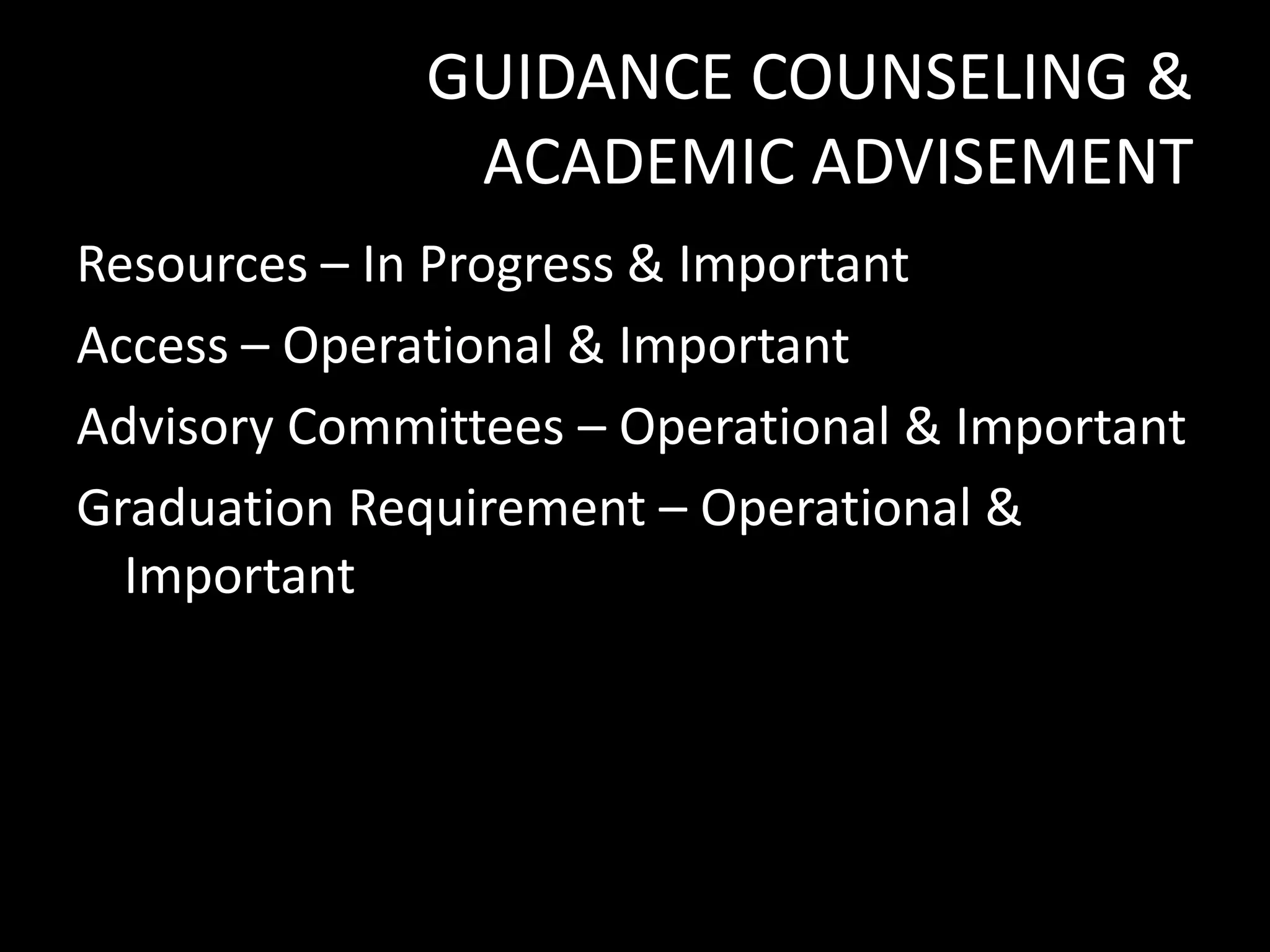
GUIDANCE COUNSELING &
ACADEMIC ADVISEMENT
Resources – In Progress & Important
Access – Operational & Important
Advisory Committees – Operational & Important
Graduation Requirement – Operational &
Important
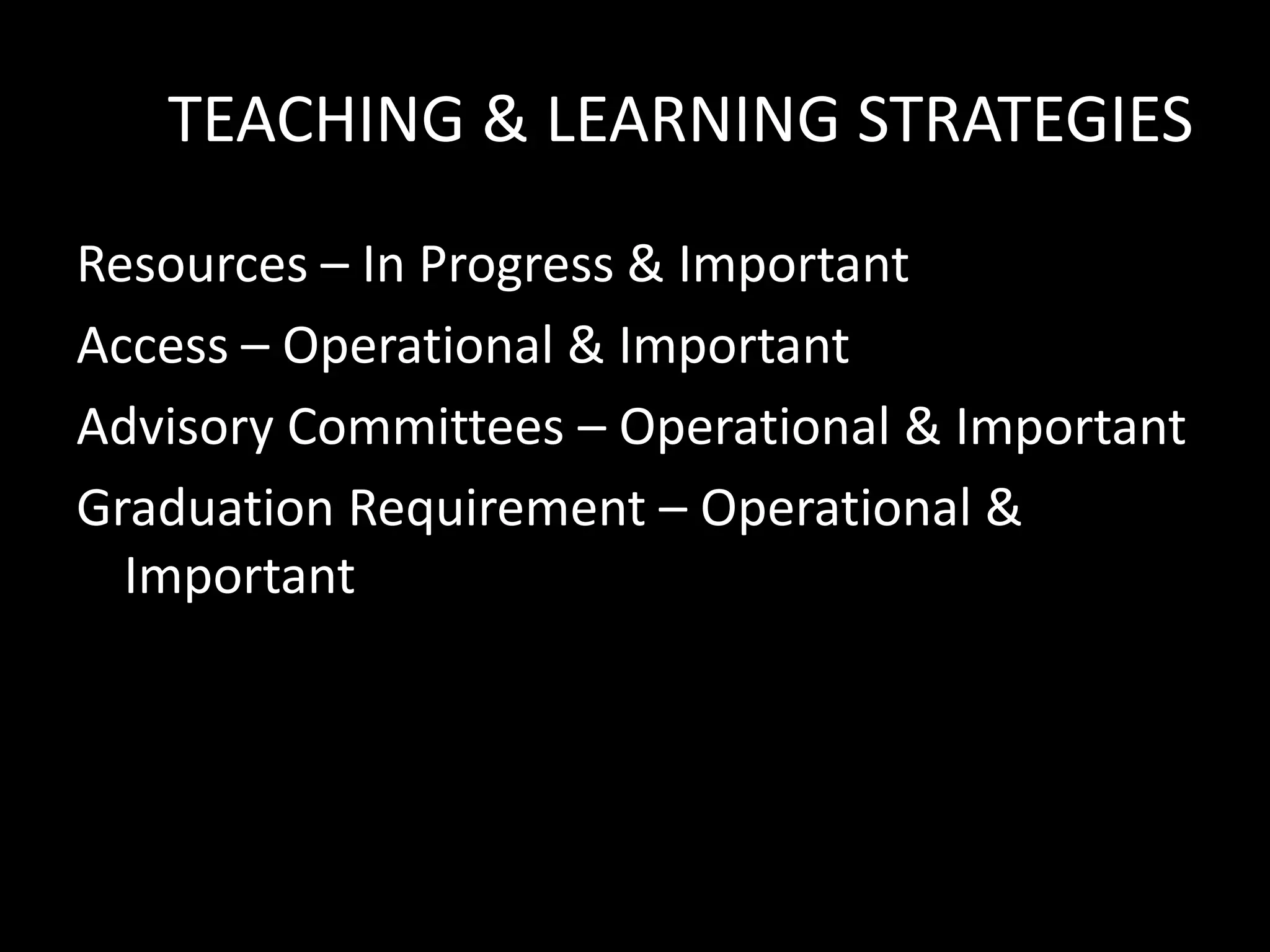
TEACHING & LEARNING STRATEGIES
Resources – In Progress & Important
Access – Operational & Important
Advisory Committees – Operational & Important
Graduation Requirement – Operational &
Important
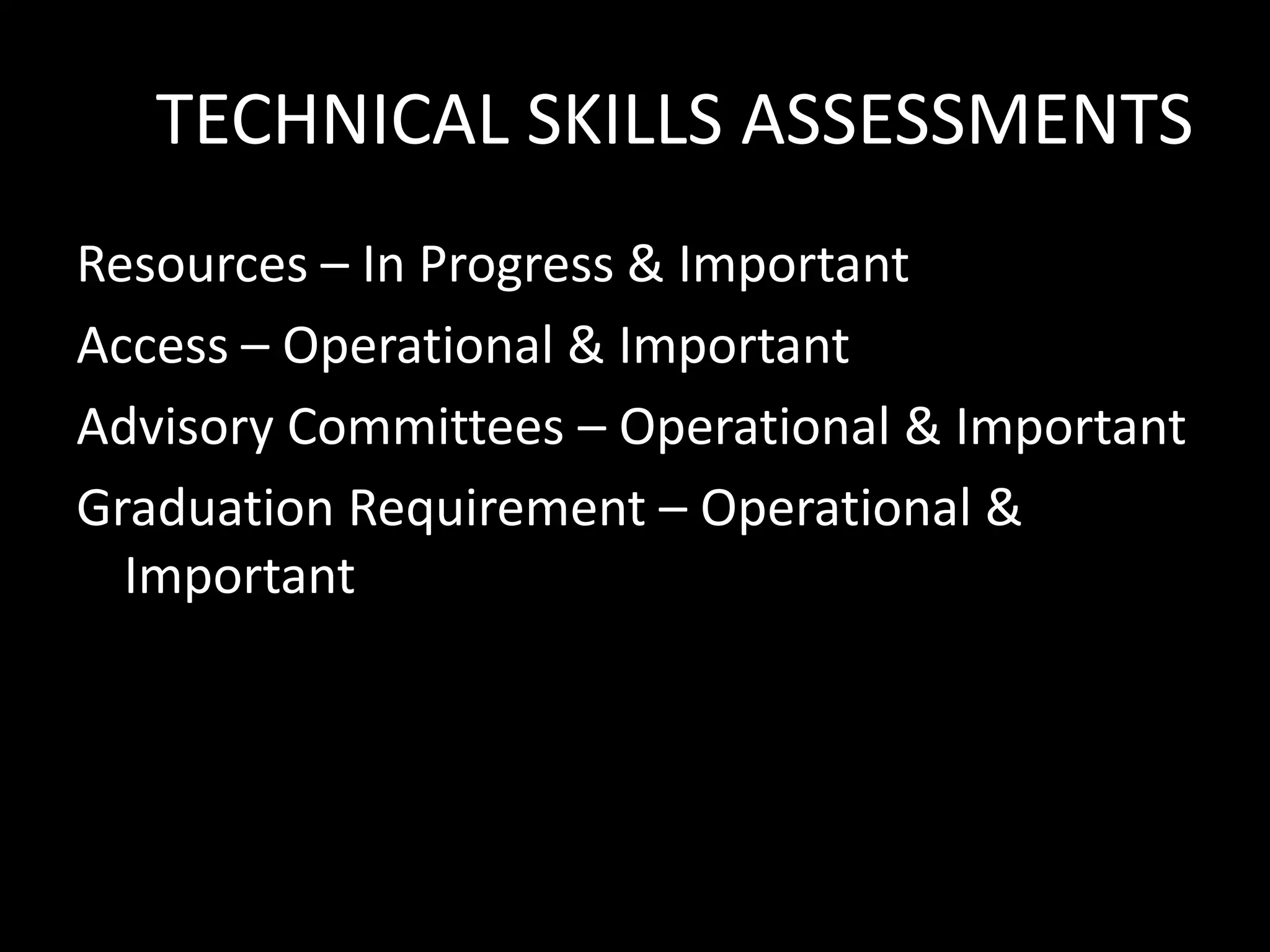
TECHNICAL SKILLS ASSESSMENTS
Resources – In Progress & Important
Access – Operational & Important
Advisory Committees – Operational & Important
Graduation Requirement – Operational &
Important
Moving from

Programs of Study
to

Rigorous Programs of Study
in Oklahoma Supplemental RFP
Duncan Public Schools
Video Tutorials
Framework Workshops
TA Visits
Next Steps
Connecting RPOS to Career Pathways
Business and Industry Involvement
100% Commitment
Implementation Stage
“Be Prepared”
Oklahoma RPOS Website
Jeremy L Zweiacker
State Programs of Study & College Transition
Coordinator
405.743.6881
jzwei@okcareertech.org
http://oklahomacte.blogspot.com
@okcareertech

Moving from POS to RPOS in Oklahoma

  • 1.
    Moving from Programs ofStudy to Rigorous Programs of Study in Oklahoma NCPN Conference 2013
  • 2.
    Innovation in CareerPathways National Award National Association of Career Pathways Leadership
  • 3.
    Education in Oklahoma OklahomaState Department of Education Oklahoma Department of Career and Technology Education Oklahoma State Regents for Higher Education
  • 4.
    Oklahoma CTE ODCTE 393 comprehensiveschool districts 29 technology center districts 14 skills centers business and industry
  • 5.
    Oklahoma CTE 135,372 comprehensiveschool enrollments 28,658 high school and adult technology center enrollments
  • 6.
    CTE Partners 18 collegesand universities (AAS degree granting) business and industry
  • 7.
    Innovation in CTE TechPrep Rigorous Programs of Study
  • 8.
  • 9.
    A Program ofStudy is a comprehensive, structured approach for delivering academic and CTE to prepare students for postsecondary education and career success
  • 11.
    Framing RPOS Technology CentersThat Work High Schools That Work Pathways to Prosperity Reflect, Transform, Lead: A New Vision for Career Technical Education Carl D. Perkins Career and Technical Education Act of 2006
  • 12.
  • 13.
    Carl Perkins IV& Programs of Study
  • 14.
    Incorporate and alignsecondary and postsecondary education elements http://www.flickr.com/photos/mgstyer/4661387399/
  • 15.
    Include academic andCTE content in a coordinated, non-duplicative progression of courses
  • 16.
    Offer the opportunity,where appropriate, for secondary students to acquire postsecondary credits, and
  • 17.
    Lead to anindustry-recognized credential or certificate at the postsecondary level, or an associate or baccalaureate degree
  • 18.
  • 19.
    Investing in America's Future:A Blueprint for Transforming Career and Technical Education
  • 20.
    Effective ALIGNMENT betweenCTE and labor market needs to equip students with 21stcentury skills and prepare them for in-demand occupations in high-growth industry sectors
  • 21.
    Strong COLLABORATION amongsecondary and postsecondary institutions, employers, and industry partners to improve the quality of CTE programs
  • 22.
    Meaningful ACCOUNTABILITY forimproving academic outcomes and building technical and employability skills in CTE programs, based upon common definitions and clear metrics for performance
  • 23.
    Increased emphasis onINNOVATION supported by systemic reform of state policies and practices to support CTE implementation of effective practices at the local level.
  • 24.
    Carl Perkins V& Rigorous Programs of Study
  • 26.
    RPOS Decision Marking Framework 1framework piece ≠ 10% Doing a lot of things right!
  • 27.
    LEGISLATION & POLICIES Federal,state, and local legislation or administrative policies promote POS development and implementation.
  • 28.
    PARTNERSHIPS Ongoing relationships among education, business,an d other community stakeholders are central to POS design, implementation, and maintenance.
  • 29.
    PROFESSIONAL DEVELOPMENT Sustained, intensive,an d focused opportunities for administrators, teachers , and faculty foster POS design, implementation, and maintenance.
  • 30.
    ACCOUNTABILITY & EVALUATION SYSTEMS Systemsand strategies to gather quantitative and qualitative data on both POS components and student outcomes are crucial for ongoing efforts to development and implement POS.
  • 31.
    COLLEGE & CAREER READINESSSTANDARDS Content standards that define what students are expected to know and be able to do to enter and advance in college and/or their careers comprise the foundation of a POS.
  • 32.
    COURSE SEQUENCES Non-duplicative sequences ofsecondary and postsecondary courses within a POS ensure that students transition to postsecondary education without duplicating classes or requiring remedial coursework. (Individual Career Plan)
  • 33.
    CREDIT TRANSFER AGREEMENTS Credittransfer agreements provide opportunities for secondary students to be awarded transcripted postsecondary credit, supported with formal agreements among secondary and postsecondary education systems. (Cooperative Alliance Program)
  • 34.
    GUIDANCE COUNSELING & ACADEMICADVISEMENT Guidance counseling and academic advisement help students to make informed decisions about which POS to pursue.
  • 35.
    TEACHING & LEARNINGSTRATEGIES Innovative and creative instructional approaches enable teachers to integrate academic and technical instruction and students to apply academic and technical learning in their POS coursework.
  • 36.
    TECHNICAL SKILLS ASSESSMENTS National,state, and/or local assessments provide ongoing information on the extent to which students are attaining the necessary knowledge and skills for entry into and advancement in postsecondary education and careers in their chosen POS.
  • 37.
    Credentials Lead to anindustryrecognized credential or certificate at the postsecondary level, or an associate or baccalaureate degree
  • 38.
    How we aregetting there? “Introduction Phase”
  • 39.
  • 40.
  • 41.
    Analysis of Stakeholder Interpretationsof Programs of Study in Oklahoma
  • 42.
  • 43.
  • 44.
    Caddo-Kiowa Technology Center ChoctawHigh School Claremore High School Meridian Technology Center Mid America Technology Center Oklahoma State University Institute of Technology Redlands Community College Tulsa Community College Tulsa Public Schools
  • 45.
    The Project Action planfor addressing one or more implementation barriers
  • 46.
  • 47.
    Caddo Kiowa TechnologyCenter Take a closer look at its Visual Design Program of Study to be better able to align programs and policies and make changes necessary to integrate RPOS Study into Oklahoma’s Career Pathways system, to align partner school offerings and CareerTech programs with the needs of business and industry and to begin addressing the skills gap and contributing to state and local economic growth and development.
  • 48.
    Choctaw High School Enhanceand improve all Career Academy curricula including Program of Study materials, partner participation, curriculum presentation and resources/materials availability.
  • 49.
    Claremore High School Enhanceits Zebra Advisement Program. The program enhances students’ awareness of educational and career opportunities and helps students make meaningful and informed choices regarding their preparation for the future. The programs uses consistent individualized guidance and joint student/parent/teacher comprehensive planning. In the last 14 years, ZAP has averaged a 95 percent participation rate of parents/guardians at ZAP enrollment time.
  • 50.
    Meridian Technology Center Workingto create awareness of the Oklahoma A‐F Report Card, industry credentials and postsecondary opportunities through the Cooperative Alliance Program.
  • 51.
    Mid America TechnologyCenter Mid‐America is working to improve communication with its sending schools and how it uses data across its campus. The technology center will work to use existing and emerging technology to enhance the process by collecting accurate and timely data relating to course work, assessments and guidance/counseling plans.
  • 52.
    OSUIT OSUIT will workto evaluate college readiness in Oklahoma’s Cooperative Alliance students. OSUIT established college credit articulation agreements with many of Oklahoma’s CareerTech centers in the 1980s. Since then, these agreements have grown and developed into the Cooperative Alliance agreements. OSUIT has Cooperative Alliance agreements with more than 50 technology center campuses. Approximately 10 percent to 15 percent of OSUIT students enter college with Cooperative Alliance credit. Many foundation courses for OSUIT’s degree programs are offered at CareerTech centers through these agreements.
  • 53.
    Redlands Community College Redlandswill work to further enhance the child development programs that it has developed in partnership with Caddo Kiowa Technology Center.
  • 54.
    Tulsa Community College TCCis working toward improving high school transitions in manufacturing and aerospace. The college is looking at the technical components and aligning them with national credentials.
  • 55.
    Tulsa Public Schools Theproject for Tulsa Public Schools consisted of taking a look at professional development through Teacher Leader Effectiveness.
  • 56.
    Rigorous Programs ofStudy Implementation Self-Study
  • 57.
    Framework Importance Legislation and Policies Current Status InProgress Partnerships In Progress Important Professional Development In Progress Important Accountability and Evaluation Systems In Progress Important College and Career Readiness Standards In Progress Important Course Sequence In Progress Important Credit Transfer Agreements In Progress Important Guidance Counseling and Academic Advisement Teaching and Learning Strategies Operational Important In Progress Important Technical Skills Assessments In Progress Important Important
  • 58.
    LEGISLATION & POLICIES Resources– In Progress & Important Access – Operational & Important Advisory Committees – Operational & Important Graduation Requirement – Operational & Important
  • 59.
    PARTNERSHIPS MOU – InProgress & Important Balanced - In Progress & Important Engaged - In Progress & Important Balanced - In Progress & Important Advocate - In Progress & Important Resources - In Progress & Important
  • 60.
    PROFESSIONAL DEVELOPMENT Process –In Progress/Operational & Important High Quality – Operational & Important Joint Opportunities – Operational & Important Contextual – In Progress & Important
  • 61.
    ACCOUNTABILITY & EVALUATION SYSTEMS Usage– In Progress & Important Procedures - In Progress & Important Performance Data - In Progress & Important Disaggregated - In Progress & Important Shared - In Progress & Important Culture – Operational & Important
  • 62.
    COLLEGE & CAREER READINESSSTANDARDS Aligned Reading, Math, Science – Operational & Important Aligned with Postsecondary – Operational & Important Aligned with Technical Standards – Operational & Important
  • 63.
    COURSE SEQUENCES Aligned –Operational & Important Articulated – Operational & Important Broad - Operational & Important
  • 64.
    CREDIT TRANSFER AGREEMENTS Agreements– Operational & Important Essential - Operational & Important Extra Help - Operational & Important Criteria Established - Operational & Important Faculty - Operational & Important Review - Operational & Important Assessment – In Progress & Important
  • 65.
    GUIDANCE COUNSELING & ACADEMICADVISEMENT Resources – In Progress & Important Access – Operational & Important Advisory Committees – Operational & Important Graduation Requirement – Operational & Important
  • 66.
    TEACHING & LEARNINGSTRATEGIES Resources – In Progress & Important Access – Operational & Important Advisory Committees – Operational & Important Graduation Requirement – Operational & Important
  • 67.
    TECHNICAL SKILLS ASSESSMENTS Resources– In Progress & Important Access – Operational & Important Advisory Committees – Operational & Important Graduation Requirement – Operational & Important
  • 68.
    Moving from Programs ofStudy to Rigorous Programs of Study in Oklahoma Supplemental RFP Duncan Public Schools
  • 69.
  • 70.
    Next Steps Connecting RPOSto Career Pathways Business and Industry Involvement 100% Commitment
  • 71.
  • 72.
  • 73.
    Jeremy L Zweiacker StatePrograms of Study & College Transition Coordinator 405.743.6881 jzwei@okcareertech.org http://oklahomacte.blogspot.com @okcareertech

Editor's Notes

  • #2 Welcome to Moving from Programs of Study to Rigorous Programs of Study in Oklahoma
  • #10 Current definition
  • #11 Programs of Study are more than a Plan of Study, or Individual Career Plan. POS starts at the Cluster level.
  • #12 Programs of Study is a part of school improvement. It is a part of the work done by SREB, mentioned in Pathways to Prosperity and is the new vision for CTE of the National State Directors. It is currently a requirement in Carl Perkins. It is the right thing to do for students regardless of what happens to Perkins funding.
  • #14 Welcome to Moving from Programs of Study to Rigorous Programs of Study in Oklahoma
  • #15 One of four minimum components of a Program of Study as defined in Carl Perkins.
  • #16 One of four minimum components of a Program of Study as defined in Carl Perkins.
  • #17 One of four minimum components of a Program of Study as defined in Carl Perkins.
  • #18 One of four minimum components of a Program of Study as defined in Carl Perkins.
  • #26 The Rigorous Programs of Study Framework.
  • #28 One of ten components of the Rigorous Programs of Study Framework.
  • #29 One of ten components of the Rigorous Programs of Study Framework.
  • #30 One of ten components of the Rigorous Programs of Study Framework.
  • #31 One of ten components of the Rigorous Programs of Study Framework.
  • #32 One of ten components of the Rigorous Programs of Study Framework.
  • #33 One of ten components of the Rigorous Programs of Study Framework.
  • #34 One of ten components of the Rigorous Programs of Study Framework.
  • #35 One of ten components of the Rigorous Programs of Study Framework.
  • #36 One of ten components of the Rigorous Programs of Study Framework.
  • #37 One of ten components of the Rigorous Programs of Study Framework.
  • #40 Oklahoma was one of four participants with Minnesota, Kentucky and Guam. Conducted by the National Research Center for CTE at the University of Louisville.
  • #41 We knew that this was an issue. Programs of Study are called Plans of Study, Career Majors, etc.
  • #42 We worked with a researcher from the University of Louisville. The results of the study confirmed that there was confusion.
  • #43 ODCTE will now reference Individual Career Plan, or ICP, instead of Plans of Study.
  • #44 We are conducting the OK Programs of Study Institute this fall.
  • #45 Participants of the OkPOSI
  • #47 All Perkins LEA’s will be invited. The blueprint for Oklahoma’s Programs of Study, and how they will be implemented under Perkins, will be revealed.
  • #59 One of ten components of the Rigorous Programs of Study Framework.
  • #60 One of ten components of the Rigorous Programs of Study Framework.
  • #61 One of ten components of the Rigorous Programs of Study Framework.
  • #62 One of ten components of the Rigorous Programs of Study Framework.
  • #63 One of ten components of the Rigorous Programs of Study Framework.
  • #64 One of ten components of the Rigorous Programs of Study Framework.
  • #65 One of ten components of the Rigorous Programs of Study Framework.
  • #66 One of ten components of the Rigorous Programs of Study Framework.
  • #67 One of ten components of the Rigorous Programs of Study Framework.
  • #68 One of ten components of the Rigorous Programs of Study Framework.
  • #69 Welcome to Moving from Programs of Study to Rigorous Programs of Study in Oklahoma