Motion, Speed, Velocity
and Acceleration
and Acceleration
VECTORS AND SCALORS
VECTORS AND SCALORS
ORIGIN - POINT AT WHICH BOTH VARIABLES
ARE AT 0 (ZERO)
ARE AT 0 (ZERO)
MAGNITUDE – SIZE
MAGNITUDE – SIZE
VECTORS – DIRECTION (represented by
arrows)
arrows)
SCALARS – QUANTITIES W/OUT DIRECTION
(ex distance m, time s, temp C)
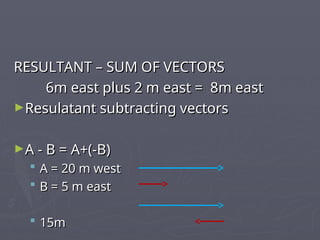
RESULTANT – SUM OF VECTORS
6m east plus 2 m east = 8m east
►Resulatant subtracting vectors
Resulatant subtracting vectors
►A - B = A+(-B)
A - B = A+(-B)
 A = 20 m west
A = 20 m west
 B = 5 m east
B = 5 m east
 15m
15m
Time Interval/Displacement
►Time interval - change in time =final time
Time interval - change in time =final time
–initial time ….
–initial time ….
►formula
formula
►Displacement - Change in distance = final
Displacement - Change in distance = final
distance – initial distance
►formula
formula
Motion
Motion
►Motion
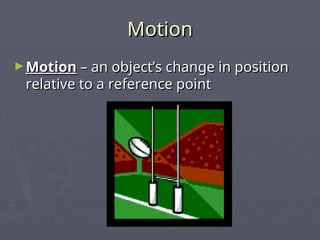
Motion – an object’s change in position
– an object’s change in position
relative to a reference point
Reference Point
Reference Point
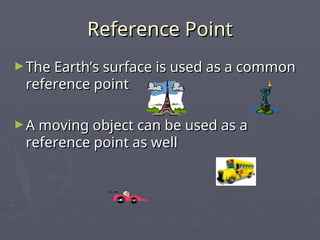
►The Earth’s surface is used as a common
The Earth’s surface is used as a common
reference point
reference point
►A moving object can be used as a
A moving object can be used as a
reference point as well
Speed
Speed
►Speed
Speed is the distance traveled divided by
is the distance traveled divided by
the time interval during which the motion
occurred
occurred
►Normally, objects do not travel at a
Normally, objects do not travel at a
constant speed
constant speed
►Average Speed -
Average Speed - total distance
total distance
total time
total time
Which Distance?
Which Distance?
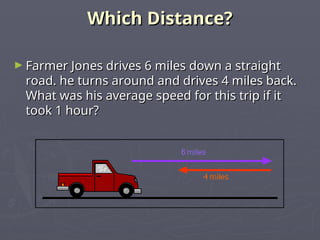
► Farmer Jones drives 6 miles down a straight
Farmer Jones drives 6 miles down a straight
road. he turns around and drives 4 miles back.
What was his average speed for this trip if it
took 1 hour?
took 1 hour?
Your answer to this problem
depends on your interpretation of
"distance traveled". You could say:
► The
The total distance
total distance traveled by Farmer Jones is 10
traveled by Farmer Jones is 10
miles. Therefore his average speed is 10 mi/hr.
► The
The net distance
net distance traveled by Farmer Jones is 2 miles.
traveled by Farmer Jones is 2 miles.
Therefore, his average speed is 2 mi/hr.
► There are good reasons to use either interpretation -
There are good reasons to use either interpretation -
it's mostly a matter of preference. We will interpret
"distance traveled" to be
"distance traveled" to be net distance
net distance (
(also called
also called
displacement).
displacement). Farmer Jones' average speed was 2
Farmer Jones' average speed was 2
mi/hr.
mi/hr.
Velocity
Velocity
►Velocity
Velocity is the speed of an object in a
is the speed of an object in a
particular direction
►Imagine two birds leave the same tree at
Imagine two birds leave the same tree at
the same time. The both fly at 10km/hr
for 5 minutes. Why don’t they end up at
the same place?
the same place?
Velocity
Velocity
►Velocity
Velocity appears to be very similar to
appears to be very similar to
speed, however, when describing the
velocity of an object you need to provide
a magnitude and a direction
►Magnitude
Magnitude – the speed of the object
– the speed of the object
►Direction
Direction – the direction the object is
– the direction the object is
moving
moving
►Pg 43 demo
Pg 43 demo
Velocity
Velocity
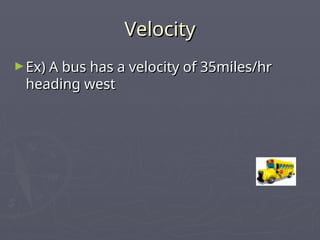
►Ex) A bus has a velocity of 35miles/hr
Ex) A bus has a velocity of 35miles/hr
heading west
heading west
Resultant Velocity
Resultant Velocity
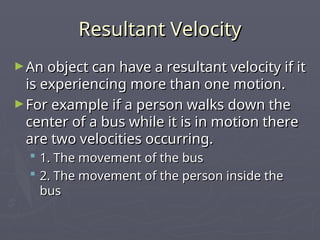
►An object can have a resultant velocity if it
An object can have a resultant velocity if it
is experiencing more than one motion.
►For example if a person walks down the
For example if a person walks down the
center of a bus while it is in motion there
are two velocities occurring.
 1. The movement of the bus
1. The movement of the bus
 2. The movement of the person inside the
2. The movement of the person inside the
bus
bus
Example
Example
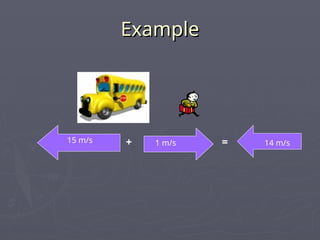
15 m/s + 1 m/s = 14 m/s
Example
Example
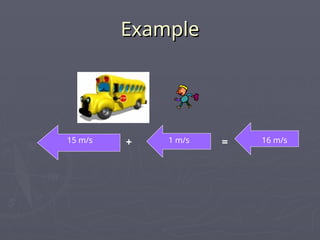
15 m/s + =
1 m/s 16 m/s
Acceleration
Acceleration
►Acceleration
Acceleration is the rate at which velocity
is the rate at which velocity
changes over time
changes over time
 An object accelerates if its speed, direction, or
An object accelerates if its speed, direction, or
both change
both change
►Average acceleration =
final velocity – starting velocity
time it takes to change velocity
Acceleration
Acceleration
►Example
Example
 A car on the highway is traveling 55 mi/hr
A car on the highway is traveling 55 mi/hr
and it passes another car. In order to pass,
the car has to accelerate to 65 mi/hr. The car
reaches this velocity 40 seconds later. What
is the average acceleration of the car?
Acceleration and Velocity
►As velocity
As velocity increases
increases, so does
, so does
acceleration
acceleration
►As velocity
As velocity decreases
decreases, so does
, so does
acceleration
acceleration
►When direction changes, so does
When direction changes, so does
acceleration
acceleration
►When there is a
When there is a constant velocity
constant velocity, there
, there
is no acceleration
is no acceleration

Motion Speed VelocityandAcceleration.ppt

  • 1.
    Motion, Speed, Velocity Motion,Speed, Velocity and Acceleration and Acceleration
  • 2.
    VECTORS AND SCALORS VECTORSAND SCALORS ORIGIN - POINT AT WHICH BOTH VARIABLES ORIGIN - POINT AT WHICH BOTH VARIABLES ARE AT 0 (ZERO) ARE AT 0 (ZERO) MAGNITUDE – SIZE MAGNITUDE – SIZE VECTORS – DIRECTION (represented by VECTORS – DIRECTION (represented by arrows) arrows) SCALARS – QUANTITIES W/OUT DIRECTION SCALARS – QUANTITIES W/OUT DIRECTION (ex distance m, time s, temp C) (ex distance m, time s, temp C)
  • 3.
    RESULTANT – SUMOF VECTORS RESULTANT – SUM OF VECTORS 6m east plus 2 m east = 8m east 6m east plus 2 m east = 8m east ►Resulatant subtracting vectors Resulatant subtracting vectors ►A - B = A+(-B) A - B = A+(-B)  A = 20 m west A = 20 m west  B = 5 m east B = 5 m east  15m 15m
  • 4.
    Time Interval/Displacement Time Interval/Displacement ►Timeinterval - change in time =final time Time interval - change in time =final time –initial time …. –initial time …. ►formula formula ►Displacement - Change in distance = final Displacement - Change in distance = final distance – initial distance distance – initial distance ►formula formula
  • 5.
    Motion Motion ►Motion Motion – anobject’s change in position – an object’s change in position relative to a reference point relative to a reference point
  • 6.
    Reference Point Reference Point ►TheEarth’s surface is used as a common The Earth’s surface is used as a common reference point reference point ►A moving object can be used as a A moving object can be used as a reference point as well reference point as well
  • 7.
    Speed Speed ►Speed Speed is thedistance traveled divided by is the distance traveled divided by the time interval during which the motion the time interval during which the motion occurred occurred ►Normally, objects do not travel at a Normally, objects do not travel at a constant speed constant speed ►Average Speed - Average Speed - total distance total distance total time total time
  • 8.
    Which Distance? Which Distance? ►Farmer Jones drives 6 miles down a straight Farmer Jones drives 6 miles down a straight road. he turns around and drives 4 miles back. road. he turns around and drives 4 miles back. What was his average speed for this trip if it What was his average speed for this trip if it took 1 hour? took 1 hour?
  • 9.
    Your answer tothis problem Your answer to this problem depends on your interpretation of depends on your interpretation of "distance traveled". You could say: "distance traveled". You could say: ► The The total distance total distance traveled by Farmer Jones is 10 traveled by Farmer Jones is 10 miles. Therefore his average speed is 10 mi/hr. miles. Therefore his average speed is 10 mi/hr. ► The The net distance net distance traveled by Farmer Jones is 2 miles. traveled by Farmer Jones is 2 miles. Therefore, his average speed is 2 mi/hr. Therefore, his average speed is 2 mi/hr. ► There are good reasons to use either interpretation - There are good reasons to use either interpretation - it's mostly a matter of preference. We will interpret it's mostly a matter of preference. We will interpret "distance traveled" to be "distance traveled" to be net distance net distance ( (also called also called displacement). displacement). Farmer Jones' average speed was 2 Farmer Jones' average speed was 2 mi/hr. mi/hr.
  • 10.
    Velocity Velocity ►Velocity Velocity is thespeed of an object in a is the speed of an object in a particular direction particular direction ►Imagine two birds leave the same tree at Imagine two birds leave the same tree at the same time. The both fly at 10km/hr the same time. The both fly at 10km/hr for 5 minutes. Why don’t they end up at for 5 minutes. Why don’t they end up at the same place? the same place?
  • 12.
    Velocity Velocity ►Velocity Velocity appears tobe very similar to appears to be very similar to speed, however, when describing the speed, however, when describing the velocity of an object you need to provide velocity of an object you need to provide a magnitude and a direction a magnitude and a direction ►Magnitude Magnitude – the speed of the object – the speed of the object ►Direction Direction – the direction the object is – the direction the object is moving moving ►Pg 43 demo Pg 43 demo
  • 13.
    Velocity Velocity ►Ex) A bushas a velocity of 35miles/hr Ex) A bus has a velocity of 35miles/hr heading west heading west
  • 14.
    Resultant Velocity Resultant Velocity ►Anobject can have a resultant velocity if it An object can have a resultant velocity if it is experiencing more than one motion. is experiencing more than one motion. ►For example if a person walks down the For example if a person walks down the center of a bus while it is in motion there center of a bus while it is in motion there are two velocities occurring. are two velocities occurring.  1. The movement of the bus 1. The movement of the bus  2. The movement of the person inside the 2. The movement of the person inside the bus bus
  • 15.
  • 16.
  • 17.
    Acceleration Acceleration ►Acceleration Acceleration is therate at which velocity is the rate at which velocity changes over time changes over time  An object accelerates if its speed, direction, or An object accelerates if its speed, direction, or both change both change ►Average acceleration = final velocity – starting velocity time it takes to change velocity
  • 18.
    Acceleration Acceleration ►Example Example  A caron the highway is traveling 55 mi/hr A car on the highway is traveling 55 mi/hr and it passes another car. In order to pass, and it passes another car. In order to pass, the car has to accelerate to 65 mi/hr. The car the car has to accelerate to 65 mi/hr. The car reaches this velocity 40 seconds later. What reaches this velocity 40 seconds later. What is the average acceleration of the car? is the average acceleration of the car?
  • 19.
    Acceleration and Velocity Accelerationand Velocity ►As velocity As velocity increases increases, so does , so does acceleration acceleration ►As velocity As velocity decreases decreases, so does , so does acceleration acceleration ►When direction changes, so does When direction changes, so does acceleration acceleration ►When there is a When there is a constant velocity constant velocity, there , there is no acceleration is no acceleration