Motherboard, Microprocessor
and USB
1
Motherboard
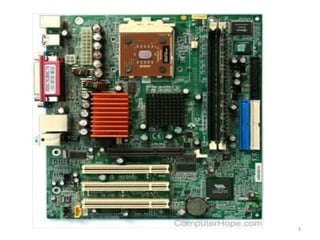
• Motherboard is the main core of the computer.
• It is also known as Printed Circuit Board (PCB) or circuit board or
System Board.
• It is the main circuit board in which many internal devices such as
video card, sound card, memory, CPU and other devices are
attached.
• None of the other card or devices can work without motherboard.
• Motherboard is a rectangular fiber glass with a printed circuit board
on the surface of which connects one component to another.
• Although the system board's physical structure has changed over
time, its logical structure has remained relatively constant.
• The system board of the personal computer consists of a
microprocessor, supporting circuits, ROM, the system's Primary
Memory units, keyboard interface, timing circuit etc.
2
Motherboard
3
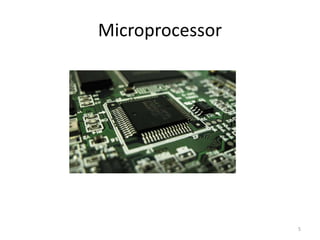
Microprocessor
• Microprocessor is the brain of computer, which does all
the work.
• It is a computer processor that incorporates all the
functions of CPU (Central Processing Unit) on a single
IC (Integrated Circuit) or at the most a few ICs.
• Microprocessors were first introduced in early 1970s.
4004 was the first general purpose microprocessor
used by Intel in building personal computers.
• Arrival of low cost general purpose microprocessors
has been instrumental in development of modern
society the way it has.
4
Microprocessor
5
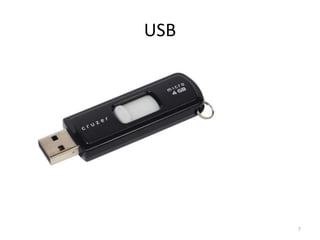
Universal Serial Bus
• It is a high speed serial bus.
• Its data transfer rate is higher than that of a serial port. It
allows interfacing several devices to a single port in a daisy
chain.
• It provides power line along with data lines.
• USB cable contains 4 wires two out of four wires in the USB
cable are used to supply electrical power to devices and
two are reserved for send data and commands.
• It can operate in two modes i.e. Low speed mode and
medium speed mode.
• In low speed mode data transfer rate is 1.5 Mbps and at
medium speed mode data transfer mode is 12 Mbps.
6
USB
7

Motherboard-Microprocessor-and-USB.pptx

  • 1.
  • 2.
    Motherboard • Motherboard isthe main core of the computer. • It is also known as Printed Circuit Board (PCB) or circuit board or System Board. • It is the main circuit board in which many internal devices such as video card, sound card, memory, CPU and other devices are attached. • None of the other card or devices can work without motherboard. • Motherboard is a rectangular fiber glass with a printed circuit board on the surface of which connects one component to another. • Although the system board's physical structure has changed over time, its logical structure has remained relatively constant. • The system board of the personal computer consists of a microprocessor, supporting circuits, ROM, the system's Primary Memory units, keyboard interface, timing circuit etc. 2
  • 3.
  • 4.
    Microprocessor • Microprocessor isthe brain of computer, which does all the work. • It is a computer processor that incorporates all the functions of CPU (Central Processing Unit) on a single IC (Integrated Circuit) or at the most a few ICs. • Microprocessors were first introduced in early 1970s. 4004 was the first general purpose microprocessor used by Intel in building personal computers. • Arrival of low cost general purpose microprocessors has been instrumental in development of modern society the way it has. 4
  • 5.
  • 6.
    Universal Serial Bus •It is a high speed serial bus. • Its data transfer rate is higher than that of a serial port. It allows interfacing several devices to a single port in a daisy chain. • It provides power line along with data lines. • USB cable contains 4 wires two out of four wires in the USB cable are used to supply electrical power to devices and two are reserved for send data and commands. • It can operate in two modes i.e. Low speed mode and medium speed mode. • In low speed mode data transfer rate is 1.5 Mbps and at medium speed mode data transfer mode is 12 Mbps. 6
  • 7.