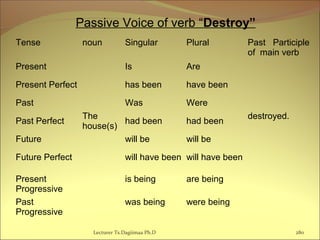
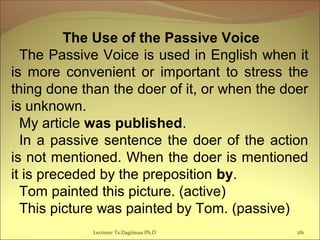
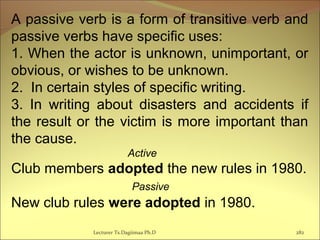
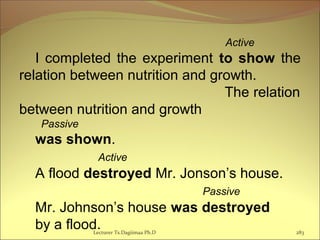
Õè÷ýýëèéí èíäåêñ: ENGL 205
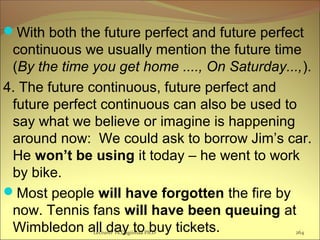
Õè÷ýýëèéí íýð: Õýëíèé îíîë II
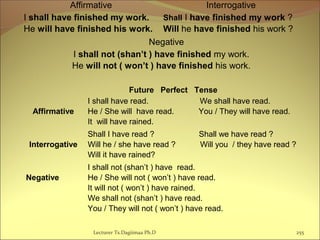
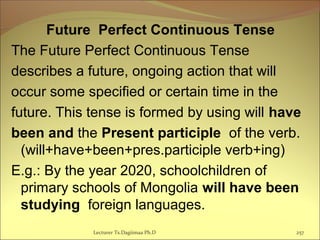
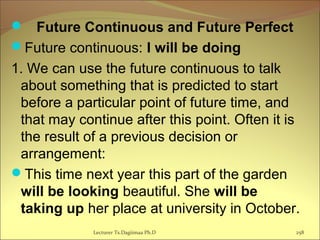
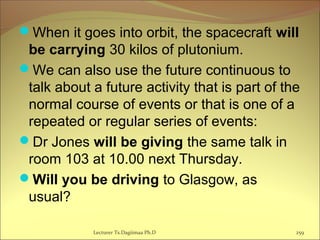
/Àíãëè õýëíèé ¿ã ç¿é /
Àãóóëãûí áàãòààìæ: 3 êðåäèò
Ñóäëàõ àíãè: Àíãëè õýëíèé áàãø,
 Àíãëè õýëíèé îð÷óóëàã÷
Ñóäëàõ óëèðàë: IV
2Lecturer Ts.Dagiimaa Ph.D
Ëåêöèéí àãóóëãà
1. Noun & Articles
2. Adjective & Adverbs
3. Pronouns
4. Prepositions
5. The verbs To Be, To Do, To have
6. Modal Verbs Can, Could, Be able to be,
7. May, Must, To have + infinitive , Have to
8. To be + infinitive , Need, Should, Ought to,
9. Should, Ought to, Would, Dare
3Lecturer Ts.Dagiimaa Ph.D
10. Present Indefinite & Present Continuous
Tenses.
11. Present Perfect Continuous & Present
Perfect Tenses.
12. Past Indefinite & Past Continuous Tenses.
13. Past Perfect Continuous & Past Perfect
Tenses.
14. Past Perfect Continuous, Past Perfect & Past
Continuous Tenses.
15. Future Indefinite & Future Continuous Tenses.
16. To be + infinitive, Future Perfect & Future
Perfect Continuous Tenses.
4Lecturer Ts.Dagiimaa Ph.D
LECTURE 1
NOUN, ARTICLES
&
ADJECTIVES
5Lecturer Ts.Dagiimaa Ph.D
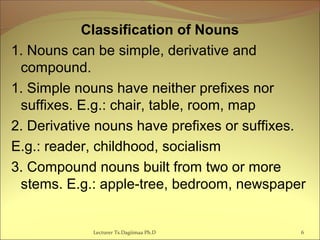
Classification of Nouns
1. Nouns can be simple, derivative and
compound.
1. Simple nouns have neither prefixes nor
suffixes. E.g.: chair, table, room, map
2. Derivative nouns have prefixes or suffixes.
E.g.: reader, childhood, socialism
3. Compound nouns built from two or more
stems. E.g.: apple-tree, bedroom, newspaper
6Lecturer Ts.Dagiimaa Ph.D
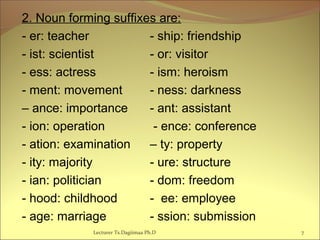
2. Noun forming suffixes are:
- er: teacher - ship: friendship
- ist: scientist - or: visitor
- ess: actress - ism: heroism
- ment: movement - ness: darkness
– ance: importance - ant: assistant
- ion: operation - ence: conference
- ation: examination – ty: property
- ity: majority - ure: structure
- ian: politician - dom: freedom
- hood: childhood - ee: employee
- age: marriage - ssion: submission
7Lecturer Ts.Dagiimaa Ph.D
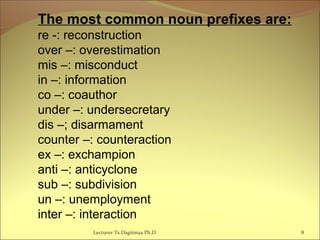
The most common noun prefixes are:
re -: reconstruction
over –: overestimation
mis –: misconduct
in –: information
co –: coauthor
under –: undersecretary
dis –; disarmament
counter –: counteraction
ex –: exchampion
anti –: anticyclone
sub –: subdivision
un –: unemployment
inter –: interaction
8Lecturer Ts.Dagiimaa Ph.D
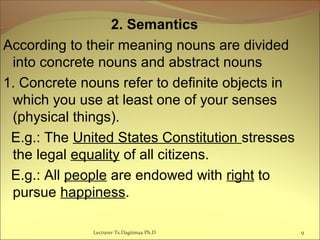
2. Semantics
According to their meaning nouns are divided
into concrete nouns and abstract nouns
1. Concrete nouns refer to definite objects in
which you use at least one of your senses
(physical things).
E.g.: The United States Constitution stresses
the legal equality of all citizens.
E.g.: All people are endowed with right to
pursue happiness.
9Lecturer Ts.Dagiimaa Ph.D
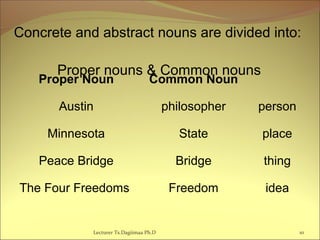
Concrete and abstract nouns are divided into:
Proper nouns & Common nouns
Proper Noun Common Noun
Austin philosopher person
Minnesota State place
Peace Bridge Bridge thing
The Four Freedoms Freedom idea
10Lecturer Ts.Dagiimaa Ph.D
1. Proper noun is a noun denotes a
particular thing. E.g.: Moscow, London,
February
2. Common nouns refer to any and every
objects of the same kind.
E.g.: a man, a dog, a river.
To the class of common nouns belong also
material nouns.
Lecturer Ts.Dagiimaa Ph.D 11
Collective Noun
Collective nouns denote a number of things
collected together or names a group and unit.
E.g.: family, team, people, nation
They are usually singular and are used with
singular verbs.
E.g.: Soviet hockey team was playing very well.
According to their lexical meaning English
nouns are divided into three classes:
1. Masculine (for male beings) - father, boy
2. Feminine (for female beings) - mother, girl
12Lecturer Ts.Dagiimaa Ph.D
3. Neuter (for lifeless thing) – room, flower
Many English nouns have the same form for
both masculine and feminine.
E.g.: parent, singer, child, and pupil
To indicate the gender one must use a
compound.
E.g.: woman doctor, man servant
Some nouns form the feminine from the
masculine by adding - ess (words ending in
– er or – or often drop – or-)
E.g.: poet – poetess, actor - actress
13Lecturer Ts.Dagiimaa Ph.D
Articles
A and an are indefinite articles that can
be used only before singular countable
nouns, the can be used before uncountable
nouns and before countable plural nouns.
a ( an ) – indefinite article
the - definite article
No article, often called the zero article,
identifies certain indefinite meanings of
nouns.
Articles are determiners and come before the
nouns they modify.
14Lecturer Ts.Dagiimaa Ph.D
The indefinite article A and An
A comes before a consonant sound but
sometimes before a vowel: a book, a table,
a university
An – before a vowel sound but sometimes
before a consonant: an author, an arm,
an old man, an hour
  The Indefinite article is used:
1) Before a countable noun in the singular
when it is mentioned for the first time.
E.g.: I see a man. A house has a roof. 15Lecturer Ts.Dagiimaa Ph
2) Before a countable noun in the singular
when this noun is used as an individual
representative of a class of things or beings.
E.g.: A dog is a domestic animal.
3) With nouns denoting professions:
E.g.: I am a teacher. He is a doctor.
4) In certain numerical expressions:
E.g.: a couple, a dozen, a hundred
5) In expressions of price, speed, ration, time:
E.g.: a penny, once a year, 4 times a day,
6) In exclamations before countable nouns:
E.g.: What a day! Such a pity! 16Lecturer Ts.Dagiimaa Ph.D
The Definite articles the used:
The definite article the can be with all nouns.
Use the to identify a noun that shows:
1) reference backward to a noun already
mentioned.
E.g.: A dog has been barking all day and here
is the dog now, standing outside the gate.
2) reference forward to an identification
soon to be made, often by modifiers
following the noun. E.g.: The man at the
door wants to speak to you.
Lecturer Ts.Dagiimaa Ph.D 17
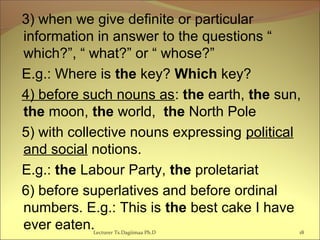
3) when we give definite or particular
information in answer to the questions “
which?”, “ what?” or “ whose?”
E.g.: Where is the key? Which key?
4) before such nouns as: the earth, the sun,
the moon, the world, the North Pole
5) with collective nouns expressing political
and social notions.
E.g.: the Labour Party, the proletariat
6) before superlatives and before ordinal
numbers. E.g.: This is the best cake I have
ever eaten. 18Lecturer Ts.Dagiimaa Ph.D
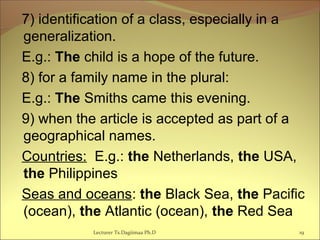
7) identification of a class, especially in a
generalization.
E.g.: The child is a hope of the future.
8) for a family name in the plural:
E.g.: The Smiths came this evening.
9) when the article is accepted as part of a
geographical names.
Countries: E.g.: the Netherlands, the USA,
the Philippines
Seas and oceans: the Black Sea, the Pacific
(ocean), the Atlantic (ocean), the Red Sea
19Lecturer Ts.Dagiimaa Ph.D
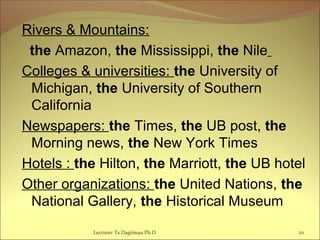
Rivers & Mountains:
the Amazon, the Mississippi, the Nile
Colleges & universities: the University of
Michigan, the University of Southern
California
Newspapers: the Times, the UB post, the
Morning news, the New York Times
Hotels : the Hilton, the Marriott, the UB hotel
Other organizations: the United Nations, the
National Gallery, the Historical Museum
20Lecturer Ts.Dagiimaa Ph.D
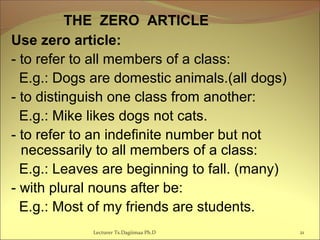
  THE ZERO ARTICLE
Use zero article:
- to refer to all members of a class:
E.g.: Dogs are domestic animals.(all dogs)
- to distinguish one class from another:
E.g.: Mike likes dogs not cats.
- to refer to an indefinite number but not
necessarily to all members of a class:
E.g.: Leaves are beginning to fall. (many)
- with plural nouns after be:
E.g.: Most of my friends are students.
21Lecturer Ts.Dagiimaa Ph.D
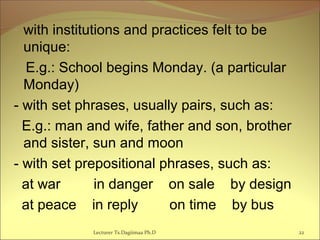
- with institutions and practices felt to be
unique:
E.g.: School begins Monday. (a particular
Monday)
- with set phrases, usually pairs, such as:
E.g.: man and wife, father and son, brother
and sister, sun and moon
- with set prepositional phrases, such as:
at war in danger on sale by design
at peace in reply on time by bus
22Lecturer Ts.Dagiimaa Ph.D
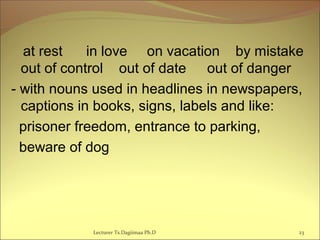
at rest in love on vacation by mistake
out of control out of date out of danger
- with nouns used in headlines in newspapers,
captions in books, signs, labels and like:
prisoner freedom, entrance to parking,
beware of dog
Lecturer Ts.Dagiimaa Ph.D 23
24Lecturer Ts.Dagiimaa Ph.D
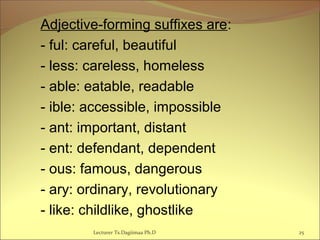
Adjective-forming suffixes are:
- ful: careful, beautiful
- less: careless, homeless
- able: eatable, readable
- ible: accessible, impossible
- ant: important, distant
- ent: defendant, dependent
- ous: famous, dangerous
- ary: ordinary, revolutionary
- like: childlike, ghostlike
Lecturer Ts.Dagiimaa Ph.D 25
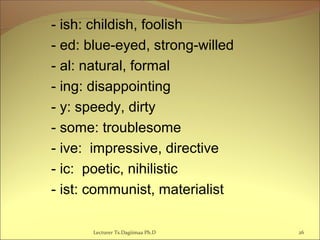
- ish: childish, foolish
- ed: blue-eyed, strong-willed
- al: natural, formal
- ing: disappointing
- y: speedy, dirty
- some: troublesome
- ive: impressive, directive
- ic: poetic, nihilistic
- ist: communist, materialist
Lecturer Ts.Dagiimaa Ph.D 26
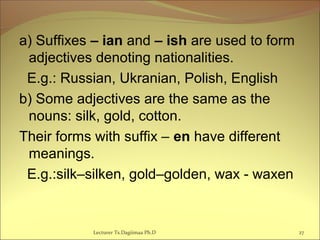
a) Suffixes – ian and – ish are used to form
adjectives denoting nationalities.
E.g.: Russian, Ukranian, Polish, English
b) Some adjectives are the same as the
nouns: silk, gold, cotton.
Their forms with suffix – en have different
meanings.
E.g.:silk–silken, gold–golden, wax - waxen
27Lecturer Ts.Dagiimaa Ph.D
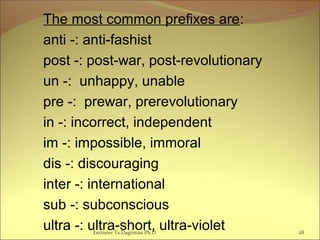
The most common prefixes are:
anti -: anti-fashist
post -: post-war, post-revolutionary
un -: unhappy, unable
pre -: prewar, prerevolutionary
in -: incorrect, independent
im -: impossible, immoral
dis -: discouraging
inter -: international
sub -: subconscious
ultra -: ultra-short, ultra-violetLecturer Ts.Dagiimaa Ph.D 28
LECTURE 2
DEGREE OF COMPARISON,
ADVERB, PERSONAL,
POSSESSIVE, REFLEXIVE
&
RELATIVE PRONOUNS
Lecturer Ts.Dagiimaa Ph.D 29

Degrees of Comparison
There are two degrees of comparison of
adjectives: the comparative and superlative.
1. One – syllable and some two – syllable
adjectives form their comparative and
superlative degrees by adding – er and – est.
E.g.: dark – darker – (the) darkest
clever – cleverer – (the) cleverest
2. Adjectives of two or more syllables form the
degrees of comparison using more or most:
careful – more careful – the most careful
interesting – more interesting – the most
interesting
30Lecturer Ts.Dagiimaa Ph.D
3. Some adjectives have irregular forms of
comparison: good – better – the best
little – less – the least
4. A few adjectives have two forms of
comparison. The second form has a
special meaning:
far – further – the furthest
(for distance and time)
far-farther–the farthest
(for distance only)
Lecturer Ts.Dagiimaa Ph.D 31
old–older–the oldest (for people and things)
old–elder–the eldest (for people and things)
The definite article the is used before
adjectives in the superlative degree.
5. The is not used with superlatives which
have the word most in the meaning “very”.
E.g.: It is the most interesting book.
It is a very interesting book.
Lecturer Ts.Dagiimaa Ph.D 32
 Constructions with Comparisons
As … as is used with the positive form of the
adjective: E.g.: He is as tall as his brother.
Not so … as is used in the negative
sentences:
E.g.: He is not so tall as his elder brother.
Than is used with the comparative degree of
the adjective: E.g.: He is taller than his brother.
 When than or as are followed by the
personal pronouns ( he, she, it, they ) the
verb is usually repeated: E.g.: I am taller than
he is.
33Lecturer Ts.Dagiimaa Ph.D
 Substantivization of Adjectives
Adjectives can be substantivized, having
acquired some or all of the characteristics of
nouns (namely, the plural form, the Possessive
Case, they can be used with articles) they are
called wholly substantivized adjectives:
E.g.: a Russian - Russians
 Some adjectives acquire only some of the
characteristics of the noun, they are used with
the definite article. They are called partially
substantivized adjectives: E.g.: the English, the
unemployed, the beautiful, the singular, the
plural. 34Lecturer Ts.Dagiimaa Ph.D
 ADVERB
Adverbs are divided into:
simple, derivative and compound.
1. Simple adverbs:
E.g.: fast, soon, here, then, now, still
2. Derivative adverbs are formed from
adjectives by adding suffix - ly.
E.g.: slow – slowly, careful - carefully
A few adverbs are formed from nouns:
E.g.: hourly, daily, ashore, besides, sideways,
backwards, namely.
35Lecturer Ts.Dagiimaa Ph.D
3. Compound adverbs are built from two or
more stems:
E.g.: sometimes, somewhere, nowhere,
everywhere.
Mind some exceptions :
1. The adverb of the adjective good is well.
2. Some adjectives and adverbs have the
same form: high, low, deep, near, far, fast,
hard, early, late, much, little.
E.g.: That is a fast train. (adj)
 It goes very fast. (adv)
Lecturer Ts.Dagiimaa Ph.D 36
3. The forms highly, lowly, nearly, hardly, lately
exist, but have other meanings than their
corresponding adjectives:
E.g.: This mount is very nigh. (adj)
 The wind blows high. (adv)
 He is highly talented person. (adv)
 The place of Adverbs in the Sentence
1. Adverbs of time: yesterday, then, yet, now,
today, tomorrow – are placed at the end of the
sentence or at the very beginning of it.
E.g.: I went to the theatre yesterday.
 Yesterday I went to the theatre. 37Lecturer Ts.Dagiimaa Ph.D
2. Adverbs of repetition or
frequency: never, often, always,
seldom, sometimes, usually, still
precede the principal verb.
E.g.: They never do this.
 I often go there.
But with the verb to be they follow the
verb. E.g.: She is still in bed.
 The girl is often ill.
Lecturer Ts.Dagiimaa Ph.D 38
3. Adverbs of manner answer the
question How? or How well? kindly, badly,
well and of place here, there – are usually
placed after the direct object or after the verb.
E.g.: Mr. Black’s wife plays the piano well.
4. If an adverb of time and an adverb of
place are used together the latter precedes
the former.
E.g.: I’ll go there tomorrow.
39Lecturer Ts.Dagiimaa Ph.D
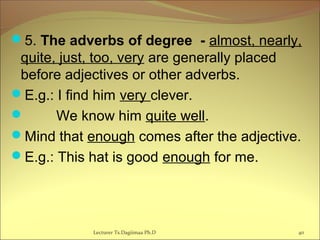
5. The adverbs of degree - almost, nearly,
quite, just, too, very are generally placed
before adjectives or other adverbs.
E.g.: I find him very clever.
 We know him quite well.
Mind that enough comes after the adjective.
E.g.: This hat is good enough for me.
Lecturer Ts.Dagiimaa Ph.D 40
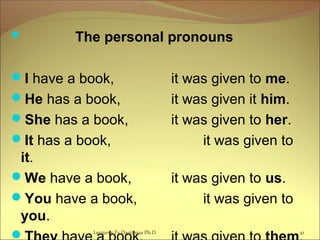
 The personal pronouns
I have a book, it was given to me.
He has a book, it was given it him.
She has a book, it was given to her.
It has a book, it was given to
it.
We have a book, it was given to us.
You have a book, it was given to
you.
 41Lecturer Ts.Dagiimaa Ph.D
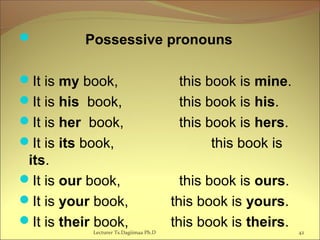
 Possessive pronouns
It is my book, this book is mine.
It is his book, this book is his.
It is her book, this book is hers.
It is its book, this book is
its.
It is our book, this book is ours.
It is your book, this book is yours.
It is their book, this book is theirs.
42Lecturer Ts.Dagiimaa Ph.D
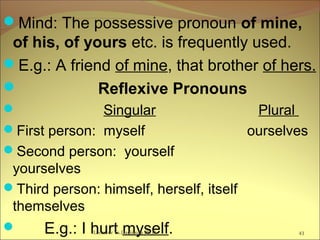
Mind: The possessive pronoun of mine,
of his, of yours etc. is frequently used.
E.g.: A friend of mine, that brother of hers.
 Reflexive Pronouns
 Singular Plural
First person: myself ourselves
Second person: yourself
yourselves
Third person: himself, herself, itself
themselves
 E.g.: I hurt myself. 43Lecturer Ts.Dagiimaa Ph.D
Some reflexive pronouns are used
emphatically and are called Emphasizing
Pronouns.
Both have the same form but their
functions are different. Compare:
E.g.: He washed himself.
 (reflexive pronoun).
 He himself washed the child.
 (emphasizing pronoun)

Lecturer Ts.Dagiimaa Ph.D 44
 Relative Pronouns
Who, whom are used for persons or
animals.
E.g.: The man who came in was my father.
Whose is mainly used for human beings or
animals but it may be applied to things too.
E.g.: He wore a coat whose collar almost
reached his ears.
Which as a relative pronoun is used only for
things or animals.
E.g.: He showed me the letter which he had
got from his friend. 45Lecturer Ts.Dagiimaa Ph.D
My dog which was lost, is found.
That is mainly used both for animals and
things. E.g.: This is the house that Jack built.
After ordinal numbers, the words all, any,
only and combinations of nouns with
adjectives in the superlative degree only that
is used.
E.g.: Shakespeare is the greatest poet that
England has ever had.
What is used to replace the noun.
E.g.: Tell us what you know.
Lecturer Ts.Dagiimaa Ph.D 46
As is used as a relative pronoun after same
and such and may refer to living beings and
things.
E.g.: I haven’t the same opinion as you
have. It’s not such an interesting film as we
thought.
Mind : With collective nouns, denoting
person, which is used with the verb in the
singular and who with the verb in the plural.
E.g.: The London team which played so well
last season has bad results this summer.
47Lecturer Ts.Dagiimaa Ph.D
E.g.: The team, who are just getting their
tickets, will meet on the platform at 2.30.
The Relative pronoun is often omitted.
E.g.: I’m going to the picture you told
me about.
Lecturer Ts.Dagiimaa Ph.D 48
 LECTURE 3
 DEMONSTRATIVE,
 INTERROGATIVE,
 INDEFINITE, NEGATIVE
 PRONOUNS & ONE
 ANOTHER, EITHER,
 NEITHER, SOME, ANY,
Lecturer Ts.Dagiimaa Ph.D 49
Lecturer Ts.Dagiimaa Ph.D 50
 Demonstrative Pronouns
Singular: this , that
Plural: these, those
E.g.: This is my brother, these are my
brothers.
Mind: When there is some idea of
comparison or selection the pronouns one /
ones are often placed after these
demonstratives.
E.g.: I don’t like this hat, I’ll buy that one.
Such is used to mean “so great” or “of that
kind”. E.g.: Such is the power of the man.
The former is used for the first of the
two, the latter for the second of the
two.
E.g.: Shakespeare and Pushkin were
both great poets, the former lived in
the sixteenth, the latter in the
nineteenth century.


Lecturer Ts.Dagiimaa Ph.D 51
 Interrogative Pronouns
The interrogative pronouns who, whom,
whose, what, which are used to form
questions.
1. Who, whom, whose are used in
reference to persons.
E.g.: Who is this woman?
 Who are these people?
 Whom did you speak to?
 Whose bag is this?
52Lecturer Ts.Dagiimaa Ph.D
2. Which has a selective meaning.
E.g.: Here are three books. Which
would you like to read?
3. What can be used instead of a noun
( What do you mean? ) and an
adjective
( What picture are you going to see? )
Lecturer Ts.Dagiimaa Ph.D 53
Distinguish between:
a) Who is he? (What is his name?)
- He is Jason.
What is he? What is his profession?
- He is a worker.
Which Jason do you mean?
- I mean my neighbor.
What shall we read ? - We’ll read
Shakespeare’s plays.
Which of Shakespeare’s plays shall we
read? - Macbeth.
54Lecturer Ts.Dagiimaa Ph.D
  Indefinite Pronouns
1. Much and little are used with
uncountable nouns and demand the verb in
the singular.
E.g.: I have much (little) time.
 Much (little) can be said about.
2. Many and few are used with countable
nouns and demand the verb in the plural.
E.g.: Many (few) students of our group
passed the exams well.
55Lecturer Ts.Dagiimaa Ph.D
In spoken English instead of many and much
in affirmative sentences such expressions as a
lot of…, lots of…, plenty of…., a great deal
of… are often used. E.g.: I’ve got a few books
on literary criticism. I’ve got a little time.
3. Other may be used both in the singular and
in the plural. It can be used with the definite
article or indefinite article.
E.g.: Give me another example. Give me the
other example of these two. Give me other
examples. This example is not very good, read
me the others on page five.
Lecturer Ts.Dagiimaa Ph.D 56
4. One is often used in the sense of any
person or every person.
E.g.: One must observe the traffic rules.
One or ones are used as word-substitutes
to avoid repetition of nouns. E.g.: I don’t like
this blue hat. I’ll buy the red one.
Mind: Besides one pronouns that and
those can be used as word-substitutes.
E.g.: The price of gold is higher than that of
silver. Our computing centre got some new
computers similar to those described in this
magazine.
Lecturer Ts.Dagiimaa Ph.D 57
5. All takes a group of things or persons as a
whole and can be used both in the singular or
in the plural.
E.g.: All are present today. All is lost.
Before singular nouns the whole is more
often used. Compare:
E.g.: All books were interesting. I read the
whole book with great interest.
6. Both is used when two persons or things
are regarded together. E.g.: we both, they both
Lecturer Ts.Dagiimaa Ph.D 58
7. Every and each refer to the members
taken one by one. Every is mostly used
when the members of a group have
something in common. Each is used when
there is some point of difference.
E.g.: It was a rush – hour and every bus
was full. Helen gave each of the guests a
cup of tea.
8. Each other is used when there are two
persons concerned.
E.g.: Tom and Helen loved each other.
59Lecturer Ts.Dagiimaa Ph.D
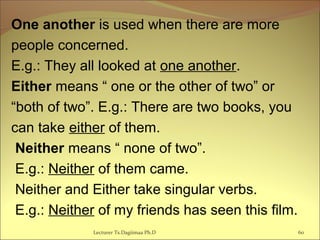
One another is used when there are more
people concerned.
E.g.: They all looked at one another.
Either means “ one or the other of two” or
“both of two”. E.g.: There are two books, you
can take either of them.
Neither means “ none of two”.
E.g.: Neither of them came.
Neither and Either take singular verbs.
E.g.: Neither of my friends has seen this film.
Lecturer Ts.Dagiimaa Ph.D 60
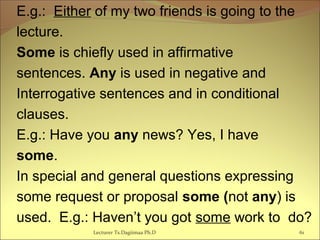
E.g.: Either of my two friends is going to the
lecture.
Some is chiefly used in affirmative
sentences. Any is used in negative and
Interrogative sentences and in conditional
clauses.
E.g.: Have you any news? Yes, I have
some.
In special and general questions expressing
some request or proposal some (not any) is
used. E.g.: Haven’t you got some work to do?
Lecturer Ts.Dagiimaa Ph.D 61
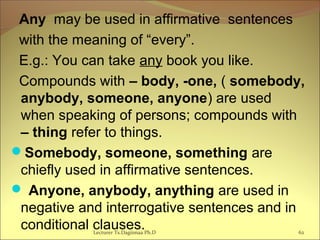
Any may be used in affirmative sentences
with the meaning of “every”.
E.g.: You can take any book you like.
Compounds with – body, -one, ( somebody,
anybody, someone, anyone) are used
when speaking of persons; compounds with
– thing refer to things.
Somebody, someone, something are
chiefly used in affirmative sentences.
 Anyone, anybody, anything are used in
negative and interrogative sentences and in
conditional clauses.Lecturer Ts.Dagiimaa Ph.D 62
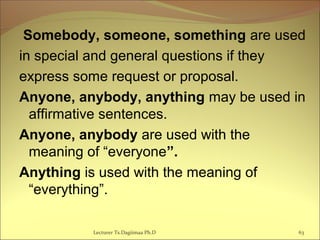
Somebody, someone, something are used
in special and general questions if they
express some request or proposal.
Anyone, anybody, anything may be used in
affirmative sentences.
Anyone, anybody are used with the
meaning of “everyone”.
Anything is used with the meaning of
“everything”.
63Lecturer Ts.Dagiimaa Ph.D
 Negative Pronouns
No and none are the negative forms of any.
The pronoun no is used only before a noun
both in the singular and plural.
E.g.: I have no time to do this today. He had
no friends there.
The pronoun none is the absolute form used
without no accompanying noun. It can be
used both for human beings and things.
E.g.: None of us knew the answer.
64Lecturer Ts.Dagiimaa Ph.D
Compounds nobody, no one, nothing are
the negative forms of anybody, anyone,
anything.
Nobody and no one refer to human beings.
E.g.: There was nobody in the room.
 No one knew the stranger.
Nothing refers to things.
E.g.: He could do nothing about it.
65Lecturer Ts.Dagiimaa Ph.D
 LECTURE 4

 PREPOSITIONS
 & SOME USEFUL
 PREPOSITIONS
Lecturer Ts.Dagiimaa Ph.D 66
Prepositions
1. Prepositions can be simple (at, in, on
etc.,), compound (into, out of, upon etc.,)
and phrase prepositions (in front of, by
means of, etc.,). Some prepositions coincide
with the adverbs. We can tell one from the
other if we regard the role which they play in
the sentence.
Compare: We shall go home after the lecture.
(prep.) I didn’t meet him after. (adverb)
67Lecturer Ts.Dagiimaa Ph.D
2. Prepositions are usually placed before the
word with which they are connected. But
some prepositions are very often used at the
end of the sentences. They are usually
prepositions that are closely associated with
verbs.
E.g.: I study at the University.
But : What are you looking at?
(in interrogative sentences).
The factory she works at is very large.
(in attributive clauses).
68Lecturer Ts.Dagiimaa Ph.D
                           At, On and In
At, on, in generally express the idea of position.
E.g.: I am at home. I met him at the party.
At, on, and in are used in expressions of time
and date.
At – for moments of time.
E.g.: at eight o’clock, at half past four
On – for days and dates.
E.g.: on Sundays, on August 30th
In – for weeks, months, seasons and years.
E.g.: in 1970, in summer, in the morning, in the
afternoon, in the first week of July. 69Lecturer Ts.Dagiimaa Ph.D
Some combinations with at, on and in.
On time – “ at the arranged”.
E.g.: The 10 a.m. train started on time.
In time –“ not late”. E.g.: They never come in
time. In time can also mean “in the end”.
E.g.: You’ll get used to it in time.
In a year, in two days, in an hour
E.g.: He will come in two hours.
At the beginning (of), at the end (of).
E.g.: at the beginning of the book, at the end of
the book
Lecturer Ts.Dagiimaa Ph.D 70
In the beginning –“at first”; in the end–“at last”.
In is used for countries, big towns, provinces
and regions or any enclosed space.
E.g.: The delegation will arrive in Moscow on
Monday.
At is used for small towns, villages, suburbs,
certain points (e.g., a cross-road, a bridge, a
bus-stop).
Where either in or at can be used, there is a
slight difference in meaning.
At means “inside”, “outside” or “beside” the
building. In means “inside” only.
Lecturer Ts.Dagiimaa Ph.D 71
In, Into and To
In is used for position as shown above.
E.g.: He is in the room.
Into (and to) express movement and are used
with verbs of motion.
E.g.: He came into the room.
I go to my office by train.
72Lecturer Ts.Dagiimaa Ph.D
To and Till / Until
To can be used for place and time.
E.g.: We work from 8.00 to 6.00 or from 8.0
till 6.00. till / until for time only.
E.g.: let’s start now and work till dark.
Till is often used with a negative verb to
emphasize lateness.
E.g.: I shan’t get there till 5o’clock.
Lecturer Ts.Dagiimaa Ph.D 73
During and For
During is used before known periods of time,
such as: winter, vacation, holidays etc. It’s
therefore usually followed immediately by the
name of a period or by the, this, that, these
or those. E.g.: during the summer, during the
1960, during that time, during his childhood
For is used for a period of time, definite in
length but otherwise indefinite. It is usually
followed by a singular noun preceded by a, a
plural noun, an adjective of quantity, or ever.
E.g.: for a long time, for a year, for five days
74Lecturer Ts.Dagiimaa Ph.D
Either for or during can be used before the
whole. Neither is used before all.
E.g.: He worked for the whole day.
But: He worked all day.
As it has been pointed out, for is used with a
period.
Since is used with a point of time and
always with a Perfect Tense.
E.g: I haven’t seen him since five o’clock.
(the beginning of the month; last year, we
came back).Lecturer Ts.Dagiimaa Ph.D 75
  By and With
By in connection with a noun is usually used for
the doer of the action in the Passive Voice and
with for the instruments with which the action
is done.
E.g.: His hair was cut by his mother with the
scissors.
There are many other uses of both
prepositions. E.g.: Come and sit by the
window. She said she would have returned
home by nine o’clock. He came in with his
friend.
76Lecturer Ts.Dagiimaa Ph.D
Beside and Besides
Beside means “near by”, “close by”, “by the
side of”. E.g.: Come and sit beside me.
Besides, as a preposition, means “in
addition to”, or “other than”.
E.g.: Some other people besides Peter will
go there.
Besides is also a conjunction meaning
“furthermore”.
77Lecturer Ts.Dagiimaa Ph.D
Between and Among
Between is used for only two things or
persons. E.g.: A new agreement was signed
between the two countries.
Among is used for more than two persons or
things. E.g.: Come and sit among us.
Lecturer Ts.Dagiimaa Ph.D 78
Some other useful prepositions
Of expresses grammatical relations.
E.g.: The leg of the table.
The end of the day.
Of can be used to mean “consisting of”
or “containing”. E.g.: A chest of
drawers, a suit of clothes, a book of
essays
Lecturer Ts.Dagiimaa Ph.D 79
Of is used in many different combinations.
E.g.: It was kind of you to do that.
We are tired of all this.
Also : on account of, on behalf of, for the
sake of, in the hope of, to the left of
Up and down have the basic function of
expressing motion or position in the vertical
direction.
E.g.: To go up the hill, go down the hill
80Lecturer Ts.Dagiimaa Ph.D
Up and down can also express horizontal
movement or position.
E.g.: He has gone up the road. He has gone
Down the road. Same: He has gone along
the road.
When Englishmen use up and down for
rivers they mean either towards the source
of the river. (“upstream”) or towards its
mouth (“downstream”).
Over and under are used both for motion and
for position.
81Lecturer Ts.Dagiimaa Ph.D
E.g.: The bird flew over the house. He
climbed over the wall. The bus went under
the railway bridge. The village is over the
hills (the other side of the hills)
Sometimes over is used with a vague
meaning of “away somewhere”.
E.g.: She has just gone over to the shops.
Above and below correspond in meaning to
over and under, but they are generally used
to express position and only seldom to
express motion. They are often used as
adverbs.
Lecturer Ts.Dagiimaa Ph.D 82
E.g.: The airplane was flying above the sea,
but when we looked down we saw only clouds
below. He looked at the sky above.
There is not much difference between below
and beneath, but the latter is perhaps rather
more precise, meaning “immediately below”.
Beyond is used to express both position and
motion. E.g.: The house is beyond the school.
The word “beyond’ is often used figuratively.
E.g.: It is beyond all belief – incredible. We
succeeded beyond our hopes and dreams–
much better than we expected. This is beyond
me. Lecturer Ts.Dagiimaa Ph.D 83
Against is a synonym of “beside and touching
it”. E.g.: The bookcase is against the wall.
Against is also the opposite of for, when for
means “in favor of”.
Towards is used figuratively, meaning
“as a contribution to” and in the expressions
towards the end of the month, towards the
middle of the year, meaning “nearly at the
end of” and “about the middle of”.
Lecturer Ts.Dagiimaa Ph.D 84
After is used to denote time and place.
E.g.: I came home after two o’clock.
He entered the room after me.
Before is contrary in meaning to “after”.
E.g.: Before lunch I had a walk. I was in Kiev a
fortnight before I was in Minsk.
Don’t mix up before and ago, after and
afterwards (later).
E.g.: I was in Kiev a fortnight ago. Before I
came to Kiev I had been to Leningrad. I came
home after they had left. I came home.
Afterwards they left.
85Lecturer Ts.Dagiimaa Ph.D
LECTURE 5
THE VERBS
“TO BE”,“TO DO”
“TO HAVE” &
CAN, COULD
Lecturer Ts.Dagiimaa Ph.D 86
Verb To be
I. To be as a notional verb is used to express:
1. Information about persons or things.
E.g.: He is a student. He was at the library.
She will be at home.
2. Mental or physical condition.
E.g.: I am ill. He is a cheerful.
3. Age. E.g.: She is twenty years old.
4. Price, time and date, distance, size and so
on. E.g.: It is late.
87Lecturer Ts.Dagiimaa Ph.D
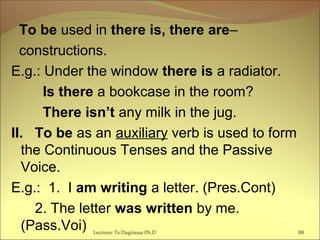
To be used in there is, there are–
constructions.
E.g.: Under the window there is a radiator.
Is there a bookcase in the room?
There isn’t any milk in the jug.
II. To be as an auxiliary verb is used to form
the Continuous Tenses and the Passive
Voice.
E.g.: 1. I am writing a letter. (Pres.Cont)
2. The letter was written by me.
(Pass.Voi) Lecturer Ts.Dagiimaa Ph.D 88
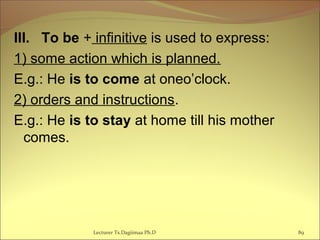
III. To be + infinitive is used to express:
1) some action which is planned.
E.g.: He is to come at oneo’clock.
2) orders and instructions.
E.g.: He is to stay at home till his mother
comes.
89Lecturer Ts.Dagiimaa Ph.D
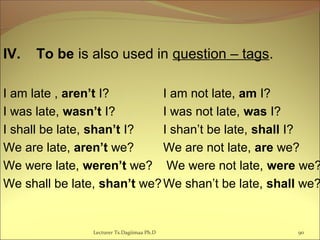
IV. To be is also used in question – tags.
I am late , aren’t I? I am not late, am I?
I was late, wasn’t I? I was not late, was I?
I shall be late, shan’t I? I shan’t be late, shall I?
We are late, aren’t we? We are not late, are we?
We were late, weren’t we? We were not late, were we?
We shall be late, shan’t we?We shan’t be late, shall we?
90Lecturer Ts.Dagiimaa Ph.D
Lecturer Ts.Dagiimaa Ph.D 91
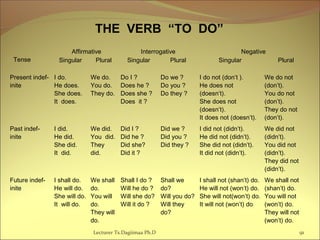
THE VERB “TO DO”
Tense
Affirmative Interrogative Negative
Singular Plural Singular Plural Singular Plural
Present indef-
inite
I do.
He does.
She does.
It does.
We do.
You do.
They do.
Do I ?
Does he ?
Does she ?
Does it ?
Do we ?
Do you ?
Do they ?
I do not (don’t ).
He does not
(doesn’t).
She does not
(doesn’t).
It does not (doesn’t).
We do not
(don’t).
You do not
(don’t).
They do not
(don’t).
Past indef-
inite
I did.
He did.
She did.
It did.
We did.
You did.
They
did.
Did I ?
Did he ?
Did she?
Did it ?
Did we ?
Did you ?
Did they ?
I did not (didn’t).
He did not (didn’t).
She did not (didn’t).
It did not (didn’t).
We did not
(didn’t).
You did not
(didn’t).
They did not
(didn’t).
Future indef-
inite
I shall do.
He will do.
She will do.
It will do.
We shall
do.
You will
do.
They will
do.
Shall I do ?
Will he do ?
Will she do?
Will it do ?
Shall we
do?
Will you do?
Will they
do?
I shall not (shan’t) do.
He will not (won’t) do.
She will not(won’t) do.
It will not (won’t) do
We shall not
(shan’t) do.
You will not
(won’t) do.
They will not
(won’t) do.
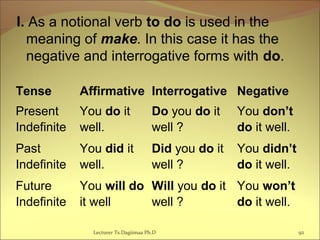
I. As a notional verb to do is used in the
meaning of make. In this case it has the
negative and interrogative forms with do.
Tense Affirmative Interrogative Negative
Present
Indefinite
You do it
well.
Do you do it
well ?
You don’t
do it well.
Past
Indefinite
You did it
well.
Did you do it
well ?
You didn’t
do it well.
Future
Indefinite
You will do
it well
Will you do it
well ?
You won’t
do it well.
92Lecturer Ts.Dagiimaa Ph.D
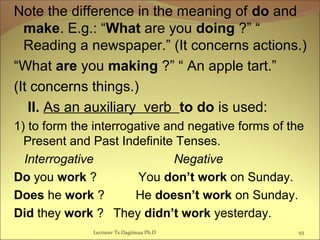
Note the difference in the meaning of do and
make. E.g.: “What are you doing ?” “
Reading a newspaper.” (It concerns actions.)
“What are you making ?” “ An apple tart.”
(It concerns things.)
II. As an auxiliary verb to do is used:
1) to form the interrogative and negative forms of the
Present and Past Indefinite Tenses.
Interrogative Negative
Do you work ? You don’t work on Sunday.
Does he work ? He doesn’t work on Sunday.
Did they work ? They didn’t work yesterday.
93Lecturer Ts.Dagiimaa Ph.D
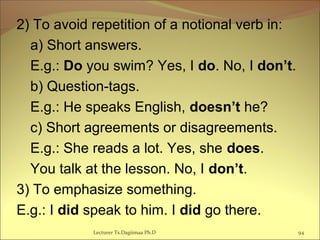
2) To avoid repetition of a notional verb in:
a) Short answers.
E.g.: Do you swim? Yes, I do. No, I don’t.
b) Question-tags.
E.g.: He speaks English, doesn’t he?
c) Short agreements or disagreements.
E.g.: She reads a lot. Yes, she does.
You talk at the lesson. No, I don’t.
3) To emphasize something.
E.g.: I did speak to him. I did go there.
94Lecturer Ts.Dagiimaa Ph.D
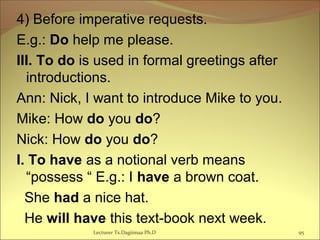
4) Before imperative requests.
E.g.: Do help me please.
III. To do is used in formal greetings after
introductions.
Ann: Nick, I want to introduce Mike to you.
Mike: How do you do?
Nick: How do you do?
I. To have as a notional verb means
“possess “ E.g.: I have a brown coat.
She had a nice hat.
He will have this text-book next week.
Lecturer Ts.Dagiimaa Ph.D 95
The interrogative and negative
constructions are formed with do or without
it:
Affirmative Interrogative Negative
I have a
book.
He has a
book.
Have I a book ?
Do I have a book ?
Has he a book ?
Does he have a
book ?
I have no book.
I don’t have a book.
He has no book.
He doesn’t have a
book.
96Lecturer Ts.Dagiimaa Ph.D
Verb To have
1. There is a tendency at present to use
do constructions except Perfect Tenses
the forms without do are practiced as
well.
E.g.: Do you have to go there each Sunday?
2. Very often have got is used in the
meaning of have. The negative and
interrogative forms of have got are
used with do as well as without it.
97Lecturer Ts.Dagiimaa Ph.D
Lecturer Ts.Dagiimaa Ph.D 98
Affirmative Interrogative Negative
We have
got a
garden.
Have you got a
garden?
Do you have got
a garden?
We haven’t got a
garden.
We don’t have got
a garden.
II. As an auxiliary verb to have is used to form
the Perfect Tenses.
III. As modal verb to have is used to express
obligation in the present, past and future.
E.g.: He has to come. He had to come.
He will have to come.
IV. To have is also used in question-tags:
I have time to spare, haven’t I?
I have no time to spare, have I?
I had time to spare, hadn’t I?
I had no time to spare, had I?
V. To have can also be used in some other
meanings, denoting process.
1) in the meaning of “take”.
He has a bath every day.
2) in the meaning of “encounter”.
She has a lot of trouble.
99Lecturer Ts.Dagiimaa Ph.D
3) in the meaning of “give”.
We are having a party tonight.
4) in the meaning of “enjoy”.
He is having a very pleasant time there.
VI. Had better + Infinitive without to is
used in the meaning of it would be better.
E.g.: You had better go to the doctor.
VII. To have is used in have-something -
done construction.
E.g.: I have my shoes cleaned.
(I made someone to clean my shoes).
100Lecturer Ts.Dagiimaa Ph.D
 Modal verbs are : can, may, must, need, ought
to, should, would, dare, have to + Infinitive,
to be + Infinitive.
Modal verbs have the following peculiarities:
1) they require no to with the infinitive followed
(except ought, need and dare)
2) they do not take – S in the 3rd
person singular;
3) they require no do in the interrogative and
negative forms (except dare, need, have +
Infinitive)
4) they have no future form;
101Lecturer Ts.Dagiimaa Ph.D
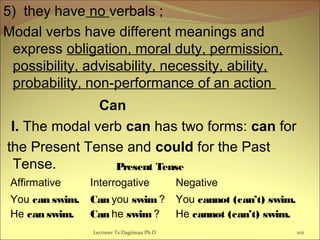
5) they have no verbals ;
Modal verbs have different meanings and
express obligation, moral duty, permission,
possibility, advisability, necessity, ability,
probability, non-performance of an action
Can
I. The modal verb can has two forms: can for
the Present Tense and could for the Past
Tense.
Lecturer Ts.Dagiimaa Ph.D 102
Present Tense
Affirmative Interrogative Negative
You can swim.
He can swim.
Can you swim ?
Can he swim ?
You cannot (can’t) swim.
He cannot (can’t) swim.
103Lecturer Ts.Dagiimaa Ph.D
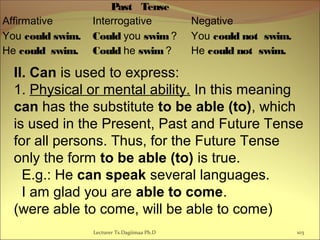
Past Tense
Affirmative Interrogative Negative
You could swim.
He could swim.
Could you swim ?
Could he swim ?
You could not swim.
He could not swim.
II. Can is used to express:
1. Physical or mental ability. In this meaning
can has the substitute to be able (to), which
is used in the Present, Past and Future Tense
for all persons. Thus, for the Future Tense
only the form to be able (to) is true.
E.g.: He can speak several languages.
I am glad you are able to come.
(were able to come, will be able to come)
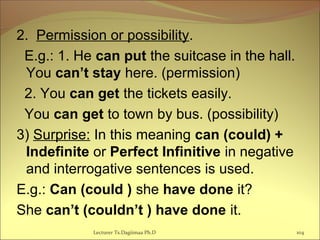
2. Permission or possibility.
E.g.: 1. He can put the suitcase in the hall.
You can’t stay here. (permission)
2. You can get the tickets easily.
You can get to town by bus. (possibility)
3) Surprise: In this meaning can (could) +
Indefinite or Perfect Infinitive in negative
and interrogative sentences is used.
E.g.: Can (could ) she have done it?
She can’t (couldn’t ) have done it.
104Lecturer Ts.Dagiimaa Ph.D
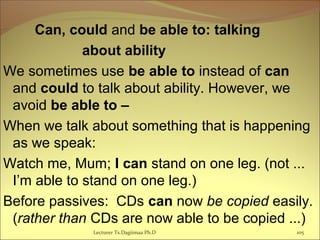
Can, could and be able to: talking
about ability
We sometimes use be able to instead of can
and could to talk about ability. However, we
avoid be able to –
When we talk about something that is happening
as we speak:
Watch me, Mum; I can stand on one leg. (not ...
I’m able to stand on one leg.)
Before passives: CDs can now be copied easily.
(rather than CDs are now able to be copied ...)
Lecturer Ts.Dagiimaa Ph.D 105
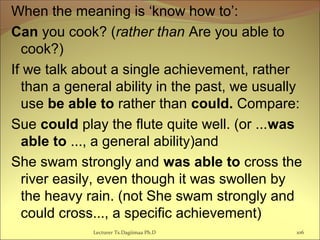
When the meaning is ‘know how to’:
Can you cook? (rather than Are you able to
cook?)
If we talk about a single achievement, rather
than a general ability in the past, we usually
use be able to rather than could. Compare:
Sue could play the flute quite well. (or ...was
able to ..., a general ability)and
She swam strongly and was able to cross the
river easily, even though it was swollen by
the heavy rain. (not She swam strongly and
could cross..., a specific achievement)
Lecturer Ts.Dagiimaa Ph.D 106
However, could is usually more natural –
in negative sentences:
I tried to get up but I couldn’t move. (rather
than .... I wasn’t able to move.)
With verbs of the senses – e.g. feel, hear,
see, smell, taste – and with verbs of
‘thinking’ – e.g. believe, decide, remember,
understand:
I could remember the crash, but nothing after
that. (rather than I was able to remember ...)
Lecturer Ts.Dagiimaa Ph.D 107
After the phrases the only thing /place/
time, and after all when it means ‘the only
thing’:
All we could see were his feet. (rather than
All we were able to ...)
to suggest that something almost didn’t
happen, particularly with almost, hardly,
just, nearly:
I could nearly touch the ceiling. (rather than I
was nearly able to...)
Lecturer Ts.Dagiimaa Ph.D 108
LECTURE 6
MODAL VERBS: CAN,
COULD, BE ABLE TO,
BE ALLOWED TO
&
MAY, MUST
Lecturer Ts.Dagiimaa Ph.D 109
Can and could: talking about possibility
To talk about the theoretical possibility of
something happening we use could, not
can. However, we use can, not could, to
say that something is possible and actually
happens. Compare:
It could be expensive to keep a cat. (=if we
had one, it could or it may not be
expensive) and
It can be expensive to keep a cat. (=it can
be, and it sometimes is)
Lecturer Ts.Dagiimaa Ph.D 110
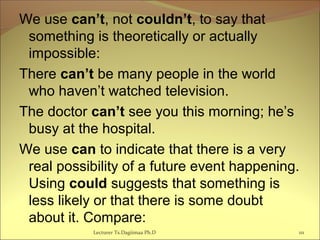
We use can’t, not couldn’t, to say that
something is theoretically or actually
impossible:
There can’t be many people in the world
who haven’t watched television.
The doctor can’t see you this morning; he’s
busy at the hospital.
We use can to indicate that there is a very
real possibility of a future event happening.
Using could suggests that something is
less likely or that there is some doubt
about it. Compare:
Lecturer Ts.Dagiimaa Ph.D 111
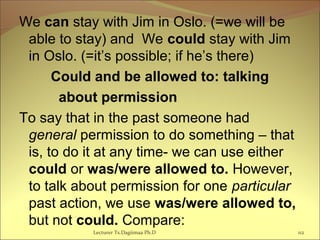
We can stay with Jim in Oslo. (=we will be
able to stay) and We could stay with Jim
in Oslo. (=it’s possible; if he’s there)
Could and be allowed to: talking
about permission
To say that in the past someone had
general permission to do something – that
is, to do it at any time- we can use either
could or was/were allowed to. However,
to talk about permission for one particular
past action, we use was/were allowed to,
but not could. Compare:
Lecturer Ts.Dagiimaa Ph.D 112
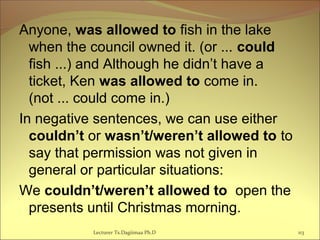
Anyone, was allowed to fish in the lake
when the council owned it. (or ... could
fish ...) and Although he didn’t have a
ticket, Ken was allowed to come in.
(not ... could come in.)
In negative sentences, we can use either
couldn’t or wasn’t/weren’t allowed to to
say that permission was not given in
general or particular situations:
We couldn’t/weren’t allowed to open the
presents until Christmas morning.
Lecturer Ts.Dagiimaa Ph.D 113
Lecturer Ts.Dagiimaa Ph.D 114
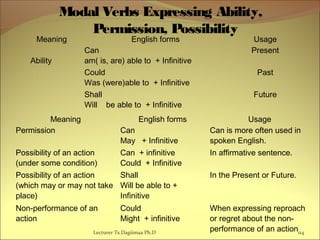
Meaning English forms Usage
Ability
Can
am( is, are) able to + Infinitive
Present
Could
Was (were)able to + Infinitive
Past
Shall
Will be able to + Infinitive
Future
Meaning English forms Usage
Permission Can
May + Infinitive
Can is more often used in
spoken English.
Possibility of an action
(under some condition)
Can + infinitive
Could + Infinitive
In affirmative sentence.
Possibility of an action
(which may or may not take
place)
Shall
Will be able to +
Infinitive
In the Present or Future.
Non-performance of an
action
Could
Might + infinitive
When expressing reproach
or regret about the non-
performance of an action
Modal Verbs Expressing Ability,
Permission, Possibility
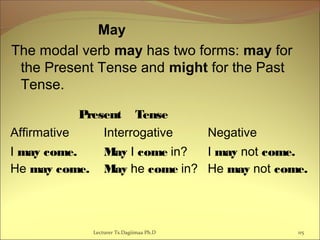
May
The modal verb may has two forms: may for
the Present Tense and might for the Past
Tense.
Lecturer Ts.Dagiimaa Ph.D 115
Present Tense
Affirmative Interrogative Negative
I may come.
He may come.
May I come in?
May he come in?
I may not come.
He may not come.
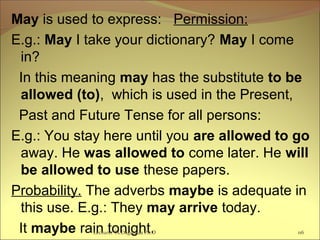
May is used to express: Permission:
E.g.: May I take your dictionary? May I come
in?
In this meaning may has the substitute to be
allowed (to), which is used in the Present,
Past and Future Tense for all persons:
E.g.: You stay here until you are allowed to go
away. He was allowed to come later. He will
be allowed to use these papers.
Probability. The adverbs maybe is adequate in
this use. E.g.: They may arrive today.
It maybe rain tonight. 116Lecturer Ts.Dagiimaa Ph.D
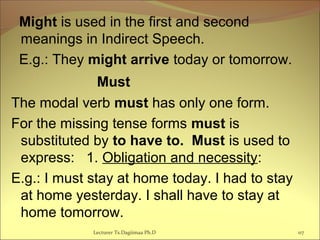
Might is used in the first and second
meanings in Indirect Speech.
E.g.: They might arrive today or tomorrow.
                         Must
The modal verb must has only one form.
For the missing tense forms must is
substituted by to have to. Must is used to
express: 1. Obligation and necessity:
E.g.: I must stay at home today. I had to stay
at home yesterday. I shall have to stay at
home tomorrow.
117Lecturer Ts.Dagiimaa Ph.D
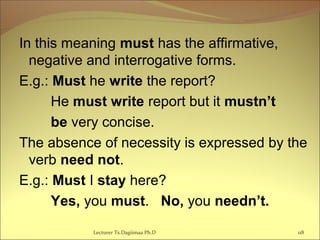
In this meaning must has the affirmative,
negative and interrogative forms.
E.g.: Must he write the report?
He must write report but it mustn’t
be very concise.
The absence of necessity is expressed by the
verb need not.
E.g.: Must I stay here?
Yes, you must. No, you needn’t.
Lecturer Ts.Dagiimaa Ph.D 118
2. Command. In this meaning must has no
substitute ( but to have to in the Past Tense
). E.g.: You must read this text once more.
You must go out at once.
3. Probability. In this meaning must is used
in the affirmative sentences only.
E.g.: He must be the captain of the ship.
4. Must + Perfect Infinitive denotes the action
in the Past. E.g.: They must have read this
newspaper article.
119Lecturer Ts.Dagiimaa Ph.D
Must and have (got) to
We use must and must not in formal rules and
regulations and in warnings:
E.g.: Bookings must be made at least seven
days before departure. The government must
not be allowed to appoint judges.
In spoken English we often use must and
mustn’t (=must not) to propose a future
arrangement, such as a meeting or social
event, without making detailed plans:
E.g.: We must get together more often.
We mustn’t leave it so long next time.
Lecturer Ts.Dagiimaa Ph.D 120
We can also use I must ... to remind ourselves
to do something: E.g.: I must phone Steve
when I get home. I said I’d call him last night,
but I forgot.
To draw a conclusion about –
* Something that happened in the past we use
must + have +past participle: E.g.: That’s
not Kate’s car. She must have borrowed it
from her parents.
* Something happening at or around the time of
speaking we use must be +-ing: I can’t hear
anyone moving around upstairs. You must be
imagining things.Lecturer Ts.Dagiimaa Ph.D 121
* Something that is likely to happen in the
future we use must be going to or must be
+ -ing:
‘What are all those workmen doing?’ ‘I think
they must be going to dig up the road.’
I was wrong about the meeting being today. It
must be happening next Friday.
* A present situation we use must be, or
have (got) to be in informal speech:
Their goalkeeper has got to be at least two
metres tall! (or ...must be ...)
Lecturer Ts.Dagiimaa Ph.D 122
We can use must have to to say that we
conclude something based on what we know
about a present situation and must have
had to to conclude something about a past
situation:
E.g.: I can’t start the computer. You must
have to know a password. (=a password is
necessary)
E.g.: John wasn’t at home when I went round.
He must have had to go out unexpectedly.
Lecturer Ts.Dagiimaa Ph.D 123
Note that we can’t say ‘must’ve to’ or ‘must
have got to/ must’ve got to’ (but we can
say must’ve had to).
In questions that hope for or expect a
negative answer we prefer have (got) to,
although in formal contexts must is
sometimes used:
Do we have to answer all the questions? (or
Have we got to ...?; Must we ...? is also
possible but rather formal)
Lecturer Ts.Dagiimaa Ph.D 124
We use have to in questions that imply a
criticism. Must can also be used, although
some people think this is rather old-
fashioned.
We usually stress have and must in
sentences like this:
E.g.: Do you have to play your trumpet
here? It’s deafening me! (or more formally
Must you play ...?)
Lecturer Ts.Dagiimaa Ph.D 125
Sometimes we can use either have to or have
got to. However –
* We use have to with frequency adverbs such
as always, never, normally, rarely, sometimes,
etc: I often have to work at the weekend to get
everything done.
* With the past simple we use had to especially
in questions and negative sentences:
E.g.: When did you have to give it back?(not
When had you got to give it back?) We didn’t
have to wait too long for an answer. (not We
hadn’t got to wait too long ...)
Lecturer Ts.Dagiimaa Ph.D 126
* If have is contracted (e.g. I’ve, He’s, It’d)
then we must include got: The experiment
has failed twice before, so it’s got to work
this time. (not ... so it’s to work this time.)
* We don’t use have got to with other modal
verbs: Employees will have to accept the
new conditions or be dismissed. (not
Employees will have got to accept...)
Notice also that have got to is often preferred
in informal speech.
Lecturer Ts.Dagiimaa Ph.D 127
Lecturer Ts.Dagiimaa Ph.D 128
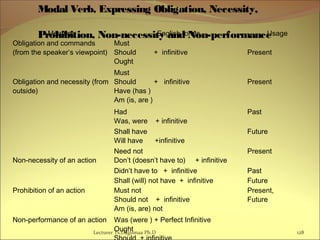
Meaning English forms Usage
Obligation and commands
(from the speaker’s viewpoint)
Must
Should + infinitive
Ought
Present
Obligation and necessity (from
outside)
Must
Should + infinitive
Have (has )
Am (is, are )
Present
Had
Was, were + infinitive
Past
Shall have
Will have +infinitive
Future
Non-necessity of an action
Need not
Don’t (doesn’t have to) + infinitive
Present
Didn’t have to + infinitive Past
Shall (will) not have + infinitive Future
Prohibition of an action Must not
Should not + infinitive
Am (is, are) not
Present,
Future
Non-performance of an action Was (were ) + Perfect Infinitive
Ought
Modal Verb, Expressing Obligation, Necessity,
Prohibition, Non-necessity and Non-performance
LECTURE 7
TO HAVE + INFINITIVE,
HAVE TO, NEED,
OUGHT TO
&
SHOULD
Lecturer Ts.Dagiimaa Ph.D 129
To have + Infinitive
To have + Infinitive as a modal expression,
is used in the Present,
Past and Future Indefinite Tense and
expresses an obligation or necessity
imposed from outside.
E.g.: I have to get up early. I had to get up
early yesterday. I shall have to get up early
tomorrow morning.
130Lecturer Ts.Dagiimaa Ph.D
Lecturer Ts.Dagiimaa Ph.D 131
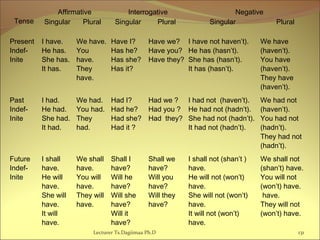
Tense
Affirmative Interrogative Negative
Singular Plural Singular Plural Singular Plural
Present
Indef-
Inite
I have.
He has.
She has.
It has.
We have.
You
have.
They
have.
Have I?
Has he?
Has she?
Has it?
Have we?
Have you?
Have they?
I have not haven’t).
He has (hasn’t).
She has (hasn’t).
It has (hasn’t).
We have
(haven’t).
You have
(haven’t).
They have
(haven’t).
Past
Indef-
Inite
I had.
He had.
She had.
It had.
We had.
You had.
They
had.
Had I?
Had he?
Had she?
Had it ?
Had we ?
Had you ?
Had they?
I had not (haven’t).
He had not (hadn’t).
She had not (hadn’t).
It had not (hadn’t).
We had not
(haven’t).
You had not
(hadn’t).
They had not
(hadn’t).
Future
Indef-
Inite
I shall
have.
He will
have.
She will
have.
It will
have.
We shall
have.
You will
have.
They will
have.
Shall I
have?
Will he
have?
Will she
have?
Will it
have?
Shall we
have?
Will you
have?
Will they
have?
I shall not (shan’t )
have.
He will not (won’t)
have.
She will not (won’t)
have.
It will not (won’t)
have.
We shall not
(shan’t) have.
You will not
(won’t) have.
have.
They will not
(won’t) have.
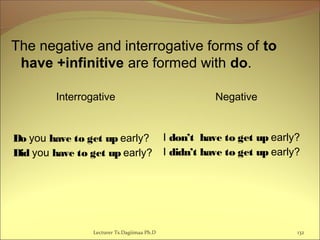
The negative and interrogative forms of to
have +infinitive are formed with do.
Lecturer Ts.Dagiimaa Ph.D 132
Interrogative Negative
Do you have to get up early?
Did you have to get up early?
I don’t have to get up early?
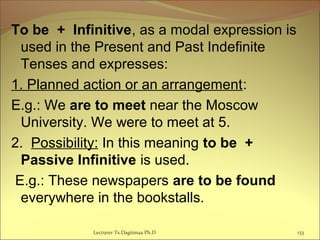
I didn’t have to get up early?
To be + Infinitive, as a modal expression is
used in the Present and Past Indefinite
Tenses and expresses:
1. Planned action or an arrangement:
E.g.: We are to meet near the Moscow
University. We were to meet at 5.
2. Possibility: In this meaning to be +
Passive Infinitive is used.
E.g.: These newspapers are to be found
everywhere in the bookstalls.
133Lecturer Ts.Dagiimaa Ph.D
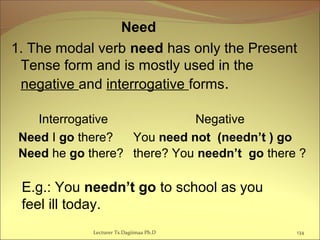
Need
1. The modal verb need has only the Present
Tense form and is mostly used in the
negative and interrogative forms.
Interrogative Negative
Need I go there?
Need he go there?
You need not (needn’t ) go
there? You needn’t go there ?
134Lecturer Ts.Dagiimaa Ph.D
E.g.: You needn’t go to school as you
feel ill today.
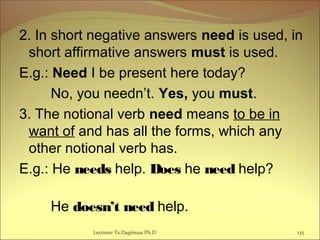
2. In short negative answers need is used, in
short affirmative answers must is used.
E.g.: Need I be present here today?
No, you needn’t. Yes, you must.
3. The notional verb need means to be in
want of and has all the forms, which any
other notional verb has.
E.g.: He needs help. Does he need help?
He doesn’t need help.
135Lecturer Ts.Dagiimaa Ph.D
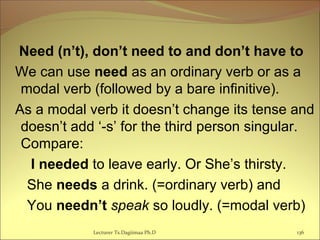
Need (n’t), don’t need to and don’t have to
We can use need as an ordinary verb or as a
modal verb (followed by a bare infinitive).
As a modal verb it doesn’t change its tense and
doesn’t add ‘-s’ for the third person singular.
Compare:
I needed to leave early. Or She’s thirsty.
She needs a drink. (=ordinary verb) and
You needn’t speak so loudly. (=modal verb)
Lecturer Ts.Dagiimaa Ph.D 136
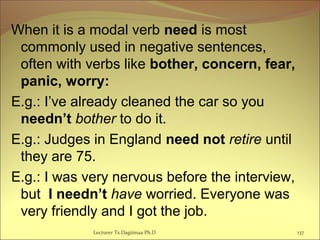
When it is a modal verb need is most
commonly used in negative sentences,
often with verbs like bother, concern, fear,
panic, worry:
E.g.: I’ve already cleaned the car so you
needn’t bother to do it.
E.g.: Judges in England need not retire until
they are 75.
E.g.: I was very nervous before the interview,
but I needn’t have worried. Everyone was
very friendly and I got the job.
Lecturer Ts.Dagiimaa Ph.D 137
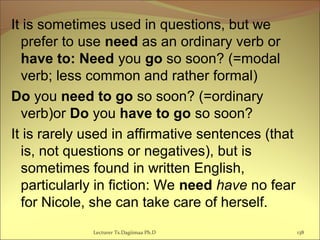
It is sometimes used in questions, but we
prefer to use need as an ordinary verb or
have to: Need you go so soon? (=modal
verb; less common and rather formal)
Do you need to go so soon? (=ordinary
verb)or Do you have to go so soon?
It is rarely used in affirmative sentences (that
is, not questions or negatives), but is
sometimes found in written English,
particularly in fiction: We need have no fear
for Nicole, she can take care of herself.
Lecturer Ts.Dagiimaa Ph.D 138
In other styles of formal written English it is
used in this way with negative words such
as hardly, never, nobody/ no-one, and
only:
E.g.: The changes need only be small to
make the proposals acceptable. (less
formally The changes only need to be...)
Nobody ever need know about the money.
(less formally Nobody ever needs to know...)
‘I don’t want my parents to know.’ ‘They need
never find out.’ (less formally They never
need to find out.)Lecturer Ts.Dagiimaa Ph.D 139
To give permission not to do something we can
use either needn’t or don’t need to:
You needn’t cut the grass, I’ll do it later.
(or You don’t need to cut the grass...)
To talk about a general necessity, we prefer
don’t need to: You don’t need to be over 18
to get into a disco.(rather than You needn’t be...)
We can often use either needn’t or don’t have
to with little difference in meaning to say that it
is unnecessary to do something:
You needn’t whisper. Nobody can hear us. (or
You don’t have to ...)Lecturer Ts.Dagiimaa Ph.D 140
However, some people prefer needn’t when
it is the speaker who decides the lack of
necessity, and don’t have to when
external rules or somebody else’s actions
make something unnecessary. Compare:
As you worked late yesterday you needn’t
come in until 10.00 tomorrow morning. (the
speaker’s decision) and
We’ve been told that we don’t have to be at
work until 10.00 tomorrow. (reporting
someone else’s decision.)
Lecturer Ts.Dagiimaa Ph.D 141
We can use needn’t (or don’t have to) to
say that something is not necessarily true.
We don’t use mustn’t in this way:
Volcanoes needn’t erupt constantly to be
classified as ‘active’. (or Volcanoes don’t
have to erupt...; not Volcanoes mustn’t
erupt...)
Nowadays it needn’t cost a fortune to own
a powerful computer. (or Nowadays it
doesn’t have to cost ...; not Nowadays it
mustn’t cost ...)
Lecturer Ts.Dagiimaa Ph.D 142
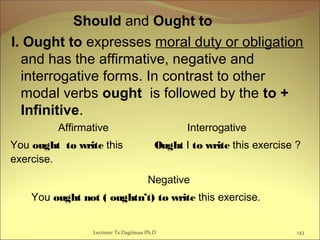
Should and Ought to
I. Ought to expresses moral duty or obligation
and has the affirmative, negative and
interrogative forms. In contrast to other
modal verbs ought is followed by the to +
Infinitive.
143Lecturer Ts.Dagiimaa Ph.D
Affirmative Interrogative
You ought to write this
exercise.
Ought I to write this exercise ?
Negative
You ought not ( oughtn’t) to write this exercise.
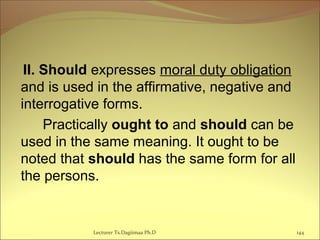
II. Should expresses moral duty obligation
and is used in the affirmative, negative and
interrogative forms.
Practically ought to and should can be
used in the same meaning. It ought to be
noted that should has the same form for all
the persons.
Lecturer Ts.Dagiimaa Ph.D 144
Lecturer Ts.Dagiimaa Ph.D 145
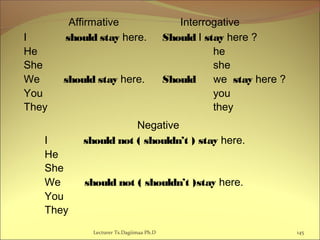
Affirmative Interrogative
I should stay here.
He
She
We should stay here.
You
They
Should I stay here ?
he
she
Should we stay here ?
you
they
Negative
I should not ( shouldn’t ) stay here.
He
She
We should not ( shouldn’t )stay here.
You
They
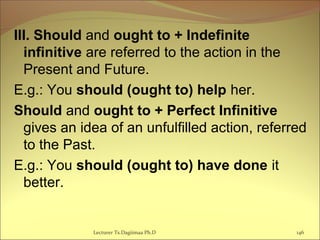
III. Should and ought to + Indefinite
infinitive are referred to the action in the
Present and Future.
E.g.: You should (ought to) help her.
Should and ought to + Perfect Infinitive
gives an idea of an unfulfilled action, referred
to the Past.
E.g.: You should (ought to) have done it
better.
146Lecturer Ts.Dagiimaa Ph.D
IV. Should / Would + infinitive are used
to express wish in phrases I should like,
She would like.
E.g.: I should like to know all about him.
I should like to listen to this nice song
once more. He would like to stay here
for some time.
Lecturer Ts.Dagiimaa Ph.D 147
LECTURE 8
SHOULD, OUGHT TO,
WOULD, DARE &
PRESENT INDEFINITE,
PRESENT CONTINUOUS
TENSES
Lecturer Ts.Dagiimaa Ph.D 148
Should, ought to and had better
We can often use either should or ought to
to talk about obligations and
recommendations (e.g. You should/ought
to finish your homework before you go out)
and probability (e.g. it should/ought to be
ready by now) although in general should
is used more frequently.
Ought to is used particularly in speech and
most often to talk about obligation rather
than probability.
Lecturer Ts.Dagiimaa Ph.D 149
Notice also the following details –
* We prefer should when we say what an
outside authority recommends:
The manual says that the computer should
be disconnected from the power supply
before the cover is removed. (rather that ...
ought to be disconnected ...)
* We use should (or would), not ought to,
when we give advice with I...:
I should leave early tomorrow, if I were you.
(or I would leave...; or I’d leave...)
Lecturer Ts.Dagiimaa Ph.D 150
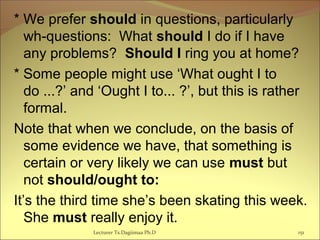
* We prefer should in questions, particularly
wh-questions: What should I do if I have
any problems? Should I ring you at home?
* Some people might use ‘What ought I to
do ...?’ and ‘Ought I to... ?’, but this is rather
formal.
Note that when we conclude, on the basis of
some evidence we have, that something is
certain or very likely we can use must but
not should/ought to:
It’s the third time she’s been skating this week.
She must really enjoy it.
Lecturer Ts.Dagiimaa Ph.D 151
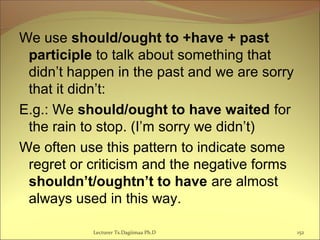
We use should/ought to +have + past
participle to talk about something that
didn’t happen in the past and we are sorry
that it didn’t:
E.g.: We should/ought to have waited for
the rain to stop. (I’m sorry we didn’t)
We often use this pattern to indicate some
regret or criticism and the negative forms
shouldn’t/oughtn’t to have are almost
always used in this way.
Lecturer Ts.Dagiimaa Ph.D 152
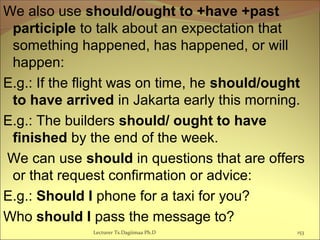
We also use should/ought to +have +past
participle to talk about an expectation that
something happened, has happened, or will
happen:
E.g.: If the flight was on time, he should/ought
to have arrived in Jakarta early this morning.
E.g.: The builders should/ ought to have
finished by the end of the week.
We can use should in questions that are offers
or that request confirmation or advice:
E.g.: Should I phone for a taxi for you?
Who should I pass the message to?
Lecturer Ts.Dagiimaa Ph.D 153
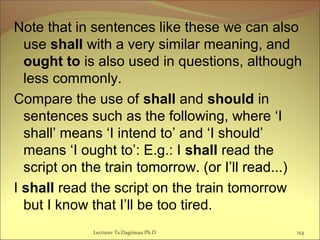
Note that in sentences like these we can also
use shall with a very similar meaning, and
ought to is also used in questions, although
less commonly.
Compare the use of shall and should in
sentences such as the following, where ‘I
shall’ means ‘I intend to’ and ‘I should’
means ‘I ought to’: E.g.: I shall read the
script on the train tomorrow. (or I’ll read...)
I shall read the script on the train tomorrow
but I know that I’ll be too tired.
Lecturer Ts.Dagiimaa Ph.D 154
We can use had better instead of should/ ought
to, especially in spoken English, to say that we
think it is a good idea to do something:
If you’re not well, you’d better ask Ann to go
instead. (or ... you should/ought to...) although
we don’t use it to talk about the past or to make
general comments:
You should/ought to have caught a later train.
(not You had better have caught...)
I don’t think parents should/ought to give their
children sweets. (not I don’t think parents had
better give their children sweets.)
Lecturer Ts.Dagiimaa Ph.D 155
We prefer had better if we want to express
particular urgency and in demands and threats:
E.g.: There’s someone moving about downstairs.
We’d better call the police, quickly.
Notice that the negative form is had better not.
In question forms the subject comes after had,
although many people avoid questions with had
better:
E.g.: He’d better not be late again or he’ll be in
trouble. Hadn’t we better get a taxi?(or
Shouldn’t we get ...?)
Lecturer Ts.Dagiimaa Ph.D 156
  Would
The modal verb would has the same form
for all persons and is used to express
different meanings. It expresses:
1. Volition.
E.g.: I would be happy to exchange
letters with you. I said that I would go to
the museum.
2. Persistence to do something.
E.g.: I asked him to tell the truth, but he
would not.
157Lecturer Ts.Dagiimaa Ph.D
3. A customary action in the Past.
E.g.: Sometimes they would visit him.
They would often talk about their life.
4. Polite requests.
E.g.: Would you mind giving me the
pencil?
Would you pass me the bread, please?
5. Would rather is used to express
reference.
Lecturer Ts.Dagiimaa Ph.D 158
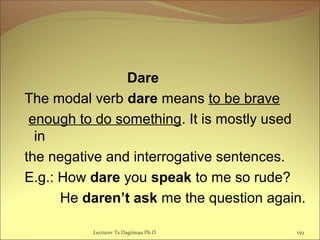
Dare
The modal verb dare means to be brave
enough to do something. It is mostly used
in
the negative and interrogative sentences.
E.g.: How dare you speak to me so rude?
He daren’t ask me the question again.
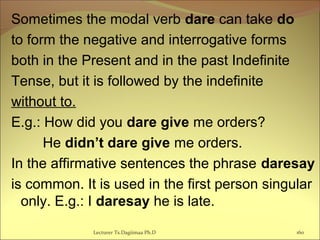
159Lecturer Ts.Dagiimaa Ph.D
Sometimes the modal verb dare can take do
to form the negative and interrogative forms
both in the Present and in the past Indefinite
Tense, but it is followed by the indefinite
without to.
E.g.: How did you dare give me orders?
He didn’t dare give me orders.
In the affirmative sentences the phrase daresay
is common. It is used in the first person singular
only. E.g.: I daresay he is late.
Lecturer Ts.Dagiimaa Ph.D 160
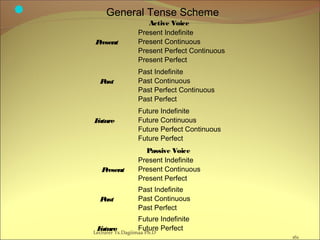
 General Tense Scheme
Lecturer Ts.Dagiimaa Ph.D
161
Active Voice
Present
Present Indefinite
Present Continuous
Present Perfect Continuous
Present Perfect
Past
Past Indefinite
Past Continuous
Past Perfect Continuous
Past Perfect
Future
Future Indefinite
Future Continuous
Future Perfect Continuous
Future Perfect
Passive Voice
Present
Present Indefinite
Present Continuous
Present Perfect
Past
Past Indefinite
Past Continuous
Past Perfect
Future
Future Indefinite
Future Perfect
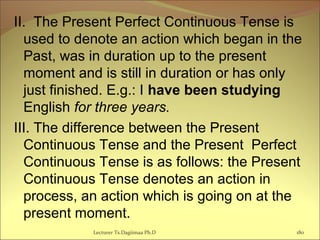
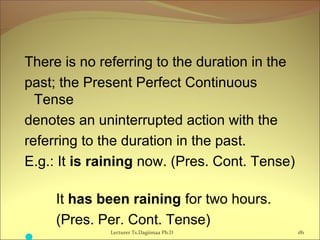
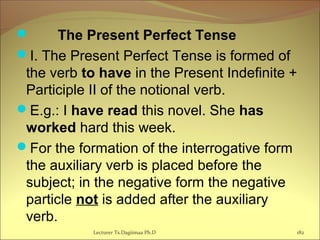
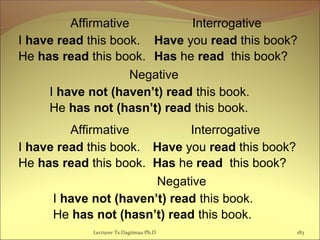
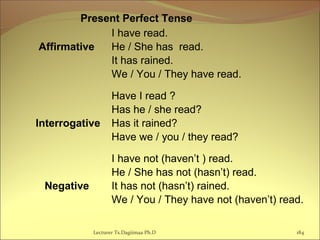
  The Present Indefinite Tense
The Present Indefinite Tense is formed from
the infinitive without to.
3rd
person singular –s or –es is added.
E.g.: he works [s], he writes [s], he learns [z],
he teaches [iz], he goes [z].
The interrogative and negative forms of the
Present Indefinite Tense are formed with the
verb do. E.g.: Do you study English? Yes, I
do. No, I do not. (don’t). Does he study
English? Yes, he does. No, he does not.
(doesn’t).
162Lecturer Ts.Dagiimaa Ph.D
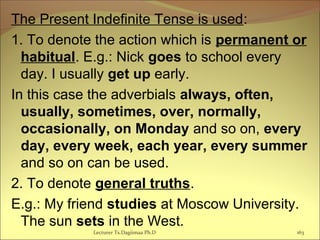
The Present Indefinite Tense is used:
1. To denote the action which is permanent or
habitual. E.g.: Nick goes to school every
day. I usually get up early.
In this case the adverbials always, often,
usually, sometimes, over, normally,
occasionally, on Monday and so on, every
day, every week, each year, every summer
and so on can be used.
2. To denote general truths.
E.g.: My friend studies at Moscow University.
The sun sets in the West.
Lecturer Ts.Dagiimaa Ph.D 163
Lecturer Ts.Dagiimaa Ph.D 164
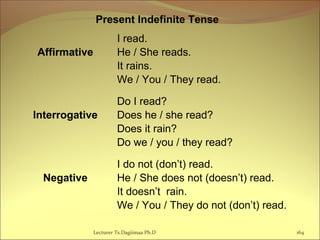
Present Indefinite Tense
Affirmative
I read.
He / She reads.
It rains.
We / You / They read.
Interrogative
Do I read?
Does he / she read?
Does it rain?
Do we / you / they read?
Negative
I do not (don’t) read.
He / She does not (doesn’t) read.
It doesn’t rain.
We / You / They do not (don’t) read.
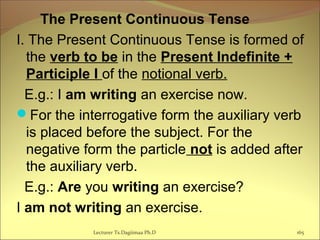
The Present Continuous Tense
I. The Present Continuous Tense is formed of
the verb to be in the Present Indefinite +
Participle I of the notional verb.
E.g.: I am writing an exercise now.
For the interrogative form the auxiliary verb
is placed before the subject. For the
negative form the particle not is added after
the auxiliary verb.
E.g.: Are you writing an exercise?
I am not writing an exercise.
165Lecturer Ts.Dagiimaa Ph.D
Lecturer Ts.Dagiimaa Ph.D 166
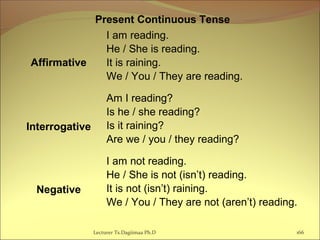
Present Continuous Tense
Affirmative
I am reading.
He / She is reading.
It is raining.
We / You / They are reading.
Interrogative
Am I reading?
Is he / she reading?
Is it raining?
Are we / you / they reading?
Negative
I am not reading.
He / She is not (isn’t) reading.
It is not (isn’t) raining.
We / You / They are not (aren’t) reading.
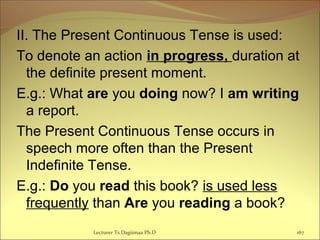
II. The Present Continuous Tense is used:
To denote an action in progress, duration at
the definite present moment.
E.g.: What are you doing now? I am writing
a report.
The Present Continuous Tense occurs in
speech more often than the Present
Indefinite Tense.
E.g.: Do you read this book? is used less
frequently than Are you reading a book?
Lecturer Ts.Dagiimaa Ph.D 167
Certain verbs are usually not used in the
Continuous Tenses. They are : be, have,
appear, believe, become, expect, feel,
forget, forgive, like, hate, hear, know, see,
seem, think.
Sometimes they are found in the Continuous
Tenses, if they have certain color in
meaning.
E.g.: How are you feeling? (in the medical
sense) How are you liking it?(in the
meaning of ‘enjoy’) I’m seeing you tomorrow.
(I shall visit you tomorrow) 168Lecturer Ts.Dagiimaa Ph.D
He is expecting the news today. (in the
meaning of ‘await’)
Are you hearing from him? (in the meaning of
‘having a news’)
I am thinking it over. (someone asks about
my opinion.)
To denote one’s plans in the nearest future
(the time of action must always be
mentioned).
Lecturer Ts.Dagiimaa Ph.D 169
E.g.: Are you doing anything special tonight?
Yes, I am going to the Club. Instead of a
future action in duration in
adverbial clauses of condition and time.
E.g.: If he is smoking when I am absent, I
shall blame him.
The Present Continuous Tense is never
used with the question word when,
except when the immediate future is to
be expressed.
170Lecturer Ts.Dagiimaa Ph.D
LECTURE 9
PRESENT CONTINUOUS
AND PRESENT SIMPLE
& PRESENT PERFECT
CONTINUOUS,
PRESENT PERFECT
TENSES
Lecturer Ts.Dagiimaa Ph.D 171
PRESENT CONTINUOUS AND
PRESENT SIMPLE
1. We can use the present continuous tense
with some state verbs (e.g.: attract, like, look,
love, sound) when we want to emphasize
that a situation is temporary or for a period of
time around the present.
Compare: Jean stays with us quite often.
The children love having her here. and
Jean’s with us at the moment.
The children are loving having her here.
Lecturer Ts.Dagiimaa Ph.D 172
2. Some verbs have different meanings when
they are used to talk about states and when
they describe actions. With their ‘state’
meanings, they usually take simple rather than
continuous forms. With their ‘action’ meanings,
they may take simple or continuous forms,
depending on context. Compare:
The new treatment for influenza doesn’t
appear to work. (appear: state = seem) and
Madonna is currently appearing in a musical
on Broadway. She is often appears in
musicals. (appear: action = take part.)
Lecturer Ts.Dagiimaa Ph.D 173
3. With some verbs describing mental states
(e.g.: find, realize, regret, think, understand)
we can use the present continuous to
emphasize that we have recently started to
think about something or that we are not sure
about something. Compare:
I regret that the company will have to be sold.
(=I have made the decision and I am sorry
about it) and I’m regretting my decision to
give her the job. (=I am increasingly aware that
It was the wrong decision)
Lecturer Ts.Dagiimaa Ph.D
174
When it means ‘think carefully about’ the verb
consider is only used with the present
continuous: E.g.: He is considering taking
early retirement. (not He considers taking early
retirement.)
4. We use present simple with verbs which
perform the action they describe:
E.g.: I admit I can’t see as well as I used to.
We apologize for not replying earlier.
Lecturer Ts.Dagiimaa Ph.D 175
5. We often use the present simple and
present continuous in stories and jokes in
informal spoken English to create the
impression that events are happening now.
This can make them more direct and
exciting and hold people’s attention:
E.g.: She goes up to this man and looks
straight into his eyes. He’s not wearing his
glasses, and he doesn’t recognize her ….
This man’s playing golf when a kangaroo bounds
up to him, grabs his club and hits his ball about
half a mile …
Lecturer Ts.Dagiimaa Ph.D 176
The main events are usually described in
sequence using the present simple and
longer background events are described
using the present continuous.
6. We also use the present simple and present
continuous in live commentaries (for
example, on sports events) when the report
takes place at the same time as the action:
King serves to the left-hand court and Adams
makes a wonderful return. She’s playing
magnificent tennis in this match …
Lecturer Ts.Dagiimaa Ph.D 177
I. Present Perfect Continuous Tense
is formed of the verb to be in the Present Perfect
Tense + Participle I of the notional verb.
E.g.: He has been writing the exercise for two
hours.
For the interrogative form the first auxiliary verb is
placed before the subject. For the negative form
the particle not is placed after the first auxiliary
verb.
E.g.: Has he been writing the exercise for two
hours? He has not been writing the exercise
for two hours.
178Lecturer Ts.Dagiimaa Ph.D
Lecturer Ts.Dagiimaa Ph.D 179
Present Perfect Continuous Tense
Affirmative
I have been reading.
He / She has been reading.
It has been raining.
We / You / They have been reading.
Interrogative
Have I been reading?
Has he/ she been reading?
Has it been raining?
Have we / you / they been reading?
Negative
I have not been reading.
He / She has not (hasn’t)been reading.
It has not (hasn’t)been raining.
We / You / They have not (haven’t)
been reading.
II. The Present Perfect Continuous Tense is
used to denote an action which began in the
Past, was in duration up to the present
moment and is still in duration or has only
just finished. E.g.: I have been studying
English for three years.
III. The difference between the Present
Continuous Tense and the Present Perfect
Continuous Tense is as follows: the Present
Continuous Tense denotes an action in
process, an action which is going on at the
present moment.
180Lecturer Ts.Dagiimaa Ph.D
There is no referring to the duration in the
past; the Present Perfect Continuous
Tense
denotes an uninterrupted action with the
referring to the duration in the past.
E.g.: It is raining now. (Pres. Cont. Tense)
It has been raining for two hours.
(Pres. Per. Cont. Tense)
             Lecturer Ts.Dagiimaa Ph.D 181
 The Present Perfect Tense  
I. The Present Perfect Tense is formed of
the verb to have in the Present Indefinite +
Participle II of the notional verb.
E.g.: I have read this novel. She has
worked hard this week.
For the formation of the interrogative form
the auxiliary verb is placed before the
subject; in the negative form the negative
particle not is added after the auxiliary
verb.
182Lecturer Ts.Dagiimaa Ph.D
Lecturer Ts.Dagiimaa Ph.D 183
Affirmative Interrogative
I have read this book.
He has read this book.
Have you read this book?
Has he read this book?
Negative
I have not (haven’t) read this book.
He has not (hasn’t) read this book.
Affirmative Interrogative
I have read this book.
He has read this book.
Have you read this book?
Has he read this book?
Negative
I have not (haven’t) read this book.
He has not (hasn’t) read this book.
Lecturer Ts.Dagiimaa Ph.D 184
Present Perfect Tense
Affirmative
I have read.
He / She has read.
It has rained.
We / You / They have read.
Interrogative
Have I read ?
Has he / she read?
Has it rained?
Have we / you / they read?
Negative
I have not (haven’t ) read.
He / She has not (hasn’t) read.
It has not (hasn’t) rained.
We / You / They have not (haven’t) read.
II. The Present Perfect Tense is used:
1. To express the completion of an action by
now. That’s why we are not interested in when
the action took place, we are interested in the
completion of an action by now and its effect on
present events. This is probably the commonest
use of the Present Perfect Tense. E.g.: I have
seen this film. (I know it at present) He has
gone out. (He is not here at present)
2. With the adverbials of indefinite time, such
as: never, ever, just, always, yet, often, seldom,
already.
185Lecturer Ts.Dagiimaa Ph.D
2 The adverbial is placed between have and
the notional verb.
E.g.: She has never been to this town before.
The adverbial yet can be placed at the end of
the sentence. E.g.: He hasn’t translated this
text yet.
 3. With a word or phrase which denotes an
incomplete period of time such as: today,
this week, this month, this year etc.
E.g.: I have been this town twice this year. He
has read about it in the newspaper today.
Lecturer Ts.Dagiimaa Ph.D 186
4. With the prepositions since and for; for
means “length of time up to now”, since
means “from some definite period in the past
till now”. 
E.g.: I haven’t seen you since last week.
 I haven’t seen you for a week.
 The Present Perfect Tense is never used:
1. if a definite time in the past is suggested.
E.g.: I was in Leningrad two years ago.
2. in questions beginning with when.
 E.g.: When did the class begin?
187Lecturer Ts.Dagiimaa Ph.D
 LECTURE 10
PAST INDEFINITE,
PAST CONTINUOUS,
PAST PERFECT
&
PAST PERFECT
CONTINUOUS TENSESLecturer Ts.Dagiimaa Ph.D 188
 The Past Indefinite Tense
I. 1. The Past Indefinite Tense of the regular
verbs is formed by adding –ed or –d to the
infinitive without to.
E.g.: to open–opened, to ask–asked
The pronunciation of –ed or –d is as
follows:
[ t ]-after voiceless consonants: liked,
worked
[d ]-after voiced consonants and vowels:
learned, stayed. 189Lecturer Ts.Dagiimaa Ph.D
The formation of the Past Indefinite Tense of
some verbs is as follows:
1. If a verb ends in a consonant preceded by
a short stressed vowel, the consonant is
doubled. E.g.: to stop – stopped
2. Final y is changed into i. But if the final y
is preceded by a vowel it remains unchanged.
E.g.: to study – studied, to play - played
3. Final r is doubled if it is preceded by a
stressed vowel. But if the vowel is unstressed
r is not doubled. E.g.: to refer – referred, to
answer – answered, to cover - covered
Lecturer Ts.Dagiimaa Ph.D 190
II. The Past Indefinite Tense of the
irregular verbs is formed by a vowel
change, the change of the consonant, or
sometimes irregular verbs have the same
form for the Infinitive and the Past Indefinite
Tense.
E.g.: to come – came, to spend - spent
The interrogative and negative forms of the
Past Indefinite Tense of both regular and
irregular verbs are formed by means of the
auxiliary verb to do (did).
191Lecturer Ts.Dagiimaa Ph.D
Lecturer Ts.Dagiimaa Ph.D 192
Affirmative Interrogative
He asked a question.
He read a book.
Did he ask a question ?
Did he read this book?
Negative
He did not (didn’t) ask a question.
He did not (didn’t) read this book.
Past Indefinite Tense
Affirmative
I / He / She asked, read. It rained.
We / You / They asked, read.
Interrogative
Did I / he / she ask, read? Did it rain?
Did we / you / they ask, read?
Negative
I / He / She did not ask, read.
It did not rain.
We / You / They did not ask, read.
II. The Past Indefinite Tense is used:
1. To denote an action in the past, the past
time may or may not be mentioned.
E.g.: He visited me yesterday.
2. To denote a succession of actions in the
past.
E.g.: He sat down at the table, opened the
copy-book and began to write.
3. To denote past habit.
 E.g.: He never smoked.
193Lecturer Ts.Dagiimaa Ph.D
III. The difference between the Past
Indefinite and the Present Perfect Tense is
as follows. The Past Indefinite Tense is not
connected with the present, it entirely
belongs to the past, while the Present
Perfect Tense is connected with the present.
E.g.: I have been to Kiev twice this year.
 I was in Kiev last year.
Lecturer Ts.Dagiimaa Ph.D 194
 Past simple and present perfect
A. Time expressions that refer to the present,
such as this morning /week / month and
today, can be used with either past simple or
present perfect verbs. If we think of this
morning (etc.) as a past, completed time
period, then we use the past simple; if we think
of this morning (etc.) as a time period which
includes the present moment, then we use the
present perfect. Compare: E.g.: I didn’t shave
this morning. (=the morning is over and I didn’t
shave) and I haven’t shaved this morning.(=it
is still the morning and I might shave later)
Lecturer Ts.Dagiimaa Ph.D 195
B. In a sentence which includes a time
clause with since, we generally prefer a past
simple verb in the time clause and a present
perfect verb in the main clause. The time
clause refers to a particular point in the past:
E.g.: Since Mr Hassan became president,
both taxes and unemployment have
increased. (rather than … has become…)
She hasn’t been able to play tennis since
she broke her arm. (rather than…has
broken…)
Lecturer Ts.Dagiimaa Ph.D 196
Notice, however, that we use the present
perfect in the time clause if the two situations
described in the main clause and time clause
extend until the present: E.g.: Have you met
any of your neighbours since you’ve lived
here?(not…you lived…)
C. After the pattern It/This/That is/will be the
first time… we generally use the present
perfect in the next clause: E.g.: That’s the first
time I’ve seen Jan look embarrassed.
(reporting a past event) E.g.: It won’t be the first
time she has voted against the government in
her long career. (talking about a future event)
Lecturer Ts.Dagiimaa Ph.D 197
D. With time clauses introduced by after,
when, until, as soon as, once, by the time
and the time expressions the
minute/second/moment the past simple
refers to past, completed events and the
present perfect refers to future events.
Compare these examples:
E.g.: After she left hospital (past), she had
a long holiday. and
After Dominic has left school (future), he
will be spending six months in India.
Lecturer Ts.Dagiimaa Ph.D 198
 The Past Continuous Tense
I. The Past Continuous Tense is formed
of the auxiliary verb to be in the Past
Indefinite Tense + Participle I of the
notional verb.
E.g.: We were waiting for him from 5 till 6
o’clock.
In the interrogative form the auxiliary verb
is placed before the subject. In the
negative form the negative particle not is
added after the auxiliary verb.
199Lecturer Ts.Dagiimaa Ph.D
Lecturer Ts.Dagiimaa Ph.D 200
Affirmative Interrogative
I was writing the composition.
He was driving a car.
They were reading a newspaper.
Was I writing the composition ?
Was he driving a car?
Were they reading a newspaper?
Negative
I was not (wasn’t ) writing the composition.
He was not (wasn’t ) driving a car.
They were not (weren’t ) reading a newspaper.
Past Continuous Tense
Affirmative
I / He / She was reading.
It was raining.
We / You / They were reading.
Interrogative
Was I, he, she reading?
Was it raining?
Were we / you / they reading?
Negative
I / He / She was not reading.
It was not raining.
We / You / They were not reading.
II. The Past Continuous Tense is used to
denote an action in duration in some definite
period of time in the past. The past time can
also be expressed by another past action.
E.g.: I was writing the composition from 6
till 9 o’clock yesterday.
He was driving a car at 5 o’clock
yesterday. They were reading a newspaper
when he came in.
201Lecturer Ts.Dagiimaa Ph.D
Sometimes two past actions are in duration
at the same time.
 E.g.: He was reading a newspaper while
she was watching TV.
III. Some verbs are very rarely used in the
Past Continuous Tense. Certain verbs are
usually not used in the Continuous Tenses.
They are: be, have, appear, believe,
become, expect, feel, forget, forgive,
like, hate, hear, know, see, seem, think.
Lecturer Ts.Dagiimaa Ph.D 202
 The Past Perfect Continuous Tense
1. The Past Perfect Continuous Tense is
formed by means of the auxiliary verb to have
in the Past Perfect Tense + Participle II of the
notional verb.
E.g.: She said that by the end of June she had
been studying English for 2 years.
For the formation of the interrogative form the
first auxiliary verb is placed before the subject.
For the formation of the negative form the
negative particle not is added after the first
auxiliary verb.
203Lecturer Ts.Dagiimaa Ph.D
Lecturer Ts.Dagiimaa Ph.D 204
Affirmative Interrogative
He had been driving the car. Had he been driving the car?
Negative
He had not (hadn’t ) been driving the car.
Past Perfect Continuous Tense
Affirmative
I / He / She had been reading.
It had been raining.
We / You / They had been reading.
Interrogative
Had I / he / she been reading?
Had it been raining?
Had we / you / they been reading?
Negative
I / She / He had not been reading.
It had not been raining.
We / You / They had not been reading.
II. The Past Perfect Continuous Tense is
used to denote an action which was in
duration in the past before another past
action or past time.
E.g.: He had been driving his car for
several hours before he reached this town.
Jack explained swiftly what he and Dick had
been working at for the whole day.
He was smoking, and he had been
obviously smoking a good deal because the
air of the room with its closed windows wasLecturer Ts.Dagiimaa Ph.D 205
 The Past Perfect Tense
I. The Past Perfect Tense is formed by
means of the auxiliary verb to have in the
Past Indefinite Tense +Participle II of the
notional verb.
  E.g.: They had finished their work by 6
o’clock.
For the formation of interrogative form the
auxiliary verb to have is placed before the
subject. For the formation of the negative
form particle not is added after the auxiliary
verb. 206Lecturer Ts.Dagiimaa Ph.D
Lecturer Ts.Dagiimaa Ph.D 207
Affirmative Interrogative
They had been finished their
work.
Had they finished their
work?
Negative
They had not (hadn’t ) finished their work.
Past Perfect Tense
Affirmative
I / He / She had read.
It had rained.
We / You / They had read.
Interrogative
Had I / he / she read?
Had it rained?
Had we / you / they read?
Negative
I / He / She had not (hadn’t) read.
It had not (hadn’t ) rained.
We / You / They had not (hadn’t ) read.
II. The Past Perfect Tense is used to
denote an action which is completed
before a past moment or a past action.
E.g.: I had written the exercise by 5
o’clock. I read the book after I had
finished my work.
Lecturer Ts.Dagiimaa Ph.D 208
LECTURE 11
 PRESENT AND PAST
SIMPLE, CONTINUOUS &
PERFECT TENSES
209Lecturer Ts.Dagiimaa Ph.D
 Past Perfect and Past Simple
1. When we give an account of a sequence
of past events we usually put these events
in chronological order using the past
simple. If we want to refer to an event out
of order – that is, an event which
happened before the last event in the
sequence we have written or spoken about
– we can use the past perfect.
Lecturer Ts.Dagiimaa Ph.D 210
2. When we understand that we are talking
about events before another past event,
we don’t have to continue using the past
perfect:
E.g.: We bought a new car last month.
We’d driven my parents’ old car for ages,
but it started (or had started) to fall apart.
We put (or had put) a new engine in it, but
that didn’t solve (or hadn’t solved) the
problems we were having.
Lecturer Ts.Dagiimaa Ph.D 211
3. If the order of past events is clear from
the context (for example, if time
expressions make the order clear) we can
often use either the past perfect or the past
simple:
After Ivan had finished reading, he put
out the light. (or… Ivan finished…) They
were given help and advice before they
had made the decision. (or… they
made…)
The two leaders agreed to meet, even
though earlier talks had failed to reach an
agreement. (or … talks failed…)Lecturer Ts.Dagiimaa Ph.D 212
4. The past perfect is often used in reporting
what was originally said or thought in the
present perfect or past simple:
Lecturer Ts.Dagiimaa Ph.D 213
Talking about a past event Reporting this past event
• ‘I have met him before.’
• ‘The village hasn’t
changed much.’
• I was sure that I had met him before.
(not… I met him…)
• On my last visit to Wixton I found that the
village hadn’t changed much. (not… the
village didn’t change…)
• ‘Smithers drowned in
the recent floods.’
• ‘She stole the watch.’
• Police were convinced Smithers had
drowned in the recent floods. (or …
drowned …)
• She admitted that she had stolen the
watch. (or .. stole …)
5. We can use either the past perfect or past
simple (and often past continuous and past
perfect continuous) when we talk about
things that we intended to do, but didn’t or
won’t now do in the future:
I had hoped to visit the gallery before I left
Florence, but it’s closed on Sundays. (or I
hoped …, I was hoping …, I had been
hoping…)
Lecturer Ts.Dagiimaa Ph.D 214
Bill planned to retire at 60, but we have
persuaded him to stay for a few more
years. (or Bill had planned …, Bill was
planning…, Bill had been planning…)
Other verbs used like this include:
consider +-ing; expect to; intend to;
mean to; think about +-ing / of + -ing;
want to.
Lecturer Ts.Dagiimaa Ph.D 215
 Past Perfect Continuous, Past Perfect
 and Past Continuous
1. We use the past perfect continuous to talk about
something that was in progress recently before or
up to a past point in time, and the past perfect when
we talk about a finished activity before a past time:
I’d been finishing some work in the garden when
Sue arrived, so I didn’t hear her come in. (not I’d
finished some work in the garden when Sue arrived,
so I didn’t hear her come in.) and I’d finished all
the ironing so I started cleaning the windows, (not
I’d been finishing all the ironing so I started cleaning
the windows.)Lecturer Ts.Dagiimaa Ph.D 216
Sometimes we can use either the past perfect
continuous or the past perfect with a very
similar meaning: I’d been working/I’d worked
hard all year, so I felt that I deserved a holiday.
2. If we talk about how many times something
happened in a period up to a particular past
time, we use the past perfect, not the past
perfect continuous: How many times had you
met him before yesterday? (not How many
times had you been meeting …) I had stayed in
the hotel twice in the 1980s. (not I had been
staying in the hotel twice…)
Lecturer Ts.Dagiimaa Ph.D 217
3.The past perfect continuous can be used to
talk about a situation or activity that went on
before a particular past time and 1) finished
at that time, 2) continued beyond it, or 3)
finished shortly before it:
1) We’d been driving for about an hour
when the engine suddenly stopped.
2) She felt terrible during the interview
because she had been suffering from flu
since the previous day.
3) When I last saw John, he’d been
running and was out of breath.
Lecturer Ts.Dagiimaa Ph.D 218
If we are not interested in how long the
activity went on, we can use the past
continuous instead of the past perfect
continuous. Compare:
When the merger was announced it
became apparent that the two companies
had been discussing the possibility since
last year, and
A friend told me about a conversation
she’d recently overheard. Two women
were discussing their holiday plans.
Lecturer Ts.Dagiimaa Ph.D 219
I first met Steve and Jane when they had been
going out together for five years, and they
didn’t get married for another three years after
that. And Emma met Graham when she was
going out with his best friend.
4. Remember that we don’t describe states with
continuous tenses, and we use the past perfect,
not the past perfect continuous, even when we
focus on the length of a situation up to a
particular past time: We had owned the car for
6 months before we discovered it was stolen.
(not We had been owning the car for 6 months.)
Lecturer Ts.Dagiimaa Ph.D 220
5. The past perfect continuous in mainly used in
written texts and is less common in speech.
Here are two examples of the past perfect
continuous used in newspaper stories:
The body of a climber who went missing in the
Alps was finally found yesterday. Carl Sims had
been climbing alone in the dangerous area of
Harz Waterfall, which has claimed many lives in
the past.
A spokesman for the company said Morgan
hadn’t been working for them long and wasn’t
familiar with safety procedures: ‘It was an
unfortunate incident …’Lecturer Ts.Dagiimaa Ph.D 221
 Present and Past time review
Continuous and simple
1. When we focus on an activity itself, starting
before and continuing up to (and possibly
beyond) a particular point of time, rather than
focusing on actions as completed events, we
use continuous forms: Janet can’t come to
the phone. She’s washing her hair. As
you’re not using your car at the moment,
can I borrow it? This time yesterday I was
flying over the Pacific. Was she wearing
that red dress when you saw her?
Lecturer Ts.Dagiimaa Ph.D 222
We use simple forms to talk about general
situations, habits, and things that are or were
always true:
When I worked as a postman I got up at 3
o’clock every morning. Miguel doesn’t play
golf very well. These birds build their nests
on the ground. The earthquake struck the
area at midday yesterday. (past simple for
completed events)
Lecturer Ts.Dagiimaa Ph.D 223
We use simple forms with verbs that describe
unchanging states; that is, things that stay the
same: She intends to work hard at school and
go on to university. Did you understand the
instructions we were given?
However, we can use continuous forms with
these verbs when they describe something
happening or changing:
She was intending to talk to Tony about the
idea, but she didn’t get the opportunity.
I’m understanding physics much better now
that Mr Davies is teaching us.
Lecturer Ts.Dagiimaa Ph.D 224
Lecturer Ts.Dagiimaa Ph.D 225
2. Perfect
We use perfect verbs forms to describe one
event or state from the point of view of a later
time. The present perfect suggests a
connection between something that
happened in the past and the present time.
Notice, however, that the situation or event
does not have to continue until the time of
speaking, only to have some connection or
relevance to the present time:
I’ve finished the new Harry Potter book
now, so you can borrow my copy if you like.
Have you turned the gas off? I don’t like it to
be on when I’m not at home.
Your nose is bleeding. Has somebody hit
you?
The past perfect is used to locate a past
event before another past event:
I invited him out to dinner, but he said he
had already eaten.
By the time I picked up the phone, they had
rung off.
Lecturer Ts.Dagiimaa Ph.D 226
3. Combinations of perfect and continuous
We combine the perfect and continuous forms
in the present perfect continuous to describe
an activity in progress either at or recently
before the time of speaking, and possibly
beyond it: E.g.: I have been following the
discussions with great interest.
We can also use the present perfect
continuous to talk about activities that have
recently finished with some result that can be
seen, heard, etc.: Look at the dirt on your
clothes! Have you been digging in the
garden again?Lecturer Ts.Dagiimaa Ph.D 227
The past perfect continuous has a similar
meaning. However, the point of reference
is not ‘now’ (as it is with the present perfect
continuous) but a point in the past:
E.g.: When we met Simon and Pat, they
had been riding.
It had been snowing heavily for hours
and when I went to the door I couldn’t
open it.
Lecturer Ts.Dagiimaa Ph.D 228
LECTURE 12
 FUTURE INDEFINITE ,
WILL AND BE GOING TO
 &
FUTURE CONTINUOUS
TENSES
Lecturer Ts.Dagiimaa Ph.D 229
The Future Indefinite Tense
The Future Indefinite Tense is formed by means
of the auxiliary verbs shall (1st
person, singular
and plural ), will (2nd
, 3rd
persons singular and
plural ) + the Infinitive of the notional verb without
to. E.g.: He will work late today.
But there is a growing tendency to use will for all
persons. For the formation of interrogative form
the auxiliary verb is placed before the subject. For
the formation of the negative form the negative
particle not is added after the auxiliary verb.
Short form is ‘ll.
230Lecturer Ts.Dagiimaa Ph.D
Lecturer Ts.Dagiimaa Ph.D 231
Affirmative Interrogative
I shall see him tomorrow.
He will see you tomorrow.
We’ll see them tomorrow.
Shall I see him tomorrow?
Will he see you tomorrow?
Shall we see them tomorrow?
Negative
I shall not (shan’t ) see him tomorrow.
He will not ( won’t ) see you tomorrow.
We shall not (shan’t ) see them tomorrow.
Future Indefinite Tense
Affirmative
I shall (‘ll) read.
He / She will read.
It will rain.
We shall read.
You / They will( they’ll ) read.
Interrogative
Shall I read ?
Will he / she read?
Will it rain?
Shall we read?
Will you / they read?
Negative
I shall not (shan’t ) read.
He / She will not ( won’t ) read.
It will not ( won’t ) rain.
We shall not (shan’t ) read.
You / They will not ( won’t ) read.
II. The Future Indefinite Tense is used to
denote actions of facts in the future, and
sometimes habitual actions.
E.g.: I shall attend the English class three
times a week. She will take his exams in
spring.
III. The problem of choosing a proper form of
Future is rather complicated in Modern
English.
232Lecturer Ts.Dagiimaa Ph.D
There is a growing tendency not to use the
Future Indefinite Tense, but to substitute it
either by the Present Continuous Tense, or
by the to be going + Infinitive form, or by
the Future Continuous Tense.
E.g.: 1. They are coming soon.
2. He is going to write the letter later.
3. She will be driving the car at 6
o’clock tomorrow.
233Lecturer Ts.Dagiimaa Ph.D
IV. After temporal conjunctions when, until,
before, after, as soon as, while, till and if
no future is used. It is substituted by a
Present Tense. E.g.: 1. He will stay here
until you come. 2. I’ll speak to him, when
he returns. 3. If you wish, I’ll show you
round the University campus.
 To Be Going to + Infinitive
To Be Going to + Infinitive is one of the
commonest ways to express futurity. It is
more usual with persons, than with things.
Lecturer Ts.Dagiimaa Ph.D 234
Will and Be Going to
1. We can use either will or be going to to talk
about something that is planned, or something
that we think is likely to happen in the future:
We will study climate change in a later part of
the course. (or We are going to study...)
Where will you stay in Berlin?(or Where are
you going to stay...?)
The south of the city won’t be affected by the
power cuts. (or ....isn’t going to be affected...)
We often prefer be going to in informal
contexts
Lecturer Ts.Dagiimaa Ph.D 235
2. We use will rather than be going to to
make a prediction based on our opinion or
experience: Why not come over at the
weekend? The children will enjoy seeing
you again. ‘Shall I ask Sandra?’ ‘No, she
won’t want to be disturbed.’
We use be going to rather than will when
we make a prediction based on some
present evidence: The sky has gone really
dark. There’s going to be a storm.
What’s the matter with her? ‘It looks like
she’s going to faint.’
Lecturer Ts.Dagiimaa Ph.D 236
3. To predict the future we often use will
with I bet (informal), I expect, I hope, I
imagine, I reckon (informal), I think, I
wonder, and I’m sure, and in questions with
think and reckon:
I imagine the stadium will be full for the
match on Saturday. That cheese smells
awful. I bet nobody will eat it. When do you
think you’ll finish work? Do you reckon he’ll
say yes?
Be going to can also be used with these
phrases, particularly in informal contexts.
Lecturer Ts.Dagiimaa Ph.D 237
4. We use will when we make a decision at
the moment of speaking and be going to for
decisions about the future that have already
been made. Compare:
I’ll pick him up at 8.00. (an offer; making an
arrangement now) and I’m going to collect
the children at 8.00. (this was previously
arranged)
‘Pineapples are on special offer this week.’
‘In that case, I’ll buy two.’ and When I’ve
saved up enough money, I’m going to buy a
digital camera.
Lecturer Ts.Dagiimaa Ph.D 238
However, in a formal style, we use will
rather than be going to to talk about future
events that have been previously arranged in
some detail. Compare: Are you going to talk
at the meeting tonight? and The meeting
will begin at 9.00 a.m. Refreshments will be
available from 8.30 onwards.
5. We can use will or be going to with little
difference in meaning in the main clause of
an if-sentence when we say that something
(often something negative) is conditional on
something else:
Lecturer Ts.Dagiimaa Ph.D 239
If we go on like this, we’ll/we’re going to
lose all our money.
You’ll/You’re going to knock that glass over
if you’re not more careful.
However, we use will, not be going to,
when the main clause refers to offers,
requests, promises, etc. and ability: If Jack
phones I’ll let you know.
(= an offer; ‘..., I’m going to let you know’
suggests ‘I intend to let you know when Jack
phones’)
Lecturer Ts.Dagiimaa Ph.D 240
If you look to your left, you’ll see the lake.
(= you’ll be able to see; ‘... you’re going to
see...’ suggests ‘I know this is what you can
see when you look to your left’ ) and when
one thing is the logical consequence of
another:
If you don’t switch on the monitor first, the
computer won’t come on.
Lecturer Ts.Dagiimaa Ph.D 241
The Present Continuous Tense for the
Future The Present Continuous Tense for
the Future is used for definite agreements
in the near future. Time expression is
needed.
The Present Continuous Tense for the
Future is mostly used with persons.
E.g.: She is singing a folk song next.
They are going to the museum in the
afternoon.
 
242Lecturer Ts.Dagiimaa Ph.D
        The Future Continuous Tense
1. The Future Continuous Tense is formed by
means of the auxiliary verb to be in the Future
Indefinite Tense+Participle I of the notional
verb.
E.g.: He will be flying to Kiev at this very time
tomorrow.
For the formation of the interrogative form the
first auxiliary verb is placed before the subject,
for the formation of the negative form the
negative particle not is added after the auxiliary
verb.
243Lecturer Ts.Dagiimaa Ph.D
Lecturer Ts.Dagiimaa Ph.D 244
Affirmative Interrogative
I shall be writing.
He will be writing.
Shall I be writing?
Will he be writing?
Negative
I shall not (shan’t ) be writing.
He will not ( won’t ) be writing.
Future Continuous Tense
Affirmative
I shall be reading.
He / She will be reading.
It will be raining.
We shall be reading.
You / They will be reading.
Interrogative
Shall I be reading ?
Will he / she be reading ?
Will it be raining?
Shall we be reading ?
Will you / they be reading ?
Negative
I shall not (shan’t ) be reading.
He / She will not ( won’t ) be reading.
It will not ( won’t ) be raining.
We shall not (shan’t ) be reading.
You / They will not ( won’t ) be reading.
II. The Future Continuous Tense is used to
denote an action in duration in the Future, the
time of action is definite. E.g.: We shall be
discussing this problem when he comes.
III. The Future Continuous Tense is often
used to substitute the Future Indefinite
Tense.
E.g.: They will be dancing and having fun.
They will be cooking and baking.
245Lecturer Ts.Dagiimaa Ph.D
LECTURE 13
 BE TO + INFINITIVE,
 FUTURE PERFECT
 &
 FUTURE PERFECT
 CONTINUOUS TENSES
Lecturer Ts.Dagiimaa Ph.D 246
Be to + infinitive
1. Be to + infinitive is commonly used in news
reports to talk about events that are likely to
happen in the near future.
E.g.: Police officers are to visit every home in
the area. The main Rome to Naples railway line
is to be reopened today. (passive form)
It is used to talk about formal or official
arrangements, formal instructions, and to give
orders.
E.g.: You are not to leave the school without
my permission.
Lecturer Ts.Dagiimaa Ph.D 247
The European Parliament is to introduce a
new law on safety at work.
Children are not to be left unsupervised in
the museum. (passive form)
Passive forms are often used to make orders
and instructions more impersonal.
Notice that we only use be to + infinitive to
talk about future events that can be
controlled by people. Compare:
In the next few years, thousands of speed
cameras are to appear on major roads.
(or ....will appear ...) and
Lecturer Ts.Dagiimaa Ph.D 248
Scientists say they can’t predict when or
where the disease will appear again.
(not ... the disease is to appear again; the
appearance of the disease can’t be
controlled)
The President is to return to Brazil later
today. (or .... will return ...) and
The comet will return to our solar system
in around 500 years. (not The comet is to
return ...; the movement of the comet can’t
be controlled)
Lecturer Ts.Dagiimaa Ph.D 249
However, when be to + infinitive refers to
the future from the past, we often use it to
describe what happened to someone,
whether they were able to influence events
or not:
Matthew Flinders sailed past Tasmania in
1770, but it was to be a further 30 years
before he landed there.
Clare Atkins was to write two more books
about her experiences in Africa before her
death in 1967.
Lecturer Ts.Dagiimaa Ph.D 250
2. We often use be to + infinitive in if-clauses to
say that something must happen first (in the
main clause) before something else can happen
(in the if-clause): If the human race is to
survive, we must look at environmental
problems now. The law needs to be revised if
justice is to be done. (passive form)
Compare the use of be to + infinitive and the
present simple for the future in if – clauses:
If Jones is to win gold at the next Olympics, he
needs to work on his fitness. and If Jones wins
gold at the next Olympics, he has said that he
will retire from athletics.Lecturer Ts.Dagiimaa Ph.D 251
Notice how the order of cause and effects
in if-sentences is reversed with these two
tenses: If Jones is to win gold ... (=effect),
he need to work ... (=cause) and
If Jones wins gold ... (=cause), he has
said that he will retire ...(=effect)
3. We can use be about to + infinitive to
say that something will (not) happen in the
very near future: I’m about to start work
on my second novel. Appearing on TV
might make her famous, but it’s not about
to make her rich.
Lecturer Ts.Dagiimaa Ph.D 252
Notice that while be to + infinitive is
mainly used in news reports and formal
contexts, we often use be about to +
infinitive in conversation:
We’re just about to eat. Do you want to
join us?
I was about to go to bed when my
brother turned up.
Lecturer Ts.Dagiimaa Ph.D 253
 The Future Perfect Tense
1. The Future Perfect Tense is formed by
means of the auxiliary verb to have in the
Future Indefinite Tense + Participle II of the
notional verb.
E.g.: I shall have finished the experiment by 5
o’clock.
For the formation of the interrogative form
the first auxiliary verb is placed before the
subject, for the formation of the negative
form the negative particle not is added after
the first auxiliary verb.
254Lecturer Ts.Dagiimaa Ph.D
Lecturer Ts.Dagiimaa Ph.D 255
Affirmative Interrogative
I shall have finished my work.
He will have finished his work.
Shall I have finished my work ?
Will he have finished his work ?
Negative
I shall not (shan’t ) have finished my work.
He will not ( won’t ) have finished his work.
Future Perfect Tense
Affirmative
I shall have read. We shall have read.
He / She will have read. You / They will have read.
It will have rained.
Interrogative
Shall I have read ? Shall we have read ?
Will he / she have read ? Will you / they have read ?
Will it have rained?
Negative
I shall not (shan’t ) have read.
He / She will not ( won’t ) have read.
It will not ( won’t ) have rained.
We shall not (shan’t ) have read.
You / They will not ( won’t ) have read.
II . The Future Perfect Tense is used to
denote an action which will be completed
before a definite future moment or a certain
future action. We are interested in the
completion of the action, not in the time of
it.
E.g.: I’ll have read three Shakespeare’s
plays by the end of the term. He will have
finished writing the letter before they come.

256Lecturer Ts.Dagiimaa Ph.D
Future Perfect Continuous Tense
The Future Perfect Continuous Tense
describes a future, ongoing action that will
occur some specified or certain time in the
future. This tense is formed by using will have
been and the Present participle of the verb.
(will+have+been+pres.participle verb+ing)
E.g.: By the year 2020, schoolchildren of
primary schools of Mongolia will have been
studying foreign languages.
Lecturer Ts.Dagiimaa Ph.D 257
 Future Continuous and Future Perfect
Future continuous: I will be doing
1. We can use the future continuous to talk
about something that is predicted to start
before a particular point of future time, and
that may continue after this point. Often it is
the result of a previous decision or
arrangement:
This time next year this part of the garden
will be looking beautiful. She will be
taking up her place at university in October.
Lecturer Ts.Dagiimaa Ph.D 258
When it goes into orbit, the spacecraft will
be carrying 30 kilos of plutonium.
We can also use the future continuous to
talk about a future activity that is part of the
normal course of events or that is one of a
repeated or regular series of events:
Dr Jones will be giving the same talk in
room 103 at 10.00 next Thursday.
Will you be driving to Glasgow, as
usual?
Lecturer Ts.Dagiimaa Ph.D 259
We can often use either the future
continuous or the present continuous when
we talk about arranged activities or events
in the future. Compare:
We will be leaving for Istanbul at 7.00 in
the evening. (timetabled; or ... are
leaving ...) and
When the race starts later this afternoon
the drivers will be hoping for drier weather
than last year. (not ... are hoping ...; not
reporting the details of a programme or
timetable)
Lecturer Ts.Dagiimaa Ph.D 260
2. The future continuous is sometimes used to
indicate that a future activity is pre-arranged.
Using will can indicate willingness, intention,
invitation, etc. Compare: Ann will be helping
us to organise the party. (suggests a
previous arrangement) and Ann’ll help us
organise the party. (suggests she is willing to
help)
When we don’t want to indicate willingness,
intention, invitation, etc., we prefer to use the
future continuous instead of will.
Lecturer Ts.Dagiimaa Ph.D 261
For example, If guests have stayed longer
than you wanted, and you don’t know when
they are leaving, you might ask:
Will you be staying with us again tonight?
(asking about their plans)
Will you stay with us again tonight? (they
might think this is an invitation)
3. Future perfect and future perfect continuous:
I will have done and I will have been doing
Lecturer Ts.Dagiimaa Ph.D 262
We use the future perfect to say that something
will be ended, completed, or achieved by a
particular point in the future: By the time you get
home I will have cleaned the house from top to
bottom. I’m sure his awful behaviour will soon
have been forgotten.(= passive form)
We use the future perfect continuous to
emphasise the duration of an activity in
progress at a particular point in the future:
On Saturday, we will have been living in this
house for a year. Next year I will have been
working in the company for 30 years.
Lecturer Ts.Dagiimaa Ph.D 263
With both the future perfect and future perfect
continuous we usually mention the future time
(By the time you get home ...., On Saturday...,).
4. The future continuous, future perfect and
future perfect continuous can also be used to
say what we believe or imagine is happening
around now: We could ask to borrow Jim’s car.
He won’t be using it today – he went to work
by bike.
Most people will have forgotten the fire by
now. Tennis fans will have been queuing at
Wimbledon all day to buy tickets.Lecturer Ts.Dagiimaa Ph.D 264
We can use the future perfect continuous
to say what we think was happening at a
point in the past:
Motorist Alan Hesketh will have been
asking himself whether speed cameras
are a good idea after he was fined 100 last
week for driving at 33 mph in a 30 mph
zone.
Lecturer Ts.Dagiimaa Ph.D 265
LECTURE 14

 PASSIVE VOICE
Lecturer Ts.Dagiimaa Ph.D 266
Passive Voice
The Passive Voice is formed by means of
the
verb to be with the Past Participle of the verb.
Identifying the Passive
Passives are common in written English,
especially in writing where the purpose is to
instruct or explain for instance in textbooks and
informative articles.
E.g.: All adult citizens are allowed to vote.
A presidential election is held every four
Lecturer Ts.Dagiimaa Ph.D 267
A writer wants to be sure that his ideas are
clear. He wants to focus our attention on key
words, so he sometimes uses the passive to
put those key words at the beginning of a
sentence.
Here are examples from advertisements:
- This sports car was engineered for fast
pickup and fuel economy.
- The diamond has been set in a slender band
of 18 carat gold.
Lecturer Ts.Dagiimaa Ph.D 268
- This blade was designed to give you a
smooth, close shave.
In speaking, the passive is often used
when answering questions like these:
- Who took this photo?
- It was taken by Paul.
- Do you want me to make the bed?
- No thanks, it has already been made.
Lecturer Ts.Dagiimaa Ph.D 269
- Have you mailed the letter yet?
- No, it is being mailed today.
Look at these nine passive verbs again :
* The car was engineered…
* The diamond has been set …
* The blade was designed…
Lecturer Ts.Dagiimaa Ph.D 270
* Adult citizens are allowed…
* An election is held…
* Votes are counted…
* The letter is being mailed…
* The photo was taken…
* The beg has been made….
Lecturer Ts.Dagiimaa Ph.D 271
Passive verbs have two things in common.
They all have …
1. some forms of the verb to be:
am, is, has been, etc.
2. and a past participle.
Lecturer Ts.Dagiimaa Ph.D 272
Be + Past Participle
was
has been
was
is
are
is being
was
has been
engineered
set
designed
held
allowed
mailed
taken
made
Forming the Passive.
Intransitive verbs cannot be used to
form passive sentences. You can use your
dictionary to find out :
- the symbol “vt” after a verb stands for
“verb transitive”
- the symbol “vi” tells you that the verb is
transitive.
Lecturer Ts.Dagiimaa Ph.D 273
E.g.: They are coming at 10 o’clock.
(They are not “coming” anything)
Joe stays late every day.
(Joe doesn’t “stay” anything)

Lecturer Ts.Dagiimaa Ph.D 274
vt vi
make
take
hear
find
carry
be
sit
rise
come
stay
Forming the Passive
There are two things you need to do to
form the passive.
1. Change the transitive verb to its passive
form.
catch > are caught
2. Move the object (receiver or action) to the
subject position.
Cats catch mice. > Mice are caught.
Lecturer Ts.Dagiimaa Ph.D 275
There is one more thing you have to
think
about when forming a passive sentence.
If the subject is important to the meaning of
the sentence, move it to the end and put “by”
before it.
Mice are caught by cats.
“Cats” are important to this sentence
because the paragraph is about cats.
Lecturer Ts.Dagiimaa Ph.D 276
Passive in the Past Tense
The object of an active sentence becomes
the subject in the passive:
They showed the new house to us.
The new house was shown to us.
Sometimes an direct object in an active
sentence becomes the subject of a
passive sentence:
They showed us the new house.
We were shown the new house.
Lecturer Ts.Dagiimaa Ph.D 277
+
Lecturer Ts.Dagiimaa Ph.D 278
be
was wasn’t
was being wasn’t being
were weren’t
were being weren’t being
past
participle
E.g.: I asked when I should arrive at the university.
I was told that classes would begin on October 3rd
.
Passive in Other Tenses
Use: The auxiliary + be + past participle
Future: will be done won’t be done
Present Perfect: has been done have been done
hasn’t been done haven’t been done
Past Perfect: had been done hadn’t been done
E.g.: Sarah: Is this the end of the story?
Jack: No, it will be continued in the next book.
Lecturer Ts.Dagiimaa Ph.D 279
Passive Voice of verb “Destroy”
Lecturer Ts.Dagiimaa Ph.D 280
Tense noun Singular Plural Past Participle
of main verb
Present
The
house(s)
Is Are
destroyed.
Present Perfect has been have been
Past Was Were
Past Perfect had been had been
Future will be will be
Future Perfect will have been will have been
Present
Progressive
is being are being
Past
Progressive
was being were being
The Use of the Passive Voice
The Passive Voice is used in English when it
is more convenient or important to stress the
thing done than the doer of it, or when the doer
is unknown.
My article was published.
In a passive sentence the doer of the action
is not mentioned. When the doer is mentioned
it is preceded by the preposition by.
Tom painted this picture. (active)
This picture was painted by Tom. (passive)
Lecturer Ts.Dagiimaa Ph.D 281
A passive verb is a form of transitive verb and
passive verbs have specific uses:
1. When the actor is unknown, unimportant, or
obvious, or wishes to be unknown.
2. In certain styles of specific writing.
3. In writing about disasters and accidents if
the result or the victim is more important than
the cause.
Active
Club members adopted the new rules in 1980.
Passive
New club rules were adopted in 1980.
Lecturer Ts.Dagiimaa Ph.D 282
Active
I completed the experiment to show the
relation between nutrition and growth.
The relation
between nutrition and growth
Passive
was shown.
Active
A flood destroyed Mr. Jonson’s house.
Passive
Mr. Johnson’s house was destroyed
by a flood.Lecturer Ts.Dagiimaa Ph.D 283
Advantages of the Passive Voice
1.A passive construction emphasizes the
result in an impersonal style. This use is
sometimes desirable in scientific and technical
writing. Water was produced by mixing two
parts of hydrogen and one part of oxygen. The
effects of confinement in a small space were
repeatedly observed in the experimental
animals.
2.A passive verb emphasizes a victim or the
result of a disaster.
Active: The motorcycle injured the child.
Passive: The child was injured.Lecturer Ts.Dagiimaa Ph.D 284
3. Use a passive verb when the agent or
actor is so unimportant or obvious that you
do not need to mention it.
The school auditorium was built in 1912.
(Who did the construction is unimportant.)
The thief was arrested. (Unless several law
enforcement agencies are working on the
same case, you can assume that the agent
is the local police.)
Lecturer Ts.Dagiimaa Ph.D 285
4. Use a passive verb if you want to hide the
name of the person who is responsible for
an unpleasant decision or result.
The proposal to raise taxes was approved.
(no agent)
An increase in tuition fees was proposed.
(no agent)
Lecturer Ts.Dagiimaa Ph.D 286
LECTURE 15

 The forms of Conditions
 &
 The use of Conditional
 Tenses in Conditional
 sentencesLecturer Ts.Dagiimaa Ph.D 287
Conditional sentences (if clauses)
If – clauses are used to talk about a situation
that is hypothetical, or not really the situation
when the statement is made.
The Forms of Conditions
The Present Conditional Tense is formed with
should / would + Infinitive for the 1st
person
and would + Infinitive for the other persons.
Lecturer Ts.Dagiimaa Ph.D 288
Lecturer Ts.Dagiimaa Ph.D 289
Affirmative Interrogative
I should / would make.
You would make. (You’d
make.)
He would make. (He’d make.)
Should I guess?
Would you guess?
Would he guess?
Negative
I should not (shouldn’t) guess.
You would not (wouldn’t) guess.
He would not (wouldn’t) guess.
The negative – interrogative form is also
used.
Should I not (shouldn’t I) speak?
Would you not (wouldn’t you ) speak?
The Perfect Conditional Tense is formed
with should / would + Perfect Infinitive.
Lecturer Ts.Dagiimaa Ph.D 290
 
Lecturer Ts.Dagiimaa Ph.D 291
Affirmative Interrogative
I should have made.
You would have made.
He would have made.
Should I have guessed?
Would you have guessed?
Would he have guessed?
Negative
I should not (shouldn’t) have guessed.
You would not (wouldn’t) have guessed.
He would not (wouldn’t) have guessed.
The negative – interrogative form is also
used.
Should I not (shouldn’t I) have spoken?
Would you not (wouldn’t you ) have
spoken?
Lecturer Ts.Dagiimaa Ph.D 292
The use of Conditional Tenses in
Conditional Sentences
English can express three important ideas with
“if”:
1. He will come if you call him. (= smth. will
happen if a certain condition is fulfilled.)
2. He would come if you called him. (the action
of the “if” clause is not taking place at this
moment, but I can imagine the probable result.)
3. He would have come if you had called him. (=
but he didn’t come! Why? Because he didn’t call
him.)
Lecturer Ts.Dagiimaa Ph.D 293
Conditional sentences have two parts:
* the “if”- clause
* the main clause
In the sentence: If it rains I shall stay at
home.
“If it rains” is the “if”- clause
“I shall stay at home” is the main clause.
Lecturer Ts.Dagiimaa Ph.D 294
Type 1 – Probable Condition
The verb in the “if”-clause is in the Present
Tense, the verb in the main clause in the
Future Indefinite Tense.
E.g.: If he runs all the way he’ll get there
in time.
Lecturer Ts.Dagiimaa Ph.D 295
Type 2 – Improbable Condition
The verb in the “if”-clause is in the Past
Indefinite Tense, the verb in the main clause
in the Conditional Tense.
E.g.: If I dropped the cup it would break.
Lecturer Ts.Dagiimaa Ph.D 296
Type 3 – Impossible Condition
The verb in the “if”-clause is in the Past
Perfect Tense, the verb in the main clause -in
the Perfect Conditional Tense.
E.g.: If I had known of your arrival I
should have met you. (but I didn’t know
so
I didn’t meet you)
Lecturer Ts.Dagiimaa Ph.D 297
Real Conditions
In a real condition, the if-clause has the
Simple Present Tense for future or present
meanings.
Present: If I have a question, I always ask my
teacher.
Future: She’ll answer If I ask her.
/ Notice that comma(,) after the if-clause
when if-clause comes first. /
Lecturer Ts.Dagiimaa Ph.D 298
You can use modal verbs (can, should,
etc.)
in the main clause.
John can ask for help if he needs it.
If John needs help, he can ask for it.
(present) (modal)
(Does he or will he need help?
We don’t know.)
Lecturer Ts.Dagiimaa Ph.D 299
You can use will (-’ll) in the main clause
when you are talking about a condition in
the future. But you should not use will in
the if-clause.
If John needs help, he can ask for it.
John will ask for help if he needs it.
(future) (present)
(Will he need help? We don’t know.)
Lecturer Ts.Dagiimaa Ph.D 300
The if-clause can have the simple past
tense for real past meaning, but this is not
very common.
John asked for help if he needed it.
If John needed help, he asked for it.
(He asked any time he needed help.
or If he needed help, he probably
asked for it.)
Lecturer Ts.Dagiimaa Ph.D 301
Real Conditions
Now you can try all the kinds of conditions
Real present/ future: If he’s ready, he’ll go.
past: If he was ready, he went.
Hypothetical present/future: If he were, he’d go.
If he’d been ready, he would have gone.
Lecturer Ts.Dagiimaa Ph.D 302
If-clause main clause
If …. (present)…. , …..(future/will).
…. (modal).
…. (present).
If ….. (past) ….. , …. (past).
Present / Future Hypothetical
Conditions
Some present / future hypothetical
conditions are not impossible but are unlikely,
improbable, or doubtful.
If I had time, I would go tomorrow.
(Past form ‘had’ in the if-clause for future
time.)
I’m not sure, but I probably won’t have time.Lecturer Ts.Dagiimaa Ph.D 303
Just as real will becomes hypothetical
would, real can becomes could:
Real: I can go If I want to.
Hypothetical: I could go if I wanted to.
(Maybe I don’t want to go tomorrow, or
maybe it is just very doubtful.)
Hypothetical: I could fly if I had wings.
(It’s not doubtful. It is quite impossible)
Lecturer Ts.Dagiimaa Ph.D 304
We have just seen could in present /
future hypothetical main clauses:
You could swim now if you knew how
(but you don’t know how).
Could is used in hypothetical if-clause
too; would, like will, normally is not.
Lecturer Ts.Dagiimaa Ph.D 305
We’d be happy if we could see the result
of all this (but we can’t).
The verb be has a special hypothetical
form, were.
Present/Future
Real: If he’s there now, he’ll see her.
(he can see her).
Hypothetical: If he were there now, he
would/could see her.
Lecturer Ts.Dagiimaa Ph.D 306
Use this chart to help you if you
have
trouble:
Lecturer Ts.Dagiimaa Ph.D 307
If-clause Main clause
If (past tense
verb)
If …. could
If …. were
would
could
might
Past Hypothetical Conditions
The verb in a past hypothetical condition
looks like a past perfect , and the verb in the
main clause has would/could + have + a
past participle:
If I had wanted to, I would have gone.
(But I did not want to go, so I didn’t.)
If I had had wings, I could have flown.
(I did not have wings, so I couldn’t fly.)
Past hypothetical conditions are all
contrary to fact or impossible.
Lecturer Ts.Dagiimaa Ph.D 308
In past hypothetical conditions, as in the
past perfect, the auxiliary verb had is often
contracted to ’d:
If I’d wanted to, I would have gone.
(If I had wanted to, …)
Don’t confuse this with ‘d for would in
present / future hypothetical sentences:
If I wanted to, I’d go.
( …. I would go.)
Lecturer Ts.Dagiimaa Ph.D 309
You will remember that could can be used
in present / future hypothetical if-clauses:
I’d be glad if I could learn all this.
Similarly, could have is used in past
hypothetical if-clauses:
I would have been glad if I could have
learned all that.
Lecturer Ts.Dagiimaa Ph.D 310
Use the following chart if you have
difficulty.
Lecturer Ts.Dagiimaa Ph.D 311
If-clause Main clause
If …. (past perfect)
If …. could have +
(past participle)
would have
could have
might have

Morphology lecture

  • 2.
    Õè÷ýýëèéí èíäåêñ: ENGL205 Õè÷ýýëèéí íýð: Õýëíèé îíîë II /Àíãëè õýëíèé ¿ã ç¿é / Àãóóëãûí áàãòààìæ: 3 êðåäèò Ñóäëàõ àíãè: Àíãëè õýëíèé áàãø,  Àíãëè õýëíèé îð÷óóëàã÷ Ñóäëàõ óëèðàë: IV 2Lecturer Ts.Dagiimaa Ph.D
  • 3.
    Ëåêöèéí àãóóëãà 1. Noun& Articles 2. Adjective & Adverbs 3. Pronouns 4. Prepositions 5. The verbs To Be, To Do, To have 6. Modal Verbs Can, Could, Be able to be, 7. May, Must, To have + infinitive , Have to 8. To be + infinitive , Need, Should, Ought to, 9. Should, Ought to, Would, Dare 3Lecturer Ts.Dagiimaa Ph.D
  • 4.
    10. Present Indefinite& Present Continuous Tenses. 11. Present Perfect Continuous & Present Perfect Tenses. 12. Past Indefinite & Past Continuous Tenses. 13. Past Perfect Continuous & Past Perfect Tenses. 14. Past Perfect Continuous, Past Perfect & Past Continuous Tenses. 15. Future Indefinite & Future Continuous Tenses. 16. To be + infinitive, Future Perfect & Future Perfect Continuous Tenses. 4Lecturer Ts.Dagiimaa Ph.D
  • 5.
  • 6.
    Classification of Nouns 1.Nouns can be simple, derivative and compound. 1. Simple nouns have neither prefixes nor suffixes. E.g.: chair, table, room, map 2. Derivative nouns have prefixes or suffixes. E.g.: reader, childhood, socialism 3. Compound nouns built from two or more stems. E.g.: apple-tree, bedroom, newspaper 6Lecturer Ts.Dagiimaa Ph.D
  • 7.
    2. Noun formingsuffixes are: - er: teacher - ship: friendship - ist: scientist - or: visitor - ess: actress - ism: heroism - ment: movement - ness: darkness – ance: importance - ant: assistant - ion: operation - ence: conference - ation: examination – ty: property - ity: majority - ure: structure - ian: politician - dom: freedom - hood: childhood - ee: employee - age: marriage - ssion: submission 7Lecturer Ts.Dagiimaa Ph.D
  • 8.
    The most commonnoun prefixes are: re -: reconstruction over –: overestimation mis –: misconduct in –: information co –: coauthor under –: undersecretary dis –; disarmament counter –: counteraction ex –: exchampion anti –: anticyclone sub –: subdivision un –: unemployment inter –: interaction 8Lecturer Ts.Dagiimaa Ph.D
  • 9.
    2. Semantics According totheir meaning nouns are divided into concrete nouns and abstract nouns 1. Concrete nouns refer to definite objects in which you use at least one of your senses (physical things). E.g.: The United States Constitution stresses the legal equality of all citizens. E.g.: All people are endowed with right to pursue happiness. 9Lecturer Ts.Dagiimaa Ph.D
  • 10.
    Concrete and abstractnouns are divided into: Proper nouns & Common nouns Proper Noun Common Noun Austin philosopher person Minnesota State place Peace Bridge Bridge thing The Four Freedoms Freedom idea 10Lecturer Ts.Dagiimaa Ph.D
  • 11.
    1. Proper nounis a noun denotes a particular thing. E.g.: Moscow, London, February 2. Common nouns refer to any and every objects of the same kind. E.g.: a man, a dog, a river. To the class of common nouns belong also material nouns. Lecturer Ts.Dagiimaa Ph.D 11
  • 12.
    Collective Noun Collective nounsdenote a number of things collected together or names a group and unit. E.g.: family, team, people, nation They are usually singular and are used with singular verbs. E.g.: Soviet hockey team was playing very well. According to their lexical meaning English nouns are divided into three classes: 1. Masculine (for male beings) - father, boy 2. Feminine (for female beings) - mother, girl 12Lecturer Ts.Dagiimaa Ph.D
  • 13.
    3. Neuter (forlifeless thing) – room, flower Many English nouns have the same form for both masculine and feminine. E.g.: parent, singer, child, and pupil To indicate the gender one must use a compound. E.g.: woman doctor, man servant Some nouns form the feminine from the masculine by adding - ess (words ending in – er or – or often drop – or-) E.g.: poet – poetess, actor - actress 13Lecturer Ts.Dagiimaa Ph.D
  • 14.
    Articles A and anare indefinite articles that can be used only before singular countable nouns, the can be used before uncountable nouns and before countable plural nouns. a ( an ) – indefinite article the - definite article No article, often called the zero article, identifies certain indefinite meanings of nouns. Articles are determiners and come before the nouns they modify. 14Lecturer Ts.Dagiimaa Ph.D
  • 15.
    The indefinite articleA and An A comes before a consonant sound but sometimes before a vowel: a book, a table, a university An – before a vowel sound but sometimes before a consonant: an author, an arm, an old man, an hour   The Indefinite article is used: 1) Before a countable noun in the singular when it is mentioned for the first time. E.g.: I see a man. A house has a roof. 15Lecturer Ts.Dagiimaa Ph
  • 16.
    2) Before acountable noun in the singular when this noun is used as an individual representative of a class of things or beings. E.g.: A dog is a domestic animal. 3) With nouns denoting professions: E.g.: I am a teacher. He is a doctor. 4) In certain numerical expressions: E.g.: a couple, a dozen, a hundred 5) In expressions of price, speed, ration, time: E.g.: a penny, once a year, 4 times a day, 6) In exclamations before countable nouns: E.g.: What a day! Such a pity! 16Lecturer Ts.Dagiimaa Ph.D
  • 17.
    The Definite articlesthe used: The definite article the can be with all nouns. Use the to identify a noun that shows: 1) reference backward to a noun already mentioned. E.g.: A dog has been barking all day and here is the dog now, standing outside the gate. 2) reference forward to an identification soon to be made, often by modifiers following the noun. E.g.: The man at the door wants to speak to you. Lecturer Ts.Dagiimaa Ph.D 17
  • 18.
    3) when wegive definite or particular information in answer to the questions “ which?”, “ what?” or “ whose?” E.g.: Where is the key? Which key? 4) before such nouns as: the earth, the sun, the moon, the world, the North Pole 5) with collective nouns expressing political and social notions. E.g.: the Labour Party, the proletariat 6) before superlatives and before ordinal numbers. E.g.: This is the best cake I have ever eaten. 18Lecturer Ts.Dagiimaa Ph.D
  • 19.
    7) identification ofa class, especially in a generalization. E.g.: The child is a hope of the future. 8) for a family name in the plural: E.g.: The Smiths came this evening. 9) when the article is accepted as part of a geographical names. Countries: E.g.: the Netherlands, the USA, the Philippines Seas and oceans: the Black Sea, the Pacific (ocean), the Atlantic (ocean), the Red Sea 19Lecturer Ts.Dagiimaa Ph.D
  • 20.
    Rivers & Mountains: theAmazon, the Mississippi, the Nile Colleges & universities: the University of Michigan, the University of Southern California Newspapers: the Times, the UB post, the Morning news, the New York Times Hotels : the Hilton, the Marriott, the UB hotel Other organizations: the United Nations, the National Gallery, the Historical Museum 20Lecturer Ts.Dagiimaa Ph.D
  • 21.
      THE ZEROARTICLE Use zero article: - to refer to all members of a class: E.g.: Dogs are domestic animals.(all dogs) - to distinguish one class from another: E.g.: Mike likes dogs not cats. - to refer to an indefinite number but not necessarily to all members of a class: E.g.: Leaves are beginning to fall. (many) - with plural nouns after be: E.g.: Most of my friends are students. 21Lecturer Ts.Dagiimaa Ph.D
  • 22.
    - with institutionsand practices felt to be unique: E.g.: School begins Monday. (a particular Monday) - with set phrases, usually pairs, such as: E.g.: man and wife, father and son, brother and sister, sun and moon - with set prepositional phrases, such as: at war in danger on sale by design at peace in reply on time by bus 22Lecturer Ts.Dagiimaa Ph.D
  • 23.
    at rest inlove on vacation by mistake out of control out of date out of danger - with nouns used in headlines in newspapers, captions in books, signs, labels and like: prisoner freedom, entrance to parking, beware of dog Lecturer Ts.Dagiimaa Ph.D 23
  • 24.
  • 25.
    Adjective-forming suffixes are: -ful: careful, beautiful - less: careless, homeless - able: eatable, readable - ible: accessible, impossible - ant: important, distant - ent: defendant, dependent - ous: famous, dangerous - ary: ordinary, revolutionary - like: childlike, ghostlike Lecturer Ts.Dagiimaa Ph.D 25
  • 26.
    - ish: childish,foolish - ed: blue-eyed, strong-willed - al: natural, formal - ing: disappointing - y: speedy, dirty - some: troublesome - ive: impressive, directive - ic: poetic, nihilistic - ist: communist, materialist Lecturer Ts.Dagiimaa Ph.D 26
  • 27.
    a) Suffixes –ian and – ish are used to form adjectives denoting nationalities. E.g.: Russian, Ukranian, Polish, English b) Some adjectives are the same as the nouns: silk, gold, cotton. Their forms with suffix – en have different meanings. E.g.:silk–silken, gold–golden, wax - waxen 27Lecturer Ts.Dagiimaa Ph.D
  • 28.
    The most commonprefixes are: anti -: anti-fashist post -: post-war, post-revolutionary un -: unhappy, unable pre -: prewar, prerevolutionary in -: incorrect, independent im -: impossible, immoral dis -: discouraging inter -: international sub -: subconscious ultra -: ultra-short, ultra-violetLecturer Ts.Dagiimaa Ph.D 28
  • 29.
    LECTURE 2 DEGREE OFCOMPARISON, ADVERB, PERSONAL, POSSESSIVE, REFLEXIVE & RELATIVE PRONOUNS Lecturer Ts.Dagiimaa Ph.D 29
  • 30.
     Degrees of Comparison Thereare two degrees of comparison of adjectives: the comparative and superlative. 1. One – syllable and some two – syllable adjectives form their comparative and superlative degrees by adding – er and – est. E.g.: dark – darker – (the) darkest clever – cleverer – (the) cleverest 2. Adjectives of two or more syllables form the degrees of comparison using more or most: careful – more careful – the most careful interesting – more interesting – the most interesting 30Lecturer Ts.Dagiimaa Ph.D
  • 31.
    3. Some adjectiveshave irregular forms of comparison: good – better – the best little – less – the least 4. A few adjectives have two forms of comparison. The second form has a special meaning: far – further – the furthest (for distance and time) far-farther–the farthest (for distance only) Lecturer Ts.Dagiimaa Ph.D 31
  • 32.
    old–older–the oldest (forpeople and things) old–elder–the eldest (for people and things) The definite article the is used before adjectives in the superlative degree. 5. The is not used with superlatives which have the word most in the meaning “very”. E.g.: It is the most interesting book. It is a very interesting book. Lecturer Ts.Dagiimaa Ph.D 32
  • 33.
     Constructions withComparisons As … as is used with the positive form of the adjective: E.g.: He is as tall as his brother. Not so … as is used in the negative sentences: E.g.: He is not so tall as his elder brother. Than is used with the comparative degree of the adjective: E.g.: He is taller than his brother.  When than or as are followed by the personal pronouns ( he, she, it, they ) the verb is usually repeated: E.g.: I am taller than he is. 33Lecturer Ts.Dagiimaa Ph.D
  • 34.
     Substantivization ofAdjectives Adjectives can be substantivized, having acquired some or all of the characteristics of nouns (namely, the plural form, the Possessive Case, they can be used with articles) they are called wholly substantivized adjectives: E.g.: a Russian - Russians  Some adjectives acquire only some of the characteristics of the noun, they are used with the definite article. They are called partially substantivized adjectives: E.g.: the English, the unemployed, the beautiful, the singular, the plural. 34Lecturer Ts.Dagiimaa Ph.D
  • 35.
     ADVERB Adverbs aredivided into: simple, derivative and compound. 1. Simple adverbs: E.g.: fast, soon, here, then, now, still 2. Derivative adverbs are formed from adjectives by adding suffix - ly. E.g.: slow – slowly, careful - carefully A few adverbs are formed from nouns: E.g.: hourly, daily, ashore, besides, sideways, backwards, namely. 35Lecturer Ts.Dagiimaa Ph.D
  • 36.
    3. Compound adverbsare built from two or more stems: E.g.: sometimes, somewhere, nowhere, everywhere. Mind some exceptions : 1. The adverb of the adjective good is well. 2. Some adjectives and adverbs have the same form: high, low, deep, near, far, fast, hard, early, late, much, little. E.g.: That is a fast train. (adj)  It goes very fast. (adv) Lecturer Ts.Dagiimaa Ph.D 36
  • 37.
    3. The formshighly, lowly, nearly, hardly, lately exist, but have other meanings than their corresponding adjectives: E.g.: This mount is very nigh. (adj)  The wind blows high. (adv)  He is highly talented person. (adv)  The place of Adverbs in the Sentence 1. Adverbs of time: yesterday, then, yet, now, today, tomorrow – are placed at the end of the sentence or at the very beginning of it. E.g.: I went to the theatre yesterday.  Yesterday I went to the theatre. 37Lecturer Ts.Dagiimaa Ph.D
  • 38.
    2. Adverbs ofrepetition or frequency: never, often, always, seldom, sometimes, usually, still precede the principal verb. E.g.: They never do this.  I often go there. But with the verb to be they follow the verb. E.g.: She is still in bed.  The girl is often ill. Lecturer Ts.Dagiimaa Ph.D 38
  • 39.
    3. Adverbs ofmanner answer the question How? or How well? kindly, badly, well and of place here, there – are usually placed after the direct object or after the verb. E.g.: Mr. Black’s wife plays the piano well. 4. If an adverb of time and an adverb of place are used together the latter precedes the former. E.g.: I’ll go there tomorrow. 39Lecturer Ts.Dagiimaa Ph.D
  • 40.
    5. The adverbsof degree - almost, nearly, quite, just, too, very are generally placed before adjectives or other adverbs. E.g.: I find him very clever.  We know him quite well. Mind that enough comes after the adjective. E.g.: This hat is good enough for me. Lecturer Ts.Dagiimaa Ph.D 40
  • 41.
     The personalpronouns I have a book, it was given to me. He has a book, it was given it him. She has a book, it was given to her. It has a book, it was given to it. We have a book, it was given to us. You have a book, it was given to you.  41Lecturer Ts.Dagiimaa Ph.D
  • 42.
     Possessive pronouns Itis my book, this book is mine. It is his book, this book is his. It is her book, this book is hers. It is its book, this book is its. It is our book, this book is ours. It is your book, this book is yours. It is their book, this book is theirs. 42Lecturer Ts.Dagiimaa Ph.D
  • 43.
    Mind: The possessivepronoun of mine, of his, of yours etc. is frequently used. E.g.: A friend of mine, that brother of hers.  Reflexive Pronouns  Singular Plural First person: myself ourselves Second person: yourself yourselves Third person: himself, herself, itself themselves  E.g.: I hurt myself. 43Lecturer Ts.Dagiimaa Ph.D
  • 44.
    Some reflexive pronounsare used emphatically and are called Emphasizing Pronouns. Both have the same form but their functions are different. Compare: E.g.: He washed himself.  (reflexive pronoun).  He himself washed the child.  (emphasizing pronoun)  Lecturer Ts.Dagiimaa Ph.D 44
  • 45.
     Relative Pronouns Who,whom are used for persons or animals. E.g.: The man who came in was my father. Whose is mainly used for human beings or animals but it may be applied to things too. E.g.: He wore a coat whose collar almost reached his ears. Which as a relative pronoun is used only for things or animals. E.g.: He showed me the letter which he had got from his friend. 45Lecturer Ts.Dagiimaa Ph.D
  • 46.
    My dog whichwas lost, is found. That is mainly used both for animals and things. E.g.: This is the house that Jack built. After ordinal numbers, the words all, any, only and combinations of nouns with adjectives in the superlative degree only that is used. E.g.: Shakespeare is the greatest poet that England has ever had. What is used to replace the noun. E.g.: Tell us what you know. Lecturer Ts.Dagiimaa Ph.D 46
  • 47.
    As is usedas a relative pronoun after same and such and may refer to living beings and things. E.g.: I haven’t the same opinion as you have. It’s not such an interesting film as we thought. Mind : With collective nouns, denoting person, which is used with the verb in the singular and who with the verb in the plural. E.g.: The London team which played so well last season has bad results this summer. 47Lecturer Ts.Dagiimaa Ph.D
  • 48.
    E.g.: The team,who are just getting their tickets, will meet on the platform at 2.30. The Relative pronoun is often omitted. E.g.: I’m going to the picture you told me about. Lecturer Ts.Dagiimaa Ph.D 48
  • 49.
     LECTURE 3 DEMONSTRATIVE,  INTERROGATIVE,  INDEFINITE, NEGATIVE  PRONOUNS & ONE  ANOTHER, EITHER,  NEITHER, SOME, ANY, Lecturer Ts.Dagiimaa Ph.D 49
  • 50.
    Lecturer Ts.Dagiimaa Ph.D50  Demonstrative Pronouns Singular: this , that Plural: these, those E.g.: This is my brother, these are my brothers. Mind: When there is some idea of comparison or selection the pronouns one / ones are often placed after these demonstratives. E.g.: I don’t like this hat, I’ll buy that one. Such is used to mean “so great” or “of that kind”. E.g.: Such is the power of the man.
  • 51.
    The former isused for the first of the two, the latter for the second of the two. E.g.: Shakespeare and Pushkin were both great poets, the former lived in the sixteenth, the latter in the nineteenth century.   Lecturer Ts.Dagiimaa Ph.D 51
  • 52.
     Interrogative Pronouns Theinterrogative pronouns who, whom, whose, what, which are used to form questions. 1. Who, whom, whose are used in reference to persons. E.g.: Who is this woman?  Who are these people?  Whom did you speak to?  Whose bag is this? 52Lecturer Ts.Dagiimaa Ph.D
  • 53.
    2. Which hasa selective meaning. E.g.: Here are three books. Which would you like to read? 3. What can be used instead of a noun ( What do you mean? ) and an adjective ( What picture are you going to see? ) Lecturer Ts.Dagiimaa Ph.D 53
  • 54.
    Distinguish between: a) Whois he? (What is his name?) - He is Jason. What is he? What is his profession? - He is a worker. Which Jason do you mean? - I mean my neighbor. What shall we read ? - We’ll read Shakespeare’s plays. Which of Shakespeare’s plays shall we read? - Macbeth. 54Lecturer Ts.Dagiimaa Ph.D
  • 55.
      Indefinite Pronouns 1.Much and little are used with uncountable nouns and demand the verb in the singular. E.g.: I have much (little) time.  Much (little) can be said about. 2. Many and few are used with countable nouns and demand the verb in the plural. E.g.: Many (few) students of our group passed the exams well. 55Lecturer Ts.Dagiimaa Ph.D
  • 56.
    In spoken Englishinstead of many and much in affirmative sentences such expressions as a lot of…, lots of…, plenty of…., a great deal of… are often used. E.g.: I’ve got a few books on literary criticism. I’ve got a little time. 3. Other may be used both in the singular and in the plural. It can be used with the definite article or indefinite article. E.g.: Give me another example. Give me the other example of these two. Give me other examples. This example is not very good, read me the others on page five. Lecturer Ts.Dagiimaa Ph.D 56
  • 57.
    4. One isoften used in the sense of any person or every person. E.g.: One must observe the traffic rules. One or ones are used as word-substitutes to avoid repetition of nouns. E.g.: I don’t like this blue hat. I’ll buy the red one. Mind: Besides one pronouns that and those can be used as word-substitutes. E.g.: The price of gold is higher than that of silver. Our computing centre got some new computers similar to those described in this magazine. Lecturer Ts.Dagiimaa Ph.D 57
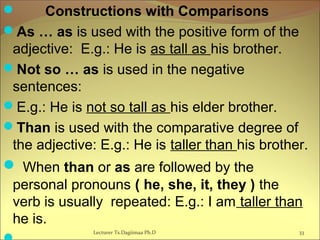
  • 58.
    5. All takesa group of things or persons as a whole and can be used both in the singular or in the plural. E.g.: All are present today. All is lost. Before singular nouns the whole is more often used. Compare: E.g.: All books were interesting. I read the whole book with great interest. 6. Both is used when two persons or things are regarded together. E.g.: we both, they both Lecturer Ts.Dagiimaa Ph.D 58
  • 59.
    7. Every andeach refer to the members taken one by one. Every is mostly used when the members of a group have something in common. Each is used when there is some point of difference. E.g.: It was a rush – hour and every bus was full. Helen gave each of the guests a cup of tea. 8. Each other is used when there are two persons concerned. E.g.: Tom and Helen loved each other. 59Lecturer Ts.Dagiimaa Ph.D
  • 60.
    One another isused when there are more people concerned. E.g.: They all looked at one another. Either means “ one or the other of two” or “both of two”. E.g.: There are two books, you can take either of them. Neither means “ none of two”. E.g.: Neither of them came. Neither and Either take singular verbs. E.g.: Neither of my friends has seen this film. Lecturer Ts.Dagiimaa Ph.D 60
  • 61.
    E.g.: Either ofmy two friends is going to the lecture. Some is chiefly used in affirmative sentences. Any is used in negative and Interrogative sentences and in conditional clauses. E.g.: Have you any news? Yes, I have some. In special and general questions expressing some request or proposal some (not any) is used. E.g.: Haven’t you got some work to do? Lecturer Ts.Dagiimaa Ph.D 61
  • 62.
    Any may beused in affirmative sentences with the meaning of “every”. E.g.: You can take any book you like. Compounds with – body, -one, ( somebody, anybody, someone, anyone) are used when speaking of persons; compounds with – thing refer to things. Somebody, someone, something are chiefly used in affirmative sentences.  Anyone, anybody, anything are used in negative and interrogative sentences and in conditional clauses.Lecturer Ts.Dagiimaa Ph.D 62
  • 63.
    Somebody, someone, somethingare used in special and general questions if they express some request or proposal. Anyone, anybody, anything may be used in affirmative sentences. Anyone, anybody are used with the meaning of “everyone”. Anything is used with the meaning of “everything”. 63Lecturer Ts.Dagiimaa Ph.D
  • 64.
     Negative Pronouns Noand none are the negative forms of any. The pronoun no is used only before a noun both in the singular and plural. E.g.: I have no time to do this today. He had no friends there. The pronoun none is the absolute form used without no accompanying noun. It can be used both for human beings and things. E.g.: None of us knew the answer. 64Lecturer Ts.Dagiimaa Ph.D
  • 65.
    Compounds nobody, noone, nothing are the negative forms of anybody, anyone, anything. Nobody and no one refer to human beings. E.g.: There was nobody in the room.  No one knew the stranger. Nothing refers to things. E.g.: He could do nothing about it. 65Lecturer Ts.Dagiimaa Ph.D
  • 66.
     LECTURE 4  PREPOSITIONS  & SOME USEFUL  PREPOSITIONS Lecturer Ts.Dagiimaa Ph.D 66
  • 67.
    Prepositions 1. Prepositions canbe simple (at, in, on etc.,), compound (into, out of, upon etc.,) and phrase prepositions (in front of, by means of, etc.,). Some prepositions coincide with the adverbs. We can tell one from the other if we regard the role which they play in the sentence. Compare: We shall go home after the lecture. (prep.) I didn’t meet him after. (adverb) 67Lecturer Ts.Dagiimaa Ph.D
  • 68.
    2. Prepositions areusually placed before the word with which they are connected. But some prepositions are very often used at the end of the sentences. They are usually prepositions that are closely associated with verbs. E.g.: I study at the University. But : What are you looking at? (in interrogative sentences). The factory she works at is very large. (in attributive clauses). 68Lecturer Ts.Dagiimaa Ph.D
  • 69.
                               At, On andIn At, on, in generally express the idea of position. E.g.: I am at home. I met him at the party. At, on, and in are used in expressions of time and date. At – for moments of time. E.g.: at eight o’clock, at half past four On – for days and dates. E.g.: on Sundays, on August 30th In – for weeks, months, seasons and years. E.g.: in 1970, in summer, in the morning, in the afternoon, in the first week of July. 69Lecturer Ts.Dagiimaa Ph.D
  • 70.
    Some combinations withat, on and in. On time – “ at the arranged”. E.g.: The 10 a.m. train started on time. In time –“ not late”. E.g.: They never come in time. In time can also mean “in the end”. E.g.: You’ll get used to it in time. In a year, in two days, in an hour E.g.: He will come in two hours. At the beginning (of), at the end (of). E.g.: at the beginning of the book, at the end of the book Lecturer Ts.Dagiimaa Ph.D 70
  • 71.
    In the beginning–“at first”; in the end–“at last”. In is used for countries, big towns, provinces and regions or any enclosed space. E.g.: The delegation will arrive in Moscow on Monday. At is used for small towns, villages, suburbs, certain points (e.g., a cross-road, a bridge, a bus-stop). Where either in or at can be used, there is a slight difference in meaning. At means “inside”, “outside” or “beside” the building. In means “inside” only. Lecturer Ts.Dagiimaa Ph.D 71
  • 72.
    In, Into andTo In is used for position as shown above. E.g.: He is in the room. Into (and to) express movement and are used with verbs of motion. E.g.: He came into the room. I go to my office by train. 72Lecturer Ts.Dagiimaa Ph.D
  • 73.
    To and Till/ Until To can be used for place and time. E.g.: We work from 8.00 to 6.00 or from 8.0 till 6.00. till / until for time only. E.g.: let’s start now and work till dark. Till is often used with a negative verb to emphasize lateness. E.g.: I shan’t get there till 5o’clock. Lecturer Ts.Dagiimaa Ph.D 73
  • 74.
    During and For Duringis used before known periods of time, such as: winter, vacation, holidays etc. It’s therefore usually followed immediately by the name of a period or by the, this, that, these or those. E.g.: during the summer, during the 1960, during that time, during his childhood For is used for a period of time, definite in length but otherwise indefinite. It is usually followed by a singular noun preceded by a, a plural noun, an adjective of quantity, or ever. E.g.: for a long time, for a year, for five days 74Lecturer Ts.Dagiimaa Ph.D
  • 75.
    Either for orduring can be used before the whole. Neither is used before all. E.g.: He worked for the whole day. But: He worked all day. As it has been pointed out, for is used with a period. Since is used with a point of time and always with a Perfect Tense. E.g: I haven’t seen him since five o’clock. (the beginning of the month; last year, we came back).Lecturer Ts.Dagiimaa Ph.D 75
  • 76.
      By andWith By in connection with a noun is usually used for the doer of the action in the Passive Voice and with for the instruments with which the action is done. E.g.: His hair was cut by his mother with the scissors. There are many other uses of both prepositions. E.g.: Come and sit by the window. She said she would have returned home by nine o’clock. He came in with his friend. 76Lecturer Ts.Dagiimaa Ph.D
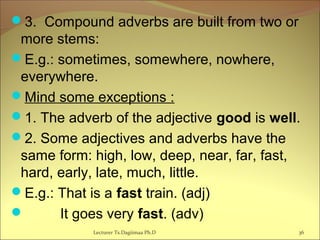
  • 77.
    Beside and Besides Besidemeans “near by”, “close by”, “by the side of”. E.g.: Come and sit beside me. Besides, as a preposition, means “in addition to”, or “other than”. E.g.: Some other people besides Peter will go there. Besides is also a conjunction meaning “furthermore”. 77Lecturer Ts.Dagiimaa Ph.D
  • 78.
    Between and Among Betweenis used for only two things or persons. E.g.: A new agreement was signed between the two countries. Among is used for more than two persons or things. E.g.: Come and sit among us. Lecturer Ts.Dagiimaa Ph.D 78
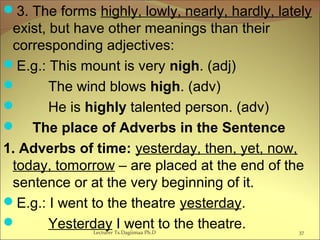
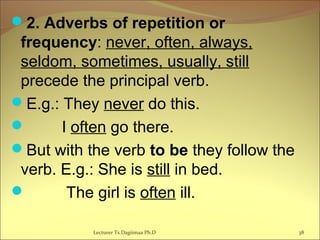
  • 79.
    Some other usefulprepositions Of expresses grammatical relations. E.g.: The leg of the table. The end of the day. Of can be used to mean “consisting of” or “containing”. E.g.: A chest of drawers, a suit of clothes, a book of essays Lecturer Ts.Dagiimaa Ph.D 79
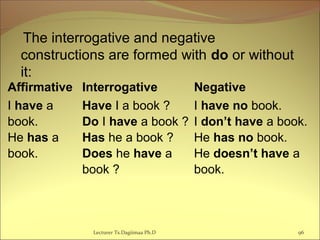
  • 80.
    Of is usedin many different combinations. E.g.: It was kind of you to do that. We are tired of all this. Also : on account of, on behalf of, for the sake of, in the hope of, to the left of Up and down have the basic function of expressing motion or position in the vertical direction. E.g.: To go up the hill, go down the hill 80Lecturer Ts.Dagiimaa Ph.D
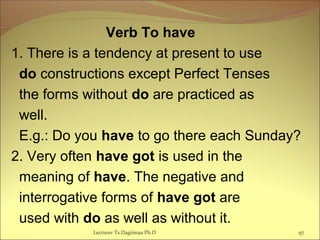
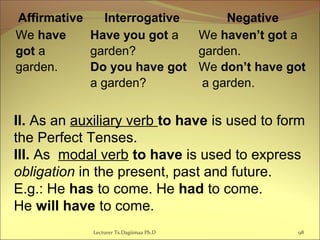
  • 81.
    Up and downcan also express horizontal movement or position. E.g.: He has gone up the road. He has gone Down the road. Same: He has gone along the road. When Englishmen use up and down for rivers they mean either towards the source of the river. (“upstream”) or towards its mouth (“downstream”). Over and under are used both for motion and for position. 81Lecturer Ts.Dagiimaa Ph.D
  • 82.
    E.g.: The birdflew over the house. He climbed over the wall. The bus went under the railway bridge. The village is over the hills (the other side of the hills) Sometimes over is used with a vague meaning of “away somewhere”. E.g.: She has just gone over to the shops. Above and below correspond in meaning to over and under, but they are generally used to express position and only seldom to express motion. They are often used as adverbs. Lecturer Ts.Dagiimaa Ph.D 82
  • 83.
    E.g.: The airplanewas flying above the sea, but when we looked down we saw only clouds below. He looked at the sky above. There is not much difference between below and beneath, but the latter is perhaps rather more precise, meaning “immediately below”. Beyond is used to express both position and motion. E.g.: The house is beyond the school. The word “beyond’ is often used figuratively. E.g.: It is beyond all belief – incredible. We succeeded beyond our hopes and dreams– much better than we expected. This is beyond me. Lecturer Ts.Dagiimaa Ph.D 83
  • 84.
    Against is asynonym of “beside and touching it”. E.g.: The bookcase is against the wall. Against is also the opposite of for, when for means “in favor of”. Towards is used figuratively, meaning “as a contribution to” and in the expressions towards the end of the month, towards the middle of the year, meaning “nearly at the end of” and “about the middle of”. Lecturer Ts.Dagiimaa Ph.D 84
  • 85.
    After is usedto denote time and place. E.g.: I came home after two o’clock. He entered the room after me. Before is contrary in meaning to “after”. E.g.: Before lunch I had a walk. I was in Kiev a fortnight before I was in Minsk. Don’t mix up before and ago, after and afterwards (later). E.g.: I was in Kiev a fortnight ago. Before I came to Kiev I had been to Leningrad. I came home after they had left. I came home. Afterwards they left. 85Lecturer Ts.Dagiimaa Ph.D
  • 86.
    LECTURE 5 THE VERBS “TOBE”,“TO DO” “TO HAVE” & CAN, COULD Lecturer Ts.Dagiimaa Ph.D 86
  • 87.
    Verb To be I.To be as a notional verb is used to express: 1. Information about persons or things. E.g.: He is a student. He was at the library. She will be at home. 2. Mental or physical condition. E.g.: I am ill. He is a cheerful. 3. Age. E.g.: She is twenty years old. 4. Price, time and date, distance, size and so on. E.g.: It is late. 87Lecturer Ts.Dagiimaa Ph.D
  • 88.
    To be usedin there is, there are– constructions. E.g.: Under the window there is a radiator. Is there a bookcase in the room? There isn’t any milk in the jug. II. To be as an auxiliary verb is used to form the Continuous Tenses and the Passive Voice. E.g.: 1. I am writing a letter. (Pres.Cont) 2. The letter was written by me. (Pass.Voi) Lecturer Ts.Dagiimaa Ph.D 88
  • 89.
    III. To be+ infinitive is used to express: 1) some action which is planned. E.g.: He is to come at oneo’clock. 2) orders and instructions. E.g.: He is to stay at home till his mother comes. 89Lecturer Ts.Dagiimaa Ph.D
  • 90.
    IV. To beis also used in question – tags. I am late , aren’t I? I am not late, am I? I was late, wasn’t I? I was not late, was I? I shall be late, shan’t I? I shan’t be late, shall I? We are late, aren’t we? We are not late, are we? We were late, weren’t we? We were not late, were we? We shall be late, shan’t we?We shan’t be late, shall we? 90Lecturer Ts.Dagiimaa Ph.D
  • 91.
    Lecturer Ts.Dagiimaa Ph.D91 THE VERB “TO DO” Tense Affirmative Interrogative Negative Singular Plural Singular Plural Singular Plural Present indef- inite I do. He does. She does. It does. We do. You do. They do. Do I ? Does he ? Does she ? Does it ? Do we ? Do you ? Do they ? I do not (don’t ). He does not (doesn’t). She does not (doesn’t). It does not (doesn’t). We do not (don’t). You do not (don’t). They do not (don’t). Past indef- inite I did. He did. She did. It did. We did. You did. They did. Did I ? Did he ? Did she? Did it ? Did we ? Did you ? Did they ? I did not (didn’t). He did not (didn’t). She did not (didn’t). It did not (didn’t). We did not (didn’t). You did not (didn’t). They did not (didn’t). Future indef- inite I shall do. He will do. She will do. It will do. We shall do. You will do. They will do. Shall I do ? Will he do ? Will she do? Will it do ? Shall we do? Will you do? Will they do? I shall not (shan’t) do. He will not (won’t) do. She will not(won’t) do. It will not (won’t) do We shall not (shan’t) do. You will not (won’t) do. They will not (won’t) do.
  • 92.
    I. As anotional verb to do is used in the meaning of make. In this case it has the negative and interrogative forms with do. Tense Affirmative Interrogative Negative Present Indefinite You do it well. Do you do it well ? You don’t do it well. Past Indefinite You did it well. Did you do it well ? You didn’t do it well. Future Indefinite You will do it well Will you do it well ? You won’t do it well. 92Lecturer Ts.Dagiimaa Ph.D
  • 93.
    Note the differencein the meaning of do and make. E.g.: “What are you doing ?” “ Reading a newspaper.” (It concerns actions.) “What are you making ?” “ An apple tart.” (It concerns things.) II. As an auxiliary verb to do is used: 1) to form the interrogative and negative forms of the Present and Past Indefinite Tenses. Interrogative Negative Do you work ? You don’t work on Sunday. Does he work ? He doesn’t work on Sunday. Did they work ? They didn’t work yesterday. 93Lecturer Ts.Dagiimaa Ph.D
  • 94.
    2) To avoidrepetition of a notional verb in: a) Short answers. E.g.: Do you swim? Yes, I do. No, I don’t. b) Question-tags. E.g.: He speaks English, doesn’t he? c) Short agreements or disagreements. E.g.: She reads a lot. Yes, she does. You talk at the lesson. No, I don’t. 3) To emphasize something. E.g.: I did speak to him. I did go there. 94Lecturer Ts.Dagiimaa Ph.D
  • 95.
    4) Before imperativerequests. E.g.: Do help me please. III. To do is used in formal greetings after introductions. Ann: Nick, I want to introduce Mike to you. Mike: How do you do? Nick: How do you do? I. To have as a notional verb means “possess “ E.g.: I have a brown coat. She had a nice hat. He will have this text-book next week. Lecturer Ts.Dagiimaa Ph.D 95
  • 96.
    The interrogative andnegative constructions are formed with do or without it: Affirmative Interrogative Negative I have a book. He has a book. Have I a book ? Do I have a book ? Has he a book ? Does he have a book ? I have no book. I don’t have a book. He has no book. He doesn’t have a book. 96Lecturer Ts.Dagiimaa Ph.D
  • 97.
    Verb To have 1.There is a tendency at present to use do constructions except Perfect Tenses the forms without do are practiced as well. E.g.: Do you have to go there each Sunday? 2. Very often have got is used in the meaning of have. The negative and interrogative forms of have got are used with do as well as without it. 97Lecturer Ts.Dagiimaa Ph.D
  • 98.
    Lecturer Ts.Dagiimaa Ph.D98 Affirmative Interrogative Negative We have got a garden. Have you got a garden? Do you have got a garden? We haven’t got a garden. We don’t have got a garden. II. As an auxiliary verb to have is used to form the Perfect Tenses. III. As modal verb to have is used to express obligation in the present, past and future. E.g.: He has to come. He had to come. He will have to come.
  • 99.
    IV. To haveis also used in question-tags: I have time to spare, haven’t I? I have no time to spare, have I? I had time to spare, hadn’t I? I had no time to spare, had I? V. To have can also be used in some other meanings, denoting process. 1) in the meaning of “take”. He has a bath every day. 2) in the meaning of “encounter”. She has a lot of trouble. 99Lecturer Ts.Dagiimaa Ph.D
  • 100.
    3) in themeaning of “give”. We are having a party tonight. 4) in the meaning of “enjoy”. He is having a very pleasant time there. VI. Had better + Infinitive without to is used in the meaning of it would be better. E.g.: You had better go to the doctor. VII. To have is used in have-something - done construction. E.g.: I have my shoes cleaned. (I made someone to clean my shoes). 100Lecturer Ts.Dagiimaa Ph.D
  • 101.
     Modal verbs are: can, may, must, need, ought to, should, would, dare, have to + Infinitive, to be + Infinitive. Modal verbs have the following peculiarities: 1) they require no to with the infinitive followed (except ought, need and dare) 2) they do not take – S in the 3rd person singular; 3) they require no do in the interrogative and negative forms (except dare, need, have + Infinitive) 4) they have no future form; 101Lecturer Ts.Dagiimaa Ph.D
  • 102.
    5) they haveno verbals ; Modal verbs have different meanings and express obligation, moral duty, permission, possibility, advisability, necessity, ability, probability, non-performance of an action Can I. The modal verb can has two forms: can for the Present Tense and could for the Past Tense. Lecturer Ts.Dagiimaa Ph.D 102 Present Tense Affirmative Interrogative Negative You can swim. He can swim. Can you swim ? Can he swim ? You cannot (can’t) swim. He cannot (can’t) swim.
  • 103.
    103Lecturer Ts.Dagiimaa Ph.D PastTense Affirmative Interrogative Negative You could swim. He could swim. Could you swim ? Could he swim ? You could not swim. He could not swim. II. Can is used to express: 1. Physical or mental ability. In this meaning can has the substitute to be able (to), which is used in the Present, Past and Future Tense for all persons. Thus, for the Future Tense only the form to be able (to) is true. E.g.: He can speak several languages. I am glad you are able to come. (were able to come, will be able to come)
  • 104.
    2. Permission orpossibility. E.g.: 1. He can put the suitcase in the hall. You can’t stay here. (permission) 2. You can get the tickets easily. You can get to town by bus. (possibility) 3) Surprise: In this meaning can (could) + Indefinite or Perfect Infinitive in negative and interrogative sentences is used. E.g.: Can (could ) she have done it? She can’t (couldn’t ) have done it. 104Lecturer Ts.Dagiimaa Ph.D
  • 105.
    Can, could andbe able to: talking about ability We sometimes use be able to instead of can and could to talk about ability. However, we avoid be able to – When we talk about something that is happening as we speak: Watch me, Mum; I can stand on one leg. (not ... I’m able to stand on one leg.) Before passives: CDs can now be copied easily. (rather than CDs are now able to be copied ...) Lecturer Ts.Dagiimaa Ph.D 105
  • 106.
    When the meaningis ‘know how to’: Can you cook? (rather than Are you able to cook?) If we talk about a single achievement, rather than a general ability in the past, we usually use be able to rather than could. Compare: Sue could play the flute quite well. (or ...was able to ..., a general ability)and She swam strongly and was able to cross the river easily, even though it was swollen by the heavy rain. (not She swam strongly and could cross..., a specific achievement) Lecturer Ts.Dagiimaa Ph.D 106
  • 107.
    However, could isusually more natural – in negative sentences: I tried to get up but I couldn’t move. (rather than .... I wasn’t able to move.) With verbs of the senses – e.g. feel, hear, see, smell, taste – and with verbs of ‘thinking’ – e.g. believe, decide, remember, understand: I could remember the crash, but nothing after that. (rather than I was able to remember ...) Lecturer Ts.Dagiimaa Ph.D 107
  • 108.
    After the phrasesthe only thing /place/ time, and after all when it means ‘the only thing’: All we could see were his feet. (rather than All we were able to ...) to suggest that something almost didn’t happen, particularly with almost, hardly, just, nearly: I could nearly touch the ceiling. (rather than I was nearly able to...) Lecturer Ts.Dagiimaa Ph.D 108
  • 109.
    LECTURE 6 MODAL VERBS:CAN, COULD, BE ABLE TO, BE ALLOWED TO & MAY, MUST Lecturer Ts.Dagiimaa Ph.D 109
  • 110.
    Can and could:talking about possibility To talk about the theoretical possibility of something happening we use could, not can. However, we use can, not could, to say that something is possible and actually happens. Compare: It could be expensive to keep a cat. (=if we had one, it could or it may not be expensive) and It can be expensive to keep a cat. (=it can be, and it sometimes is) Lecturer Ts.Dagiimaa Ph.D 110
  • 111.
    We use can’t,not couldn’t, to say that something is theoretically or actually impossible: There can’t be many people in the world who haven’t watched television. The doctor can’t see you this morning; he’s busy at the hospital. We use can to indicate that there is a very real possibility of a future event happening. Using could suggests that something is less likely or that there is some doubt about it. Compare: Lecturer Ts.Dagiimaa Ph.D 111
  • 112.
    We can staywith Jim in Oslo. (=we will be able to stay) and We could stay with Jim in Oslo. (=it’s possible; if he’s there) Could and be allowed to: talking about permission To say that in the past someone had general permission to do something – that is, to do it at any time- we can use either could or was/were allowed to. However, to talk about permission for one particular past action, we use was/were allowed to, but not could. Compare: Lecturer Ts.Dagiimaa Ph.D 112
  • 113.
    Anyone, was allowedto fish in the lake when the council owned it. (or ... could fish ...) and Although he didn’t have a ticket, Ken was allowed to come in. (not ... could come in.) In negative sentences, we can use either couldn’t or wasn’t/weren’t allowed to to say that permission was not given in general or particular situations: We couldn’t/weren’t allowed to open the presents until Christmas morning. Lecturer Ts.Dagiimaa Ph.D 113
  • 114.
    Lecturer Ts.Dagiimaa Ph.D114 Meaning English forms Usage Ability Can am( is, are) able to + Infinitive Present Could Was (were)able to + Infinitive Past Shall Will be able to + Infinitive Future Meaning English forms Usage Permission Can May + Infinitive Can is more often used in spoken English. Possibility of an action (under some condition) Can + infinitive Could + Infinitive In affirmative sentence. Possibility of an action (which may or may not take place) Shall Will be able to + Infinitive In the Present or Future. Non-performance of an action Could Might + infinitive When expressing reproach or regret about the non- performance of an action Modal Verbs Expressing Ability, Permission, Possibility
  • 115.
    May The modal verbmay has two forms: may for the Present Tense and might for the Past Tense. Lecturer Ts.Dagiimaa Ph.D 115 Present Tense Affirmative Interrogative Negative I may come. He may come. May I come in? May he come in? I may not come. He may not come.
  • 116.
    May is usedto express: Permission: E.g.: May I take your dictionary? May I come in? In this meaning may has the substitute to be allowed (to), which is used in the Present, Past and Future Tense for all persons: E.g.: You stay here until you are allowed to go away. He was allowed to come later. He will be allowed to use these papers. Probability. The adverbs maybe is adequate in this use. E.g.: They may arrive today. It maybe rain tonight. 116Lecturer Ts.Dagiimaa Ph.D
  • 117.
    Might is usedin the first and second meanings in Indirect Speech. E.g.: They might arrive today or tomorrow.                          Must The modal verb must has only one form. For the missing tense forms must is substituted by to have to. Must is used to express: 1. Obligation and necessity: E.g.: I must stay at home today. I had to stay at home yesterday. I shall have to stay at home tomorrow. 117Lecturer Ts.Dagiimaa Ph.D
  • 118.
    In this meaningmust has the affirmative, negative and interrogative forms. E.g.: Must he write the report? He must write report but it mustn’t be very concise. The absence of necessity is expressed by the verb need not. E.g.: Must I stay here? Yes, you must. No, you needn’t. Lecturer Ts.Dagiimaa Ph.D 118
  • 119.
    2. Command. Inthis meaning must has no substitute ( but to have to in the Past Tense ). E.g.: You must read this text once more. You must go out at once. 3. Probability. In this meaning must is used in the affirmative sentences only. E.g.: He must be the captain of the ship. 4. Must + Perfect Infinitive denotes the action in the Past. E.g.: They must have read this newspaper article. 119Lecturer Ts.Dagiimaa Ph.D
  • 120.
    Must and have(got) to We use must and must not in formal rules and regulations and in warnings: E.g.: Bookings must be made at least seven days before departure. The government must not be allowed to appoint judges. In spoken English we often use must and mustn’t (=must not) to propose a future arrangement, such as a meeting or social event, without making detailed plans: E.g.: We must get together more often. We mustn’t leave it so long next time. Lecturer Ts.Dagiimaa Ph.D 120
  • 121.
    We can alsouse I must ... to remind ourselves to do something: E.g.: I must phone Steve when I get home. I said I’d call him last night, but I forgot. To draw a conclusion about – * Something that happened in the past we use must + have +past participle: E.g.: That’s not Kate’s car. She must have borrowed it from her parents. * Something happening at or around the time of speaking we use must be +-ing: I can’t hear anyone moving around upstairs. You must be imagining things.Lecturer Ts.Dagiimaa Ph.D 121
  • 122.
    * Something thatis likely to happen in the future we use must be going to or must be + -ing: ‘What are all those workmen doing?’ ‘I think they must be going to dig up the road.’ I was wrong about the meeting being today. It must be happening next Friday. * A present situation we use must be, or have (got) to be in informal speech: Their goalkeeper has got to be at least two metres tall! (or ...must be ...) Lecturer Ts.Dagiimaa Ph.D 122
  • 123.
    We can usemust have to to say that we conclude something based on what we know about a present situation and must have had to to conclude something about a past situation: E.g.: I can’t start the computer. You must have to know a password. (=a password is necessary) E.g.: John wasn’t at home when I went round. He must have had to go out unexpectedly. Lecturer Ts.Dagiimaa Ph.D 123
  • 124.
    Note that wecan’t say ‘must’ve to’ or ‘must have got to/ must’ve got to’ (but we can say must’ve had to). In questions that hope for or expect a negative answer we prefer have (got) to, although in formal contexts must is sometimes used: Do we have to answer all the questions? (or Have we got to ...?; Must we ...? is also possible but rather formal) Lecturer Ts.Dagiimaa Ph.D 124
  • 125.
    We use haveto in questions that imply a criticism. Must can also be used, although some people think this is rather old- fashioned. We usually stress have and must in sentences like this: E.g.: Do you have to play your trumpet here? It’s deafening me! (or more formally Must you play ...?) Lecturer Ts.Dagiimaa Ph.D 125
  • 126.
    Sometimes we canuse either have to or have got to. However – * We use have to with frequency adverbs such as always, never, normally, rarely, sometimes, etc: I often have to work at the weekend to get everything done. * With the past simple we use had to especially in questions and negative sentences: E.g.: When did you have to give it back?(not When had you got to give it back?) We didn’t have to wait too long for an answer. (not We hadn’t got to wait too long ...) Lecturer Ts.Dagiimaa Ph.D 126
  • 127.
    * If haveis contracted (e.g. I’ve, He’s, It’d) then we must include got: The experiment has failed twice before, so it’s got to work this time. (not ... so it’s to work this time.) * We don’t use have got to with other modal verbs: Employees will have to accept the new conditions or be dismissed. (not Employees will have got to accept...) Notice also that have got to is often preferred in informal speech. Lecturer Ts.Dagiimaa Ph.D 127
  • 128.
    Lecturer Ts.Dagiimaa Ph.D128 Meaning English forms Usage Obligation and commands (from the speaker’s viewpoint) Must Should + infinitive Ought Present Obligation and necessity (from outside) Must Should + infinitive Have (has ) Am (is, are ) Present Had Was, were + infinitive Past Shall have Will have +infinitive Future Non-necessity of an action Need not Don’t (doesn’t have to) + infinitive Present Didn’t have to + infinitive Past Shall (will) not have + infinitive Future Prohibition of an action Must not Should not + infinitive Am (is, are) not Present, Future Non-performance of an action Was (were ) + Perfect Infinitive Ought Modal Verb, Expressing Obligation, Necessity, Prohibition, Non-necessity and Non-performance
  • 129.
    LECTURE 7 TO HAVE+ INFINITIVE, HAVE TO, NEED, OUGHT TO & SHOULD Lecturer Ts.Dagiimaa Ph.D 129
  • 130.
    To have +Infinitive To have + Infinitive as a modal expression, is used in the Present, Past and Future Indefinite Tense and expresses an obligation or necessity imposed from outside. E.g.: I have to get up early. I had to get up early yesterday. I shall have to get up early tomorrow morning. 130Lecturer Ts.Dagiimaa Ph.D
  • 131.
    Lecturer Ts.Dagiimaa Ph.D131 Tense Affirmative Interrogative Negative Singular Plural Singular Plural Singular Plural Present Indef- Inite I have. He has. She has. It has. We have. You have. They have. Have I? Has he? Has she? Has it? Have we? Have you? Have they? I have not haven’t). He has (hasn’t). She has (hasn’t). It has (hasn’t). We have (haven’t). You have (haven’t). They have (haven’t). Past Indef- Inite I had. He had. She had. It had. We had. You had. They had. Had I? Had he? Had she? Had it ? Had we ? Had you ? Had they? I had not (haven’t). He had not (hadn’t). She had not (hadn’t). It had not (hadn’t). We had not (haven’t). You had not (hadn’t). They had not (hadn’t). Future Indef- Inite I shall have. He will have. She will have. It will have. We shall have. You will have. They will have. Shall I have? Will he have? Will she have? Will it have? Shall we have? Will you have? Will they have? I shall not (shan’t ) have. He will not (won’t) have. She will not (won’t) have. It will not (won’t) have. We shall not (shan’t) have. You will not (won’t) have. have. They will not (won’t) have.
  • 132.
    The negative andinterrogative forms of to have +infinitive are formed with do. Lecturer Ts.Dagiimaa Ph.D 132 Interrogative Negative Do you have to get up early? Did you have to get up early? I don’t have to get up early? I didn’t have to get up early?
  • 133.
    To be +Infinitive, as a modal expression is used in the Present and Past Indefinite Tenses and expresses: 1. Planned action or an arrangement: E.g.: We are to meet near the Moscow University. We were to meet at 5. 2. Possibility: In this meaning to be + Passive Infinitive is used. E.g.: These newspapers are to be found everywhere in the bookstalls. 133Lecturer Ts.Dagiimaa Ph.D
  • 134.
    Need 1. The modalverb need has only the Present Tense form and is mostly used in the negative and interrogative forms. Interrogative Negative Need I go there? Need he go there? You need not (needn’t ) go there? You needn’t go there ? 134Lecturer Ts.Dagiimaa Ph.D E.g.: You needn’t go to school as you feel ill today.
  • 135.
    2. In shortnegative answers need is used, in short affirmative answers must is used. E.g.: Need I be present here today? No, you needn’t. Yes, you must. 3. The notional verb need means to be in want of and has all the forms, which any other notional verb has. E.g.: He needs help. Does he need help? He doesn’t need help. 135Lecturer Ts.Dagiimaa Ph.D
  • 136.
    Need (n’t), don’tneed to and don’t have to We can use need as an ordinary verb or as a modal verb (followed by a bare infinitive). As a modal verb it doesn’t change its tense and doesn’t add ‘-s’ for the third person singular. Compare: I needed to leave early. Or She’s thirsty. She needs a drink. (=ordinary verb) and You needn’t speak so loudly. (=modal verb) Lecturer Ts.Dagiimaa Ph.D 136
  • 137.
    When it isa modal verb need is most commonly used in negative sentences, often with verbs like bother, concern, fear, panic, worry: E.g.: I’ve already cleaned the car so you needn’t bother to do it. E.g.: Judges in England need not retire until they are 75. E.g.: I was very nervous before the interview, but I needn’t have worried. Everyone was very friendly and I got the job. Lecturer Ts.Dagiimaa Ph.D 137
  • 138.
    It is sometimesused in questions, but we prefer to use need as an ordinary verb or have to: Need you go so soon? (=modal verb; less common and rather formal) Do you need to go so soon? (=ordinary verb)or Do you have to go so soon? It is rarely used in affirmative sentences (that is, not questions or negatives), but is sometimes found in written English, particularly in fiction: We need have no fear for Nicole, she can take care of herself. Lecturer Ts.Dagiimaa Ph.D 138
  • 139.
    In other stylesof formal written English it is used in this way with negative words such as hardly, never, nobody/ no-one, and only: E.g.: The changes need only be small to make the proposals acceptable. (less formally The changes only need to be...) Nobody ever need know about the money. (less formally Nobody ever needs to know...) ‘I don’t want my parents to know.’ ‘They need never find out.’ (less formally They never need to find out.)Lecturer Ts.Dagiimaa Ph.D 139
  • 140.
    To give permissionnot to do something we can use either needn’t or don’t need to: You needn’t cut the grass, I’ll do it later. (or You don’t need to cut the grass...) To talk about a general necessity, we prefer don’t need to: You don’t need to be over 18 to get into a disco.(rather than You needn’t be...) We can often use either needn’t or don’t have to with little difference in meaning to say that it is unnecessary to do something: You needn’t whisper. Nobody can hear us. (or You don’t have to ...)Lecturer Ts.Dagiimaa Ph.D 140
  • 141.
    However, some peopleprefer needn’t when it is the speaker who decides the lack of necessity, and don’t have to when external rules or somebody else’s actions make something unnecessary. Compare: As you worked late yesterday you needn’t come in until 10.00 tomorrow morning. (the speaker’s decision) and We’ve been told that we don’t have to be at work until 10.00 tomorrow. (reporting someone else’s decision.) Lecturer Ts.Dagiimaa Ph.D 141
  • 142.
    We can useneedn’t (or don’t have to) to say that something is not necessarily true. We don’t use mustn’t in this way: Volcanoes needn’t erupt constantly to be classified as ‘active’. (or Volcanoes don’t have to erupt...; not Volcanoes mustn’t erupt...) Nowadays it needn’t cost a fortune to own a powerful computer. (or Nowadays it doesn’t have to cost ...; not Nowadays it mustn’t cost ...) Lecturer Ts.Dagiimaa Ph.D 142
  • 143.
    Should and Oughtto I. Ought to expresses moral duty or obligation and has the affirmative, negative and interrogative forms. In contrast to other modal verbs ought is followed by the to + Infinitive. 143Lecturer Ts.Dagiimaa Ph.D Affirmative Interrogative You ought to write this exercise. Ought I to write this exercise ? Negative You ought not ( oughtn’t) to write this exercise.
  • 144.
    II. Should expressesmoral duty obligation and is used in the affirmative, negative and interrogative forms. Practically ought to and should can be used in the same meaning. It ought to be noted that should has the same form for all the persons. Lecturer Ts.Dagiimaa Ph.D 144
  • 145.
    Lecturer Ts.Dagiimaa Ph.D145 Affirmative Interrogative I should stay here. He She We should stay here. You They Should I stay here ? he she Should we stay here ? you they Negative I should not ( shouldn’t ) stay here. He She We should not ( shouldn’t )stay here. You They
  • 146.
    III. Should andought to + Indefinite infinitive are referred to the action in the Present and Future. E.g.: You should (ought to) help her. Should and ought to + Perfect Infinitive gives an idea of an unfulfilled action, referred to the Past. E.g.: You should (ought to) have done it better. 146Lecturer Ts.Dagiimaa Ph.D
  • 147.
    IV. Should /Would + infinitive are used to express wish in phrases I should like, She would like. E.g.: I should like to know all about him. I should like to listen to this nice song once more. He would like to stay here for some time. Lecturer Ts.Dagiimaa Ph.D 147
  • 148.
    LECTURE 8 SHOULD, OUGHTTO, WOULD, DARE & PRESENT INDEFINITE, PRESENT CONTINUOUS TENSES Lecturer Ts.Dagiimaa Ph.D 148
  • 149.
    Should, ought toand had better We can often use either should or ought to to talk about obligations and recommendations (e.g. You should/ought to finish your homework before you go out) and probability (e.g. it should/ought to be ready by now) although in general should is used more frequently. Ought to is used particularly in speech and most often to talk about obligation rather than probability. Lecturer Ts.Dagiimaa Ph.D 149
  • 150.
    Notice also thefollowing details – * We prefer should when we say what an outside authority recommends: The manual says that the computer should be disconnected from the power supply before the cover is removed. (rather that ... ought to be disconnected ...) * We use should (or would), not ought to, when we give advice with I...: I should leave early tomorrow, if I were you. (or I would leave...; or I’d leave...) Lecturer Ts.Dagiimaa Ph.D 150
  • 151.
    * We prefershould in questions, particularly wh-questions: What should I do if I have any problems? Should I ring you at home? * Some people might use ‘What ought I to do ...?’ and ‘Ought I to... ?’, but this is rather formal. Note that when we conclude, on the basis of some evidence we have, that something is certain or very likely we can use must but not should/ought to: It’s the third time she’s been skating this week. She must really enjoy it. Lecturer Ts.Dagiimaa Ph.D 151
  • 152.
    We use should/oughtto +have + past participle to talk about something that didn’t happen in the past and we are sorry that it didn’t: E.g.: We should/ought to have waited for the rain to stop. (I’m sorry we didn’t) We often use this pattern to indicate some regret or criticism and the negative forms shouldn’t/oughtn’t to have are almost always used in this way. Lecturer Ts.Dagiimaa Ph.D 152
  • 153.
    We also useshould/ought to +have +past participle to talk about an expectation that something happened, has happened, or will happen: E.g.: If the flight was on time, he should/ought to have arrived in Jakarta early this morning. E.g.: The builders should/ ought to have finished by the end of the week. We can use should in questions that are offers or that request confirmation or advice: E.g.: Should I phone for a taxi for you? Who should I pass the message to? Lecturer Ts.Dagiimaa Ph.D 153
  • 154.
    Note that insentences like these we can also use shall with a very similar meaning, and ought to is also used in questions, although less commonly. Compare the use of shall and should in sentences such as the following, where ‘I shall’ means ‘I intend to’ and ‘I should’ means ‘I ought to’: E.g.: I shall read the script on the train tomorrow. (or I’ll read...) I shall read the script on the train tomorrow but I know that I’ll be too tired. Lecturer Ts.Dagiimaa Ph.D 154
  • 155.
    We can usehad better instead of should/ ought to, especially in spoken English, to say that we think it is a good idea to do something: If you’re not well, you’d better ask Ann to go instead. (or ... you should/ought to...) although we don’t use it to talk about the past or to make general comments: You should/ought to have caught a later train. (not You had better have caught...) I don’t think parents should/ought to give their children sweets. (not I don’t think parents had better give their children sweets.) Lecturer Ts.Dagiimaa Ph.D 155
  • 156.
    We prefer hadbetter if we want to express particular urgency and in demands and threats: E.g.: There’s someone moving about downstairs. We’d better call the police, quickly. Notice that the negative form is had better not. In question forms the subject comes after had, although many people avoid questions with had better: E.g.: He’d better not be late again or he’ll be in trouble. Hadn’t we better get a taxi?(or Shouldn’t we get ...?) Lecturer Ts.Dagiimaa Ph.D 156
  • 157.
      Would The modalverb would has the same form for all persons and is used to express different meanings. It expresses: 1. Volition. E.g.: I would be happy to exchange letters with you. I said that I would go to the museum. 2. Persistence to do something. E.g.: I asked him to tell the truth, but he would not. 157Lecturer Ts.Dagiimaa Ph.D
  • 158.
    3. A customaryaction in the Past. E.g.: Sometimes they would visit him. They would often talk about their life. 4. Polite requests. E.g.: Would you mind giving me the pencil? Would you pass me the bread, please? 5. Would rather is used to express reference. Lecturer Ts.Dagiimaa Ph.D 158
  • 159.
    Dare The modal verbdare means to be brave enough to do something. It is mostly used in the negative and interrogative sentences. E.g.: How dare you speak to me so rude? He daren’t ask me the question again. 159Lecturer Ts.Dagiimaa Ph.D
  • 160.
    Sometimes the modalverb dare can take do to form the negative and interrogative forms both in the Present and in the past Indefinite Tense, but it is followed by the indefinite without to. E.g.: How did you dare give me orders? He didn’t dare give me orders. In the affirmative sentences the phrase daresay is common. It is used in the first person singular only. E.g.: I daresay he is late. Lecturer Ts.Dagiimaa Ph.D 160
  • 161.
     General TenseScheme Lecturer Ts.Dagiimaa Ph.D 161 Active Voice Present Present Indefinite Present Continuous Present Perfect Continuous Present Perfect Past Past Indefinite Past Continuous Past Perfect Continuous Past Perfect Future Future Indefinite Future Continuous Future Perfect Continuous Future Perfect Passive Voice Present Present Indefinite Present Continuous Present Perfect Past Past Indefinite Past Continuous Past Perfect Future Future Indefinite Future Perfect
  • 162.
      The PresentIndefinite Tense The Present Indefinite Tense is formed from the infinitive without to. 3rd person singular –s or –es is added. E.g.: he works [s], he writes [s], he learns [z], he teaches [iz], he goes [z]. The interrogative and negative forms of the Present Indefinite Tense are formed with the verb do. E.g.: Do you study English? Yes, I do. No, I do not. (don’t). Does he study English? Yes, he does. No, he does not. (doesn’t). 162Lecturer Ts.Dagiimaa Ph.D
  • 163.
    The Present IndefiniteTense is used: 1. To denote the action which is permanent or habitual. E.g.: Nick goes to school every day. I usually get up early. In this case the adverbials always, often, usually, sometimes, over, normally, occasionally, on Monday and so on, every day, every week, each year, every summer and so on can be used. 2. To denote general truths. E.g.: My friend studies at Moscow University. The sun sets in the West. Lecturer Ts.Dagiimaa Ph.D 163
  • 164.
    Lecturer Ts.Dagiimaa Ph.D 164 Present IndefiniteTense Affirmative I read. He / She reads. It rains. We / You / They read. Interrogative Do I read? Does he / she read? Does it rain? Do we / you / they read? Negative I do not (don’t) read. He / She does not (doesn’t) read. It doesn’t rain. We / You / They do not (don’t) read.
  • 165.
    The Present ContinuousTense I. The Present Continuous Tense is formed of the verb to be in the Present Indefinite + Participle I of the notional verb. E.g.: I am writing an exercise now. For the interrogative form the auxiliary verb is placed before the subject. For the negative form the particle not is added after the auxiliary verb. E.g.: Are you writing an exercise? I am not writing an exercise. 165Lecturer Ts.Dagiimaa Ph.D
  • 166.
    Lecturer Ts.Dagiimaa Ph.D 166 Present ContinuousTense Affirmative I am reading. He / She is reading. It is raining. We / You / They are reading. Interrogative Am I reading? Is he / she reading? Is it raining? Are we / you / they reading? Negative I am not reading. He / She is not (isn’t) reading. It is not (isn’t) raining. We / You / They are not (aren’t) reading.
  • 167.
    II. The PresentContinuous Tense is used: To denote an action in progress, duration at the definite present moment. E.g.: What are you doing now? I am writing a report. The Present Continuous Tense occurs in speech more often than the Present Indefinite Tense. E.g.: Do you read this book? is used less frequently than Are you reading a book? Lecturer Ts.Dagiimaa Ph.D 167
  • 168.
    Certain verbs areusually not used in the Continuous Tenses. They are : be, have, appear, believe, become, expect, feel, forget, forgive, like, hate, hear, know, see, seem, think. Sometimes they are found in the Continuous Tenses, if they have certain color in meaning. E.g.: How are you feeling? (in the medical sense) How are you liking it?(in the meaning of ‘enjoy’) I’m seeing you tomorrow. (I shall visit you tomorrow) 168Lecturer Ts.Dagiimaa Ph.D
  • 169.
    He is expectingthe news today. (in the meaning of ‘await’) Are you hearing from him? (in the meaning of ‘having a news’) I am thinking it over. (someone asks about my opinion.) To denote one’s plans in the nearest future (the time of action must always be mentioned). Lecturer Ts.Dagiimaa Ph.D 169
  • 170.
    E.g.: Are youdoing anything special tonight? Yes, I am going to the Club. Instead of a future action in duration in adverbial clauses of condition and time. E.g.: If he is smoking when I am absent, I shall blame him. The Present Continuous Tense is never used with the question word when, except when the immediate future is to be expressed. 170Lecturer Ts.Dagiimaa Ph.D
  • 171.
    LECTURE 9 PRESENT CONTINUOUS ANDPRESENT SIMPLE & PRESENT PERFECT CONTINUOUS, PRESENT PERFECT TENSES Lecturer Ts.Dagiimaa Ph.D 171
  • 172.
    PRESENT CONTINUOUS AND PRESENTSIMPLE 1. We can use the present continuous tense with some state verbs (e.g.: attract, like, look, love, sound) when we want to emphasize that a situation is temporary or for a period of time around the present. Compare: Jean stays with us quite often. The children love having her here. and Jean’s with us at the moment. The children are loving having her here. Lecturer Ts.Dagiimaa Ph.D 172
  • 173.
    2. Some verbshave different meanings when they are used to talk about states and when they describe actions. With their ‘state’ meanings, they usually take simple rather than continuous forms. With their ‘action’ meanings, they may take simple or continuous forms, depending on context. Compare: The new treatment for influenza doesn’t appear to work. (appear: state = seem) and Madonna is currently appearing in a musical on Broadway. She is often appears in musicals. (appear: action = take part.) Lecturer Ts.Dagiimaa Ph.D 173
  • 174.
    3. With someverbs describing mental states (e.g.: find, realize, regret, think, understand) we can use the present continuous to emphasize that we have recently started to think about something or that we are not sure about something. Compare: I regret that the company will have to be sold. (=I have made the decision and I am sorry about it) and I’m regretting my decision to give her the job. (=I am increasingly aware that It was the wrong decision) Lecturer Ts.Dagiimaa Ph.D 174
  • 175.
    When it means‘think carefully about’ the verb consider is only used with the present continuous: E.g.: He is considering taking early retirement. (not He considers taking early retirement.) 4. We use present simple with verbs which perform the action they describe: E.g.: I admit I can’t see as well as I used to. We apologize for not replying earlier. Lecturer Ts.Dagiimaa Ph.D 175
  • 176.
    5. We oftenuse the present simple and present continuous in stories and jokes in informal spoken English to create the impression that events are happening now. This can make them more direct and exciting and hold people’s attention: E.g.: She goes up to this man and looks straight into his eyes. He’s not wearing his glasses, and he doesn’t recognize her …. This man’s playing golf when a kangaroo bounds up to him, grabs his club and hits his ball about half a mile … Lecturer Ts.Dagiimaa Ph.D 176
  • 177.
    The main eventsare usually described in sequence using the present simple and longer background events are described using the present continuous. 6. We also use the present simple and present continuous in live commentaries (for example, on sports events) when the report takes place at the same time as the action: King serves to the left-hand court and Adams makes a wonderful return. She’s playing magnificent tennis in this match … Lecturer Ts.Dagiimaa Ph.D 177
  • 178.
    I. Present PerfectContinuous Tense is formed of the verb to be in the Present Perfect Tense + Participle I of the notional verb. E.g.: He has been writing the exercise for two hours. For the interrogative form the first auxiliary verb is placed before the subject. For the negative form the particle not is placed after the first auxiliary verb. E.g.: Has he been writing the exercise for two hours? He has not been writing the exercise for two hours. 178Lecturer Ts.Dagiimaa Ph.D
  • 179.
    Lecturer Ts.Dagiimaa Ph.D 179 Present PerfectContinuous Tense Affirmative I have been reading. He / She has been reading. It has been raining. We / You / They have been reading. Interrogative Have I been reading? Has he/ she been reading? Has it been raining? Have we / you / they been reading? Negative I have not been reading. He / She has not (hasn’t)been reading. It has not (hasn’t)been raining. We / You / They have not (haven’t) been reading.
  • 180.
    II. The PresentPerfect Continuous Tense is used to denote an action which began in the Past, was in duration up to the present moment and is still in duration or has only just finished. E.g.: I have been studying English for three years. III. The difference between the Present Continuous Tense and the Present Perfect Continuous Tense is as follows: the Present Continuous Tense denotes an action in process, an action which is going on at the present moment. 180Lecturer Ts.Dagiimaa Ph.D
  • 181.
    There is noreferring to the duration in the past; the Present Perfect Continuous Tense denotes an uninterrupted action with the referring to the duration in the past. E.g.: It is raining now. (Pres. Cont. Tense) It has been raining for two hours. (Pres. Per. Cont. Tense)              Lecturer Ts.Dagiimaa Ph.D 181
  • 182.
     The PresentPerfect Tense   I. The Present Perfect Tense is formed of the verb to have in the Present Indefinite + Participle II of the notional verb. E.g.: I have read this novel. She has worked hard this week. For the formation of the interrogative form the auxiliary verb is placed before the subject; in the negative form the negative particle not is added after the auxiliary verb. 182Lecturer Ts.Dagiimaa Ph.D
  • 183.
    Lecturer Ts.Dagiimaa Ph.D 183 Affirmative Interrogative Ihave read this book. He has read this book. Have you read this book? Has he read this book? Negative I have not (haven’t) read this book. He has not (hasn’t) read this book. Affirmative Interrogative I have read this book. He has read this book. Have you read this book? Has he read this book? Negative I have not (haven’t) read this book. He has not (hasn’t) read this book.
  • 184.
    Lecturer Ts.Dagiimaa Ph.D 184 Present PerfectTense Affirmative I have read. He / She has read. It has rained. We / You / They have read. Interrogative Have I read ? Has he / she read? Has it rained? Have we / you / they read? Negative I have not (haven’t ) read. He / She has not (hasn’t) read. It has not (hasn’t) rained. We / You / They have not (haven’t) read.
  • 185.
    II. The PresentPerfect Tense is used: 1. To express the completion of an action by now. That’s why we are not interested in when the action took place, we are interested in the completion of an action by now and its effect on present events. This is probably the commonest use of the Present Perfect Tense. E.g.: I have seen this film. (I know it at present) He has gone out. (He is not here at present) 2. With the adverbials of indefinite time, such as: never, ever, just, always, yet, often, seldom, already. 185Lecturer Ts.Dagiimaa Ph.D
  • 186.
    2 The adverbialis placed between have and the notional verb. E.g.: She has never been to this town before. The adverbial yet can be placed at the end of the sentence. E.g.: He hasn’t translated this text yet.  3. With a word or phrase which denotes an incomplete period of time such as: today, this week, this month, this year etc. E.g.: I have been this town twice this year. He has read about it in the newspaper today. Lecturer Ts.Dagiimaa Ph.D 186
  • 187.
    4. With theprepositions since and for; for means “length of time up to now”, since means “from some definite period in the past till now”.  E.g.: I haven’t seen you since last week.  I haven’t seen you for a week.  The Present Perfect Tense is never used: 1. if a definite time in the past is suggested. E.g.: I was in Leningrad two years ago. 2. in questions beginning with when.  E.g.: When did the class begin? 187Lecturer Ts.Dagiimaa Ph.D
  • 188.
     LECTURE 10 PASTINDEFINITE, PAST CONTINUOUS, PAST PERFECT & PAST PERFECT CONTINUOUS TENSESLecturer Ts.Dagiimaa Ph.D 188
  • 189.
     The PastIndefinite Tense I. 1. The Past Indefinite Tense of the regular verbs is formed by adding –ed or –d to the infinitive without to. E.g.: to open–opened, to ask–asked The pronunciation of –ed or –d is as follows: [ t ]-after voiceless consonants: liked, worked [d ]-after voiced consonants and vowels: learned, stayed. 189Lecturer Ts.Dagiimaa Ph.D
  • 190.
    The formation ofthe Past Indefinite Tense of some verbs is as follows: 1. If a verb ends in a consonant preceded by a short stressed vowel, the consonant is doubled. E.g.: to stop – stopped 2. Final y is changed into i. But if the final y is preceded by a vowel it remains unchanged. E.g.: to study – studied, to play - played 3. Final r is doubled if it is preceded by a stressed vowel. But if the vowel is unstressed r is not doubled. E.g.: to refer – referred, to answer – answered, to cover - covered Lecturer Ts.Dagiimaa Ph.D 190
  • 191.
    II. The PastIndefinite Tense of the irregular verbs is formed by a vowel change, the change of the consonant, or sometimes irregular verbs have the same form for the Infinitive and the Past Indefinite Tense. E.g.: to come – came, to spend - spent The interrogative and negative forms of the Past Indefinite Tense of both regular and irregular verbs are formed by means of the auxiliary verb to do (did). 191Lecturer Ts.Dagiimaa Ph.D
  • 192.
    Lecturer Ts.Dagiimaa Ph.D 192 Affirmative Interrogative Heasked a question. He read a book. Did he ask a question ? Did he read this book? Negative He did not (didn’t) ask a question. He did not (didn’t) read this book. Past Indefinite Tense Affirmative I / He / She asked, read. It rained. We / You / They asked, read. Interrogative Did I / he / she ask, read? Did it rain? Did we / you / they ask, read? Negative I / He / She did not ask, read. It did not rain. We / You / They did not ask, read.
  • 193.
    II. The PastIndefinite Tense is used: 1. To denote an action in the past, the past time may or may not be mentioned. E.g.: He visited me yesterday. 2. To denote a succession of actions in the past. E.g.: He sat down at the table, opened the copy-book and began to write. 3. To denote past habit.  E.g.: He never smoked. 193Lecturer Ts.Dagiimaa Ph.D
  • 194.
    III. The differencebetween the Past Indefinite and the Present Perfect Tense is as follows. The Past Indefinite Tense is not connected with the present, it entirely belongs to the past, while the Present Perfect Tense is connected with the present. E.g.: I have been to Kiev twice this year.  I was in Kiev last year. Lecturer Ts.Dagiimaa Ph.D 194
  • 195.
     Past simpleand present perfect A. Time expressions that refer to the present, such as this morning /week / month and today, can be used with either past simple or present perfect verbs. If we think of this morning (etc.) as a past, completed time period, then we use the past simple; if we think of this morning (etc.) as a time period which includes the present moment, then we use the present perfect. Compare: E.g.: I didn’t shave this morning. (=the morning is over and I didn’t shave) and I haven’t shaved this morning.(=it is still the morning and I might shave later) Lecturer Ts.Dagiimaa Ph.D 195
  • 196.
    B. In asentence which includes a time clause with since, we generally prefer a past simple verb in the time clause and a present perfect verb in the main clause. The time clause refers to a particular point in the past: E.g.: Since Mr Hassan became president, both taxes and unemployment have increased. (rather than … has become…) She hasn’t been able to play tennis since she broke her arm. (rather than…has broken…) Lecturer Ts.Dagiimaa Ph.D 196
  • 197.
    Notice, however, thatwe use the present perfect in the time clause if the two situations described in the main clause and time clause extend until the present: E.g.: Have you met any of your neighbours since you’ve lived here?(not…you lived…) C. After the pattern It/This/That is/will be the first time… we generally use the present perfect in the next clause: E.g.: That’s the first time I’ve seen Jan look embarrassed. (reporting a past event) E.g.: It won’t be the first time she has voted against the government in her long career. (talking about a future event) Lecturer Ts.Dagiimaa Ph.D 197
  • 198.
    D. With timeclauses introduced by after, when, until, as soon as, once, by the time and the time expressions the minute/second/moment the past simple refers to past, completed events and the present perfect refers to future events. Compare these examples: E.g.: After she left hospital (past), she had a long holiday. and After Dominic has left school (future), he will be spending six months in India. Lecturer Ts.Dagiimaa Ph.D 198
  • 199.
     The PastContinuous Tense I. The Past Continuous Tense is formed of the auxiliary verb to be in the Past Indefinite Tense + Participle I of the notional verb. E.g.: We were waiting for him from 5 till 6 o’clock. In the interrogative form the auxiliary verb is placed before the subject. In the negative form the negative particle not is added after the auxiliary verb. 199Lecturer Ts.Dagiimaa Ph.D
  • 200.
    Lecturer Ts.Dagiimaa Ph.D 200 Affirmative Interrogative Iwas writing the composition. He was driving a car. They were reading a newspaper. Was I writing the composition ? Was he driving a car? Were they reading a newspaper? Negative I was not (wasn’t ) writing the composition. He was not (wasn’t ) driving a car. They were not (weren’t ) reading a newspaper. Past Continuous Tense Affirmative I / He / She was reading. It was raining. We / You / They were reading. Interrogative Was I, he, she reading? Was it raining? Were we / you / they reading? Negative I / He / She was not reading. It was not raining. We / You / They were not reading.
  • 201.
    II. The PastContinuous Tense is used to denote an action in duration in some definite period of time in the past. The past time can also be expressed by another past action. E.g.: I was writing the composition from 6 till 9 o’clock yesterday. He was driving a car at 5 o’clock yesterday. They were reading a newspaper when he came in. 201Lecturer Ts.Dagiimaa Ph.D
  • 202.
    Sometimes two pastactions are in duration at the same time.  E.g.: He was reading a newspaper while she was watching TV. III. Some verbs are very rarely used in the Past Continuous Tense. Certain verbs are usually not used in the Continuous Tenses. They are: be, have, appear, believe, become, expect, feel, forget, forgive, like, hate, hear, know, see, seem, think. Lecturer Ts.Dagiimaa Ph.D 202
  • 203.
     The PastPerfect Continuous Tense 1. The Past Perfect Continuous Tense is formed by means of the auxiliary verb to have in the Past Perfect Tense + Participle II of the notional verb. E.g.: She said that by the end of June she had been studying English for 2 years. For the formation of the interrogative form the first auxiliary verb is placed before the subject. For the formation of the negative form the negative particle not is added after the first auxiliary verb. 203Lecturer Ts.Dagiimaa Ph.D
  • 204.
    Lecturer Ts.Dagiimaa Ph.D 204 Affirmative Interrogative Hehad been driving the car. Had he been driving the car? Negative He had not (hadn’t ) been driving the car. Past Perfect Continuous Tense Affirmative I / He / She had been reading. It had been raining. We / You / They had been reading. Interrogative Had I / he / she been reading? Had it been raining? Had we / you / they been reading? Negative I / She / He had not been reading. It had not been raining. We / You / They had not been reading.
  • 205.
    II. The PastPerfect Continuous Tense is used to denote an action which was in duration in the past before another past action or past time. E.g.: He had been driving his car for several hours before he reached this town. Jack explained swiftly what he and Dick had been working at for the whole day. He was smoking, and he had been obviously smoking a good deal because the air of the room with its closed windows wasLecturer Ts.Dagiimaa Ph.D 205
  • 206.
     The PastPerfect Tense I. The Past Perfect Tense is formed by means of the auxiliary verb to have in the Past Indefinite Tense +Participle II of the notional verb.   E.g.: They had finished their work by 6 o’clock. For the formation of interrogative form the auxiliary verb to have is placed before the subject. For the formation of the negative form particle not is added after the auxiliary verb. 206Lecturer Ts.Dagiimaa Ph.D
  • 207.
    Lecturer Ts.Dagiimaa Ph.D 207 Affirmative Interrogative Theyhad been finished their work. Had they finished their work? Negative They had not (hadn’t ) finished their work. Past Perfect Tense Affirmative I / He / She had read. It had rained. We / You / They had read. Interrogative Had I / he / she read? Had it rained? Had we / you / they read? Negative I / He / She had not (hadn’t) read. It had not (hadn’t ) rained. We / You / They had not (hadn’t ) read.
  • 208.
    II. The PastPerfect Tense is used to denote an action which is completed before a past moment or a past action. E.g.: I had written the exercise by 5 o’clock. I read the book after I had finished my work. Lecturer Ts.Dagiimaa Ph.D 208
  • 209.
    LECTURE 11  PRESENTAND PAST SIMPLE, CONTINUOUS & PERFECT TENSES 209Lecturer Ts.Dagiimaa Ph.D
  • 210.
     Past Perfectand Past Simple 1. When we give an account of a sequence of past events we usually put these events in chronological order using the past simple. If we want to refer to an event out of order – that is, an event which happened before the last event in the sequence we have written or spoken about – we can use the past perfect. Lecturer Ts.Dagiimaa Ph.D 210
  • 211.
    2. When weunderstand that we are talking about events before another past event, we don’t have to continue using the past perfect: E.g.: We bought a new car last month. We’d driven my parents’ old car for ages, but it started (or had started) to fall apart. We put (or had put) a new engine in it, but that didn’t solve (or hadn’t solved) the problems we were having. Lecturer Ts.Dagiimaa Ph.D 211
  • 212.
    3. If theorder of past events is clear from the context (for example, if time expressions make the order clear) we can often use either the past perfect or the past simple: After Ivan had finished reading, he put out the light. (or… Ivan finished…) They were given help and advice before they had made the decision. (or… they made…) The two leaders agreed to meet, even though earlier talks had failed to reach an agreement. (or … talks failed…)Lecturer Ts.Dagiimaa Ph.D 212
  • 213.
    4. The pastperfect is often used in reporting what was originally said or thought in the present perfect or past simple: Lecturer Ts.Dagiimaa Ph.D 213 Talking about a past event Reporting this past event • ‘I have met him before.’ • ‘The village hasn’t changed much.’ • I was sure that I had met him before. (not… I met him…) • On my last visit to Wixton I found that the village hadn’t changed much. (not… the village didn’t change…) • ‘Smithers drowned in the recent floods.’ • ‘She stole the watch.’ • Police were convinced Smithers had drowned in the recent floods. (or … drowned …) • She admitted that she had stolen the watch. (or .. stole …)
  • 214.
    5. We canuse either the past perfect or past simple (and often past continuous and past perfect continuous) when we talk about things that we intended to do, but didn’t or won’t now do in the future: I had hoped to visit the gallery before I left Florence, but it’s closed on Sundays. (or I hoped …, I was hoping …, I had been hoping…) Lecturer Ts.Dagiimaa Ph.D 214
  • 215.
    Bill planned toretire at 60, but we have persuaded him to stay for a few more years. (or Bill had planned …, Bill was planning…, Bill had been planning…) Other verbs used like this include: consider +-ing; expect to; intend to; mean to; think about +-ing / of + -ing; want to. Lecturer Ts.Dagiimaa Ph.D 215
  • 216.
     Past PerfectContinuous, Past Perfect  and Past Continuous 1. We use the past perfect continuous to talk about something that was in progress recently before or up to a past point in time, and the past perfect when we talk about a finished activity before a past time: I’d been finishing some work in the garden when Sue arrived, so I didn’t hear her come in. (not I’d finished some work in the garden when Sue arrived, so I didn’t hear her come in.) and I’d finished all the ironing so I started cleaning the windows, (not I’d been finishing all the ironing so I started cleaning the windows.)Lecturer Ts.Dagiimaa Ph.D 216
  • 217.
    Sometimes we canuse either the past perfect continuous or the past perfect with a very similar meaning: I’d been working/I’d worked hard all year, so I felt that I deserved a holiday. 2. If we talk about how many times something happened in a period up to a particular past time, we use the past perfect, not the past perfect continuous: How many times had you met him before yesterday? (not How many times had you been meeting …) I had stayed in the hotel twice in the 1980s. (not I had been staying in the hotel twice…) Lecturer Ts.Dagiimaa Ph.D 217
  • 218.
    3.The past perfectcontinuous can be used to talk about a situation or activity that went on before a particular past time and 1) finished at that time, 2) continued beyond it, or 3) finished shortly before it: 1) We’d been driving for about an hour when the engine suddenly stopped. 2) She felt terrible during the interview because she had been suffering from flu since the previous day. 3) When I last saw John, he’d been running and was out of breath. Lecturer Ts.Dagiimaa Ph.D 218
  • 219.
    If we arenot interested in how long the activity went on, we can use the past continuous instead of the past perfect continuous. Compare: When the merger was announced it became apparent that the two companies had been discussing the possibility since last year, and A friend told me about a conversation she’d recently overheard. Two women were discussing their holiday plans. Lecturer Ts.Dagiimaa Ph.D 219
  • 220.
    I first metSteve and Jane when they had been going out together for five years, and they didn’t get married for another three years after that. And Emma met Graham when she was going out with his best friend. 4. Remember that we don’t describe states with continuous tenses, and we use the past perfect, not the past perfect continuous, even when we focus on the length of a situation up to a particular past time: We had owned the car for 6 months before we discovered it was stolen. (not We had been owning the car for 6 months.) Lecturer Ts.Dagiimaa Ph.D 220
  • 221.
    5. The pastperfect continuous in mainly used in written texts and is less common in speech. Here are two examples of the past perfect continuous used in newspaper stories: The body of a climber who went missing in the Alps was finally found yesterday. Carl Sims had been climbing alone in the dangerous area of Harz Waterfall, which has claimed many lives in the past. A spokesman for the company said Morgan hadn’t been working for them long and wasn’t familiar with safety procedures: ‘It was an unfortunate incident …’Lecturer Ts.Dagiimaa Ph.D 221
  • 222.
     Present andPast time review Continuous and simple 1. When we focus on an activity itself, starting before and continuing up to (and possibly beyond) a particular point of time, rather than focusing on actions as completed events, we use continuous forms: Janet can’t come to the phone. She’s washing her hair. As you’re not using your car at the moment, can I borrow it? This time yesterday I was flying over the Pacific. Was she wearing that red dress when you saw her? Lecturer Ts.Dagiimaa Ph.D 222
  • 223.
    We use simpleforms to talk about general situations, habits, and things that are or were always true: When I worked as a postman I got up at 3 o’clock every morning. Miguel doesn’t play golf very well. These birds build their nests on the ground. The earthquake struck the area at midday yesterday. (past simple for completed events) Lecturer Ts.Dagiimaa Ph.D 223
  • 224.
    We use simpleforms with verbs that describe unchanging states; that is, things that stay the same: She intends to work hard at school and go on to university. Did you understand the instructions we were given? However, we can use continuous forms with these verbs when they describe something happening or changing: She was intending to talk to Tony about the idea, but she didn’t get the opportunity. I’m understanding physics much better now that Mr Davies is teaching us. Lecturer Ts.Dagiimaa Ph.D 224
  • 225.
    Lecturer Ts.Dagiimaa Ph.D 225 2. Perfect Weuse perfect verbs forms to describe one event or state from the point of view of a later time. The present perfect suggests a connection between something that happened in the past and the present time. Notice, however, that the situation or event does not have to continue until the time of speaking, only to have some connection or relevance to the present time: I’ve finished the new Harry Potter book now, so you can borrow my copy if you like.
  • 226.
    Have you turnedthe gas off? I don’t like it to be on when I’m not at home. Your nose is bleeding. Has somebody hit you? The past perfect is used to locate a past event before another past event: I invited him out to dinner, but he said he had already eaten. By the time I picked up the phone, they had rung off. Lecturer Ts.Dagiimaa Ph.D 226
  • 227.
    3. Combinations ofperfect and continuous We combine the perfect and continuous forms in the present perfect continuous to describe an activity in progress either at or recently before the time of speaking, and possibly beyond it: E.g.: I have been following the discussions with great interest. We can also use the present perfect continuous to talk about activities that have recently finished with some result that can be seen, heard, etc.: Look at the dirt on your clothes! Have you been digging in the garden again?Lecturer Ts.Dagiimaa Ph.D 227
  • 228.
    The past perfectcontinuous has a similar meaning. However, the point of reference is not ‘now’ (as it is with the present perfect continuous) but a point in the past: E.g.: When we met Simon and Pat, they had been riding. It had been snowing heavily for hours and when I went to the door I couldn’t open it. Lecturer Ts.Dagiimaa Ph.D 228
  • 229.
    LECTURE 12  FUTUREINDEFINITE , WILL AND BE GOING TO  & FUTURE CONTINUOUS TENSES Lecturer Ts.Dagiimaa Ph.D 229
  • 230.
    The Future IndefiniteTense The Future Indefinite Tense is formed by means of the auxiliary verbs shall (1st person, singular and plural ), will (2nd , 3rd persons singular and plural ) + the Infinitive of the notional verb without to. E.g.: He will work late today. But there is a growing tendency to use will for all persons. For the formation of interrogative form the auxiliary verb is placed before the subject. For the formation of the negative form the negative particle not is added after the auxiliary verb. Short form is ‘ll. 230Lecturer Ts.Dagiimaa Ph.D
  • 231.
    Lecturer Ts.Dagiimaa Ph.D 231 Affirmative Interrogative Ishall see him tomorrow. He will see you tomorrow. We’ll see them tomorrow. Shall I see him tomorrow? Will he see you tomorrow? Shall we see them tomorrow? Negative I shall not (shan’t ) see him tomorrow. He will not ( won’t ) see you tomorrow. We shall not (shan’t ) see them tomorrow. Future Indefinite Tense Affirmative I shall (‘ll) read. He / She will read. It will rain. We shall read. You / They will( they’ll ) read. Interrogative Shall I read ? Will he / she read? Will it rain? Shall we read? Will you / they read? Negative I shall not (shan’t ) read. He / She will not ( won’t ) read. It will not ( won’t ) rain. We shall not (shan’t ) read. You / They will not ( won’t ) read.
  • 232.
    II. The FutureIndefinite Tense is used to denote actions of facts in the future, and sometimes habitual actions. E.g.: I shall attend the English class three times a week. She will take his exams in spring. III. The problem of choosing a proper form of Future is rather complicated in Modern English. 232Lecturer Ts.Dagiimaa Ph.D
  • 233.
    There is agrowing tendency not to use the Future Indefinite Tense, but to substitute it either by the Present Continuous Tense, or by the to be going + Infinitive form, or by the Future Continuous Tense. E.g.: 1. They are coming soon. 2. He is going to write the letter later. 3. She will be driving the car at 6 o’clock tomorrow. 233Lecturer Ts.Dagiimaa Ph.D
  • 234.
    IV. After temporalconjunctions when, until, before, after, as soon as, while, till and if no future is used. It is substituted by a Present Tense. E.g.: 1. He will stay here until you come. 2. I’ll speak to him, when he returns. 3. If you wish, I’ll show you round the University campus.  To Be Going to + Infinitive To Be Going to + Infinitive is one of the commonest ways to express futurity. It is more usual with persons, than with things. Lecturer Ts.Dagiimaa Ph.D 234
  • 235.
    Will and BeGoing to 1. We can use either will or be going to to talk about something that is planned, or something that we think is likely to happen in the future: We will study climate change in a later part of the course. (or We are going to study...) Where will you stay in Berlin?(or Where are you going to stay...?) The south of the city won’t be affected by the power cuts. (or ....isn’t going to be affected...) We often prefer be going to in informal contexts Lecturer Ts.Dagiimaa Ph.D 235
  • 236.
    2. We usewill rather than be going to to make a prediction based on our opinion or experience: Why not come over at the weekend? The children will enjoy seeing you again. ‘Shall I ask Sandra?’ ‘No, she won’t want to be disturbed.’ We use be going to rather than will when we make a prediction based on some present evidence: The sky has gone really dark. There’s going to be a storm. What’s the matter with her? ‘It looks like she’s going to faint.’ Lecturer Ts.Dagiimaa Ph.D 236
  • 237.
    3. To predictthe future we often use will with I bet (informal), I expect, I hope, I imagine, I reckon (informal), I think, I wonder, and I’m sure, and in questions with think and reckon: I imagine the stadium will be full for the match on Saturday. That cheese smells awful. I bet nobody will eat it. When do you think you’ll finish work? Do you reckon he’ll say yes? Be going to can also be used with these phrases, particularly in informal contexts. Lecturer Ts.Dagiimaa Ph.D 237
  • 238.
    4. We usewill when we make a decision at the moment of speaking and be going to for decisions about the future that have already been made. Compare: I’ll pick him up at 8.00. (an offer; making an arrangement now) and I’m going to collect the children at 8.00. (this was previously arranged) ‘Pineapples are on special offer this week.’ ‘In that case, I’ll buy two.’ and When I’ve saved up enough money, I’m going to buy a digital camera. Lecturer Ts.Dagiimaa Ph.D 238
  • 239.
    However, in aformal style, we use will rather than be going to to talk about future events that have been previously arranged in some detail. Compare: Are you going to talk at the meeting tonight? and The meeting will begin at 9.00 a.m. Refreshments will be available from 8.30 onwards. 5. We can use will or be going to with little difference in meaning in the main clause of an if-sentence when we say that something (often something negative) is conditional on something else: Lecturer Ts.Dagiimaa Ph.D 239
  • 240.
    If we goon like this, we’ll/we’re going to lose all our money. You’ll/You’re going to knock that glass over if you’re not more careful. However, we use will, not be going to, when the main clause refers to offers, requests, promises, etc. and ability: If Jack phones I’ll let you know. (= an offer; ‘..., I’m going to let you know’ suggests ‘I intend to let you know when Jack phones’) Lecturer Ts.Dagiimaa Ph.D 240
  • 241.
    If you lookto your left, you’ll see the lake. (= you’ll be able to see; ‘... you’re going to see...’ suggests ‘I know this is what you can see when you look to your left’ ) and when one thing is the logical consequence of another: If you don’t switch on the monitor first, the computer won’t come on. Lecturer Ts.Dagiimaa Ph.D 241
  • 242.
    The Present ContinuousTense for the Future The Present Continuous Tense for the Future is used for definite agreements in the near future. Time expression is needed. The Present Continuous Tense for the Future is mostly used with persons. E.g.: She is singing a folk song next. They are going to the museum in the afternoon.   242Lecturer Ts.Dagiimaa Ph.D
  • 243.
            The FutureContinuous Tense 1. The Future Continuous Tense is formed by means of the auxiliary verb to be in the Future Indefinite Tense+Participle I of the notional verb. E.g.: He will be flying to Kiev at this very time tomorrow. For the formation of the interrogative form the first auxiliary verb is placed before the subject, for the formation of the negative form the negative particle not is added after the auxiliary verb. 243Lecturer Ts.Dagiimaa Ph.D
  • 244.
    Lecturer Ts.Dagiimaa Ph.D244 Affirmative Interrogative I shall be writing. He will be writing. Shall I be writing? Will he be writing? Negative I shall not (shan’t ) be writing. He will not ( won’t ) be writing. Future Continuous Tense Affirmative I shall be reading. He / She will be reading. It will be raining. We shall be reading. You / They will be reading. Interrogative Shall I be reading ? Will he / she be reading ? Will it be raining? Shall we be reading ? Will you / they be reading ? Negative I shall not (shan’t ) be reading. He / She will not ( won’t ) be reading. It will not ( won’t ) be raining. We shall not (shan’t ) be reading. You / They will not ( won’t ) be reading.
  • 245.
    II. The FutureContinuous Tense is used to denote an action in duration in the Future, the time of action is definite. E.g.: We shall be discussing this problem when he comes. III. The Future Continuous Tense is often used to substitute the Future Indefinite Tense. E.g.: They will be dancing and having fun. They will be cooking and baking. 245Lecturer Ts.Dagiimaa Ph.D
  • 246.
    LECTURE 13  BETO + INFINITIVE,  FUTURE PERFECT  &  FUTURE PERFECT  CONTINUOUS TENSES Lecturer Ts.Dagiimaa Ph.D 246
  • 247.
    Be to +infinitive 1. Be to + infinitive is commonly used in news reports to talk about events that are likely to happen in the near future. E.g.: Police officers are to visit every home in the area. The main Rome to Naples railway line is to be reopened today. (passive form) It is used to talk about formal or official arrangements, formal instructions, and to give orders. E.g.: You are not to leave the school without my permission. Lecturer Ts.Dagiimaa Ph.D 247
  • 248.
    The European Parliamentis to introduce a new law on safety at work. Children are not to be left unsupervised in the museum. (passive form) Passive forms are often used to make orders and instructions more impersonal. Notice that we only use be to + infinitive to talk about future events that can be controlled by people. Compare: In the next few years, thousands of speed cameras are to appear on major roads. (or ....will appear ...) and Lecturer Ts.Dagiimaa Ph.D 248
  • 249.
    Scientists say theycan’t predict when or where the disease will appear again. (not ... the disease is to appear again; the appearance of the disease can’t be controlled) The President is to return to Brazil later today. (or .... will return ...) and The comet will return to our solar system in around 500 years. (not The comet is to return ...; the movement of the comet can’t be controlled) Lecturer Ts.Dagiimaa Ph.D 249
  • 250.
    However, when beto + infinitive refers to the future from the past, we often use it to describe what happened to someone, whether they were able to influence events or not: Matthew Flinders sailed past Tasmania in 1770, but it was to be a further 30 years before he landed there. Clare Atkins was to write two more books about her experiences in Africa before her death in 1967. Lecturer Ts.Dagiimaa Ph.D 250
  • 251.
    2. We oftenuse be to + infinitive in if-clauses to say that something must happen first (in the main clause) before something else can happen (in the if-clause): If the human race is to survive, we must look at environmental problems now. The law needs to be revised if justice is to be done. (passive form) Compare the use of be to + infinitive and the present simple for the future in if – clauses: If Jones is to win gold at the next Olympics, he needs to work on his fitness. and If Jones wins gold at the next Olympics, he has said that he will retire from athletics.Lecturer Ts.Dagiimaa Ph.D 251
  • 252.
    Notice how theorder of cause and effects in if-sentences is reversed with these two tenses: If Jones is to win gold ... (=effect), he need to work ... (=cause) and If Jones wins gold ... (=cause), he has said that he will retire ...(=effect) 3. We can use be about to + infinitive to say that something will (not) happen in the very near future: I’m about to start work on my second novel. Appearing on TV might make her famous, but it’s not about to make her rich. Lecturer Ts.Dagiimaa Ph.D 252
  • 253.
    Notice that whilebe to + infinitive is mainly used in news reports and formal contexts, we often use be about to + infinitive in conversation: We’re just about to eat. Do you want to join us? I was about to go to bed when my brother turned up. Lecturer Ts.Dagiimaa Ph.D 253
  • 254.
     The FuturePerfect Tense 1. The Future Perfect Tense is formed by means of the auxiliary verb to have in the Future Indefinite Tense + Participle II of the notional verb. E.g.: I shall have finished the experiment by 5 o’clock. For the formation of the interrogative form the first auxiliary verb is placed before the subject, for the formation of the negative form the negative particle not is added after the first auxiliary verb. 254Lecturer Ts.Dagiimaa Ph.D
  • 255.
    Lecturer Ts.Dagiimaa Ph.D255 Affirmative Interrogative I shall have finished my work. He will have finished his work. Shall I have finished my work ? Will he have finished his work ? Negative I shall not (shan’t ) have finished my work. He will not ( won’t ) have finished his work. Future Perfect Tense Affirmative I shall have read. We shall have read. He / She will have read. You / They will have read. It will have rained. Interrogative Shall I have read ? Shall we have read ? Will he / she have read ? Will you / they have read ? Will it have rained? Negative I shall not (shan’t ) have read. He / She will not ( won’t ) have read. It will not ( won’t ) have rained. We shall not (shan’t ) have read. You / They will not ( won’t ) have read.
  • 256.
    II . TheFuture Perfect Tense is used to denote an action which will be completed before a definite future moment or a certain future action. We are interested in the completion of the action, not in the time of it. E.g.: I’ll have read three Shakespeare’s plays by the end of the term. He will have finished writing the letter before they come.  256Lecturer Ts.Dagiimaa Ph.D
  • 257.
    Future Perfect ContinuousTense The Future Perfect Continuous Tense describes a future, ongoing action that will occur some specified or certain time in the future. This tense is formed by using will have been and the Present participle of the verb. (will+have+been+pres.participle verb+ing) E.g.: By the year 2020, schoolchildren of primary schools of Mongolia will have been studying foreign languages. Lecturer Ts.Dagiimaa Ph.D 257
  • 258.
     Future Continuousand Future Perfect Future continuous: I will be doing 1. We can use the future continuous to talk about something that is predicted to start before a particular point of future time, and that may continue after this point. Often it is the result of a previous decision or arrangement: This time next year this part of the garden will be looking beautiful. She will be taking up her place at university in October. Lecturer Ts.Dagiimaa Ph.D 258
  • 259.
    When it goesinto orbit, the spacecraft will be carrying 30 kilos of plutonium. We can also use the future continuous to talk about a future activity that is part of the normal course of events or that is one of a repeated or regular series of events: Dr Jones will be giving the same talk in room 103 at 10.00 next Thursday. Will you be driving to Glasgow, as usual? Lecturer Ts.Dagiimaa Ph.D 259
  • 260.
    We can oftenuse either the future continuous or the present continuous when we talk about arranged activities or events in the future. Compare: We will be leaving for Istanbul at 7.00 in the evening. (timetabled; or ... are leaving ...) and When the race starts later this afternoon the drivers will be hoping for drier weather than last year. (not ... are hoping ...; not reporting the details of a programme or timetable) Lecturer Ts.Dagiimaa Ph.D 260
  • 261.
    2. The futurecontinuous is sometimes used to indicate that a future activity is pre-arranged. Using will can indicate willingness, intention, invitation, etc. Compare: Ann will be helping us to organise the party. (suggests a previous arrangement) and Ann’ll help us organise the party. (suggests she is willing to help) When we don’t want to indicate willingness, intention, invitation, etc., we prefer to use the future continuous instead of will. Lecturer Ts.Dagiimaa Ph.D 261
  • 262.
    For example, Ifguests have stayed longer than you wanted, and you don’t know when they are leaving, you might ask: Will you be staying with us again tonight? (asking about their plans) Will you stay with us again tonight? (they might think this is an invitation) 3. Future perfect and future perfect continuous: I will have done and I will have been doing Lecturer Ts.Dagiimaa Ph.D 262
  • 263.
    We use thefuture perfect to say that something will be ended, completed, or achieved by a particular point in the future: By the time you get home I will have cleaned the house from top to bottom. I’m sure his awful behaviour will soon have been forgotten.(= passive form) We use the future perfect continuous to emphasise the duration of an activity in progress at a particular point in the future: On Saturday, we will have been living in this house for a year. Next year I will have been working in the company for 30 years. Lecturer Ts.Dagiimaa Ph.D 263
  • 264.
    With both thefuture perfect and future perfect continuous we usually mention the future time (By the time you get home ...., On Saturday...,). 4. The future continuous, future perfect and future perfect continuous can also be used to say what we believe or imagine is happening around now: We could ask to borrow Jim’s car. He won’t be using it today – he went to work by bike. Most people will have forgotten the fire by now. Tennis fans will have been queuing at Wimbledon all day to buy tickets.Lecturer Ts.Dagiimaa Ph.D 264
  • 265.
    We can usethe future perfect continuous to say what we think was happening at a point in the past: Motorist Alan Hesketh will have been asking himself whether speed cameras are a good idea after he was fined 100 last week for driving at 33 mph in a 30 mph zone. Lecturer Ts.Dagiimaa Ph.D 265
  • 266.
    LECTURE 14   PASSIVEVOICE Lecturer Ts.Dagiimaa Ph.D 266
  • 267.
    Passive Voice The PassiveVoice is formed by means of the verb to be with the Past Participle of the verb. Identifying the Passive Passives are common in written English, especially in writing where the purpose is to instruct or explain for instance in textbooks and informative articles. E.g.: All adult citizens are allowed to vote. A presidential election is held every four Lecturer Ts.Dagiimaa Ph.D 267
  • 268.
    A writer wantsto be sure that his ideas are clear. He wants to focus our attention on key words, so he sometimes uses the passive to put those key words at the beginning of a sentence. Here are examples from advertisements: - This sports car was engineered for fast pickup and fuel economy. - The diamond has been set in a slender band of 18 carat gold. Lecturer Ts.Dagiimaa Ph.D 268
  • 269.
    - This bladewas designed to give you a smooth, close shave. In speaking, the passive is often used when answering questions like these: - Who took this photo? - It was taken by Paul. - Do you want me to make the bed? - No thanks, it has already been made. Lecturer Ts.Dagiimaa Ph.D 269
  • 270.
    - Have youmailed the letter yet? - No, it is being mailed today. Look at these nine passive verbs again : * The car was engineered… * The diamond has been set … * The blade was designed… Lecturer Ts.Dagiimaa Ph.D 270
  • 271.
    * Adult citizensare allowed… * An election is held… * Votes are counted… * The letter is being mailed… * The photo was taken… * The beg has been made…. Lecturer Ts.Dagiimaa Ph.D 271
  • 272.
    Passive verbs havetwo things in common. They all have … 1. some forms of the verb to be: am, is, has been, etc. 2. and a past participle. Lecturer Ts.Dagiimaa Ph.D 272 Be + Past Participle was has been was is are is being was has been engineered set designed held allowed mailed taken made
  • 273.
    Forming the Passive. Intransitiveverbs cannot be used to form passive sentences. You can use your dictionary to find out : - the symbol “vt” after a verb stands for “verb transitive” - the symbol “vi” tells you that the verb is transitive. Lecturer Ts.Dagiimaa Ph.D 273
  • 274.
    E.g.: They arecoming at 10 o’clock. (They are not “coming” anything) Joe stays late every day. (Joe doesn’t “stay” anything)  Lecturer Ts.Dagiimaa Ph.D 274 vt vi make take hear find carry be sit rise come stay
  • 275.
    Forming the Passive Thereare two things you need to do to form the passive. 1. Change the transitive verb to its passive form. catch > are caught 2. Move the object (receiver or action) to the subject position. Cats catch mice. > Mice are caught. Lecturer Ts.Dagiimaa Ph.D 275
  • 276.
    There is onemore thing you have to think about when forming a passive sentence. If the subject is important to the meaning of the sentence, move it to the end and put “by” before it. Mice are caught by cats. “Cats” are important to this sentence because the paragraph is about cats. Lecturer Ts.Dagiimaa Ph.D 276
  • 277.
    Passive in thePast Tense The object of an active sentence becomes the subject in the passive: They showed the new house to us. The new house was shown to us. Sometimes an direct object in an active sentence becomes the subject of a passive sentence: They showed us the new house. We were shown the new house. Lecturer Ts.Dagiimaa Ph.D 277
  • 278.
    + Lecturer Ts.Dagiimaa Ph.D278 be was wasn’t was being wasn’t being were weren’t were being weren’t being past participle
  • 279.
    E.g.: I askedwhen I should arrive at the university. I was told that classes would begin on October 3rd . Passive in Other Tenses Use: The auxiliary + be + past participle Future: will be done won’t be done Present Perfect: has been done have been done hasn’t been done haven’t been done Past Perfect: had been done hadn’t been done E.g.: Sarah: Is this the end of the story? Jack: No, it will be continued in the next book. Lecturer Ts.Dagiimaa Ph.D 279
  • 280.
    Passive Voice ofverb “Destroy” Lecturer Ts.Dagiimaa Ph.D 280 Tense noun Singular Plural Past Participle of main verb Present The house(s) Is Are destroyed. Present Perfect has been have been Past Was Were Past Perfect had been had been Future will be will be Future Perfect will have been will have been Present Progressive is being are being Past Progressive was being were being
  • 281.
    The Use ofthe Passive Voice The Passive Voice is used in English when it is more convenient or important to stress the thing done than the doer of it, or when the doer is unknown. My article was published. In a passive sentence the doer of the action is not mentioned. When the doer is mentioned it is preceded by the preposition by. Tom painted this picture. (active) This picture was painted by Tom. (passive) Lecturer Ts.Dagiimaa Ph.D 281
  • 282.
    A passive verbis a form of transitive verb and passive verbs have specific uses: 1. When the actor is unknown, unimportant, or obvious, or wishes to be unknown. 2. In certain styles of specific writing. 3. In writing about disasters and accidents if the result or the victim is more important than the cause. Active Club members adopted the new rules in 1980. Passive New club rules were adopted in 1980. Lecturer Ts.Dagiimaa Ph.D 282
  • 283.
    Active I completed theexperiment to show the relation between nutrition and growth. The relation between nutrition and growth Passive was shown. Active A flood destroyed Mr. Jonson’s house. Passive Mr. Johnson’s house was destroyed by a flood.Lecturer Ts.Dagiimaa Ph.D 283
  • 284.
    Advantages of thePassive Voice 1.A passive construction emphasizes the result in an impersonal style. This use is sometimes desirable in scientific and technical writing. Water was produced by mixing two parts of hydrogen and one part of oxygen. The effects of confinement in a small space were repeatedly observed in the experimental animals. 2.A passive verb emphasizes a victim or the result of a disaster. Active: The motorcycle injured the child. Passive: The child was injured.Lecturer Ts.Dagiimaa Ph.D 284
  • 285.
    3. Use apassive verb when the agent or actor is so unimportant or obvious that you do not need to mention it. The school auditorium was built in 1912. (Who did the construction is unimportant.) The thief was arrested. (Unless several law enforcement agencies are working on the same case, you can assume that the agent is the local police.) Lecturer Ts.Dagiimaa Ph.D 285
  • 286.
    4. Use apassive verb if you want to hide the name of the person who is responsible for an unpleasant decision or result. The proposal to raise taxes was approved. (no agent) An increase in tuition fees was proposed. (no agent) Lecturer Ts.Dagiimaa Ph.D 286
  • 287.
    LECTURE 15   Theforms of Conditions  &  The use of Conditional  Tenses in Conditional  sentencesLecturer Ts.Dagiimaa Ph.D 287
  • 288.
    Conditional sentences (ifclauses) If – clauses are used to talk about a situation that is hypothetical, or not really the situation when the statement is made. The Forms of Conditions The Present Conditional Tense is formed with should / would + Infinitive for the 1st person and would + Infinitive for the other persons. Lecturer Ts.Dagiimaa Ph.D 288
  • 289.
    Lecturer Ts.Dagiimaa Ph.D289 Affirmative Interrogative I should / would make. You would make. (You’d make.) He would make. (He’d make.) Should I guess? Would you guess? Would he guess? Negative I should not (shouldn’t) guess. You would not (wouldn’t) guess. He would not (wouldn’t) guess.
  • 290.
    The negative –interrogative form is also used. Should I not (shouldn’t I) speak? Would you not (wouldn’t you ) speak? The Perfect Conditional Tense is formed with should / would + Perfect Infinitive. Lecturer Ts.Dagiimaa Ph.D 290
  • 291.
      Lecturer Ts.Dagiimaa Ph.D291 Affirmative Interrogative I should have made. You would have made. He would have made. Should I have guessed? Would you have guessed? Would he have guessed? Negative I should not (shouldn’t) have guessed. You would not (wouldn’t) have guessed. He would not (wouldn’t) have guessed.
  • 292.
    The negative –interrogative form is also used. Should I not (shouldn’t I) have spoken? Would you not (wouldn’t you ) have spoken? Lecturer Ts.Dagiimaa Ph.D 292
  • 293.
    The use ofConditional Tenses in Conditional Sentences English can express three important ideas with “if”: 1. He will come if you call him. (= smth. will happen if a certain condition is fulfilled.) 2. He would come if you called him. (the action of the “if” clause is not taking place at this moment, but I can imagine the probable result.) 3. He would have come if you had called him. (= but he didn’t come! Why? Because he didn’t call him.) Lecturer Ts.Dagiimaa Ph.D 293
  • 294.
    Conditional sentences havetwo parts: * the “if”- clause * the main clause In the sentence: If it rains I shall stay at home. “If it rains” is the “if”- clause “I shall stay at home” is the main clause. Lecturer Ts.Dagiimaa Ph.D 294
  • 295.
    Type 1 –Probable Condition The verb in the “if”-clause is in the Present Tense, the verb in the main clause in the Future Indefinite Tense. E.g.: If he runs all the way he’ll get there in time. Lecturer Ts.Dagiimaa Ph.D 295
  • 296.
    Type 2 –Improbable Condition The verb in the “if”-clause is in the Past Indefinite Tense, the verb in the main clause in the Conditional Tense. E.g.: If I dropped the cup it would break. Lecturer Ts.Dagiimaa Ph.D 296
  • 297.
    Type 3 –Impossible Condition The verb in the “if”-clause is in the Past Perfect Tense, the verb in the main clause -in the Perfect Conditional Tense. E.g.: If I had known of your arrival I should have met you. (but I didn’t know so I didn’t meet you) Lecturer Ts.Dagiimaa Ph.D 297
  • 298.
    Real Conditions In areal condition, the if-clause has the Simple Present Tense for future or present meanings. Present: If I have a question, I always ask my teacher. Future: She’ll answer If I ask her. / Notice that comma(,) after the if-clause when if-clause comes first. / Lecturer Ts.Dagiimaa Ph.D 298
  • 299.
    You can usemodal verbs (can, should, etc.) in the main clause. John can ask for help if he needs it. If John needs help, he can ask for it. (present) (modal) (Does he or will he need help? We don’t know.) Lecturer Ts.Dagiimaa Ph.D 299
  • 300.
    You can usewill (-’ll) in the main clause when you are talking about a condition in the future. But you should not use will in the if-clause. If John needs help, he can ask for it. John will ask for help if he needs it. (future) (present) (Will he need help? We don’t know.) Lecturer Ts.Dagiimaa Ph.D 300
  • 301.
    The if-clause canhave the simple past tense for real past meaning, but this is not very common. John asked for help if he needed it. If John needed help, he asked for it. (He asked any time he needed help. or If he needed help, he probably asked for it.) Lecturer Ts.Dagiimaa Ph.D 301
  • 302.
    Real Conditions Now youcan try all the kinds of conditions Real present/ future: If he’s ready, he’ll go. past: If he was ready, he went. Hypothetical present/future: If he were, he’d go. If he’d been ready, he would have gone. Lecturer Ts.Dagiimaa Ph.D 302 If-clause main clause If …. (present)…. , …..(future/will). …. (modal). …. (present). If ….. (past) ….. , …. (past).
  • 303.
    Present / FutureHypothetical Conditions Some present / future hypothetical conditions are not impossible but are unlikely, improbable, or doubtful. If I had time, I would go tomorrow. (Past form ‘had’ in the if-clause for future time.) I’m not sure, but I probably won’t have time.Lecturer Ts.Dagiimaa Ph.D 303
  • 304.
    Just as realwill becomes hypothetical would, real can becomes could: Real: I can go If I want to. Hypothetical: I could go if I wanted to. (Maybe I don’t want to go tomorrow, or maybe it is just very doubtful.) Hypothetical: I could fly if I had wings. (It’s not doubtful. It is quite impossible) Lecturer Ts.Dagiimaa Ph.D 304
  • 305.
    We have justseen could in present / future hypothetical main clauses: You could swim now if you knew how (but you don’t know how). Could is used in hypothetical if-clause too; would, like will, normally is not. Lecturer Ts.Dagiimaa Ph.D 305
  • 306.
    We’d be happyif we could see the result of all this (but we can’t). The verb be has a special hypothetical form, were. Present/Future Real: If he’s there now, he’ll see her. (he can see her). Hypothetical: If he were there now, he would/could see her. Lecturer Ts.Dagiimaa Ph.D 306
  • 307.
    Use this chartto help you if you have trouble: Lecturer Ts.Dagiimaa Ph.D 307 If-clause Main clause If (past tense verb) If …. could If …. were would could might
  • 308.
    Past Hypothetical Conditions Theverb in a past hypothetical condition looks like a past perfect , and the verb in the main clause has would/could + have + a past participle: If I had wanted to, I would have gone. (But I did not want to go, so I didn’t.) If I had had wings, I could have flown. (I did not have wings, so I couldn’t fly.) Past hypothetical conditions are all contrary to fact or impossible. Lecturer Ts.Dagiimaa Ph.D 308
  • 309.
    In past hypotheticalconditions, as in the past perfect, the auxiliary verb had is often contracted to ’d: If I’d wanted to, I would have gone. (If I had wanted to, …) Don’t confuse this with ‘d for would in present / future hypothetical sentences: If I wanted to, I’d go. ( …. I would go.) Lecturer Ts.Dagiimaa Ph.D 309
  • 310.
    You will rememberthat could can be used in present / future hypothetical if-clauses: I’d be glad if I could learn all this. Similarly, could have is used in past hypothetical if-clauses: I would have been glad if I could have learned all that. Lecturer Ts.Dagiimaa Ph.D 310
  • 311.
    Use the followingchart if you have difficulty. Lecturer Ts.Dagiimaa Ph.D 311 If-clause Main clause If …. (past perfect) If …. could have + (past participle) would have could have might have