AFUA ASANTEWAA
Get Healthy!: Innovative
Public Market Strategies and
Programs to Increase Access
to Fresh, Healthy Food
Mobile and Good Food Market
Senior Coordinator
FoodShare
AFUA ASANTEWAA
MOBILE & GOOD FOOD MARKET
& COMMUNITY ANIMATOR
SENIOR COORDINATOR
•  Canada’s largest food security
organization
•  Working with communities to
improve access to affordable healthy
food and to reduce hunger
•  Programs include GF Box, cooking,
GF & Mobile Markets, school
nutrition and community gardens
•  Although our Mission is “Good
Healthy Food for All, and that our doors
are open to customers from Toronto’s
•  richest neighbourhoods, our priority is
low-income communities
•  In 1985, at the inception of
FoodShare, Toronto City Executive
Committee adopted key
recommendations towards alleviating
hunger based on FoodShare’s
report, A Concept to Help Fight
Hunger in Toronto
•  The recommendations included: City
of Planning and Development
Department provide incentives
to encourage supermarket space in
neighbourhoods lacking such spaces
•  The latter was slow in coming and
farmers market began popping up in
neighbourhoods lacking grocery
stores
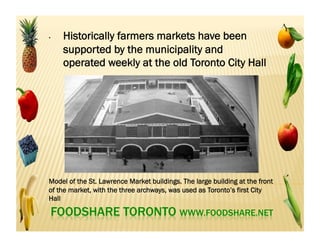
•  Historically farmers markets have been
supported by the municipality and
operated weekly at the old Toronto City Hall
Model of the St. Lawrence Market buildings. The large building at the front
of the market, with the three archways, was used as Toronto’s first City
Hall
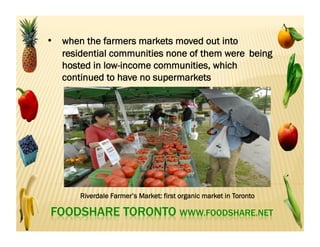
•  when the farmers markets moved out into
residential communities none of them were being
hosted in low-income communities, which
continued to have no supermarkets
Riverdale Farmer’s Market: first organic market in Toronto
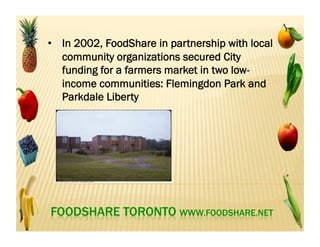
•  In 2002, FoodShare in partnership with local
community organizations secured City
funding for a farmers market in two low-
income communities: Flemingdon Park and
Parkdale Liberty
•  In 2003, affordable food began
selling in these markets
•  You’re listening and thinking ‘what is
so innovative about that?’
•  It was innovative because these were
not farmers market—they were called
Good Food Markets
•  By definition, the US Department of
Agriculture, refers to a farmers’
Market as “an association of local
farmers who assemble at a defined
location for the purpose of selling
their produce directly to consumers”
(USDA, 1996; Lauren Baker 2005)
•  At the Parkdale Liberty and
Flemingdon Park markets fresh
produce were being sold, but there
were no farmers
•  FoodShare had instead innovatively
used it’s purchasing power as a
wholesale supplier to buy produce
directly from farmers and Ontario
Food Terminal
•  This model bypassed the middle-man
and allowed FoodShare to sell the
produce simply at cost to Parkdale
and Flemingdon Markets
•  FoodShare had instead innovatively
used it’s purchasing power as a
wholesale supplier to buy produce
directly from farmers and Ontario
Food Terminal
•  This model bypassed the middle-man
and allowed FoodShare to sell the
produce simply at cost to Parkdale
and Flemingdon Markets
•  The markets were operated by local
community residents:
1.  to improve health (access to healthy
food)
2.  for affordability (reducing the cost of
healthy food)
3.  for accessibility (locating markets in
food deserts)
4. for community-building (through
social interaction, networking,
volunteerism, education and
celebration)
5. Supporting local farmers (buying food
directly from farmers at a fair price). (CANADIAN
POLICY RESEARCH NETWork)
•  By 2007 the GF Markets had expanded to
12 across the City; today, it’s at 17
markets
•  For a comprehensive understanding of the
impact that GF Markets are having take a
look at one in an indigenous community in
a typical isolated Northern Ontario
community that goes beyond the term
Food Desert
Fort Albany Good Food Market
•  Along with Fort Albany, FoodShare
provides produce to 5 other Northern
Ontario indigenous communities by
exactly the same mode of transport
•  Debbie Field, FoodShare’s ED, had
to obtain an exemption from our
board of directors to service the
northern communities, since we’re
mandated to only serve the Toronto
area
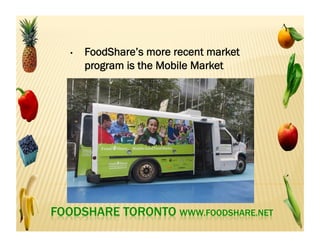
•  FoodShare’s more recent market
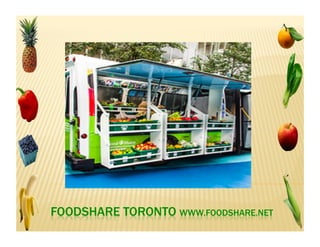
program is the Mobile Market
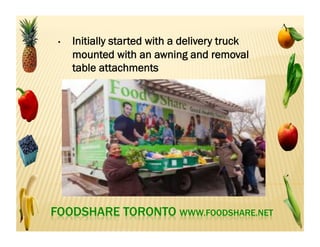
•  Initially started with a delivery truck
mounted with an awning and removal
table attachments
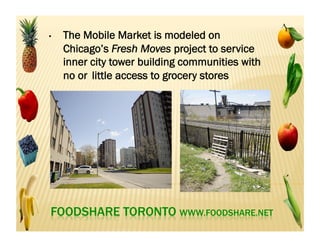
•  The Mobile Market is modeled on
Chicago’s Fresh Moves project to service
inner city tower building communities with
no or little access to grocery stores
FoodShare Mobile Good Food Market
•  In Toronto, approximately 1 in 3 children (age
2-11) is either overweight or obese
•  According to a 2010 report from Statistics
Canada, children as a group are “taller, heavier,
fatter and weaker than in 1981”
•  This may lead to accelerated
“non-communicable disease development,
increased health care costs, and loss of future
productivity”
•  The risk is higher in low-income communities
due to poor diet
9th International Public Markets Conference - Afua Asantewaa

9th International Public Markets Conference - Afua Asantewaa

  • 1.
    AFUA ASANTEWAA Get Healthy!:Innovative Public Market Strategies and Programs to Increase Access to Fresh, Healthy Food Mobile and Good Food Market Senior Coordinator FoodShare
  • 2.
    AFUA ASANTEWAA MOBILE &GOOD FOOD MARKET & COMMUNITY ANIMATOR SENIOR COORDINATOR
  • 3.
    •  Canada’s largestfood security organization •  Working with communities to improve access to affordable healthy food and to reduce hunger •  Programs include GF Box, cooking, GF & Mobile Markets, school nutrition and community gardens •  Although our Mission is “Good Healthy Food for All, and that our doors are open to customers from Toronto’s
  • 4.
    •  richest neighbourhoods,our priority is low-income communities •  In 1985, at the inception of FoodShare, Toronto City Executive Committee adopted key recommendations towards alleviating hunger based on FoodShare’s report, A Concept to Help Fight Hunger in Toronto
  • 5.
    •  The recommendationsincluded: City of Planning and Development Department provide incentives to encourage supermarket space in neighbourhoods lacking such spaces •  The latter was slow in coming and farmers market began popping up in neighbourhoods lacking grocery stores
  • 6.
    •  Historically farmersmarkets have been supported by the municipality and operated weekly at the old Toronto City Hall Model of the St. Lawrence Market buildings. The large building at the front of the market, with the three archways, was used as Toronto’s first City Hall
  • 7.
    •  when thefarmers markets moved out into residential communities none of them were being hosted in low-income communities, which continued to have no supermarkets Riverdale Farmer’s Market: first organic market in Toronto
  • 8.
    •  In 2002,FoodShare in partnership with local community organizations secured City funding for a farmers market in two low- income communities: Flemingdon Park and Parkdale Liberty
  • 9.
    •  In 2003,affordable food began selling in these markets •  You’re listening and thinking ‘what is so innovative about that?’ •  It was innovative because these were not farmers market—they were called Good Food Markets
  • 10.
    •  By definition,the US Department of Agriculture, refers to a farmers’ Market as “an association of local farmers who assemble at a defined location for the purpose of selling their produce directly to consumers” (USDA, 1996; Lauren Baker 2005) •  At the Parkdale Liberty and Flemingdon Park markets fresh produce were being sold, but there were no farmers
  • 11.
    •  FoodShare hadinstead innovatively used it’s purchasing power as a wholesale supplier to buy produce directly from farmers and Ontario Food Terminal •  This model bypassed the middle-man and allowed FoodShare to sell the produce simply at cost to Parkdale and Flemingdon Markets
  • 12.
    •  FoodShare hadinstead innovatively used it’s purchasing power as a wholesale supplier to buy produce directly from farmers and Ontario Food Terminal •  This model bypassed the middle-man and allowed FoodShare to sell the produce simply at cost to Parkdale and Flemingdon Markets
  • 13.
    •  The marketswere operated by local community residents: 1.  to improve health (access to healthy food) 2.  for affordability (reducing the cost of healthy food) 3.  for accessibility (locating markets in food deserts) 4. for community-building (through social interaction, networking, volunteerism, education and celebration)
  • 14.
    5. Supporting localfarmers (buying food directly from farmers at a fair price). (CANADIAN POLICY RESEARCH NETWork) •  By 2007 the GF Markets had expanded to 12 across the City; today, it’s at 17 markets •  For a comprehensive understanding of the impact that GF Markets are having take a look at one in an indigenous community in a typical isolated Northern Ontario community that goes beyond the term Food Desert
  • 15.
    Fort Albany GoodFood Market
  • 16.
    •  Along withFort Albany, FoodShare provides produce to 5 other Northern Ontario indigenous communities by exactly the same mode of transport •  Debbie Field, FoodShare’s ED, had to obtain an exemption from our board of directors to service the northern communities, since we’re mandated to only serve the Toronto area
  • 17.
    •  FoodShare’s morerecent market program is the Mobile Market
  • 18.
    •  Initially startedwith a delivery truck mounted with an awning and removal table attachments
  • 19.
    •  The MobileMarket is modeled on Chicago’s Fresh Moves project to service inner city tower building communities with no or little access to grocery stores
  • 20.
  • 22.
    •  In Toronto,approximately 1 in 3 children (age 2-11) is either overweight or obese •  According to a 2010 report from Statistics Canada, children as a group are “taller, heavier, fatter and weaker than in 1981” •  This may lead to accelerated “non-communicable disease development, increased health care costs, and loss of future productivity” •  The risk is higher in low-income communities due to poor diet