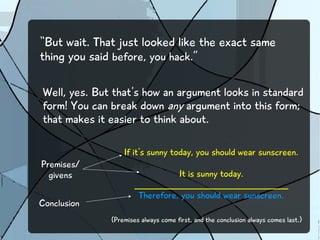
This document provides an overview of logic and logical arguments. It explains that logic involves using known information to draw reasonable conclusions. Good logical arguments have conclusions that follow logically from their premises. The document contrasts deductive reasoning, where conclusions are guaranteed if the premises are true, with inductive reasoning, where conclusions are probable but could have exceptions. It emphasizes the importance of evaluating arguments by considering alternative explanations or counterexamples that could invalidate the conclusion even if the premises are true.