Monitors
There are two categories of Monitors
1. Liquid Crystal Display (LCD) or Flat
Panel Display Screen
2. Cathode Ray Tubes (CRTs)
Liquid Crystal Display (LCD)
Monitor
Inside of a Liquid Crystal Display (LCD)
Monitor
How LCDs work
1. Light is emitted from backlight
2. The light gets polarized then passes through glass substrate
3. When the light passes through the liquid crystal it either is
either blocked or allowed to go through
4. Light that passes through the liquid crystal then passes
through the color filter
5. Light goes through another polarizer and glass substrate
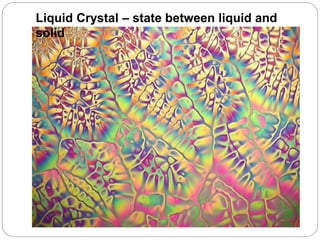
Liquid Crystal – state between liquid and
solid
Inside of a Liquid Crystal Display (LCD)
Monitor
Cathode Ray Tubes (CRTs) Monitor
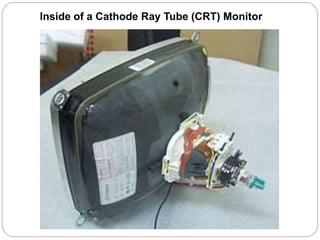
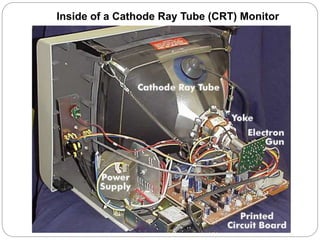
Inside of a Cathode Ray Tube (CRT) Monitor
Cathode Ray Tube (CRT)
Electron Gun
CRT Monitors
A CRT monitor contains millions of tiny red,
green, and blue phosphor dots that glow when
struck by an electron beam that travels across
the screen to create a visible image.
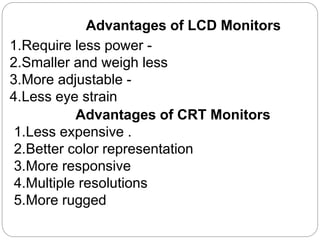
Advantages of LCD Monitors
1.Require less power -
2.Smaller and weigh less
3.More adjustable -
4.Less eye strain
Advantages of CRT Monitors
1.Less expensive .
2.Better color representation
3.More responsive
4.Multiple resolutions
5.More rugged

Monitor

  • 1.
  • 2.
    There are twocategories of Monitors 1. Liquid Crystal Display (LCD) or Flat Panel Display Screen 2. Cathode Ray Tubes (CRTs)
  • 3.
  • 4.
    Inside of aLiquid Crystal Display (LCD) Monitor
  • 5.
    How LCDs work 1.Light is emitted from backlight 2. The light gets polarized then passes through glass substrate 3. When the light passes through the liquid crystal it either is either blocked or allowed to go through 4. Light that passes through the liquid crystal then passes through the color filter 5. Light goes through another polarizer and glass substrate
  • 6.
    Liquid Crystal –state between liquid and solid
  • 7.
    Inside of aLiquid Crystal Display (LCD) Monitor
  • 8.
    Cathode Ray Tubes(CRTs) Monitor
  • 10.
    Inside of aCathode Ray Tube (CRT) Monitor
  • 11.
    Inside of aCathode Ray Tube (CRT) Monitor
  • 12.
  • 13.
  • 14.
    CRT Monitors A CRTmonitor contains millions of tiny red, green, and blue phosphor dots that glow when struck by an electron beam that travels across the screen to create a visible image.
  • 15.
    Advantages of LCDMonitors 1.Require less power - 2.Smaller and weigh less 3.More adjustable - 4.Less eye strain Advantages of CRT Monitors 1.Less expensive . 2.Better color representation 3.More responsive 4.Multiple resolutions 5.More rugged