Introduction to
Mongo
DB
info@tibacademy.in www.traininginbangalore.com
095133 32301
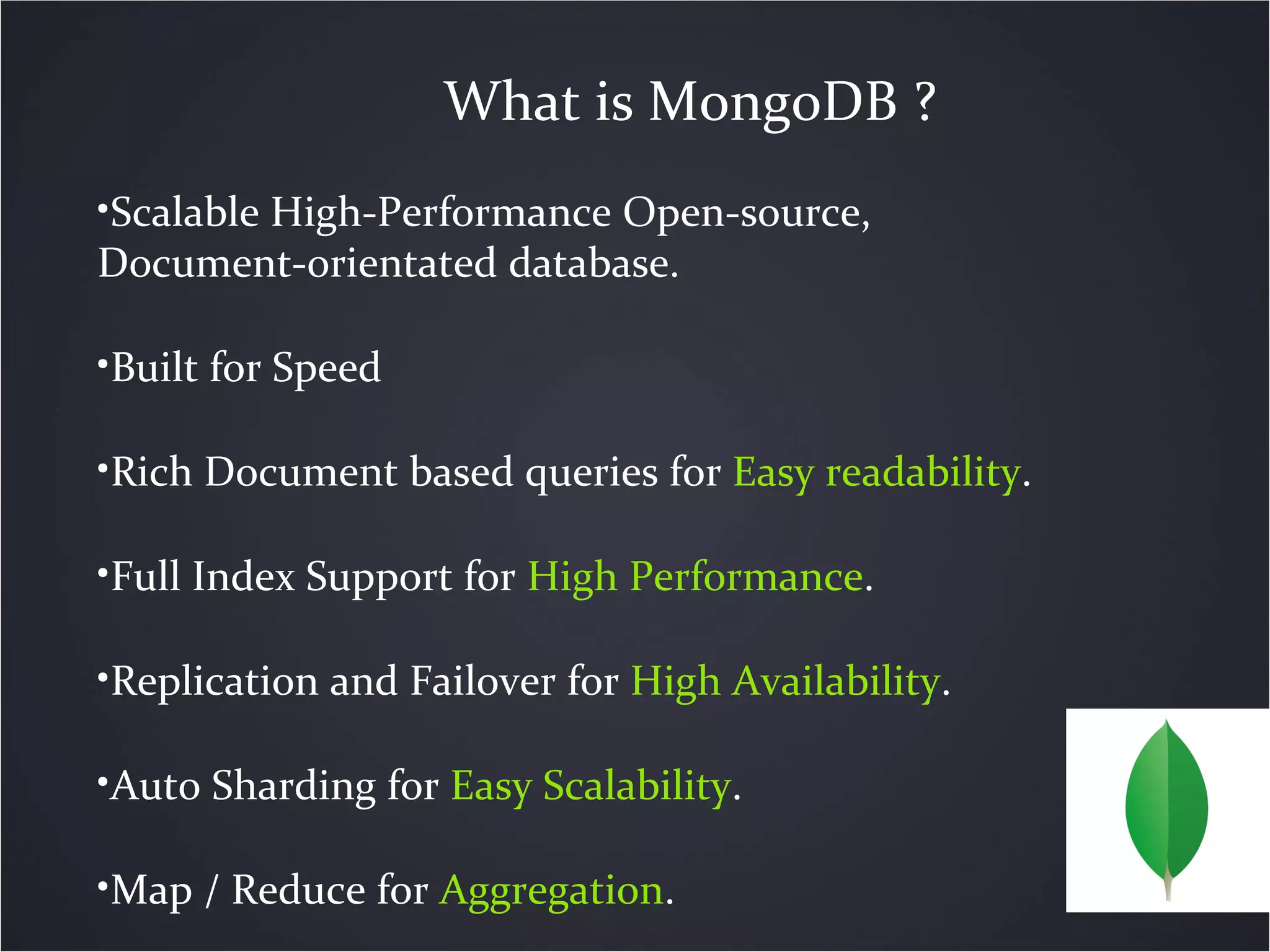
The Great Divide
MongoDB - Sweet Spot: Easy, Flexible and Scalable
What is MongoDB ?
•Scalable High-Performance Open-source,
Document-orientated database.
•Built for Speed
•Rich Document based queries for Easy readability.
•Full Index Support for High Performance.
•Replication and Failover for High Availability.
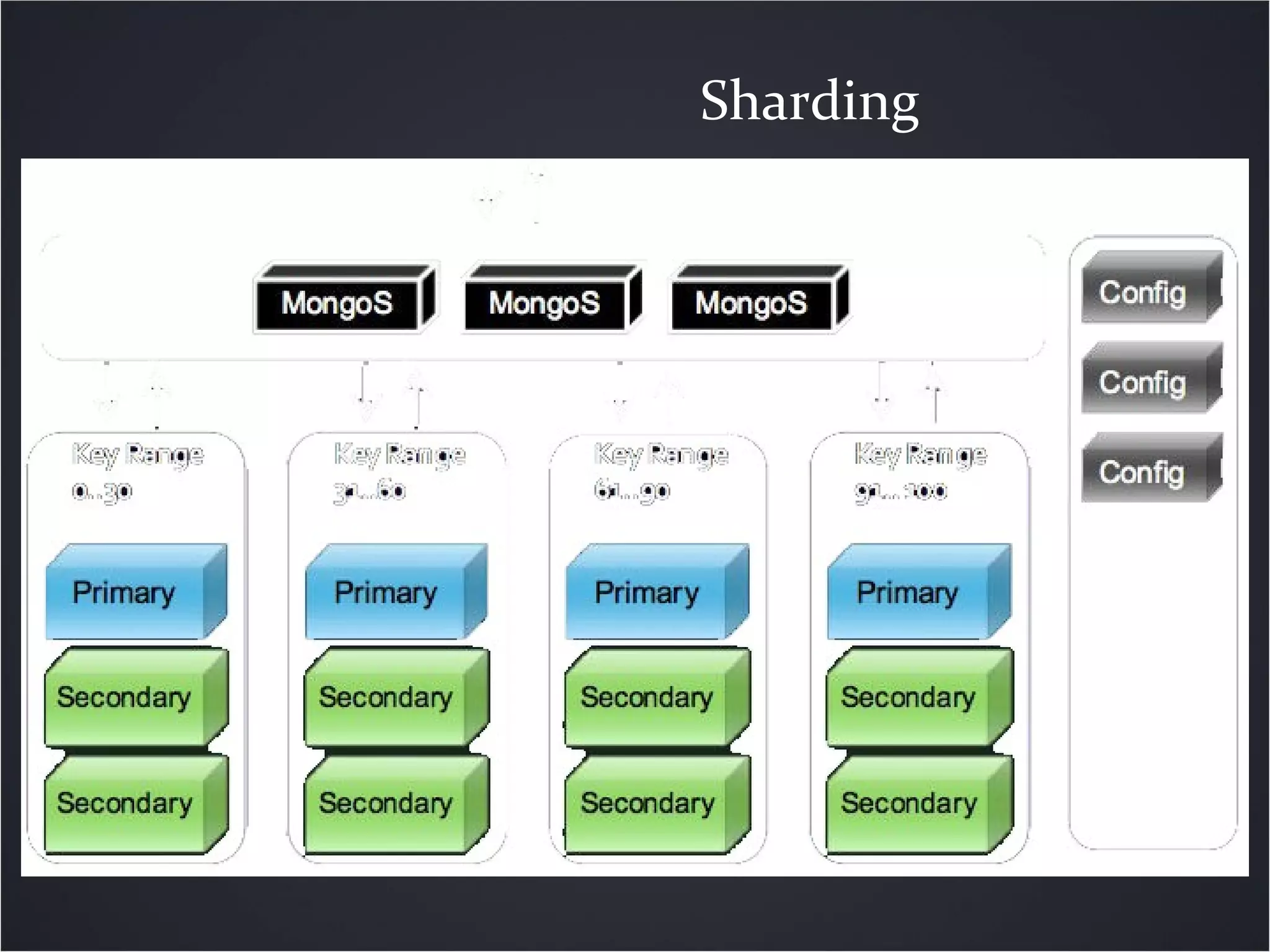
•Auto Sharding for Easy Scalability.
•Map / Reduce for Aggregation.
Why use MongoDB?
•SQL was invented in the 70’s to store data.
•MongoDB stores documents (or) objects.
•Now-a-days, everyone works with objects
(Python/Ruby/Java/etc.)
•And we need Databases to persist our objects.
Then why not store objects directly ?
•Embedded documents and arrays reduce need for
joins. No Joins and No-multi document
transactions.
What is MongoDB great for?
• RDBMS replacement for Web Applications.
• Semi-structured Content Management.
• Real-time Analytics & High-Speed Logging.
• Caching and High Scalability
Web 2.0, Media, SAAS, Gaming HealthCare,
Finance, Telecom, Government
Not great for?
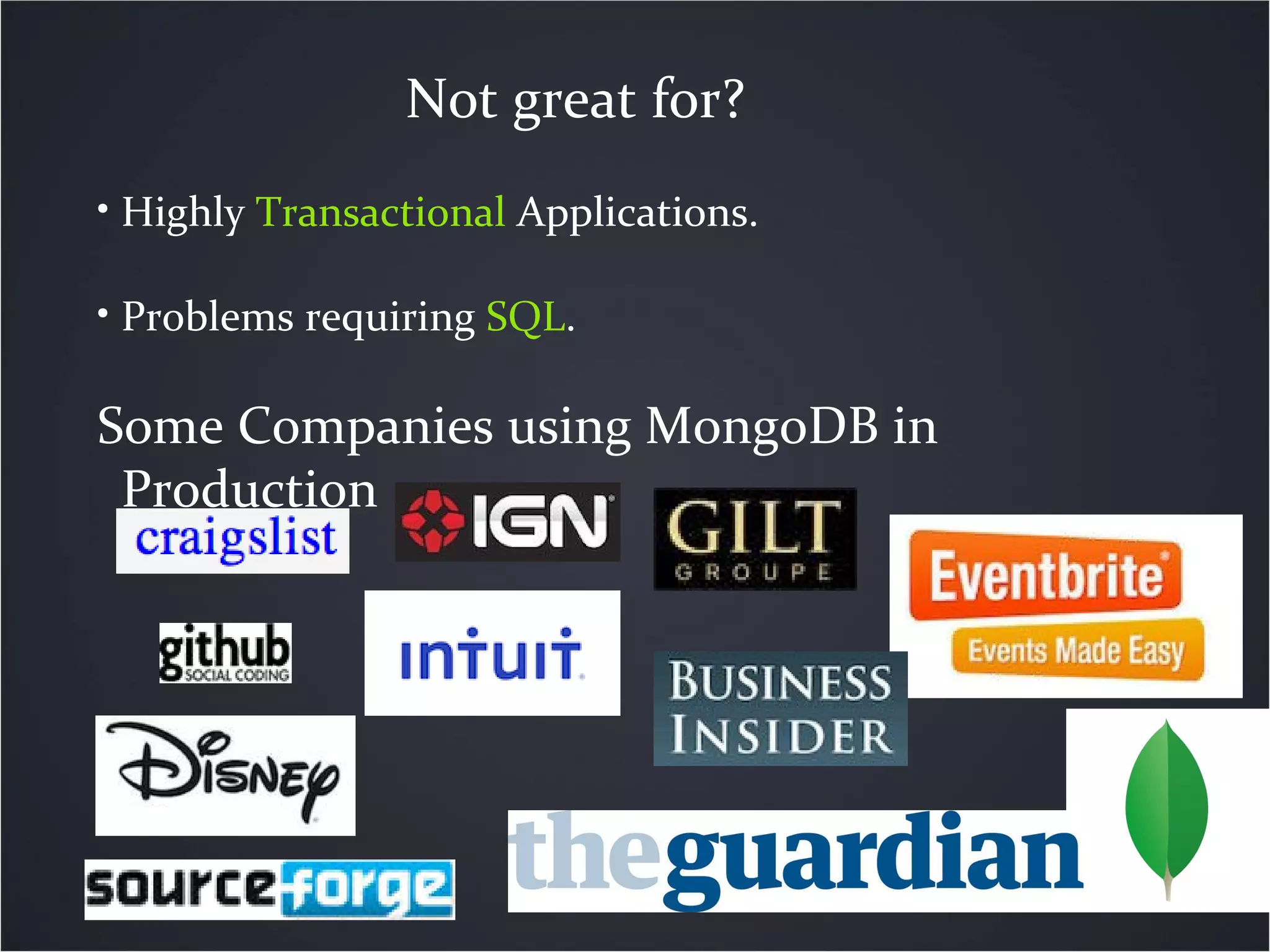
• Highly Transactional Applications.
• Problems requiring SQL.
Some Companies using MongoDB in
Production
Let’s Dive
in !
Database
When I say Think
Database
• Made up of Multiple Collections.
• Created on-the-fly when referenced for the first time.
Collection
When I say Think
Table
•Schema-less, and contains Documents.
•Indexable by one/more keys.
•Created on-the-fly when referenced for the first time.
•Capped Collections: Fixed size, older records get dropped
after reaching the limit.
Document
When I say Think
Record/Row
• Stored in a Collection.
• Can have _id key – works like Primary keys in MySQL.
• Supported Relationships – Embedded (or) References.
• Document storage in BSON (Binary form of JSON).
var p = { ‘_id’: ‘3432’,
‘author’: DBRef(‘User’, 2),
‘title’: ‘Introduction to MongoDB’,
‘body’: ‘MongoDB is an open sources.. ‘,
‘timestamp’: Date(’01-04-12’),
‘tags’: [‘MongoDB’, ‘NoSQL’],
‘comments’: [{‘author’: DBRef(‘User’, 4),
‘date’: Date(’02-04-12’),
‘text’: ‘Did you see.. ‘, ‘upvotes’: 7, … ]
}
> db.posts.save(p);
Understanding the Document
Model.
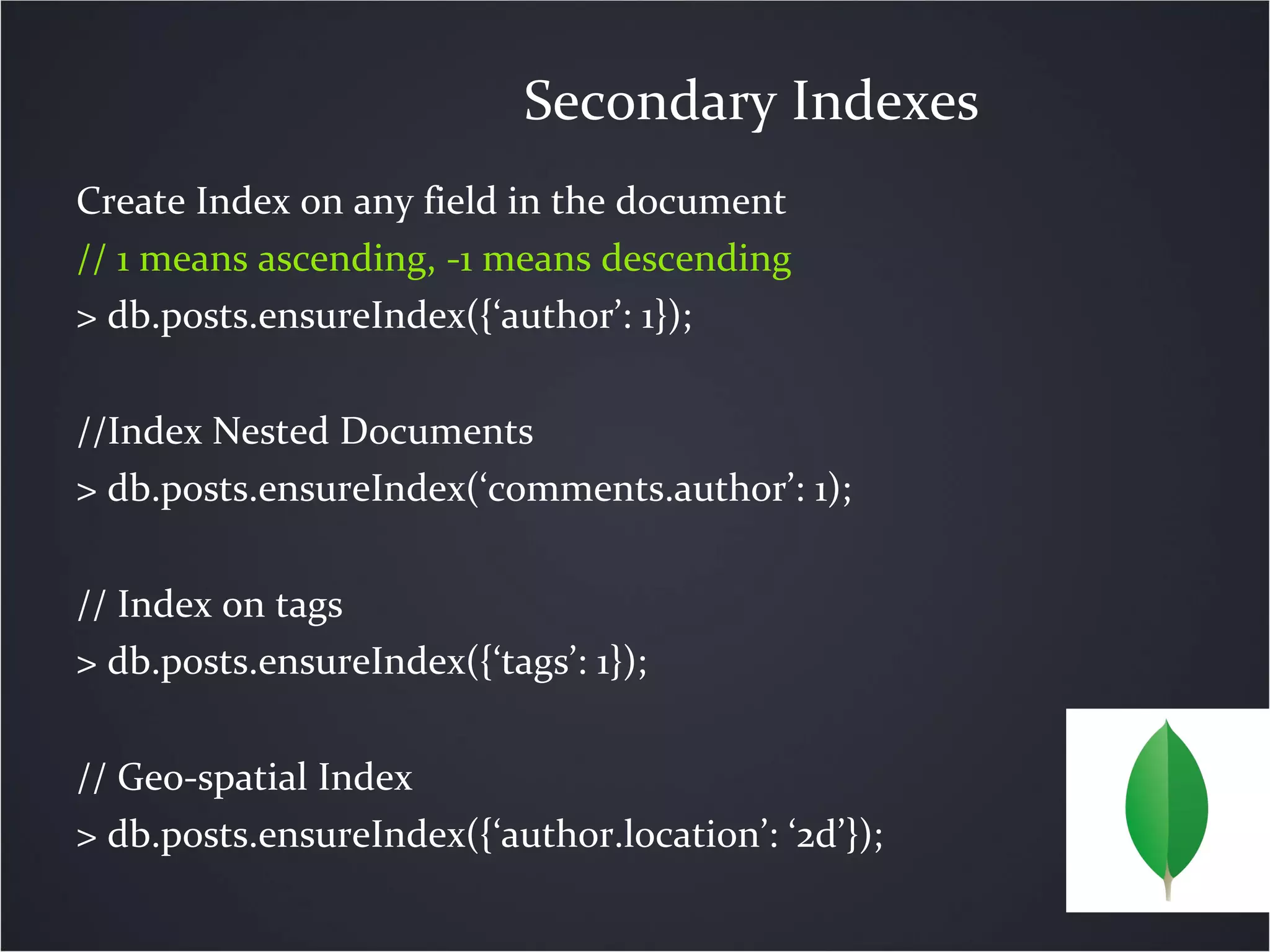
Create Index on any field in the document
// 1 means ascending, -1 means descending
> db.posts.ensureIndex({‘author’: 1});
//Index Nested Documents
> db.posts.ensureIndex(‘comments.author’: 1);
// Index on tags
> db.posts.ensureIndex({‘tags’: 1});
// Geo-spatial Index
> db.posts.ensureIndex({‘author.location’: ‘2d’});
Secondary Indexes
// find posts which has ‘MongoDB’ tag.
> db.posts.find({tags: ‘MongoDB’});
// find posts by author’s comments.
> db.posts.find({‘comments.author’: DBRef(‘User’,2)}).count();
// find posts written after 31st March.
> db.posts.find({‘timestamp’: {‘gte’: Date(’31-03-12’)}});
// find posts written by authors around [22, 42]
> db.posts.find({‘author.location’: {‘near’:[22, 42]});
$gt, $lt, $gte, $lte, $ne, $all, $in, $nin, count, limit, skip, group, etc…
What about Queries? So Simple
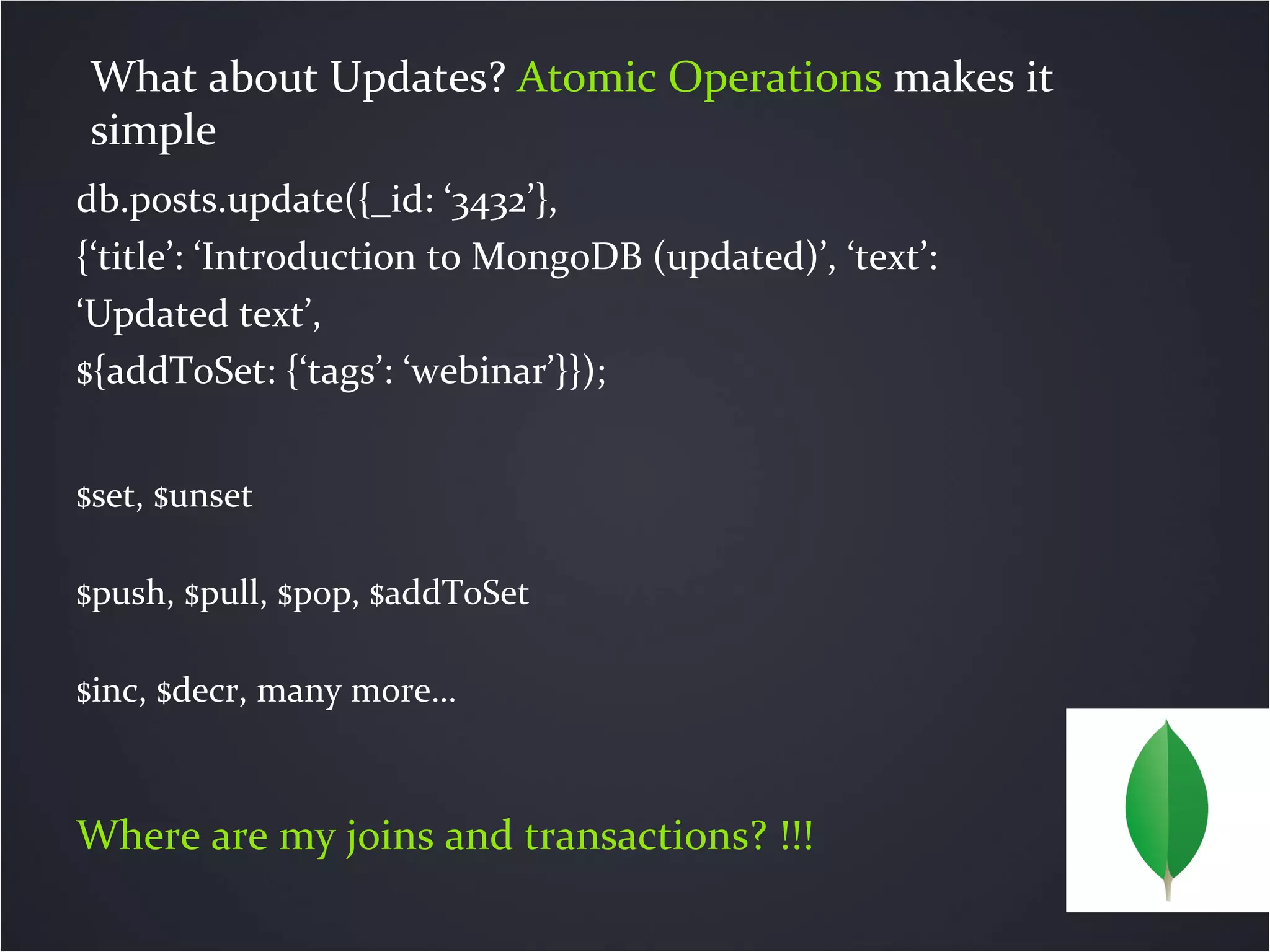
db.posts.update({_id: ‘3432’},
{‘title’: ‘Introduction to MongoDB (updated)’, ‘text’:
‘Updated text’,
${addToSet: {‘tags’: ‘webinar’}});
$set, $unset
$push, $pull, $pop, $addToSet
$inc, $decr, many more…
Where are my joins and transactions? !!!
What about Updates? Atomic Operations makes it
simple
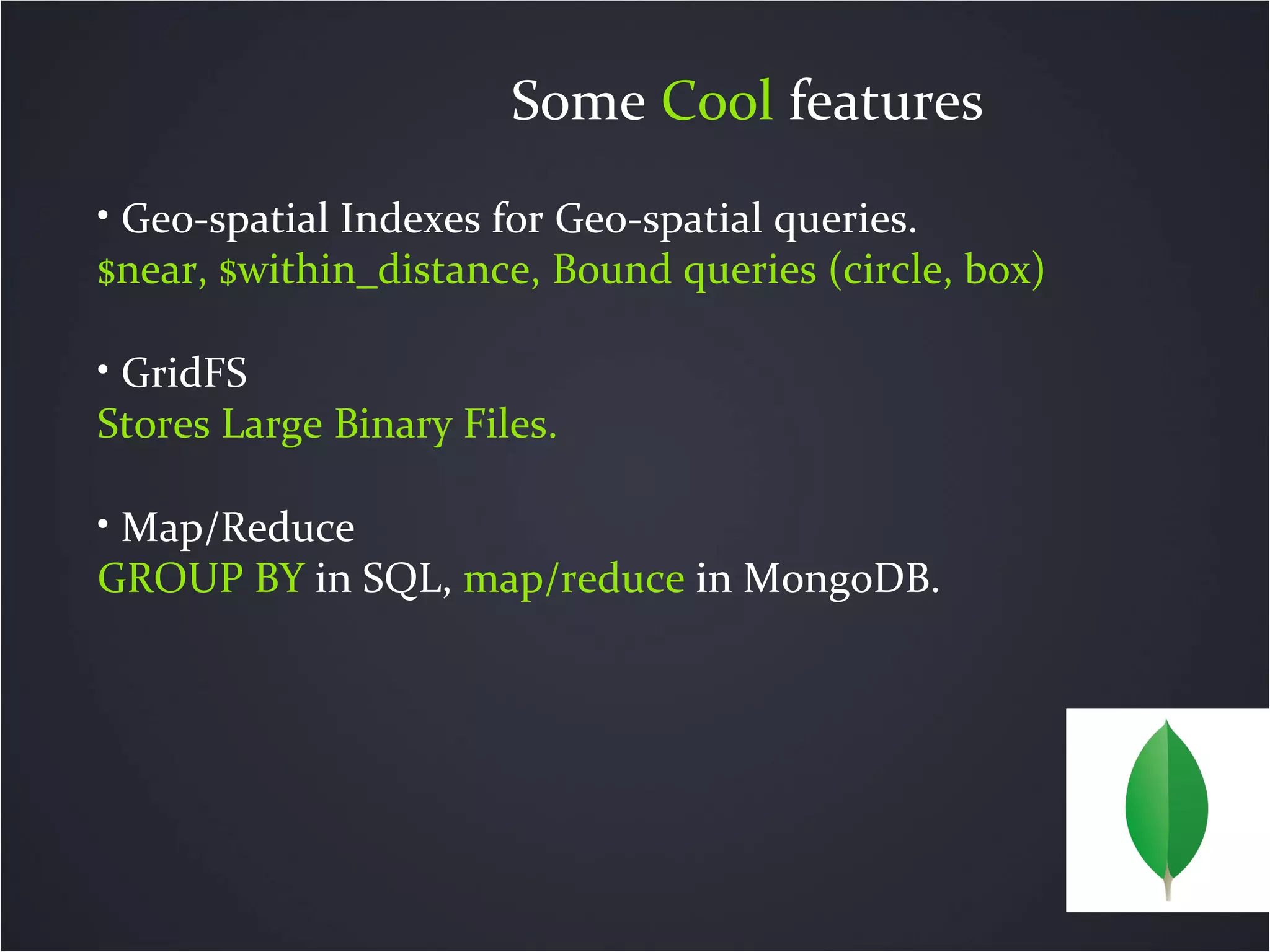
Some Cool features
• Geo-spatial Indexes for Geo-spatial queries.
$near, $within_distance, Bound queries (circle, box)
• GridFS
Stores Large Binary Files.
• Map/Reduce
GROUP BY in SQL, map/reduce in MongoDB.
Deployment
& Scaling
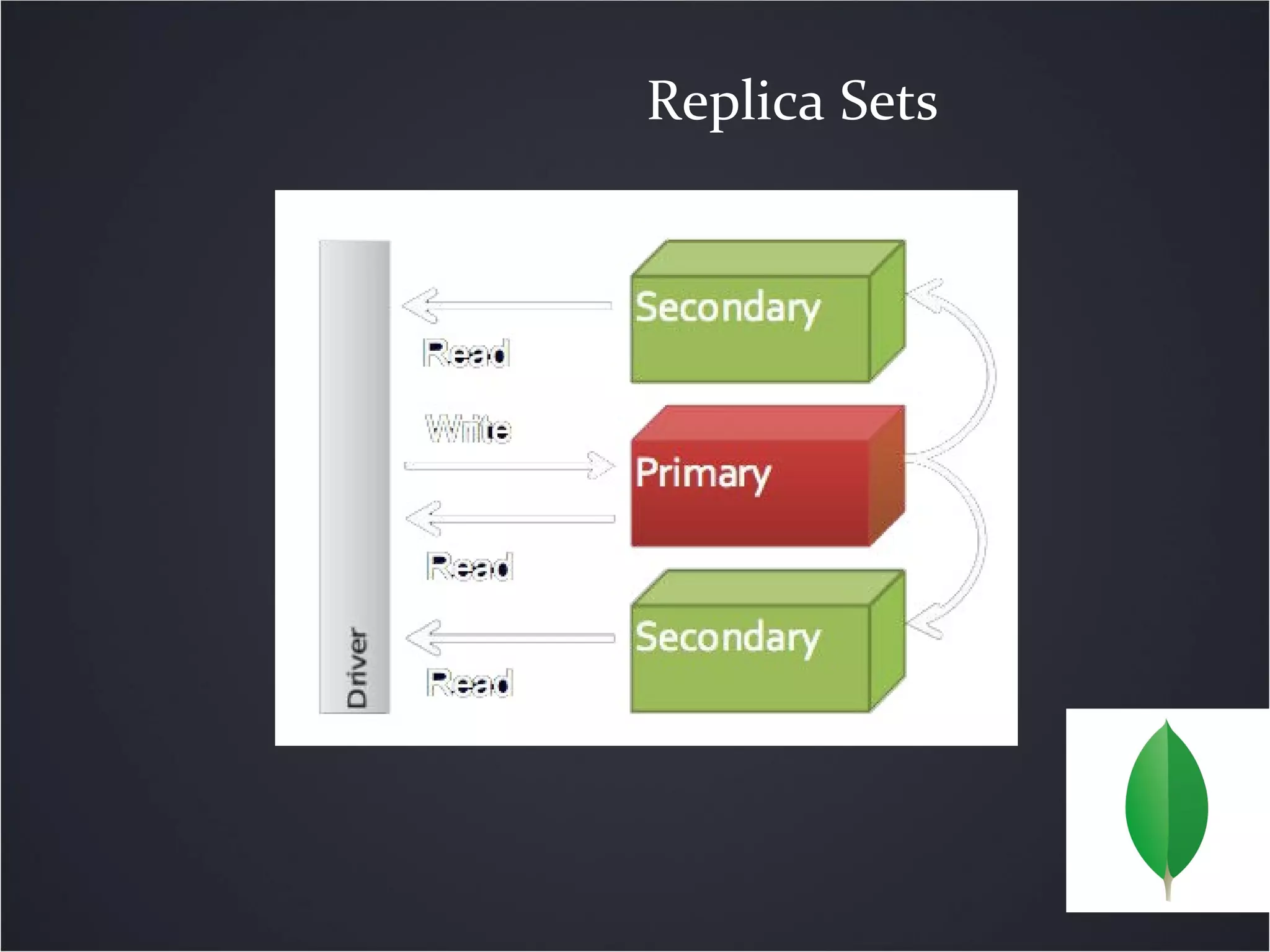
Replica Sets
Sharding
Python MongoDB
MongoEngine
PyMongo based ORM – A Separate Topic !
No. 5/3, Second Floor and Third Floor,
BEML Layout, Varathur Road,
Thubarahalli, Kundalahalli Gate,
Bengaluru, Karnataka 560066

Mongodb Training Tutorial in Bangalore

  • 1.
  • 2.
    The Great Divide MongoDB- Sweet Spot: Easy, Flexible and Scalable
  • 3.
    What is MongoDB? •Scalable High-Performance Open-source, Document-orientated database. •Built for Speed •Rich Document based queries for Easy readability. •Full Index Support for High Performance. •Replication and Failover for High Availability. •Auto Sharding for Easy Scalability. •Map / Reduce for Aggregation.
  • 4.
    Why use MongoDB? •SQLwas invented in the 70’s to store data. •MongoDB stores documents (or) objects. •Now-a-days, everyone works with objects (Python/Ruby/Java/etc.) •And we need Databases to persist our objects. Then why not store objects directly ? •Embedded documents and arrays reduce need for joins. No Joins and No-multi document transactions.
  • 5.
    What is MongoDBgreat for? • RDBMS replacement for Web Applications. • Semi-structured Content Management. • Real-time Analytics & High-Speed Logging. • Caching and High Scalability Web 2.0, Media, SAAS, Gaming HealthCare, Finance, Telecom, Government
  • 6.
    Not great for? •Highly Transactional Applications. • Problems requiring SQL. Some Companies using MongoDB in Production
  • 7.
  • 8.
    Database When I sayThink Database • Made up of Multiple Collections. • Created on-the-fly when referenced for the first time.
  • 9.
    Collection When I sayThink Table •Schema-less, and contains Documents. •Indexable by one/more keys. •Created on-the-fly when referenced for the first time. •Capped Collections: Fixed size, older records get dropped after reaching the limit.
  • 10.
    Document When I sayThink Record/Row • Stored in a Collection. • Can have _id key – works like Primary keys in MySQL. • Supported Relationships – Embedded (or) References. • Document storage in BSON (Binary form of JSON).
  • 11.
    var p ={ ‘_id’: ‘3432’, ‘author’: DBRef(‘User’, 2), ‘title’: ‘Introduction to MongoDB’, ‘body’: ‘MongoDB is an open sources.. ‘, ‘timestamp’: Date(’01-04-12’), ‘tags’: [‘MongoDB’, ‘NoSQL’], ‘comments’: [{‘author’: DBRef(‘User’, 4), ‘date’: Date(’02-04-12’), ‘text’: ‘Did you see.. ‘, ‘upvotes’: 7, … ] } > db.posts.save(p); Understanding the Document Model.
  • 12.
    Create Index onany field in the document // 1 means ascending, -1 means descending > db.posts.ensureIndex({‘author’: 1}); //Index Nested Documents > db.posts.ensureIndex(‘comments.author’: 1); // Index on tags > db.posts.ensureIndex({‘tags’: 1}); // Geo-spatial Index > db.posts.ensureIndex({‘author.location’: ‘2d’}); Secondary Indexes
  • 13.
    // find postswhich has ‘MongoDB’ tag. > db.posts.find({tags: ‘MongoDB’}); // find posts by author’s comments. > db.posts.find({‘comments.author’: DBRef(‘User’,2)}).count(); // find posts written after 31st March. > db.posts.find({‘timestamp’: {‘gte’: Date(’31-03-12’)}}); // find posts written by authors around [22, 42] > db.posts.find({‘author.location’: {‘near’:[22, 42]}); $gt, $lt, $gte, $lte, $ne, $all, $in, $nin, count, limit, skip, group, etc… What about Queries? So Simple
  • 14.
    db.posts.update({_id: ‘3432’}, {‘title’: ‘Introductionto MongoDB (updated)’, ‘text’: ‘Updated text’, ${addToSet: {‘tags’: ‘webinar’}}); $set, $unset $push, $pull, $pop, $addToSet $inc, $decr, many more… Where are my joins and transactions? !!! What about Updates? Atomic Operations makes it simple
  • 15.
    Some Cool features •Geo-spatial Indexes for Geo-spatial queries. $near, $within_distance, Bound queries (circle, box) • GridFS Stores Large Binary Files. • Map/Reduce GROUP BY in SQL, map/reduce in MongoDB.
  • 16.
  • 17.
  • 18.
  • 19.
    Python MongoDB MongoEngine PyMongo basedORM – A Separate Topic ! No. 5/3, Second Floor and Third Floor, BEML Layout, Varathur Road, Thubarahalli, Kundalahalli Gate, Bengaluru, Karnataka 560066