By ,
Kowndinya Mannepalli
"Mongo DB is scalable, open source, high performance, document oriented database.“
- 10 gen
By ,
Kowndinya Mannepalli
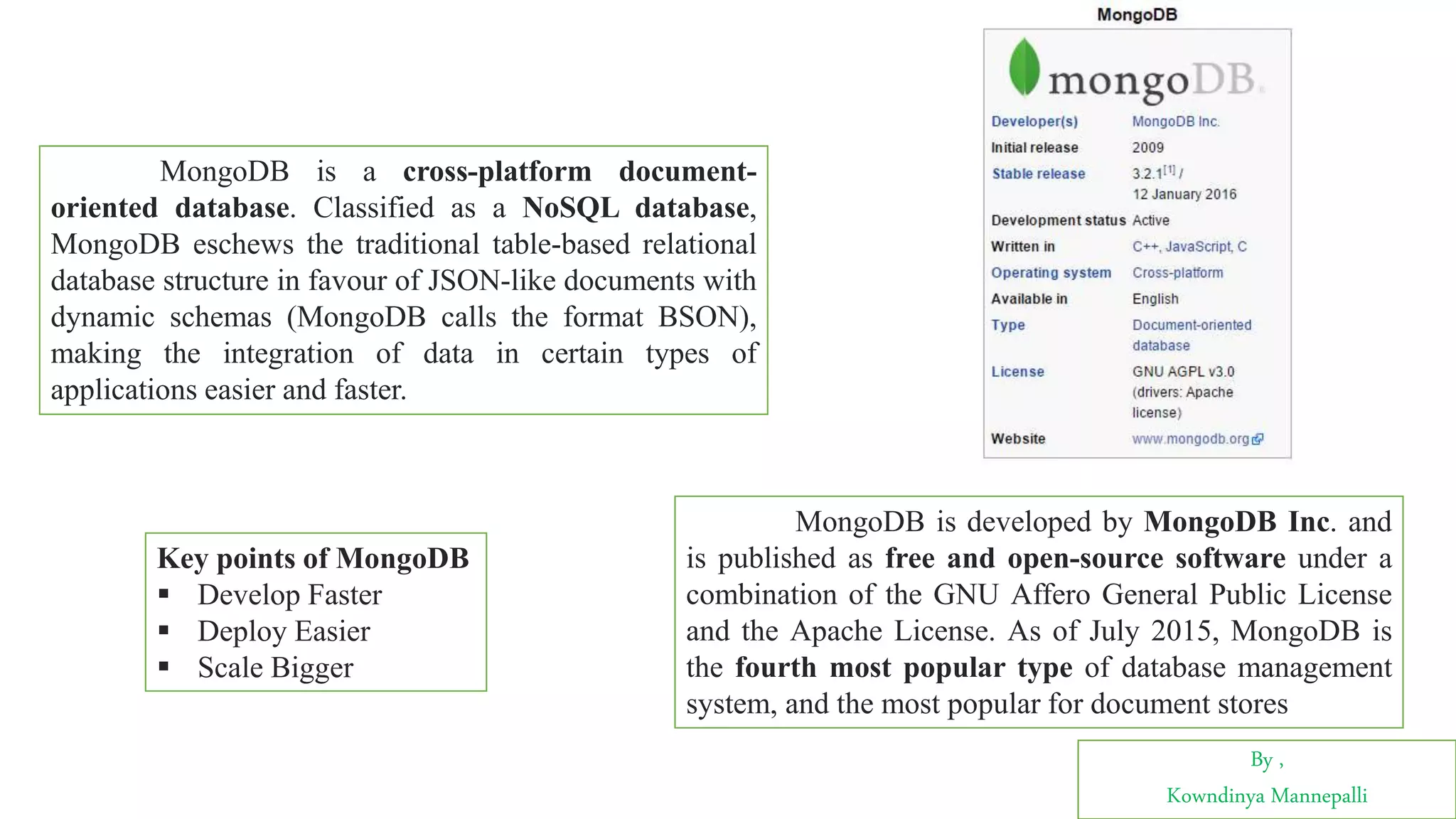
MongoDB is a cross-platform document-
oriented database. Classified as a NoSQL database,
MongoDB eschews the traditional table-based relational
database structure in favour of JSON-like documents with
dynamic schemas (MongoDB calls the format BSON),
making the integration of data in certain types of
applications easier and faster.
MongoDB is developed by MongoDB Inc. and
is published as free and open-source software under a
combination of the GNU Affero General Public License
and the Apache License. As of July 2015, MongoDB is
the fourth most popular type of database management
system, and the most popular for document stores
Key points of MongoDB
 Develop Faster
 Deploy Easier
 Scale Bigger
By ,
Kowndinya Mannepalli
Main purpose to build MongoDB:
 Scalability
 Performance
 High Availability
 Scaling from single server deployments to large, complex multi-site architectures.
By ,
Kowndinya Mannepalli
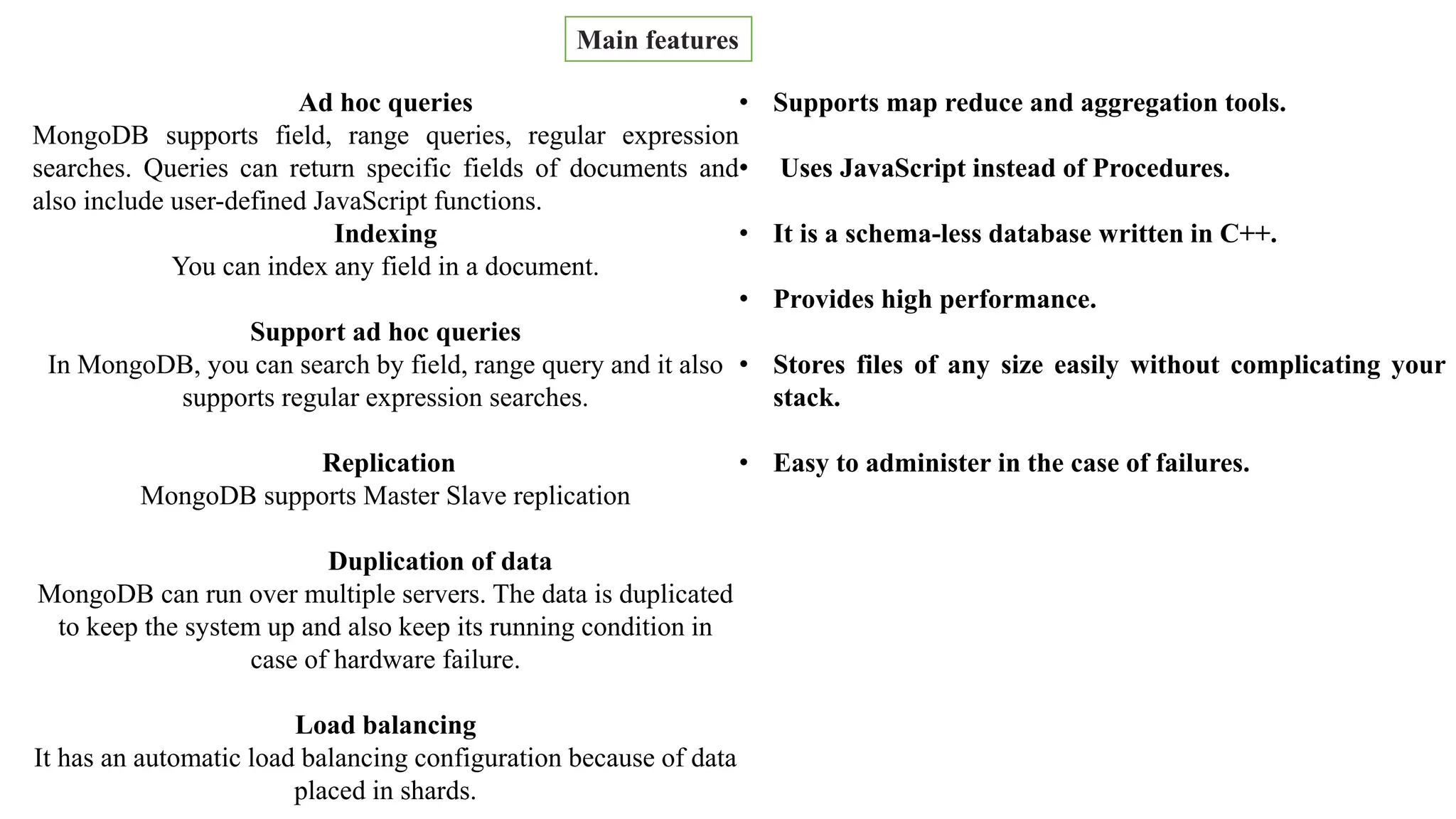
Main features
Ad hoc queries
MongoDB supports field, range queries, regular expression
searches. Queries can return specific fields of documents and
also include user-defined JavaScript functions.
Indexing
You can index any field in a document.
Support ad hoc queries
In MongoDB, you can search by field, range query and it also
supports regular expression searches.
Replication
MongoDB supports Master Slave replication
Duplication of data
MongoDB can run over multiple servers. The data is duplicated
to keep the system up and also keep its running condition in
case of hardware failure.
Load balancing
It has an automatic load balancing configuration because of data
placed in shards.
• Supports map reduce and aggregation tools.
• Uses JavaScript instead of Procedures.
• It is a schema-less database written in C++.
• Provides high performance.
• Stores files of any size easily without complicating your
stack.
• Easy to administer in the case of failures.
By ,
Kowndinya Mannepalli
• A NoSQL database provides a mechanism for
storage and retrieval of data which is modelled in
means other than the tabular relations used in
relational databases.
• NoSQL Database is used to refer a non-SQL or non
relational database.
• It is generally used to store big data and real-time
web applications.
Advantages
• It supports query language.
• It provides fast performance.
• It provides horizontal scalability.
By ,
Kowndinya Mannepalli
NoSQL database can be classified as 4 basic types:
• Key value store NoSQL database
• Document store NoSQL database
• Column store NoSQL database
• Graph base NoSQL database
There are many NoSQL databases. MongoDB, Cassandra, CouchBD, Hypertable, Redis, Riak,
Neo4j, HBASE, Couchbase, MemcacheDB, Voldemort, RevenDB etc. are the examples of
NoSQL databases.
By ,
Kowndinya Mannepalli
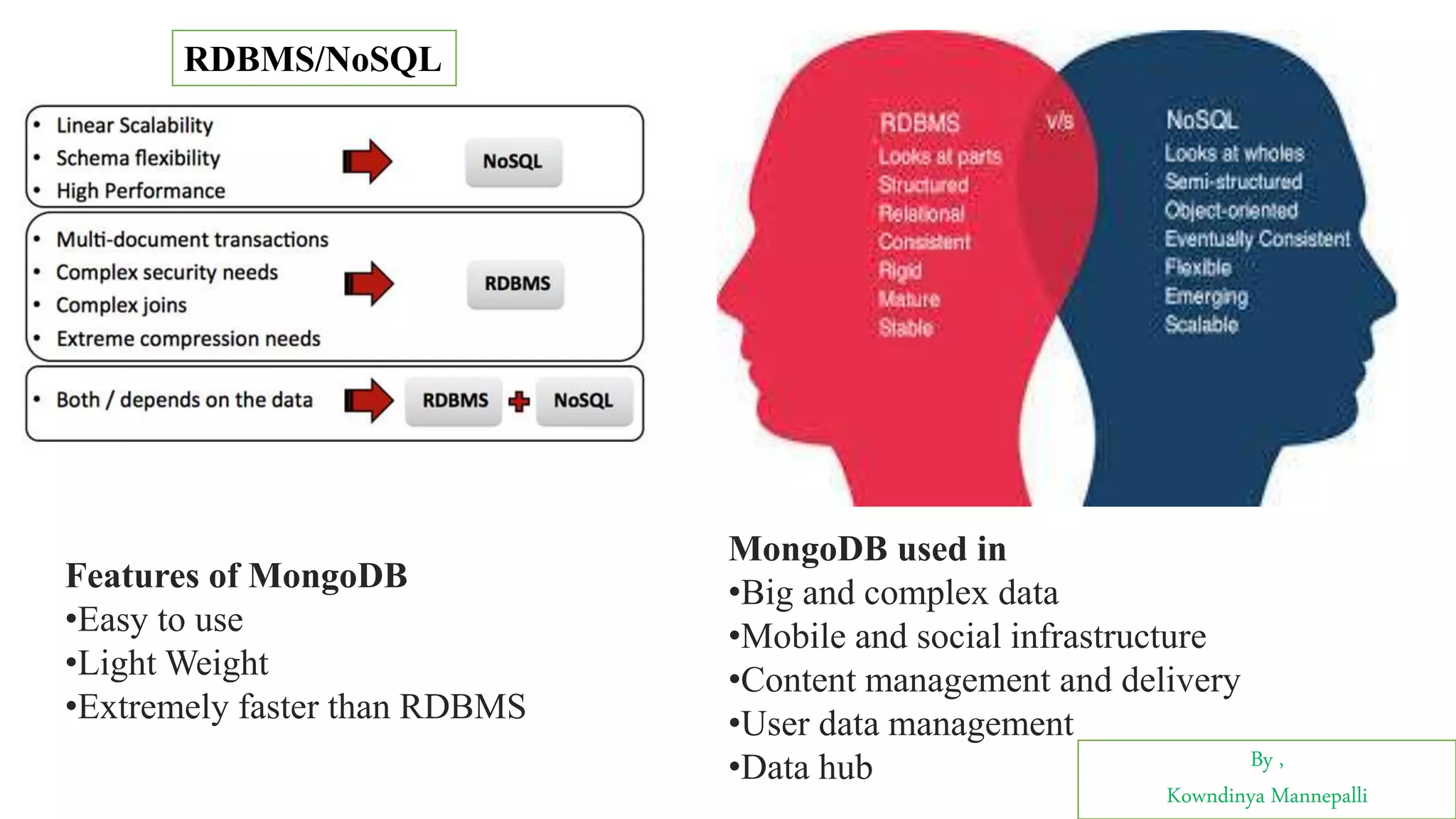
Features of MongoDB
•Easy to use
•Light Weight
•Extremely faster than RDBMS
MongoDB used in
•Big and complex data
•Mobile and social infrastructure
•Content management and delivery
•User data management
•Data hub
RDBMS/NoSQL
By ,
Kowndinya Mannepalli
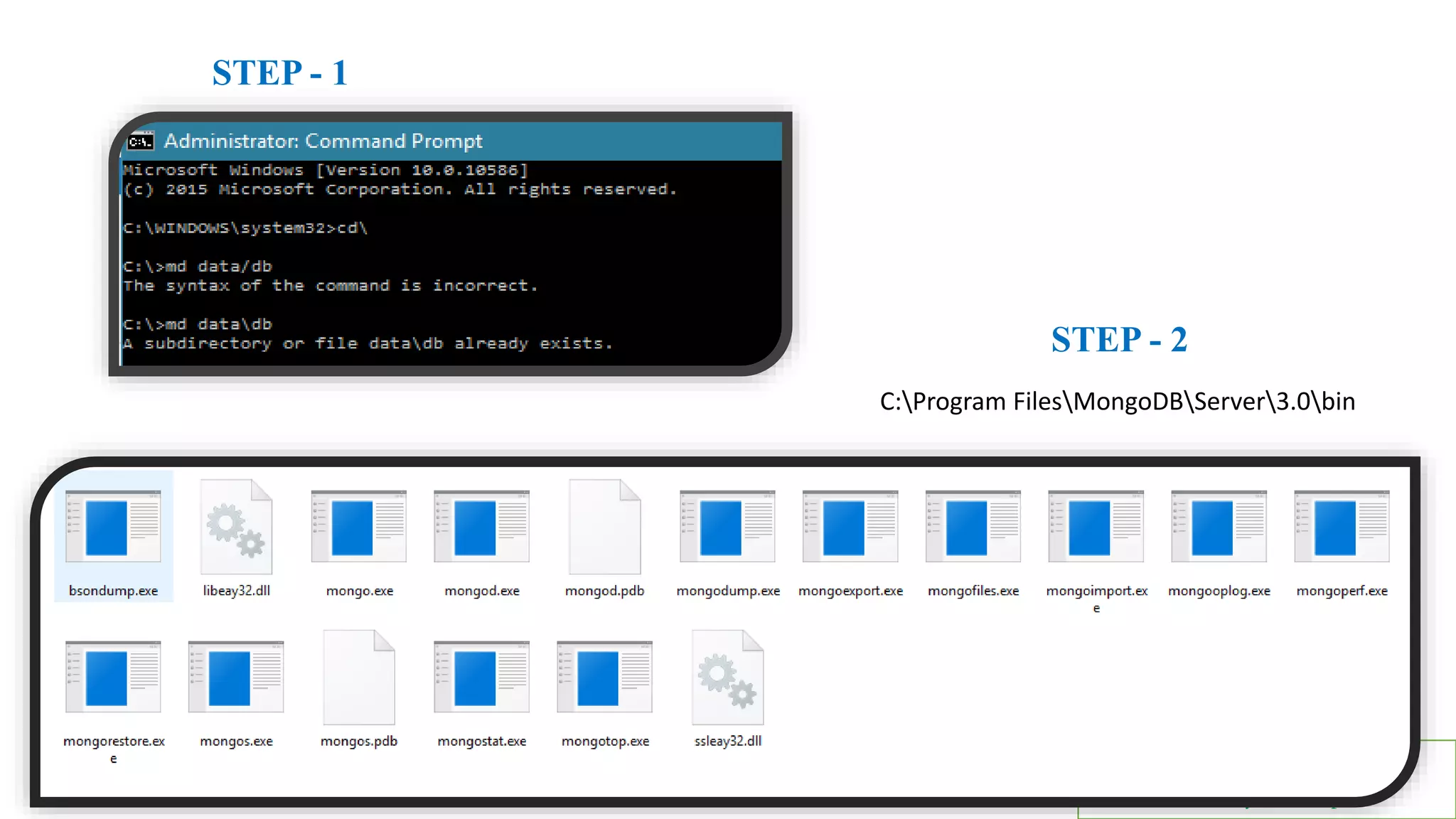
STEP - 1
C:Program FilesMongoDBServer3.0bin
STEP - 2
By ,
Kowndinya Mannepalli
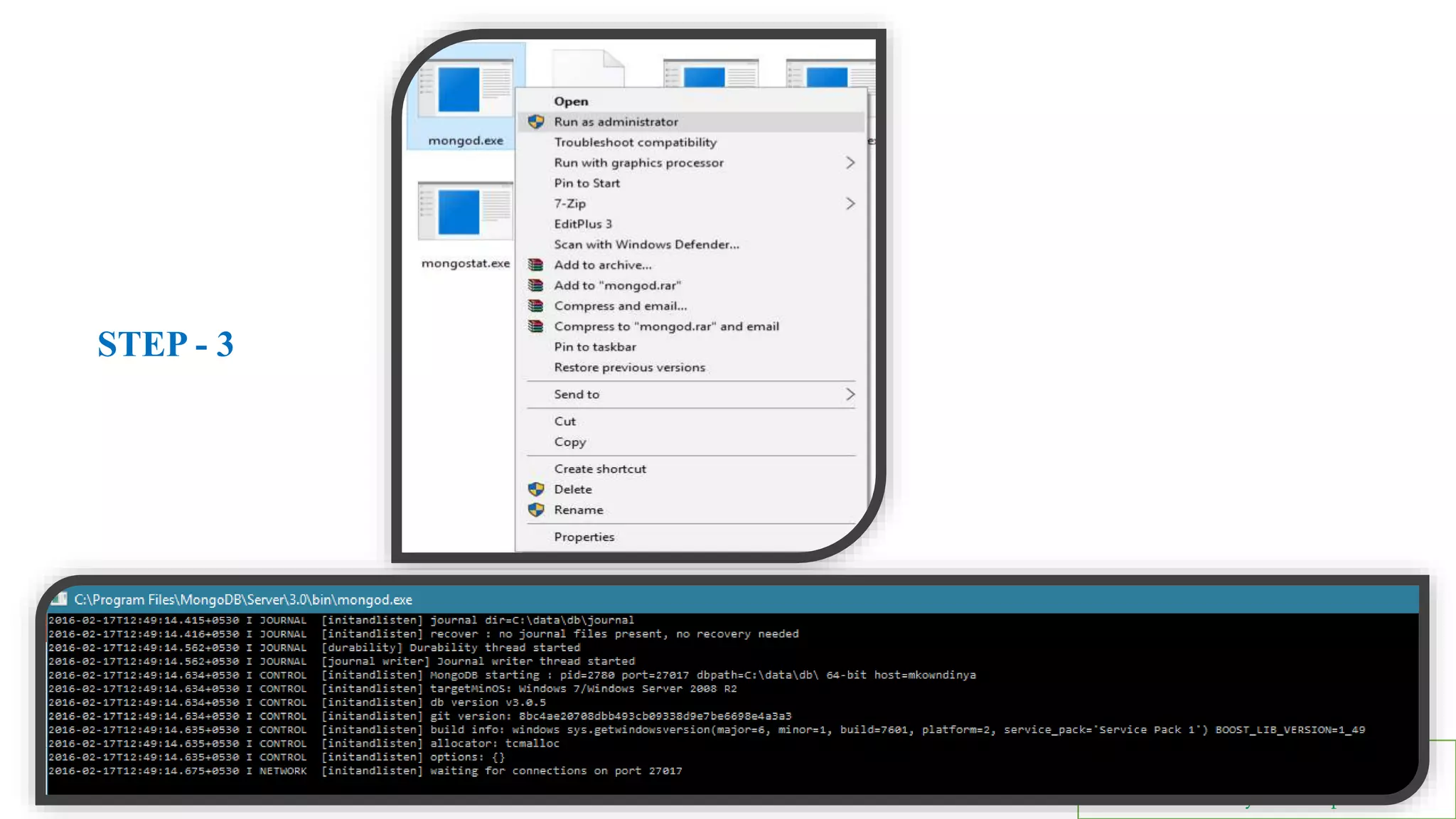
STEP - 3
By ,
Kowndinya Mannepalli
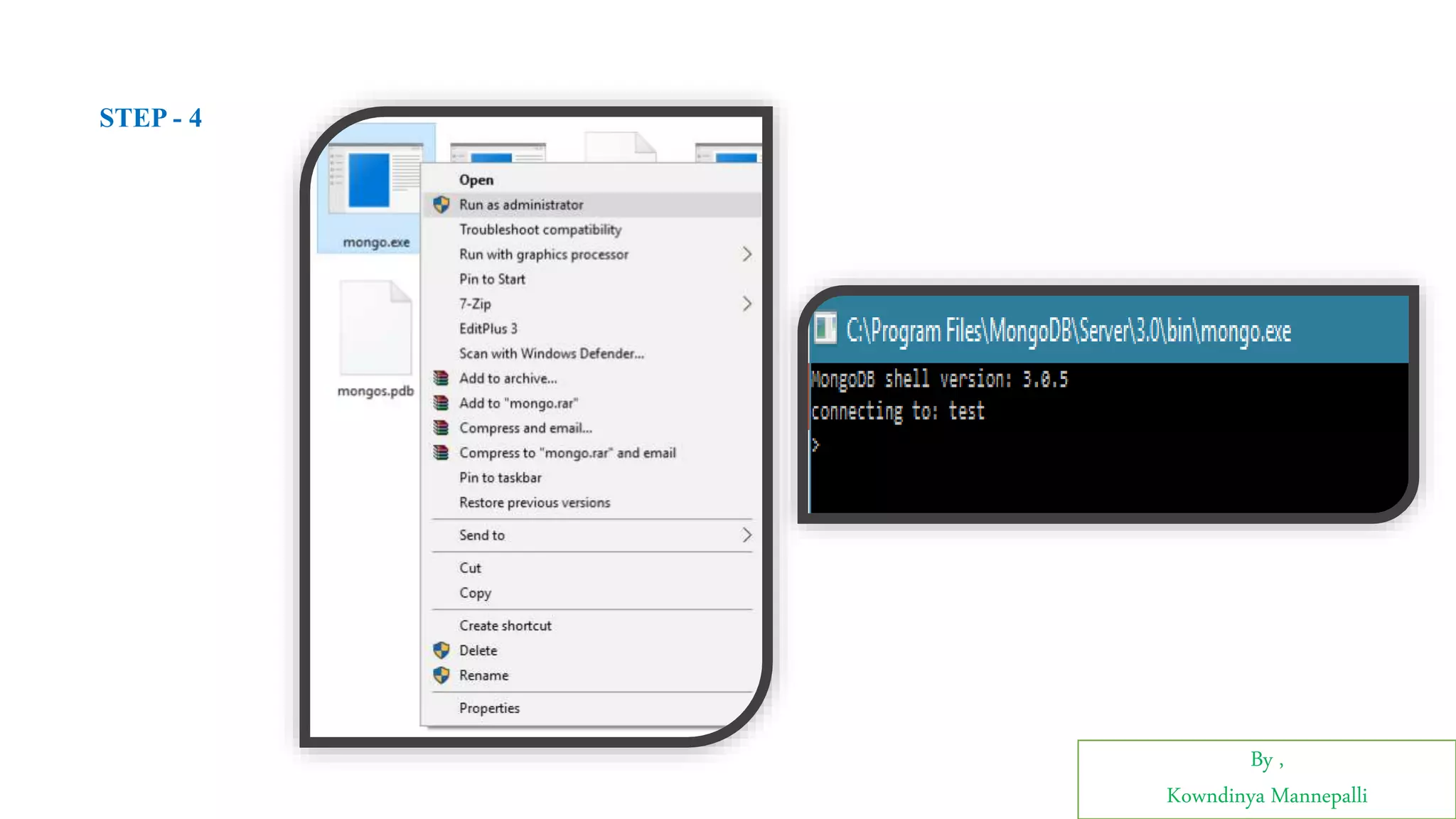
STEP - 4
By ,
Kowndinya Mannepalli
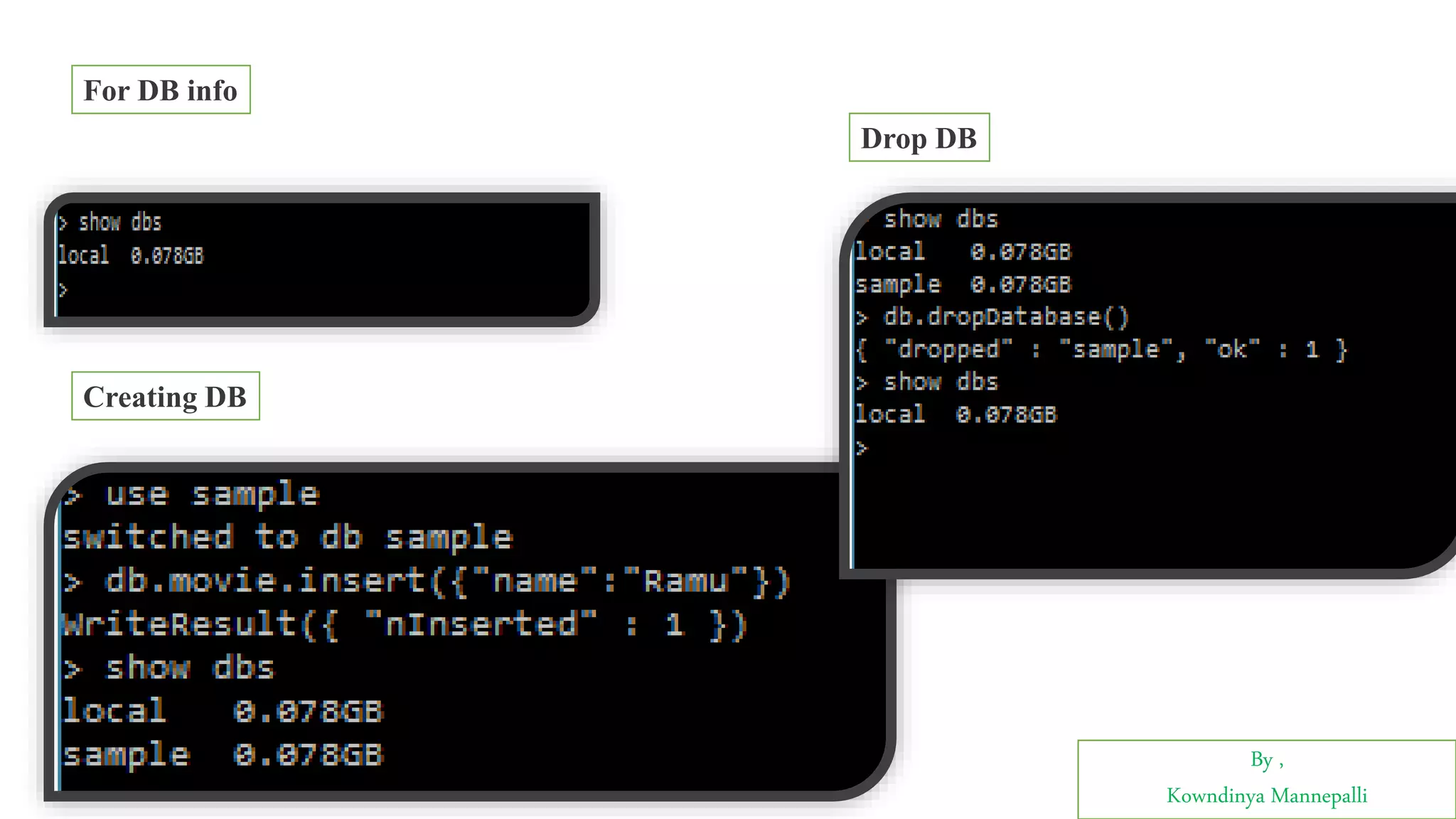
For DB info
Creating DB
Drop DB
By ,
Kowndinya Mannepalli
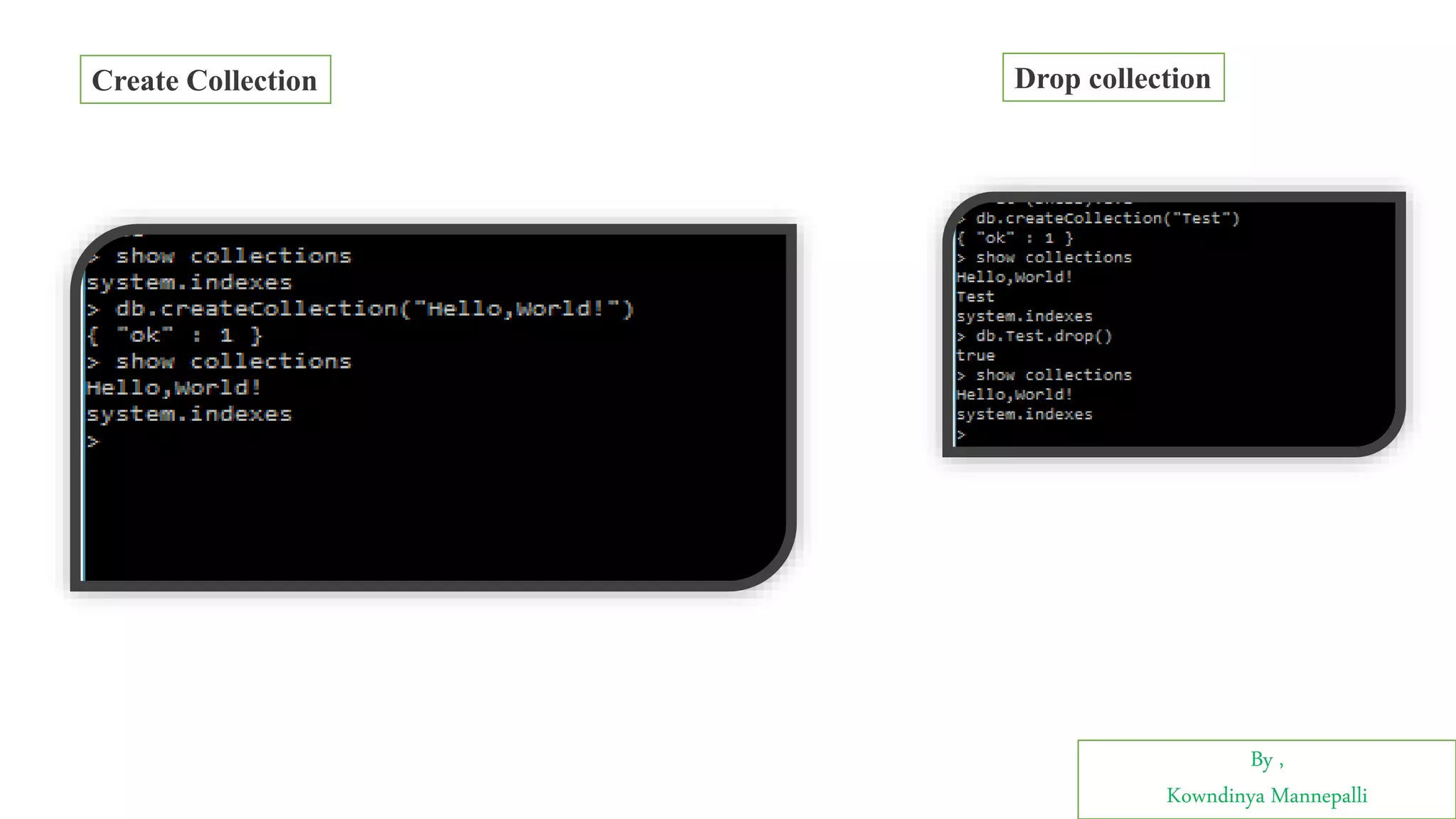
Create Collection Drop collection
By ,
Kowndinya Mannepalli
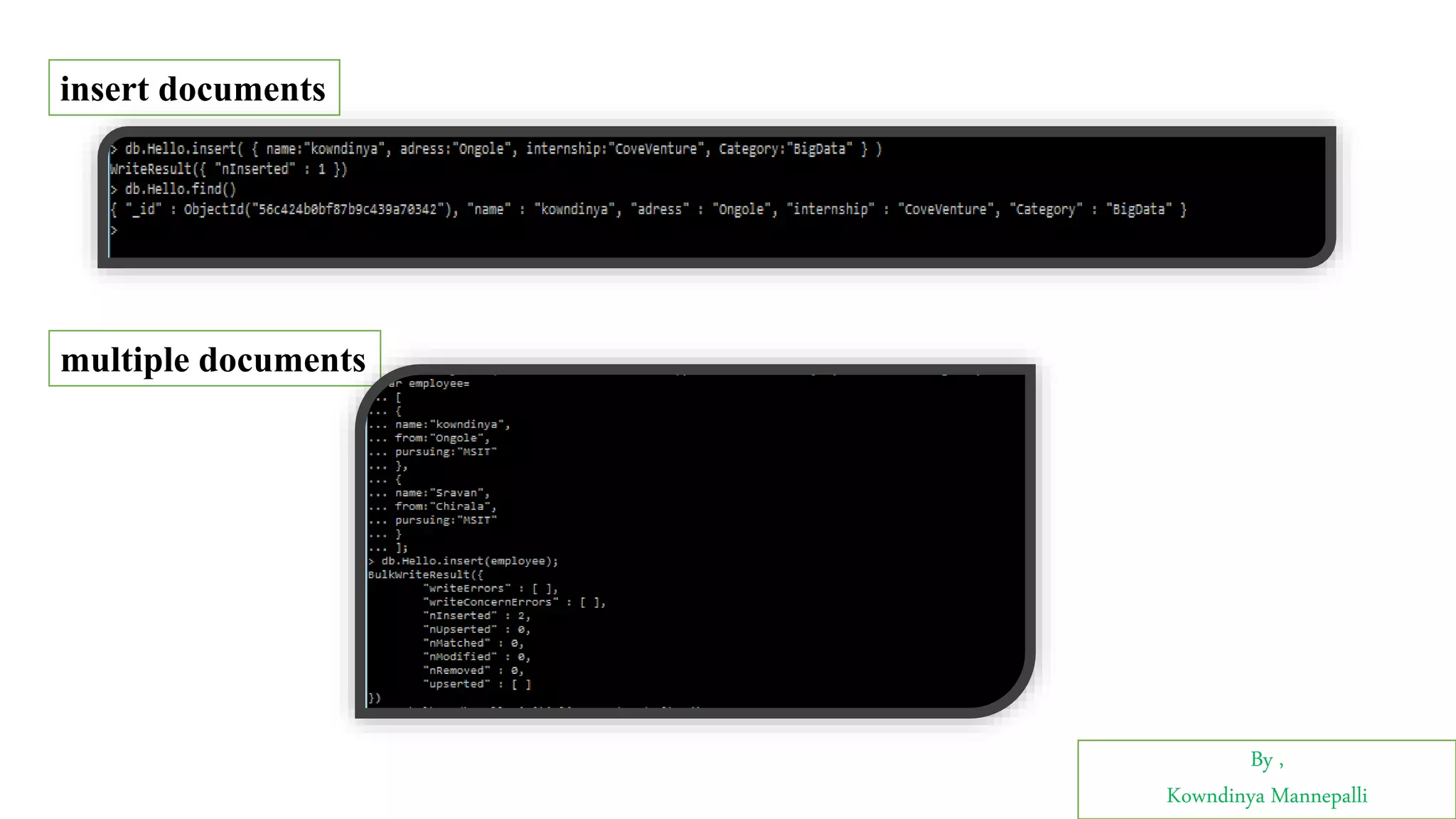
insert documents
multiple documents
By ,
Kowndinya Mannepalli
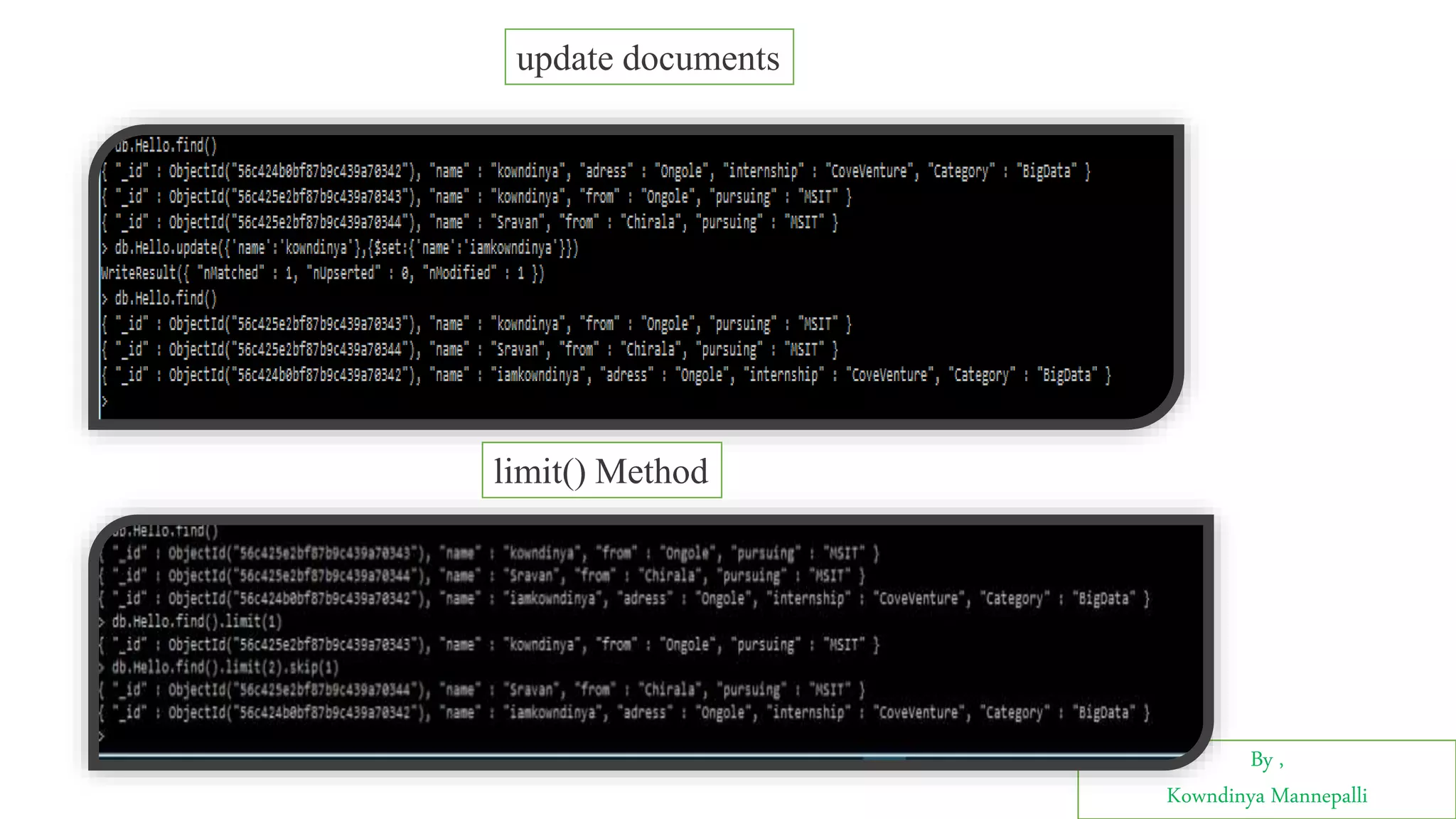
update documents
limit() Method
By ,
Kowndinya Mannepalli
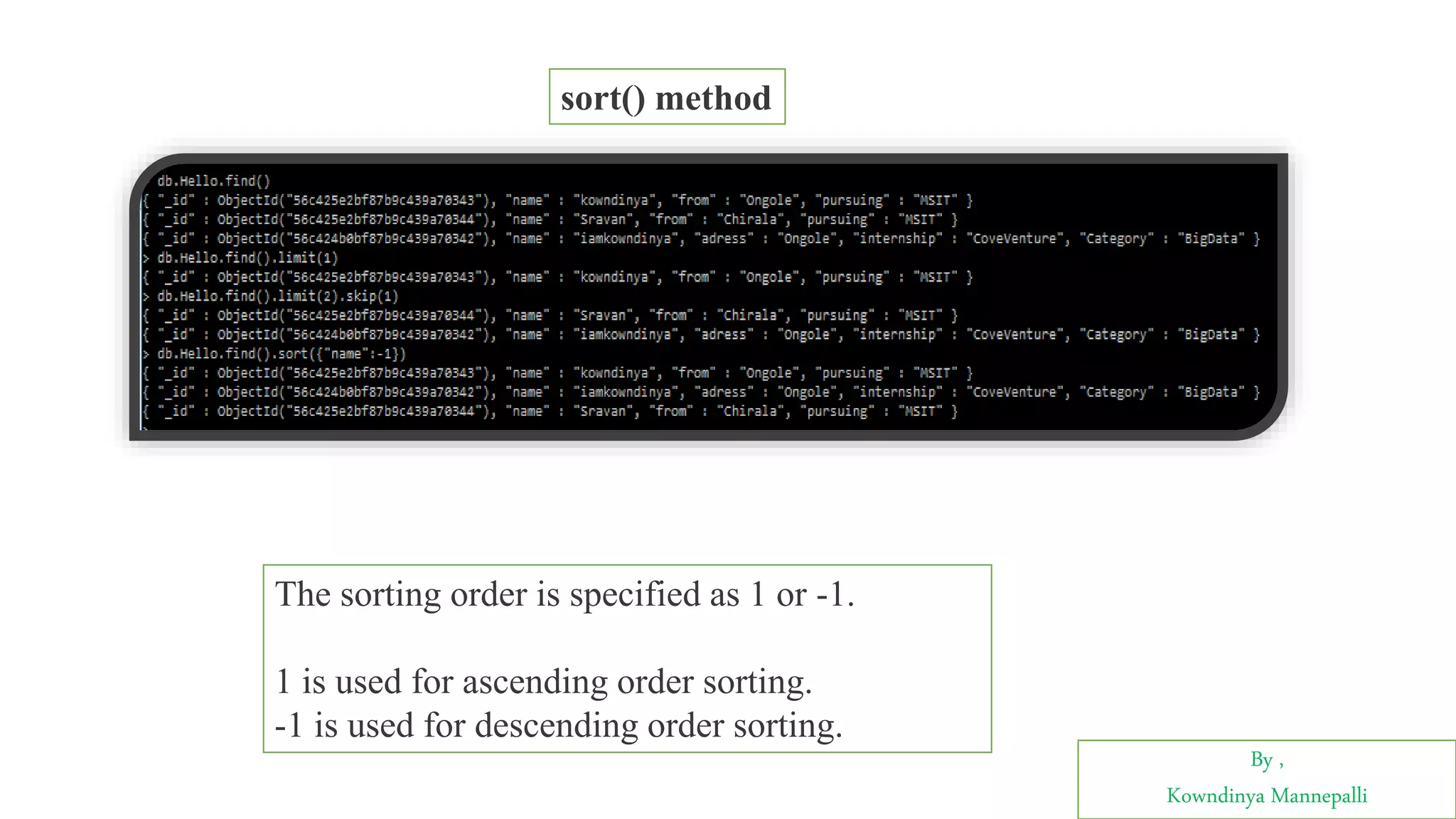
sort() method
The sorting order is specified as 1 or -1.
1 is used for ascending order sorting.
-1 is used for descending order sorting.
By ,
Kowndinya Mannepalli
References BY
 https://en.wikipedia.org/wiki/MongoDB
 http://www.javatpoint.com/
 https://www.mongodb.org/
By ,
Kowndinya Mannepalli

Mongo db

  • 1.
    By , Kowndinya Mannepalli "MongoDB is scalable, open source, high performance, document oriented database.“ - 10 gen
  • 2.
    By , Kowndinya Mannepalli MongoDBis a cross-platform document- oriented database. Classified as a NoSQL database, MongoDB eschews the traditional table-based relational database structure in favour of JSON-like documents with dynamic schemas (MongoDB calls the format BSON), making the integration of data in certain types of applications easier and faster. MongoDB is developed by MongoDB Inc. and is published as free and open-source software under a combination of the GNU Affero General Public License and the Apache License. As of July 2015, MongoDB is the fourth most popular type of database management system, and the most popular for document stores Key points of MongoDB  Develop Faster  Deploy Easier  Scale Bigger
  • 3.
    By , Kowndinya Mannepalli Mainpurpose to build MongoDB:  Scalability  Performance  High Availability  Scaling from single server deployments to large, complex multi-site architectures.
  • 4.
    By , Kowndinya Mannepalli Mainfeatures Ad hoc queries MongoDB supports field, range queries, regular expression searches. Queries can return specific fields of documents and also include user-defined JavaScript functions. Indexing You can index any field in a document. Support ad hoc queries In MongoDB, you can search by field, range query and it also supports regular expression searches. Replication MongoDB supports Master Slave replication Duplication of data MongoDB can run over multiple servers. The data is duplicated to keep the system up and also keep its running condition in case of hardware failure. Load balancing It has an automatic load balancing configuration because of data placed in shards. • Supports map reduce and aggregation tools. • Uses JavaScript instead of Procedures. • It is a schema-less database written in C++. • Provides high performance. • Stores files of any size easily without complicating your stack. • Easy to administer in the case of failures.
  • 5.
    By , Kowndinya Mannepalli •A NoSQL database provides a mechanism for storage and retrieval of data which is modelled in means other than the tabular relations used in relational databases. • NoSQL Database is used to refer a non-SQL or non relational database. • It is generally used to store big data and real-time web applications. Advantages • It supports query language. • It provides fast performance. • It provides horizontal scalability.
  • 6.
    By , Kowndinya Mannepalli NoSQLdatabase can be classified as 4 basic types: • Key value store NoSQL database • Document store NoSQL database • Column store NoSQL database • Graph base NoSQL database There are many NoSQL databases. MongoDB, Cassandra, CouchBD, Hypertable, Redis, Riak, Neo4j, HBASE, Couchbase, MemcacheDB, Voldemort, RevenDB etc. are the examples of NoSQL databases.
  • 7.
    By , Kowndinya Mannepalli Featuresof MongoDB •Easy to use •Light Weight •Extremely faster than RDBMS MongoDB used in •Big and complex data •Mobile and social infrastructure •Content management and delivery •User data management •Data hub RDBMS/NoSQL
  • 8.
    By , Kowndinya Mannepalli STEP- 1 C:Program FilesMongoDBServer3.0bin STEP - 2
  • 9.
  • 10.
  • 11.
    By , Kowndinya Mannepalli ForDB info Creating DB Drop DB
  • 12.
    By , Kowndinya Mannepalli CreateCollection Drop collection
  • 13.
    By , Kowndinya Mannepalli insertdocuments multiple documents
  • 14.
    By , Kowndinya Mannepalli updatedocuments limit() Method
  • 15.
    By , Kowndinya Mannepalli sort()method The sorting order is specified as 1 or -1. 1 is used for ascending order sorting. -1 is used for descending order sorting.
  • 16.
    By , Kowndinya Mannepalli ReferencesBY  https://en.wikipedia.org/wiki/MongoDB  http://www.javatpoint.com/  https://www.mongodb.org/
  • 17.