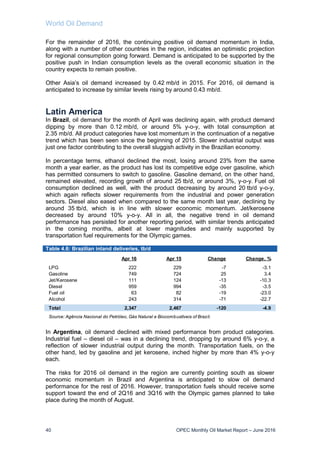
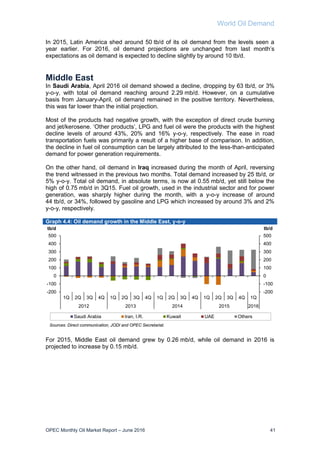
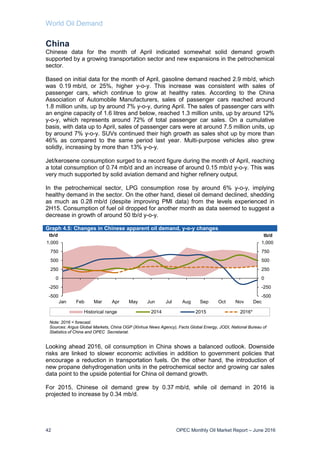
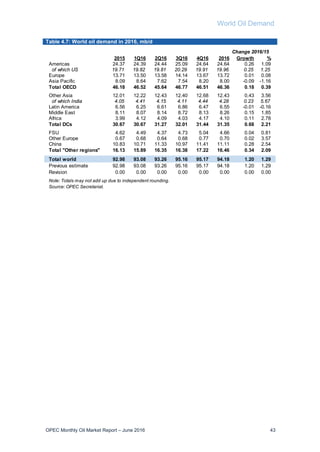
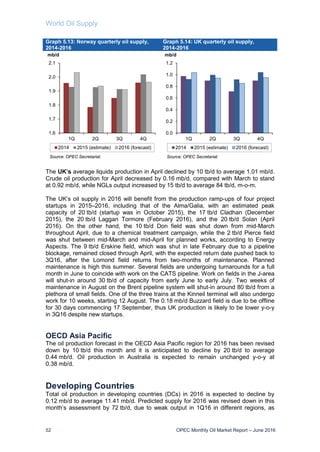
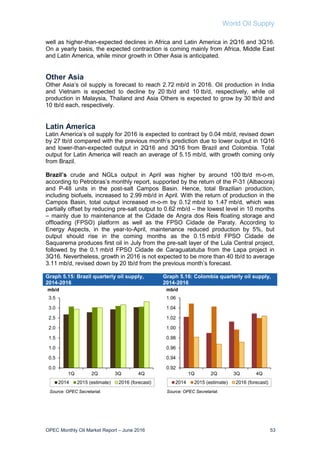
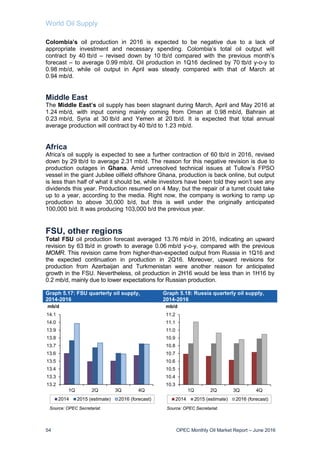
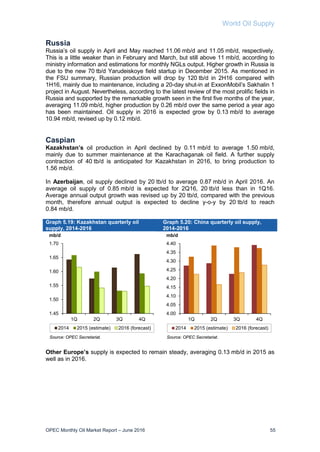
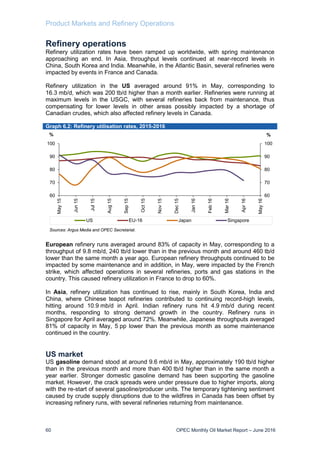
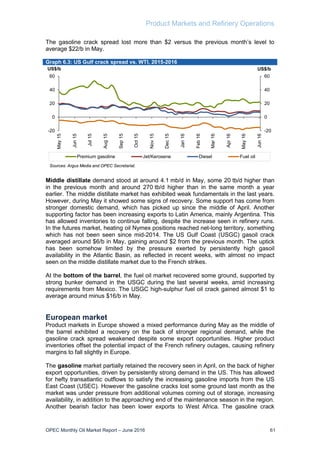
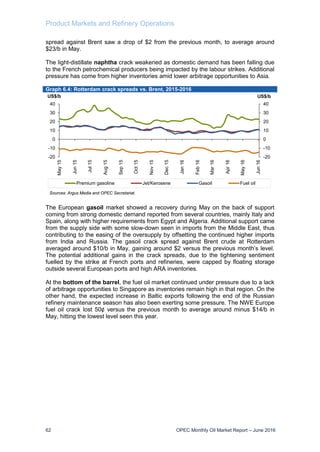
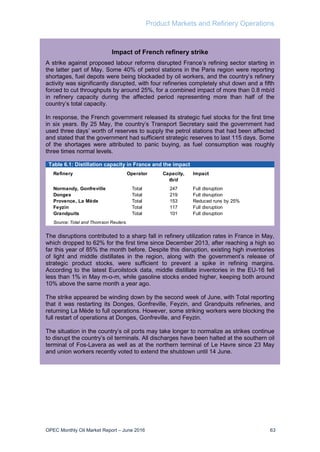
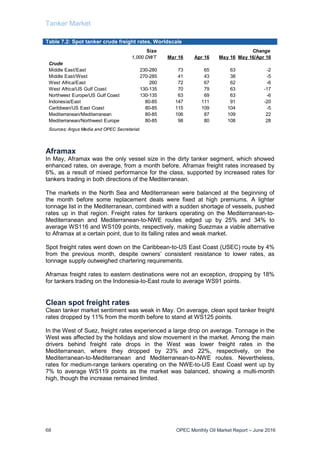
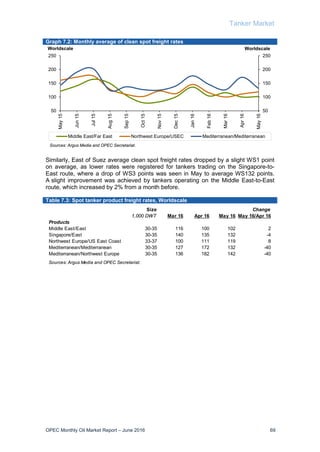
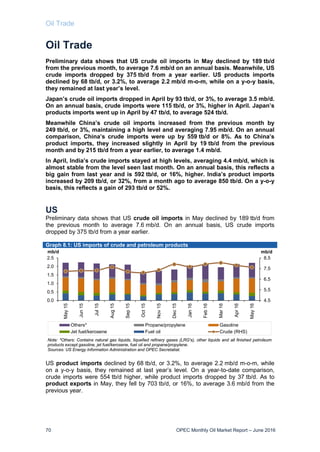
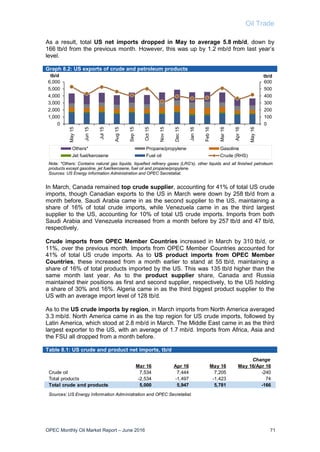
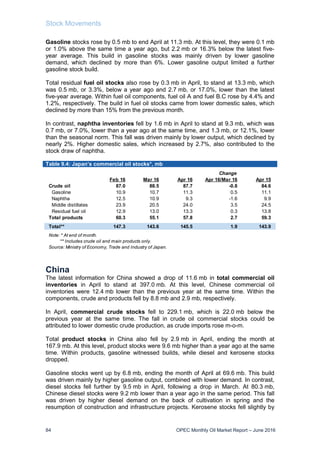
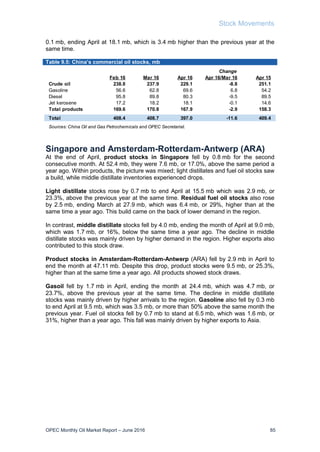
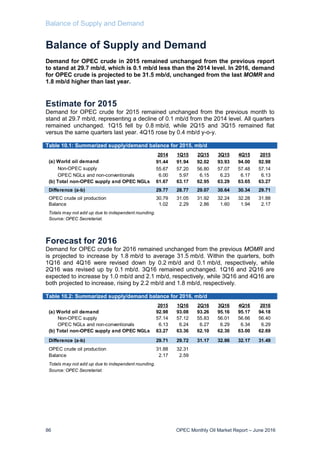
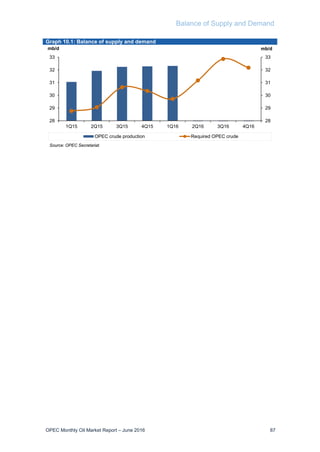
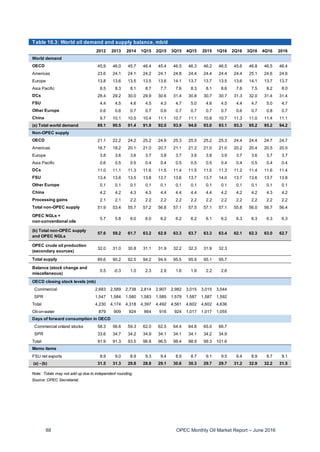
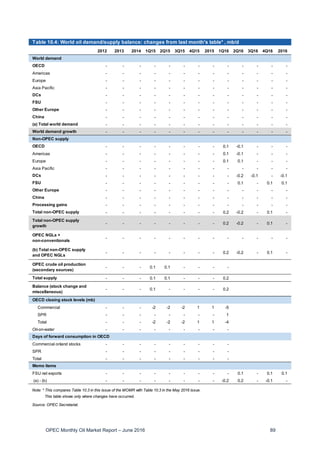
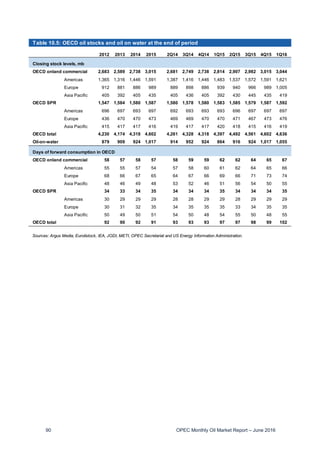
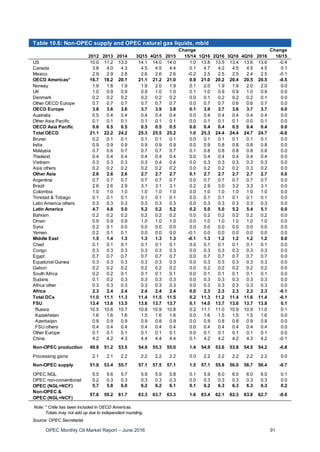
Monthly Oil Market Report
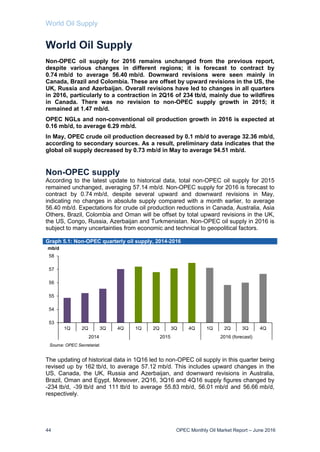
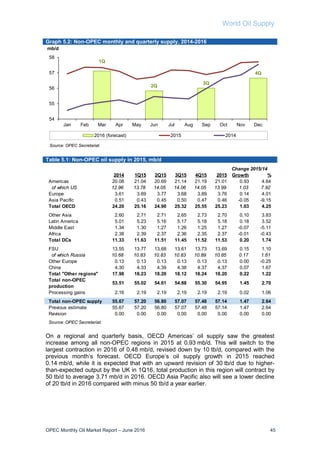
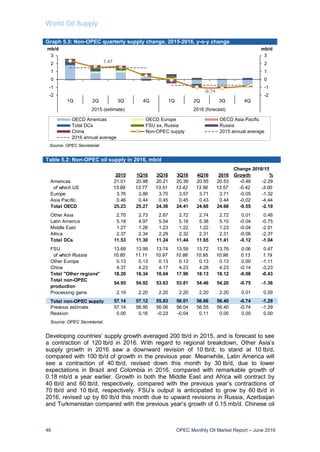
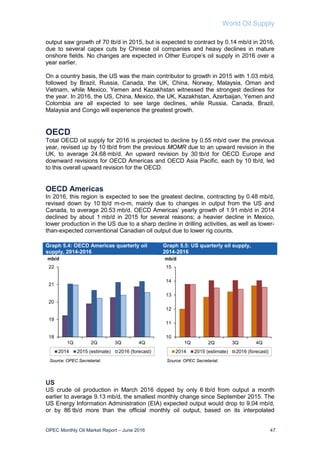
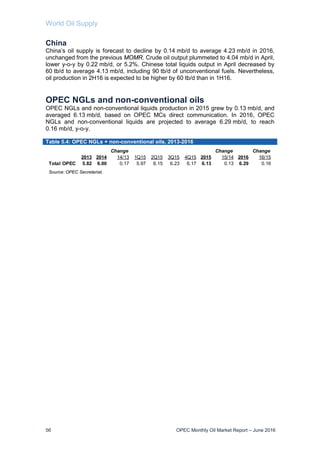
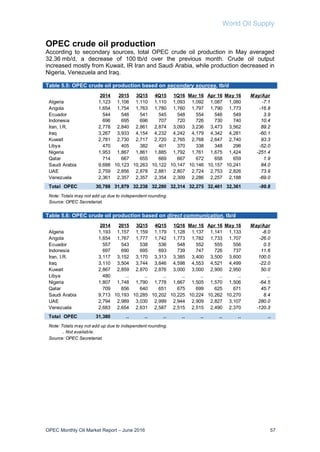
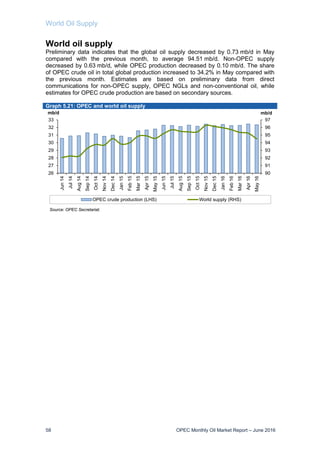
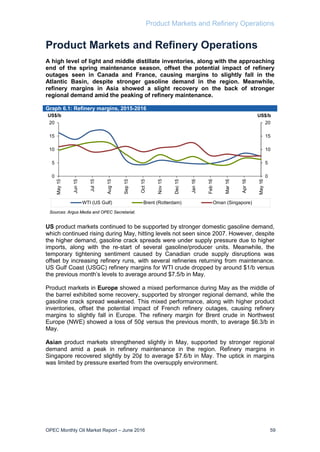
O P E C13 June 2016
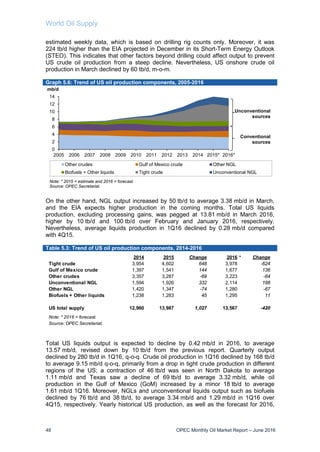
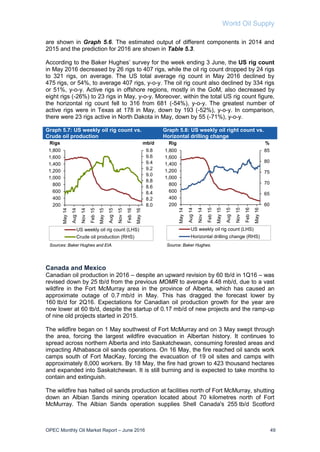
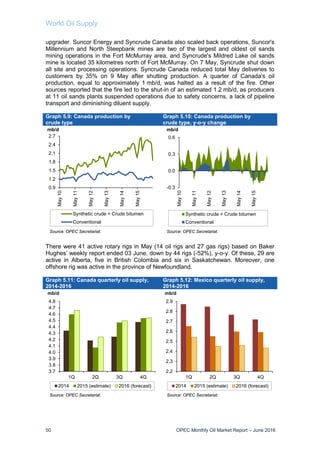
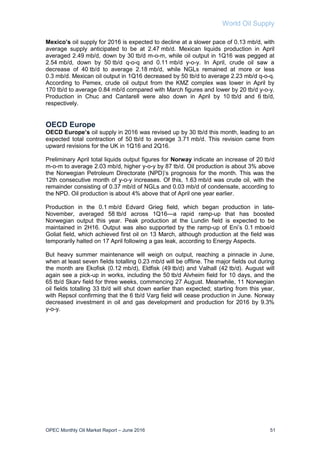
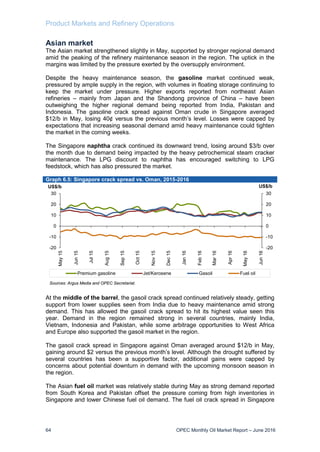
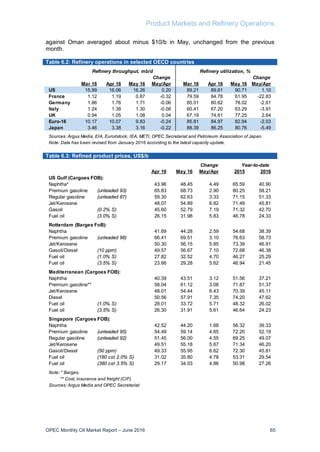
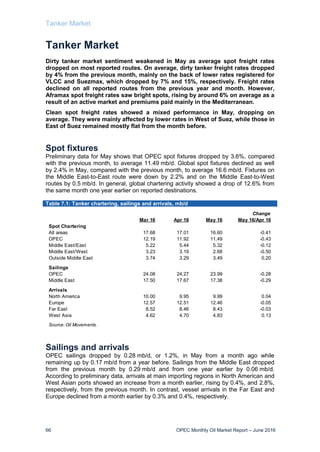
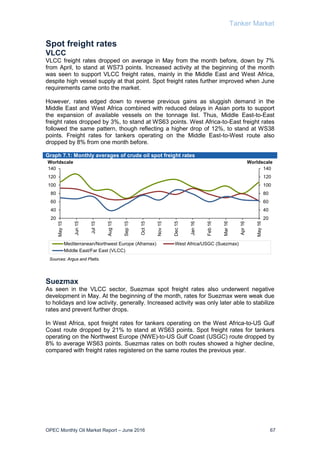
Feature article:
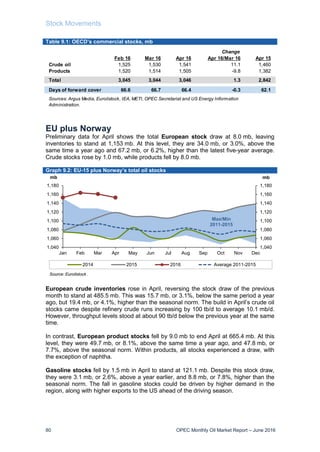
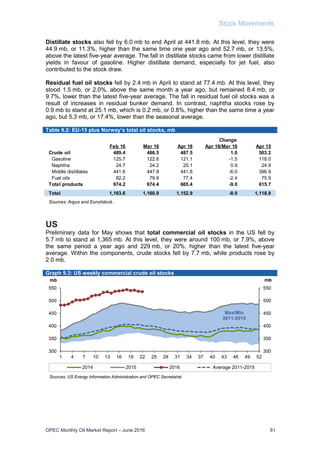
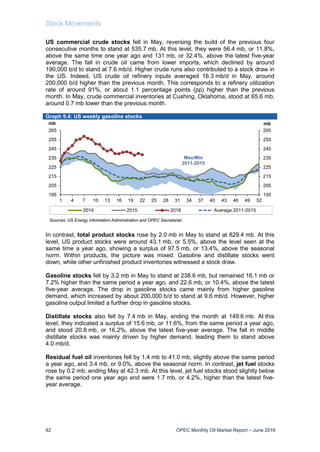
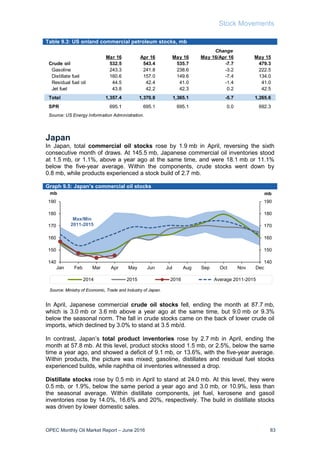
World oil market prospects for the second half of 2016
Oil market highlights
Feature article
Crude oil price movements
Commodity markets
World economy
World oil demand
World oil supply
Product markets and refinery operations
Tanker market
Oil trade
Stock movements
Balance of supply and demand
1
3
5
12
17
35
44
59
66
70
78
86
Organization of the Petroleum Exporting Countries
Helferstorferstrasse 17, A-1010 Vienna, Austria
E-mail: prid(at)opec.org
Website: www.opec.org
OPEC Monthly Oil Market Report – June 2016 1
Oil market highlights
Crude Oil Price Movements
The OPEC Reference Basket averaged $43.21/b in May, representing a gain of $5.35 over
the previous month. ICE Brent ended up $4.31 at $47.65/b, while Nymex WTI rose $5.67
to $46.80/b. The ICE Brent-Nymex WTI spread narrowed significantly to 85¢/b in May from
$2.21/b the month before.
World Economy
World economic growth is forecast at 3.1% for this year, after estimated growth of 2.9% the
year before, both unchanged from the previous month. OECD growth in 2016 remains at
1.9%, slightly below the 2.0% seen in 2015. The forecast for the major emerging
economies remains unchanged. China and India continue to expand this year at a
considerable level of 6.5% and 7.5%, respectively. Brazil and Russia, however, are
forecast to remain in recession this year, contracting by 3.4% and 1.1%, respectively.
World Oil Demand
World oil demand growth for 2016 remains unchanged from the previous report at
1.20 mb/d to average 94.18 mb/d. Other Asia, led by India, is anticipated to be the main
contributor to oil demand growth in 2016. Similar to 2015, transportation fuels, supported
by healthy vehicle sales and the low oil price environment, are projected to provide the bulk
of expected growth. The 2015 growth estimate was also left unchanged at 1.54 mb/d to
average 92.98 mb/d.
World Oil Supply
The forecast for non-OPEC oil supply in 2016 remains unchanged, with a contraction of
0.74 mb/d expected to average 56.40 mb/d. The downward revisions in Canada, Brazil and
Colombia broadly offset upward revisions in the US, UK, Russia and Azerbaijan. Non-
OPEC supply growth in 2015 was left unchanged at 1.47 mb/d. OPEC NGLs and non-
conventionals are expected to increase by 0.16 mb/d to average 6.29 mb/d this year. In
May, secondary sources show OPEC crude oil production decreased by 0.1 mb/d to
average 32.36 mb/d.
Product Markets and Refining Operations
The high level of inventories in light and middle distillates, along with the approaching end
of the spring maintenance season, offset the potential impact from events in Canada and
France. This caused margins to edge lower in the Atlantic Basin, despite stronger gasoline
demand in the region. Meanwhile, in Asia, refinery margins showed a slight recovery on
the back of stronger regional gasoline and gasoil demand amid a peak in refinery
maintenance.
Tanker Market
Sentiment in the dirty tanker market was generally weak in May. VLCC and Suezmax spot
freight rates declined on the back of light tonnage demand and increased tanker
availability. However, Aframax spot freight rates improved. Clean tanker freight rates
declined on average, as a result of low freight rates reported for West of Suez. In May,
global chartering activities dropped and sailings from the Middle East, and OPEC more
broadly, were lower month-on-month.
Stock Movements
OECD commercial oil stocks rose slightly in April to stand at 3,046 mb. At this level, OECD
commercial oil stocks are around 338 mb above the latest five-year average, with crude
indicating a lower surplus of 194 mb and products broadly flat at 144 mb. In terms of days
of forward cover, OECD commercial stocks stood at 66.4 days, some 7.1 days higher than
the five-year average.
Balance of Supply and Demand
Demand for OPEC crude in 2016 is projected at 31.5 mb/d, unchanged from the last report
and 1.8 mb/d higher than last year. For 2015, demand for OPEC crude is also unchanged,
averaging 29.7 mb/d, which represents a decline of 0.1 mb/d from the previous year.
2 OPEC Monthly Oil Market Report – June 2016
OPEC Monthly Oil Market Report – June 2016 3
World oil market prospects for the second half of 2016
The OPEC Reference Basket has improved considerably from the low levels seen at the start of this year to
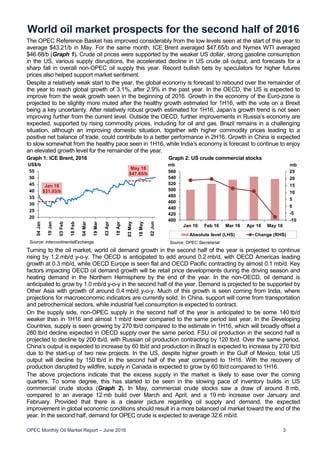
average $43.21/b in May. For the same month, ICE Brent averaged $47.65/b and Nymex WTI averaged
$46.68/b (Graph 1). Crude oil prices were supported by the weaker US dollar, strong gasoline consumption
in the US, various supply disruptions, the accelerated decline in US crude oil output, and forecasts for a
sharp fall in overall non-OPEC oil supply this year. Record bullish bets by speculators for higher futures
prices also helped support market sentiment.
Despite a relatively weak start to the year, the global economy is forecast to rebound over the remainder of
the year to reach global growth of 3.1%, after 2.9% in the past year. In the OECD, the US is expected to
improve from the weak growth seen in the beginning of 2016. Growth in the economy of the Euro-zone is
projected to be slightly more muted after the healthy growth estimated for 1H16, with the vote on a Brexit
being a key uncertainty. After relatively robust growth estimated for 1H16, Japan’s growth trend is not seen
improving further from the current level. Outside the OECD, further improvements in Russia’s economy are
expected, supported by rising commodity prices, including for oil and gas. Brazil remains in a challenging
situation, although an improving domestic situation, together with higher commodity prices leading to a
positive net balance of trade, could contribute to a better performance in 2H16. Growth in China is expected
to slow somewhat from the healthy pace seen in 1H16, while India’s economy is forecast to continue to enjoy
an elevated growth level for the remainder of the year.
Graph 1: ICE Brent, 2016 Graph 2: US crude commercial stocks
Turning to the oil market, world oil demand growth in the second half of the year is projected to continue
rising by 1.2 mb/d y-o-y. The OECD is anticipated to add around 0.2 mb/d, with OECD Americas leading
growth at 0.3 mb/d, while OECD Europe is seen flat and OECD Pacific contracting by almost 0.1 mb/d. Key
factors impacting OECD oil demand growth will be retail price developments during the driving season and
heating demand in the Northern Hemisphere by the end of the year. In the non-OECD, oil demand is
anticipated to grow by 1.0 mb/d y-o-y in the second half of the year. Demand is projected to be supported by
Other Asia with growth of around 0.4 mb/d y-o-y. Much of this growth is seen coming from India, where
projections for macroeconomic indicators are currently solid. In China, support will come from transportation
and petrochemical sectors, while industrial fuel consumption is expected to contract.
On the supply side, non-OPEC supply in the second half of the year is anticipated to be some 140 tb/d
weaker than in 1H16 and almost 1 mb/d lower compared to the same period last year. In the Developing
Countries, supply is seen growing by 270 tb/d compared to the estimate in 1H16, which will broadly offset a
280 tb/d decline expected in OECD supply over the same period. FSU oil production in the second half is
projected to decline by 200 tb/d, with Russian oil production contracting by 120 tb/d. Over the same period,
China’s output is expected to increase by 60 tb/d and production in Brazil is expected to increase by 270 tb/d
due to the start-up of two new projects. In the US, despite higher growth in the Gulf of Mexico, total US
output will decline by 150 tb/d in the second half of the year compared to 1H16. With the recovery of
production disrupted by wildfire, supply in Canada is expected to grow by 60 tb/d compared to 1H16.
The above projections indicate that the excess supply in the market is likely to ease over the coming
quarters. To some degree, this has started to be seen in the slowing pace of inventory builds in US
commercial crude stocks (Graph 2). In May, commercial crude stocks saw a draw of around 8 mb,
compared to an average 12 mb build over March and April, and a 19 mb increase over January and
February. Provided that there is a clearer picture regarding oil supply and demand, the expected
improvement in global economic conditions should result in a more balanced oil market toward the end of the
year. In the second half, demand for OPEC crude is expected to average 32.6 mb/d.
Jan 16
$31.93/b
May 16
$47.65/b
20
25
30
35
40
45
50
55
04Jan
19Jan
03Feb
18Feb
04Mar
19Mar
03Apr
18Apr
03May
18May
02Jun
US$/b
Source: IntercontinentalExchange.
-10
-5
0
5
10
15
20
25
400
420
440
460
480
500
520
540
560
Jan 16 Feb 16 Mar 16 Apr 16 May 16
mbmb
Absolute level (LHS) Change (RHS)
Source: OPEC Secretariat.
4 OPEC Monthly Oil Market Report – June 2016
Crude Oil Price Movements
OPEC Monthly Oil Market Report – June 2016 5
Crude Oil Price Movements
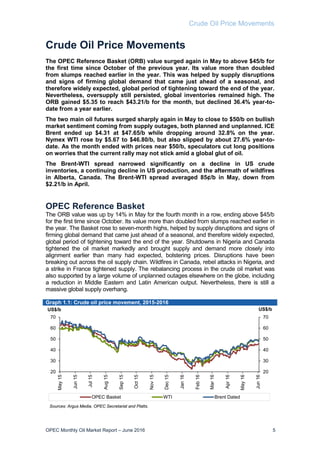
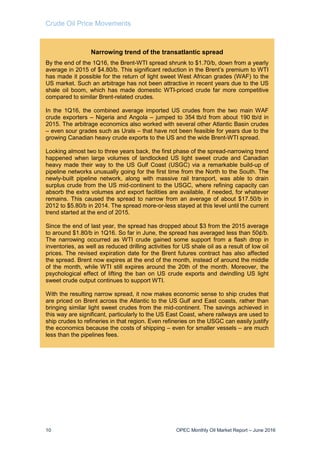
The OPEC Reference Basket (ORB) value surged again in May to above $45/b for
the first time since October of the previous year. Its value more than doubled
from slumps reached earlier in the year. This was helped by supply disruptions
and signs of firming global demand that came just ahead of a seasonal, and
therefore widely expected, global period of tightening toward the end of the year.
Nevertheless, oversupply still persisted, global inventories remained high. The
ORB gained $5.35 to reach $43.21/b for the month, but declined 36.4% year-to-
date from a year earlier.
The two main oil futures surged sharply again in May to close to $50/b on bullish
market sentiment coming from supply outages, both planned and unplanned. ICE
Brent ended up $4.31 at $47.65/b while dropping around 32.8% on the year.
Nymex WTI rose by $5.67 to $46.80/b, but also slipped by about 27.6% year-to-
date. As the month ended with prices near $50/b, speculators cut long positions
on worries that the current rally may not stick amid a global glut of oil.
The Brent-WTI spread narrowed significantly on a decline in US crude
inventories, a continuing decline in US production, and the aftermath of wildfires
in Alberta, Canada. The Brent-WTI spread averaged 85¢/b in May, down from
$2.21/b in April.
OPEC Reference Basket
The ORB value was up by 14% in May for the fourth month in a row, ending above $45/b
for the first time since October. Its value more than doubled from slumps reached earlier in
the year. The Basket rose to seven-month highs, helped by supply disruptions and signs of
firming global demand that came just ahead of a seasonal, and therefore widely expected,
global period of tightening toward the end of the year. Shutdowns in Nigeria and Canada
tightened the oil market markedly and brought supply and demand more closely into
alignment earlier than many had expected, bolstering prices. Disruptions have been
breaking out across the oil supply chain. Wildfires in Canada, rebel attacks in Nigeria, and
a strike in France tightened supply. The rebalancing process in the crude oil market was
also supported by a large volume of unplanned outages elsewhere on the globe, including
a reduction in Middle Eastern and Latin American output. Nevertheless, there is still a
massive global supply overhang.
Graph 1.1: Crude oil price movement, 2015-2016
20
30
40
50
60
70
20
30
40
50
60
70
May15
Jun15
Jul15
Aug15
Sep15
Oct15
Nov15
Dec15
Jan16
Feb16
Mar16
Apr16
May16
Jun16
US$/bUS$/b
OPEC Basket WTI Brent Dated
Sources: Argus Media, OPEC Secretariat and Platts.
Crude Oil Price Movements
6 OPEC Monthly Oil Market Report – June 2016
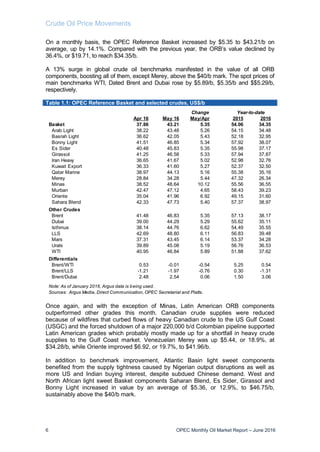
On a monthly basis, the OPEC Reference Basket increased by $5.35 to $43.21/b on
average, up by 14.1%. Compared with the previous year, the ORB’s value declined by
36.4%, or $19.71, to reach $34.35/b.
A 13% surge in global crude oil benchmarks manifested in the value of all ORB
components, boosting all of them, except Merey, above the $40/b mark. The spot prices of
main benchmarks WTI, Dated Brent and Dubai rose by $5.89/b, $5.35/b and $$5.29/b,
respectively.
Table 1.1: OPEC Reference Basket and selected crudes, US$/b
Once again, and with the exception of Minas, Latin American ORB components
outperformed other grades this month. Canadian crude supplies were reduced
because of wildfires that curbed flows of heavy Canadian crude to the US Gulf Coast
(USGC) and the forced shutdown of a major 220,000 b/d Colombian pipeline supported
Latin American grades which probably mostly made up for a shortfall in heavy crude
supplies to the Gulf Coast market. Venezuelan Merey was up $5.44, or 18.9%, at
$34.28/b, while Oriente improved $6.92, or 19.7%, to $41.96/b.
In addition to benchmark improvement, Atlantic Basin light sweet components
benefited from the supply tightness caused by Nigerian output disruptions as well as
more US and Indian buying interest, despite subdued Chinese demand. West and
North African light sweet Basket components Saharan Blend, Es Sider, Girassol and
Bonny Light increased in value by an average of $5.36, or 12.9%, to $46.75/b,
sustainably above the $40/b mark.
Change
Apr 16 May 16 May/Apr 2015 2016
Basket 37.86 43.21 5.35 54.06 34.35
Arab Light 38.22 43.48 5.26 54.15 34.48
Basrah Light 36.62 42.05 5.43 52.18 32.95
Bonny Light 41.51 46.85 5.34 57.92 38.07
Es Sider 40.48 45.83 5.35 55.98 37.17
Girassol 41.25 46.58 5.33 57.94 37.87
Iran Heavy 36.65 41.67 5.02 52.98 32.76
Kuwait Export 36.33 41.60 5.27 52.37 32.50
Qatar Marine 38.97 44.13 5.16 55.38 35.16
Merey 28.84 34.28 5.44 47.32 26.34
Minas 38.52 48.64 10.12 55.56 36.55
Murban 42.47 47.12 4.65 58.43 39.23
Oriente 35.04 41.96 6.92 49.15 31.60
Sahara Blend 42.33 47.73 5.40 57.37 38.97
Other Crudes
Brent 41.48 46.83 5.35 57.13 38.17
Dubai 39.00 44.29 5.29 55.62 35.11
Isthmus 38.14 44.76 6.62 54.49 35.55
LLS 42.69 48.80 6.11 56.83 39.48
Mars 37.31 43.45 6.14 53.37 34.28
Urals 39.89 45.08 5.19 56.76 36.53
WTI 40.95 46.84 5.89 51.88 37.62
Differentials
Brent/WTI 0.53 -0.01 -0.54 5.25 0.54
Brent/LLS -1.21 -1.97 -0.76 0.30 -1.31
Brent/Dubai 2.48 2.54 0.06 1.50 3.06
Note: As of January 2016, Argus data is being used.
Year-to-date
Sources: Argus Media, Direct Communication, OPEC Secretariat and Platts.
Crude Oil Price Movements
OPEC Monthly Oil Market Report – June 2016 7
Amid a narrowing Brent/Dubai spread and tighter arbitrage volumes of light sweet
crudes and despite weak naphtha and gasoline refining margins in the Asia Pacific,
Indonesian Minas was up by $10.12, or 26.3%, to $48.64/b.
Middle Eastern spot component grades Murban and Qatar Marine rose on average by
$4.91, or 12.1%, to $45.63/b, while multi-destination grades Arab light, Basrah light,
Iran Heavy and Kuwait Export increased on average by $5.22, or 13.7%, to $42.20/b.
Firm demand supported medium sour Mideast Gulf grades.
On 10 June, the OPEC Reference Basket stood at $47.05/b, $3.84 above the May
average.
The oil futures market
Oil futures surged sharply again in May to close to $50/b on bullish market sentiment
coming from supply outages, both planned and unplanned. Wildfires knocked out some
700,000 b/d of Canadian production in May, while Nigerian output slumped to levels
not seen in over a decade on the back of a wave of militant activity coupled with some
technical issues.
These unexpected outages exacerbated other enduring supply concerns, particularly a
decline in US shale oil production and export limitations due to regional conflict. The
timing of these unplanned outages was ideal to buoy market sentiment, as they came
just ahead of a seasonal, and therefore widely expected, global period of tightening in
3Q16. Oil futures’ strong performance was also supported by positively noted higher
1Q16 oil demand, particularly for gasoline.
Gasoline remained the driver of growth over the first quarter of 2016, with particularly
strong consumption recorded in the US, China, India, and other Asian countries. LPG
and naphtha continued to provide support on the back of petrochemical demand, while
other light distillate (jet and kerosene) sales maintained their steady growth.
ICE Brent ended May up $4.31, or 9.9%, at $47.65/b on a monthly average basis, while
Nymex WTI rose by $5.67, or 13.8%, to $46.80/b. Compared with the same period one
year earlier, ICE Brent lost $19.22, or 32.8%, to stand at $39.23/b, while Nymex WTI
declined by $14.35, or 27.6%, to stand at $37.63/b year-to-date.
On 10 June, ICE Brent stood at $50.54/b and Nymex WTI at $49.07/b.
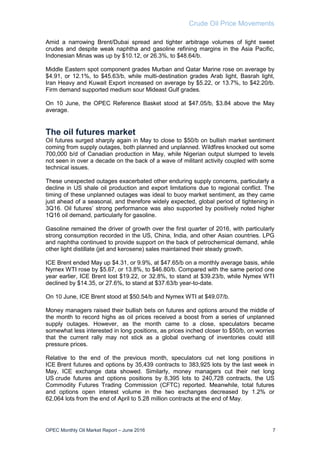
Money managers raised their bullish bets on futures and options around the middle of
the month to record highs as oil prices received a boost from a series of unplanned
supply outages. However, as the month came to a close, speculators became
somewhat less interested in long positions, as prices inched closer to $50/b, on worries
that the current rally may not stick as a global overhang of inventories could still
pressure prices.
Relative to the end of the previous month, speculators cut net long positions in
ICE Brent futures and options by 35,439 contracts to 383,925 lots by the last week in
May, ICE exchange data showed. Similarly, money managers cut their net long
US crude futures and options positions by 8,395 lots to 240,728 contracts, the US
Commodity Futures Trading Commission (CFTC) reported. Meanwhile, total futures
and options open interest volume in the two exchanges decreased by 1.2% or
62,064 lots from the end of April to 5.28 million contracts at the end of May.
Crude Oil Price Movements
8 OPEC Monthly Oil Market Report – June 2016
Graph 1.2: Nymex WTI price vs.
Speculative activity, 2015-2016
Graph 1.3: ICE Brent price vs.
Speculative activity, 2015-2016
During May, daily average traded volumes for Nymex WTI contracts decreased by
100,954 lots, down by 9%, to 1,023,525 contracts, while those of ICE Brent were
146,211 contracts lower, down by 16.6%, to 735,698 lots. Daily aggregate traded
volume for both crude oil futures markets declined by 247,165 contracts to about
1.76 million futures contracts, equivalent to around 1.8 billion b/d. Total traded volume
in both exchanges dropped in May due to several holidays in London and New York to
21.49 million and 16.19 million contracts for Nymex WTI and ICE Brent, respectively.
The futures market structure
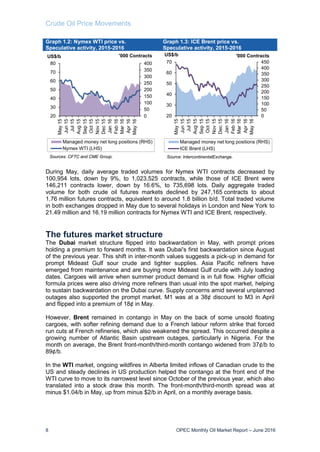
The Dubai market structure flipped into backwardation in May, with prompt prices
holding a premium to forward months. It was Dubai's first backwardation since August
of the previous year. This shift in inter-month values suggests a pick-up in demand for
prompt Mideast Gulf sour crude and tighter supplies. Asia Pacific refiners have
emerged from maintenance and are buying more Mideast Gulf crude with July loading
dates. Cargoes will arrive when summer product demand is in full flow. Higher official
formula prices were also driving more refiners than usual into the spot market, helping
to sustain backwardation on the Dubai curve. Supply concerns amid several unplanned
outages also supported the prompt market. M1 was at a 38¢ discount to M3 in April
and flipped into a premium of 18¢ in May.
However, Brent remained in contango in May on the back of some unsold floating
cargoes, with softer refining demand due to a French labour reform strike that forced
run cuts at French refineries, which also weakened the spread. This occurred despite a
growing number of Atlantic Basin upstream outages, particularly in Nigeria. For the
month on average, the Brent front-month/third-month contango widened from 37¢/b to
89¢/b.
In the WTI market, ongoing wildfires in Alberta limited inflows of Canadian crude to the
US and steady declines in US production helped the contango at the front end of the
WTI curve to move to its narrowest level since October of the previous year, which also
translated into a stock draw this month. The front-month/third-month spread was at
minus $1.04/b in May, up from minus $2/b in April, on a monthly average basis.
0
50
100
150
200
250
300
350
400
20
30
40
50
60
70
80
May15
Jun15
Jul15
Aug15
Sep15
Oct15
Nov15
Dec15
Jan16
Feb16
Mar16
Apr16
May16
US$/b
Managed money net long positions (RHS)
Nymex WTI (LHS)
'000 Contracts
Sources: CFTC and CME Group.
0
50
100
150
200
250
300
350
400
450
20
30
40
50
60
70
May15
Jun15
Jul15
Aug15
Sep15
Oct15
Nov15
Dec15
Jan16
Feb16
Mar16
Apr16
May16
US$/b
Managed money net long positions (RHS)
ICE Brent (LHS)
'000 Contracts
Source: IntercontinentalExchange.
Crude Oil Price Movements
OPEC Monthly Oil Market Report – June 2016 9
Graph 1.4: Nymex WTI and ICE Brent forward curves, 2016
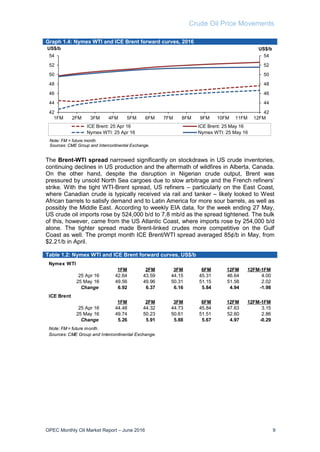
The Brent-WTI spread narrowed significantly on stockdraws in US crude inventories,
continuing declines in US production and the aftermath of wildfires in Alberta, Canada.
On the other hand, despite the disruption in Nigerian crude output, Brent was
pressured by unsold North Sea cargoes due to slow arbitrage and the French refiners’
strike. With the tight WTI-Brent spread, US refiners – particularly on the East Coast,
where Canadian crude is typically received via rail and tanker – likely looked to West
African barrels to satisfy demand and to Latin America for more sour barrels, as well as
possibly the Middle East. According to weekly EIA data, for the week ending 27 May,
US crude oil imports rose by 524,000 b/d to 7.8 mb/d as the spread tightened. The bulk
of this, however, came from the US Atlantic Coast, where imports rose by 254,000 b/d
alone. The tighter spread made Brent-linked crudes more competitive on the Gulf
Coast as well. The prompt month ICE Brent/WTI spread averaged 85¢/b in May, from
$2.21/b in April.
Table 1.2: Nymex WTI and ICE Brent forward curves, US$/b
42
44
46
48
50
52
54
42
44
46
48
50
52
54
1FM 2FM 3FM 4FM 5FM 6FM 7FM 8FM 9FM 10FM 11FM 12FM
US$/bUS$/b
ICE Brent: 25 Apr 16 ICE Brent: 25 May 16
Nymex WTI: 25 Apr 16 Nymex WTI: 25 May 16
Note: FM = future month.
Sources: CME Group and Intercontinental Exchange.
Nymex WTI
1FM 2FM 3FM 6FM 12FM 12FM-1FM
25 Apr 16 42.64 43.59 44.15 45.31 46.64 4.00
25 May 16 49.56 49.96 50.31 51.15 51.58 2.02
Change 6.92 6.37 6.16 5.84 4.94 -1.98
ICE Brent
1FM 2FM 3FM 6FM 12FM 12FM-1FM
25 Apr 16 44.48 44.32 44.73 45.84 47.63 3.15
25 May 16 49.74 50.23 50.61 51.51 52.60 2.86
Change 5.26 5.91 5.88 5.67 4.97 -0.29
Note: FM = future month.
Sources: CME Group and Intercontinental Exchange.
Crude Oil Price Movements
10 OPEC Monthly Oil Market Report – June 2016
Narrowing trend of the transatlantic spread
By the end of the 1Q16, the Brent-WTI spread shrunk to $1.70/b, down from a yearly
average in 2015 of $4.80/b. This significant reduction in the Brent’s premium to WTI
has made it possible for the return of light sweet West African grades (WAF) to the
US market. Such an arbitrage has not been attractive in recent years due to the US
shale oil boom, which has made domestic WTI-priced crude far more competitive
compared to similar Brent-related crudes.
In the 1Q16, the combined average imported US crudes from the two main WAF
crude exporters – Nigeria and Angola – jumped to 354 tb/d from about 190 tb/d in
2015. The arbitrage economics also worked with several other Atlantic Basin crudes
– even sour grades such as Urals – that have not been feasible for years due to the
growing Canadian heavy crude exports to the US and the wide Brent-WTI spread.
Looking almost two to three years back, the first phase of the spread-narrowing trend
happened when large volumes of landlocked US light sweet crude and Canadian
heavy made their way to the US Gulf Coast (USGC) via a remarkable build-up of
pipeline networks unusually going for the first time from the North to the South. The
newly-built pipeline network, along with massive rail transport, was able to drain
surplus crude from the US mid-continent to the USGC, where refining capacity can
absorb the extra volumes and export facilities are available, if needed, for whatever
remains. This caused the spread to narrow from an average of about $17.50/b in
2012 to $5.80/b in 2014. The spread more-or-less stayed at this level until the current
trend started at the end of 2015.
Since the end of last year, the spread has dropped about $3 from the 2015 average
to around $1.80/b in 1Q16. So far in June, the spread has averaged less than 50¢/b.
The narrowing occurred as WTI crude gained some support from a flash drop in
inventories, as well as reduced drilling activities for US shale oil as a result of low oil
prices. The revised expiration date for the Brent futures contract has also affected
the spread. Brent now expires at the end of the month, instead of around the middle
of the month, while WTI still expires around the 20th of the month. Moreover, the
psychological effect of lifting the ban on US crude exports and dwindling US light
sweet crude output continues to support WTI.
With the resulting narrow spread, it now makes economic sense to ship crudes that
are priced on Brent across the Atlantic to the US Gulf and East coasts, rather than
bringing similar light sweet crudes from the mid-continent. The savings achieved in
this way are significant, particularly to the US East Coast, where railways are used to
ship crudes to refineries in that region. Even refineries on the USGC can easily justify
the economics because the costs of shipping – even for smaller vessels – are much
less than the pipelines fees.
Crude Oil Price Movements
OPEC Monthly Oil Market Report – June 2016 11
The light sweet/medium sour crude spread
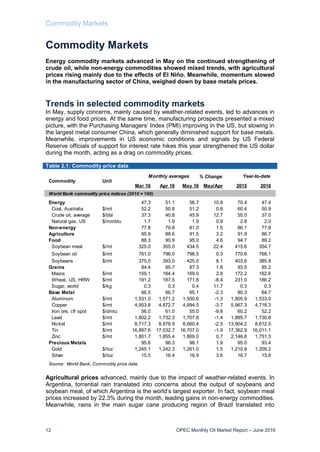
Sweet/sour differentials were mixed over the month, widening slightly in the
Mediterranean, while continuing a narrowing trend in Asia. On the USGC, the spread
remained almost unchanged.
In Europe, the Urals medium sour crude discount to light sweet North Sea Brent
increased in May as an industrial strike in France that forced Total to halt output at all
its five refineries in the country limited prompt crude oil demand in the region. Urals
differentials were also pressured on ample supply and weaker refinery margins. A
loading plan showed higher oil exports from the Black Sea and stable loadings in the
Baltic, despite a seasonal rise in Russia's refinery runs. An influx of shipments of
Mideast Gulf crudes also restrained Urals. On the other hand, the light sweet North
Sea market was supported by low availability of prompt-loading barrels in the Atlantic
Basin, counterbalancing the effect of the French refiners’ strike on sweet grades,
particularly those which are heavier. The Dated Brent-Med Urals spread widened in
May to $1.75/b.
Graph 1.5: Brent Dated vs. Sour grades (Urals and Dubai) spread, 2015-2016
In Asia, the light sweet Tapis premium over medium sour Dubai shrank again this
month by around 85¢ to reach $3.60/b, its narrowest in over eight months. This took
place as Asian Pacific regional sweet grades continued to suffer from slowing Chinese
demand and some competition from West African North Sea cargoes. Meanwhile, high
inventories and weak gasoline margins weighed on demand for ultra-light sweet crude.
On the other hand, Middle East crude benchmark Dubai remained firm over the month,
gaining support from several purchases in the window and firm Asia Pacific demand as
refineries returned from spring maintenance.
In the USGC, the Light Louisiana Sweet (LLS) premium over medium sour Mars
remained roughly unchanged at $5.35/b as both grades were affected by the disruption
of Canadian crude oil supplies to the US. Reduced Canadian crude supplies due to
wildfires curbed flows of heavy Canadian crude to the USGC and forced the shutdown
of a major 220,000 b/d Colombian pipeline supporting these grades. Light, sweet
barrels on the USGC got a boost as barrels moved inland following the Canadian
production curbs.
-4
-2
0
2
4
6
8
-4
-2
0
2
4
6
8
May15
Jun15
Jul15
Aug15
Sep15
Oct15
Nov15
Dec15
Jan16
Feb16
Mar16
Apr16
May16
Jun16
US$/bUS$/b
Dubai Urals
Sources: Argus Media, OPEC Secretariat and Platts.
Commodity Markets
12 OPEC Monthly Oil Market Report – June 2016
Commodity Markets
Energy commodity markets advanced in May on the continued strengthening of
crude oil, while non-energy commodities showed mixed trends, with agricultural
prices rising mainly due to the effects of El Niño. Meanwhile, momentum slowed
in the manufacturing sector of China, weighed down by base metals prices.
Trends in selected commodity markets
In May, supply concerns, mainly caused by weather-related events, led to advances in
energy and food prices. At the same time, manufacturing prospects presented a mixed
picture, with the Purchasing Managers’ Index (PMI) improving in the US, but slowing in
the largest metal consumer China, which generally diminished support for base metals.
Meanwhile, improvements in US economic conditions and signals by US Federal
Reserve officials of support for interest rate hikes this year strengthened the US dollar
during the month, acting as a drag on commodity prices.
Table 2.1: Commodity price data
Agricultural prices advanced, mainly due to the impact of weather-related events. In
Argentina, torrential rain translated into concerns about the output of soybeans and
soybean meal, of which Argentina is the world’s largest exporter. In fact, soybean meal
prices increased by 22.3% during the month, leading gains in non-energy commodities.
Meanwhile, rains in the main sugar cane producing region of Brazil translated into
% Change
Mar 16 Apr 16 May 16 May/Apr 2015 2016
Energy 47.3 51.1 56.7 10.8 70.4 47.4
Coal, Australia $/mt 52.2 50.8 51.2 0.8 60.4 50.9
Crude oil, average $/bbl 37.3 40.8 45.9 12.7 55.0 37.0
Natural gas, US $/mmbtu 1.7 1.9 1.9 0.9 2.8 2.0
Non-energy 77.8 79.8 81.0 1.5 86.1 77.8
Agriculture 85.9 88.6 91.5 3.2 91.9 86.7
Food 88.3 90.9 95.0 4.6 94.7 89.2
Soybean meal $/mt 325.0 355.0 434.5 22.4 415.6 354.7
Soybean oil $/mt 761.0 796.0 798.5 0.3 770.6 768.1
Soybeans $/mt 375.0 393.0 425.0 8.1 403.6 385.8
Grains 84.4 85.7 87.3 1.8 93.5 85.2
Maize $/mt 159.1 164.4 169.0 2.8 172.2 162.6
Wheat, US, HRW $/mt 191.2 187.5 171.8 -8.4 231.0 186.2
Sugar, world $/kg 0.3 0.3 0.4 11.7 0.3 0.3
Base Metal 66.5 66.7 65.1 -2.3 80.3 64.7
Aluminum $/mt 1,531.0 1,571.2 1,550.6 -1.3 1,805.9 1,533.0
Copper $/mt 4,953.8 4,872.7 4,694.5 -3.7 5,967.3 4,718.3
Iron ore, cfr spot $/dmtu 56.0 61.0 55.0 -9.8 60.2 52.2
Lead $/mt 1,802.2 1,732.3 1,707.8 -1.4 1,885.7 1,730.8
Nickel $/mt 8,717.3 8,878.9 8,660.4 -2.5 13,904.2 8,612.5
Tin $/mt 16,897.6 17,032.7 16,707.0 -1.9 17,362.9 16,011.1
Zinc $/mt 1,801.7 1,855.4 1,869.0 0.7 2,146.8 1,751.3
Precious Metals 95.6 96.3 98.1 1.9 95.0 93.4
Gold $/toz 1,245.1 1,242.3 1,261.0 1.5 1,210.8 1,209.2
Silver $/toz 15.5 16.4 16.9 3.6 16.7 15.6
Source: World Bank, Commodity price data.
World Bank commodity price indices (2010 = 100)
UnitCommodity
Monthly averages Year-to-date
Commodity Markets
OPEC Monthly Oil Market Report – June 2016 13
harvest delays, while shipments from main export ports also slowed, which propelled a
11% advance in sugar prices. The opposite situation, a drought in Thailand, supported
a jump in rice prices. Meanwhile, wheat prices declined as the US the Department of
Agriculture forecasts larger ending stocks in the next marketing year.
Metals prices generally declined after having advanced over the previous three
months on a stronger dollar and slowing manufacturing momentum in China, seen in
May manufacturing PMI readings of 49.2 versus 49.4 the previous month. Measures
undertaken by commodity exchanges to limit risk-taking in Chinese commodity futures
trading also weighed on prices, especially those of iron ore and steel, which had rallied
since the begining of the year. However, housing prices continued to recover, with
prices for new homes rising in 65 of the 70 largest cities in the month of April, according
to the National Bureau of Statistics. This could lend support to iron ore and steel prices.
Moreover, world steel output decreased by 0.5% y-o-y in April, but increased in China
by 0.5%. Zinc broke the trend and rose during the month on the expectation of supply
cuts and an improving housing market in China.
Energy prices advanced on top of a further recovery in oil prices due to supply
outages in Canada and Nigeria and improving gasoline demand. Meanwhile, natural
gas prices showed a mixed picture. In the US, prices were supported by fewer
additions to storage compared to previous years. However, inventories were still high at
the end of the withdrawal season, which weighed on prices. In Europe, prices declined
on adequate inventories and the lagging effect of oil-indexed contracts. Data from Gas
Infrastructure Europe showed that EU-28 inventories were 18% higher than a year ago
at the end of May. The climate prediction centre of the US currently sees a 75%
chance of development of La Niña – which tends to bring the opposite weather impacts
of El Niño – during the fall and winter 2016/2017, thereby potentially supporting natural
gas consumption.
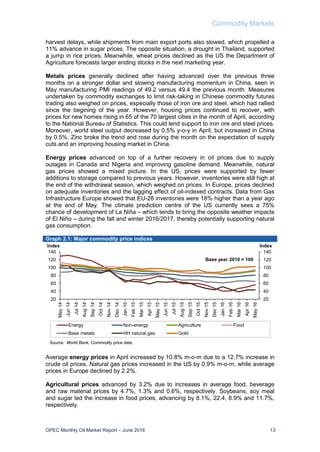
Graph 2.1: Major commodity price indices
Average energy prices in April increased by 10.8% m-o-m due to a 12.7% increase in
crude oil prices. Natural gas prices increased in the US by 0.9% m-o-m, while average
prices in Europe declined by 2.2%.
Agricultural prices advanced by 3.2% due to increases in average food, beverage
and raw material prices by 4.7%, 1.3% and 0.6%, respectively. Soybeans, soy meal
and sugar led the increase in food prices, advancing by 8.1%, 22.4, 8.9% and 11.7%,
respectively.
20
40
60
80
100
120
140
20
40
60
80
100
120
140
May14
Jun14
Jul14
Aug14
Sep14
Oct14
Nov14
Dec14
Jan15
Feb15
Mar15
Apr15
May15
Jun15
Jul15
Aug15
Sep15
Oct15
Nov15
Dec15
Jan16
Feb16
Mar16
Apr16
May16
IndexIndex
Energy Non-energy Agriculture Food
Base metals HH natural gas Gold
Source: World Bank, Commodity price data.
Base year 2010 = 100
Commodity Markets
14 OPEC Monthly Oil Market Report – June 2016
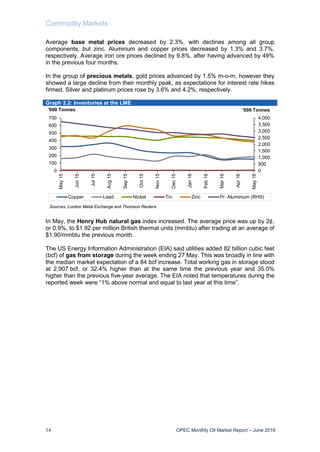
Average base metal prices decreased by 2.3%, with declines among all group
components, but zinc. Aluminum and copper prices decreased by 1.3% and 3.7%,
respectively. Average iron ore prices declined by 9.8%, after having advanced by 49%
in the previous four months.
In the group of precious metals, gold prices advanced by 1.5% m-o-m, however they
showed a large decline from their monthly peak, as expectations for interest rate hikes
firmed. Silver and platinum prices rose by 3.6% and 4.2%, respectively.
Graph 2.2: Inventories at the LME
In May, the Henry Hub natural gas index increased. The average price was up by 2¢,
or 0.9%, to $1.92 per million British thermal units (mmbtu) after trading at an average of
$1.90/mmbtu the previous month.
The US Energy Information Administration (EIA) said utilities added 82 billion cubic feet
(bcf) of gas from storage during the week ending 27 May. This was broadly in line with
the median market expectation of a 84 bcf increase. Total working gas in storage stood
at 2,907 bcf, or 32.4% higher than at the same time the previous year and 35.0%
higher than the previous five-year average. The EIA noted that temperatures during the
reported week were “1% above normal and equal to last year at this time”.
0
500
1,000
1,500
2,000
2,500
3,000
3,500
4,000
0
100
200
300
400
500
600
700
May15
Jun15
Jul15
Aug15
Sep15
Oct15
Nov15
Dec15
Jan16
Feb16
Mar16
Apr16
May16
'000 Tonnes'000 Tonnes
Copper Lead Nickel Tin Zinc Pr. Aluminium (RHS)
Sources: London Metal Exchange and Thomson Reuters.
Commodity Markets
OPEC Monthly Oil Market Report – June 2016 15
Investment flows into commodities
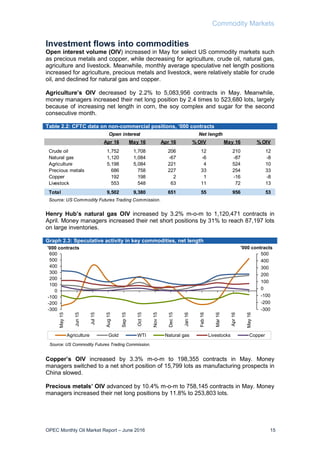
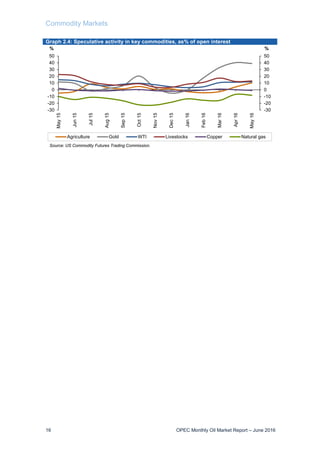
Open interest volume (OIV) increased in May for select US commodity markets such
as precious metals and copper, while decreasing for agriculture, crude oil, natural gas,
agriculture and livestock. Meanwhile, monthly average speculative net length positions
increased for agriculture, precious metals and livestock, were relatively stable for crude
oil, and declined for natural gas and copper.
Agriculture’s OIV decreased by 2.2% to 5,083,956 contracts in May. Meanwhile,
money managers increased their net long position by 2.4 times to 523,680 lots, largely
because of increasing net length in corn, the soy complex and sugar for the second
consecutive month.
Table 2.2: CFTC data on non-commercial positions, ‘000 contracts
Henry Hub’s natural gas OIV increased by 3.2% m-o-m to 1,120,471 contracts in
April. Money managers increased their net short positions by 31% to reach 87,197 lots
on large inventories.
Graph 2.3: Speculative activity in key commodities, net length
Copper’s OIV increased by 3.3% m-o-m to 198,355 contracts in May. Money
managers switched to a net short position of 15,799 lots as manufacturing prospects in
China slowed.
Precious metals’ OIV advanced by 10.4% m-o-m to 758,145 contracts in May. Money
managers increased their net long positions by 11.8% to 253,803 lots.
-300
-200
-100
0
100
200
300
400
500
-300
-200
-100
0
100
200
300
400
500
600
May15
Jun15
Jul15
Aug15
Sep15
Oct15
Nov15
Dec15
Jan16
Feb16
Mar16
Apr16
May16'000 contracts'000 contracts
Agriculture Gold WTI Natural gas Livestocks Copper
Source: US Commodity Futures Trading Commission.
Apr 16 May 16 Apr 16 % OIV May 16 % OIV
Crude oil 1,752 1,708 206 12 210 12
Natural gas 1,120 1,084 -67 -6 -87 -8
Agriculture 5,198 5,084 221 4 524 10
Precious metals 686 758 227 33 254 33
Copper 192 198 2 1 -16 -8
Livestock 553 548 63 11 72 13
Total 9,502 9,380 651 55 956 53
Source: US Commodity Futures Trading Commission.
Open interest Net length
Commodity Markets
16 OPEC Monthly Oil Market Report – June 2016
Graph 2.4: Speculative activity in key commodities, as% of open interest
-30
-20
-10
0
10
20
30
40
50
-30
-20
-10
0
10
20
30
40
50
May15
Jun15
Jul15
Aug15
Sep15
Oct15
Nov15
Dec15
Jan16
Feb16
Mar16
Apr16
May16
%%
Agriculture Gold WTI Livestocks Copper Natural gas
Source: US Commodity Futures Trading Commission.
World Economy
OPEC Monthly Oil Market Report – June 2016 17
World Economy
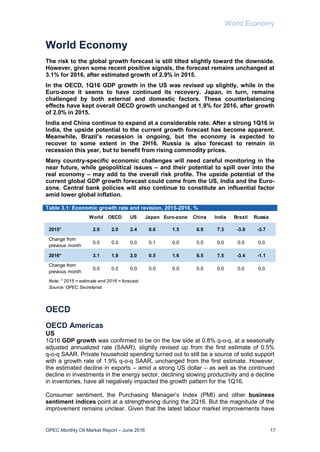
The risk to the global growth forecast is still tilted slightly toward the downside.
However, given some recent positive signals, the forecast remains unchanged at
3.1% for 2016, after estimated growth of 2.9% in 2015.
In the OECD, 1Q16 GDP growth in the US was revised up slightly, while in the
Euro-zone it seems to have continued its recovery. Japan, in turn, remains
challenged by both external and domestic factors. These counterbalancing
effects have kept overall OECD growth unchanged at 1.9% for 2016, after growth
of 2.0% in 2015.
India and China continue to expand at a considerable rate. After a strong 1Q16 in
India, the upside potential to the current growth forecast has become apparent.
Meanwhile, Brazil’s recession is ongoing, but the economy is expected to
recover to some extent in the 2H16. Russia is also forecast to remain in
recession this year, but to benefit from rising commodity prices.
Many country-specific economic challenges will need careful monitoring in the
near future, while geopolitical issues – and their potential to spill over into the
real economy – may add to the overall risk profile. The upside potential of the
current global GDP growth forecast could come from the US, India and the Euro-
zone. Central bank policies will also continue to constitute an influential factor
amid lower global inflation.
Table 3.1: Economic growth rate and revision, 2015-2016, %
OECD
OECD Americas
US
1Q16 GDP growth was confirmed to be on the low side at 0.8% q-o-q, at a seasonally
adjusted annualized rate (SAAR), slightly revised up from the first estimate of 0.5%
q-o-q SAAR. Private household spending turned out to still be a source of solid support
with a growth rate of 1.9% q-o-q SAAR, unchanged from the first estimate. However,
the estimated decline in exports – amid a strong US dollar – as well as the continued
decline in investments in the energy sector, declining slowing productivity and a decline
in inventories, have all negatively impacted the growth pattern for the 1Q16.
Consumer sentiment, the Purchasing Manager’s Index (PMI) and other business
sentiment indices point at a strengthening during the 2Q16. But the magnitude of the
improvement remains unclear. Given that the latest labour market improvements have
World OECD US Japan Euro-zone China India Brazil Russia
2015* 2.9 2.0 2.4 0.6 1.5 6.9 7.3 -3.8 -3.7
Change from
previous month
0.0 0.0 0.0 0.1 0.0 0.0 0.0 0.0 0.0
2016* 3.1 1.9 2.0 0.5 1.6 6.5 7.5 -3.4 -1.1
Change from
previous month
0.0 0.0 0.0 0.0 0.0 0.0 0.0 0.0 0.0
Note: * 2015 = estimate and 2016 = forecast.
Source: OPEC Secretariat.
World Economy
18 OPEC Monthly Oil Market Report – June 2016
been clearly below expectations, the US Federal Reserve (Fed) will carefully review
these developments. And although it seems that the Fed is envisaging another interest
rate hike in the coming months, a rate hike at its upcoming June meeting seems rather
unlikely, given the current uncertainties.
Total industrial production remains weak and has been significantly impacted by the
challenges in the energy sector, while manufacturing continues growing, albeit at a low
pace. Total industrial production declined by 1.1% y-o-y in April. But while it is the
eighth consecutive month of decline, the rate of decline is improving – i.e. it is
recovering on a monthly base. Mining, including oil sector-related output, fell
considerably again, dropping 13.3% y-o-y, the largest decline in this data series on
record. However, within this number, manufacturing held up relatively well at 0.6%
y-o-y, following growth of 0.5% y-o-y in March. Ongoing weakness is reflected in
manufacturing orders, which fell by 1.8% y-o-y in March. But this development is also
less dramatic than it was in the previous month, when orders fell by 4.3% y-o-y. The
negative trend of order growth in the energy sector continued to be considerably
negative, with new orders for machinery in the mining, oil and gas sectors declining by
92.4% y-o-y in April.
Retail sales continued rising in April, when growth stood at 3.0% y-o-y after growth of
1.7% y-o-y in March. The lessening improvements in the labour market, however, are
pointing at some potential softening of this growth trend. While the unemployment rate
stood at 4.7% in May, non-farm payroll additions grew by a meagre 38,000 after a
downward revision of 123,000 in April. The lower unemployment rate may also be
explained by the worsening level of the participation rate, which fell again to 62.6%
from the April level of 62.8%. The Conference Board’s Consumer Confidence Index
remained solid, though it fell slightly to 92.6 in May, after 94.7 in April and 96.1 in
March.
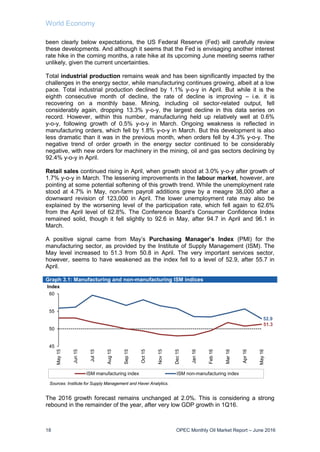
A positive signal came from May’s Purchasing Manager’s Index (PMI) for the
manufacturing sector, as provided by the Institute of Supply Management (ISM). The
May level increased to 51.3 from 50.8 in April. The very important services sector,
however, seems to have weakened as the index fell to a level of 52.9, after 55.7 in
April.
Graph 3.1: Manufacturing and non-manufacturing ISM indices
The 2016 growth forecast remains unchanged at 2.0%. This is considering a strong
rebound in the remainder of the year, after very low GDP growth in 1Q16.
51.3
52.9
45
50
55
60
May15
Jun15
Jul15
Aug15
Sep15
Oct15
Nov15
Dec15
Jan16
Feb16
Mar16
Apr16
May16
Index
ISM manufacturing index ISM non-manufacturing index
Sources: Institute for Supply Management and Haver Analytics.
World Economy
OPEC Monthly Oil Market Report – June 2016 19
Canada
The situation of Canada’s economy remains challenging. The combination of recent
wildfires that have hurt the oil industry and the current soft dynamic in the US economy,
Canada’s most important trading partner, are estimated to have negatively impacted
economic growth. Canadian exports declined again in April, falling by 2.3% y-o-y, after
a decline of 4.5% y-o-y in March. Also, industrial production remained muted and rose
by only 0.2% y-o-y in March and by 0.6% y-o-y in February. On a positive note, retail
trade improved again by 3.2% y-o-y in March, after an already considerable increase of
5.7% y-o-y in February. Some other positive developments are reflected in the PMI for
manufacturing, which remained almost unchanged in May at 52.1, compared to 52.2 in
April. This is now the third consecutive month of a PMI level above 50. Given the
challenges ahead, and despite some positive momentum up to around April, the GDP
forecast for 2016 remains at 1.5%. This compares to estimated GDP growth of 1.1% in
2015.
OECD Asia Pacific
Japan
The latest signals of ongoing challenges to the Japanese economy have been provided
by the government, which announced that it would postpone until 2019 a sales tax hike
that was planned for 2017. Despite year-long stimulus measures, the Japanese
economy remains in only a slow or no-growth dynamic. Postponing the sales tax
increase may allow for slightly more fiscal stimulus, constituting one of the so-called
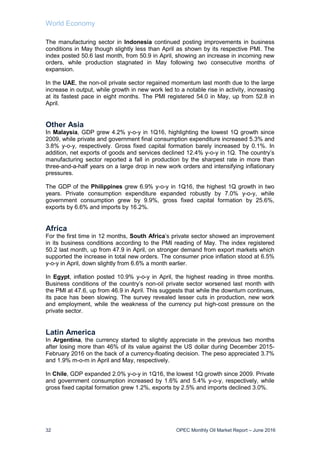
“three arrows”. But the sovereign debt level needs to be very carefully managed.
Structural measures, as currently envisaged by the government, are only paying off
slowly and the effect in the short-term is limited. Monetary stimulus is already at an
unprecedented level. Despite these monetary measures, the yen has risen significantly
over the past months and inflation has turned negative again, while the Bank of Japan
(BoJ) is still trying to achieve an inflation rate of 2%. Hence, the situation for domestic
demand remains challenging and the most recent lead indicators again point to only
low growth this year.
After having turned slightly positive in February, consumer prices fell by 0.3% y-o-y in
April, after remaining stagnant in March. When excluding the two volatile groups of
energy and food, the country’s core inflation figure stood at 0.7% in April, slightly higher
than in March. Support for domestic consumption – and inflation – came again from the
March data for real income. After a decline in labour-related earnings in 2015, the 1Q
has shown an increase of 1.4% y-o-y, followed by now a monthly rise of 0.8% y-o-y in
April. This trend has continued to be supported by the extremely tight labour market,
which saw an unemployment rate of only 3.2% in April, unchanged from March.
Japanese exports continued their declining trend. They have now declined for the
eighth consecutive month in April, falling by 10.1% y-o-y. The 1Q16 average decline
stood at 7.8% y-o-y. Also, industrial production fell again considerably in April,
declining by 1.9% y-o-y. 1Q16 industrial production already declined by 3.3% y-o-y.
Domestic demand has also remained weak in the past months. It remained negative
and again declined by 0.8% y-o-y in April, compared to a decline of 1.0% in March.
World Economy
20 OPEC Monthly Oil Market Report – June 2016
Graph 3.2: Japanese retail trade Graph 3.3: Japanese PMI indices
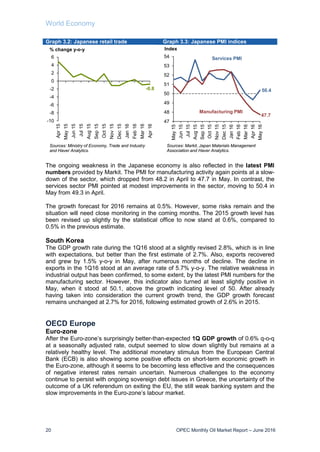
The ongoing weakness in the Japanese economy is also reflected in the latest PMI
numbers provided by Markit. The PMI for manufacturing activity again points at a slow-
down of the sector, which dropped from 48.2 in April to 47.7 in May. In contrast, the
services sector PMI pointed at modest improvements in the sector, moving to 50.4 in
May from 49.3 in April.
The growth forecast for 2016 remains at 0.5%. However, some risks remain and the
situation will need close monitoring in the coming months. The 2015 growth level has
been revised up slightly by the statistical office to now stand at 0.6%, compared to
0.5% in the previous estimate.
South Korea
The GDP growth rate during the 1Q16 stood at a slightly revised 2.8%, which is in line
with expectations, but better than the first estimate of 2.7%. Also, exports recovered
and grew by 1.5% y-o-y in May, after numerous months of decline. The decline in
exports in the 1Q16 stood at an average rate of 5.7% y-o-y. The relative weakness in
industrial output has been confirmed, to some extent, by the latest PMI numbers for the
manufacturing sector. However, this indicator also turned at least slightly positive in
May, when it stood at 50.1, above the growth indicating level of 50. After already
having taken into consideration the current growth trend, the GDP growth forecast
remains unchanged at 2.7% for 2016, following estimated growth of 2.6% in 2015.
OECD Europe
Euro-zone
After the Euro-zone’s surprisingly better-than-expected 1Q GDP growth of 0.6% q-o-q
at a seasonally adjusted rate, output seemed to slow down slightly but remains at a
relatively healthy level. The additional monetary stimulus from the European Central
Bank (ECB) is also showing some positive effects on short-term economic growth in
the Euro-zone, although it seems to be becoming less effective and the consequences
of negative interest rates remain uncertain. Numerous challenges to the economy
continue to persist with ongoing sovereign debt issues in Greece, the uncertainty of the
outcome of a UK referendum on exiting the EU, the still weak banking system and the
slow improvements in the Euro-zone’s labour market.
-0.8
-10
-8
-6
-4
-2
0
2
4
6 Apr15
May15
Jun15
Jul15
Aug15
Sep15
Oct15
Nov15
Dec15
Jan16
Feb16
Mar16
Apr16
Sources: Ministry of Economy, Trade and Industry
and Haver Analytics.
% change y-o-y
50.4
47.7
47
48
49
50
51
52
53
54
May15
Jun15
Jul15
Aug15
Sep15
Oct15
Nov15
Dec15
Jan16
Feb16
Mar16
Apr16
May16
Index
Sources: Markit, Japan Materials Management
Association and Haver Analytics.
Services PMI
Manufacturing PMI
World Economy
OPEC Monthly Oil Market Report – June 2016 21
After a strong recovery at the beginning of the year, the latest industrial production
number for February shows again some softening dynamic. It rose only marginally by
0.1% y-o-y, after growth of 1.1% y-o-y in February and 3.6% y-o-y in January. Also,
manufacturing growth was very low in March, expanding only by 0.2% y-o-y, after 2.0%
in February and 4.4% y-o-y in January. As in other economies, mining and quarrying
declined considerably, amid falling commodity prices in the past months. However, the
rate of decline decreased, falling by 4.5% y-o-y in March, after a decline of 12.5% y-o-y
in February and a drop of 14.3% y-o-y in January.
Retail sales performed well, too, though at a slightly lower growth rate when compared
to previous months. Consumers increased spending in the retail sector by 1.5% y-o-y in
April, after 1.9% y-o-y in March. The latest consumer confidence surveys point at some
slowdown in the coming months, as growing uncertainties about the development of
the Euro-zone’s economy, in combination with ongoing challenges in the labour
market, may dent private household consumption. The unemployment rate stood at
10.2% in April, the same level as in March.
Despite the latest round of ECB stimulus, inflation remained negative. It declined by
0.1% y-o-y in May, after a decline of 0.2% y-o-y in April. While slightly improving, the
lessening effectiveness of ECB stimulus seems to be also mirrored in the latest figures
of credit supply. April’s growth stood at only 0.5% y-o-y, after 0.3% y-o-y in March. This
may also be the outcome of the ongoing challenges in the banking system, with volatile
developments in the credit supply seen in the past months pointing at some continuing
fragility.
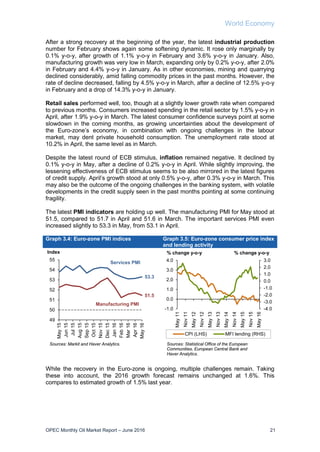
The latest PMI indicators are holding up well. The manufacturing PMI for May stood at
51.5, compared to 51.7 in April and 51.6 in March. The important services PMI even
increased slightly to 53.3 in May, from 53.1 in April.
Graph 3.4: Euro-zone PMI indices Graph 3.5: Euro-zone consumer price index
and lending activity
While the recovery in the Euro-zone is ongoing, multiple challenges remain. Taking
these into account, the 2016 growth forecast remains unchanged at 1.6%. This
compares to estimated growth of 1.5% last year.
53.3
51.5
49
50
51
52
53
54
55
May15
Jun15
Jul15
Aug15
Sep15
Oct15
Nov15
Dec15
Jan16
Feb16
Mar16
Apr16
May16
Index
Sources: Markit and Haver Analytics.
Services PMI
Manufacturing PMI
-4.0
-3.0
-2.0
-1.0
0.0
1.0
2.0
3.0
-1.0
0.0
1.0
2.0
3.0
4.0
May11
Nov11
May12
Nov12
May13
Nov13
May14
Nov14
May15
Nov15
May16
CPI (LHS) MFI lending (RHS)
Sources: Statistical Office of the European
Communities, European Central Bank and
Haver Analytics.
% change y-o-y % change y-o-y
World Economy
22 OPEC Monthly Oil Market Report – June 2016
UK
The most important question currently is certainly the effect a UK exit from the EU and
the effect that this may have on the former’s economy. It seems somewhat obvious that
the effect might by significantly negative in the short-term. However, it remains to be
seen how British voters will decide. The subject will certainly need close monitoring. In
the meantime, the UK economy continues on a relatively healthy growth trajectory,
while some softening in the economy is ongoing, due to the uncertainty about the 23
June referendum. Industrial production in April rose considerably after many months of
weak output, growing by 1.6% y-o-y, compared to a decline of 0.3% y-o-y in March.
International trade has continued declining this year, with exports falling again by 0.6%
y-o-y in March, after a decline of 0.7% y-o-y in February. This marks the seventh
consecutive month of decline. The latest May PMI number for the manufacturing sector
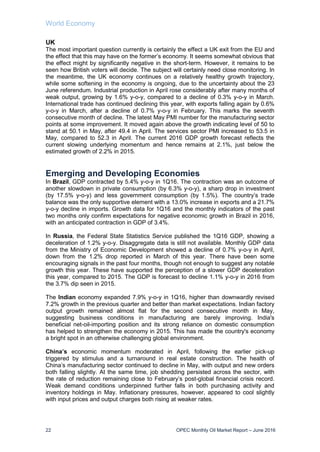
points at some improvement. It moved again above the growth indicating level of 50 to
stand at 50.1 in May, after 49.4 in April. The services sector PMI increased to 53.5 in
May, compared to 52.3 in April. The current 2016 GDP growth forecast reflects the
current slowing underlying momentum and hence remains at 2.1%, just below the
estimated growth of 2.2% in 2015.
Emerging and Developing Economies
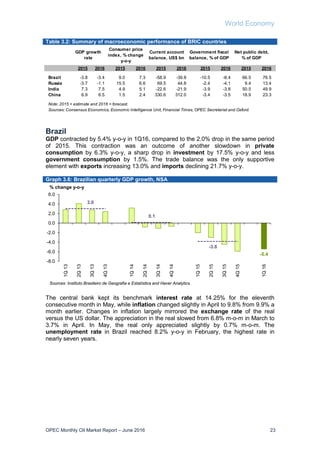
In Brazil, GDP contracted by 5.4% y-o-y in 1Q16. The contraction was an outcome of
another slowdown in private consumption (by 6.3% y-o-y), a sharp drop in investment
(by 17.5% y-o-y) and less government consumption (by 1.5%). The country’s trade
balance was the only supportive element with a 13.0% increase in exports and a 21.7%
y-o-y decline in imports. Growth data for 1Q16 and the monthly indicators of the past
two months only confirm expectations for negative economic growth in Brazil in 2016,
with an anticipated contraction in GDP of 3.4%.
In Russia, the Federal State Statistics Service published the 1Q16 GDP, showing a
deceleration of 1.2% y-o-y. Disaggregate data is still not available. Monthly GDP data
from the Ministry of Economic Development showed a decline of 0.7% y-o-y in April,
down from the 1.2% drop reported in March of this year. There have been some
encouraging signals in the past four months, though not enough to suggest any notable
growth this year. These have supported the perception of a slower GDP deceleration
this year, compared to 2015. The GDP is forecast to decline 1.1% y-o-y in 2016 from
the 3.7% dip seen in 2015.
The Indian economy expanded 7.9% y-o-y in 1Q16, higher than downwardly revised
7.2% growth in the previous quarter and better than market expectations. Indian factory
output growth remained almost flat for the second consecutive month in May,
suggesting business conditions in manufacturing are barely improving. India's
beneficial net-oil-importing position and its strong reliance on domestic consumption
has helped to strengthen the economy in 2015. This has made the country's economy
a bright spot in an otherwise challenging global environment.
China’s economic momentum moderated in April, following the earlier pick-up
triggered by stimulus and a turnaround in real estate construction. The health of
China’s manufacturing sector continued to decline in May, with output and new orders
both falling slightly. At the same time, job shedding persisted across the sector, with
the rate of reduction remaining close to February’s post-global financial crisis record.
Weak demand conditions underpinned further falls in both purchasing activity and
inventory holdings in May. Inflationary pressures, however, appeared to cool slightly
with input prices and output charges both rising at weaker rates.
World Economy
OPEC Monthly Oil Market Report – June 2016 23
Table 3.2: Summary of macroeconomic performance of BRIC countries
Brazil
GDP contracted by 5.4% y-o-y in 1Q16, compared to the 2.0% drop in the same period
of 2015. This contraction was an outcome of another slowdown in private
consumption by 6.3% y-o-y, a sharp drop in investment by 17.5% y-o-y and less
government consumption by 1.5%. The trade balance was the only supportive
element with exports increasing 13.0% and imports declining 21.7% y-o-y.
Graph 3.6: Brazilian quarterly GDP growth, NSA
The central bank kept its benchmark interest rate at 14.25% for the eleventh
consecutive month in May, while inflation changed slightly in April to 9.8% from 9.9% a
month earlier. Changes in inflation largely mirrored the exchange rate of the real
versus the US dollar. The appreciation in the real slowed from 6.8% m-o-m in March to
3.7% in April. In May, the real only appreciated slightly by 0.7% m-o-m. The
unemployment rate in Brazil reached 8.2% y-o-y in February, the highest rate in
nearly seven years.
-5.4
3.0
0.1
-3.8
-8.0
-6.0
-4.0
-2.0
0.0
2.0
4.0
6.0
1Q13
2Q13
3Q13
4Q13
1Q14
2Q14
3Q14
4Q14
1Q15
2Q15
3Q15
4Q15
1Q16
% change y-o-y
Sources: Instituto Brasileiro de Geografia e Estatística and Haver Analytics.
2015 2016 2015 2016 2015 2016 2015 2016 2015 2016
Brazil -3.8 -3.4 9.0 7.3 -58.9 -39.8 -10.5 -8.4 66.5 76.5
Russia -3.7 -1.1 15.5 6.6 69.5 44.8 -2.4 -4.1 9.4 13.4
India 7.3 7.5 4.9 5.1 -22.6 -21.9 -3.9 -3.8 50.5 49.9
China 6.9 6.5 1.5 2.4 330.6 312.0 -3.4 -3.5 18.9 23.3
Sources: Consensus Economics, Economic Intelligence Unit, Financial Times, OPEC Secretariat and Oxford.
Note: 2015 = estimate and 2016 = forecast.
GDP growth
rate
Consumer price
index, % change
y-o-y
Current account
balance, US$ bn
Government fiscal
balance, % of GDP
Net public debt,
% of GDP
World Economy
24 OPEC Monthly Oil Market Report – June 2016
Graph 3.7: Brazilian unemployment rate Graph 3.8: Brazilian inflation vs.
Interest rate
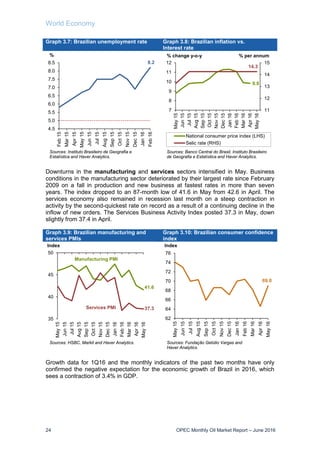
Downturns in the manufacturing and services sectors intensified in May. Business
conditions in the manufacturing sector deteriorated by their largest rate since February
2009 on a fall in production and new business at fastest rates in more than seven
years. The index dropped to an 87-month low of 41.6 in May from 42.6 in April. The
services economy also remained in recession last month on a steep contraction in
activity by the second-quickest rate on record as a result of a continuing decline in the
inflow of new orders. The Services Business Activity Index posted 37.3 in May, down
slightly from 37.4 in April.
Graph 3.9: Brazilian manufacturing and
services PMIs
Graph 3.10: Brazilian consumer confidence
index
Growth data for 1Q16 and the monthly indicators of the past two months have only
confirmed the negative expectation for the economic growth of Brazil in 2016, which
sees a contraction of 3.4% in GDP.
8.2
4.5
5.0
5.5
6.0
6.5
7.0
7.5
8.0
8.5
Feb15
Mar15
Apr15
May15
Jun15
Jul15
Aug15
Sep15
Oct15
Nov15
Dec15
Jan16
Feb16
%
Sources: Instituto Brasileiro de Geografia e
Estatística and Haver Analytics.
9.8
14.3
11
12
13
14
15
7
8
9
10
11
12
May15
Jun15
Jul15
Aug15
Sep15
Oct15
Nov15
Dec15
Jan16
Feb16
Mar16
Apr16
May16
National consumer price index (LHS)
Selic rate (RHS)
Sources: Banco Central do Brasil, Instituto Brasileiro
de Geografia e Estatística and Haver Analytics.
% change y-o-y % per annum
41.6
37.3
35
40
45
50
May15
Jun15
Jul15
Aug15
Sep15
Oct15
Nov15
Dec15
Jan16
Feb16
Mar16
Apr16
May16
Index
Sources: HSBC, Markit and Haver Analytics.
Services PMI
Manufacturing PMI
69.0
62
64
66
68
70
72
74
76
May15
Jun15
Jul15
Aug15
Sep15
Oct15
Nov15
Dec15
Jan16
Feb16
Mar16
Apr16
May16
Index
Sources: Fundação Getúlio Vargas and
Haver Analytics.
World Economy
OPEC Monthly Oil Market Report – June 2016 25
Russia
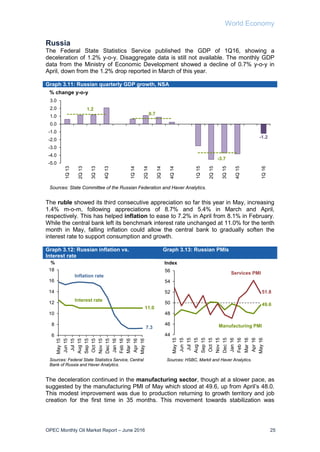
The Federal State Statistics Service published the GDP of 1Q16, showing a
deceleration of 1.2% y-o-y. Disaggregate data is still not available. The monthly GDP
data from the Ministry of Economic Development showed a decline of 0.7% y-o-y in
April, down from the 1.2% drop reported in March of this year.
Graph 3.11: Russian quarterly GDP growth, NSA
The ruble showed its third consecutive appreciation so far this year in May, increasing
1.4% m-o-m, following appreciations of 8.7% and 5.4% in March and April,
respectively. This has helped inflation to ease to 7.2% in April from 8.1% in February.
While the central bank left its benchmark interest rate unchanged at 11.0% for the tenth
month in May, falling inflation could allow the central bank to gradually soften the
interest rate to support consumption and growth.
Graph 3.12: Russian inflation vs.
Interest rate
Graph 3.13: Russian PMIs
The deceleration continued in the manufacturing sector, though at a slower pace, as
suggested by the manufacturing PMI of May which stood at 49.6, up from April’s 48.0.
This modest improvement was due to production returning to growth territory and job
creation for the first time in 35 months. This movement towards stabilization was
-1.2
1.2
0.7
-3.7
-5.0
-4.0
-3.0
-2.0
-1.0
0.0
1.0
2.0
3.0
1Q13
2Q13
3Q13
4Q13
1Q14
2Q14
3Q14
4Q14
1Q15
2Q15
3Q15
4Q15
1Q16
% change y-o-y
Sources: State Committee of the Russian Federation and Haver Analytics.
7.3
11.0
6
8
10
12
14
16
18
May15
Jun15
Jul15
Aug15
Sep15
Oct15
Nov15
Dec15
Jan16
Feb16
Mar16
Apr16
May16
%
Sources: Federal State Statistics Service, Central
Bank of Russia and Haver Analytics.
Inflation rate
Interest rate
49.6
51.8
44
46
48
50
52
54
56
May15
Jun15
Jul15
Aug15
Sep15
Oct15
Nov15
Dec15
Jan16
Feb16
Mar16
Apr16
May16Index
Sources: HSBC, Markit and Haver Analytics.
Services PMI
Manufacturing PMI
World Economy
26 OPEC Monthly Oil Market Report – June 2016
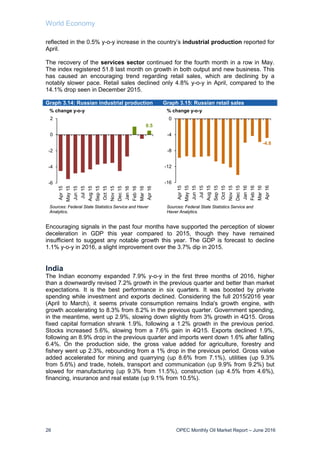
reflected in the 0.5% y-o-y increase in the country’s industrial production reported for
April.
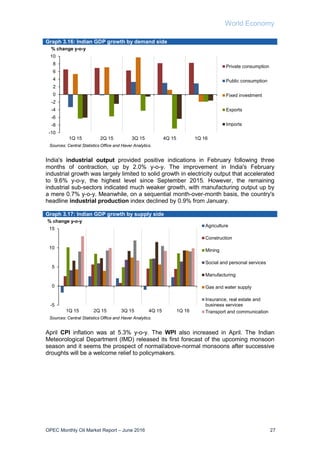
The recovery of the services sector continued for the fourth month in a row in May.
The index registered 51.8 last month on growth in both output and new business. This
has caused an encouraging trend regarding retail sales, which are declining by a
notably slower pace. Retail sales declined only 4.8% y-o-y in April, compared to the
14.1% drop seen in December 2015.
Graph 3.14: Russian industrial production Graph 3.15: Russian retail sales
Encouraging signals in the past four months have supported the perception of slower
deceleration in GDP this year compared to 2015, though they have remained
insufficient to suggest any notable growth this year. The GDP is forecast to decline
1.1% y-o-y in 2016, a slight improvement over the 3.7% dip in 2015.
India
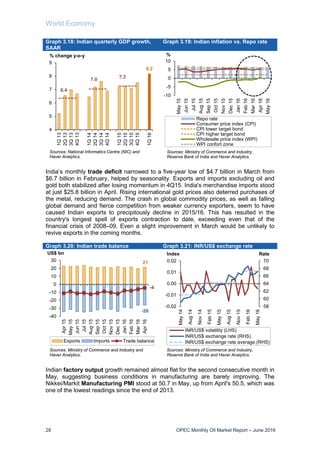
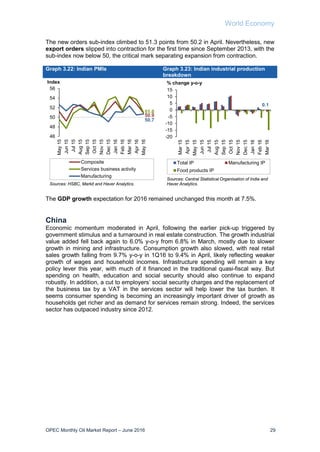
The Indian economy expanded 7.9% y-o-y in the first three months of 2016, higher
than a downwardly revised 7.2% growth in the previous quarter and better than market
expectations. It is the best performance in six quarters. It was boosted by private
spending while investment and exports declined. Considering the full 2015/2016 year
(April to March), it seems private consumption remains India's growth engine, with
growth accelerating to 8.3% from 8.2% in the previous quarter. Government spending,
in the meantime, went up 2.9%, slowing down slightly from 3% growth in 4Q15. Gross
fixed capital formation shrank 1.9%, following a 1.2% growth in the previous period.
Stocks increased 5.6%, slowing from a 7.6% gain in 4Q15. Exports declined 1.9%,
following an 8.9% drop in the previous quarter and imports went down 1.6% after falling
6.4%. On the production side, the gross value added for agriculture, forestry and
fishery went up 2.3%, rebounding from a 1% drop in the previous period. Gross value
added accelerated for mining and quarrying (up 8.6% from 7.1%), utilities (up 9.3%
from 5.6%) and trade, hotels, transport and communication (up 9.9% from 9.2%) but
slowed for manufacturing (up 9.3% from 11.5%), construction (up 4.5% from 4.6%),
financing, insurance and real estate (up 9.1% from 10.5%).
0.5
-6
-4
-2
0
2
Apr15
May15
Jun15
Jul15
Aug15
Sep15
Oct15
Nov15
Dec15
Jan16
Feb16
Mar16
Apr16
% change y-o-y
Sources: Federal State Statistics Service and Haver
Analytics.
-4.8
-16
-12
-8
-4
0
Apr15
May15
Jun15
Jul15
Aug15
Sep15
Oct15
Nov15
Dec15
Jan16
Feb16
Mar16
Apr16
% change y-o-y
Sources: Federal State Statistics Service and
Haver Analytics.
World Economy
OPEC Monthly Oil Market Report – June 2016 27
Graph 3.16: Indian GDP growth by demand side
India's industrial output provided positive indications in February following three
months of contraction, up by 2.0% y-o-y. The improvement in India's February
industrial growth was largely limited to solid growth in electricity output that accelerated
to 9.6% y-o-y, the highest level since September 2015. However, the remaining
industrial sub-sectors indicated much weaker growth, with manufacturing output up by
a mere 0.7% y-o-y. Meanwhile, on a sequential month-over-month basis, the country's
headline industrial production index declined by 0.9% from January.
Graph 3.17: Indian GDP growth by supply side
April CPI inflation was at 5.3% y-o-y. The WPI also increased in April. The Indian
Meteorological Department (IMD) released its first forecast of the upcoming monsoon
season and it seems the prospect of normal/above-normal monsoons after successive
droughts will be a welcome relief to policymakers.
-10
-8
-6
-4
-2
0
2
4
6
8
10
1Q 15 2Q 15 3Q 15 4Q 15 1Q 16
% change y-o-y
Private consumption
Public consumption
Fixed investment
Exports
Imports
Sources: Central Statistics Office and Haver Analytics.
-5
0
5
10
15
1Q 15 2Q 15 3Q 15 4Q 15 1Q 16
% change y-o-y
Agriculture
Construction
Mining
Social and personal services
Manufacturing
Gas and water supply
Insurance, real estate and
business services
Transport and communication
Sources: Central Statistics Office and Haver Analytics.
World Economy
28 OPEC Monthly Oil Market Report – June 2016
Graph 3.18: Indian quarterly GDP growth,
SAAR
Graph 3.19: Indian inflation vs. Repo rate
India’s monthly trade deficit narrowed to a five-year low of $4.7 billion in March from
$6.7 billion in February, helped by seasonality. Exports and imports excluding oil and
gold both stabilized after losing momentum in 4Q15. India's merchandise imports stood
at just $25.8 billion in April. Rising international gold prices also deterred purchases of
the metal, reducing demand. The crash in global commodity prices, as well as falling
global demand and fierce competition from weaker currency exporters, seem to have
caused Indian exports to precipitously decline in 2015/16. This has resulted in the
country's longest spell of exports contraction to date, exceeding even that of the
financial crisis of 2008–09. Even a slight improvement in March would be unlikely to
revive exports in the coming months.
Graph 3.20: Indian trade balance Graph 3.21: INR/US$ exchange rate
Indian factory output growth remained almost flat for the second consecutive month in
May, suggesting business conditions in manufacturing are barely improving. The
Nikkei/Markit Manufacturing PMI stood at 50.7 in May, up from April's 50.5, which was
one of the lowest readings since the end of 2013.
8.2
6.4
7.0
7.3
4
5
6
7
8
9
1Q13
2Q13
3Q13
4Q13
1Q14
2Q14
3Q14
4Q14
1Q15
2Q15
3Q15
4Q15
1Q16Sources: National Informatics Centre (NIC) and
Haver Analytics.
% change y-o-y
-10
-5
0
5
10
May15
Jun15
Jul15
Aug15
Sep15
Oct15
Nov15
Dec15
Jan16
Feb16
Mar16
Apr16
May16
%
Repo rate
Consumer price index (CPI)
CPI lower target bond
CPI higher target bond
Wholesale price index (WPI)
WPI confort zone
Sources: Ministry of Commerce and Industry,
Reserve Bank of India and Haver Analytics.
21
-26
-4
-40
-30
-20
-10
0
10
20
30
Apr15
May15
Jun15
Jul15
Aug15
Sep15
Oct15
Nov15
Dec15
Jan16
Feb16
Mar16
Apr16
US$ bn
Exports Imports Trade balance
Sources: Ministry of Commerce and Industry and
Haver Analytics.
58
60
62
64
66
68
70
-0.02
-0.01
0.00
0.01
0.02
May14
Aug14
Nov14
Feb15
May15
Aug15
Nov15
Feb16
May16
INR/US$ volatility (LHS)
INR/US$ exchange rate (RHS)
INR/US$ exchange rate average (RHS)
Index Rate
Sources: Ministry of Commerce and Industry,
Reserve Bank of India and Haver Analytics.
World Economy
OPEC Monthly Oil Market Report – June 2016 29
The new orders sub-index climbed to 51.3 points from 50.2 in April. Nevertheless, new
export orders slipped into contraction for the first time since September 2013, with the
sub-index now below 50, the critical mark separating expansion from contraction.
Graph 3.22: Indian PMIs Graph 3.23: Indian industrial production
breakdown
The GDP growth expectation for 2016 remained unchanged this month at 7.5%.
China
Economic momentum moderated in April, following the earlier pick-up triggered by
government stimulus and a turnaround in real estate construction. The growth industrial
value added fell back again to 6.0% y-o-y from 6.8% in March, mostly due to slower
growth in mining and infrastructure. Consumption growth also slowed, with real retail
sales growth falling from 9.7% y-o-y in 1Q16 to 9.4% in April, likely reflecting weaker
growth of wages and household incomes. Infrastructure spending will remain a key
policy lever this year, with much of it financed in the traditional quasi-fiscal way. But
spending on health, education and social security should also continue to expand
robustly. In addition, a cut to employers’ social security charges and the replacement of
the business tax by a VAT in the services sector will help lower the tax burden. It
seems consumer spending is becoming an increasingly important driver of growth as
households get richer and as demand for services remain strong. Indeed, the services
sector has outpaced industry since 2012.
50.9
51.0
50.7
46
48
50
52
54
56
May15
Jun15
Jul15
Aug15
Sep15
Oct15
Nov15
Dec15
Jan16
Feb16
Mar16
Apr16
May16
Index
Composite
Services business activity
Manufacturing
Sources: HSBC, Markit and Haver Analytics.
0.1
-20
-15
-10
-5
0
5
10
15
Mar15
Apr15
May15
Jun15
Jul15
Aug15
Sep15
Oct15
Nov15
Dec15
Jan16
Feb16
Mar16
Total IP Manufacturing IP
Food products IP
Sources: Central Statistical Organisation of India and
Haver Analytics.
% change y-o-y
World Economy
30 OPEC Monthly Oil Market Report – June 2016
Graph 3.24: Chinese quarterly GDP growth rate, SAAR
China’s CPI inflation increased slightly to 2.42% y-o-y in April from 2.41% in March.
Excluding food and energy prices, the core CPI rose 1.5% y-o-y in April. Deflation of
the producer price index (PPI) moderated to 3.4% y-o-y in April from 4.3% y-o-y in
March. Overall, PPI deflation has run uninterrupted for 50 months.
Graph 3.25: Chinese CPI vs. PPI Graph 3.26: Chinese trade balance
China's trade surplus will play a marginally positive role in GDP growth in the first
quarter. But this will also dissipate as 2016 progresses. China’s April trade report
showed some improvements, with April exports (in US dollar terms) dropping 1.8%
y-o-y after increasing 11.5% y-o-y in March. Imports, in US dollar terms, dropped
10.9% y-o-y in April, after falling 7.6% in March. As a result, the trade surplus increased
to $45.5 billion from March’s $29.8 billion. China’s weak trade figures are consistent
with weak global trade in recent years.
The health of China’s manufacturing sector continued to decline in May, with output
and new orders both falling slightly. At the same time, job shedding persisted across
the sector, with the rate of reduction remaining close to February’s post-global financial
crisis record. Weak demand conditions underpinned further falls in both purchasing
activity and inventory holdings in May. Inflationary pressures appeared to cool slightly,
however, with input prices and output charges both rising at weaker rates.
6.7
7.7
7.3
6.9
6.0
6.4
6.8
7.2
7.6
8.0
1Q 2Q 3Q 4Q 1Q 2Q 3Q 4Q 1Q 2Q 3Q 4Q 1Q
2013 2014 2015 2016
Sources: China's National Bureau of Statistics and Haver Analytics.
% change y-o-y
-10
-5
0
5
10
15
May14
Jul14
Sep14
Nov14
Jan15
Mar15
May15
Jul15
Sep15
Nov15
Jan16
Mar16
May16
CPI
PPI
Official interest rate
Average house price in 100 cities
Sources: China Index Academy, China National
Bureau of Statistics, Soufan and Haver Analytics.
% change y-o-y
173
-127
46
-200
-150
-100
-50
0
50
100
150
200
250
Apr15
May15
Jun15
Jul15
Aug15
Sep15
Oct15
Nov15
Dec15
Jan16
Feb16
Mar16
Apr16
US$ bn
Exports Imports Trade balance
Sources: China Customs and Haver Analytics.
World Economy
OPEC Monthly Oil Market Report – June 2016 31
China's manufacturing PMI for May came in at 49.2, down 0.2 from April’s reading,
marking the second consecutive monthly decline. Readings for the output and new
order categories fell again, but employment improved slightly. Overall, China’s
economy has not been able to sustain the recovery it had in 1Q16 and is in the process
of bottoming out.
Graph 3.27: Chinese PMIs Graph 3.28: Chinese industrial production
China’s GDP growth expectation in 2016 has been kept unchanged this month at
6.5%.
OPEC Member Countries
In Saudi Arabia, the non-oil private sector grew by the highest rate in six months in
May, with the PMI posting 54.8, up from 54.2 in April. The survey showed the fastest
rise in total new orders so far this year. Purchasing activity and output both notably
rose. This improvement in the private sector is perceived as an encouraging signal,
showing the resilience of the economy and strong domestic demand during times of
fiscal challenges.
Graph 3.29: PMIs of Indonesia, Saudi Arabia and UAE
50.5
49.2
51.2
46
47
48
49
50
51
52
53
54
May15
Jun15
Jul15
Aug15
Sep15
Oct15
Nov15
Dec15
Jan16
Feb16
Mar16
Apr16
May16
Index
Sources: HSBC, Markit and Haver Analytics.
Composite
PMI
Manufacturing PMI
Services PMI
6.0
5.0
5.2
5.4
5.6
5.8
6.0
6.2
6.4
6.6
6.8
7.0
Apr15
May15
Jun15
Jul15
Aug15
Sep15
Oct15
Nov15
Dec15
Jan16
Feb16
Mar16
Apr16
% change y-o-y
Sources: China National Bureau of Statistics and
Haver Analytics.
50.6
54.8
54.0
45
50
55
60
65
May14
Jun14
Jul14
Aug14
Sep14
Oct14
Nov14
Dec14
Jan15
Feb15
Mar15
Apr15
May15
Jun15
Jul15
Aug15
Sep15
Oct15
Nov15
Dec15
Jan16
Feb16
Mar16
Apr16
May16
Index
Indonesia Saudi Arabia UAE
Sources: HSBC, Markit, Nikkei, SAAB, Stanbic IBTC Bank and Haver Analytics.
World Economy
32 OPEC Monthly Oil Market Report – June 2016
The manufacturing sector in Indonesia continued posting improvements in business
conditions in May though slightly less than April as shown by its respective PMI. The
index posted 50.6 last month, from 50.9 in April, showing an increase in incoming new
orders, while production stagnated in May following two consecutive months of
expansion.
In the UAE, the non-oil private sector regained momentum last month due to the large
increase in output, while growth in new work led to a notable rise in activity, increasing
at its fastest pace in eight months. The PMI registered 54.0 in May, up from 52.8 in
April.
Other Asia
In Malaysia, GDP grew 4.2% y-o-y in 1Q16, highlighting the lowest 1Q growth since
2009, while private and government final consumption expenditure increased 5.3% and
3.8% y-o-y, respectively. Gross fixed capital formation barely increased by 0.1%. In
addition, net exports of goods and services declined 12.4% y-o-y in 1Q. The country’s
manufacturing sector reported a fall in production by the sharpest rate in more than
three-and-a-half years on a large drop in new work orders and intensifying inflationary
pressures.
The GDP of the Philippines grew 6.9% y-o-y in 1Q16, the highest 1Q growth in two
years. Private consumption expenditure expanded robustly by 7.0% y-o-y, while
government consumption grew by 9.9%, gross fixed capital formation by 25.6%,
exports by 6.6% and imports by 16.2%.
Africa
For the first time in 12 months, South Africa’s private sector showed an improvement
in its business conditions according to the PMI reading of May. The index registered
50.2 last month, up from 47.9 in April, on stronger demand from export markets which
supported the increase in total new orders. The consumer price inflation stood at 6.5%
y-o-y in April, down slightly from 6.6% a month earlier.
In Egypt, inflation posted 10.9% y-o-y in April, the highest reading in three months.
Business conditions of the country’s non-oil private sector worsened last month with
the PMI at 47.6, up from 46.9 in April. This suggests that while the downturn continues,
its pace has been slowing. The survey revealed lesser cuts in production, new work
and employment, while the weakness of the currency put high-cost pressure on the
private sector.
Latin America
In Argentina, the currency started to slightly appreciate in the previous two months
after losing more than 46% of its value against the US dollar during December 2015-
February 2016 on the back of a currency-floating decision. The peso appreciated 3.7%
and 1.9% m-o-m in April and May, respectively.
In Chile, GDP expanded 2.0% y-o-y in 1Q16, the lowest 1Q growth since 2009. Private
and government consumption increased by 1.6% and 5.4% y-o-y, respectively, while
gross fixed capital formation grew 1.2%, exports by 2.5% and imports declined 3.0%.
World Economy
OPEC Monthly Oil Market Report – June 2016 33
Transition region
The economy of Poland grew 2.5% y-o-y in 1Q16, the lowest 1Q rate of growth in two
years. Public and household consumption increased 3.7% and 3.0% y-o-y,
respectively. Gross fixed capital formation declined 2.2%, exports of goods and
services rose 6.8%, and imports increased 9.3% y-o-y.
Gross fixed capital formation also declined in the Czech Republic by 0.1% where GDP
expanded 2.6% y-o-y in 1Q16. The manufacturing sector posted a fall in its PMI to the
lowest level in about three years, registering 53.3 in May on a slower increase in
production since July 2013, while input prices increased.
Oil prices, US dollar and inflation
The US dollar showed mixed trends in May against all major currencies. It gained
slightly against the euro by 0.2% in May, after having declined the previous three
months. It declined by 0.8% against the yen and has declined for six consecutive
months – down by 11% since November 2015. It also declined by 1.5% compared to
the pound sterling. Its movements have been generally related to market assessments
on the outcome of the upcoming referendum in the UK. And against the Swiss franc,
the US dollar advanced by 1.3%.
Compared to the Chinese yuan, the US dollar advanced by 0.5% m-o-m on average in
May, after three consecutive monthly declines. Compared to the Brazilian real, it fell by
0.7% m-o-m on average in May, the fourth consecutive month of decline, helped by
higher commodity prices and internal political developments. Also, against the Russian
ruble, the US dollar fell by 1.4% m-o-m due to rising crude oil prices. And against the
Indian rupee, the US dollar advanced by 0.7% m-o-m.
Minutes from the April meeting of the Fed suggest diminishing concerns regarding “the
risks to the economic outlook posed by global economic and financial developments”
since the previous meeting. This, in conjunction with speeches by some Fed officials
during the month, increased the market’s assessment of the potential of interest rate
hikes at upcoming meetings, with the effect of strengthening the US dollar during the
month. However, the recent employment report of May in the US showing non-farm
payrolls well below market expectations, as well as the uncertainty regarding the
upcoming Brexit referendum, are likely to prevent further interest rate increases at the
upcoming Fed meeting until further information confirming the recent pick-up in
economic activity in the US is received.
In nominal terms, the price of the OPEC Reference Basket (ORB) rose by a monthly
average of $5.35, or 14.1%, from $37.86/b in April to $43.21/b in May. In real terms,
after accounting for inflation and currency fluctuations, the ORB rose by 14.1%, or
$3.57, to $29.02/b from $25.36/b (base June 2001=100). Over the same period, the US
dollar fell slightly by 0.2% against the import-weighted modified
Geneva I + US dollar basket*, while inflation declined by 0.2%.
*
The ‘modified Geneva I+US$ basket’ includes the euro, the Japanese yen, the US dollar, the pound
sterling and the Swiss franc, weighted according to the merchandise imports of OPEC Member Countries
from the countries in the basket.
World Economy
34 OPEC Monthly Oil Market Report – June 2016
Graph 3.30: Impact of inflation and currency fluctuations on the spot OPEC Reference
Basket price
*
*
The ‘modified Geneva I+US$ basket’ includes the euro, the Japanese yen, the US dollar, the pound
sterling and the Swiss franc, weighted according to the merchandise imports of OPEC Member Countries
from the countries in the basket.
0
20
40
60
80
100
120 May12
Jul12
Sep12
Nov12
Jan13
Mar13
May13
Jul13
Sep13
Nov13
Jan14
Mar14
May14
Jul14
Sep14
Nov14
Jan15
Mar15
May15
Jul15
Sep15
Nov15
Jan16
Mar16
May16
US$/b
Nominal Reference Basket price Real Reference Basket price
Source: OPEC Secretariat.
Base: June 2001 = 100
$43.21/b
$28.93/b
World Oil Demand
OPEC Monthly Oil Market Report – June 2016 35
World Oil Demand
In 2015, world oil demand was left broadly unchanged from last month’s MOMR.
Total world oil demand growth stood at 1.54 mb/d and total oil consumption at
92.98 mb/d. In 2016, world oil demand is anticipated to grow by 1.20 mb/d from
2015, which is largely unchanged from last month’s projections. Total oil
consumption in 2016 is anticipated to be around 94.18 mb/d.
Table 4.1: World oil demand in 2015, mb/d
Graph 4.1: Quarterly world oil demand y-o-y growth
-1,000
-500
0
500
1,000
1,500
2,000
1Q 2Q 3Q 4Q 1Q 2Q 3Q 4Q 1Q 2Q 3Q 4Q
2014 2015 2016 (forecast)
tb/d
OECD Non-OECD Total world
Source: OPEC Secretariat.
2014 1Q15 2Q15 3Q15 4Q15 2015 Growth %
Americas 24.14 24.24 24.12 24.77 24.37 24.37 0.24 0.99
of which US 19.41 19.62 19.54 20.02 19.68 19.71 0.30 1.56
Europe 13.45 13.46 13.57 14.14 13.68 13.71 0.26 1.95
Asia Pacific 8.13 8.75 7.72 7.63 8.28 8.09 -0.04 -0.49
Total OECD 45.72 46.45 45.40 46.54 46.34 46.18 0.46 1.01
Other Asia 11.58 11.63 12.06 12.03 12.30 12.01 0.42 3.64
of which India 3.79 4.01 3.98 3.94 4.27 4.05 0.26 6.99
Latin America 6.61 6.33 6.58 6.85 6.47 6.56 -0.05 -0.78
Middle East 7.86 7.95 7.98 8.55 7.97 8.11 0.26 3.28
Africa 3.90 4.01 3.98 3.92 4.06 3.99 0.09 2.26
Total DCs 29.96 29.91 30.61 31.35 30.80 30.67 0.72 2.39
FSU 4.64 4.48 4.32 4.69 4.99 4.62 -0.02 -0.43
Other Europe 0.65 0.66 0.62 0.66 0.75 0.67 0.02 2.88
China 10.46 10.44 11.06 10.69 11.13 10.83 0.37 3.51
Total "Other regions" 15.76 15.57 16.01 16.04 16.86 16.13 0.37 2.32
Total world 91.44 91.94 92.02 93.93 94.00 92.98 1.54 1.69
Previous estimate 91.44 91.94 92.01 93.93 94.00 92.98 1.54 1.69
Revision 0.00 -0.01 0.00 0.00 0.00 0.00 0.00 0.00
Source: OPEC Secretariat.
Note: Totals may not add up due to independent rounding.
Change 2015/14
World Oil Demand
36 OPEC Monthly Oil Market Report – June 2016
OECD Americas
US oil demand, mainly supported by rising gasoline requirements, came up strong in
March 2016, recording the highest monthly y-o-y growth since August 2015, at
0.4 mb/d or 2.0%. To a large extent, this growth originates in the road transportation
sector and particularly gasoline. This was also been supported by solid growth in new
car registrations, notably pick-up truck and sport utility vehicles (SUVs). Strong gains
have been observed in propane/propylene and residual fuel oil demand, while distillate
fuel requirements declined y-o-y as a result of warmer weather, both compared to the
same month a year earlier and the historical normal.
Table 4.2: US oil demand, tb/d
The 1Q16 has shown solid growth in US oil demand, with an overall growth of
0.2 mb/d, as compared to the same quarter of last year and with gasoline accounting
for the lion’s share of that growth. Preliminary April and May 2016 volumes, which are
based on weekly data, imply a continuation of this positive trend, with transportation
fuels accounting for the bulk of these increases.
The 2016 US oil demand growth depends on several factors, such as the economy, the
degree of substitution with other commodities and the oil price environment. However,
potential remains skewed to the upside, compared with last month’s publication, as a
result of recent developments in the demand for transportation fuels – such as the
dominance of pick-ups and SUVs in new car sales.
Graph 4.2: US oil consumption, y-o-y changes
-1,000
-500
0
500
1,000
1,500
May14
Jun14
Jul14
Aug14
Sep14
Oct14
Nov14
Dec14
Jan15
Feb15
Mar15
Apr15
May15
Jun15
Jul15
Aug15
Sep15
Oct15
Nov15
Dec15
Jan16
Feb16
Mar16
Apr16
May16
tb/d
All other Distillates Gasoline Total oil
Source: US Energy Information Administration.
2016 2015 tb/d %
Motor gasoline 9,343 9,027 316 3.5
Distillate fuel oil 3,992 4,143 -151 -3.7
Kerosene-type jet fuel 1,566 1,478 88 6.0
Residual fuel oil 320 225 95 42.1
Propane/Propylene 1,234 1,217 17 1.4
Other products 3,435 3,242 193 6.0
US 50 19,890 19,333 558 2.9
US territories 399 376 23 6.1
Total 20,290 19,709 581 2.9
Source: US Energy Information Administration.
Average January - May Change 2016/15
World Oil Demand
OPEC Monthly Oil Market Report – June 2016 37
In Mexico, April 2016 was a month of growth for oil demand and was dominated by
substantial decreases in the demand for residual fuel oil, which was partly offset by
slight increases in LPG demand. However, this was partly offset by y-o-y declines in
gasoline and residual fuel oil requirements.
The latest March 2016 Canadian data showed overall declines in oil demand. Losses
were seen for LPG and gas diesel oil requirements, and have been partly offset by
strong gains in the demand for gasoline and naphtha. The 2016 projections for
Canadian oil demand remain unchanged from those reported last month and foresee a
slight decline as compared to 2015.
In 2015, OECD Americas oil demand grew by 0.24 mb/d as compared to 2014. For
2016, OECD Americas oil demand is projected to grow once more by 0.26 mb/d as
compared to the previous year.
OECD Europe
European oil demand continued to grow in the first four months of 2016, particularly
during 1Q16. The main reasons behind these figures are the improving economy and
colder weather, in addition to lower fuel oil prices in the road transportation sector,
despite rigorous taxation measures that minimized the effect of the reduction in
international oil prices.
Preliminary total oil demand data for April 2016 from the ‘Big 4’ indicate, however, a
reverse in the current trend showing declines of around 0.2 mb/d y-o-y. Slight gains in
jet fuel requirements have been largely offset by declines in all other main petroleum
categories requirements compared with the same month last year, with gasoline and
gas oil requirements falling by approximately 4% and 2%, respectively.
The European oil demand outlook for 2016 remains slightly positive, mainly as a result
of improving industrial production and a continuously growing auto market, which
showed gains in April 2016 of around 9% y-o-y. Downside risks also continue to exist
and are of a financial nature: unsolved debt issues in a number of countries in the
region, in combination with high oil-use related taxes, especially in the transportation
sector. The general expectations for the region’s oil demand during 2016 remain
cautiously optimistic and are largely related to developments in the economy.
In 2015, European oil demand grew by 0.26 mb/d, while oil demand in 2016 is
projected to only slightly increase by 0.01 mb/d.
Table 4.3: Europe Big 4* oil demand, tb/d
Apr 16 Apr 15 Change from Apr 15 Change from Apr 15, %
LPG 430 442 -11 -2.6
Naphtha 715 717 -2 -0.3
Gasoline 1,095 1,137 -42 -3.7
Jet/Kerosene 761 757 4 0.5
Gas/Diesel oil 3,158 3,236 -78 -2.4
Fuel oil 252 257 -5 -2.0
Other products 555 618 -64 -10.3
Total 6,966 7,164 -198 -2.8
Note: * Germany, France, Italy and the UK.
Sources: JODI, OPEC Secretariat, UK Department of Energy and Climate Change and Unione Petrolifera.
World Oil Demand
38 OPEC Monthly Oil Market Report – June 2016
OECD Asia Pacific
April 2016 Japanese oil demand decreased sharply by 5.6% y-o-y, continuing the
declining trend seen each month since April 2015. There have been falling
requirements in all main product categories, notably in fuels used for direct crude
burning and electricity generation, the result of natural gas and coal substitution in
addition to warmer weather conditions. Japanese oil demand growth has been deeply
in the negative during the first four months of the year with declines largely dominated
by electricity generating fuels and naphtha.
The outlook risks for 2016 are skewed to the downside as a result of rather gloomy
economic forecasts and the relatively high likelihood of a the re-start of operations in
some of the country’s nuclear plants during 2H16.
Table 4.4: Japanese domestic sales, tb/d
In South Korea, March 2016 oil demand came up bullish for the second month in a
row. Flourishing petrochemical activities, which have called for increasing LPG
requirements, have been accompanied by bullish demand for petroleum products in the
transportation and industrial sectors – notably diesel, jet fuel and residual fuel. The
risks for the 2016 outlook for South Korean oil demand remain positively skewed to the
upside.
For 2015, OECD Asia Pacific oil demand shrank by 0.04 mb/d. The downward trend is
expected to continue also in 2016, by 0.09 mb/d.
Other Asia
In April, oil consumption in India remained growing at a high pace with demand rising
by over 0.4 mb/d y-o-y, or an increase of over 10% y-o-y. Total consumption remained
hovering around a historical high of 4.6 mb/d. All product categories registered solid
growth with fuel oil and gasoline rising the most. Fuel oil added more than 29% and
gasoline around 12% y-o-y.
Fuel oil consumption received support from drought conditions in the country limiting
hydropower output and increasing product consumption for the purpose of generating
electricity. There was also solid demand in sectors such as fertilizers, steel and general
trade sectors. Fuel oil was 62 tb/d higher than in the same month a year earlier. April
data for gasoline remained positive, too, with total consumption close to 0.57 mb/d,
rising by 60 tb/d y-o-y, largely supported by passenger car sales data.
Apr 16 Change from Apr 15 Change from Apr 15, %
LPG 469 -15 -3.0
Gasoline 882 -15 -1.7
Naphtha 818 -7 -0.8
Jet fuel 88 -5 -5.2
Kerosene 206 -9 -4.3
Gasoil 558 -17 -3.0
Fuel oil 436 -67 -13.4
Other products 56 3 5.8
Direct crude burning 66 -80 -54.6
Total 3,580 -212 -5.6
Source: Ministry of Economy Trade and Industry of Japan.
World Oil Demand
OPEC Monthly Oil Market Report – June 2016 39
According to the Petroleum, Planning and Analysis Cell of the Ministry of Petroleum,
general improvements in the Indian economy have played a positive role, with
increasing income levels and subsequent increases in vehicle owners. Furthermore,
declining prices have also contributed to the expansion in household expenditures on
energy, which have benefited the additional use of cars and two-wheelers in particular.
Graph 4.3: Changes in Indian oil demand, y-o-y
For LPG, demand picked up in April as compared to the same period a year earlier,
registering around 50 tb/d, or more than an 8% rise y-o-y, as LPG demand in
households continues to provide support to consumption.
Weather-related developments have boosted diesel oil consumption in India, as well as
in some other Southeast Asian countries such as Pakistan and Vietnam, during the
month of April. The El Niño phenomenon crippled water availability reducing
hydropower generation output and, in turn, pushing consumption for diesel and fuel oil
higher. Demand for diesel in India received support from the rise in industrial output,
which is in line with general improvements in the macroeconomic indicators of the
country. Diesel oil demand grew by 73 tb/d, or around 5% y-o-y.
Table 4.5: Indian oil demand by main products, tb/d
In Indonesia, the latest available March 2016 data indicates slightly lower growth from
the previous month, with a rise of around 20 tb/d or around 1% y-o-y. All product
categories were in positive territory, with the exception of fuel oil. Jet/kerosene, LPG
and gasoline led the growth, each increasing by around 10%, 6% and 5% y-o-y,
respectively.
-150
0
150
300
450
600
Apr14
May14
Jun14
Jul14
Aug14
Sep14
Oct14
Nov14
Dec14
Jan15
Feb15
Mar15
Apr15
May15
Jun15
Jul15
Aug15
Sep15
Oct15
Nov15
Dec15
Jan16
Feb16
Mar16
Apr16
tb/d
LPG Gasoline Kerosene Diesel oil Fuel oil Other products
Sources: OPEC Secretariat and Petroleum Planning and Analysis Cell of India.
Apr 16 Apr 15 Change Change, %
LPG 643 595 49 8.2
Gasoline 568 508 60 11.9
Kerosene 305 302 3 0.9
Diesel oil 1,687 1,614 73 4.5
Fuel oil 272 211 62 29.2
Other products 1,110 924 185 20.1
Total oil demand 4,586 4,154 432 10.4
Sources: OPEC Secretariat and Petroleum Planning and Analysis Cell of India.
World Oil Demand
40 OPEC Monthly Oil Market Report – June 2016
For the remainder of 2016, the continuing positive oil demand momentum in India,
along with a number of other countries in the region, indicates an optimistic projection
for regional consumption going forward. Demand is anticipated to be supported by the
positive push in Indian consumption levels as the overall economic situation in the
country expects to remain positive.
Other Asia’s oil demand increased by 0.42 mb/d in 2015. For 2016, oil demand is
anticipated to increase by similar levels rising by around 0.43 mb/d.
Latin America
In Brazil, oil demand for the month of April was declining again, with product demand
dipping by more than 0.12 mb/d, or around 5% y-o-y, with total consumption at
2.35 mb/d. All product categories have lost momentum in the continuation of a negative
trend which has been seen since the beginning of 2015. Slower industrial output was
just one factor contributing to the overall sluggish activity in the Brazilian economy.
In percentage terms, ethanol declined the most, losing around 23% from the same
month a year earlier, as the product has lost its competitive edge over gasoline, which
has permitted consumers to switch to gasoline. Gasoline demand, on the other hand,
remained elevated, recording growth of around 25 tb/d, or around 3%, y-o-y. Fuel oil
consumption declined as well, with the product decreasing by around 20 tb/d y-o-y,
which again reflects slower requirements from the industrial and power generation
sectors. Diesel also eased when compared to the same month last year, declining by
around 35 tb/d, which is in line with slower economic momentum. Jet/kerosene
decreased by around 10% y-o-y. All in all, the negative trend in oil demand
performance has persisted for another reporting period, with similar trends anticipated
in the coming months, albeit at lower magnitudes and mainly supported by
transportation fuel requirements for the Olympic games.
Table 4.6: Brazilian inland deliveries, tb/d
In Argentina, oil demand declined with mixed performance from product categories.
Industrial fuel – diesel oil – was in a declining trend, dropping by around 6% y-o-y, a
reflection of slower industrial output during the month. Transportation fuels, on the
other hand, led by gasoline and jet kerosene, inched higher by more than 4% y-o-y
each.
The risks for 2016 oil demand in the region are currently pointing south as slower
economic momentum in Brazil and Argentina is anticipated to slow oil demand
performance for the rest of 2016. However, transportation fuels should receive some
support toward the end of 2Q16 and 3Q16 with the Olympic games planned to take
place during the month of August.
Apr 16 Apr 15 Change Change, %
LPG 222 229 -7 -3.1
Gasoline 749 724 25 3.4
Jet/Kerosene 111 124 -13 -10.3
Diesel 959 994 -35 -3.5
Fuel oil 63 82 -19 -23.0
Alcohol 243 314 -71 -22.7
Total 2,347 2,467 -120 -4.9
Source: Agência Nacional do Petróleo, Gás Natural e Biocombustíveis of Brazil.
World Oil Demand
OPEC Monthly Oil Market Report – June 2016 41
In 2015, Latin America shed around 50 tb/d of its oil demand from the levels seen a
year earlier. For 2016, oil demand projections are unchanged from last month’s
expectations as oil demand is expected to decline slightly by around 10 tb/d.
Middle East
In Saudi Arabia, April 2016 oil demand showed a decline, dropping by 63 tb/d, or 3%
y-o-y, with total oil demand reaching around 2.29 mb/d. However, on a cumulative
basis from January-April, oil demand remained in the positive territory. Nevertheless,
this was far lower than the initial projection.
Most of the products had negative growth, with the exception of direct crude burning
and jet/kerosene. ‘Other products’, LPG and fuel oil were the products with the highest
decline levels of around 43%, 20% and 16% y-o-y, respectively. The ease in road
transportation fuels was primarily a result of a higher base of comparison. In addition,
the decline in fuel oil consumption can be largely attributed to the less-than-anticipated
demand for power generation requirements.
On the other hand, oil demand in Iraq increased during the month of April, reversing
the trend witnessed in the previous two months. Total demand increased by 25 tb/d, or
5% y-o-y. Total oil demand, in absolute terms, is now at 0.55 mb/d, yet still below the
high of 0.75 mb/d in 3Q15. Fuel oil growth, used in the industrial sector and for power
generation, was sharply higher during the month, with a y-o-y increase of around
44 tb/d, or 34%, followed by gasoline and LPG which increased by around 3% and 2%
y-o-y, respectively.
Graph 4.4: Oil demand growth in the Middle East, y-o-y
For 2015, Middle East oil demand grew by 0.26 mb/d, while oil demand in 2016 is
projected to increase by 0.15 mb/d.
-200
-100
0
100
200
300
400
500
-200
-100
0
100
200
300
400
500
1Q 2Q 3Q 4Q 1Q 2Q 3Q 4Q 1Q 2Q 3Q 4Q 1Q 2Q 3Q 4Q 1Q
2012 2013 2014 2015 2016
tb/dtb/d
Saudi Arabia Iran, I.R. Kuwait UAE Others
Sources: Direct communication, JODI and OPEC Secretariat.
World Oil Demand
42 OPEC Monthly Oil Market Report – June 2016
China
Chinese data for the month of April indicated somewhat solid demand growth
supported by a growing transportation sector and new expansions in the petrochemical
sector.
Based on initial data for the month of April, gasoline demand reached 2.9 mb/d, which
was 0.19 mb/d, or 25%, higher y-o-y. This increase was consistent with sales of
passenger cars, which continue to grow at healthy rates. According to the China
Association of Automobile Manufacturers, sales of passenger cars reached around
1.8 million units, up by around 7% y-o-y, during April. The sales of passenger cars with
an engine capacity of 1.6 litres and below, reached 1.3 million units, up by around 12%
y-o-y, which represents around 72% of total passenger car sales. On a cumulative
basis, with data up to April, sales of passenger cars were at around 7.5 million units, up
by around 7% y-o-y. SUVs continued their high growth as sales shot up by more than
46% as compared to the same period last year. Multi-purpose vehicles also grew
solidly, increasing by more than 13% y-o-y.
Jet/kerosene consumption surged to a record figure during the month of April, reaching
a total consumption of 0.74 mb/d and an increase of around 0.15 mb/d y-o-y. This was
very much supported by solid aviation demand and higher refinery output.
In the petrochemical sector, LPG consumption rose by around 6% y-o-y, implying
healthy demand in the sector. On the other hand, diesel oil demand declined, shedding
as much as 0.28 mb/d (despite improving PMI data) from the levels experienced in
2H15. Consumption of fuel oil dropped for another month as data seemed to suggest a
decrease in growth of around 50 tb/d y-o-y.
Graph 4.5: Changes in Chinese apparent oil demand, y-o-y changes
Looking ahead 2016, oil consumption in China shows a balanced outlook. Downside
risks are linked to slower economic activities in addition to government policies that
encourage a reduction in transportation fuels. On the other hand, the introduction of
new propane dehydrogenation units in the petrochemical sector and growing car sales
data point to the upside potential for China oil demand growth.
For 2015, Chinese oil demand grew by 0.37 mb/d, while oil demand in 2016 is
projected to increase by 0.34 mb/d.
-500
-250
0
250
500
750
1,000
-500
-250
0
250
500
750
1,000
Jan Feb Mar Apr May Jun Jul Aug Sep Oct Nov Dec
tb/dtb/d
Historical range 2014 2015 2016*
Note: 2016 = forecast.
Sources: Argus Global Markets, China OGP (Xinhua News Agency), Facts Global Energy, JODI, National Bureau of
Statistics of China and OPEC Secretariat.
World Oil Demand
OPEC Monthly Oil Market Report – June 2016 43
Table 4.7: World oil demand in 2016, mb/d
2015 1Q16 2Q16 3Q16 4Q16 2016 Growth %
Americas 24.37 24.39 24.44 25.09 24.64 24.64 0.26 1.09
of which US 19.71 19.82 19.81 20.29 19.91 19.96 0.25 1.25
Europe 13.71 13.50 13.58 14.14 13.67 13.72 0.01 0.08
Asia Pacific 8.09 8.64 7.62 7.54 8.20 8.00 -0.09 -1.16
Total OECD 46.18 46.52 45.64 46.77 46.51 46.36 0.18 0.39
Other Asia 12.01 12.22 12.43 12.40 12.68 12.43 0.43 3.56
of which India 4.05 4.41 4.15 4.11 4.44 4.28 0.23 5.67
Latin America 6.56 6.25 6.61 6.86 6.47 6.55 -0.01 -0.16
Middle East 8.11 8.07 8.14 8.72 8.13 8.26 0.15 1.85
Africa 3.99 4.12 4.09 4.03 4.17 4.10 0.11 2.78
Total DCs 30.67 30.67 31.27 32.01 31.44 31.35 0.68 2.21
FSU 4.62 4.49 4.37 4.73 5.04 4.66 0.04 0.81
Other Europe 0.67 0.68 0.64 0.68 0.77 0.70 0.02 3.57
China 10.83 10.71 11.33 10.97 11.41 11.11 0.28 2.54
Total "Other regions" 16.13 15.89 16.35 16.38 17.22 16.46 0.34 2.09
Total world 92.98 93.08 93.26 95.16 95.17 94.18 1.20 1.29
Previous estimate 92.98 93.08 93.26 95.16 95.17 94.18 1.20 1.29
Revision 0.00 0.00 0.00 0.00 0.00 0.00 0.00 0.00
Source: OPEC Secretariat.
Change 2016/15
Note: Totals may not add up due to independent rounding.
World Oil Supply
44 OPEC Monthly Oil Market Report – June 2016
World Oil Supply
Non-OPEC oil supply for 2016 remains unchanged from the previous report,
despite various changes in different regions; it is forecast to contract by
0.74 mb/d to average 56.40 mb/d. Downward revisions were seen mainly in
Canada, Brazil and Colombia. These are offset by upward revisions in the US, the
UK, Russia and Azerbaijan. Overall revisions have led to changes in all quarters
in 2016, particularly to a contraction in 2Q16 of 234 tb/d, mainly due to wildfires
in Canada. There was no revision to non-OPEC supply growth in 2015; it
remained at 1.47 mb/d.
OPEC NGLs and non-conventional oil production growth in 2016 is expected at
0.16 mb/d, to average 6.29 mb/d.
In May, OPEC crude oil production decreased by 0.1 mb/d to average 32.36 mb/d,
according to secondary sources. As a result, preliminary data indicates that the
global oil supply decreased by 0.73 mb/d in May to average 94.51 mb/d.
Non-OPEC supply
According to the latest update to historical data, total non-OPEC oil supply for 2015
remained unchanged, averaging 57.14 mb/d. Non-OPEC supply for 2016 is forecast to
contract by 0.74 mb/d, despite several upward and downward revisions in May,
indicating no changes in absolute supply compared with a month earlier, to average
56.40 mb/d. Expectations for crude oil production reductions in Canada, Australia, Asia
Others, Brazil, Colombia and Oman will be offset by total upward revisions in the UK,
the US, Congo, Russia, Azerbaijan and Turkmenistan. Non-OPEC oil supply in 2016 is
subject to many uncertainties from economic and technical to geopolitical factors.
Graph 5.1: Non-OPEC quarterly oil supply, 2014-2016
The updating of historical data in 1Q16 led to non-OPEC oil supply in this quarter being
revised up by 162 tb/d, to average 57.12 mb/d. This includes upward changes in the
US, Canada, the UK, Russia and Azerbaijan, and downward revisions in Australia,
Brazil, Oman and Egypt. Moreover, 2Q16, 3Q16 and 4Q16 supply figures changed by
-234 tb/d, -39 tb/d and 111 tb/d to average 55.83 mb/d, 56.01 mb/d and 56.66 mb/d,
respectively.
53
54
55
56
57
58
1Q 2Q 3Q 4Q 1Q 2Q 3Q 4Q 1Q 2Q 3Q 4Q
2014 2015 2016 (forecast)
mb/d
Source: OPEC Secretariat.
World Oil Supply
OPEC Monthly Oil Market Report – June 2016 45
Graph 5.2: Non-OPEC monthly and quarterly supply, 2014-2016
Table 5.1: Non-OPEC oil supply in 2015, mb/d
On a regional and quarterly basis, OECD Americas’ oil supply saw the greatest
increase among all non-OPEC regions in 2015 at 0.93 mb/d. This will switch to the
largest contraction in 2016 of 0.48 mb/d, revised down by 10 tb/d, compared with the
previous month’s forecast. OECD Europe’s oil supply growth in 2015 reached
0.14 mb/d, while it is expected that with an upward revision of 30 tb/d due to higher-
than-expected output by the UK in 1Q16, total production in this region will contract by
50 tb/d to average 3.71 mb/d in 2016. OECD Asia Pacific also will see a lower decline
of 20 tb/d in 2016 compared with minus 50 tb/d a year earlier.
1Q
2Q
3Q
4Q
54
55
56
57
58
Jan Feb Mar Apr May Jun Jul Aug Sep Oct Nov Dec
mb/d
2016 (forecast) 2015 2014
Source: OPEC Secretariat.
2014 1Q15 2Q15 3Q15 4Q15 2015 Growth %
Americas 20.08 21.04 20.69 21.14 21.19 21.01 0.93 4.64
of which US 12.96 13.78 14.05 14.06 14.05 13.99 1.03 7.92
Europe 3.61 3.69 3.77 3.68 3.89 3.76 0.14 4.01
Asia Pacific 0.51 0.43 0.45 0.50 0.47 0.46 -0.05 -9.15
Total OECD 24.20 25.16 24.90 25.32 25.55 25.23 1.03 4.25
Other Asia 2.60 2.71 2.71 2.65 2.73 2.70 0.10 3.83
Latin America 5.01 5.23 5.16 5.17 5.18 5.18 0.18 3.52
Middle East 1.34 1.30 1.27 1.26 1.25 1.27 -0.07 -5.11
Africa 2.38 2.39 2.37 2.36 2.35 2.37 -0.01 -0.43
Total DCs 11.33 11.63 11.51 11.45 11.52 11.53 0.20 1.74
FSU 13.55 13.77 13.68 13.61 13.73 13.69 0.15 1.10
of which Russia 10.68 10.83 10.83 10.83 10.89 10.85 0.17 1.61
Other Europe 0.13 0.13 0.13 0.13 0.13 0.13 0.00 -0.25
China 4.30 4.33 4.39 4.38 4.37 4.37 0.07 1.67
Total "Other regions" 17.98 18.23 18.20 18.12 18.24 18.20 0.22 1.22
Total non-OPEC
production
53.51 55.02 54.61 54.88 55.30 54.95 1.45 2.70
Processing gains 2.16 2.19 2.19 2.19 2.19 2.19 0.02 1.06
Total non-OPEC supply 55.67 57.20 56.80 57.07 57.48 57.14 1.47 2.64
Previous estimate 55.67 57.20 56.80 57.07 57.48 57.14 1.47 2.64
Revision 0.00 0.00 0.00 0.00 0.00 0.00 0.00 0.00
Source: OPEC Secretariat.
Change 2015/14
World Oil Supply
46 OPEC Monthly Oil Market Report – June 2016
Graph 5.3: Non-OPEC quarterly supply change, 2015-2016, y-o-y change
Table 5.2: Non-OPEC oil supply in 2016, mb/d
Developing countries’ supply growth averaged 200 tb/d in 2015, and is forecast to see
a contraction of 120 tb/d in 2016. With regard to regional breakdown, Other Asia’s
supply growth in 2016 saw a downward revision of 10 tb/d, to stand at 10 tb/d,
compared with 100 tb/d of growth in the previous year. Meanwhile, Latin America will
see a contraction of 40 tb/d, revised down this month by 30 tb/d, due to lower
expectations in Brazil and Colombia in 2016, compared with remarkable growth of
0.18 mb/d a year earlier. Growth in both the Middle East and Africa will contract by
40 tb/d and 60 tb/d, respectively, compared with the previous year’s contractions of
70 tb/d and 10 tb/d, respectively. FSU’s output is anticipated to grow by 60 tb/d in
2016, revised up by 60 tb/d this month due to upward revisions in Russia, Azerbaijan
and Turkmenistan compared with the previous year’s growth of 0.15 mb/d. Chinese oil
1.47
-0.74
-2
-1
0
1
2
3
-2
-1
0
1
2
3
1Q 2Q 3Q 4Q 1Q 2Q 3Q 4Q
2015 (estimate) 2016 (forecast)
mb/dmb/d
OECD Americas OECD Europe OECD Asia Pacific
Total DCs FSU ex. Russia Russia
China Non-OPEC supply 2015 annual average
2016 annual average
Source: OPEC Secretariat.
2015 1Q16 2Q16 3Q16 4Q16 2016 Growth %
Americas 21.01 20.98 20.21 20.39 20.55 20.53 -0.48 -2.29
of which US 13.99 13.77 13.51 13.42 13.56 13.57 -0.42 -3.00
Europe 3.76 3.86 3.70 3.57 3.71 3.71 -0.05 -1.32
Asia Pacific 0.46 0.44 0.45 0.45 0.43 0.44 -0.02 -4.44
Total OECD 25.23 25.27 24.36 24.41 24.68 24.68 -0.55 -2.19
Other Asia 2.70 2.73 2.67 2.72 2.74 2.72 0.01 0.46
Latin America 5.18 4.97 5.04 5.18 5.38 5.15 -0.04 -0.75
Middle East 1.27 1.26 1.23 1.22 1.22 1.23 -0.04 -2.91
Africa 2.37 2.34 2.29 2.32 2.31 2.31 -0.06 -2.37
Total DCs 11.53 11.30 11.24 11.44 11.65 11.41 -0.12 -1.04
FSU 13.69 13.99 13.74 13.59 13.72 13.76 0.06 0.47
of which Russia 10.85 11.11 10.97 10.88 10.95 10.98 0.13 1.19
Other Europe 0.13 0.13 0.13 0.13 0.13 0.13 0.00 -1.11
China 4.37 4.23 4.17 4.23 4.28 4.23 -0.14 -3.23
Total "Other regions" 18.20 18.34 18.04 17.96 18.13 18.12 -0.08 -0.43
Total non-OPEC
production
54.95 54.92 53.63 53.81 54.46 54.20 -0.75 -1.36
Processing gains 2.19 2.20 2.20 2.20 2.20 2.20 0.01 0.59
Total non-OPEC supply 57.14 57.12 55.83 56.01 56.66 56.40 -0.74 -1.29
Previous estimate 57.14 56.95 56.06 56.04 56.55 56.40 -0.74 -1.29
Revision 0.00 0.16 -0.23 -0.04 0.11 0.00 0.00 0.00
Source: OPEC Secretariat.
Change 2016/15
World Oil Supply
OPEC Monthly Oil Market Report – June 2016 47
output saw growth of 70 tb/d in 2015, but is expected to contract by 0.14 mb/d in 2016,
due to several capex cuts by Chinese oil companies and heavy declines in mature
onshore fields. No changes are expected in Other Europe’s oil supply in 2016 over a
year earlier.
On a country basis, the US was the main contributor to growth in 2015 with 1.03 mb/d,
followed by Brazil, Russia, Canada, the UK, China, Norway, Malaysia, Oman and
Vietnam, while Mexico, Yemen and Kazakhstan witnessed the strongest declines for
the year. In 2016, the US, China, Mexico, the UK, Kazakhstan, Azerbaijan, Yemen and
Colombia are all expected to see large declines, while Russia, Canada, Brazil,
Malaysia and Congo will experience the greatest growth.
OECD
Total OECD oil supply for 2016 is projected to decline by 0.55 mb/d over the previous
year, revised up by 10 tb/d from the previous MOMR due to an upward revision in the
UK, to average 24.68 mb/d. An upward revision by 30 tb/d for OECD Europe and
downward revisions for OECD Americas and OECD Asia Pacific, each by 10 tb/d, led
to this overall upward revision for the OECD.
OECD Americas
In 2016, this region is expected to see the greatest decline, contracting by 0.48 mb/d,
revised down by 10 tb/d m-o-m, mainly due to changes in output from the US and
Canada, to average 20.53 mb/d. OECD Americas’ yearly growth of 1.91 mb/d in 2014
declined by about 1 mb/d in 2015 for several reasons; a heavier decline in Mexico,
lower production in the US due to a sharp decline in drilling activities, as well as lower-
than-expected conventional Canadian oil output due to lower rig counts.
Graph 5.4: OECD Americas quarterly oil
supply, 2014-2016
Graph 5.5: US quarterly oil supply,
2014-2016
US
US crude oil production in March 2016 dipped by only 6 tb/d from output a month
earlier to average 9.13 mb/d, the smallest monthly change since September 2015. The
US Energy Information Administration (EIA) expected output would drop to 9.04 mb/d,
or by 86 tb/d more than the official monthly oil output, based on its interpolated
18
19
20
21
22
1Q 2Q 3Q 4Q
mb/d
2014 2015 (estimate) 2016 (forecast)
Source: OPEC Secretariat.
10
11
12
13
14
15
1Q 2Q 3Q 4Q
mb/d
2014 2015 (estimate) 2016 (forecast)
Source: OPEC Secretariat.
World Oil Supply
48 OPEC Monthly Oil Market Report – June 2016
estimated weekly data, which is based on drilling rig counts only. Moreover, it was
224 tb/d higher than the EIA projected in December in its Short-Term Energy Outlook
(STEO). This indicates that other factors beyond drilling could affect output to prevent
US crude oil production from a steep decline. Nevertheless, US onshore crude oil
production in March declined by 60 tb/d, m-o-m.
Graph 5.6: Trend of US oil production components, 2005-2016
On the other hand, NGL output increased by 50 tb/d to average 3.38 mb/d in March,
and the EIA expects higher production in the coming months. Total US liquids
production, excluding processing gains, was pegged at 13.81 mb/d in March 2016,
higher by 10 tb/d and 100 tb/d over February and January 2016, respectively.
Nevertheless, average liquids production in 1Q16 declined by 0.28 mb/d compared
with 4Q15.
Table 5.3: Trend of US oil production components, 2014-2016
Total US liquids output is expected to decline by 0.42 mb/d in 2016, to average
13.57 mb/d, revised down by 10 tb/d from the previous report. Quarterly output
declined by 280 tb/d in 1Q16, q-o-q. Crude oil production in 1Q16 declined by 168 tb/d
to average 9.15 mb/d q-o-q, primarily from a drop in tight crude production in different
regions of the US; a contraction of 46 tb/d was seen in North Dakota to average
1.11 mb/d and Texas saw a decline of 69 tb/d to average 3.32 mb/d, while oil
production in the Gulf of Mexico (GoM) increased by a minor 18 tb/d to average
1.61 mb/d 1Q16. Moreover, NGLs and unconventional liquids output such as biofuels
declined by 76 tb/d and 38 tb/d, to average 3.34 mb/d and 1.29 mb/d in 1Q16 over
4Q15, respectively. Yearly historical US production, as well as the forecast for 2016,
0
2
4
6
8
10
12
14
2005 2006 2007 2008 2009 2010 2011 2012 2013 2014 2015* 2016*
mb/d
Other crudes Gulf of Mexico crude Other NGL
Biofuels + Other liquids Tight crude Unconventional NGL
Note: * 2015 = estimate and 2016 = forecast.
Source: OPEC Secretariat.
Conventional
sources
Unconventional
sources
2014 2015 Change 2016 * Change
Tight crude 3,954 4,602 648 3,978 -624
Gulf of Mexico crude 1,397 1,541 144 1,677 136
Other crudes 3,357 3,287 -69 3,223 -64
Unconventional NGL 1,594 1,926 332 2,114 188
Other NGL 1,420 1,347 -74 1,280 -67
Biofuels + Other liquids 1,238 1,283 45 1,295 11
US total supply 12,960 13,987 1,027 13,567 -420
Note: * 2016 = forecast.
Source: OPEC Secretariat.
World Oil Supply
OPEC Monthly Oil Market Report – June 2016 49
are shown in Graph 5.6. The estimated output of different components in 2014 and
2015 and the prediction for 2016 are shown in Table 5.3.
According to the Baker Hughes’ survey for the week ending 3 June, the US rig count
in May 2016 decreased by 26 rigs to 407 rigs, while the oil rig count dropped by 24 rigs
to 321 rigs, on average. The US total average rig count in May 2016 declined by
475 rigs, or 54%, to average 407 rigs, y-o-y. The oil rig count also declined by 334 rigs
or 51%, y-o-y. Active rigs in offshore regions, mostly in the GoM, also decreased by
eight rigs (-26%) to 23 rigs in May, y-o-y. Moreover, within the total US rig count figure,
the horizontal rig count fell to 316 from 681 (-54%), y-o-y. The greatest number of
active rigs were in Texas at 178 in May, down by 193 (-52%), y-o-y. In comparison,
there were 23 rigs active in North Dakota in May, down by 55 (-71%), y-o-y.
Graph 5.7: US weekly oil rig count vs.
Crude oil production
Graph 5.8: US weekly oil right count vs.
Horizontal drilling change
Canada and Mexico
Canadian oil production in 2016 – despite an upward revision by 60 tb/d in 1Q16 – was
revised down by 25 tb/d from the previous MOMR to average 4.48 mb/d, due to a vast
wildfire in the Fort McMurray area in the province of Alberta, which has caused an
approximate outage of 0.7 mb/d in May. This has dragged the forecast lower by
160 tb/d for 2Q16. Expectations for Canadian oil production growth for the year are
now lower at 60 tb/d, despite the startup of 0.17 mb/d of new projects and the ramp-up
of nine old projects started in 2015.
The wildfire began on 1 May southwest of Fort McMurray and on 3 May swept through
the area, forcing the largest wildfire evacuation in Albertan history. It continues to
spread across northern Alberta and into Saskatchewan, consuming forested areas and
impacting Athabasca oil sands operations. On 16 May, the fire reached oil sands work
camps south of Fort MacKay, forcing the evacuation of 19 oil sites and camps with
approximately 8,000 workers. By 18 May, the fire had grown to 423 thousand hectares
and expanded into Saskatchewan. It is still burning and is expected to take months to
contain and extinguish.
The wildfire has halted oil sands production at facilities north of Fort McMurray, shutting
down an Albian Sands mining operation located about 70 kilometres north of Fort
McMurray. The Albian Sands operation supplies Shell Canada's 255 tb/d Scotford
8.0
8.2
8.4
8.6
8.8
9.0
9.2
9.4
9.6
9.8
200
400
600
800
1,000
1,200
1,400
1,600
1,800
May14
Aug14
Nov14
Feb15
May15
Aug15
Nov15
Feb16
May16
mb/dRigs
US weekly oil rig count (LHS)
Crude oil production (RHS)
Sources: Baker Hughes and EIA.
60
65
70
75
80
85
200
400
600
800
1,000
1,200
1,400
1,600
1,800
May14
Aug14
Nov14
Feb15
May15
Aug15
Nov15
Feb16
May16
%Rig
US weekly oil rig count (LHS)
Horizontal drilling change (RHS)
Source: Baker Hughes.
World Oil Supply
50 OPEC Monthly Oil Market Report – June 2016
upgrader. Suncor Energy and Syncrude Canada also scaled back operations. Suncor's
Millennium and North Steepbank mines are two of the largest and oldest oil sands
mining operations in the Fort McMurray area, and Syncrude's Mildred Lake oil sands
mine is located 35 kilometres north of Fort McMurray. On 7 May, Syncrude shut down
all site and processing operations. Syncrude Canada reduced total May deliveries to
customers by 35% on 9 May after shutting production. A quarter of Canada's oil
production, equal to approximately 1 mb/d, was halted as a result of the fire. Other
sources reported that the fire led to the shut-in of an estimated 1.2 mb/d, as producers
at 11 oil sands plants suspended operations due to safety concerns, a lack of pipeline
transport and diminishing diluent supply.
Graph 5.9: Canada production by
crude type
Graph 5.10: Canada production by
crude type, y-o-y change
There were 41 active rotary rigs in May (14 oil rigs and 27 gas rigs) based on Baker
Hughes’ weekly report ended 03 June, down by 44 rigs (-52%), y-o-y. Of these, 29 are
active in Alberta, five in British Colombia and six in Saskatchewan. Moreover, one
offshore rig was active in the province of Newfoundland.
Graph 5.11: Canada quarterly oil supply,
2014-2016
Graph 5.12: Mexico quarterly oil supply,
2014-2016
0.9
1.2
1.5
1.8
2.1
2.4
2.7
May10
May11
May12
May13
May14
May15
mb/d
Synthetic crude + Crude bitumen
Conventional
Source: OPEC Secretariat.
-0.3
0.0
0.3
0.6
May10
May11
May12
May13
May14
May15
mb/d
Synthetic crude + Crude bitumen
Conventional
Source: OPEC Secretariat.
3.7
3.8
3.9
4.0
4.1
4.2
4.3
4.4
4.5
4.6
4.7
4.8
1Q 2Q 3Q 4Q
mb/d
2014 2015 (estimate) 2016 (forecast)
Source: OPEC Secretariat.
2.2
2.3
2.4
2.5
2.6
2.7
2.8
2.9
1Q 2Q 3Q 4Q
mb/d
2014 2015 (estimate) 2016 (forecast)
Source: OPEC Secretariat.
World Oil Supply
OPEC Monthly Oil Market Report – June 2016 51
Mexico’s oil supply for 2016 is expected to decline at a slower pace of 0.13 mb/d, with
average supply anticipated to be at 2.47 mb/d. Mexican liquids production in April
averaged 2.49 mb/d, down by 30 tb/d m-o-m, while oil output in 1Q16 was pegged at
2.54 mb/d, down by 50 tb/d q-o-q and 0.11 mb/d y-o-y. In April, crude oil saw a
decrease of 40 tb/d to average 2.18 mb/d, while NGLs remained at more or less
0.3 mb/d. Mexican oil output in 1Q16 decreased by 50 tb/d to average 2.23 mb/d q-o-q.
According to Pemex, crude oil output from the KMZ complex was lower in April by
170 tb/d to average 0.84 mb/d compared with March figures and lower by 20 tb/d y-o-y.
Production in Chuc and Cantarell were also down in April by 10 tb/d and 6 tb/d,
respectively.
OECD Europe
OECD Europe’s oil supply in 2016 was revised up by 30 tb/d this month, leading to an
expected total contraction of 50 tb/d to average 3.71 mb/d. This revision came from
upward revisions for the UK in 1Q16 and 2Q16.
Preliminary April total liquids output figures for Norway indicate an increase of 20 tb/d
m-o-m to average 2.03 mb/d, higher y-o-y by 87 tb/d. Oil production is about 3% above
the Norwegian Petroleum Directorate (NPD)’s prognosis for the month. This was the
12th consecutive month of y-o-y increases. Of this, 1.63 mb/d was crude oil, with the
remainder consisting of 0.37 mb/d of NGLs and 0.03 mb/d of condensate, according to
the NPD. Oil production is about 4% above that of April one year earlier.
Production in the 0.1 mb/d Edvard Grieg field, which began production in late-
November, averaged 58 tb/d across 1Q16—a rapid ramp-up that has boosted
Norwegian output this year. Peak production at the Lundin field is expected to be
maintained in 2H16. Output was also supported by the ramp-up of Eni’s 0.1 mboe/d
Goliat field, which achieved first oil on 13 March, although production at the field was
temporarily halted on 17 April following a gas leak, according to Energy Aspects.
But heavy summer maintenance will weigh on output, reaching a pinnacle in June,
when at least seven fields totalling 0.23 mb/d will be offline. The major fields out during
the month are Ekofisk (0.12 mb/d), Eldfisk (49 tb/d) and Valhall (42 tb/d). August will
again see a pick-up in works, including the 50 tb/d Alvheim field for 10 days, and the
65 tb/d Skarv field for three weeks, commencing 27 August. Meanwhile, 11 Norwegian
oil fields totalling 33 tb/d will shut down earlier than expected; starting from this year,
with Repsol confirming that the 6 tb/d Varg field will cease production in June. Norway
decreased investment in oil and gas development and production for 2016 by 9.3%
y-o-y.
World Oil Supply
52 OPEC Monthly Oil Market Report – June 2016
Graph 5.13: Norway quarterly oil supply,
2014-2016
Graph 5.14: UK quarterly oil supply,
2014-2016
The UK’s average liquids production in April declined by 10 tb/d to average 1.01 mb/d.
Crude oil production for April decreased by 0.16 mb/d, compared with March to stand
at 0.92 mb/d, while NGLs output increased by 15 tb/d to average 84 tb/d, m-o-m.
The UK’s oil supply in 2016 will benefit from the production ramp-ups of four project
startups in 2015–2016, including that of the Alma/Galia, with an estimated peak
capacity of 20 tb/d (startup was in October 2015), the 17 tb/d Cladhan (December
2015), the 20 tb/d Laggan Tormore (February 2016), and the 20 tb/d Solan (April
2016). On the other hand, the 10 tb/d Don field was shut down from mid-March
throughout April, due to a chemical treatment campaign, while the 2 tb/d Pierce field
was shut between mid-March and mid-April for planned works, according to Energy
Aspects. The 9 tb/d Erskine field, which was shut in late February due to a pipeline
blockage, remained closed through April, with the expected return date pushed back to
3Q16, after the Lomond field returns from two-months of maintenance. Planned
maintenance is high this summer. Several fields are undergoing turnarounds for a full
month in June to coincide with work on the CATS pipeline. Work on fields in the J-area
will shut-in around 30 tb/d of capacity from early June to early July. Two weeks of
maintenance in August on the Brent pipeline system will shut-in around 80 tb/d from a
plethora of small fields. One of the three trains at the Kinneil terminal will also undergo
work for 10 weeks, starting 12 August. The 0.18 mb/d Buzzard field is due to be offline
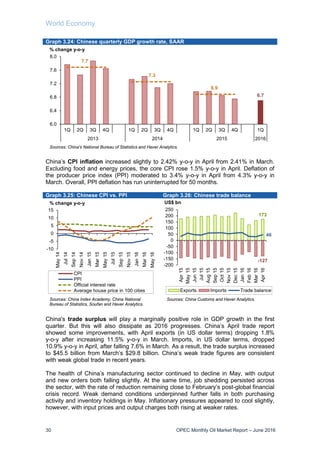
for 30 days commencing 17 September, thus UK production is likely to be lower y-o-y
in 3Q16 despite new startups.
OECD Asia Pacific
The oil production forecast in the OECD Asia Pacific region for 2016 has been revised
down by 10 tb/d this month and it is anticipated to decline by 20 tb/d to average
0.44 mb/d. Oil production in Australia is expected to remain unchanged y-o-y at
0.38 mb/d.
Developing Countries
Total oil production in developing countries (DCs) in 2016 is expected to decline by
0.12 mb/d to average 11.41 mb/d. Predicted supply for 2016 was revised down in this
month’s assessment by 72 tb/d, due to weak output in 1Q16 in different regions, as
1.6
1.7
1.8
1.9
2.0
2.1
1Q 2Q 3Q 4Q
mb/d
2014 2015 (estimate) 2016 (forecast)
Source: OPEC Secretariat.
0.0
0.2
0.4
0.6
0.8
1.0
1.2
1Q 2Q 3Q 4Q
mb/d
2014 2015 (estimate) 2016 (forecast)
Source: OPEC Secretariat.
World Oil Supply
OPEC Monthly Oil Market Report – June 2016 53
well as higher-than-expected declines in Africa and Latin America in 2Q16 and 3Q16.
On a yearly basis, the expected contraction is coming mainly from Africa, Middle East
and Latin America, while minor growth in Other Asia is anticipated.
Other Asia
Other Asia’s oil supply is forecast to reach 2.72 mb/d in 2016. Oil production in India
and Vietnam is expected to decline by 20 tb/d and 10 tb/d, respectively, while oil
production in Malaysia, Thailand and Asia Others is expected to grow by 30 tb/d and
10 tb/d each, respectively.
Latin America
Latin America’s oil supply for 2016 is expected to contract by 0.04 mb/d, revised down
by 27 tb/d compared with the previous month’s prediction due to lower output in 1Q16
and lower-than-expected output in 2Q16 and 3Q16 from Brazil and Colombia. Total
output for Latin America will reach an average of 5.15 mb/d, with growth coming only
from Brazil.
Brazil’s crude and NGLs output in April was higher by around 100 tb/d m-o-m,
according to Petrobras’s monthly report, supported by the return of the P-31 (Albacora)
and P-48 units in the post-salt Campos Basin. Hence, total Brazilian production,
including biofuels, increased to 2.99 mb/d in April. With the return of production in the
Campos Basin, total output increased m-o-m by 0.12 mb/d to 1.47 mb/d, which was
partially offset by reducing pre-salt output to 0.62 mb/d – the lowest level in 10 months
– mainly due to maintenance at the Cidade de Angra dos Reis floating storage and
offloading (FPSO) platform as well as the FPSO Cidade de Paraty. According to
Energy Aspects, in the year-to-April, maintenance reduced production by 5%, but
output should rise in the coming months as the 0.15 mb/d FPSO Cidade de
Saquarema produces first oil in July from the pre-salt layer of the Lula Central project,
followed by the 0.1 mb/d FPSO Cidade de Caraguatatuba from the Lapa project in
3Q16. Nevertheless, growth in 2016 is not expected to be more than 40 tb/d to average
3.11 mb/d, revised down by 20 tb/d from the previous month’s forecast.
Graph 5.15: Brazil quarterly oil supply,
2014-2016
Graph 5.16: Colombia quarterly oil supply,
2014-2016
0.0
0.5
1.0
1.5
2.0
2.5
3.0
3.5
1Q 2Q 3Q 4Q
mb/d
2014 2015 (estimate) 2016 (forecast)
Source: OPEC Secretariat.
0.92
0.94
0.96
0.98
1.00
1.02
1.04
1.06
1Q 2Q 3Q 4Q
mb/d
2014 2015 (estimate) 2016 (forecast)
Source: OPEC Secretariat.
World Oil Supply
54 OPEC Monthly Oil Market Report – June 2016
Colombia’s oil production in 2016 is expected to be negative due to a lack of
appropriate investment and necessary spending. Colombia’s total oil output will
contract by 40 tb/d – revised down by 10 tb/d compared with the previous month’s
forecast – to average 0.99 mb/d. Oil production in 1Q16 declined by 70 tb/d y-o-y to
0.98 mb/d, while oil output in April was steady compared with that of March at
0.94 mb/d.
Middle East
The Middle East’s oil supply has been stagnant during March, April and May 2016 at
1.24 mb/d, with input coming mainly coming from Oman at 0.98 mb/d, Bahrain at
0.23 mb/d, Syria at 30 tb/d and Yemen at 20 tb/d. It is expected that total annual
average production will contract by 40 tb/d to 1.23 mb/d.
Africa
Africa’s oil supply is expected to see a further contraction of 60 tb/d in 2016, revised
down by 29 tb/d to average 2.31 mb/d. The reason for this negative revision is due to
production outages in Ghana. Amid unresolved technical issues at Tullow’s FPSO
vessel in the giant Jubilee oilfield offshore Ghana, production is back online, but output
is less than half of what it should be, while investors have been told they won’t see any
dividends this year. Production resumed on 4 May, but the repair of a turret could take
up to a year, according to the media. Right now, the company is working to ramp up
production to above 30,000 b/d, but this is well under the originally anticipated
100,000 b/d. It was producing 103,000 b/d the previous year.
FSU, other regions
Total FSU oil production forecast averaged 13.76 mb/d in 2016, indicating an upward
revision by 63 tb/d in growth to average 0.06 mb/d y-o-y, compared with the previous
MOMR. This revision came from higher-than-expected output from Russia in 1Q16 and
the expected continuation in production in 2Q16. Moreover, upward revisions for
production from Azerbaijan and Turkmenistan were another reason for anticipated
growth in the FSU. Nevertheless, oil production in 2H16 would be less than in 1H16 by
0.2 mb/d, mainly due to lower expectations for Russian production.
Graph 5.17: FSU quarterly oil supply,
2014-2016
Graph 5.18: Russia quarterly oil supply,
2014-2016
13.2
13.3
13.4
13.5
13.6
13.7
13.8
13.9
14.0
14.1
1Q 2Q 3Q 4Q
mb/d
2014 2015 (estimate) 2016 (forecast)
Source: OPEC Secretariat.
10.3
10.4
10.5
10.6
10.7
10.8
10.9
11.0
11.1
11.2
1Q 2Q 3Q 4Q
mb/d
2014 2015 (estimate) 2016 (forecast)
Source: OPEC Secretariat.
World Oil Supply
OPEC Monthly Oil Market Report – June 2016 55
Russia
Russia’s oil supply in April and May reached 11.06 mb/d and 11.05 mb/d, respectively.
This is a little weaker than in February and March, but still above 11 mb/d, according to
ministry information and estimations for monthly NGLs output. Higher growth in Russia is
due to the new 70 tb/d Yarudeiskoye field startup in December 2015. As mentioned in
the FSU summary, Russian production will drop by 120 tb/d in 2H16 compared with
1H16, mainly due to maintenance, including a 20-day shut-in at ExxonMobil’s Sakhalin 1
project in August. Nevertheless, according to the latest review of the most prolific fields in
Russia and supported by the remarkable growth seen in the first five months of the year,
averaging 11.09 mb/d, higher production by 0.26 mb/d over the same period a year ago
has been maintained. Oil supply in 2016 is expected grow by 0.13 mb/d to average
10.94 mb/d, revised up by 0.12 mb/d.
Caspian
Kazakhstan’s oil production in April declined by 0.11 mb/d to average 1.50 mb/d,
mainly due to summer maintenance at the Karachaganak oil field. A further supply
contraction of 40 tb/d is anticipated for Kazakhstan in 2016, to bring production to
1.56 mb/d.
In Azerbaijan, oil supply declined by 20 tb/d to average 0.87 mb/d in April 2016. An
average oil supply of 0.85 mb/d is expected for 2Q16, 20 tb/d less than in 1Q16.
Average annual output growth was revised up by 20 tb/d, compared with the previous
month, therefore annual output is expected to decline y-o-y by 20 tb/d to reach
0.84 mb/d.
Graph 5.19: Kazakhstan quarterly oil
supply, 2014-2016
Graph 5.20: China quarterly oil supply,
2014-2016
Other Europe’s supply is expected to remain steady, averaging 0.13 mb/d in 2015 as
well as in 2016.
1.45
1.50
1.55
1.60
1.65
1.70
1Q 2Q 3Q 4Q
mb/d
2014 2015 (estimate) 2016 (forecast)
Source: OPEC Secretariat.
4.00
4.05
4.10
4.15
4.20
4.25
4.30
4.35
4.40
1Q 2Q 3Q 4Q
mb/d
2014 2015 (estimate) 2016 (forecast)
Source: OPEC Secretariat.
World Oil Supply
56 OPEC Monthly Oil Market Report – June 2016
China
China’s oil supply is forecast to decline by 0.14 mb/d to average 4.23 mb/d in 2016,
unchanged from the previous MOMR. Crude oil output plummeted to 4.04 mb/d in April,
lower y-o-y by 0.22 mb/d, or 5.2%. Chinese total liquids output in April decreased by
60 tb/d to average 4.13 mb/d, including 90 tb/d of unconventional fuels. Nevertheless,
oil production in 2H16 is expected to be higher by 60 tb/d than in 1H16.
OPEC NGLs and non-conventional oils
OPEC NGLs and non-conventional liquids production in 2015 grew by 0.13 mb/d, and
averaged 6.13 mb/d, based on OPEC MCs direct communication. In 2016, OPEC
NGLs and non-conventional liquids are projected to average 6.29 mb/d, to reach
0.16 mb/d, y-o-y.
Table 5.4: OPEC NGLs + non-conventional oils, 2013-2016
Change Change Change
2013 2014 14/13 1Q15 2Q15 3Q15 4Q15 2015 15/14 2016 16/15
Total OPEC 5.82 6.00 0.17 5.97 6.15 6.23 6.17 6.13 0.13 6.29 0.16
Source: OPEC Secretariat.
World Oil Supply
OPEC Monthly Oil Market Report – June 2016 57
OPEC crude oil production
According to secondary sources, total OPEC crude oil production in May averaged
32.36 mb/d, a decrease of 100 tb/d over the previous month. Crude oil output
increased mostly from Kuwait, IR Iran and Saudi Arabia, while production decreased in
Nigeria, Venezuela and Iraq.
Table 5.5: OPEC crude oil production based on secondary sources, tb/d
Table 5.6: OPEC crude oil production based on direct communication, tb/d
2014 2015 3Q15 4Q15 1Q16 Mar 16 Apr 16 May 16 May/Apr
Algeria 1,123 1,106 1,110 1,110 1,093 1,092 1,087 1,080 -7.1
Angola 1,654 1,754 1,763 1,780 1,760 1,797 1,790 1,773 -16.8
Ecuador 544 546 541 545 548 554 546 549 3.9
Indonesia 696 695 696 707 720 726 730 740 10.4
Iran, I.R. 2,778 2,840 2,861 2,874 3,093 3,236 3,473 3,562 89.2
Iraq 3,267 3,933 4,154 4,232 4,242 4,179 4,342 4,281 -60.1
Kuwait 2,781 2,730 2,717 2,720 2,765 2,768 2,647 2,740 93.3
Libya 470 405 382 401 370 338 348 296 -52.0
Nigeria 1,953 1,867 1,861 1,885 1,792 1,761 1,675 1,424 -251.4
Qatar 714 667 655 669 667 672 658 659 1.9
Saudi Arabia 9,688 10,123 10,263 10,122 10,147 10,146 10,157 10,241 84.0
UAE 2,759 2,856 2,878 2,881 2,807 2,724 2,753 2,826 73.9
Venezuela 2,361 2,357 2,357 2,354 2,309 2,286 2,257 2,188 -69.0
Total OPEC 30,788 31,879 32,238 32,280 32,314 32,275 32,461 32,361 -99.8
Note: Totals may not add up due to independent rounding.
Source: OPEC Secretariat.
2014 2015 3Q15 4Q15 1Q16 Mar 16 Apr 16 May 16 May/Apr
Algeria 1,193 1,157 1,159 1,179 1,128 1,137 1,141 1,133 -8.0
Angola 1,654 1,767 1,777 1,742 1,773 1,782 1,733 1,707 -26.0
Ecuador 557 543 538 536 548 552 555 556 0.5
Indonesia 697 690 695 693 739 747 726 737 11.6
Iran, I.R. 3,117 3,152 3,170 3,313 3,385 3,400 3,500 3,600 100.0
Iraq 3,110 3,504 3,744 3,846 4,598 4,553 4,521 4,499 -22.0
Kuwait 2,867 2,859 2,870 2,876 3,000 3,000 2,900 2,950 50.0
Libya 480 .. .. .. .. .. .. .. ..
Nigeria 1,807 1,748 1,790 1,778 1,667 1,505 1,570 1,506 -64.5
Qatar 709 656 640 651 675 699 625 671 45.7
Saudi Arabia 9,713 10,193 10,285 10,202 10,225 10,224 10,262 10,270 8.4
UAE 2,794 2,989 3,030 2,999 2,944 2,909 2,827 3,107 280.0
Venezuela 2,683 2,654 2,631 2,587 2,515 2,515 2,490 2,370 -120.3
Total OPEC 31,380 .. .. .. .. .. .. .. ..
Note: Totals may not add up due to independent rounding.
.. Not available.
Source: OPEC Secretariat.
World Oil Supply
58 OPEC Monthly Oil Market Report – June 2016
World oil supply
Preliminary data indicates that the global oil supply decreased by 0.73 mb/d in May
compared with the previous month, to average 94.51 mb/d. Non-OPEC supply
decreased by 0.63 mb/d, while OPEC production decreased by 0.10 mb/d. The share
of OPEC crude oil in total global production increased to 34.2% in May compared with
the previous month. Estimates are based on preliminary data from direct
communications for non-OPEC supply, OPEC NGLs and non-conventional oil, while
estimates for OPEC crude production are based on secondary sources.
Graph 5.21: OPEC and world oil supply
90
91
92
93
94
95
96
97
26
27
28
29
30
31
32
33
Jun14
Jul14
Aug14
Sep14
Oct14
Nov14
Dec14
Jan15
Feb15
Mar15
Apr15
May15
Jun15
Jul15
Aug15
Sep15
Oct15
Nov15
Dec15
Jan16
Feb16
Mar16
Apr16
May16
mb/dmb/d
OPEC crude production (LHS) World supply (RHS)
Source: OPEC Secretariat.
Product Markets and Refinery Operations
OPEC Monthly Oil Market Report – June 2016 59
Product Markets and Refinery Operations
A high level of light and middle distillate inventories, along with the approaching
end of the spring maintenance season, offset the potential impact of refinery
outages seen in Canada and France, causing margins to slightly fall in the
Atlantic Basin, despite stronger gasoline demand in the region. Meanwhile,
refinery margins in Asia showed a slight recovery on the back of stronger
regional demand amid the peaking of refinery maintenance.
Graph 6.1: Refinery margins, 2015-2016
US product markets continued to be supported by stronger domestic gasoline demand,
which continued rising during May, hitting levels not seen since 2007. However, despite
the higher demand, gasoline crack spreads were under supply pressure due to higher
imports, along with the re-start of several gasoline/producer units. Meanwhile, the
temporary tightening sentiment caused by Canadian crude supply disruptions was
offset by increasing refinery runs, with several refineries returning from maintenance.
US Gulf Coast (USGC) refinery margins for WTI crude dropped by around $1/b versus
the previous month’s levels to average around $7.5/b in May.
Product markets in Europe showed a mixed performance during May as the middle of
the barrel exhibited some recovery, supported by stronger regional demand, while the
gasoline crack spread weakened. This mixed performance, along with higher product
inventories, offset the potential impact of French refinery outages, causing refinery
margins to slightly fall in Europe. The refinery margin for Brent crude in Northwest
Europe (NWE) showed a loss of 50¢ versus the previous month, to average $6.3/b in
May.
Asian product markets strengthened slightly in May, supported by stronger regional
demand amid a peak in refinery maintenance in the region. Refinery margins in
Singapore recovered slightly by 20¢ to average $7.6/b in May. The uptick in margins
was limited by pressure exerted from the oversupply environment.
0
5
10
15
20
0
5
10
15
20
May15
Jun15
Jul15
Aug15
Sep15
Oct15
Nov15
Dec15
Jan16
Feb16
Mar16
Apr16
May16
US$/bUS$/b
WTI (US Gulf) Brent (Rotterdam) Oman (Singapore)
Sources: Argus Media and OPEC Secretariat.
Product Markets and Refinery Operations
60 OPEC Monthly Oil Market Report – June 2016
Refinery operations
Refinery utilization rates have been ramped up worldwide, with spring maintenance
approaching an end. In Asia, throughput levels continued at near-record levels in
China, South Korea and India. Meanwhile, in the Atlantic Basin, several refineries were
impacted by events in France and Canada.
Refinery utilization in the US averaged around 91% in May, corresponding to
16.3 mb/d, which was 200 tb/d higher than a month earlier. Refineries were running at
maximum levels in the USGC, with several refineries back from maintenance, thus
compensating for lower levels in other areas possibly impacted by a shortage of
Canadian crudes, which also affected refinery levels in Canada.
Graph 6.2: Refinery utilisation rates, 2015-2016
European refinery runs averaged around 83% of capacity in May, corresponding to a
throughput of 9.8 mb/d, 240 tb/d lower than in the previous month and around 460 tb/d
lower than the same month a year ago. European refinery throughputs continued to be
impacted by some maintenance and in addition, in May, were impacted by the French
strike, which affected operations in several refineries, ports and gas stations in the
country. This caused refinery utilization in France to drop to 60%.
In Asia, refinery utilization has continued to rise, mainly in South Korea, India and
China, where Chinese teapot refineries contributed to continuing record-high levels,
hitting around 10.9 mb/d in April. Indian refinery runs hit 4.9 mb/d during recent
months, responding to strong demand growth in the country. Refinery runs in
Singapore for April averaged around 72%. Meanwhile, Japanese throughputs averaged
81% of capacity in May, 5 pp lower than the previous month as some maintenance
continued in the country.
US market
US gasoline demand stood at around 9.6 mb/d in May, approximately 190 tb/d higher
than in the previous month and more than 400 tb/d higher than in the same month a
year earlier. Stronger domestic gasoline demand has been supporting the gasoline
market. However, the crack spreads were under pressure due to higher imports, along
with the re-start of several gasoline/producer units. The temporary tightening sentiment
caused by crude supply disruptions due to the wildfires in Canada has been offset by
increasing refinery runs, with several refineries returning from maintenance.
60
70
80
90
100
60
70
80
90
100
May15
Jun15
Jul15
Aug15
Sep15
Oct15
Nov15
Dec15
Jan16
Feb16
Mar16
Apr16
May16
%%
US EU-16 Japan Singapore
Sources: Argus Media and OPEC Secretariat.
Product Markets and Refinery Operations
OPEC Monthly Oil Market Report – June 2016 61
The gasoline crack spread lost more than $2 versus the previous month’s level to
average $22/b in May.
Graph 6.3: US Gulf crack spread vs. WTI, 2015-2016
Middle distillate demand stood at around 4.1 mb/d in May, some 20 tb/d higher than
in the previous month and around 270 tb/d higher than in the same month a year
earlier. The middle distillate market has exhibited weak fundamentals in the last years.
However, during May it showed some signs of recovery. Some support has come from
stronger domestic demand, which has picked up since the middle of April. Another
supporting factor has been increasing exports to Latin America, mainly Argentina. This
has allowed inventories to continue falling, despite the increase seen in refinery runs.
In the futures market, heating oil Nymex positions reached net-long territory, something
which has not been seen since mid-2014. The US Gulf Coast (USGC) gasoil crack
averaged around $6/b in May, gaining around $2 from the previous month. The uptick
has been somehow limited by the pressure exerted by persistently high gasoil
availability in the Atlantic Basin, as reflected in recent weeks, with almost no impact
seen on the middle distillate market due to the French strikes.
At the bottom of the barrel, the fuel oil market recovered some ground, supported by
strong bunker demand in the USGC during the last several weeks, amid increasing
requirements from Mexico. The USGC high-sulphur fuel oil crack gained almost $1 to
average around minus $16/b in May.
European market
Product markets in Europe showed a mixed performance during May as the middle of
the barrel exhibited a recovery on the back of stronger regional demand, while the
gasoline crack spread weakened despite some export opportunities. Higher product
inventories offset the potential impact of the French refinery outages, causing refinery
margins to fall slightly in Europe.
The gasoline market partially retained the recovery seen in April, on the back of higher
export opportunities, driven by persistently strong demand in the US. This has allowed
for hefty transatlantic outflows to satisfy the increasing gasoline imports from the US
East Coast (USEC). However the gasoline cracks lost some ground last month as the
market was under pressure from additional volumes coming out of storage, increasing
availability, in addition to the approaching end of the maintenance season in the region.
Another bearish factor has been lower exports to West Africa. The gasoline crack
-20
0
20
40
60
-20
0
20
40
60
May15
Jun15
Jul15
Aug15
Sep15
Oct15
Nov15
Dec15
Jan16
Feb16
Mar16
Apr16
May16
Jun16
US$/bUS$/b
Premium gasoline Jet/Kerosene Diesel Fuel oil
Sources: Argus Media and OPEC Secretariat.
Product Markets and Refinery Operations
62 OPEC Monthly Oil Market Report – June 2016
spread against Brent saw a drop of $2 from the previous month, to average around
$23/b in May.
The light-distillate naphtha crack weakened as domestic demand has been falling due
to the French petrochemical producers being impacted by the labour strikes. Additional
pressure has come from higher inventories amid lower arbitrage opportunities to Asia.
Graph 6.4: Rotterdam crack spreads vs. Brent, 2015-2016
The European gasoil market showed a recovery during May on the back of support
coming from strong domestic demand reported from several countries, mainly Italy and
Spain, along with higher requirements from Egypt and Algeria. Additional support came
from the supply side with some slow-down seen in imports from the Middle East, thus
contributing to the easing of the oversupply by offsetting the continued higher imports
from India and Russia. The gasoil crack spread against Brent crude at Rotterdam
averaged around $10/b in May, gaining around $2 versus the previous month’s level.
The potential additional gains in the crack spreads, due to the tightening sentiment
fuelled by the strike at French ports and refineries, were capped by floating storage
outside several European ports and high ARA inventories.
At the bottom of the barrel, the fuel oil market continued under pressure due to a lack
of arbitrage opportunities to Singapore as inventories remain high in that region. On the
other hand, the expected increase in Baltic exports following the end of the Russian
refinery maintenance season has also been exerting some pressure. The NWE Europe
fuel oil crack lost 50¢ versus the previous month to average around minus $14/b in
May, hitting the lowest level seen this year.
-20
-10
0
10
20
30
40
-20
-10
0
10
20
30
40
May15
Jun15
Jul15
Aug15
Sep15
Oct15
Nov15
Dec15
Jan16
Feb16
Mar16
Apr16
May16
Jun16
US$/bUS$/b
Premium gasoline Jet/Kerosene Gasoil Fuel oil
Sources: Argus Media and OPEC Secretariat.
Product Markets and Refinery Operations
OPEC Monthly Oil Market Report – June 2016 63
Impact of French refinery strike
A strike against proposed labour reforms disrupted France’s refining sector starting in
the latter part of May. Some 40% of petrol stations in the Paris region were reporting
shortages, fuel depots were being blockaded by oil workers, and the country’s refinery
activity was significantly disrupted, with four refineries completely shut down and a fifth
forced to cut throughputs by around 25%, for a combined impact of more than 0.8 mb/d
in refinery capacity during the affected period representing more than half of the
country’s total capacity.
In response, the French government released its strategic fuel stocks for the first time
in six years. By 25 May, the country’s Transport Secretary said the government had
used three days’ worth of reserves to supply the petrol stations that had been affected
and stated that the government had sufficient strategic reserves to last 115 days. Some
of the shortages were attributed to panic buying, as fuel consumption was roughly
three times normal levels.
Table 6.1: Distillation capacity in France and the impact
The disruptions contributed to a sharp fall in refinery utilization rates in France in May,
which dropped to 62% for the first time since December 2013, after reaching a high so
far this year of 85% the month before. Despite this disruption, existing high inventories
of light and middle distillates in the region, along with the government’s release of
strategic product stocks, were sufficient to prevent a spike in refining margins.
According to the latest Euroilstock data, middle distillate inventories in the EU-16 fell
less than 1% in May m-o-m, while gasoline stocks ended higher, keeping both around
10% above the same month a year ago.
The strike appeared be winding down by the second week of June, with Total reporting
that it was restarting its Donges, Gonfreville, Feyzin, and Grandpuits refineries, and
returning La Mède to full operations. However, some striking workers were blocking the
full restart of operations at Donges, Gonfreville, and Feyzin.
The situation in the country’s oil ports may take longer to normalize as strikes continue
to disrupt the country’s oil terminals. All discharges have been halted at the southern oil
terminal of Fos-Lavera as well as at the northern terminal of Le Havre since 23 May
and union workers recently voted to extend the shutdown until 14 June.
Refinery Operator Capacity,
tb/d
Impact
Normandy, Gonfreville Total 247 Full disruption
Donges Total 219 Full disruption
Provence, La Mède Total 153 Reduced runs by 25%
Feyzin Total 117 Full disruption
Grandpuits Total 101 Full disruption
Source: Total and Thomson Reuters.
Product Markets and Refinery Operations
64 OPEC Monthly Oil Market Report – June 2016
Asian market
The Asian market strengthened slightly in May, supported by stronger regional demand
amid the peaking of the refinery maintenance season in the region. The uptick in the
margins was limited by the pressure exerted by the oversupply environment.
Despite the heavy maintenance season, the gasoline market continued weak,
pressured by ample supply in the region, with volumes in floating storage continuing to
keep the market under pressure. Higher exports reported from northeast Asian
refineries – mainly from Japan and the Shandong province of China – have been
outweighing the higher regional demand being reported from India, Pakistan and
Indonesia. The gasoline crack spread against Oman crude in Singapore averaged
$12/b in May, losing 40¢ versus the previous month’s level. Losses were capped by
expectations that increasing seasonal demand amid heavy maintenance could tighten
the market in the coming weeks.
The Singapore naphtha crack continued its downward trend, losing around $3/b over
the month due to demand being impacted by the heavy petrochemical steam cracker
maintenance. The LPG discount to naphtha has encouraged switching to LPG
feedstock, which has also pressured the market.
Graph 6.5: Singapore crack spread vs. Oman, 2015-2016
At the middle of the barrel, the gasoil crack spread continued relatively steady, getting
support from lower supplies seen from India due to heavy maintenance amid strong
demand. This has allowed the gasoil crack spread to hit its highest value seen this
year. Demand in the region remained strong in several countries, mainly India,
Vietnam, Indonesia and Pakistan, while some arbitrage opportunities to West Africa
and Europe also supported the gasoil market in the region.
The gasoil crack spread in Singapore against Oman averaged around $12/b in May,
gaining around $2 versus the previous month’s level. Although the drought suffered by
several countries has been a supportive factor, additional gains were capped by
concerns about potential downturn in demand with the upcoming monsoon season in
the region.
The Asian fuel oil market was relatively stable during May as strong demand reported
from South Korea and Pakistan offset the pressure coming from high inventories in
Singapore and lower Chinese fuel oil demand. The fuel oil crack spread in Singapore
-20
-10
0
10
20
30
-20
-10
0
10
20
30
May15
Jun15
Jul15
Aug15
Sep15
Oct15
Nov15
Dec15
Jan16
Feb16
Mar16
Apr16
May16
Jun16
US$/bUS$/b
Premium gasoline Jet/Kerosene Gasoil Fuel oil
Sources: Argus Media and OPEC Secretariat.
Product Markets and Refinery Operations
OPEC Monthly Oil Market Report – June 2016 65
against Oman averaged about minus $10/b in May, unchanged from the previous
month.
Table 6.2: Refinery operations in selected OECD countries
Table 6.3: Refined product prices, US$/b
Change
Apr 16 May 16 May/Apr 2015 2016
Naphtha* 43.96 48.45 4.49 65.59 40.90
Premium gasoline (unleaded 93) 65.83 68.73 2.90 80.25 58.21
Regular gasoline (unleaded 87) 59.30 62.63 3.33 71.15 51.33
Jet/Kerosene 48.07 54.89 6.82 71.49 45.81
Gasoil (0.2% S) 45.60 52.79 7.19 71.32 42.70
Fuel oil (3.0% S) 26.15 31.98 5.83 46.78 24.33
Naphtha 41.69 44.28 2.59 54.68 38.39
Premium gasoline (unleaded 98) 66.41 69.51 3.10 76.63 58.73
Jet/Kerosene 50.30 56.15 5.85 73.39 46.91
Gasoil/Diesel (10 ppm) 49.57 56.67 7.10 72.68 46.38
Fuel oil (1.0% S) 27.82 32.52 4.70 46.27 25.29
Fuel oil (3.5% S) 23.66 29.28 5.62 46.94 21.45
Naphtha 40.39 43.51 3.12 51.56 37.21
Premium gasoline** 58.04 61.12 3.08 71.87 51.37
Jet/Kerosene 48.01 54.44 6.43 70.39 45.11
Diesel 50.56 57.91 7.35 74.20 47.62
Fuel oil (1.0% S) 28.01 33.72 5.71 48.32 26.02
Fuel oil (3.5% S) 26.30 31.91 5.61 46.64 24.23
Naphtha 42.52 44.20 1.68 56.32 39.33
Premium gasoline (unleaded 95) 54.49 59.14 4.65 72.20 52.19
Regular gasoline (unleaded 92) 51.45 56.00 4.55 69.25 49.07
Jet/Kerosene 49.51 55.18 5.67 71.34 46.20
Gasoil/Diesel (50 ppm) 49.33 55.95 6.62 72.30 45.81
Fuel oil (180 cst 2.0% S) 31.02 35.80 4.78 53.31 29.54
Fuel oil (380 cst 3.5% S) 29.17 34.03 4.86 50.98 27.26
Sources: Argus Media and OPEC Secretariat.
Year-to-date
Note: * Barges.
** Cost, insurance and freight (CIF).
US Gulf (Cargoes FOB):
Rotterdam (Barges FoB):
Mediterranean (Cargoes FOB):
Singapore (Cargoes FOB):
Change Change
Mar 16 Apr 16 May 16 May/Apr Mar 16 Apr 16 May 16 May/Apr
US 15.99 16.06 16.26 0.20 89.21 89.61 90.71 1.10
France 1.12 1.19 0.87 -0.32 79.59 84.78 61.95 -22.83
Germany 1.86 1.76 1.71 -0.06 85.01 80.62 78.02 -2.61
Italy 1.24 1.38 1.30 -0.08 60.41 67.20 63.29 -3.91
UK 0.94 1.05 1.08 0.04 67.19 74.61 77.25 2.64
Euro-16 10.17 10.07 9.83 -0.24 85.81 84.97 82.94 -2.03
Japan 3.46 3.38 3.16 -0.22 88.39 86.25 80.76 -5.49
Sources: Argus Media, EIA, Euroilstock, IEA, METI, OPEC Secretariat and Petroleum Association of Japan.
Note: Data has been revised from January 2016 according to the latest capacity update.
Refinery throughput, mb/d Refinery utilization, %
Tanker Market
66 OPEC Monthly Oil Market Report – June 2016
Tanker Market
Dirty tanker market sentiment weakened in May as average spot freight rates
dropped on most reported routes. On average, dirty tanker freight rates dropped
by 4% from the previous month, mainly on the back of lower rates registered for
VLCC and Suezmax, which dropped by 7% and 15%, respectively. Freight rates
declined on all reported routes from the previous year and month. However,
Aframax spot freight rates saw bright spots, rising by around 6% on average as a
result of an active market and premiums paid mainly in the Mediterranean.
Clean spot freight rates showed a mixed performance in May, dropping on
average. They were mainly affected by lower rates in West of Suez, while those in
East of Suez remained mostly flat from the month before.
Spot fixtures
Preliminary data for May shows that OPEC spot fixtures dropped by 3.6%, compared
with the previous month, to average 11.49 mb/d. Global spot fixtures declined as well
by 2.4% in May, compared with the previous month, to average 16.6 mb/d. Fixtures on
the Middle East-to-East route were down by 2.2% and on the Middle East-to-West
routes by 0.5 mb/d. In general, global chartering activity showed a drop of 12.6% from
the same month one year earlier on reported destinations.
Table 7.1: Tanker chartering, sailings and arrivals, mb/d
Sailings and arrivals
OPEC sailings dropped by 0.28 mb/d, or 1.2%, in May from a month ago while
remaining up by 0.17 mb/d from a year before. Sailings from the Middle East dropped
from the previous month by 0.29 mb/d and from one year earlier by 0.06 mb/d.
According to preliminary data, arrivals at main importing regions in North American and
West Asian ports showed an increase from a month earlier, rising by 0.4%, and 2.8%,
respectively, from the previous month. In contrast, vessel arrivals in the Far East and
Europe declined from a month earlier by 0.3% and 0.4%, respectively.
Change
Mar 16 Apr 16 May 16 May 16/Apr 16
Spot Chartering
All areas 17.68 17.01 16.60 -0.41
OPEC 12.19 11.92 11.49 -0.43
Middle East/East 5.22 5.44 5.32 -0.12
Middle East/West 3.23 3.19 2.68 -0.50
Outside Middle East 3.74 3.29 3.49 0.20
Sailings
OPEC 24.08 24.27 23.99 -0.28
Middle East 17.50 17.67 17.38 -0.29
Arrivals
North America 10.00 9.95 9.99 0.04
Europe 12.57 12.51 12.46 -0.05
Far East 8.52 8.46 8.43 -0.03
West Asia 4.62 4.70 4.83 0.13
Source: Oil Movements.
Tanker Market
OPEC Monthly Oil Market Report – June 2016 67
Spot freight rates
VLCC
VLCC freight rates dropped on average in May from the month before, down by 7%
from April, to stand at WS73 points. Increased activity at the beginning of the month
was seen to support VLCC freight rates, mainly in the Middle East and West Africa,
despite high vessel supply at that point. Spot freight rates further improved when June
requirements came onto the market.
However, rates edged down to reverse previous gains as sluggish demand in the
Middle East and West Africa combined with reduced delays in Asian ports to support
the expansion of available vessels on the tonnage list. Thus, Middle East-to-East
freight rates dropped by 3%, to stand at WS63 points. West Africa-to-East freight rates
followed the same pattern, though reflecting a higher drop of 12%, to stand at WS38
points. Freight rates for tankers operating on the Middle East-to-West route also
dropped by 8% from one month before.
Graph 7.1: Monthly averages of crude oil spot freight rates
Suezmax
As seen in the VLCC sector, Suezmax spot freight rates also underwent negative
development in May. At the beginning of the month, rates for Suezmax were weak due
to holidays and low activity, generally. Increased activity was only later able to stabilize
rates and prevent further drops.
In West Africa, spot freight rates for tankers operating on the West Africa-to-US Gulf
Coast route dropped by 21% to stand at WS63 points. Spot freight rates for tankers
operating on the Northwest Europe (NWE)-to-US Gulf Coast (USGC) route dropped by
8% to average WS63 points. Suezmax rates on both routes showed a higher decline,
compared with freight rates registered on the same routes the previous year.
20
40
60
80
100
120
140
20
40
60
80
100
120
140
May15
Jun15
Jul15
Aug15
Sep15
Oct15
Nov15
Dec15
Jan16
Feb16
Mar16
Apr16
May16
WorldscaleWorldscale
Mediterranean/Northwest Europe (Aframax) West Africa/USGC (Suezmax)
Middle East/Far East (VLCC)
Sources: Argus and Platts.
Tanker Market
68 OPEC Monthly Oil Market Report – June 2016
Table 7.2: Spot tanker crude freight rates, Worldscale
Aframax
In May, Aframax was the only vessel size in the dirty tanker segment, which showed
enhanced rates, on average, from a month before. Aframax freight rates increased by
6%, as a result of mixed performance for the class, supported by increased rates for
tankers trading in both directions of the Mediterranean.
The markets in the North Sea and Mediterranean were balanced at the beginning of
the month before some replacement deals were fixed at high premiums. A lighter
tonnage list in the Mediterranean, combined with a sudden shortage of vessels, pushed
rates up in that region. Freight rates for tankers operating on the Mediterranean-to-
Mediterranean and Mediterranean-to-NWE routes edged up by 25% and 34% to
average WS116 and WS109 points, respectively, making Suezmax a viable alternative
to Aframax at a certain point, due to its falling rates and weak market.
Spot freight rates went down on the Caribbean-to-US East Coast (USEC) route by 4%
from the previous month, despite owners’ consistent resistance to lower rates, as
tonnage supply outweighed chartering requirements.
Aframax freight rates to eastern destinations were not an exception, dropping by 18%
for tankers trading on the Indonesia-to-East route to average WS91 points.
Clean spot freight rates
Clean tanker market sentiment was weak in May. On average, clean spot tanker freight
rates dropped by 11% from the month before to stand at WS125 points.
In the West of Suez, freight rates experienced a large drop on average. Tonnage in the
West was affected by the holidays and slow movement in the market. Among the main
drivers behind freight rate drops in the West was lower freight rates in the
Mediterranean, where they dropped by 23% and 22%, respectively, on the
Mediterranean-to-Mediterranean and Mediterranean-to-NWE routes. Nevertheless,
rates for medium-range tankers operating on the NWE-to-US East Coast went up by
7% to average WS119 points as the market was balanced, showing a multi-month
high, though the increase remained limited.
Size Change
1,000 DWT Mar 16 Apr 16 May 16 May 16/Apr 16
Crude
Middle East/East 230-280 73 65 63 -2
Middle East/West 270-285 41 43 38 -5
West Africa/East 260 72 67 62 -6
West Africa/US Gulf Coast 130-135 70 79 63 -17
Northwest Europe/US Gulf Coast 130-135 63 69 63 -6
Indonesia/East 80-85 147 111 91 -20
Caribbean/US East Coast 80-85 115 109 104 -5
Mediterranean/Mediterranean 80-85 106 87 109 22
Mediterranean/Northwest Europe 80-85 98 80 108 28
Sources: Argus Media and OPEC Secretariat.
Tanker Market
OPEC Monthly Oil Market Report – June 2016 69
Graph 7.2: Monthly average of clean spot freight rates
Similarly, East of Suez average clean spot freight rates dropped by a slight WS1 point
on average, as lower rates were registered for tankers trading on the Singapore-to-
East route, where a drop of WS3 points was seen in May to average WS132 points.
A slight improvement was achieved by tankers operating on the Middle East-to-East
route, which increased by 2% from a month before.
Table 7.3: Spot tanker product freight rates, Worldscale
50
100
150
200
250
50
100
150
200
250
May15
Jun15
Jul15
Aug15
Sep15
Oct15
Nov15
Dec15
Jan16
Feb16
Mar16
Apr16
May16
WorldscaleWorldscale
Middle East/Far East Northwest Europe/USEC Mediterranean/Mediterranean
Sources: Argus Media and OPEC Secretariat.
Size Change
1,000 DWT Mar 16 Apr 16 May 16 May 16/Apr 16
Products
Middle East/East 30-35 116 100 102 2
Singapore/East 30-35 140 135 132 -4
Northwest Europe/US East Coast 33-37 100 111 119 8
Mediterranean/Mediterranean 30-35 127 172 132 -40
Mediterranean/Northwest Europe 30-35 136 182 142 -40
Sources: Argus Media and OPEC Secretariat.
Oil Trade
70 OPEC Monthly Oil Market Report – June 2016
Oil Trade
Preliminary data shows that US crude oil imports in May declined by 189 tb/d
from the previous month, to average 7.6 mb/d on an annual basis. Meanwhile, US
crude imports dropped by 375 tb/d from a year earlier. US products imports
declined by 68 tb/d, or 3.2%, to average 2.2 mb/d m-o-m, while on a y-o-y basis,
they remained at last year’s level.
Japan’s crude oil imports dropped in April by 93 tb/d, or 3%, to average 3.5 mb/d.
On an annual basis, crude imports were 115 tb/d, or 3%, higher in April. Japan’s
products imports went up in April by 47 tb/d, to average 524 tb/d.
Meanwhile China’s crude oil imports increased from the previous month by
249 tb/d, or 3%, maintaining a high level and averaging 7.95 mb/d. On an annual
comparison, China’s crude imports were up by 559 tb/d or 8%. As to China’s
product imports, they increased slightly in April by 19 tb/d from the previous
month and by 215 tb/d from a year earlier, to average 1.4 mb/d.
In April, India’s crude imports stayed at high levels, averaging 4.4 mb/d, which is
almost stable from the level seen last month. On an annual basis, this reflects a
big gain from last year and is 592 tb/d, or 16%, higher. India’s product imports
increased by 209 tb/d, or 32%, from a month ago to average 850 tb/d. On a y-o-y
basis, this reflects a gain of 293 tb/d or 52%.
US
Preliminary data shows that US crude oil imports in May declined by 189 tb/d from
the previous month to average 7.6 mb/d. On an annual basis, US crude imports
dropped by 375 tb/d from a year earlier.
Graph 8.1: US imports of crude and petroleum products
US product imports declined by 68 tb/d, or 3.2%, to average 2.2 mb/d m-o-m, while
on a y-o-y basis, they remained at last year’s level. On a year-to-date comparison,
crude imports were 554 tb/d higher, while product imports dropped by 37 tb/d. As to
product exports in May, they fell by 703 tb/d, or 16%, to average 3.6 mb/d from the
previous year.
4.5
5.5
6.5
7.5
8.5
0.0
0.5
1.0
1.5
2.0
2.5
May15
Jun15
Jul15
Aug15
Sep15
Oct15
Nov15
Dec15
Jan16
Feb16
Mar16
Apr16
May16 mb/dmb/d
Others* Propane/propylene Gasoline
Jet fuel/kerosene Fuel oil Crude (RHS)
Note: *Others: Contains natural gas liquids, liquefied refinery gases (LRG's), other liquids and all finished petroleum
products except gasoline, jet fuel/kerosene, fuel oil and propane/propylene.
Sources: US Energy Information Administration and OPEC Secretatiat.
Oil Trade
OPEC Monthly Oil Market Report – June 2016 71
As a result, total US net imports dropped in May to average 5.8 mb/d, down by
166 tb/d from the previous month. However, this was up by 1.2 mb/d from last year’s
level.
Graph 8.2: US exports of crude and petroleum products
In March, Canada remained top crude supplier, accounting for 41% of total US crude
imports, though Canadian exports to the US in March were down by 258 tb/d from a
month before. Saudi Arabia came in as the second supplier to the US, maintaining a
share of 16% of total crude imports, while Venezuela came in as the third largest
supplier to the US, accounting for 10% of total US crude imports. Imports from both
Saudi Arabia and Venezuela increased from a month before by 257 tb/d and 47 tb/d,
respectively.
Crude imports from OPEC Member Countries increased in March by 310 tb/d, or
11%, over the previous month. Imports from OPEC Member Countries accounted for
41% of total US crude imports. As to US product imports from OPEC Member
Countries, these increased from a month earlier to stand at 55 tb/d, maintaining a
share of 16% of total products imported by the US. This was 135 tb/d higher than the
same month last year. As to the product supplier share, Canada and Russia
maintained their positions as first and second supplier, respectively, to the US holding
a share of 30% and 16%. Algeria came in as the third biggest product supplier to the
US with an average import level of 128 tb/d.
As to the US crude imports by region, in March imports from North America averaged
3.3 mb/d. North America came in as the top region for US crude imports, followed by
Latin America, which stood at 2.8 mb/d in March. The Middle East came in as the third
largest exporter to the US, with an average of 1.7 mb/d. Imports from Africa, Asia and
the FSU all dropped from a month before.
Table 8.1: US crude and product net imports, tb/d
0
100
200
300
400
500
600
0
1,000
2,000
3,000
4,000
5,000
6,000
May15
Jun15
Jul15
Aug15
Sep15
Oct15
Nov15
Dec15
Jan16
Feb16
Mar16
Apr16
May16
tb/dtb/d
Others* Propane/propylene Gasoline
Jet fuel/kerosene Fuel oil Crude (RHS)
Note: *Others: Contains natural gas liquids, liquefied refinery gases (LRG's), other liquids and all finished petroleum
products except gasoline, jet fuel/kerosene, fuel oil and propane/propylene.
Sources: US Energy Information Administration and OPEC Secretatiat.
Change
Mar 16 Apr 16 May 16 May 16/Apr 16
Crude oil 7,534 7,444 7,205 -240
Total products -2,534 -1,497 -1,423 74
Total crude and products 5,000 5,947 5,781 -166
Sources: US Energy Information Administration and OPEC Secretatiat.
Oil Trade
72 OPEC Monthly Oil Market Report – June 2016
Japan
Japan’s crude oil imports dropped in April by 93 tb/d, or 3%, to average 3.5 mb/d. On
an annual basis, crude imports were higher in April by 115 tb/d or 3%. Also, Japanese
refinery throughput dropped from the previous month.
As to the suppliers’ share, Saudi Arabia maintained their position as the largest crude
supplier to Japan, maintaining a 41% share of total crude imports with an increase in
volumes from the previous month by 222 tb/d. The UAE came in as the second largest
supplier to Japan with a share of 19% of total crude imports, although Japan’s imports
from the UAE decreased by 265 tb/d in April m-o-m. Qatar came in third place holding a
share of 10%. Japan’s imports from Qatar were up by 35 tb/d from the previous month.
Japan’s product imports went up in April by 47 tb/d to average 524 tb/d. At the same
time, Japan’s domestic product sales fell by 3.9% from last year.
Graph 8.3: Japan’s imports of crude and petroleum products
As to product exports, Japan’s exports in April were down from the previous month by
73 tb/d, to average 550 tb/d. Accordingly, Japan’s net imports increased by 27 tb/d in
April to average 3.4 mb/d, reflecting lower monthly and annual imports.
Graph 8.4: Japan’s exports of petroleum products
0
1
2
3
4
5
0
200
400
600
800
1,000
1,200
Apr15
May15
Jun15
Jul15
Aug15
Sep15
Oct15
Nov15
Dec15
Jan16
Feb16
Mar16
Apr16
mb/dtb/d
Others* LPG Naphtha Fuel oil Crude oil
Note: *Others: Contains gasoline, jet fuel, kerosene, gasoil, asphalt and paraffin wax.
Sources: Ministry of Economy, Trade and Industry of Japan and OPEC Secretariat.
0
100
200
300
400
500
600
700
0
100
200
300
400
500
600
700
Apr15
May15
Jun15
Jul15
Aug15
Sep15
Oct15
Nov15
Dec15
Jan16
Feb16
Mar16
Apr16
tb/dtb/d
Fuel oil Gasoil Jet fuel Others*
*Others: Contains LPG, gasoline, naphtha, kerosene, lubricating oil, asphalt and paraffin wax.
Sources: Ministry of Economy, Trade and Industry of Japan and OPEC Secretariat.
Oil Trade
OPEC Monthly Oil Market Report – June 2016 73
Table 8.2: Japan’s crude and product net imports, tb/d
China
China’s crude oil imports increased from the previous month to maintain their high
level. They were up by 249 tb/d, or 3%, from a month ago, averaging 7.95 mb/d. On an
annual comparison, China’s crude imports were up by 559 tb/d, or 8%. On a year-to-
date basis, crude imports were up by 742 tb/d or 11%. Refinery throughput in China
was almost 300 tb/d higher in April compared to March.
In terms of supplier share, Russia, Saudi Arabia and Angola were the top crude
suppliers to China in April holding a share of 15% 13% and 12%, respectively. In April,
these top suppliers increased their exports to China by 76 tb/d, 65 tb/d and 116 tb/d,
respectively, from a month earlier.
Graph 8.5: China’s imports of crude and petroleum products
As to China’s product imports, these increased slightly in April by 19 tb/d from the
previous month and by 215 tb/d from a year earlier to average1.4 mb/d.
China’s crude exports dropped in April from the high level seen in March to average
64 tb/d, down 57 tb/d from last month’s level and by 44 tb/d from the previous year.
0
2,000
4,000
6,000
8,000
10,000
0
400
800
1,200
1,600
Apr15
May15
Jun15
Jul15
Aug15
Sep15
Oct15
Nov15
Dec15
Jan16
Feb16
Mar16
Apr16
tb/dtb/d
Others LPG Naphtha Gasoline Jet fuel
Diesel Fuel oil Asphalt Crude (RHS)
Sources: Argus China Petroleum and China, Oil and Gas Petrochemicals and OPEC Secretariat.
Change
Feb 16 Mar 16 Apr 16 Apr 16/Mar 16
Crude oil 3,462 3,559 3,467 -93
Total products -85 -146 -26 120
Total crude and products 3,377 3,414 3,441 27
Sources: Ministry of Economy, Trade and Industry of Japan and OPEC Secretariat.
Oil Trade
74 OPEC Monthly Oil Market Report – June 2016
Graph 8.6: China’s exports of crude and petroleum products
Consequently, China’s net oil imports increased by 328 mb/d, or 4%, from the
previous month to average 8.2 mb/d, and 7% from a year ago.
Table 8.3: China’s crude and product net imports, tb/d
India
In April, India’s crude imports stayed at high levels as they averaged 4.4 mb/d despite
the country approaching peak maintenance season in May. India’s crude imports in
April remained almost stable from a month earlier. On an annual basis, this reflected a
big gain of 592 tb/d, or 16%, from the previous year. Separately, India’s refinery
throughput dropped in April from the previous month.
Graph 8.7: India’s imports of crude and petroleum products
-20
20
60
100
140
180
0
200
400
600
800
1,000
1,200
1,400
Apr15
May15
Jun15
Jul15
Aug15
Sep15
Oct15
Nov15
Dec15
Jan16
Feb16
Mar16
Apr16
tb/dtb/d
Others LPG Naphtha Gasoline Jet fuel
Diesel Fuel oil Asphalt Crude (RHS)
Sources: Argus China Petroleum and China, Oil and Gas Petrochemicals and OPEC Secretariat.
0
1,000
2,000
3,000
4,000
5,000
0
200
400
600
800
1000
Apr15
May15
Jun15
Jul15
Aug15
Sep15
Oct15
Nov15
Dec15
Jan16
Feb16
Mar16
Apr16
tb/dtb/d
Others LPG Naphtha Gasoline
Kerosene Gasoil Fuel oil Crude (RHS)
Sources: Petroleum Planning & Analysis Cell of India and OPEC Secretariat.
Change
Feb 16 Mar 16 Apr 16 Apr 16/Mar 16
Crude oil 8,006 7,550 7,885 335
Total products 401 359 351 -7
Total crude and products 8,408 7,908 8,236 328
Sources: Argus China Petroleum and China, Oil and Gas Petrochemicals and OPEC Secretariat.
Oil Trade
OPEC Monthly Oil Market Report – June 2016 75
India’s product imports increased by 209 tb/d, or 32%, from a month ago to average
850 tb/d. On a y-o-y basis, this reflects a gain of 293 tb/d, or 52%, with the increase in
product imports mainly supported by higher imports of diesel.
Graph 8.8: India’s exports of petroleum products
As to Indian product exports, in April they increased by 318 tb/d, or 33%, from a year
earlier to average 1.3 tb/d, with exports of diesel and petrol increasing from the
previous year.
Consequently, India’s total net imports increased by 284 tb/d to average 4 mb/d.
Table 8.4: India’s crude and product net imports, tb/d
FSU
In April, total crude oil exports from the FSU dropped by 55 tb/d, or 1%, to
average 6.85 mb/d. Crude exports through the Russian pipeline increased by 223 tb/d,
or 5%, to average 4.5 mb/d.
Total shipments from the Black Sea dropped by 91 tb/d, or 12%, from last month to
average 674 tb/d. Total Baltic Sea exports increased by 229 tb/d in April as shipments
from the Primorsk port terminal went up by 237 tb/d. Total shipments along the
Druzhba pipeline increased by 27 tb/d to average 1.1 mb/d.
Kozmino shipments increased by 59 tb/d, or 10%, to average 684 tb/d.
Exports through the Lukoil system declined from the previous month, particularly in
the Barents Sea and the Baltic Sea where exports dropped by 13 tb/d and 7 tb/d,
respectively.
0
400
800
1,200
1,600
0
400
800
1,200
1,600
Apr15
May15
Jun15
Jul15
Aug15
Sep15
Oct15
Nov15
Dec15
Jan16
Feb16
Mar16
Apr16
tb/dtb/d
Fuel oil Gasoil Kerosene Gasoline Naphtha Others
Sources: Petroleum Planning & Analysis Cell of India and OPEC Secretariat.
Change
Feb 16 Mar 16 Apr 16 Apr 16/Mar 16
Crude oil 4,261 4,379 4,382 3
Total products -910 -714 -434 281
Total crude and products 3,352 3,665 3,949 284
Note: India data table does not include information for crude import and product export by Reliance Industries.
Sources: Petroleum Planning & Analysis Cell of India and OPEC Secretariat.
Oil Trade
76 OPEC Monthly Oil Market Report – June 2016
Total exports from the Russian Far East were down by 35 tb/d, or 8%, from the
previous month.
Total exports from the Black Sea dropped by 226 tb/d as a result of lower shipments
from the Novorossiysk port terminal, which decreased by 238 tb/d from the month
before. In the Mediterranean Sea, Baku-Tbilisi-Ceyhan supplies dropped from the
previous month by 39 tb/d, or 6%, to average 593 tb/d.
As to products, total FSU product exports dropped by 410 tb/d, or 12%, from the
previous month to average 3.4 mb/d. This came as a result of a drop in all exports, with
the exception of vacuum gas oil.
Oil Trade
OPEC Monthly Oil Market Report – June 2016 77
Table 8.5: Recent FSU exports of crude and petroleum products by source, tb/d
Transneft system 2014 3Q15 4Q15 Mar 16 Apr 16
Europe Black sea total 605 533 653 765 674
Novorossiysk port terminal - total 605 533 653 765 674
of which: Russian oil 438 396 502 583 501
Others 166 137 151 181 173
Baltic sea total 1,304 1,492 1,511 1,501 1,730
Primorsk port terminal - total 842 955 922 893 1,130
of which: Russian oil 834 955 922 893 1,130
Others 8 0 0 0 0
Ust-Luga port terminal - total 462 536 590 607 599
of which: Russian oil 284 323 359 375 432
Others 177 213 231 233 168
Druzhba pipeline total 1,005 1,077 1,044 1,030 1,057
of which: Russian oil 973 1,045 1,012 998 1,026
Others 32 32 32 32 31
Asia Pacific ocean total 507 647 617 626 684
Kozmino port terminal - total 507 647 617 626 684
China (via ESPO pipeline) total 342 341 349 349 348
China Amur 342 341 349 349 348
3,763 4,090 4,174 4,270 4,493
Lukoil system 2014 3Q15 4Q15 Mar 16 Apr 16
Europe & Barents sea total 120 136 161 169 156
N. America Varandey offshore platform 120 136 161 169 156
Europe Baltic sea total 12 14 19 19 12
Kalinigrad port terminal 12 14 19 19 12
Other routes 2014 3Q15 4Q15 Mar 16 Apr 16
Asia Russian Far East total 275 347 369 418 384
Aniva bay port terminal 112 114 118 141 123
De Kastri port terminal 162 233 251 277 261
Central Asia total 228 211 199 192 186
Kenkiyak-Alashankou 228 211 199 192 186
Europe Black sea total 982 1,068 1,158 1,192 966
Novorossiysk port terminal (CPC) 855 961 1,029 1,066 828
Supsa port terminal 80 96 94 86 89
Batumi port terminal 39 11 35 39 49
Kulevi port terminal 9 0 0 0 0
Mediterranean sea total 602 613 485 632 593
BTC 602 613 727 632 593
Russian rail 2014 3Q15 4Q15 Mar 16 Apr 16
Russian rail 46 13 17 12 59
of which: Russian oil 8 9 10 8 55
Others 38 3 7 4 4
6,028 6,492 6,582 6,903 6,849
Products 2014 3Q15 4Q15 Mar 16 Apr 16
Gasoline 124 145 226 218 178
Naphtha 485 519 514 496 492
Jet 5 23 25 42 36
Gasoil 933 863 1,125 1,174 990
Fuel oil 1,487 1,204 1,079 1,169 968
VGO 245 264 222 285 310
3,280 3,018 3,190 3,384 2,974
Total FSU oil exports 9,308 9,510 9,772 10,287 9,823
Sources: Argus Nefte Transport and Argus Global Markets.
Total Russian crude exports
Total FSU crude exports
Total FSU product exports
Stock Movements
78 OPEC Monthly Oil Market Report – June 2016
Stock Movements
OECD commercial oil stocks rose slightly in April to stand at 3,046 mb. At this
level, they were around 338 mb above the latest five-year average. Crude and
product stocks showed a surplus of around 194 mb and 144 mb above the
seasonal norm, respectively. In terms of days of forward cover, OECD
commercial stocks stood at 66.4 days, 7.1 days higher than the latest five-year
average.
Preliminary data for May shows that total commercial oil stocks in the US fell by
5.7 mb to stand at 1,365 mb. At this level, they were around 100 mb above the
same period a year ago and 229 mb higher than the latest five-year average.
Within the components, crude stocks fell by 7.7 mb, while products rose by
2.0 mb.
The latest information for China shows a drop of 11.6 mb in total commercial oil
inventories for April to stand at 397.0 mb. Within the components, crude and
products fell by 8.8 mb and 2.9 mb, respectively.
OECD
Preliminary data for April shows that total OECD commercial oil stocks rose by
1.3 mb to stand at 3,046 mb. At this level, OECD commercial oil stocks were around
204 mb higher than the same time one year ago and 338 mb above the latest five-year
average. Within the components, crude rose by 11.1 mb, while products fell by 9.8 mb.
Weakening refinery runs have pushed OECD crude stocks higher, while heavy
maintenance in April contributed to a stock draw in products. Within OECD regions,
OECD America and OECD Asia Pacific experienced a build, while OECD Europe
witnessed a drop.
Graph 9.1: OECD’s commercial oil stocks
OECD commercial crude stocks ended April at 1,541 mb, standing 81 mb above the
same time one year earlier and more than 194 mb higher than the latest five-year
average. OECD North America and OECD Europe stocks experienced a build, while
OECD Asia Pacific stocks saw a drop.
2,500
2,600
2,700
2,800
2,900
3,000
3,100
2,500
2,600
2,700
2,800
2,900
3,000
3,100
Jan Feb Mar Apr May Jun Jul Aug Sep Oct Nov Dec
mbmb
2014 2015 2016 Average 2011-2015
Max/Min
2011-2015
Sources: Argus Media, Euroilstock, IEA, METI, OPEC Secretariat and US Energy Information Administration.
Stock Movements
OPEC Monthly Oil Market Report – June 2016 79
In contrast, OECD product inventories fell in April by 9.8 mb for the third consecutive
month to stand at 1,505 mb. At this level, product inventories stood 123 mb higher than
a year ago at the same time, and were 144 mb above the seasonal norm. OECD North
America and OECD Asia Pacific stocks experienced a drop, while those in OECD
Europe saw a build.
In terms of days of forward cover, OECD commercial stocks fell in April to stand at
66.4 days. At this level, they were 4.3 days above the previous year in the same period
and 7.1 days higher than the latest five-year average. Within the regions, OECD
Americas’ had 9.2 more days of forward cover than the historical average to stand at
66.3 days in April. OECD Asia Pacific stood 2.8 days above the seasonal average to
finish the month of April at 55.4 days. At the same time, OECD Europe indicated a
surplus of 5.8 days above the seasonal norm, averaging 72.6 days in April.
Commercial stocks in OECD Americas rose by 7.4 mb in April, ending the month at
1,628 mb. At this level, they represented a surplus of 116 mb above a year ago and
were 253 mb higher than the seasonal norm. Within components, crude stocks rose by
10.9 mb, while product stocks fell by 3.5 mb.
At the end of April, crude commercial oil stocks in OECD Americas rose, ending the
month at 865 mb, which was 58 mb above the same time one year ago, and 158 mb
above the latest five-year average. The build in crude inventories could be attributed to
lower crude runs in the US, combined with higher crude imports. In contrast, product
stocks in OECD Americas declined by 3.5 mb, ending April at 763 mb. Despite this
drop, they indicated a surplus of 58 mb above the same time one year ago, and were
94 mb higher than the seasonal norm. Maintenance shutdowns have limited product
output in the US, resulting in stock draws.
OECD Europe’s commercial stocks fell by 8.0 mb in April, following a drop of
10.4 mb in March. At 997 mb, they were 58 mb higher than the same time a year ago
and 70 mb above the latest five-year average. Crude rose by 1.0 mb, while product
stocks fell by 9.0 mb.
OECD Europe’s commercial crude stocks rose by 1.0 mb in April, ending the month
at 421 mb, slightly above the same period a year earlier and 23 mb higher than the
latest five-year average. The build in April’s crude oil stocks came despite higher crude
runs. In contrast, OECD Europe’s commercial product stocks fell by 9.0 mb to end
April at 576 mb. At this level, OECD Europe’s commercial product stocks were 57 mb
higher than a year ago at the same time, and 48 mb higher than the seasonal norm.
The fall was mainly driven by lower refinery output.
OECD Asia Pacific commercial oil stocks rose by 1.9 mb in April, reversing the trend
of the previous three consecutive months. At 421 mb, they were 30 mb higher than a
year ago and 16 mb above the five-year average. Within the components, crude fell by
0.8 mb, while product stocks went up by 2.7 mb. In April, crude inventories ended the
month at 255 mb, indicating a surplus of 22 mb above a year ago and 14 mb above the
seasonal norm. OECD Asia Pacific’s total product inventories ended April at 166 mb,
standing 7.8 mb above the same time a year ago, while standing 2.1 mb below the
seasonal norm.
Stock Movements
80 OPEC Monthly Oil Market Report – June 2016
Table 9.1: OECD’s commercial stocks, mb
EU plus Norway
Preliminary data for April shows the total European stock draw at 8.0 mb, leaving
inventories to stand at 1,153 mb. At this level, they are 34.0 mb, or 3.0%, above the
same time a year ago and 67.2 mb, or 6.2%, higher than the latest five-year average.
Crude stocks rose by 1.0 mb, while products fell by 8.0 mb.
Graph 9.2: EU-15 plus Norway’s total oil stocks
European crude inventories rose in April, reversing the stock draw of the previous
month to stand at 485.5 mb. This was 15.7 mb, or 3.1%, below the same period a year
ago, but 19.4 mb, or 4.1%, higher than the seasonal norm. The build in April’s crude oil
stocks came despite refinery crude runs increasing by 100 tb/d to average 10.1 mb/d.
However, throughput levels stood at about 90 tb/d below the previous year at the same
time.
In contrast, European product stocks fell by 9.0 mb to end April at 665.4 mb. At this
level, they were 49.7 mb, or 8.1%, above the same time a year ago, and 47.8 mb, or
7.7%, above the seasonal norm. Within products, all stocks experienced a draw, with
the exception of naphtha.
Gasoline stocks fell by 1.5 mb in April to stand at 121.1 mb. Despite this stock draw,
they were 3.1 mb, or 2.6%, above a year earlier, and 8.8 mb, or 7.8%, higher than the
seasonal norm. The fall in gasoline stocks could be driven by higher demand in the
region, along with higher exports to the US ahead of the driving season.
1,040
1,060
1,080
1,100
1,120
1,140
1,160
1,180
1,040
1,060
1,080
1,100
1,120
1,140
1,160
1,180
Jan Feb Mar Apr May Jun Jul Aug Sep Oct Nov Dec
mbmb
2014 2015 2016 Average 2011-2015
Max/Min
2011-2015
Source: Euroilstock .
Change
Feb 16 Mar 16 Apr 16 Apr 16/Mar 16 Apr 15
Crude oil 1,525 1,530 1,541 11.1 1,460
Products 1,520 1,514 1,505 -9.8 1,382
Total 3,045 3,044 3,046 1.3 2,842
Days of forward cover 66.6 66.7 66.4 -0.3 62.1
Sources: Argus Media, Euroilstock, IEA, METI, OPEC Secretariat and US Energy Information
Administration.
Stock Movements
OPEC Monthly Oil Market Report – June 2016 81
Distillate stocks also fell by 6.0 mb to end April at 441.8 mb. At this level, they were
44.9 mb, or 11.3%, higher than the same time one year ago and 52.7 mb, or 13.5%,
above the latest five-year average. The fall in distillate stocks came from lower distillate
yields in favour of gasoline. Higher distillate demand, especially for jet fuel, also
contributed to the stock draw.
Residual fuel oil stocks fell by 2.4 mb in April to stand at 77.4 mb. At this level, they
stood 1.5 mb, or 2.0%, above the same month a year ago, but remained 8.4 mb, or
9.7%, lower than the latest five-year average. The fall in residual fuel oil stocks was a
result of increases in residual bunker demand. In contrast, naphtha stocks rose by
0.9 mb to stand at 25.1 mb, which is 0.2 mb, or 0.8%, higher than the same time a year
ago, but 5.3 mb, or 17.4%, lower than the seasonal average.
Table 9.2: EU-15 plus Norway’s total oil stocks, mb
US
Preliminary data for May shows that total commercial oil stocks in the US fell by
5.7 mb to stand at 1,365 mb. At this level, they were around 100 mb, or 7.9%, above
the same period a year ago and 229 mb, or 20%, higher than the latest five-year
average. Within the components, crude stocks fell by 7.7 mb, while products rose by
2.0 mb.
Graph 9.3: US weekly commercial crude oil stocks
300
350
400
450
500
550
300
350
400
450
500
550
1 4 7 10 13 16 19 22 25 28 31 34 37 40 43 46 49 52
mbmb
2014 2015 2016 Average 2011-2015
Max/Min
2011-2015
Sources: US Energy Information Administration and OPEC Secretariat.
Change
Feb 16 Mar 16 Apr 16 Apr 16/Mar 16 Apr 15
Crude oil 489.4 486.5 487.5 1.0 503.2
Gasoline 125.7 122.6 121.1 -1.5 118.0
Naphtha 24.7 24.2 25.1 0.9 24.9
Middle distillates 441.6 447.8 441.8 -6.0 396.9
Fuel oils 82.2 79.8 77.4 -2.4 75.9
Total products 674.2 674.4 665.4 -9.0 615.7
Total 1,163.6 1,160.9 1,152.9 -8.0 1,118.9
Sources: Argus and Euroilstock.
Stock Movements
82 OPEC Monthly Oil Market Report – June 2016
US commercial crude stocks fell in May, reversing the build of the previous four
consecutive months to stand at 535.7 mb. At this level, they were 56.4 mb, or 11.8%,
above the same time one year ago and 131 mb, or 32.4%, above the latest five-year
average. The fall in crude oil came from lower imports, which declined by around
190,000 b/d to stand at 7.6 mb/d. Higher crude runs also contributed to a stock draw in
the US. Indeed, US crude oil refinery inputs averaged 16.3 mb/d in May, around
200,000 b/d higher than the previous month. This corresponds to a refinery utilization
rate of around 91%, or about 1.1 percentage points (pp) higher than the previous
month. In May, crude commercial inventories at Cushing, Oklahoma, stood at 65.6 mb,
around 0.7 mb lower than the previous month.
Graph 9.4: US weekly gasoline stocks
In contrast, total product stocks rose by 2.0 mb in May to stand at 829.4 mb. At this
level, US product stocks were around 43.1 mb, or 5.5%, above the level seen at the
same time a year ago, showing a surplus of 97.5 mb, or 13.4%, above the seasonal
norm. Within products, the picture was mixed. Gasoline and distillate stocks went
down, while other unfinished product inventories witnessed a stock draw.
Gasoline stocks fell by 3.2 mb in May to stand at 238.6 mb, but remained 16.1 mb or
7.2% higher than the same period a year ago, and 22.6 mb, or 10.4%, above the latest
five-year average. The drop in gasoline stocks came mainly from higher gasoline
demand, which increased by about 200,000 b/d to stand at 9.6 mb/d. However, higher
gasoline output limited a further drop in gasoline stocks.
Distillate stocks also fell by 7.4 mb in May, ending the month at 149.6 mb. At this
level, they indicated a surplus of 15.6 mb, or 11.6%, from the same period a year ago,
and stood 20.8 mb, or 16.2%, above the latest five-year average. The fall in middle
distillate stocks was mainly driven by higher demand, leading them to stand above
4.0 mb/d.
Residual fuel oil inventories fell by 1.4 mb to 41.0 mb, slightly above the same period
a year ago, and 3.4 mb, or 9.0%, above the seasonal norm. In contrast, jet fuel stocks
rose by 0.2 mb, ending May at 42.3 mb. At this level, jet fuel stocks stood slightly below
the same period one year ago and were 1.7 mb, or 4.2%, higher than the latest five-
year average.
195
205
215
225
235
245
255
265
195
205
215
225
235
245
255
265
1 4 7 10 13 16 19 22 25 28 31 34 37 40 43 46 49 52
mbmb
2014 2015 2016 Average 2011-2015
Max/Min
2011-2015
Sources: US Energy Information Administration and OPEC Secretariat.
Stock Movements
OPEC Monthly Oil Market Report – June 2016 83
Table 9.3: US onland commercial petroleum stocks, mb
Japan
In Japan, total commercial oil stocks rose by 1.9 mb in April, reversing the sixth
consecutive month of draws. At 145.5 mb, Japanese commercial oil inventories stood
at 1.5 mb, or 1.1%, above a year ago at the same time, and were 18.1 mb or 11.1%
below the five-year average. Within the components, crude stocks went down by
0.8 mb, while products experienced a stock build of 2.7 mb.
Graph 9.5: Japan’s commercial oil stocks
In April, Japanese commercial crude oil stocks fell, ending the month at 87.7 mb,
which is 3.0 mb or 3.6 mb above a year ago at the same time, but 9.0 mb or 9.3%
below the seasonal norm. The fall in crude stocks came on the back of lower crude oil
imports, which declined by 3.0% to stand at 3.5 mb/d.
In contrast, Japan’s total product inventories rose by 2.7 mb in April, ending the
month at 57.8 mb. At this level, product stocks stood 1.5 mb, or 2.5%, below the same
time a year ago, and showed a deficit of 9.1 mb, or 13.6%, with the five-year average.
Within products, the picture was mixed; gasoline, distillates and residual fuel stocks
experienced builds, while naphtha oil inventories witnessed a drop.
Distillate stocks rose by 0.5 mb in April to stand at 24.0 mb. At this level, they were
0.5 mb, or 1.9%, below the same period a year ago and 3.0 mb, or 10.9%, less than
the seasonal average. Within distillate components, jet fuel, kerosene and gasoil
inventories rose by 14.0%, 16.6% and 20%, respectively. The build in distillate stocks
was driven by lower domestic sales.
140
150
160
170
180
190
140
150
160
170
180
190
Jan Feb Mar Apr May Jun Jul Aug Sep Oct Nov Dec
mbmb
2014 2015 2016 Average 2011-2015
Max/Min
2011-2015
Source: Ministry of Economic, Trade and Industry of Japan.
Change
Mar 16 Apr 16 May 16 May 16/Apr 16 May 15
Crude oil 532.5 543.4 535.7 -7.7 479.3
Gasoline 243.3 241.8 238.6 -3.2 222.5
Distillate fuel 160.6 157.0 149.6 -7.4 134.0
Residual fuel oil 44.5 42.4 41.0 -1.4 41.0
Jet fuel 43.8 42.2 42.3 0.2 42.5
Total 1,357.4 1,370.8 1,365.1 -5.7 1,265.6
SPR 695.1 695.1 695.1 0.0 692.3
Source: US Energy Information Administration.
Stock Movements
84 OPEC Monthly Oil Market Report – June 2016
Gasoline stocks rose by 0.5 mb to end April at 11.3 mb. At this level, they were 0.1 mb
or 1.0% above the same time a year ago, but 2.2 mb or 16.3% below the latest five-
year average. This build in gasoline stocks was mainly driven by lower gasoline
demand, which declined by more than 6%. Lower gasoline output limited a further
gasoline stock build.
Total residual fuel oil stocks also rose by 0.3 mb in April, to stand at 13.3 mb, which
was 0.5 mb, or 3.3%, below a year ago and 2.7 mb, or 17.0%, lower than the latest
five-year average. Within fuel oil components, fuel oil A and fuel B.C rose by 4.4% and
1.2%, respectively. The build in fuel oil stocks came from lower domestic sales, which
declined by more than 15% from the previous month.
In contrast, naphtha inventories fell by 1.6 mb in April to stand at 9.3 mb, which was
0.7 mb, or 7.0%, lower than a year ago at the same time, and 1.3 mb, or 12.1%, lower
than the seasonal norm. This fall was driven mainly by lower output, which declined by
nearly 2%. Higher domestic sales, which increased by 2.7%, also contributed to the
stock draw of naphtha.
Table 9.4: Japan’s commercial oil stocks*, mb
China
The latest information for China showed a drop of 11.6 mb in total commercial oil
inventories in April to stand at 397.0 mb. At this level, Chinese commercial oil
inventories were 12.4 mb lower than the previous year at the same time. Within the
components, crude and products fell by 8.8 mb and 2.9 mb, respectively.
In April, commercial crude stocks fell to 229.1 mb, which is 22.0 mb below the
previous year at the same time. The fall in crude oil commercial stocks could be
attributed to lower domestic crude production, as crude imports rose m-o-m.
Total product stocks in China also fell by 2.9 mb in April, ending the month at
167.9 mb. At this level, product stocks were 9.6 mb higher than a year ago at the same
time. Within products, gasoline witnessed builds, while diesel and kerosene stocks
dropped.
Gasoline stocks went up by 6.8 mb, ending the month of April at 69.6 mb. This build
was driven mainly by higher gasoline output, combined with lower demand. In contrast,
diesel stocks fell further by 9.5 mb in April, following a drop in March. At 80.3 mb,
Chinese diesel stocks were 9.2 mb lower than a year ago in the same period. This fall
was driven by higher diesel demand on the back of cultivation in spring and the
resumption of construction and infrastructure projects. Kerosene stocks fell slightly by
Change
Feb 16 Mar 16 Apr 16 Apr 16/Mar 16 Apr 15
Crude oil 87.0 88.5 87.7 -0.8 84.6
Gasoline 10.9 10.7 11.3 0.5 11.1
Naphtha 12.5 10.9 9.3 -1.6 9.9
Middle distillates 23.9 20.5 24.0 3.5 24.5
Residual fuel oil 12.9 13.0 13.3 0.3 13.8
Total products 60.3 55.1 57.8 2.7 59.3
Total** 147.3 143.6 145.5 1.9 143.9
Note: * At end of month.
** Includes crude oil and main products only.
Source: Ministry of Economy, Trade and Industry of Japan.
Stock Movements
OPEC Monthly Oil Market Report – June 2016 85
0.1 mb, ending April at 18.1 mb, which is 3.4 mb higher than the previous year at the
same time.
Table 9.5: China’s commercial oil stocks, mb
Singapore and Amsterdam-Rotterdam-Antwerp (ARA)
At the end of April, product stocks in Singapore fell by 0.8 mb for the second
consecutive month. At 52.4 mb, they were 7.6 mb, or 17.0%, above the same period a
year ago. Within products, the picture was mixed; light distillates and fuel oil stocks saw
a build, while middle distillate inventories experienced drops.
Light distillate stocks rose by 0.7 mb to end April at 15.5 mb which was 2.9 mb, or
23.3%, above the previous year at the same time. Residual fuel oil stocks also rose
by 2.5 mb, ending March at 27.9 mb, which was 6.4 mb, or 29%, higher than at the
same time a year ago. This build came on the back of lower demand in the region.
In contrast, middle distillate stocks fell by 4.0 mb, ending the month of April at 9.0 mb,
which was 1.7 mb, or 16%, below the same time a year ago. The decline in middle
distillate stocks was mainly driven by higher demand in the region. Higher exports also
contributed to this stock draw.
Product stocks in Amsterdam-Rotterdam-Antwerp (ARA) fell by 2.9 mb in April to
end the month at 47.11 mb. Despite this drop, product stocks were 9.5 mb, or 25.3%,
higher than at the same time a year ago. All products showed stock draws.
Gasoil fell by 1.7 mb in April, ending the month at 24.4 mb, which was 4.7 mb, or
23.7%, above the previous year at the same time. The decline in middle distillate
stocks was mainly driven by higher arrivals to the region. Gasoline also fell by 0.3 mb
to end April at 9.5 mb, which was 3.5 mb, or more than 50% above the same month the
previous year. Fuel oil stocks fell by 0.7 mb to stand at 6.5 mb, which was 1.6 mb, or
31%, higher than a year ago. This fall was mainly driven by higher exports to Asia.
Change
Feb 16 Mar 16 Apr 16 Apr 16/Mar 16 Apr 15
Crude oil 238.8 237.9 229.1 -8.8 251.1
Gasoline 56.6 62.8 69.6 6.8 54.2
Diesel 95.8 89.8 80.3 -9.5 89.5
Jet kerosene 17.2 18.2 18.1 -0.1 14.6
Total products 169.6 170.8 167.9 -2.9 158.3
Total 408.4 408.7 397.0 -11.6 409.4
Sources: China Oil and Gas Petrochemicals and OPEC Secretariat.
Balance of Supply and Demand
86 OPEC Monthly Oil Market Report – June 2016
Balance of Supply and Demand
Demand for OPEC crude in 2015 remained unchanged from the previous report
to stand at 29.7 mb/d, which is 0.1 mb/d less than the 2014 level. In 2016, demand
for OPEC crude is projected to be 31.5 mb/d, unchanged from the last MOMR and
1.8 mb/d higher than last year.
Estimate for 2015
Demand for OPEC crude for 2015 remained unchanged from the previous month to
stand at 29.7 mb/d, representing a decline of 0.1 mb/d from the 2014 level. All quarters
remained unchanged. 1Q15 fell by 0.8 mb/d, while 2Q15 and 3Q15 remained flat
versus the same quarters last year. 4Q15 rose by 0.4 mb/d y-o-y.
Table 10.1: Summarized supply/demand balance for 2015, mb/d
Forecast for 2016
Demand for OPEC crude for 2016 remained unchanged from the previous MOMR and
is projected to increase by 1.8 mb/d to average 31.5 mb/d. Within the quarters, both
1Q16 and 4Q16 were revised down by 0.2 mb/d and 0.1 mb/d, respectively, while
2Q16 was revised up by 0.1 mb/d. 3Q16 remained unchanged. 1Q16 and 2Q16 are
expected to increase by 1.0 mb/d and 2.1 mb/d, respectively, while 3Q16 and 4Q16 are
both projected to increase, rising by 2.2 mb/d and 1.8 mb/d, respectively.
Table 10.2: Summarized supply/demand balance for 2016, mb/d
2014 1Q15 2Q15 3Q15 4Q15 2015
(a) World oil demand 91.44 91.94 92.02 93.93 94.00 92.98
Non-OPEC supply 55.67 57.20 56.80 57.07 57.48 57.14
OPEC NGLs and non-conventionals 6.00 5.97 6.15 6.23 6.17 6.13
(b) Total non-OPEC supply and OPEC NGLs 61.67 63.17 62.95 63.29 63.65 63.27
Difference (a-b) 29.77 28.77 29.07 30.64 30.34 29.71
OPEC crude oil production 30.79 31.05 31.92 32.24 32.28 31.88
Balance 1.02 2.29 2.86 1.60 1.94 2.17
Totals may not add up due to independent rounding.
Source: OPEC Secretariat.
2015 1Q16 2Q16 3Q16 4Q16 2016
(a) World oil demand 92.98 93.08 93.26 95.16 95.17 94.18
Non-OPEC supply 57.14 57.12 55.83 56.01 56.66 56.40
OPEC NGLs and non-conventionals 6.13 6.24 6.27 6.29 6.34 6.29
(b) Total non-OPEC supply and OPEC NGLs 63.27 63.36 62.10 62.30 63.00 62.69
Difference (a-b) 29.71 29.72 31.17 32.86 32.17 31.49
OPEC crude oil production 31.88 32.31
Balance 2.17 2.59
Totals may not add up due to independent rounding.
Source: OPEC Secretariat.
Balance of Supply and Demand
OPEC Monthly Oil Market Report – June 2016 87
Graph 10.1: Balance of supply and demand
28
29
30
31
32
33
28
29
30
31
32
33
1Q15 2Q15 3Q15 4Q15 1Q16 2Q16 3Q16 4Q16
mb/dmb/d
OPEC crude production Required OPEC crude
Source: OPEC Secretariat.
88 OPEC Monthly Oil Market Report – June 2016
Table 10.3: World oil demand and supply balance, mb/d
2012 2013 2014 1Q15 2Q15 3Q15 4Q15 2015 1Q16 2Q16 3Q16 4Q16 2016
World demand
OECD 45.9 46.0 45.7 46.4 45.4 46.5 46.3 46.2 46.5 45.6 46.8 46.5 46.4
Americas 23.6 24.1 24.1 24.2 24.1 24.8 24.4 24.4 24.4 24.4 25.1 24.6 24.6
Europe 13.8 13.6 13.5 13.5 13.6 14.1 13.7 13.7 13.5 13.6 14.1 13.7 13.7
Asia Pacific 8.5 8.3 8.1 8.7 7.7 7.6 8.3 8.1 8.6 7.6 7.5 8.2 8.0
DCs 28.4 29.2 30.0 29.9 30.6 31.4 30.8 30.7 30.7 31.3 32.0 31.4 31.4
FSU 4.4 4.5 4.6 4.5 4.3 4.7 5.0 4.6 4.5 4.4 4.7 5.0 4.7
Other Europe 0.6 0.6 0.7 0.7 0.6 0.7 0.7 0.7 0.7 0.6 0.7 0.8 0.7
China 9.7 10.1 10.5 10.4 11.1 10.7 11.1 10.8 10.7 11.3 11.0 11.4 11.1
(a) Total world demand 89.1 90.5 91.4 91.9 92.0 93.9 94.0 93.0 93.1 93.3 95.2 95.2 94.2
Non-OPEC supply
OECD 21.1 22.2 24.2 25.2 24.9 25.3 25.5 25.2 25.3 24.4 24.4 24.7 24.7
Americas 16.7 18.2 20.1 21.0 20.7 21.1 21.2 21.0 21.0 20.2 20.4 20.5 20.5
Europe 3.8 3.6 3.6 3.7 3.8 3.7 3.9 3.8 3.9 3.7 3.6 3.7 3.7
Asia Pacific 0.6 0.5 0.5 0.4 0.4 0.5 0.5 0.5 0.4 0.4 0.5 0.4 0.4
DCs 11.0 11.1 11.3 11.6 11.5 11.4 11.5 11.5 11.3 11.2 11.4 11.6 11.4
FSU 13.4 13.6 13.5 13.8 13.7 13.6 13.7 13.7 14.0 13.7 13.6 13.7 13.8
Other Europe 0.1 0.1 0.1 0.1 0.1 0.1 0.1 0.1 0.1 0.1 0.1 0.1 0.1
China 4.2 4.2 4.3 4.3 4.4 4.4 4.4 4.4 4.2 4.2 4.2 4.3 4.2
Processing gains 2.1 2.1 2.2 2.2 2.2 2.2 2.2 2.2 2.2 2.2 2.2 2.2 2.2
Total non-OPEC supply 51.9 53.4 55.7 57.2 56.8 57.1 57.5 57.1 57.1 55.8 56.0 56.7 56.4
OPEC NGLs +
non-conventional oils
5.7 5.8 6.0 6.0 6.2 6.2 6.2 6.1 6.2 6.3 6.3 6.3 6.3
(b) Total non-OPEC supply
and OPEC NGLs
57.6 59.2 61.7 63.2 62.9 63.3 63.7 63.3 63.4 62.1 62.3 63.0 62.7
OPEC crude oil production
(secondary sources)
32.0 31.0 30.8 31.1 31.9 32.2 32.3 31.9 32.3
Total supply 89.6 90.2 92.5 94.2 94.9 95.5 95.9 95.1 95.7
Balance (stock change and
miscellaneous)
0.5 -0.3 1.0 2.3 2.9 1.6 1.9 2.2 2.6
OECD closing stock levels (mb)
Commercial 2,683 2,589 2,738 2,814 2,907 2,982 3,015 3,015 3,044
SPR 1,547 1,584 1,580 1,583 1,585 1,579 1,587 1,587 1,592
Total 4,230 4,174 4,318 4,397 4,492 4,561 4,602 4,602 4,636
Oil-on-water 879 909 924 864 916 924 1,017 1,017 1,055
Days of forward consumption in OECD
Commercial onland stocks 58.3 56.6 59.3 62.0 62.5 64.4 64.8 65.0 66.7
SPR 33.6 34.7 34.2 34.9 34.1 34.1 34.1 34.2 34.9
Total 91.9 91.3 93.5 96.8 96.5 98.4 98.9 99.3 101.6
Memo items
FSU net exports 8.9 9.0 8.9 9.3 9.4 8.9 8.7 9.1 9.5 9.4 8.9 8.7 9.1
(a) - (b) 31.5 31.3 29.8 28.8 29.1 30.6 30.3 29.7 29.7 31.2 32.9 32.2 31.5
Note: Totals may not add up due to independent rounding.
Source: OPEC Secretariat.
OPEC Monthly Oil Market Report – June 2016 89
Table 10.4: World oil demand/supply balance: changes from last month's table* , mb/d
2012 2013 2014 1Q15 2Q15 3Q15 4Q15 2015 1Q16 2Q16 3Q16 4Q16 2016
World demand
OECD - - - - - - - - - - - - -
Americas - - - - - - - - - - - - -
Europe - - - - - - - - - - - - -
Asia Pacific - - - - - - - - - - - - -
DCs - - - - - - - - - - - - -
FSU - - - - - - - - - - - - -
Other Europe - - - - - - - - - - - - -
China - - - - - - - - - - - - -
(a) Total world demand - - - - - - - - - - - - -
World demand growth - - - - - - - - - - - - -
Non-OPEC supply
OECD - - - - - - - - 0.1 -0.1 - - -
Americas - - - - - - - - 0.1 -0.1 - - -
Europe - - - - - - - - 0.1 0.1 - - -
Asia Pacific - - - - - - - - - - - - -
DCs - - - - - - - - - -0.2 -0.1 - -0.1
FSU - - - - - - - - - 0.1 - 0.1 0.1
Other Europe - - - - - - - - - - - - -
China - - - - - - - - - - - - -
Processing gains - - - - - - - - - - - - -
Total non-OPEC supply - - - - - - - - 0.2 -0.2 - 0.1 -
Total non-OPEC supply
growth
- - - - - - - - 0.2 -0.2 - 0.1 -
OPEC NGLs +
non-conventionals
- - - - - - - - - - - - -
(b) Total non-OPEC supply
and OPEC NGLs
- - - - - - - - 0.2 -0.2 - 0.1 -
OPEC crude oil production
(secondary sources)
- - - 0.1 0.1 - - - -
Total supply - - - 0.1 0.1 - - - 0.2
Balance (stock change and
miscellaneous)
- - - 0.1 - - - - 0.2
OECD closing stock levels (mb)
Commercial - - - -2 -2 -2 1 1 -5
SPR - - - - - - - - 1
Total - - - -2 -2 -2 1 1 -4
Oil-on-water - - - - - - - - -
Days of forward consumption in OECD
Commercial onland stocks - - - - - - - - -
SPR - - - - - - - - -
Total - - - - - - - - -
Memo items
FSU net exports - - - - - - - - - 0.1 - 0.1 0.1
(a) - (b) - - - - - - - - -0.2 0.2 - -0.1 -
Note: * This compares Table 10.3 in this issue of the MOMR with Table 10.3 in the May 2016 issue.
This table shows only where changes have occurred.
Source: OPEC Secretariat.
90 OPEC Monthly Oil Market Report – June 2016
Table 10.5: OECD oil stocks and oil on water at the end of period
2012 2013 2014 2015 2Q14 3Q14 4Q14 1Q15 2Q15 3Q15 4Q15 1Q16
Closing stock levels, mb
OECD onland commercial 2,683 2,589 2,738 3,015 2,681 2,749 2,738 2,814 2,907 2,982 3,015 3,044
Americas 1,365 1,316 1,446 1,591 1,387 1,416 1,446 1,483 1,537 1,572 1,591 1,621
Europe 912 881 886 989 889 898 886 939 940 966 989 1,005
Asia Pacific 405 392 405 435 405 436 405 392 430 445 435 419
OECD SPR 1,547 1,584 1,580 1,587 1,580 1,578 1,580 1,583 1,585 1,579 1,587 1,592
Americas 696 697 693 697 692 693 693 693 696 697 697 697
Europe 436 470 470 473 469 469 470 470 471 467 473 476
Asia Pacific 415 417 417 416 419 417 417 420 418 415 416 419
OECD total 4,230 4,174 4,318 4,602 4,261 4,328 4,318 4,397 4,492 4,561 4,602 4,636
Oil-on-water 879 909 924 1,017 914 952 924 864 916 924 1,017 1,055
Days of forward consumption in OECD
OECD onland commercial 58 57 58 57 58 59 59 62 62 64 65 67
Americas 55 55 57 54 57 58 60 61 62 64 65 66
Europe 68 66 67 65 64 67 66 69 66 71 73 74
Asia Pacific 48 46 49 48 53 52 46 51 56 54 50 55
OECD SPR 34 33 34 35 34 34 34 35 34 34 34 35
Americas 30 29 29 29 28 28 29 29 28 29 29 29
Europe 30 31 32 35 34 35 35 35 33 34 35 35
Asia Pacific 50 49 50 51 54 50 48 54 55 50 48 55
OECD total 92 90 92 91 93 93 93 97 97 98 99 102
Sources: Argus Media, Euroilstock, IEA, JODI, METI, OPEC Secretariat and US Energy Information Administration.
OPEC Monthly Oil Market Report – June 2016 91
Table 10.6: Non-OPEC supply and OPEC natural gas liquids, mb/d
Change Change
2012 2013 2014 3Q15 4Q15 2015 15/14 1Q16 2Q16 3Q16 4Q16 2016 16/15
US 10.0 11.2 13.0 14.1 14.0 14.0 1.0 13.8 13.5 13.4 13.6 13.6 -0.4
Canada 3.8 4.0 4.3 4.5 4.5 4.4 0.1 4.7 4.2 4.5 4.5 4.5 0.1
Mexico 2.9 2.9 2.8 2.6 2.6 2.6 -0.2 2.5 2.5 2.5 2.4 2.5 -0.1
OECD Americas* 16.7 18.2 20.1 21.1 21.2 21.0 0.9 21.0 20.2 20.4 20.5 20.5 -0.5
Norway 1.9 1.8 1.9 1.9 2.0 1.9 0.1 2.0 1.9 1.9 2.0 2.0 0.0
UK 1.0 0.9 0.9 0.9 1.0 1.0 0.1 1.0 0.9 0.9 1.0 0.9 0.0
Denmark 0.2 0.2 0.2 0.2 0.2 0.2 0.0 0.1 0.2 0.2 0.2 0.1 0.0
Other OECD Europe 0.7 0.7 0.7 0.7 0.7 0.7 0.0 0.7 0.7 0.6 0.6 0.7 0.0
OECD Europe 3.8 3.6 3.6 3.7 3.9 3.8 0.1 3.9 3.7 3.6 3.7 3.7 0.0
Australia 0.5 0.4 0.4 0.4 0.4 0.4 0.0 0.4 0.4 0.4 0.4 0.4 0.0
Other Asia Pacific 0.1 0.1 0.1 0.1 0.1 0.1 0.0 0.1 0.1 0.1 0.0 0.1 0.0
OECD Asia Pacific 0.6 0.5 0.5 0.5 0.5 0.5 0.0 0.4 0.4 0.5 0.4 0.4 0.0
Total OECD 21.1 22.2 24.2 25.3 25.5 25.2 1.0 25.3 24.4 24.4 24.7 24.7 -0.6
Brunei 0.2 0.1 0.1 0.1 0.1 0.1 0.0 0.1 0.1 0.1 0.1 0.1 0.0
India 0.9 0.9 0.9 0.9 0.9 0.9 0.0 0.9 0.8 0.8 0.8 0.8 0.0
Malaysia 0.7 0.6 0.7 0.7 0.7 0.7 0.1 0.8 0.8 0.8 0.8 0.8 0.0
Thailand 0.4 0.4 0.4 0.4 0.4 0.4 0.0 0.4 0.4 0.4 0.4 0.4 0.0
Vietnam 0.3 0.3 0.3 0.3 0.4 0.4 0.0 0.3 0.3 0.3 0.3 0.3 0.0
Asia others 0.2 0.2 0.2 0.2 0.2 0.2 0.0 0.2 0.2 0.2 0.3 0.2 0.0
Other Asia 2.6 2.6 2.6 2.7 2.7 2.7 0.1 2.7 2.7 2.7 2.7 2.7 0.0
Argentina 0.7 0.7 0.7 0.7 0.7 0.7 0.0 0.7 0.7 0.7 0.7 0.7 0.0
Brazil 2.6 2.6 2.9 3.1 3.1 3.1 0.2 2.9 3.0 3.2 3.3 3.1 0.0
Colombia 1.0 1.0 1.0 1.0 1.0 1.0 0.0 1.0 1.0 1.0 1.0 1.0 0.0
Trinidad & Tobago 0.1 0.1 0.1 0.1 0.1 0.1 0.0 0.1 0.1 0.1 0.1 0.1 0.0
Latin America others 0.3 0.3 0.3 0.3 0.3 0.3 0.0 0.3 0.3 0.3 0.3 0.3 0.0
Latin America 4.7 4.8 5.0 5.2 5.2 5.2 0.2 5.0 5.0 5.2 5.4 5.1 0.0
Bahrain 0.2 0.2 0.2 0.2 0.2 0.2 0.0 0.2 0.2 0.2 0.2 0.2 0.0
Oman 0.9 0.9 0.9 1.0 1.0 1.0 0.0 1.0 1.0 1.0 1.0 1.0 0.0
Syria 0.2 0.1 0.0 0.0 0.0 0.0 0.0 0.0 0.0 0.0 0.0 0.0 0.0
Yemen 0.2 0.1 0.1 0.0 0.0 0.0 -0.1 0.0 0.0 0.0 0.0 0.0 0.0
Middle East 1.5 1.4 1.3 1.3 1.3 1.3 -0.1 1.3 1.2 1.2 1.2 1.2 0.0
Chad 0.1 0.1 0.1 0.1 0.1 0.1 0.0 0.1 0.1 0.1 0.1 0.1 0.0
Congo 0.3 0.3 0.3 0.3 0.3 0.3 0.0 0.3 0.3 0.3 0.3 0.3 0.0
Egypt 0.7 0.7 0.7 0.7 0.7 0.7 0.0 0.7 0.7 0.7 0.7 0.7 0.0
Equatorial Guinea 0.3 0.3 0.3 0.3 0.3 0.3 0.0 0.3 0.3 0.3 0.3 0.3 0.0
Gabon 0.2 0.2 0.2 0.2 0.2 0.2 0.0 0.2 0.2 0.2 0.2 0.2 0.0
South Africa 0.2 0.2 0.1 0.1 0.1 0.1 0.0 0.1 0.1 0.1 0.1 0.1 0.0
Sudans 0.1 0.2 0.3 0.3 0.3 0.3 0.0 0.3 0.3 0.3 0.3 0.3 0.0
Africa other 0.3 0.3 0.3 0.3 0.3 0.3 0.0 0.3 0.3 0.3 0.3 0.3 0.0
Africa 2.3 2.4 2.4 2.4 2.4 2.4 0.0 2.3 2.3 2.3 2.3 2.3 -0.1
Total DCs 11.0 11.1 11.3 11.4 11.5 11.5 0.2 11.3 11.2 11.4 11.6 11.4 -0.1
FSU 13.4 13.6 13.5 13.6 13.7 13.7 0.1 14.0 13.7 13.6 13.7 13.8 0.1
Russia 10.5 10.6 10.7 10.8 10.9 10.8 0.2 11.1 11.0 10.9 10.9 11.0 0.1
Kazakhstan 1.6 1.6 1.6 1.5 1.6 1.6 0.0 1.6 1.5 1.5 1.5 1.6 0.0
Azerbaijan 0.9 0.9 0.9 0.9 0.8 0.9 0.0 0.9 0.8 0.8 0.9 0.8 0.0
FSU others 0.4 0.4 0.4 0.4 0.4 0.4 0.0 0.4 0.4 0.4 0.4 0.4 0.0
Other Europe 0.1 0.1 0.1 0.1 0.1 0.1 0.0 0.1 0.1 0.1 0.1 0.1 0.0
China 4.2 4.2 4.3 4.4 4.4 4.4 0.1 4.2 4.2 4.2 4.3 4.2 -0.1
Non-OPEC production 49.8 51.2 53.5 54.9 55.3 55.0 1.4 54.9 53.6 53.8 54.5 54.2 -0.8
Processing gains 2.1 2.1 2.2 2.2 2.2 2.2 0.0 2.2 2.2 2.2 2.2 2.2 0.0
Non-OPEC supply 51.9 53.4 55.7 57.1 57.5 57.1 1.5 57.1 55.8 56.0 56.7 56.4 -0.7
OPEC NGL 5.5 5.6 5.7 5.9 5.9 5.8 0.1 5.9 6.0 6.0 6.0 6.0 0.1
OPEC non-conventional 0.2 0.3 0.3 0.3 0.3 0.3 0.0 0.3 0.3 0.3 0.3 0.3 0.0
OPEC (NGL+NCF) 5.7 5.8 6.0 6.2 6.2 6.1 0.1 6.2 6.3 6.3 6.3 6.3 0.2
Non-OPEC &
OPEC (NGL+NCF)
57.6 59.2 61.7 63.3 63.7 63.3 1.6 63.4 62.1 62.3 63.0 62.7 -0.6
Note: * Chile has been included in OECD Americas.
Source: OPEC Secretariat.
Totals may not add up due to independent rounding.
92 OPEC Monthly Oil Market Report – June 2016
Table 10.7: World Rig Count
Change Change
2012 2013 2014 2015 15/14 2Q15 3Q15 4Q15 1Q16 Apr 16 May 16 May/Apr
US 1,919 1,761 1,862 977 -885 909 866 754 551 436 407 -29
Canada 364 354 380 192 -188 99 191 169 172 41 41 0
Mexico 106 106 86 52 -34 59 42 39 36 23 22 -1
Americas 2,390 2,221 2,327 1,221 -1,107 1,067 1,098 962 759 500 470 -30
Norway 17 20 17 17 1 18 18 15 18 17 17 0
UK 18 17 16 14 -2 14 13 12 9 8 9 1
Europe 119 135 145 117 -28 116 109 110 104 90 95 5
Asia Pacific 24 27 26 17 -9 17 16 15 10 6 7 1
Total OECD 2,533 2,383 2,499 1,355 -1,144 1,200 1,222 1,087 873 596 572 -24
Other Asia 172 180 194 175 -19 175 177 167 157 156 164 8
Latin America 180 166 172 145 -27 143 149 128 83 66 62 -4
Middle East 136 102 108 102 -6 98 100 106 98 90 94 4
Africa 7 16 28 11 -16 12 8 3 2 0 1 1
Total DCs 494 465 502 433 -69 428 435 404 340 312 321 9
Non-OPEC rig count 3,027 2,848 3,000 1,788 -1,213 1,628 1,657 1,492 1,213 908 893 -15
Algeria 36 47 48 51 3 52 51 49 52 55 55 0
Angola 9 11 15 11 -4 12 8 11 9 9 9 0
Ecuador 20 26 24 12 -12 15 12 4 3 3 2 -1
Indonesia 45 38 34 27 -7 28 24 24 19 17 19
Iran** 54 54 54 54 0 54 54 54 57 57 57 0
Iraq** 58 83 79 52 -27 53 47 51 49 43 43 0
Kuwait** 31 32 38 47 8 49 44 42 41 40 43 3
Libya** 9 15 10 3 -8 3 1 1 1 1 1 0
Nigeria 36 37 34 30 -4 29 28 28 27 25 25 0
Qatar 8 9 10 8 -3 8 7 6 7 7 7 0
Saudi Arabia 112 114 134 155 21 155 154 158 157 154 154 0
UAE 24 28 34 42 8 39 41 52 50 50 50 0
Venezuela 117 121 116 110 -6 105 114 112 111 111 102 -9
OPEC rig count 557 614 630 602 -29 602 585 590 583 572 567 -5
Worldwide rig count* 3,584 3,462 3,631 2,389 -1,241 2,231 2,242 2,082 1,796 1,480 1,460 -20
of which:
Oil 2,594 2,611 2,795 1,727 -1,068 1,616 1,606 1,471 1,268 1,057 1,038 -19
Gas 886 746 743 563 -180 516 536 509 422 318 309 -9
Others 106 109 95 100 5 98 99 102 106 105 113 8
Note: Totals may not add up due to independent rounding. * Excludes China and FSU.
na: Not available. ** Estimated figure when Baker Hughes Incorporated did
Sources: Baker Hughes Incorporated & Secretariat's estimates. not reported the data.
OPEC Monthly Oil Market Report – June 2016 93
Contributors to the OPEC Monthly Oil Market Report
Editor-in-Chief
Omar S. Abdul-Hamid, Director, Research Division
email: oabdul-hamid(at)opec.org
Editor
Hojatollah Ghanimi Fard, Head, Petroleum Studies Department
email: h.ghanimifard(at)opec.org
Analysts
Crude Oil Price Movements Eissa Alzerma
email: ealzerma(at)opec.org
Commodity Markets Hector Hurtado
email: hhurtado(at)opec.org
World Economy Afshin Javan
email: ajavan(at)opec.org
Imad Al-Khayyat
email: ial-khayyat(at)opec.org
Joerg Spitzy
email: jspitzy(at)opec.org
World Oil Demand Hassan Balfakeih
email: hbalfakeih(at)opec.org
World Oil Supply Mohammad Ali Danesh
email: mdanesh(at)opec.org
Product Markets and Refinery Operations Elio Rodriguez
email: erodriguez(at)opec.org
Tanker Market and Oil Trade Anisah Almadhayyan
email: aalmadhayyan(at)opec.org
Stock Movements Aziz Yahyai
email: ayahyai(at)opec.org
Technical and editorial team Aziz Yahyai
email: ayahyai(at)opec.org
Douglas Linton
email: dlinton(at)opec.org
Data services
Adedapo Odulaja, Head, Data Services Department (aodulaja(at)opec.org),
Hossein Hassani, Statistical Systems Coordinator (hhassani(at)opec.org),
Pantelis Christodoulides (World Oil Demand and Stock Movements),
Klaus Stoeger (World Oil Supply), Harvir Kalirai (World Economy),
Mouhamad Moudassir (Product Markets and Refinery Operations),
Mohammad Sattar (Tanker Market and Oil Trade),
Anna Gredinger (Crude Oil Price Movements and Commodities)
Editing, production, design and circulation
Alvino-Mario Fantini, Maureen MacNeill, Scott Laury,
Viveca Hameder, Hataichanok Leimlehner, Andrea Birnbach
94 OPEC Monthly Oil Market Report – June 2016
Disclaimer
The data, analysis and any other information contained in the Monthly Oil Market Report (the
“MOMR”) is for informational purposes only and is not intended as a substitute for advice from
your business, finance, investment consultant or other professional. The views expressed in the
MOMR are those of the OPEC Secretariat and do not necessarily reflect the views of its
Governing Bodies and/or individual OPEC Member Countries.
Whilst reasonable efforts have been made to ensure the accuracy of the MOMR’s content, the
OPEC Secretariat makes no warranties or representations as to its accuracy, currency
reference or comprehensiveness, and assumes no liability or responsibility for any inaccuracy,
error or omission, or for any loss or damage arising in connection with or attributable to any
action or decision taken as a result of using or relying on the information in the MOMR.
The MOMR may contain references to material(s) from third parties whose copyright must be
acknowledged by obtaining necessary authorization from the copyright owner(s). The OPEC
Secretariat shall not be liable or responsible for any unauthorized use of third party material(s).
All rights of the Publication shall be reserved to the OPEC Secretariat, including every exclusive
economic right, in full or per excerpts, with special reference but without limitation, to the right to
publish it by press and/or by any communications medium whatsoever, including Internet;
translate, include in a data base, make changes, transform and process for any kind of use,
including radio, television or cinema adaptations, as well as sound-video recording, audio-visual
screenplays and electronic processing of any kind and nature whatsoever.
Full reproduction, copying or transmission of the MOMR is not permitted in any form or by any
means by third parties without the OPEC Secretariat’s written permission, however the
information contained therein may be used and/or reproduced for educational and other non-
commercial purposes without the OPEC Secretariat’s prior written permission, provided that
OPEC is fully acknowledged as the copyright holder.
Next report to be issued on 12 July 2016.
OPEC Basket average price US$/b
May OPEC crude production mb/d, according to secondary sources
Economic growth rate per cent
up 5.35 in May
down 0.10 in May
May 2016 43.21
April 2016 37.86
Year-to-date 34.35
May 2016 32.36
April 2016 32.46
World OECD US Japan Euro-zone China India
2015 2.9 2.0 2.4 0.6 1.5 6.9 7.3
2016 3.1 1.9 2.0 0.5 1.6 6.5 7.5
Supply and demand mb/d
OECD commercial stocks mb
2015 15/14 2016 16/15
World demand 93.0 1.5 World demand 94.2 1.2
Non-OPEC supply 57.1 1.5 Non-OPEC supply 56.4 –0.7
OPEC NGLs 6.1 0.1 OPEC NGLs 6.3 0.2
Difference 29.7 –0.1 Difference 31.5 1.8
Feb 16 Mar 16 Apr 16 Apr 16/Mar 16 Apr 15
Crude oil 1,525 1,530 1,541 11.1 1,460
Products 1,520 1,514 1,505 –9.8 1,382
Total 3,045 3,044 3,046 1.3 2,842
Days of forward cover 66.6 66.7 66.4 –0.3 62.1

Momr june 2016

  • 1.
    Monthly Oil MarketReport O P E C13 June 2016 Feature article: World oil market prospects for the second half of 2016 Oil market highlights Feature article Crude oil price movements Commodity markets World economy World oil demand World oil supply Product markets and refinery operations Tanker market Oil trade Stock movements Balance of supply and demand 1 3 5 12 17 35 44 59 66 70 78 86
  • 2.
    Organization of thePetroleum Exporting Countries Helferstorferstrasse 17, A-1010 Vienna, Austria E-mail: prid(at)opec.org Website: www.opec.org
  • 3.
    OPEC Monthly OilMarket Report – June 2016 1 Oil market highlights Crude Oil Price Movements The OPEC Reference Basket averaged $43.21/b in May, representing a gain of $5.35 over the previous month. ICE Brent ended up $4.31 at $47.65/b, while Nymex WTI rose $5.67 to $46.80/b. The ICE Brent-Nymex WTI spread narrowed significantly to 85¢/b in May from $2.21/b the month before. World Economy World economic growth is forecast at 3.1% for this year, after estimated growth of 2.9% the year before, both unchanged from the previous month. OECD growth in 2016 remains at 1.9%, slightly below the 2.0% seen in 2015. The forecast for the major emerging economies remains unchanged. China and India continue to expand this year at a considerable level of 6.5% and 7.5%, respectively. Brazil and Russia, however, are forecast to remain in recession this year, contracting by 3.4% and 1.1%, respectively. World Oil Demand World oil demand growth for 2016 remains unchanged from the previous report at 1.20 mb/d to average 94.18 mb/d. Other Asia, led by India, is anticipated to be the main contributor to oil demand growth in 2016. Similar to 2015, transportation fuels, supported by healthy vehicle sales and the low oil price environment, are projected to provide the bulk of expected growth. The 2015 growth estimate was also left unchanged at 1.54 mb/d to average 92.98 mb/d. World Oil Supply The forecast for non-OPEC oil supply in 2016 remains unchanged, with a contraction of 0.74 mb/d expected to average 56.40 mb/d. The downward revisions in Canada, Brazil and Colombia broadly offset upward revisions in the US, UK, Russia and Azerbaijan. Non- OPEC supply growth in 2015 was left unchanged at 1.47 mb/d. OPEC NGLs and non- conventionals are expected to increase by 0.16 mb/d to average 6.29 mb/d this year. In May, secondary sources show OPEC crude oil production decreased by 0.1 mb/d to average 32.36 mb/d. Product Markets and Refining Operations The high level of inventories in light and middle distillates, along with the approaching end of the spring maintenance season, offset the potential impact from events in Canada and France. This caused margins to edge lower in the Atlantic Basin, despite stronger gasoline demand in the region. Meanwhile, in Asia, refinery margins showed a slight recovery on the back of stronger regional gasoline and gasoil demand amid a peak in refinery maintenance. Tanker Market Sentiment in the dirty tanker market was generally weak in May. VLCC and Suezmax spot freight rates declined on the back of light tonnage demand and increased tanker availability. However, Aframax spot freight rates improved. Clean tanker freight rates declined on average, as a result of low freight rates reported for West of Suez. In May, global chartering activities dropped and sailings from the Middle East, and OPEC more broadly, were lower month-on-month. Stock Movements OECD commercial oil stocks rose slightly in April to stand at 3,046 mb. At this level, OECD commercial oil stocks are around 338 mb above the latest five-year average, with crude indicating a lower surplus of 194 mb and products broadly flat at 144 mb. In terms of days of forward cover, OECD commercial stocks stood at 66.4 days, some 7.1 days higher than the five-year average. Balance of Supply and Demand Demand for OPEC crude in 2016 is projected at 31.5 mb/d, unchanged from the last report and 1.8 mb/d higher than last year. For 2015, demand for OPEC crude is also unchanged, averaging 29.7 mb/d, which represents a decline of 0.1 mb/d from the previous year.
  • 4.
    2 OPEC MonthlyOil Market Report – June 2016
  • 5.
    OPEC Monthly OilMarket Report – June 2016 3 World oil market prospects for the second half of 2016 The OPEC Reference Basket has improved considerably from the low levels seen at the start of this year to average $43.21/b in May. For the same month, ICE Brent averaged $47.65/b and Nymex WTI averaged $46.68/b (Graph 1). Crude oil prices were supported by the weaker US dollar, strong gasoline consumption in the US, various supply disruptions, the accelerated decline in US crude oil output, and forecasts for a sharp fall in overall non-OPEC oil supply this year. Record bullish bets by speculators for higher futures prices also helped support market sentiment. Despite a relatively weak start to the year, the global economy is forecast to rebound over the remainder of the year to reach global growth of 3.1%, after 2.9% in the past year. In the OECD, the US is expected to improve from the weak growth seen in the beginning of 2016. Growth in the economy of the Euro-zone is projected to be slightly more muted after the healthy growth estimated for 1H16, with the vote on a Brexit being a key uncertainty. After relatively robust growth estimated for 1H16, Japan’s growth trend is not seen improving further from the current level. Outside the OECD, further improvements in Russia’s economy are expected, supported by rising commodity prices, including for oil and gas. Brazil remains in a challenging situation, although an improving domestic situation, together with higher commodity prices leading to a positive net balance of trade, could contribute to a better performance in 2H16. Growth in China is expected to slow somewhat from the healthy pace seen in 1H16, while India’s economy is forecast to continue to enjoy an elevated growth level for the remainder of the year. Graph 1: ICE Brent, 2016 Graph 2: US crude commercial stocks Turning to the oil market, world oil demand growth in the second half of the year is projected to continue rising by 1.2 mb/d y-o-y. The OECD is anticipated to add around 0.2 mb/d, with OECD Americas leading growth at 0.3 mb/d, while OECD Europe is seen flat and OECD Pacific contracting by almost 0.1 mb/d. Key factors impacting OECD oil demand growth will be retail price developments during the driving season and heating demand in the Northern Hemisphere by the end of the year. In the non-OECD, oil demand is anticipated to grow by 1.0 mb/d y-o-y in the second half of the year. Demand is projected to be supported by Other Asia with growth of around 0.4 mb/d y-o-y. Much of this growth is seen coming from India, where projections for macroeconomic indicators are currently solid. In China, support will come from transportation and petrochemical sectors, while industrial fuel consumption is expected to contract. On the supply side, non-OPEC supply in the second half of the year is anticipated to be some 140 tb/d weaker than in 1H16 and almost 1 mb/d lower compared to the same period last year. In the Developing Countries, supply is seen growing by 270 tb/d compared to the estimate in 1H16, which will broadly offset a 280 tb/d decline expected in OECD supply over the same period. FSU oil production in the second half is projected to decline by 200 tb/d, with Russian oil production contracting by 120 tb/d. Over the same period, China’s output is expected to increase by 60 tb/d and production in Brazil is expected to increase by 270 tb/d due to the start-up of two new projects. In the US, despite higher growth in the Gulf of Mexico, total US output will decline by 150 tb/d in the second half of the year compared to 1H16. With the recovery of production disrupted by wildfire, supply in Canada is expected to grow by 60 tb/d compared to 1H16. The above projections indicate that the excess supply in the market is likely to ease over the coming quarters. To some degree, this has started to be seen in the slowing pace of inventory builds in US commercial crude stocks (Graph 2). In May, commercial crude stocks saw a draw of around 8 mb, compared to an average 12 mb build over March and April, and a 19 mb increase over January and February. Provided that there is a clearer picture regarding oil supply and demand, the expected improvement in global economic conditions should result in a more balanced oil market toward the end of the year. In the second half, demand for OPEC crude is expected to average 32.6 mb/d. Jan 16 $31.93/b May 16 $47.65/b 20 25 30 35 40 45 50 55 04Jan 19Jan 03Feb 18Feb 04Mar 19Mar 03Apr 18Apr 03May 18May 02Jun US$/b Source: IntercontinentalExchange. -10 -5 0 5 10 15 20 25 400 420 440 460 480 500 520 540 560 Jan 16 Feb 16 Mar 16 Apr 16 May 16 mbmb Absolute level (LHS) Change (RHS) Source: OPEC Secretariat.
  • 6.
    4 OPEC MonthlyOil Market Report – June 2016
  • 7.
    Crude Oil PriceMovements OPEC Monthly Oil Market Report – June 2016 5 Crude Oil Price Movements The OPEC Reference Basket (ORB) value surged again in May to above $45/b for the first time since October of the previous year. Its value more than doubled from slumps reached earlier in the year. This was helped by supply disruptions and signs of firming global demand that came just ahead of a seasonal, and therefore widely expected, global period of tightening toward the end of the year. Nevertheless, oversupply still persisted, global inventories remained high. The ORB gained $5.35 to reach $43.21/b for the month, but declined 36.4% year-to- date from a year earlier. The two main oil futures surged sharply again in May to close to $50/b on bullish market sentiment coming from supply outages, both planned and unplanned. ICE Brent ended up $4.31 at $47.65/b while dropping around 32.8% on the year. Nymex WTI rose by $5.67 to $46.80/b, but also slipped by about 27.6% year-to- date. As the month ended with prices near $50/b, speculators cut long positions on worries that the current rally may not stick amid a global glut of oil. The Brent-WTI spread narrowed significantly on a decline in US crude inventories, a continuing decline in US production, and the aftermath of wildfires in Alberta, Canada. The Brent-WTI spread averaged 85¢/b in May, down from $2.21/b in April. OPEC Reference Basket The ORB value was up by 14% in May for the fourth month in a row, ending above $45/b for the first time since October. Its value more than doubled from slumps reached earlier in the year. The Basket rose to seven-month highs, helped by supply disruptions and signs of firming global demand that came just ahead of a seasonal, and therefore widely expected, global period of tightening toward the end of the year. Shutdowns in Nigeria and Canada tightened the oil market markedly and brought supply and demand more closely into alignment earlier than many had expected, bolstering prices. Disruptions have been breaking out across the oil supply chain. Wildfires in Canada, rebel attacks in Nigeria, and a strike in France tightened supply. The rebalancing process in the crude oil market was also supported by a large volume of unplanned outages elsewhere on the globe, including a reduction in Middle Eastern and Latin American output. Nevertheless, there is still a massive global supply overhang. Graph 1.1: Crude oil price movement, 2015-2016 20 30 40 50 60 70 20 30 40 50 60 70 May15 Jun15 Jul15 Aug15 Sep15 Oct15 Nov15 Dec15 Jan16 Feb16 Mar16 Apr16 May16 Jun16 US$/bUS$/b OPEC Basket WTI Brent Dated Sources: Argus Media, OPEC Secretariat and Platts.
  • 8.
    Crude Oil PriceMovements 6 OPEC Monthly Oil Market Report – June 2016 On a monthly basis, the OPEC Reference Basket increased by $5.35 to $43.21/b on average, up by 14.1%. Compared with the previous year, the ORB’s value declined by 36.4%, or $19.71, to reach $34.35/b. A 13% surge in global crude oil benchmarks manifested in the value of all ORB components, boosting all of them, except Merey, above the $40/b mark. The spot prices of main benchmarks WTI, Dated Brent and Dubai rose by $5.89/b, $5.35/b and $$5.29/b, respectively. Table 1.1: OPEC Reference Basket and selected crudes, US$/b Once again, and with the exception of Minas, Latin American ORB components outperformed other grades this month. Canadian crude supplies were reduced because of wildfires that curbed flows of heavy Canadian crude to the US Gulf Coast (USGC) and the forced shutdown of a major 220,000 b/d Colombian pipeline supported Latin American grades which probably mostly made up for a shortfall in heavy crude supplies to the Gulf Coast market. Venezuelan Merey was up $5.44, or 18.9%, at $34.28/b, while Oriente improved $6.92, or 19.7%, to $41.96/b. In addition to benchmark improvement, Atlantic Basin light sweet components benefited from the supply tightness caused by Nigerian output disruptions as well as more US and Indian buying interest, despite subdued Chinese demand. West and North African light sweet Basket components Saharan Blend, Es Sider, Girassol and Bonny Light increased in value by an average of $5.36, or 12.9%, to $46.75/b, sustainably above the $40/b mark. Change Apr 16 May 16 May/Apr 2015 2016 Basket 37.86 43.21 5.35 54.06 34.35 Arab Light 38.22 43.48 5.26 54.15 34.48 Basrah Light 36.62 42.05 5.43 52.18 32.95 Bonny Light 41.51 46.85 5.34 57.92 38.07 Es Sider 40.48 45.83 5.35 55.98 37.17 Girassol 41.25 46.58 5.33 57.94 37.87 Iran Heavy 36.65 41.67 5.02 52.98 32.76 Kuwait Export 36.33 41.60 5.27 52.37 32.50 Qatar Marine 38.97 44.13 5.16 55.38 35.16 Merey 28.84 34.28 5.44 47.32 26.34 Minas 38.52 48.64 10.12 55.56 36.55 Murban 42.47 47.12 4.65 58.43 39.23 Oriente 35.04 41.96 6.92 49.15 31.60 Sahara Blend 42.33 47.73 5.40 57.37 38.97 Other Crudes Brent 41.48 46.83 5.35 57.13 38.17 Dubai 39.00 44.29 5.29 55.62 35.11 Isthmus 38.14 44.76 6.62 54.49 35.55 LLS 42.69 48.80 6.11 56.83 39.48 Mars 37.31 43.45 6.14 53.37 34.28 Urals 39.89 45.08 5.19 56.76 36.53 WTI 40.95 46.84 5.89 51.88 37.62 Differentials Brent/WTI 0.53 -0.01 -0.54 5.25 0.54 Brent/LLS -1.21 -1.97 -0.76 0.30 -1.31 Brent/Dubai 2.48 2.54 0.06 1.50 3.06 Note: As of January 2016, Argus data is being used. Year-to-date Sources: Argus Media, Direct Communication, OPEC Secretariat and Platts.
  • 9.
    Crude Oil PriceMovements OPEC Monthly Oil Market Report – June 2016 7 Amid a narrowing Brent/Dubai spread and tighter arbitrage volumes of light sweet crudes and despite weak naphtha and gasoline refining margins in the Asia Pacific, Indonesian Minas was up by $10.12, or 26.3%, to $48.64/b. Middle Eastern spot component grades Murban and Qatar Marine rose on average by $4.91, or 12.1%, to $45.63/b, while multi-destination grades Arab light, Basrah light, Iran Heavy and Kuwait Export increased on average by $5.22, or 13.7%, to $42.20/b. Firm demand supported medium sour Mideast Gulf grades. On 10 June, the OPEC Reference Basket stood at $47.05/b, $3.84 above the May average. The oil futures market Oil futures surged sharply again in May to close to $50/b on bullish market sentiment coming from supply outages, both planned and unplanned. Wildfires knocked out some 700,000 b/d of Canadian production in May, while Nigerian output slumped to levels not seen in over a decade on the back of a wave of militant activity coupled with some technical issues. These unexpected outages exacerbated other enduring supply concerns, particularly a decline in US shale oil production and export limitations due to regional conflict. The timing of these unplanned outages was ideal to buoy market sentiment, as they came just ahead of a seasonal, and therefore widely expected, global period of tightening in 3Q16. Oil futures’ strong performance was also supported by positively noted higher 1Q16 oil demand, particularly for gasoline. Gasoline remained the driver of growth over the first quarter of 2016, with particularly strong consumption recorded in the US, China, India, and other Asian countries. LPG and naphtha continued to provide support on the back of petrochemical demand, while other light distillate (jet and kerosene) sales maintained their steady growth. ICE Brent ended May up $4.31, or 9.9%, at $47.65/b on a monthly average basis, while Nymex WTI rose by $5.67, or 13.8%, to $46.80/b. Compared with the same period one year earlier, ICE Brent lost $19.22, or 32.8%, to stand at $39.23/b, while Nymex WTI declined by $14.35, or 27.6%, to stand at $37.63/b year-to-date. On 10 June, ICE Brent stood at $50.54/b and Nymex WTI at $49.07/b. Money managers raised their bullish bets on futures and options around the middle of the month to record highs as oil prices received a boost from a series of unplanned supply outages. However, as the month came to a close, speculators became somewhat less interested in long positions, as prices inched closer to $50/b, on worries that the current rally may not stick as a global overhang of inventories could still pressure prices. Relative to the end of the previous month, speculators cut net long positions in ICE Brent futures and options by 35,439 contracts to 383,925 lots by the last week in May, ICE exchange data showed. Similarly, money managers cut their net long US crude futures and options positions by 8,395 lots to 240,728 contracts, the US Commodity Futures Trading Commission (CFTC) reported. Meanwhile, total futures and options open interest volume in the two exchanges decreased by 1.2% or 62,064 lots from the end of April to 5.28 million contracts at the end of May.
  • 10.
    Crude Oil PriceMovements 8 OPEC Monthly Oil Market Report – June 2016 Graph 1.2: Nymex WTI price vs. Speculative activity, 2015-2016 Graph 1.3: ICE Brent price vs. Speculative activity, 2015-2016 During May, daily average traded volumes for Nymex WTI contracts decreased by 100,954 lots, down by 9%, to 1,023,525 contracts, while those of ICE Brent were 146,211 contracts lower, down by 16.6%, to 735,698 lots. Daily aggregate traded volume for both crude oil futures markets declined by 247,165 contracts to about 1.76 million futures contracts, equivalent to around 1.8 billion b/d. Total traded volume in both exchanges dropped in May due to several holidays in London and New York to 21.49 million and 16.19 million contracts for Nymex WTI and ICE Brent, respectively. The futures market structure The Dubai market structure flipped into backwardation in May, with prompt prices holding a premium to forward months. It was Dubai's first backwardation since August of the previous year. This shift in inter-month values suggests a pick-up in demand for prompt Mideast Gulf sour crude and tighter supplies. Asia Pacific refiners have emerged from maintenance and are buying more Mideast Gulf crude with July loading dates. Cargoes will arrive when summer product demand is in full flow. Higher official formula prices were also driving more refiners than usual into the spot market, helping to sustain backwardation on the Dubai curve. Supply concerns amid several unplanned outages also supported the prompt market. M1 was at a 38¢ discount to M3 in April and flipped into a premium of 18¢ in May. However, Brent remained in contango in May on the back of some unsold floating cargoes, with softer refining demand due to a French labour reform strike that forced run cuts at French refineries, which also weakened the spread. This occurred despite a growing number of Atlantic Basin upstream outages, particularly in Nigeria. For the month on average, the Brent front-month/third-month contango widened from 37¢/b to 89¢/b. In the WTI market, ongoing wildfires in Alberta limited inflows of Canadian crude to the US and steady declines in US production helped the contango at the front end of the WTI curve to move to its narrowest level since October of the previous year, which also translated into a stock draw this month. The front-month/third-month spread was at minus $1.04/b in May, up from minus $2/b in April, on a monthly average basis. 0 50 100 150 200 250 300 350 400 20 30 40 50 60 70 80 May15 Jun15 Jul15 Aug15 Sep15 Oct15 Nov15 Dec15 Jan16 Feb16 Mar16 Apr16 May16 US$/b Managed money net long positions (RHS) Nymex WTI (LHS) '000 Contracts Sources: CFTC and CME Group. 0 50 100 150 200 250 300 350 400 450 20 30 40 50 60 70 May15 Jun15 Jul15 Aug15 Sep15 Oct15 Nov15 Dec15 Jan16 Feb16 Mar16 Apr16 May16 US$/b Managed money net long positions (RHS) ICE Brent (LHS) '000 Contracts Source: IntercontinentalExchange.
  • 11.
    Crude Oil PriceMovements OPEC Monthly Oil Market Report – June 2016 9 Graph 1.4: Nymex WTI and ICE Brent forward curves, 2016 The Brent-WTI spread narrowed significantly on stockdraws in US crude inventories, continuing declines in US production and the aftermath of wildfires in Alberta, Canada. On the other hand, despite the disruption in Nigerian crude output, Brent was pressured by unsold North Sea cargoes due to slow arbitrage and the French refiners’ strike. With the tight WTI-Brent spread, US refiners – particularly on the East Coast, where Canadian crude is typically received via rail and tanker – likely looked to West African barrels to satisfy demand and to Latin America for more sour barrels, as well as possibly the Middle East. According to weekly EIA data, for the week ending 27 May, US crude oil imports rose by 524,000 b/d to 7.8 mb/d as the spread tightened. The bulk of this, however, came from the US Atlantic Coast, where imports rose by 254,000 b/d alone. The tighter spread made Brent-linked crudes more competitive on the Gulf Coast as well. The prompt month ICE Brent/WTI spread averaged 85¢/b in May, from $2.21/b in April. Table 1.2: Nymex WTI and ICE Brent forward curves, US$/b 42 44 46 48 50 52 54 42 44 46 48 50 52 54 1FM 2FM 3FM 4FM 5FM 6FM 7FM 8FM 9FM 10FM 11FM 12FM US$/bUS$/b ICE Brent: 25 Apr 16 ICE Brent: 25 May 16 Nymex WTI: 25 Apr 16 Nymex WTI: 25 May 16 Note: FM = future month. Sources: CME Group and Intercontinental Exchange. Nymex WTI 1FM 2FM 3FM 6FM 12FM 12FM-1FM 25 Apr 16 42.64 43.59 44.15 45.31 46.64 4.00 25 May 16 49.56 49.96 50.31 51.15 51.58 2.02 Change 6.92 6.37 6.16 5.84 4.94 -1.98 ICE Brent 1FM 2FM 3FM 6FM 12FM 12FM-1FM 25 Apr 16 44.48 44.32 44.73 45.84 47.63 3.15 25 May 16 49.74 50.23 50.61 51.51 52.60 2.86 Change 5.26 5.91 5.88 5.67 4.97 -0.29 Note: FM = future month. Sources: CME Group and Intercontinental Exchange.
  • 12.
    Crude Oil PriceMovements 10 OPEC Monthly Oil Market Report – June 2016 Narrowing trend of the transatlantic spread By the end of the 1Q16, the Brent-WTI spread shrunk to $1.70/b, down from a yearly average in 2015 of $4.80/b. This significant reduction in the Brent’s premium to WTI has made it possible for the return of light sweet West African grades (WAF) to the US market. Such an arbitrage has not been attractive in recent years due to the US shale oil boom, which has made domestic WTI-priced crude far more competitive compared to similar Brent-related crudes. In the 1Q16, the combined average imported US crudes from the two main WAF crude exporters – Nigeria and Angola – jumped to 354 tb/d from about 190 tb/d in 2015. The arbitrage economics also worked with several other Atlantic Basin crudes – even sour grades such as Urals – that have not been feasible for years due to the growing Canadian heavy crude exports to the US and the wide Brent-WTI spread. Looking almost two to three years back, the first phase of the spread-narrowing trend happened when large volumes of landlocked US light sweet crude and Canadian heavy made their way to the US Gulf Coast (USGC) via a remarkable build-up of pipeline networks unusually going for the first time from the North to the South. The newly-built pipeline network, along with massive rail transport, was able to drain surplus crude from the US mid-continent to the USGC, where refining capacity can absorb the extra volumes and export facilities are available, if needed, for whatever remains. This caused the spread to narrow from an average of about $17.50/b in 2012 to $5.80/b in 2014. The spread more-or-less stayed at this level until the current trend started at the end of 2015. Since the end of last year, the spread has dropped about $3 from the 2015 average to around $1.80/b in 1Q16. So far in June, the spread has averaged less than 50¢/b. The narrowing occurred as WTI crude gained some support from a flash drop in inventories, as well as reduced drilling activities for US shale oil as a result of low oil prices. The revised expiration date for the Brent futures contract has also affected the spread. Brent now expires at the end of the month, instead of around the middle of the month, while WTI still expires around the 20th of the month. Moreover, the psychological effect of lifting the ban on US crude exports and dwindling US light sweet crude output continues to support WTI. With the resulting narrow spread, it now makes economic sense to ship crudes that are priced on Brent across the Atlantic to the US Gulf and East coasts, rather than bringing similar light sweet crudes from the mid-continent. The savings achieved in this way are significant, particularly to the US East Coast, where railways are used to ship crudes to refineries in that region. Even refineries on the USGC can easily justify the economics because the costs of shipping – even for smaller vessels – are much less than the pipelines fees.
  • 13.
    Crude Oil PriceMovements OPEC Monthly Oil Market Report – June 2016 11 The light sweet/medium sour crude spread Sweet/sour differentials were mixed over the month, widening slightly in the Mediterranean, while continuing a narrowing trend in Asia. On the USGC, the spread remained almost unchanged. In Europe, the Urals medium sour crude discount to light sweet North Sea Brent increased in May as an industrial strike in France that forced Total to halt output at all its five refineries in the country limited prompt crude oil demand in the region. Urals differentials were also pressured on ample supply and weaker refinery margins. A loading plan showed higher oil exports from the Black Sea and stable loadings in the Baltic, despite a seasonal rise in Russia's refinery runs. An influx of shipments of Mideast Gulf crudes also restrained Urals. On the other hand, the light sweet North Sea market was supported by low availability of prompt-loading barrels in the Atlantic Basin, counterbalancing the effect of the French refiners’ strike on sweet grades, particularly those which are heavier. The Dated Brent-Med Urals spread widened in May to $1.75/b. Graph 1.5: Brent Dated vs. Sour grades (Urals and Dubai) spread, 2015-2016 In Asia, the light sweet Tapis premium over medium sour Dubai shrank again this month by around 85¢ to reach $3.60/b, its narrowest in over eight months. This took place as Asian Pacific regional sweet grades continued to suffer from slowing Chinese demand and some competition from West African North Sea cargoes. Meanwhile, high inventories and weak gasoline margins weighed on demand for ultra-light sweet crude. On the other hand, Middle East crude benchmark Dubai remained firm over the month, gaining support from several purchases in the window and firm Asia Pacific demand as refineries returned from spring maintenance. In the USGC, the Light Louisiana Sweet (LLS) premium over medium sour Mars remained roughly unchanged at $5.35/b as both grades were affected by the disruption of Canadian crude oil supplies to the US. Reduced Canadian crude supplies due to wildfires curbed flows of heavy Canadian crude to the USGC and forced the shutdown of a major 220,000 b/d Colombian pipeline supporting these grades. Light, sweet barrels on the USGC got a boost as barrels moved inland following the Canadian production curbs. -4 -2 0 2 4 6 8 -4 -2 0 2 4 6 8 May15 Jun15 Jul15 Aug15 Sep15 Oct15 Nov15 Dec15 Jan16 Feb16 Mar16 Apr16 May16 Jun16 US$/bUS$/b Dubai Urals Sources: Argus Media, OPEC Secretariat and Platts.
  • 14.
    Commodity Markets 12 OPECMonthly Oil Market Report – June 2016 Commodity Markets Energy commodity markets advanced in May on the continued strengthening of crude oil, while non-energy commodities showed mixed trends, with agricultural prices rising mainly due to the effects of El Niño. Meanwhile, momentum slowed in the manufacturing sector of China, weighed down by base metals prices. Trends in selected commodity markets In May, supply concerns, mainly caused by weather-related events, led to advances in energy and food prices. At the same time, manufacturing prospects presented a mixed picture, with the Purchasing Managers’ Index (PMI) improving in the US, but slowing in the largest metal consumer China, which generally diminished support for base metals. Meanwhile, improvements in US economic conditions and signals by US Federal Reserve officials of support for interest rate hikes this year strengthened the US dollar during the month, acting as a drag on commodity prices. Table 2.1: Commodity price data Agricultural prices advanced, mainly due to the impact of weather-related events. In Argentina, torrential rain translated into concerns about the output of soybeans and soybean meal, of which Argentina is the world’s largest exporter. In fact, soybean meal prices increased by 22.3% during the month, leading gains in non-energy commodities. Meanwhile, rains in the main sugar cane producing region of Brazil translated into % Change Mar 16 Apr 16 May 16 May/Apr 2015 2016 Energy 47.3 51.1 56.7 10.8 70.4 47.4 Coal, Australia $/mt 52.2 50.8 51.2 0.8 60.4 50.9 Crude oil, average $/bbl 37.3 40.8 45.9 12.7 55.0 37.0 Natural gas, US $/mmbtu 1.7 1.9 1.9 0.9 2.8 2.0 Non-energy 77.8 79.8 81.0 1.5 86.1 77.8 Agriculture 85.9 88.6 91.5 3.2 91.9 86.7 Food 88.3 90.9 95.0 4.6 94.7 89.2 Soybean meal $/mt 325.0 355.0 434.5 22.4 415.6 354.7 Soybean oil $/mt 761.0 796.0 798.5 0.3 770.6 768.1 Soybeans $/mt 375.0 393.0 425.0 8.1 403.6 385.8 Grains 84.4 85.7 87.3 1.8 93.5 85.2 Maize $/mt 159.1 164.4 169.0 2.8 172.2 162.6 Wheat, US, HRW $/mt 191.2 187.5 171.8 -8.4 231.0 186.2 Sugar, world $/kg 0.3 0.3 0.4 11.7 0.3 0.3 Base Metal 66.5 66.7 65.1 -2.3 80.3 64.7 Aluminum $/mt 1,531.0 1,571.2 1,550.6 -1.3 1,805.9 1,533.0 Copper $/mt 4,953.8 4,872.7 4,694.5 -3.7 5,967.3 4,718.3 Iron ore, cfr spot $/dmtu 56.0 61.0 55.0 -9.8 60.2 52.2 Lead $/mt 1,802.2 1,732.3 1,707.8 -1.4 1,885.7 1,730.8 Nickel $/mt 8,717.3 8,878.9 8,660.4 -2.5 13,904.2 8,612.5 Tin $/mt 16,897.6 17,032.7 16,707.0 -1.9 17,362.9 16,011.1 Zinc $/mt 1,801.7 1,855.4 1,869.0 0.7 2,146.8 1,751.3 Precious Metals 95.6 96.3 98.1 1.9 95.0 93.4 Gold $/toz 1,245.1 1,242.3 1,261.0 1.5 1,210.8 1,209.2 Silver $/toz 15.5 16.4 16.9 3.6 16.7 15.6 Source: World Bank, Commodity price data. World Bank commodity price indices (2010 = 100) UnitCommodity Monthly averages Year-to-date
  • 15.
    Commodity Markets OPEC MonthlyOil Market Report – June 2016 13 harvest delays, while shipments from main export ports also slowed, which propelled a 11% advance in sugar prices. The opposite situation, a drought in Thailand, supported a jump in rice prices. Meanwhile, wheat prices declined as the US the Department of Agriculture forecasts larger ending stocks in the next marketing year. Metals prices generally declined after having advanced over the previous three months on a stronger dollar and slowing manufacturing momentum in China, seen in May manufacturing PMI readings of 49.2 versus 49.4 the previous month. Measures undertaken by commodity exchanges to limit risk-taking in Chinese commodity futures trading also weighed on prices, especially those of iron ore and steel, which had rallied since the begining of the year. However, housing prices continued to recover, with prices for new homes rising in 65 of the 70 largest cities in the month of April, according to the National Bureau of Statistics. This could lend support to iron ore and steel prices. Moreover, world steel output decreased by 0.5% y-o-y in April, but increased in China by 0.5%. Zinc broke the trend and rose during the month on the expectation of supply cuts and an improving housing market in China. Energy prices advanced on top of a further recovery in oil prices due to supply outages in Canada and Nigeria and improving gasoline demand. Meanwhile, natural gas prices showed a mixed picture. In the US, prices were supported by fewer additions to storage compared to previous years. However, inventories were still high at the end of the withdrawal season, which weighed on prices. In Europe, prices declined on adequate inventories and the lagging effect of oil-indexed contracts. Data from Gas Infrastructure Europe showed that EU-28 inventories were 18% higher than a year ago at the end of May. The climate prediction centre of the US currently sees a 75% chance of development of La Niña – which tends to bring the opposite weather impacts of El Niño – during the fall and winter 2016/2017, thereby potentially supporting natural gas consumption. Graph 2.1: Major commodity price indices Average energy prices in April increased by 10.8% m-o-m due to a 12.7% increase in crude oil prices. Natural gas prices increased in the US by 0.9% m-o-m, while average prices in Europe declined by 2.2%. Agricultural prices advanced by 3.2% due to increases in average food, beverage and raw material prices by 4.7%, 1.3% and 0.6%, respectively. Soybeans, soy meal and sugar led the increase in food prices, advancing by 8.1%, 22.4, 8.9% and 11.7%, respectively. 20 40 60 80 100 120 140 20 40 60 80 100 120 140 May14 Jun14 Jul14 Aug14 Sep14 Oct14 Nov14 Dec14 Jan15 Feb15 Mar15 Apr15 May15 Jun15 Jul15 Aug15 Sep15 Oct15 Nov15 Dec15 Jan16 Feb16 Mar16 Apr16 May16 IndexIndex Energy Non-energy Agriculture Food Base metals HH natural gas Gold Source: World Bank, Commodity price data. Base year 2010 = 100
  • 16.
    Commodity Markets 14 OPECMonthly Oil Market Report – June 2016 Average base metal prices decreased by 2.3%, with declines among all group components, but zinc. Aluminum and copper prices decreased by 1.3% and 3.7%, respectively. Average iron ore prices declined by 9.8%, after having advanced by 49% in the previous four months. In the group of precious metals, gold prices advanced by 1.5% m-o-m, however they showed a large decline from their monthly peak, as expectations for interest rate hikes firmed. Silver and platinum prices rose by 3.6% and 4.2%, respectively. Graph 2.2: Inventories at the LME In May, the Henry Hub natural gas index increased. The average price was up by 2¢, or 0.9%, to $1.92 per million British thermal units (mmbtu) after trading at an average of $1.90/mmbtu the previous month. The US Energy Information Administration (EIA) said utilities added 82 billion cubic feet (bcf) of gas from storage during the week ending 27 May. This was broadly in line with the median market expectation of a 84 bcf increase. Total working gas in storage stood at 2,907 bcf, or 32.4% higher than at the same time the previous year and 35.0% higher than the previous five-year average. The EIA noted that temperatures during the reported week were “1% above normal and equal to last year at this time”. 0 500 1,000 1,500 2,000 2,500 3,000 3,500 4,000 0 100 200 300 400 500 600 700 May15 Jun15 Jul15 Aug15 Sep15 Oct15 Nov15 Dec15 Jan16 Feb16 Mar16 Apr16 May16 '000 Tonnes'000 Tonnes Copper Lead Nickel Tin Zinc Pr. Aluminium (RHS) Sources: London Metal Exchange and Thomson Reuters.
  • 17.
    Commodity Markets OPEC MonthlyOil Market Report – June 2016 15 Investment flows into commodities Open interest volume (OIV) increased in May for select US commodity markets such as precious metals and copper, while decreasing for agriculture, crude oil, natural gas, agriculture and livestock. Meanwhile, monthly average speculative net length positions increased for agriculture, precious metals and livestock, were relatively stable for crude oil, and declined for natural gas and copper. Agriculture’s OIV decreased by 2.2% to 5,083,956 contracts in May. Meanwhile, money managers increased their net long position by 2.4 times to 523,680 lots, largely because of increasing net length in corn, the soy complex and sugar for the second consecutive month. Table 2.2: CFTC data on non-commercial positions, ‘000 contracts Henry Hub’s natural gas OIV increased by 3.2% m-o-m to 1,120,471 contracts in April. Money managers increased their net short positions by 31% to reach 87,197 lots on large inventories. Graph 2.3: Speculative activity in key commodities, net length Copper’s OIV increased by 3.3% m-o-m to 198,355 contracts in May. Money managers switched to a net short position of 15,799 lots as manufacturing prospects in China slowed. Precious metals’ OIV advanced by 10.4% m-o-m to 758,145 contracts in May. Money managers increased their net long positions by 11.8% to 253,803 lots. -300 -200 -100 0 100 200 300 400 500 -300 -200 -100 0 100 200 300 400 500 600 May15 Jun15 Jul15 Aug15 Sep15 Oct15 Nov15 Dec15 Jan16 Feb16 Mar16 Apr16 May16'000 contracts'000 contracts Agriculture Gold WTI Natural gas Livestocks Copper Source: US Commodity Futures Trading Commission. Apr 16 May 16 Apr 16 % OIV May 16 % OIV Crude oil 1,752 1,708 206 12 210 12 Natural gas 1,120 1,084 -67 -6 -87 -8 Agriculture 5,198 5,084 221 4 524 10 Precious metals 686 758 227 33 254 33 Copper 192 198 2 1 -16 -8 Livestock 553 548 63 11 72 13 Total 9,502 9,380 651 55 956 53 Source: US Commodity Futures Trading Commission. Open interest Net length
  • 18.
    Commodity Markets 16 OPECMonthly Oil Market Report – June 2016 Graph 2.4: Speculative activity in key commodities, as% of open interest -30 -20 -10 0 10 20 30 40 50 -30 -20 -10 0 10 20 30 40 50 May15 Jun15 Jul15 Aug15 Sep15 Oct15 Nov15 Dec15 Jan16 Feb16 Mar16 Apr16 May16 %% Agriculture Gold WTI Livestocks Copper Natural gas Source: US Commodity Futures Trading Commission.
  • 19.
    World Economy OPEC MonthlyOil Market Report – June 2016 17 World Economy The risk to the global growth forecast is still tilted slightly toward the downside. However, given some recent positive signals, the forecast remains unchanged at 3.1% for 2016, after estimated growth of 2.9% in 2015. In the OECD, 1Q16 GDP growth in the US was revised up slightly, while in the Euro-zone it seems to have continued its recovery. Japan, in turn, remains challenged by both external and domestic factors. These counterbalancing effects have kept overall OECD growth unchanged at 1.9% for 2016, after growth of 2.0% in 2015. India and China continue to expand at a considerable rate. After a strong 1Q16 in India, the upside potential to the current growth forecast has become apparent. Meanwhile, Brazil’s recession is ongoing, but the economy is expected to recover to some extent in the 2H16. Russia is also forecast to remain in recession this year, but to benefit from rising commodity prices. Many country-specific economic challenges will need careful monitoring in the near future, while geopolitical issues – and their potential to spill over into the real economy – may add to the overall risk profile. The upside potential of the current global GDP growth forecast could come from the US, India and the Euro- zone. Central bank policies will also continue to constitute an influential factor amid lower global inflation. Table 3.1: Economic growth rate and revision, 2015-2016, % OECD OECD Americas US 1Q16 GDP growth was confirmed to be on the low side at 0.8% q-o-q, at a seasonally adjusted annualized rate (SAAR), slightly revised up from the first estimate of 0.5% q-o-q SAAR. Private household spending turned out to still be a source of solid support with a growth rate of 1.9% q-o-q SAAR, unchanged from the first estimate. However, the estimated decline in exports – amid a strong US dollar – as well as the continued decline in investments in the energy sector, declining slowing productivity and a decline in inventories, have all negatively impacted the growth pattern for the 1Q16. Consumer sentiment, the Purchasing Manager’s Index (PMI) and other business sentiment indices point at a strengthening during the 2Q16. But the magnitude of the improvement remains unclear. Given that the latest labour market improvements have World OECD US Japan Euro-zone China India Brazil Russia 2015* 2.9 2.0 2.4 0.6 1.5 6.9 7.3 -3.8 -3.7 Change from previous month 0.0 0.0 0.0 0.1 0.0 0.0 0.0 0.0 0.0 2016* 3.1 1.9 2.0 0.5 1.6 6.5 7.5 -3.4 -1.1 Change from previous month 0.0 0.0 0.0 0.0 0.0 0.0 0.0 0.0 0.0 Note: * 2015 = estimate and 2016 = forecast. Source: OPEC Secretariat.
  • 20.
    World Economy 18 OPECMonthly Oil Market Report – June 2016 been clearly below expectations, the US Federal Reserve (Fed) will carefully review these developments. And although it seems that the Fed is envisaging another interest rate hike in the coming months, a rate hike at its upcoming June meeting seems rather unlikely, given the current uncertainties. Total industrial production remains weak and has been significantly impacted by the challenges in the energy sector, while manufacturing continues growing, albeit at a low pace. Total industrial production declined by 1.1% y-o-y in April. But while it is the eighth consecutive month of decline, the rate of decline is improving – i.e. it is recovering on a monthly base. Mining, including oil sector-related output, fell considerably again, dropping 13.3% y-o-y, the largest decline in this data series on record. However, within this number, manufacturing held up relatively well at 0.6% y-o-y, following growth of 0.5% y-o-y in March. Ongoing weakness is reflected in manufacturing orders, which fell by 1.8% y-o-y in March. But this development is also less dramatic than it was in the previous month, when orders fell by 4.3% y-o-y. The negative trend of order growth in the energy sector continued to be considerably negative, with new orders for machinery in the mining, oil and gas sectors declining by 92.4% y-o-y in April. Retail sales continued rising in April, when growth stood at 3.0% y-o-y after growth of 1.7% y-o-y in March. The lessening improvements in the labour market, however, are pointing at some potential softening of this growth trend. While the unemployment rate stood at 4.7% in May, non-farm payroll additions grew by a meagre 38,000 after a downward revision of 123,000 in April. The lower unemployment rate may also be explained by the worsening level of the participation rate, which fell again to 62.6% from the April level of 62.8%. The Conference Board’s Consumer Confidence Index remained solid, though it fell slightly to 92.6 in May, after 94.7 in April and 96.1 in March. A positive signal came from May’s Purchasing Manager’s Index (PMI) for the manufacturing sector, as provided by the Institute of Supply Management (ISM). The May level increased to 51.3 from 50.8 in April. The very important services sector, however, seems to have weakened as the index fell to a level of 52.9, after 55.7 in April. Graph 3.1: Manufacturing and non-manufacturing ISM indices The 2016 growth forecast remains unchanged at 2.0%. This is considering a strong rebound in the remainder of the year, after very low GDP growth in 1Q16. 51.3 52.9 45 50 55 60 May15 Jun15 Jul15 Aug15 Sep15 Oct15 Nov15 Dec15 Jan16 Feb16 Mar16 Apr16 May16 Index ISM manufacturing index ISM non-manufacturing index Sources: Institute for Supply Management and Haver Analytics.
  • 21.
    World Economy OPEC MonthlyOil Market Report – June 2016 19 Canada The situation of Canada’s economy remains challenging. The combination of recent wildfires that have hurt the oil industry and the current soft dynamic in the US economy, Canada’s most important trading partner, are estimated to have negatively impacted economic growth. Canadian exports declined again in April, falling by 2.3% y-o-y, after a decline of 4.5% y-o-y in March. Also, industrial production remained muted and rose by only 0.2% y-o-y in March and by 0.6% y-o-y in February. On a positive note, retail trade improved again by 3.2% y-o-y in March, after an already considerable increase of 5.7% y-o-y in February. Some other positive developments are reflected in the PMI for manufacturing, which remained almost unchanged in May at 52.1, compared to 52.2 in April. This is now the third consecutive month of a PMI level above 50. Given the challenges ahead, and despite some positive momentum up to around April, the GDP forecast for 2016 remains at 1.5%. This compares to estimated GDP growth of 1.1% in 2015. OECD Asia Pacific Japan The latest signals of ongoing challenges to the Japanese economy have been provided by the government, which announced that it would postpone until 2019 a sales tax hike that was planned for 2017. Despite year-long stimulus measures, the Japanese economy remains in only a slow or no-growth dynamic. Postponing the sales tax increase may allow for slightly more fiscal stimulus, constituting one of the so-called “three arrows”. But the sovereign debt level needs to be very carefully managed. Structural measures, as currently envisaged by the government, are only paying off slowly and the effect in the short-term is limited. Monetary stimulus is already at an unprecedented level. Despite these monetary measures, the yen has risen significantly over the past months and inflation has turned negative again, while the Bank of Japan (BoJ) is still trying to achieve an inflation rate of 2%. Hence, the situation for domestic demand remains challenging and the most recent lead indicators again point to only low growth this year. After having turned slightly positive in February, consumer prices fell by 0.3% y-o-y in April, after remaining stagnant in March. When excluding the two volatile groups of energy and food, the country’s core inflation figure stood at 0.7% in April, slightly higher than in March. Support for domestic consumption – and inflation – came again from the March data for real income. After a decline in labour-related earnings in 2015, the 1Q has shown an increase of 1.4% y-o-y, followed by now a monthly rise of 0.8% y-o-y in April. This trend has continued to be supported by the extremely tight labour market, which saw an unemployment rate of only 3.2% in April, unchanged from March. Japanese exports continued their declining trend. They have now declined for the eighth consecutive month in April, falling by 10.1% y-o-y. The 1Q16 average decline stood at 7.8% y-o-y. Also, industrial production fell again considerably in April, declining by 1.9% y-o-y. 1Q16 industrial production already declined by 3.3% y-o-y. Domestic demand has also remained weak in the past months. It remained negative and again declined by 0.8% y-o-y in April, compared to a decline of 1.0% in March.
  • 22.
    World Economy 20 OPECMonthly Oil Market Report – June 2016 Graph 3.2: Japanese retail trade Graph 3.3: Japanese PMI indices The ongoing weakness in the Japanese economy is also reflected in the latest PMI numbers provided by Markit. The PMI for manufacturing activity again points at a slow- down of the sector, which dropped from 48.2 in April to 47.7 in May. In contrast, the services sector PMI pointed at modest improvements in the sector, moving to 50.4 in May from 49.3 in April. The growth forecast for 2016 remains at 0.5%. However, some risks remain and the situation will need close monitoring in the coming months. The 2015 growth level has been revised up slightly by the statistical office to now stand at 0.6%, compared to 0.5% in the previous estimate. South Korea The GDP growth rate during the 1Q16 stood at a slightly revised 2.8%, which is in line with expectations, but better than the first estimate of 2.7%. Also, exports recovered and grew by 1.5% y-o-y in May, after numerous months of decline. The decline in exports in the 1Q16 stood at an average rate of 5.7% y-o-y. The relative weakness in industrial output has been confirmed, to some extent, by the latest PMI numbers for the manufacturing sector. However, this indicator also turned at least slightly positive in May, when it stood at 50.1, above the growth indicating level of 50. After already having taken into consideration the current growth trend, the GDP growth forecast remains unchanged at 2.7% for 2016, following estimated growth of 2.6% in 2015. OECD Europe Euro-zone After the Euro-zone’s surprisingly better-than-expected 1Q GDP growth of 0.6% q-o-q at a seasonally adjusted rate, output seemed to slow down slightly but remains at a relatively healthy level. The additional monetary stimulus from the European Central Bank (ECB) is also showing some positive effects on short-term economic growth in the Euro-zone, although it seems to be becoming less effective and the consequences of negative interest rates remain uncertain. Numerous challenges to the economy continue to persist with ongoing sovereign debt issues in Greece, the uncertainty of the outcome of a UK referendum on exiting the EU, the still weak banking system and the slow improvements in the Euro-zone’s labour market. -0.8 -10 -8 -6 -4 -2 0 2 4 6 Apr15 May15 Jun15 Jul15 Aug15 Sep15 Oct15 Nov15 Dec15 Jan16 Feb16 Mar16 Apr16 Sources: Ministry of Economy, Trade and Industry and Haver Analytics. % change y-o-y 50.4 47.7 47 48 49 50 51 52 53 54 May15 Jun15 Jul15 Aug15 Sep15 Oct15 Nov15 Dec15 Jan16 Feb16 Mar16 Apr16 May16 Index Sources: Markit, Japan Materials Management Association and Haver Analytics. Services PMI Manufacturing PMI
  • 23.
    World Economy OPEC MonthlyOil Market Report – June 2016 21 After a strong recovery at the beginning of the year, the latest industrial production number for February shows again some softening dynamic. It rose only marginally by 0.1% y-o-y, after growth of 1.1% y-o-y in February and 3.6% y-o-y in January. Also, manufacturing growth was very low in March, expanding only by 0.2% y-o-y, after 2.0% in February and 4.4% y-o-y in January. As in other economies, mining and quarrying declined considerably, amid falling commodity prices in the past months. However, the rate of decline decreased, falling by 4.5% y-o-y in March, after a decline of 12.5% y-o-y in February and a drop of 14.3% y-o-y in January. Retail sales performed well, too, though at a slightly lower growth rate when compared to previous months. Consumers increased spending in the retail sector by 1.5% y-o-y in April, after 1.9% y-o-y in March. The latest consumer confidence surveys point at some slowdown in the coming months, as growing uncertainties about the development of the Euro-zone’s economy, in combination with ongoing challenges in the labour market, may dent private household consumption. The unemployment rate stood at 10.2% in April, the same level as in March. Despite the latest round of ECB stimulus, inflation remained negative. It declined by 0.1% y-o-y in May, after a decline of 0.2% y-o-y in April. While slightly improving, the lessening effectiveness of ECB stimulus seems to be also mirrored in the latest figures of credit supply. April’s growth stood at only 0.5% y-o-y, after 0.3% y-o-y in March. This may also be the outcome of the ongoing challenges in the banking system, with volatile developments in the credit supply seen in the past months pointing at some continuing fragility. The latest PMI indicators are holding up well. The manufacturing PMI for May stood at 51.5, compared to 51.7 in April and 51.6 in March. The important services PMI even increased slightly to 53.3 in May, from 53.1 in April. Graph 3.4: Euro-zone PMI indices Graph 3.5: Euro-zone consumer price index and lending activity While the recovery in the Euro-zone is ongoing, multiple challenges remain. Taking these into account, the 2016 growth forecast remains unchanged at 1.6%. This compares to estimated growth of 1.5% last year. 53.3 51.5 49 50 51 52 53 54 55 May15 Jun15 Jul15 Aug15 Sep15 Oct15 Nov15 Dec15 Jan16 Feb16 Mar16 Apr16 May16 Index Sources: Markit and Haver Analytics. Services PMI Manufacturing PMI -4.0 -3.0 -2.0 -1.0 0.0 1.0 2.0 3.0 -1.0 0.0 1.0 2.0 3.0 4.0 May11 Nov11 May12 Nov12 May13 Nov13 May14 Nov14 May15 Nov15 May16 CPI (LHS) MFI lending (RHS) Sources: Statistical Office of the European Communities, European Central Bank and Haver Analytics. % change y-o-y % change y-o-y
  • 24.
    World Economy 22 OPECMonthly Oil Market Report – June 2016 UK The most important question currently is certainly the effect a UK exit from the EU and the effect that this may have on the former’s economy. It seems somewhat obvious that the effect might by significantly negative in the short-term. However, it remains to be seen how British voters will decide. The subject will certainly need close monitoring. In the meantime, the UK economy continues on a relatively healthy growth trajectory, while some softening in the economy is ongoing, due to the uncertainty about the 23 June referendum. Industrial production in April rose considerably after many months of weak output, growing by 1.6% y-o-y, compared to a decline of 0.3% y-o-y in March. International trade has continued declining this year, with exports falling again by 0.6% y-o-y in March, after a decline of 0.7% y-o-y in February. This marks the seventh consecutive month of decline. The latest May PMI number for the manufacturing sector points at some improvement. It moved again above the growth indicating level of 50 to stand at 50.1 in May, after 49.4 in April. The services sector PMI increased to 53.5 in May, compared to 52.3 in April. The current 2016 GDP growth forecast reflects the current slowing underlying momentum and hence remains at 2.1%, just below the estimated growth of 2.2% in 2015. Emerging and Developing Economies In Brazil, GDP contracted by 5.4% y-o-y in 1Q16. The contraction was an outcome of another slowdown in private consumption (by 6.3% y-o-y), a sharp drop in investment (by 17.5% y-o-y) and less government consumption (by 1.5%). The country’s trade balance was the only supportive element with a 13.0% increase in exports and a 21.7% y-o-y decline in imports. Growth data for 1Q16 and the monthly indicators of the past two months only confirm expectations for negative economic growth in Brazil in 2016, with an anticipated contraction in GDP of 3.4%. In Russia, the Federal State Statistics Service published the 1Q16 GDP, showing a deceleration of 1.2% y-o-y. Disaggregate data is still not available. Monthly GDP data from the Ministry of Economic Development showed a decline of 0.7% y-o-y in April, down from the 1.2% drop reported in March of this year. There have been some encouraging signals in the past four months, though not enough to suggest any notable growth this year. These have supported the perception of a slower GDP deceleration this year, compared to 2015. The GDP is forecast to decline 1.1% y-o-y in 2016 from the 3.7% dip seen in 2015. The Indian economy expanded 7.9% y-o-y in 1Q16, higher than downwardly revised 7.2% growth in the previous quarter and better than market expectations. Indian factory output growth remained almost flat for the second consecutive month in May, suggesting business conditions in manufacturing are barely improving. India's beneficial net-oil-importing position and its strong reliance on domestic consumption has helped to strengthen the economy in 2015. This has made the country's economy a bright spot in an otherwise challenging global environment. China’s economic momentum moderated in April, following the earlier pick-up triggered by stimulus and a turnaround in real estate construction. The health of China’s manufacturing sector continued to decline in May, with output and new orders both falling slightly. At the same time, job shedding persisted across the sector, with the rate of reduction remaining close to February’s post-global financial crisis record. Weak demand conditions underpinned further falls in both purchasing activity and inventory holdings in May. Inflationary pressures, however, appeared to cool slightly with input prices and output charges both rising at weaker rates.
  • 25.
    World Economy OPEC MonthlyOil Market Report – June 2016 23 Table 3.2: Summary of macroeconomic performance of BRIC countries Brazil GDP contracted by 5.4% y-o-y in 1Q16, compared to the 2.0% drop in the same period of 2015. This contraction was an outcome of another slowdown in private consumption by 6.3% y-o-y, a sharp drop in investment by 17.5% y-o-y and less government consumption by 1.5%. The trade balance was the only supportive element with exports increasing 13.0% and imports declining 21.7% y-o-y. Graph 3.6: Brazilian quarterly GDP growth, NSA The central bank kept its benchmark interest rate at 14.25% for the eleventh consecutive month in May, while inflation changed slightly in April to 9.8% from 9.9% a month earlier. Changes in inflation largely mirrored the exchange rate of the real versus the US dollar. The appreciation in the real slowed from 6.8% m-o-m in March to 3.7% in April. In May, the real only appreciated slightly by 0.7% m-o-m. The unemployment rate in Brazil reached 8.2% y-o-y in February, the highest rate in nearly seven years. -5.4 3.0 0.1 -3.8 -8.0 -6.0 -4.0 -2.0 0.0 2.0 4.0 6.0 1Q13 2Q13 3Q13 4Q13 1Q14 2Q14 3Q14 4Q14 1Q15 2Q15 3Q15 4Q15 1Q16 % change y-o-y Sources: Instituto Brasileiro de Geografia e Estatística and Haver Analytics. 2015 2016 2015 2016 2015 2016 2015 2016 2015 2016 Brazil -3.8 -3.4 9.0 7.3 -58.9 -39.8 -10.5 -8.4 66.5 76.5 Russia -3.7 -1.1 15.5 6.6 69.5 44.8 -2.4 -4.1 9.4 13.4 India 7.3 7.5 4.9 5.1 -22.6 -21.9 -3.9 -3.8 50.5 49.9 China 6.9 6.5 1.5 2.4 330.6 312.0 -3.4 -3.5 18.9 23.3 Sources: Consensus Economics, Economic Intelligence Unit, Financial Times, OPEC Secretariat and Oxford. Note: 2015 = estimate and 2016 = forecast. GDP growth rate Consumer price index, % change y-o-y Current account balance, US$ bn Government fiscal balance, % of GDP Net public debt, % of GDP
  • 26.
    World Economy 24 OPECMonthly Oil Market Report – June 2016 Graph 3.7: Brazilian unemployment rate Graph 3.8: Brazilian inflation vs. Interest rate Downturns in the manufacturing and services sectors intensified in May. Business conditions in the manufacturing sector deteriorated by their largest rate since February 2009 on a fall in production and new business at fastest rates in more than seven years. The index dropped to an 87-month low of 41.6 in May from 42.6 in April. The services economy also remained in recession last month on a steep contraction in activity by the second-quickest rate on record as a result of a continuing decline in the inflow of new orders. The Services Business Activity Index posted 37.3 in May, down slightly from 37.4 in April. Graph 3.9: Brazilian manufacturing and services PMIs Graph 3.10: Brazilian consumer confidence index Growth data for 1Q16 and the monthly indicators of the past two months have only confirmed the negative expectation for the economic growth of Brazil in 2016, which sees a contraction of 3.4% in GDP. 8.2 4.5 5.0 5.5 6.0 6.5 7.0 7.5 8.0 8.5 Feb15 Mar15 Apr15 May15 Jun15 Jul15 Aug15 Sep15 Oct15 Nov15 Dec15 Jan16 Feb16 % Sources: Instituto Brasileiro de Geografia e Estatística and Haver Analytics. 9.8 14.3 11 12 13 14 15 7 8 9 10 11 12 May15 Jun15 Jul15 Aug15 Sep15 Oct15 Nov15 Dec15 Jan16 Feb16 Mar16 Apr16 May16 National consumer price index (LHS) Selic rate (RHS) Sources: Banco Central do Brasil, Instituto Brasileiro de Geografia e Estatística and Haver Analytics. % change y-o-y % per annum 41.6 37.3 35 40 45 50 May15 Jun15 Jul15 Aug15 Sep15 Oct15 Nov15 Dec15 Jan16 Feb16 Mar16 Apr16 May16 Index Sources: HSBC, Markit and Haver Analytics. Services PMI Manufacturing PMI 69.0 62 64 66 68 70 72 74 76 May15 Jun15 Jul15 Aug15 Sep15 Oct15 Nov15 Dec15 Jan16 Feb16 Mar16 Apr16 May16 Index Sources: Fundação Getúlio Vargas and Haver Analytics.
  • 27.
    World Economy OPEC MonthlyOil Market Report – June 2016 25 Russia The Federal State Statistics Service published the GDP of 1Q16, showing a deceleration of 1.2% y-o-y. Disaggregate data is still not available. The monthly GDP data from the Ministry of Economic Development showed a decline of 0.7% y-o-y in April, down from the 1.2% drop reported in March of this year. Graph 3.11: Russian quarterly GDP growth, NSA The ruble showed its third consecutive appreciation so far this year in May, increasing 1.4% m-o-m, following appreciations of 8.7% and 5.4% in March and April, respectively. This has helped inflation to ease to 7.2% in April from 8.1% in February. While the central bank left its benchmark interest rate unchanged at 11.0% for the tenth month in May, falling inflation could allow the central bank to gradually soften the interest rate to support consumption and growth. Graph 3.12: Russian inflation vs. Interest rate Graph 3.13: Russian PMIs The deceleration continued in the manufacturing sector, though at a slower pace, as suggested by the manufacturing PMI of May which stood at 49.6, up from April’s 48.0. This modest improvement was due to production returning to growth territory and job creation for the first time in 35 months. This movement towards stabilization was -1.2 1.2 0.7 -3.7 -5.0 -4.0 -3.0 -2.0 -1.0 0.0 1.0 2.0 3.0 1Q13 2Q13 3Q13 4Q13 1Q14 2Q14 3Q14 4Q14 1Q15 2Q15 3Q15 4Q15 1Q16 % change y-o-y Sources: State Committee of the Russian Federation and Haver Analytics. 7.3 11.0 6 8 10 12 14 16 18 May15 Jun15 Jul15 Aug15 Sep15 Oct15 Nov15 Dec15 Jan16 Feb16 Mar16 Apr16 May16 % Sources: Federal State Statistics Service, Central Bank of Russia and Haver Analytics. Inflation rate Interest rate 49.6 51.8 44 46 48 50 52 54 56 May15 Jun15 Jul15 Aug15 Sep15 Oct15 Nov15 Dec15 Jan16 Feb16 Mar16 Apr16 May16Index Sources: HSBC, Markit and Haver Analytics. Services PMI Manufacturing PMI
  • 28.
    World Economy 26 OPECMonthly Oil Market Report – June 2016 reflected in the 0.5% y-o-y increase in the country’s industrial production reported for April. The recovery of the services sector continued for the fourth month in a row in May. The index registered 51.8 last month on growth in both output and new business. This has caused an encouraging trend regarding retail sales, which are declining by a notably slower pace. Retail sales declined only 4.8% y-o-y in April, compared to the 14.1% drop seen in December 2015. Graph 3.14: Russian industrial production Graph 3.15: Russian retail sales Encouraging signals in the past four months have supported the perception of slower deceleration in GDP this year compared to 2015, though they have remained insufficient to suggest any notable growth this year. The GDP is forecast to decline 1.1% y-o-y in 2016, a slight improvement over the 3.7% dip in 2015. India The Indian economy expanded 7.9% y-o-y in the first three months of 2016, higher than a downwardly revised 7.2% growth in the previous quarter and better than market expectations. It is the best performance in six quarters. It was boosted by private spending while investment and exports declined. Considering the full 2015/2016 year (April to March), it seems private consumption remains India's growth engine, with growth accelerating to 8.3% from 8.2% in the previous quarter. Government spending, in the meantime, went up 2.9%, slowing down slightly from 3% growth in 4Q15. Gross fixed capital formation shrank 1.9%, following a 1.2% growth in the previous period. Stocks increased 5.6%, slowing from a 7.6% gain in 4Q15. Exports declined 1.9%, following an 8.9% drop in the previous quarter and imports went down 1.6% after falling 6.4%. On the production side, the gross value added for agriculture, forestry and fishery went up 2.3%, rebounding from a 1% drop in the previous period. Gross value added accelerated for mining and quarrying (up 8.6% from 7.1%), utilities (up 9.3% from 5.6%) and trade, hotels, transport and communication (up 9.9% from 9.2%) but slowed for manufacturing (up 9.3% from 11.5%), construction (up 4.5% from 4.6%), financing, insurance and real estate (up 9.1% from 10.5%). 0.5 -6 -4 -2 0 2 Apr15 May15 Jun15 Jul15 Aug15 Sep15 Oct15 Nov15 Dec15 Jan16 Feb16 Mar16 Apr16 % change y-o-y Sources: Federal State Statistics Service and Haver Analytics. -4.8 -16 -12 -8 -4 0 Apr15 May15 Jun15 Jul15 Aug15 Sep15 Oct15 Nov15 Dec15 Jan16 Feb16 Mar16 Apr16 % change y-o-y Sources: Federal State Statistics Service and Haver Analytics.
  • 29.
    World Economy OPEC MonthlyOil Market Report – June 2016 27 Graph 3.16: Indian GDP growth by demand side India's industrial output provided positive indications in February following three months of contraction, up by 2.0% y-o-y. The improvement in India's February industrial growth was largely limited to solid growth in electricity output that accelerated to 9.6% y-o-y, the highest level since September 2015. However, the remaining industrial sub-sectors indicated much weaker growth, with manufacturing output up by a mere 0.7% y-o-y. Meanwhile, on a sequential month-over-month basis, the country's headline industrial production index declined by 0.9% from January. Graph 3.17: Indian GDP growth by supply side April CPI inflation was at 5.3% y-o-y. The WPI also increased in April. The Indian Meteorological Department (IMD) released its first forecast of the upcoming monsoon season and it seems the prospect of normal/above-normal monsoons after successive droughts will be a welcome relief to policymakers. -10 -8 -6 -4 -2 0 2 4 6 8 10 1Q 15 2Q 15 3Q 15 4Q 15 1Q 16 % change y-o-y Private consumption Public consumption Fixed investment Exports Imports Sources: Central Statistics Office and Haver Analytics. -5 0 5 10 15 1Q 15 2Q 15 3Q 15 4Q 15 1Q 16 % change y-o-y Agriculture Construction Mining Social and personal services Manufacturing Gas and water supply Insurance, real estate and business services Transport and communication Sources: Central Statistics Office and Haver Analytics.
  • 30.
    World Economy 28 OPECMonthly Oil Market Report – June 2016 Graph 3.18: Indian quarterly GDP growth, SAAR Graph 3.19: Indian inflation vs. Repo rate India’s monthly trade deficit narrowed to a five-year low of $4.7 billion in March from $6.7 billion in February, helped by seasonality. Exports and imports excluding oil and gold both stabilized after losing momentum in 4Q15. India's merchandise imports stood at just $25.8 billion in April. Rising international gold prices also deterred purchases of the metal, reducing demand. The crash in global commodity prices, as well as falling global demand and fierce competition from weaker currency exporters, seem to have caused Indian exports to precipitously decline in 2015/16. This has resulted in the country's longest spell of exports contraction to date, exceeding even that of the financial crisis of 2008–09. Even a slight improvement in March would be unlikely to revive exports in the coming months. Graph 3.20: Indian trade balance Graph 3.21: INR/US$ exchange rate Indian factory output growth remained almost flat for the second consecutive month in May, suggesting business conditions in manufacturing are barely improving. The Nikkei/Markit Manufacturing PMI stood at 50.7 in May, up from April's 50.5, which was one of the lowest readings since the end of 2013. 8.2 6.4 7.0 7.3 4 5 6 7 8 9 1Q13 2Q13 3Q13 4Q13 1Q14 2Q14 3Q14 4Q14 1Q15 2Q15 3Q15 4Q15 1Q16Sources: National Informatics Centre (NIC) and Haver Analytics. % change y-o-y -10 -5 0 5 10 May15 Jun15 Jul15 Aug15 Sep15 Oct15 Nov15 Dec15 Jan16 Feb16 Mar16 Apr16 May16 % Repo rate Consumer price index (CPI) CPI lower target bond CPI higher target bond Wholesale price index (WPI) WPI confort zone Sources: Ministry of Commerce and Industry, Reserve Bank of India and Haver Analytics. 21 -26 -4 -40 -30 -20 -10 0 10 20 30 Apr15 May15 Jun15 Jul15 Aug15 Sep15 Oct15 Nov15 Dec15 Jan16 Feb16 Mar16 Apr16 US$ bn Exports Imports Trade balance Sources: Ministry of Commerce and Industry and Haver Analytics. 58 60 62 64 66 68 70 -0.02 -0.01 0.00 0.01 0.02 May14 Aug14 Nov14 Feb15 May15 Aug15 Nov15 Feb16 May16 INR/US$ volatility (LHS) INR/US$ exchange rate (RHS) INR/US$ exchange rate average (RHS) Index Rate Sources: Ministry of Commerce and Industry, Reserve Bank of India and Haver Analytics.
  • 31.
    World Economy OPEC MonthlyOil Market Report – June 2016 29 The new orders sub-index climbed to 51.3 points from 50.2 in April. Nevertheless, new export orders slipped into contraction for the first time since September 2013, with the sub-index now below 50, the critical mark separating expansion from contraction. Graph 3.22: Indian PMIs Graph 3.23: Indian industrial production breakdown The GDP growth expectation for 2016 remained unchanged this month at 7.5%. China Economic momentum moderated in April, following the earlier pick-up triggered by government stimulus and a turnaround in real estate construction. The growth industrial value added fell back again to 6.0% y-o-y from 6.8% in March, mostly due to slower growth in mining and infrastructure. Consumption growth also slowed, with real retail sales growth falling from 9.7% y-o-y in 1Q16 to 9.4% in April, likely reflecting weaker growth of wages and household incomes. Infrastructure spending will remain a key policy lever this year, with much of it financed in the traditional quasi-fiscal way. But spending on health, education and social security should also continue to expand robustly. In addition, a cut to employers’ social security charges and the replacement of the business tax by a VAT in the services sector will help lower the tax burden. It seems consumer spending is becoming an increasingly important driver of growth as households get richer and as demand for services remain strong. Indeed, the services sector has outpaced industry since 2012. 50.9 51.0 50.7 46 48 50 52 54 56 May15 Jun15 Jul15 Aug15 Sep15 Oct15 Nov15 Dec15 Jan16 Feb16 Mar16 Apr16 May16 Index Composite Services business activity Manufacturing Sources: HSBC, Markit and Haver Analytics. 0.1 -20 -15 -10 -5 0 5 10 15 Mar15 Apr15 May15 Jun15 Jul15 Aug15 Sep15 Oct15 Nov15 Dec15 Jan16 Feb16 Mar16 Total IP Manufacturing IP Food products IP Sources: Central Statistical Organisation of India and Haver Analytics. % change y-o-y
  • 32.
    World Economy 30 OPECMonthly Oil Market Report – June 2016 Graph 3.24: Chinese quarterly GDP growth rate, SAAR China’s CPI inflation increased slightly to 2.42% y-o-y in April from 2.41% in March. Excluding food and energy prices, the core CPI rose 1.5% y-o-y in April. Deflation of the producer price index (PPI) moderated to 3.4% y-o-y in April from 4.3% y-o-y in March. Overall, PPI deflation has run uninterrupted for 50 months. Graph 3.25: Chinese CPI vs. PPI Graph 3.26: Chinese trade balance China's trade surplus will play a marginally positive role in GDP growth in the first quarter. But this will also dissipate as 2016 progresses. China’s April trade report showed some improvements, with April exports (in US dollar terms) dropping 1.8% y-o-y after increasing 11.5% y-o-y in March. Imports, in US dollar terms, dropped 10.9% y-o-y in April, after falling 7.6% in March. As a result, the trade surplus increased to $45.5 billion from March’s $29.8 billion. China’s weak trade figures are consistent with weak global trade in recent years. The health of China’s manufacturing sector continued to decline in May, with output and new orders both falling slightly. At the same time, job shedding persisted across the sector, with the rate of reduction remaining close to February’s post-global financial crisis record. Weak demand conditions underpinned further falls in both purchasing activity and inventory holdings in May. Inflationary pressures appeared to cool slightly, however, with input prices and output charges both rising at weaker rates. 6.7 7.7 7.3 6.9 6.0 6.4 6.8 7.2 7.6 8.0 1Q 2Q 3Q 4Q 1Q 2Q 3Q 4Q 1Q 2Q 3Q 4Q 1Q 2013 2014 2015 2016 Sources: China's National Bureau of Statistics and Haver Analytics. % change y-o-y -10 -5 0 5 10 15 May14 Jul14 Sep14 Nov14 Jan15 Mar15 May15 Jul15 Sep15 Nov15 Jan16 Mar16 May16 CPI PPI Official interest rate Average house price in 100 cities Sources: China Index Academy, China National Bureau of Statistics, Soufan and Haver Analytics. % change y-o-y 173 -127 46 -200 -150 -100 -50 0 50 100 150 200 250 Apr15 May15 Jun15 Jul15 Aug15 Sep15 Oct15 Nov15 Dec15 Jan16 Feb16 Mar16 Apr16 US$ bn Exports Imports Trade balance Sources: China Customs and Haver Analytics.
  • 33.
    World Economy OPEC MonthlyOil Market Report – June 2016 31 China's manufacturing PMI for May came in at 49.2, down 0.2 from April’s reading, marking the second consecutive monthly decline. Readings for the output and new order categories fell again, but employment improved slightly. Overall, China’s economy has not been able to sustain the recovery it had in 1Q16 and is in the process of bottoming out. Graph 3.27: Chinese PMIs Graph 3.28: Chinese industrial production China’s GDP growth expectation in 2016 has been kept unchanged this month at 6.5%. OPEC Member Countries In Saudi Arabia, the non-oil private sector grew by the highest rate in six months in May, with the PMI posting 54.8, up from 54.2 in April. The survey showed the fastest rise in total new orders so far this year. Purchasing activity and output both notably rose. This improvement in the private sector is perceived as an encouraging signal, showing the resilience of the economy and strong domestic demand during times of fiscal challenges. Graph 3.29: PMIs of Indonesia, Saudi Arabia and UAE 50.5 49.2 51.2 46 47 48 49 50 51 52 53 54 May15 Jun15 Jul15 Aug15 Sep15 Oct15 Nov15 Dec15 Jan16 Feb16 Mar16 Apr16 May16 Index Sources: HSBC, Markit and Haver Analytics. Composite PMI Manufacturing PMI Services PMI 6.0 5.0 5.2 5.4 5.6 5.8 6.0 6.2 6.4 6.6 6.8 7.0 Apr15 May15 Jun15 Jul15 Aug15 Sep15 Oct15 Nov15 Dec15 Jan16 Feb16 Mar16 Apr16 % change y-o-y Sources: China National Bureau of Statistics and Haver Analytics. 50.6 54.8 54.0 45 50 55 60 65 May14 Jun14 Jul14 Aug14 Sep14 Oct14 Nov14 Dec14 Jan15 Feb15 Mar15 Apr15 May15 Jun15 Jul15 Aug15 Sep15 Oct15 Nov15 Dec15 Jan16 Feb16 Mar16 Apr16 May16 Index Indonesia Saudi Arabia UAE Sources: HSBC, Markit, Nikkei, SAAB, Stanbic IBTC Bank and Haver Analytics.
  • 34.
    World Economy 32 OPECMonthly Oil Market Report – June 2016 The manufacturing sector in Indonesia continued posting improvements in business conditions in May though slightly less than April as shown by its respective PMI. The index posted 50.6 last month, from 50.9 in April, showing an increase in incoming new orders, while production stagnated in May following two consecutive months of expansion. In the UAE, the non-oil private sector regained momentum last month due to the large increase in output, while growth in new work led to a notable rise in activity, increasing at its fastest pace in eight months. The PMI registered 54.0 in May, up from 52.8 in April. Other Asia In Malaysia, GDP grew 4.2% y-o-y in 1Q16, highlighting the lowest 1Q growth since 2009, while private and government final consumption expenditure increased 5.3% and 3.8% y-o-y, respectively. Gross fixed capital formation barely increased by 0.1%. In addition, net exports of goods and services declined 12.4% y-o-y in 1Q. The country’s manufacturing sector reported a fall in production by the sharpest rate in more than three-and-a-half years on a large drop in new work orders and intensifying inflationary pressures. The GDP of the Philippines grew 6.9% y-o-y in 1Q16, the highest 1Q growth in two years. Private consumption expenditure expanded robustly by 7.0% y-o-y, while government consumption grew by 9.9%, gross fixed capital formation by 25.6%, exports by 6.6% and imports by 16.2%. Africa For the first time in 12 months, South Africa’s private sector showed an improvement in its business conditions according to the PMI reading of May. The index registered 50.2 last month, up from 47.9 in April, on stronger demand from export markets which supported the increase in total new orders. The consumer price inflation stood at 6.5% y-o-y in April, down slightly from 6.6% a month earlier. In Egypt, inflation posted 10.9% y-o-y in April, the highest reading in three months. Business conditions of the country’s non-oil private sector worsened last month with the PMI at 47.6, up from 46.9 in April. This suggests that while the downturn continues, its pace has been slowing. The survey revealed lesser cuts in production, new work and employment, while the weakness of the currency put high-cost pressure on the private sector. Latin America In Argentina, the currency started to slightly appreciate in the previous two months after losing more than 46% of its value against the US dollar during December 2015- February 2016 on the back of a currency-floating decision. The peso appreciated 3.7% and 1.9% m-o-m in April and May, respectively. In Chile, GDP expanded 2.0% y-o-y in 1Q16, the lowest 1Q growth since 2009. Private and government consumption increased by 1.6% and 5.4% y-o-y, respectively, while gross fixed capital formation grew 1.2%, exports by 2.5% and imports declined 3.0%.
  • 35.
    World Economy OPEC MonthlyOil Market Report – June 2016 33 Transition region The economy of Poland grew 2.5% y-o-y in 1Q16, the lowest 1Q rate of growth in two years. Public and household consumption increased 3.7% and 3.0% y-o-y, respectively. Gross fixed capital formation declined 2.2%, exports of goods and services rose 6.8%, and imports increased 9.3% y-o-y. Gross fixed capital formation also declined in the Czech Republic by 0.1% where GDP expanded 2.6% y-o-y in 1Q16. The manufacturing sector posted a fall in its PMI to the lowest level in about three years, registering 53.3 in May on a slower increase in production since July 2013, while input prices increased. Oil prices, US dollar and inflation The US dollar showed mixed trends in May against all major currencies. It gained slightly against the euro by 0.2% in May, after having declined the previous three months. It declined by 0.8% against the yen and has declined for six consecutive months – down by 11% since November 2015. It also declined by 1.5% compared to the pound sterling. Its movements have been generally related to market assessments on the outcome of the upcoming referendum in the UK. And against the Swiss franc, the US dollar advanced by 1.3%. Compared to the Chinese yuan, the US dollar advanced by 0.5% m-o-m on average in May, after three consecutive monthly declines. Compared to the Brazilian real, it fell by 0.7% m-o-m on average in May, the fourth consecutive month of decline, helped by higher commodity prices and internal political developments. Also, against the Russian ruble, the US dollar fell by 1.4% m-o-m due to rising crude oil prices. And against the Indian rupee, the US dollar advanced by 0.7% m-o-m. Minutes from the April meeting of the Fed suggest diminishing concerns regarding “the risks to the economic outlook posed by global economic and financial developments” since the previous meeting. This, in conjunction with speeches by some Fed officials during the month, increased the market’s assessment of the potential of interest rate hikes at upcoming meetings, with the effect of strengthening the US dollar during the month. However, the recent employment report of May in the US showing non-farm payrolls well below market expectations, as well as the uncertainty regarding the upcoming Brexit referendum, are likely to prevent further interest rate increases at the upcoming Fed meeting until further information confirming the recent pick-up in economic activity in the US is received. In nominal terms, the price of the OPEC Reference Basket (ORB) rose by a monthly average of $5.35, or 14.1%, from $37.86/b in April to $43.21/b in May. In real terms, after accounting for inflation and currency fluctuations, the ORB rose by 14.1%, or $3.57, to $29.02/b from $25.36/b (base June 2001=100). Over the same period, the US dollar fell slightly by 0.2% against the import-weighted modified Geneva I + US dollar basket*, while inflation declined by 0.2%. * The ‘modified Geneva I+US$ basket’ includes the euro, the Japanese yen, the US dollar, the pound sterling and the Swiss franc, weighted according to the merchandise imports of OPEC Member Countries from the countries in the basket.
  • 36.
    World Economy 34 OPECMonthly Oil Market Report – June 2016 Graph 3.30: Impact of inflation and currency fluctuations on the spot OPEC Reference Basket price * * The ‘modified Geneva I+US$ basket’ includes the euro, the Japanese yen, the US dollar, the pound sterling and the Swiss franc, weighted according to the merchandise imports of OPEC Member Countries from the countries in the basket. 0 20 40 60 80 100 120 May12 Jul12 Sep12 Nov12 Jan13 Mar13 May13 Jul13 Sep13 Nov13 Jan14 Mar14 May14 Jul14 Sep14 Nov14 Jan15 Mar15 May15 Jul15 Sep15 Nov15 Jan16 Mar16 May16 US$/b Nominal Reference Basket price Real Reference Basket price Source: OPEC Secretariat. Base: June 2001 = 100 $43.21/b $28.93/b
  • 37.
    World Oil Demand OPECMonthly Oil Market Report – June 2016 35 World Oil Demand In 2015, world oil demand was left broadly unchanged from last month’s MOMR. Total world oil demand growth stood at 1.54 mb/d and total oil consumption at 92.98 mb/d. In 2016, world oil demand is anticipated to grow by 1.20 mb/d from 2015, which is largely unchanged from last month’s projections. Total oil consumption in 2016 is anticipated to be around 94.18 mb/d. Table 4.1: World oil demand in 2015, mb/d Graph 4.1: Quarterly world oil demand y-o-y growth -1,000 -500 0 500 1,000 1,500 2,000 1Q 2Q 3Q 4Q 1Q 2Q 3Q 4Q 1Q 2Q 3Q 4Q 2014 2015 2016 (forecast) tb/d OECD Non-OECD Total world Source: OPEC Secretariat. 2014 1Q15 2Q15 3Q15 4Q15 2015 Growth % Americas 24.14 24.24 24.12 24.77 24.37 24.37 0.24 0.99 of which US 19.41 19.62 19.54 20.02 19.68 19.71 0.30 1.56 Europe 13.45 13.46 13.57 14.14 13.68 13.71 0.26 1.95 Asia Pacific 8.13 8.75 7.72 7.63 8.28 8.09 -0.04 -0.49 Total OECD 45.72 46.45 45.40 46.54 46.34 46.18 0.46 1.01 Other Asia 11.58 11.63 12.06 12.03 12.30 12.01 0.42 3.64 of which India 3.79 4.01 3.98 3.94 4.27 4.05 0.26 6.99 Latin America 6.61 6.33 6.58 6.85 6.47 6.56 -0.05 -0.78 Middle East 7.86 7.95 7.98 8.55 7.97 8.11 0.26 3.28 Africa 3.90 4.01 3.98 3.92 4.06 3.99 0.09 2.26 Total DCs 29.96 29.91 30.61 31.35 30.80 30.67 0.72 2.39 FSU 4.64 4.48 4.32 4.69 4.99 4.62 -0.02 -0.43 Other Europe 0.65 0.66 0.62 0.66 0.75 0.67 0.02 2.88 China 10.46 10.44 11.06 10.69 11.13 10.83 0.37 3.51 Total "Other regions" 15.76 15.57 16.01 16.04 16.86 16.13 0.37 2.32 Total world 91.44 91.94 92.02 93.93 94.00 92.98 1.54 1.69 Previous estimate 91.44 91.94 92.01 93.93 94.00 92.98 1.54 1.69 Revision 0.00 -0.01 0.00 0.00 0.00 0.00 0.00 0.00 Source: OPEC Secretariat. Note: Totals may not add up due to independent rounding. Change 2015/14
  • 38.
    World Oil Demand 36OPEC Monthly Oil Market Report – June 2016 OECD Americas US oil demand, mainly supported by rising gasoline requirements, came up strong in March 2016, recording the highest monthly y-o-y growth since August 2015, at 0.4 mb/d or 2.0%. To a large extent, this growth originates in the road transportation sector and particularly gasoline. This was also been supported by solid growth in new car registrations, notably pick-up truck and sport utility vehicles (SUVs). Strong gains have been observed in propane/propylene and residual fuel oil demand, while distillate fuel requirements declined y-o-y as a result of warmer weather, both compared to the same month a year earlier and the historical normal. Table 4.2: US oil demand, tb/d The 1Q16 has shown solid growth in US oil demand, with an overall growth of 0.2 mb/d, as compared to the same quarter of last year and with gasoline accounting for the lion’s share of that growth. Preliminary April and May 2016 volumes, which are based on weekly data, imply a continuation of this positive trend, with transportation fuels accounting for the bulk of these increases. The 2016 US oil demand growth depends on several factors, such as the economy, the degree of substitution with other commodities and the oil price environment. However, potential remains skewed to the upside, compared with last month’s publication, as a result of recent developments in the demand for transportation fuels – such as the dominance of pick-ups and SUVs in new car sales. Graph 4.2: US oil consumption, y-o-y changes -1,000 -500 0 500 1,000 1,500 May14 Jun14 Jul14 Aug14 Sep14 Oct14 Nov14 Dec14 Jan15 Feb15 Mar15 Apr15 May15 Jun15 Jul15 Aug15 Sep15 Oct15 Nov15 Dec15 Jan16 Feb16 Mar16 Apr16 May16 tb/d All other Distillates Gasoline Total oil Source: US Energy Information Administration. 2016 2015 tb/d % Motor gasoline 9,343 9,027 316 3.5 Distillate fuel oil 3,992 4,143 -151 -3.7 Kerosene-type jet fuel 1,566 1,478 88 6.0 Residual fuel oil 320 225 95 42.1 Propane/Propylene 1,234 1,217 17 1.4 Other products 3,435 3,242 193 6.0 US 50 19,890 19,333 558 2.9 US territories 399 376 23 6.1 Total 20,290 19,709 581 2.9 Source: US Energy Information Administration. Average January - May Change 2016/15
  • 39.
    World Oil Demand OPECMonthly Oil Market Report – June 2016 37 In Mexico, April 2016 was a month of growth for oil demand and was dominated by substantial decreases in the demand for residual fuel oil, which was partly offset by slight increases in LPG demand. However, this was partly offset by y-o-y declines in gasoline and residual fuel oil requirements. The latest March 2016 Canadian data showed overall declines in oil demand. Losses were seen for LPG and gas diesel oil requirements, and have been partly offset by strong gains in the demand for gasoline and naphtha. The 2016 projections for Canadian oil demand remain unchanged from those reported last month and foresee a slight decline as compared to 2015. In 2015, OECD Americas oil demand grew by 0.24 mb/d as compared to 2014. For 2016, OECD Americas oil demand is projected to grow once more by 0.26 mb/d as compared to the previous year. OECD Europe European oil demand continued to grow in the first four months of 2016, particularly during 1Q16. The main reasons behind these figures are the improving economy and colder weather, in addition to lower fuel oil prices in the road transportation sector, despite rigorous taxation measures that minimized the effect of the reduction in international oil prices. Preliminary total oil demand data for April 2016 from the ‘Big 4’ indicate, however, a reverse in the current trend showing declines of around 0.2 mb/d y-o-y. Slight gains in jet fuel requirements have been largely offset by declines in all other main petroleum categories requirements compared with the same month last year, with gasoline and gas oil requirements falling by approximately 4% and 2%, respectively. The European oil demand outlook for 2016 remains slightly positive, mainly as a result of improving industrial production and a continuously growing auto market, which showed gains in April 2016 of around 9% y-o-y. Downside risks also continue to exist and are of a financial nature: unsolved debt issues in a number of countries in the region, in combination with high oil-use related taxes, especially in the transportation sector. The general expectations for the region’s oil demand during 2016 remain cautiously optimistic and are largely related to developments in the economy. In 2015, European oil demand grew by 0.26 mb/d, while oil demand in 2016 is projected to only slightly increase by 0.01 mb/d. Table 4.3: Europe Big 4* oil demand, tb/d Apr 16 Apr 15 Change from Apr 15 Change from Apr 15, % LPG 430 442 -11 -2.6 Naphtha 715 717 -2 -0.3 Gasoline 1,095 1,137 -42 -3.7 Jet/Kerosene 761 757 4 0.5 Gas/Diesel oil 3,158 3,236 -78 -2.4 Fuel oil 252 257 -5 -2.0 Other products 555 618 -64 -10.3 Total 6,966 7,164 -198 -2.8 Note: * Germany, France, Italy and the UK. Sources: JODI, OPEC Secretariat, UK Department of Energy and Climate Change and Unione Petrolifera.
  • 40.
    World Oil Demand 38OPEC Monthly Oil Market Report – June 2016 OECD Asia Pacific April 2016 Japanese oil demand decreased sharply by 5.6% y-o-y, continuing the declining trend seen each month since April 2015. There have been falling requirements in all main product categories, notably in fuels used for direct crude burning and electricity generation, the result of natural gas and coal substitution in addition to warmer weather conditions. Japanese oil demand growth has been deeply in the negative during the first four months of the year with declines largely dominated by electricity generating fuels and naphtha. The outlook risks for 2016 are skewed to the downside as a result of rather gloomy economic forecasts and the relatively high likelihood of a the re-start of operations in some of the country’s nuclear plants during 2H16. Table 4.4: Japanese domestic sales, tb/d In South Korea, March 2016 oil demand came up bullish for the second month in a row. Flourishing petrochemical activities, which have called for increasing LPG requirements, have been accompanied by bullish demand for petroleum products in the transportation and industrial sectors – notably diesel, jet fuel and residual fuel. The risks for the 2016 outlook for South Korean oil demand remain positively skewed to the upside. For 2015, OECD Asia Pacific oil demand shrank by 0.04 mb/d. The downward trend is expected to continue also in 2016, by 0.09 mb/d. Other Asia In April, oil consumption in India remained growing at a high pace with demand rising by over 0.4 mb/d y-o-y, or an increase of over 10% y-o-y. Total consumption remained hovering around a historical high of 4.6 mb/d. All product categories registered solid growth with fuel oil and gasoline rising the most. Fuel oil added more than 29% and gasoline around 12% y-o-y. Fuel oil consumption received support from drought conditions in the country limiting hydropower output and increasing product consumption for the purpose of generating electricity. There was also solid demand in sectors such as fertilizers, steel and general trade sectors. Fuel oil was 62 tb/d higher than in the same month a year earlier. April data for gasoline remained positive, too, with total consumption close to 0.57 mb/d, rising by 60 tb/d y-o-y, largely supported by passenger car sales data. Apr 16 Change from Apr 15 Change from Apr 15, % LPG 469 -15 -3.0 Gasoline 882 -15 -1.7 Naphtha 818 -7 -0.8 Jet fuel 88 -5 -5.2 Kerosene 206 -9 -4.3 Gasoil 558 -17 -3.0 Fuel oil 436 -67 -13.4 Other products 56 3 5.8 Direct crude burning 66 -80 -54.6 Total 3,580 -212 -5.6 Source: Ministry of Economy Trade and Industry of Japan.
  • 41.
    World Oil Demand OPECMonthly Oil Market Report – June 2016 39 According to the Petroleum, Planning and Analysis Cell of the Ministry of Petroleum, general improvements in the Indian economy have played a positive role, with increasing income levels and subsequent increases in vehicle owners. Furthermore, declining prices have also contributed to the expansion in household expenditures on energy, which have benefited the additional use of cars and two-wheelers in particular. Graph 4.3: Changes in Indian oil demand, y-o-y For LPG, demand picked up in April as compared to the same period a year earlier, registering around 50 tb/d, or more than an 8% rise y-o-y, as LPG demand in households continues to provide support to consumption. Weather-related developments have boosted diesel oil consumption in India, as well as in some other Southeast Asian countries such as Pakistan and Vietnam, during the month of April. The El Niño phenomenon crippled water availability reducing hydropower generation output and, in turn, pushing consumption for diesel and fuel oil higher. Demand for diesel in India received support from the rise in industrial output, which is in line with general improvements in the macroeconomic indicators of the country. Diesel oil demand grew by 73 tb/d, or around 5% y-o-y. Table 4.5: Indian oil demand by main products, tb/d In Indonesia, the latest available March 2016 data indicates slightly lower growth from the previous month, with a rise of around 20 tb/d or around 1% y-o-y. All product categories were in positive territory, with the exception of fuel oil. Jet/kerosene, LPG and gasoline led the growth, each increasing by around 10%, 6% and 5% y-o-y, respectively. -150 0 150 300 450 600 Apr14 May14 Jun14 Jul14 Aug14 Sep14 Oct14 Nov14 Dec14 Jan15 Feb15 Mar15 Apr15 May15 Jun15 Jul15 Aug15 Sep15 Oct15 Nov15 Dec15 Jan16 Feb16 Mar16 Apr16 tb/d LPG Gasoline Kerosene Diesel oil Fuel oil Other products Sources: OPEC Secretariat and Petroleum Planning and Analysis Cell of India. Apr 16 Apr 15 Change Change, % LPG 643 595 49 8.2 Gasoline 568 508 60 11.9 Kerosene 305 302 3 0.9 Diesel oil 1,687 1,614 73 4.5 Fuel oil 272 211 62 29.2 Other products 1,110 924 185 20.1 Total oil demand 4,586 4,154 432 10.4 Sources: OPEC Secretariat and Petroleum Planning and Analysis Cell of India.
  • 42.
    World Oil Demand 40OPEC Monthly Oil Market Report – June 2016 For the remainder of 2016, the continuing positive oil demand momentum in India, along with a number of other countries in the region, indicates an optimistic projection for regional consumption going forward. Demand is anticipated to be supported by the positive push in Indian consumption levels as the overall economic situation in the country expects to remain positive. Other Asia’s oil demand increased by 0.42 mb/d in 2015. For 2016, oil demand is anticipated to increase by similar levels rising by around 0.43 mb/d. Latin America In Brazil, oil demand for the month of April was declining again, with product demand dipping by more than 0.12 mb/d, or around 5% y-o-y, with total consumption at 2.35 mb/d. All product categories have lost momentum in the continuation of a negative trend which has been seen since the beginning of 2015. Slower industrial output was just one factor contributing to the overall sluggish activity in the Brazilian economy. In percentage terms, ethanol declined the most, losing around 23% from the same month a year earlier, as the product has lost its competitive edge over gasoline, which has permitted consumers to switch to gasoline. Gasoline demand, on the other hand, remained elevated, recording growth of around 25 tb/d, or around 3%, y-o-y. Fuel oil consumption declined as well, with the product decreasing by around 20 tb/d y-o-y, which again reflects slower requirements from the industrial and power generation sectors. Diesel also eased when compared to the same month last year, declining by around 35 tb/d, which is in line with slower economic momentum. Jet/kerosene decreased by around 10% y-o-y. All in all, the negative trend in oil demand performance has persisted for another reporting period, with similar trends anticipated in the coming months, albeit at lower magnitudes and mainly supported by transportation fuel requirements for the Olympic games. Table 4.6: Brazilian inland deliveries, tb/d In Argentina, oil demand declined with mixed performance from product categories. Industrial fuel – diesel oil – was in a declining trend, dropping by around 6% y-o-y, a reflection of slower industrial output during the month. Transportation fuels, on the other hand, led by gasoline and jet kerosene, inched higher by more than 4% y-o-y each. The risks for 2016 oil demand in the region are currently pointing south as slower economic momentum in Brazil and Argentina is anticipated to slow oil demand performance for the rest of 2016. However, transportation fuels should receive some support toward the end of 2Q16 and 3Q16 with the Olympic games planned to take place during the month of August. Apr 16 Apr 15 Change Change, % LPG 222 229 -7 -3.1 Gasoline 749 724 25 3.4 Jet/Kerosene 111 124 -13 -10.3 Diesel 959 994 -35 -3.5 Fuel oil 63 82 -19 -23.0 Alcohol 243 314 -71 -22.7 Total 2,347 2,467 -120 -4.9 Source: Agência Nacional do Petróleo, Gás Natural e Biocombustíveis of Brazil.
  • 43.
    World Oil Demand OPECMonthly Oil Market Report – June 2016 41 In 2015, Latin America shed around 50 tb/d of its oil demand from the levels seen a year earlier. For 2016, oil demand projections are unchanged from last month’s expectations as oil demand is expected to decline slightly by around 10 tb/d. Middle East In Saudi Arabia, April 2016 oil demand showed a decline, dropping by 63 tb/d, or 3% y-o-y, with total oil demand reaching around 2.29 mb/d. However, on a cumulative basis from January-April, oil demand remained in the positive territory. Nevertheless, this was far lower than the initial projection. Most of the products had negative growth, with the exception of direct crude burning and jet/kerosene. ‘Other products’, LPG and fuel oil were the products with the highest decline levels of around 43%, 20% and 16% y-o-y, respectively. The ease in road transportation fuels was primarily a result of a higher base of comparison. In addition, the decline in fuel oil consumption can be largely attributed to the less-than-anticipated demand for power generation requirements. On the other hand, oil demand in Iraq increased during the month of April, reversing the trend witnessed in the previous two months. Total demand increased by 25 tb/d, or 5% y-o-y. Total oil demand, in absolute terms, is now at 0.55 mb/d, yet still below the high of 0.75 mb/d in 3Q15. Fuel oil growth, used in the industrial sector and for power generation, was sharply higher during the month, with a y-o-y increase of around 44 tb/d, or 34%, followed by gasoline and LPG which increased by around 3% and 2% y-o-y, respectively. Graph 4.4: Oil demand growth in the Middle East, y-o-y For 2015, Middle East oil demand grew by 0.26 mb/d, while oil demand in 2016 is projected to increase by 0.15 mb/d. -200 -100 0 100 200 300 400 500 -200 -100 0 100 200 300 400 500 1Q 2Q 3Q 4Q 1Q 2Q 3Q 4Q 1Q 2Q 3Q 4Q 1Q 2Q 3Q 4Q 1Q 2012 2013 2014 2015 2016 tb/dtb/d Saudi Arabia Iran, I.R. Kuwait UAE Others Sources: Direct communication, JODI and OPEC Secretariat.
  • 44.
    World Oil Demand 42OPEC Monthly Oil Market Report – June 2016 China Chinese data for the month of April indicated somewhat solid demand growth supported by a growing transportation sector and new expansions in the petrochemical sector. Based on initial data for the month of April, gasoline demand reached 2.9 mb/d, which was 0.19 mb/d, or 25%, higher y-o-y. This increase was consistent with sales of passenger cars, which continue to grow at healthy rates. According to the China Association of Automobile Manufacturers, sales of passenger cars reached around 1.8 million units, up by around 7% y-o-y, during April. The sales of passenger cars with an engine capacity of 1.6 litres and below, reached 1.3 million units, up by around 12% y-o-y, which represents around 72% of total passenger car sales. On a cumulative basis, with data up to April, sales of passenger cars were at around 7.5 million units, up by around 7% y-o-y. SUVs continued their high growth as sales shot up by more than 46% as compared to the same period last year. Multi-purpose vehicles also grew solidly, increasing by more than 13% y-o-y. Jet/kerosene consumption surged to a record figure during the month of April, reaching a total consumption of 0.74 mb/d and an increase of around 0.15 mb/d y-o-y. This was very much supported by solid aviation demand and higher refinery output. In the petrochemical sector, LPG consumption rose by around 6% y-o-y, implying healthy demand in the sector. On the other hand, diesel oil demand declined, shedding as much as 0.28 mb/d (despite improving PMI data) from the levels experienced in 2H15. Consumption of fuel oil dropped for another month as data seemed to suggest a decrease in growth of around 50 tb/d y-o-y. Graph 4.5: Changes in Chinese apparent oil demand, y-o-y changes Looking ahead 2016, oil consumption in China shows a balanced outlook. Downside risks are linked to slower economic activities in addition to government policies that encourage a reduction in transportation fuels. On the other hand, the introduction of new propane dehydrogenation units in the petrochemical sector and growing car sales data point to the upside potential for China oil demand growth. For 2015, Chinese oil demand grew by 0.37 mb/d, while oil demand in 2016 is projected to increase by 0.34 mb/d. -500 -250 0 250 500 750 1,000 -500 -250 0 250 500 750 1,000 Jan Feb Mar Apr May Jun Jul Aug Sep Oct Nov Dec tb/dtb/d Historical range 2014 2015 2016* Note: 2016 = forecast. Sources: Argus Global Markets, China OGP (Xinhua News Agency), Facts Global Energy, JODI, National Bureau of Statistics of China and OPEC Secretariat.
  • 45.
    World Oil Demand OPECMonthly Oil Market Report – June 2016 43 Table 4.7: World oil demand in 2016, mb/d 2015 1Q16 2Q16 3Q16 4Q16 2016 Growth % Americas 24.37 24.39 24.44 25.09 24.64 24.64 0.26 1.09 of which US 19.71 19.82 19.81 20.29 19.91 19.96 0.25 1.25 Europe 13.71 13.50 13.58 14.14 13.67 13.72 0.01 0.08 Asia Pacific 8.09 8.64 7.62 7.54 8.20 8.00 -0.09 -1.16 Total OECD 46.18 46.52 45.64 46.77 46.51 46.36 0.18 0.39 Other Asia 12.01 12.22 12.43 12.40 12.68 12.43 0.43 3.56 of which India 4.05 4.41 4.15 4.11 4.44 4.28 0.23 5.67 Latin America 6.56 6.25 6.61 6.86 6.47 6.55 -0.01 -0.16 Middle East 8.11 8.07 8.14 8.72 8.13 8.26 0.15 1.85 Africa 3.99 4.12 4.09 4.03 4.17 4.10 0.11 2.78 Total DCs 30.67 30.67 31.27 32.01 31.44 31.35 0.68 2.21 FSU 4.62 4.49 4.37 4.73 5.04 4.66 0.04 0.81 Other Europe 0.67 0.68 0.64 0.68 0.77 0.70 0.02 3.57 China 10.83 10.71 11.33 10.97 11.41 11.11 0.28 2.54 Total "Other regions" 16.13 15.89 16.35 16.38 17.22 16.46 0.34 2.09 Total world 92.98 93.08 93.26 95.16 95.17 94.18 1.20 1.29 Previous estimate 92.98 93.08 93.26 95.16 95.17 94.18 1.20 1.29 Revision 0.00 0.00 0.00 0.00 0.00 0.00 0.00 0.00 Source: OPEC Secretariat. Change 2016/15 Note: Totals may not add up due to independent rounding.
  • 46.
    World Oil Supply 44OPEC Monthly Oil Market Report – June 2016 World Oil Supply Non-OPEC oil supply for 2016 remains unchanged from the previous report, despite various changes in different regions; it is forecast to contract by 0.74 mb/d to average 56.40 mb/d. Downward revisions were seen mainly in Canada, Brazil and Colombia. These are offset by upward revisions in the US, the UK, Russia and Azerbaijan. Overall revisions have led to changes in all quarters in 2016, particularly to a contraction in 2Q16 of 234 tb/d, mainly due to wildfires in Canada. There was no revision to non-OPEC supply growth in 2015; it remained at 1.47 mb/d. OPEC NGLs and non-conventional oil production growth in 2016 is expected at 0.16 mb/d, to average 6.29 mb/d. In May, OPEC crude oil production decreased by 0.1 mb/d to average 32.36 mb/d, according to secondary sources. As a result, preliminary data indicates that the global oil supply decreased by 0.73 mb/d in May to average 94.51 mb/d. Non-OPEC supply According to the latest update to historical data, total non-OPEC oil supply for 2015 remained unchanged, averaging 57.14 mb/d. Non-OPEC supply for 2016 is forecast to contract by 0.74 mb/d, despite several upward and downward revisions in May, indicating no changes in absolute supply compared with a month earlier, to average 56.40 mb/d. Expectations for crude oil production reductions in Canada, Australia, Asia Others, Brazil, Colombia and Oman will be offset by total upward revisions in the UK, the US, Congo, Russia, Azerbaijan and Turkmenistan. Non-OPEC oil supply in 2016 is subject to many uncertainties from economic and technical to geopolitical factors. Graph 5.1: Non-OPEC quarterly oil supply, 2014-2016 The updating of historical data in 1Q16 led to non-OPEC oil supply in this quarter being revised up by 162 tb/d, to average 57.12 mb/d. This includes upward changes in the US, Canada, the UK, Russia and Azerbaijan, and downward revisions in Australia, Brazil, Oman and Egypt. Moreover, 2Q16, 3Q16 and 4Q16 supply figures changed by -234 tb/d, -39 tb/d and 111 tb/d to average 55.83 mb/d, 56.01 mb/d and 56.66 mb/d, respectively. 53 54 55 56 57 58 1Q 2Q 3Q 4Q 1Q 2Q 3Q 4Q 1Q 2Q 3Q 4Q 2014 2015 2016 (forecast) mb/d Source: OPEC Secretariat.
  • 47.
    World Oil Supply OPECMonthly Oil Market Report – June 2016 45 Graph 5.2: Non-OPEC monthly and quarterly supply, 2014-2016 Table 5.1: Non-OPEC oil supply in 2015, mb/d On a regional and quarterly basis, OECD Americas’ oil supply saw the greatest increase among all non-OPEC regions in 2015 at 0.93 mb/d. This will switch to the largest contraction in 2016 of 0.48 mb/d, revised down by 10 tb/d, compared with the previous month’s forecast. OECD Europe’s oil supply growth in 2015 reached 0.14 mb/d, while it is expected that with an upward revision of 30 tb/d due to higher- than-expected output by the UK in 1Q16, total production in this region will contract by 50 tb/d to average 3.71 mb/d in 2016. OECD Asia Pacific also will see a lower decline of 20 tb/d in 2016 compared with minus 50 tb/d a year earlier. 1Q 2Q 3Q 4Q 54 55 56 57 58 Jan Feb Mar Apr May Jun Jul Aug Sep Oct Nov Dec mb/d 2016 (forecast) 2015 2014 Source: OPEC Secretariat. 2014 1Q15 2Q15 3Q15 4Q15 2015 Growth % Americas 20.08 21.04 20.69 21.14 21.19 21.01 0.93 4.64 of which US 12.96 13.78 14.05 14.06 14.05 13.99 1.03 7.92 Europe 3.61 3.69 3.77 3.68 3.89 3.76 0.14 4.01 Asia Pacific 0.51 0.43 0.45 0.50 0.47 0.46 -0.05 -9.15 Total OECD 24.20 25.16 24.90 25.32 25.55 25.23 1.03 4.25 Other Asia 2.60 2.71 2.71 2.65 2.73 2.70 0.10 3.83 Latin America 5.01 5.23 5.16 5.17 5.18 5.18 0.18 3.52 Middle East 1.34 1.30 1.27 1.26 1.25 1.27 -0.07 -5.11 Africa 2.38 2.39 2.37 2.36 2.35 2.37 -0.01 -0.43 Total DCs 11.33 11.63 11.51 11.45 11.52 11.53 0.20 1.74 FSU 13.55 13.77 13.68 13.61 13.73 13.69 0.15 1.10 of which Russia 10.68 10.83 10.83 10.83 10.89 10.85 0.17 1.61 Other Europe 0.13 0.13 0.13 0.13 0.13 0.13 0.00 -0.25 China 4.30 4.33 4.39 4.38 4.37 4.37 0.07 1.67 Total "Other regions" 17.98 18.23 18.20 18.12 18.24 18.20 0.22 1.22 Total non-OPEC production 53.51 55.02 54.61 54.88 55.30 54.95 1.45 2.70 Processing gains 2.16 2.19 2.19 2.19 2.19 2.19 0.02 1.06 Total non-OPEC supply 55.67 57.20 56.80 57.07 57.48 57.14 1.47 2.64 Previous estimate 55.67 57.20 56.80 57.07 57.48 57.14 1.47 2.64 Revision 0.00 0.00 0.00 0.00 0.00 0.00 0.00 0.00 Source: OPEC Secretariat. Change 2015/14
  • 48.
    World Oil Supply 46OPEC Monthly Oil Market Report – June 2016 Graph 5.3: Non-OPEC quarterly supply change, 2015-2016, y-o-y change Table 5.2: Non-OPEC oil supply in 2016, mb/d Developing countries’ supply growth averaged 200 tb/d in 2015, and is forecast to see a contraction of 120 tb/d in 2016. With regard to regional breakdown, Other Asia’s supply growth in 2016 saw a downward revision of 10 tb/d, to stand at 10 tb/d, compared with 100 tb/d of growth in the previous year. Meanwhile, Latin America will see a contraction of 40 tb/d, revised down this month by 30 tb/d, due to lower expectations in Brazil and Colombia in 2016, compared with remarkable growth of 0.18 mb/d a year earlier. Growth in both the Middle East and Africa will contract by 40 tb/d and 60 tb/d, respectively, compared with the previous year’s contractions of 70 tb/d and 10 tb/d, respectively. FSU’s output is anticipated to grow by 60 tb/d in 2016, revised up by 60 tb/d this month due to upward revisions in Russia, Azerbaijan and Turkmenistan compared with the previous year’s growth of 0.15 mb/d. Chinese oil 1.47 -0.74 -2 -1 0 1 2 3 -2 -1 0 1 2 3 1Q 2Q 3Q 4Q 1Q 2Q 3Q 4Q 2015 (estimate) 2016 (forecast) mb/dmb/d OECD Americas OECD Europe OECD Asia Pacific Total DCs FSU ex. Russia Russia China Non-OPEC supply 2015 annual average 2016 annual average Source: OPEC Secretariat. 2015 1Q16 2Q16 3Q16 4Q16 2016 Growth % Americas 21.01 20.98 20.21 20.39 20.55 20.53 -0.48 -2.29 of which US 13.99 13.77 13.51 13.42 13.56 13.57 -0.42 -3.00 Europe 3.76 3.86 3.70 3.57 3.71 3.71 -0.05 -1.32 Asia Pacific 0.46 0.44 0.45 0.45 0.43 0.44 -0.02 -4.44 Total OECD 25.23 25.27 24.36 24.41 24.68 24.68 -0.55 -2.19 Other Asia 2.70 2.73 2.67 2.72 2.74 2.72 0.01 0.46 Latin America 5.18 4.97 5.04 5.18 5.38 5.15 -0.04 -0.75 Middle East 1.27 1.26 1.23 1.22 1.22 1.23 -0.04 -2.91 Africa 2.37 2.34 2.29 2.32 2.31 2.31 -0.06 -2.37 Total DCs 11.53 11.30 11.24 11.44 11.65 11.41 -0.12 -1.04 FSU 13.69 13.99 13.74 13.59 13.72 13.76 0.06 0.47 of which Russia 10.85 11.11 10.97 10.88 10.95 10.98 0.13 1.19 Other Europe 0.13 0.13 0.13 0.13 0.13 0.13 0.00 -1.11 China 4.37 4.23 4.17 4.23 4.28 4.23 -0.14 -3.23 Total "Other regions" 18.20 18.34 18.04 17.96 18.13 18.12 -0.08 -0.43 Total non-OPEC production 54.95 54.92 53.63 53.81 54.46 54.20 -0.75 -1.36 Processing gains 2.19 2.20 2.20 2.20 2.20 2.20 0.01 0.59 Total non-OPEC supply 57.14 57.12 55.83 56.01 56.66 56.40 -0.74 -1.29 Previous estimate 57.14 56.95 56.06 56.04 56.55 56.40 -0.74 -1.29 Revision 0.00 0.16 -0.23 -0.04 0.11 0.00 0.00 0.00 Source: OPEC Secretariat. Change 2016/15
  • 49.
    World Oil Supply OPECMonthly Oil Market Report – June 2016 47 output saw growth of 70 tb/d in 2015, but is expected to contract by 0.14 mb/d in 2016, due to several capex cuts by Chinese oil companies and heavy declines in mature onshore fields. No changes are expected in Other Europe’s oil supply in 2016 over a year earlier. On a country basis, the US was the main contributor to growth in 2015 with 1.03 mb/d, followed by Brazil, Russia, Canada, the UK, China, Norway, Malaysia, Oman and Vietnam, while Mexico, Yemen and Kazakhstan witnessed the strongest declines for the year. In 2016, the US, China, Mexico, the UK, Kazakhstan, Azerbaijan, Yemen and Colombia are all expected to see large declines, while Russia, Canada, Brazil, Malaysia and Congo will experience the greatest growth. OECD Total OECD oil supply for 2016 is projected to decline by 0.55 mb/d over the previous year, revised up by 10 tb/d from the previous MOMR due to an upward revision in the UK, to average 24.68 mb/d. An upward revision by 30 tb/d for OECD Europe and downward revisions for OECD Americas and OECD Asia Pacific, each by 10 tb/d, led to this overall upward revision for the OECD. OECD Americas In 2016, this region is expected to see the greatest decline, contracting by 0.48 mb/d, revised down by 10 tb/d m-o-m, mainly due to changes in output from the US and Canada, to average 20.53 mb/d. OECD Americas’ yearly growth of 1.91 mb/d in 2014 declined by about 1 mb/d in 2015 for several reasons; a heavier decline in Mexico, lower production in the US due to a sharp decline in drilling activities, as well as lower- than-expected conventional Canadian oil output due to lower rig counts. Graph 5.4: OECD Americas quarterly oil supply, 2014-2016 Graph 5.5: US quarterly oil supply, 2014-2016 US US crude oil production in March 2016 dipped by only 6 tb/d from output a month earlier to average 9.13 mb/d, the smallest monthly change since September 2015. The US Energy Information Administration (EIA) expected output would drop to 9.04 mb/d, or by 86 tb/d more than the official monthly oil output, based on its interpolated 18 19 20 21 22 1Q 2Q 3Q 4Q mb/d 2014 2015 (estimate) 2016 (forecast) Source: OPEC Secretariat. 10 11 12 13 14 15 1Q 2Q 3Q 4Q mb/d 2014 2015 (estimate) 2016 (forecast) Source: OPEC Secretariat.
  • 50.
    World Oil Supply 48OPEC Monthly Oil Market Report – June 2016 estimated weekly data, which is based on drilling rig counts only. Moreover, it was 224 tb/d higher than the EIA projected in December in its Short-Term Energy Outlook (STEO). This indicates that other factors beyond drilling could affect output to prevent US crude oil production from a steep decline. Nevertheless, US onshore crude oil production in March declined by 60 tb/d, m-o-m. Graph 5.6: Trend of US oil production components, 2005-2016 On the other hand, NGL output increased by 50 tb/d to average 3.38 mb/d in March, and the EIA expects higher production in the coming months. Total US liquids production, excluding processing gains, was pegged at 13.81 mb/d in March 2016, higher by 10 tb/d and 100 tb/d over February and January 2016, respectively. Nevertheless, average liquids production in 1Q16 declined by 0.28 mb/d compared with 4Q15. Table 5.3: Trend of US oil production components, 2014-2016 Total US liquids output is expected to decline by 0.42 mb/d in 2016, to average 13.57 mb/d, revised down by 10 tb/d from the previous report. Quarterly output declined by 280 tb/d in 1Q16, q-o-q. Crude oil production in 1Q16 declined by 168 tb/d to average 9.15 mb/d q-o-q, primarily from a drop in tight crude production in different regions of the US; a contraction of 46 tb/d was seen in North Dakota to average 1.11 mb/d and Texas saw a decline of 69 tb/d to average 3.32 mb/d, while oil production in the Gulf of Mexico (GoM) increased by a minor 18 tb/d to average 1.61 mb/d 1Q16. Moreover, NGLs and unconventional liquids output such as biofuels declined by 76 tb/d and 38 tb/d, to average 3.34 mb/d and 1.29 mb/d in 1Q16 over 4Q15, respectively. Yearly historical US production, as well as the forecast for 2016, 0 2 4 6 8 10 12 14 2005 2006 2007 2008 2009 2010 2011 2012 2013 2014 2015* 2016* mb/d Other crudes Gulf of Mexico crude Other NGL Biofuels + Other liquids Tight crude Unconventional NGL Note: * 2015 = estimate and 2016 = forecast. Source: OPEC Secretariat. Conventional sources Unconventional sources 2014 2015 Change 2016 * Change Tight crude 3,954 4,602 648 3,978 -624 Gulf of Mexico crude 1,397 1,541 144 1,677 136 Other crudes 3,357 3,287 -69 3,223 -64 Unconventional NGL 1,594 1,926 332 2,114 188 Other NGL 1,420 1,347 -74 1,280 -67 Biofuels + Other liquids 1,238 1,283 45 1,295 11 US total supply 12,960 13,987 1,027 13,567 -420 Note: * 2016 = forecast. Source: OPEC Secretariat.
  • 51.
    World Oil Supply OPECMonthly Oil Market Report – June 2016 49 are shown in Graph 5.6. The estimated output of different components in 2014 and 2015 and the prediction for 2016 are shown in Table 5.3. According to the Baker Hughes’ survey for the week ending 3 June, the US rig count in May 2016 decreased by 26 rigs to 407 rigs, while the oil rig count dropped by 24 rigs to 321 rigs, on average. The US total average rig count in May 2016 declined by 475 rigs, or 54%, to average 407 rigs, y-o-y. The oil rig count also declined by 334 rigs or 51%, y-o-y. Active rigs in offshore regions, mostly in the GoM, also decreased by eight rigs (-26%) to 23 rigs in May, y-o-y. Moreover, within the total US rig count figure, the horizontal rig count fell to 316 from 681 (-54%), y-o-y. The greatest number of active rigs were in Texas at 178 in May, down by 193 (-52%), y-o-y. In comparison, there were 23 rigs active in North Dakota in May, down by 55 (-71%), y-o-y. Graph 5.7: US weekly oil rig count vs. Crude oil production Graph 5.8: US weekly oil right count vs. Horizontal drilling change Canada and Mexico Canadian oil production in 2016 – despite an upward revision by 60 tb/d in 1Q16 – was revised down by 25 tb/d from the previous MOMR to average 4.48 mb/d, due to a vast wildfire in the Fort McMurray area in the province of Alberta, which has caused an approximate outage of 0.7 mb/d in May. This has dragged the forecast lower by 160 tb/d for 2Q16. Expectations for Canadian oil production growth for the year are now lower at 60 tb/d, despite the startup of 0.17 mb/d of new projects and the ramp-up of nine old projects started in 2015. The wildfire began on 1 May southwest of Fort McMurray and on 3 May swept through the area, forcing the largest wildfire evacuation in Albertan history. It continues to spread across northern Alberta and into Saskatchewan, consuming forested areas and impacting Athabasca oil sands operations. On 16 May, the fire reached oil sands work camps south of Fort MacKay, forcing the evacuation of 19 oil sites and camps with approximately 8,000 workers. By 18 May, the fire had grown to 423 thousand hectares and expanded into Saskatchewan. It is still burning and is expected to take months to contain and extinguish. The wildfire has halted oil sands production at facilities north of Fort McMurray, shutting down an Albian Sands mining operation located about 70 kilometres north of Fort McMurray. The Albian Sands operation supplies Shell Canada's 255 tb/d Scotford 8.0 8.2 8.4 8.6 8.8 9.0 9.2 9.4 9.6 9.8 200 400 600 800 1,000 1,200 1,400 1,600 1,800 May14 Aug14 Nov14 Feb15 May15 Aug15 Nov15 Feb16 May16 mb/dRigs US weekly oil rig count (LHS) Crude oil production (RHS) Sources: Baker Hughes and EIA. 60 65 70 75 80 85 200 400 600 800 1,000 1,200 1,400 1,600 1,800 May14 Aug14 Nov14 Feb15 May15 Aug15 Nov15 Feb16 May16 %Rig US weekly oil rig count (LHS) Horizontal drilling change (RHS) Source: Baker Hughes.
  • 52.
    World Oil Supply 50OPEC Monthly Oil Market Report – June 2016 upgrader. Suncor Energy and Syncrude Canada also scaled back operations. Suncor's Millennium and North Steepbank mines are two of the largest and oldest oil sands mining operations in the Fort McMurray area, and Syncrude's Mildred Lake oil sands mine is located 35 kilometres north of Fort McMurray. On 7 May, Syncrude shut down all site and processing operations. Syncrude Canada reduced total May deliveries to customers by 35% on 9 May after shutting production. A quarter of Canada's oil production, equal to approximately 1 mb/d, was halted as a result of the fire. Other sources reported that the fire led to the shut-in of an estimated 1.2 mb/d, as producers at 11 oil sands plants suspended operations due to safety concerns, a lack of pipeline transport and diminishing diluent supply. Graph 5.9: Canada production by crude type Graph 5.10: Canada production by crude type, y-o-y change There were 41 active rotary rigs in May (14 oil rigs and 27 gas rigs) based on Baker Hughes’ weekly report ended 03 June, down by 44 rigs (-52%), y-o-y. Of these, 29 are active in Alberta, five in British Colombia and six in Saskatchewan. Moreover, one offshore rig was active in the province of Newfoundland. Graph 5.11: Canada quarterly oil supply, 2014-2016 Graph 5.12: Mexico quarterly oil supply, 2014-2016 0.9 1.2 1.5 1.8 2.1 2.4 2.7 May10 May11 May12 May13 May14 May15 mb/d Synthetic crude + Crude bitumen Conventional Source: OPEC Secretariat. -0.3 0.0 0.3 0.6 May10 May11 May12 May13 May14 May15 mb/d Synthetic crude + Crude bitumen Conventional Source: OPEC Secretariat. 3.7 3.8 3.9 4.0 4.1 4.2 4.3 4.4 4.5 4.6 4.7 4.8 1Q 2Q 3Q 4Q mb/d 2014 2015 (estimate) 2016 (forecast) Source: OPEC Secretariat. 2.2 2.3 2.4 2.5 2.6 2.7 2.8 2.9 1Q 2Q 3Q 4Q mb/d 2014 2015 (estimate) 2016 (forecast) Source: OPEC Secretariat.
  • 53.
    World Oil Supply OPECMonthly Oil Market Report – June 2016 51 Mexico’s oil supply for 2016 is expected to decline at a slower pace of 0.13 mb/d, with average supply anticipated to be at 2.47 mb/d. Mexican liquids production in April averaged 2.49 mb/d, down by 30 tb/d m-o-m, while oil output in 1Q16 was pegged at 2.54 mb/d, down by 50 tb/d q-o-q and 0.11 mb/d y-o-y. In April, crude oil saw a decrease of 40 tb/d to average 2.18 mb/d, while NGLs remained at more or less 0.3 mb/d. Mexican oil output in 1Q16 decreased by 50 tb/d to average 2.23 mb/d q-o-q. According to Pemex, crude oil output from the KMZ complex was lower in April by 170 tb/d to average 0.84 mb/d compared with March figures and lower by 20 tb/d y-o-y. Production in Chuc and Cantarell were also down in April by 10 tb/d and 6 tb/d, respectively. OECD Europe OECD Europe’s oil supply in 2016 was revised up by 30 tb/d this month, leading to an expected total contraction of 50 tb/d to average 3.71 mb/d. This revision came from upward revisions for the UK in 1Q16 and 2Q16. Preliminary April total liquids output figures for Norway indicate an increase of 20 tb/d m-o-m to average 2.03 mb/d, higher y-o-y by 87 tb/d. Oil production is about 3% above the Norwegian Petroleum Directorate (NPD)’s prognosis for the month. This was the 12th consecutive month of y-o-y increases. Of this, 1.63 mb/d was crude oil, with the remainder consisting of 0.37 mb/d of NGLs and 0.03 mb/d of condensate, according to the NPD. Oil production is about 4% above that of April one year earlier. Production in the 0.1 mb/d Edvard Grieg field, which began production in late- November, averaged 58 tb/d across 1Q16—a rapid ramp-up that has boosted Norwegian output this year. Peak production at the Lundin field is expected to be maintained in 2H16. Output was also supported by the ramp-up of Eni’s 0.1 mboe/d Goliat field, which achieved first oil on 13 March, although production at the field was temporarily halted on 17 April following a gas leak, according to Energy Aspects. But heavy summer maintenance will weigh on output, reaching a pinnacle in June, when at least seven fields totalling 0.23 mb/d will be offline. The major fields out during the month are Ekofisk (0.12 mb/d), Eldfisk (49 tb/d) and Valhall (42 tb/d). August will again see a pick-up in works, including the 50 tb/d Alvheim field for 10 days, and the 65 tb/d Skarv field for three weeks, commencing 27 August. Meanwhile, 11 Norwegian oil fields totalling 33 tb/d will shut down earlier than expected; starting from this year, with Repsol confirming that the 6 tb/d Varg field will cease production in June. Norway decreased investment in oil and gas development and production for 2016 by 9.3% y-o-y.
  • 54.
    World Oil Supply 52OPEC Monthly Oil Market Report – June 2016 Graph 5.13: Norway quarterly oil supply, 2014-2016 Graph 5.14: UK quarterly oil supply, 2014-2016 The UK’s average liquids production in April declined by 10 tb/d to average 1.01 mb/d. Crude oil production for April decreased by 0.16 mb/d, compared with March to stand at 0.92 mb/d, while NGLs output increased by 15 tb/d to average 84 tb/d, m-o-m. The UK’s oil supply in 2016 will benefit from the production ramp-ups of four project startups in 2015–2016, including that of the Alma/Galia, with an estimated peak capacity of 20 tb/d (startup was in October 2015), the 17 tb/d Cladhan (December 2015), the 20 tb/d Laggan Tormore (February 2016), and the 20 tb/d Solan (April 2016). On the other hand, the 10 tb/d Don field was shut down from mid-March throughout April, due to a chemical treatment campaign, while the 2 tb/d Pierce field was shut between mid-March and mid-April for planned works, according to Energy Aspects. The 9 tb/d Erskine field, which was shut in late February due to a pipeline blockage, remained closed through April, with the expected return date pushed back to 3Q16, after the Lomond field returns from two-months of maintenance. Planned maintenance is high this summer. Several fields are undergoing turnarounds for a full month in June to coincide with work on the CATS pipeline. Work on fields in the J-area will shut-in around 30 tb/d of capacity from early June to early July. Two weeks of maintenance in August on the Brent pipeline system will shut-in around 80 tb/d from a plethora of small fields. One of the three trains at the Kinneil terminal will also undergo work for 10 weeks, starting 12 August. The 0.18 mb/d Buzzard field is due to be offline for 30 days commencing 17 September, thus UK production is likely to be lower y-o-y in 3Q16 despite new startups. OECD Asia Pacific The oil production forecast in the OECD Asia Pacific region for 2016 has been revised down by 10 tb/d this month and it is anticipated to decline by 20 tb/d to average 0.44 mb/d. Oil production in Australia is expected to remain unchanged y-o-y at 0.38 mb/d. Developing Countries Total oil production in developing countries (DCs) in 2016 is expected to decline by 0.12 mb/d to average 11.41 mb/d. Predicted supply for 2016 was revised down in this month’s assessment by 72 tb/d, due to weak output in 1Q16 in different regions, as 1.6 1.7 1.8 1.9 2.0 2.1 1Q 2Q 3Q 4Q mb/d 2014 2015 (estimate) 2016 (forecast) Source: OPEC Secretariat. 0.0 0.2 0.4 0.6 0.8 1.0 1.2 1Q 2Q 3Q 4Q mb/d 2014 2015 (estimate) 2016 (forecast) Source: OPEC Secretariat.
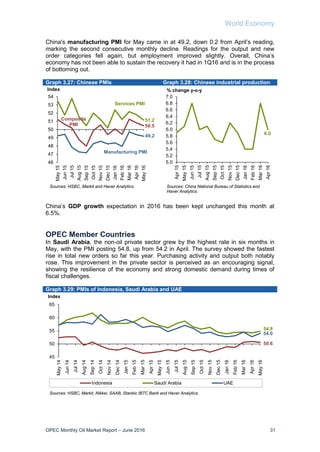
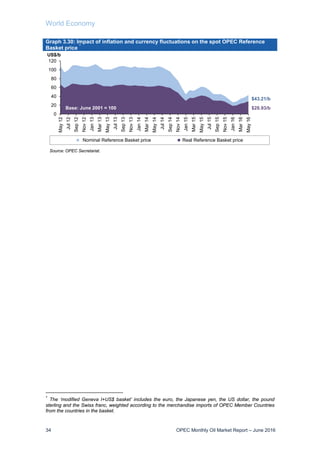
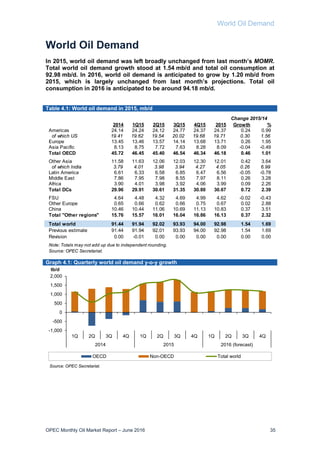
  • 55.
    World Oil Supply OPECMonthly Oil Market Report – June 2016 53 well as higher-than-expected declines in Africa and Latin America in 2Q16 and 3Q16. On a yearly basis, the expected contraction is coming mainly from Africa, Middle East and Latin America, while minor growth in Other Asia is anticipated. Other Asia Other Asia’s oil supply is forecast to reach 2.72 mb/d in 2016. Oil production in India and Vietnam is expected to decline by 20 tb/d and 10 tb/d, respectively, while oil production in Malaysia, Thailand and Asia Others is expected to grow by 30 tb/d and 10 tb/d each, respectively. Latin America Latin America’s oil supply for 2016 is expected to contract by 0.04 mb/d, revised down by 27 tb/d compared with the previous month’s prediction due to lower output in 1Q16 and lower-than-expected output in 2Q16 and 3Q16 from Brazil and Colombia. Total output for Latin America will reach an average of 5.15 mb/d, with growth coming only from Brazil. Brazil’s crude and NGLs output in April was higher by around 100 tb/d m-o-m, according to Petrobras’s monthly report, supported by the return of the P-31 (Albacora) and P-48 units in the post-salt Campos Basin. Hence, total Brazilian production, including biofuels, increased to 2.99 mb/d in April. With the return of production in the Campos Basin, total output increased m-o-m by 0.12 mb/d to 1.47 mb/d, which was partially offset by reducing pre-salt output to 0.62 mb/d – the lowest level in 10 months – mainly due to maintenance at the Cidade de Angra dos Reis floating storage and offloading (FPSO) platform as well as the FPSO Cidade de Paraty. According to Energy Aspects, in the year-to-April, maintenance reduced production by 5%, but output should rise in the coming months as the 0.15 mb/d FPSO Cidade de Saquarema produces first oil in July from the pre-salt layer of the Lula Central project, followed by the 0.1 mb/d FPSO Cidade de Caraguatatuba from the Lapa project in 3Q16. Nevertheless, growth in 2016 is not expected to be more than 40 tb/d to average 3.11 mb/d, revised down by 20 tb/d from the previous month’s forecast. Graph 5.15: Brazil quarterly oil supply, 2014-2016 Graph 5.16: Colombia quarterly oil supply, 2014-2016 0.0 0.5 1.0 1.5 2.0 2.5 3.0 3.5 1Q 2Q 3Q 4Q mb/d 2014 2015 (estimate) 2016 (forecast) Source: OPEC Secretariat. 0.92 0.94 0.96 0.98 1.00 1.02 1.04 1.06 1Q 2Q 3Q 4Q mb/d 2014 2015 (estimate) 2016 (forecast) Source: OPEC Secretariat.
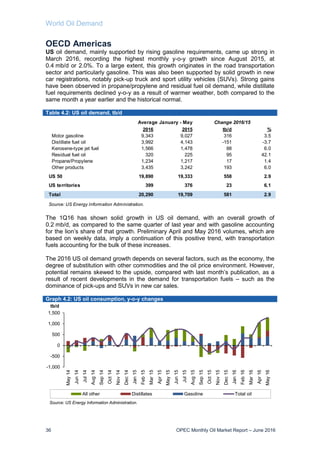
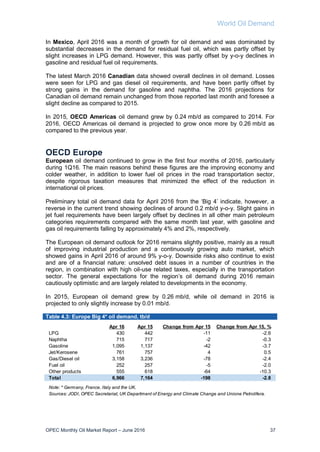
  • 56.
    World Oil Supply 54OPEC Monthly Oil Market Report – June 2016 Colombia’s oil production in 2016 is expected to be negative due to a lack of appropriate investment and necessary spending. Colombia’s total oil output will contract by 40 tb/d – revised down by 10 tb/d compared with the previous month’s forecast – to average 0.99 mb/d. Oil production in 1Q16 declined by 70 tb/d y-o-y to 0.98 mb/d, while oil output in April was steady compared with that of March at 0.94 mb/d. Middle East The Middle East’s oil supply has been stagnant during March, April and May 2016 at 1.24 mb/d, with input coming mainly coming from Oman at 0.98 mb/d, Bahrain at 0.23 mb/d, Syria at 30 tb/d and Yemen at 20 tb/d. It is expected that total annual average production will contract by 40 tb/d to 1.23 mb/d. Africa Africa’s oil supply is expected to see a further contraction of 60 tb/d in 2016, revised down by 29 tb/d to average 2.31 mb/d. The reason for this negative revision is due to production outages in Ghana. Amid unresolved technical issues at Tullow’s FPSO vessel in the giant Jubilee oilfield offshore Ghana, production is back online, but output is less than half of what it should be, while investors have been told they won’t see any dividends this year. Production resumed on 4 May, but the repair of a turret could take up to a year, according to the media. Right now, the company is working to ramp up production to above 30,000 b/d, but this is well under the originally anticipated 100,000 b/d. It was producing 103,000 b/d the previous year. FSU, other regions Total FSU oil production forecast averaged 13.76 mb/d in 2016, indicating an upward revision by 63 tb/d in growth to average 0.06 mb/d y-o-y, compared with the previous MOMR. This revision came from higher-than-expected output from Russia in 1Q16 and the expected continuation in production in 2Q16. Moreover, upward revisions for production from Azerbaijan and Turkmenistan were another reason for anticipated growth in the FSU. Nevertheless, oil production in 2H16 would be less than in 1H16 by 0.2 mb/d, mainly due to lower expectations for Russian production. Graph 5.17: FSU quarterly oil supply, 2014-2016 Graph 5.18: Russia quarterly oil supply, 2014-2016 13.2 13.3 13.4 13.5 13.6 13.7 13.8 13.9 14.0 14.1 1Q 2Q 3Q 4Q mb/d 2014 2015 (estimate) 2016 (forecast) Source: OPEC Secretariat. 10.3 10.4 10.5 10.6 10.7 10.8 10.9 11.0 11.1 11.2 1Q 2Q 3Q 4Q mb/d 2014 2015 (estimate) 2016 (forecast) Source: OPEC Secretariat.
  • 57.
    World Oil Supply OPECMonthly Oil Market Report – June 2016 55 Russia Russia’s oil supply in April and May reached 11.06 mb/d and 11.05 mb/d, respectively. This is a little weaker than in February and March, but still above 11 mb/d, according to ministry information and estimations for monthly NGLs output. Higher growth in Russia is due to the new 70 tb/d Yarudeiskoye field startup in December 2015. As mentioned in the FSU summary, Russian production will drop by 120 tb/d in 2H16 compared with 1H16, mainly due to maintenance, including a 20-day shut-in at ExxonMobil’s Sakhalin 1 project in August. Nevertheless, according to the latest review of the most prolific fields in Russia and supported by the remarkable growth seen in the first five months of the year, averaging 11.09 mb/d, higher production by 0.26 mb/d over the same period a year ago has been maintained. Oil supply in 2016 is expected grow by 0.13 mb/d to average 10.94 mb/d, revised up by 0.12 mb/d. Caspian Kazakhstan’s oil production in April declined by 0.11 mb/d to average 1.50 mb/d, mainly due to summer maintenance at the Karachaganak oil field. A further supply contraction of 40 tb/d is anticipated for Kazakhstan in 2016, to bring production to 1.56 mb/d. In Azerbaijan, oil supply declined by 20 tb/d to average 0.87 mb/d in April 2016. An average oil supply of 0.85 mb/d is expected for 2Q16, 20 tb/d less than in 1Q16. Average annual output growth was revised up by 20 tb/d, compared with the previous month, therefore annual output is expected to decline y-o-y by 20 tb/d to reach 0.84 mb/d. Graph 5.19: Kazakhstan quarterly oil supply, 2014-2016 Graph 5.20: China quarterly oil supply, 2014-2016 Other Europe’s supply is expected to remain steady, averaging 0.13 mb/d in 2015 as well as in 2016. 1.45 1.50 1.55 1.60 1.65 1.70 1Q 2Q 3Q 4Q mb/d 2014 2015 (estimate) 2016 (forecast) Source: OPEC Secretariat. 4.00 4.05 4.10 4.15 4.20 4.25 4.30 4.35 4.40 1Q 2Q 3Q 4Q mb/d 2014 2015 (estimate) 2016 (forecast) Source: OPEC Secretariat.
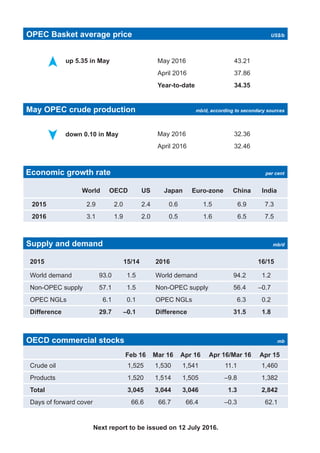
  • 58.
    World Oil Supply 56OPEC Monthly Oil Market Report – June 2016 China China’s oil supply is forecast to decline by 0.14 mb/d to average 4.23 mb/d in 2016, unchanged from the previous MOMR. Crude oil output plummeted to 4.04 mb/d in April, lower y-o-y by 0.22 mb/d, or 5.2%. Chinese total liquids output in April decreased by 60 tb/d to average 4.13 mb/d, including 90 tb/d of unconventional fuels. Nevertheless, oil production in 2H16 is expected to be higher by 60 tb/d than in 1H16. OPEC NGLs and non-conventional oils OPEC NGLs and non-conventional liquids production in 2015 grew by 0.13 mb/d, and averaged 6.13 mb/d, based on OPEC MCs direct communication. In 2016, OPEC NGLs and non-conventional liquids are projected to average 6.29 mb/d, to reach 0.16 mb/d, y-o-y. Table 5.4: OPEC NGLs + non-conventional oils, 2013-2016 Change Change Change 2013 2014 14/13 1Q15 2Q15 3Q15 4Q15 2015 15/14 2016 16/15 Total OPEC 5.82 6.00 0.17 5.97 6.15 6.23 6.17 6.13 0.13 6.29 0.16 Source: OPEC Secretariat.
  • 59.
    World Oil Supply OPECMonthly Oil Market Report – June 2016 57 OPEC crude oil production According to secondary sources, total OPEC crude oil production in May averaged 32.36 mb/d, a decrease of 100 tb/d over the previous month. Crude oil output increased mostly from Kuwait, IR Iran and Saudi Arabia, while production decreased in Nigeria, Venezuela and Iraq. Table 5.5: OPEC crude oil production based on secondary sources, tb/d Table 5.6: OPEC crude oil production based on direct communication, tb/d 2014 2015 3Q15 4Q15 1Q16 Mar 16 Apr 16 May 16 May/Apr Algeria 1,123 1,106 1,110 1,110 1,093 1,092 1,087 1,080 -7.1 Angola 1,654 1,754 1,763 1,780 1,760 1,797 1,790 1,773 -16.8 Ecuador 544 546 541 545 548 554 546 549 3.9 Indonesia 696 695 696 707 720 726 730 740 10.4 Iran, I.R. 2,778 2,840 2,861 2,874 3,093 3,236 3,473 3,562 89.2 Iraq 3,267 3,933 4,154 4,232 4,242 4,179 4,342 4,281 -60.1 Kuwait 2,781 2,730 2,717 2,720 2,765 2,768 2,647 2,740 93.3 Libya 470 405 382 401 370 338 348 296 -52.0 Nigeria 1,953 1,867 1,861 1,885 1,792 1,761 1,675 1,424 -251.4 Qatar 714 667 655 669 667 672 658 659 1.9 Saudi Arabia 9,688 10,123 10,263 10,122 10,147 10,146 10,157 10,241 84.0 UAE 2,759 2,856 2,878 2,881 2,807 2,724 2,753 2,826 73.9 Venezuela 2,361 2,357 2,357 2,354 2,309 2,286 2,257 2,188 -69.0 Total OPEC 30,788 31,879 32,238 32,280 32,314 32,275 32,461 32,361 -99.8 Note: Totals may not add up due to independent rounding. Source: OPEC Secretariat. 2014 2015 3Q15 4Q15 1Q16 Mar 16 Apr 16 May 16 May/Apr Algeria 1,193 1,157 1,159 1,179 1,128 1,137 1,141 1,133 -8.0 Angola 1,654 1,767 1,777 1,742 1,773 1,782 1,733 1,707 -26.0 Ecuador 557 543 538 536 548 552 555 556 0.5 Indonesia 697 690 695 693 739 747 726 737 11.6 Iran, I.R. 3,117 3,152 3,170 3,313 3,385 3,400 3,500 3,600 100.0 Iraq 3,110 3,504 3,744 3,846 4,598 4,553 4,521 4,499 -22.0 Kuwait 2,867 2,859 2,870 2,876 3,000 3,000 2,900 2,950 50.0 Libya 480 .. .. .. .. .. .. .. .. Nigeria 1,807 1,748 1,790 1,778 1,667 1,505 1,570 1,506 -64.5 Qatar 709 656 640 651 675 699 625 671 45.7 Saudi Arabia 9,713 10,193 10,285 10,202 10,225 10,224 10,262 10,270 8.4 UAE 2,794 2,989 3,030 2,999 2,944 2,909 2,827 3,107 280.0 Venezuela 2,683 2,654 2,631 2,587 2,515 2,515 2,490 2,370 -120.3 Total OPEC 31,380 .. .. .. .. .. .. .. .. Note: Totals may not add up due to independent rounding. .. Not available. Source: OPEC Secretariat.
  • 60.
    World Oil Supply 58OPEC Monthly Oil Market Report – June 2016 World oil supply Preliminary data indicates that the global oil supply decreased by 0.73 mb/d in May compared with the previous month, to average 94.51 mb/d. Non-OPEC supply decreased by 0.63 mb/d, while OPEC production decreased by 0.10 mb/d. The share of OPEC crude oil in total global production increased to 34.2% in May compared with the previous month. Estimates are based on preliminary data from direct communications for non-OPEC supply, OPEC NGLs and non-conventional oil, while estimates for OPEC crude production are based on secondary sources. Graph 5.21: OPEC and world oil supply 90 91 92 93 94 95 96 97 26 27 28 29 30 31 32 33 Jun14 Jul14 Aug14 Sep14 Oct14 Nov14 Dec14 Jan15 Feb15 Mar15 Apr15 May15 Jun15 Jul15 Aug15 Sep15 Oct15 Nov15 Dec15 Jan16 Feb16 Mar16 Apr16 May16 mb/dmb/d OPEC crude production (LHS) World supply (RHS) Source: OPEC Secretariat.
  • 61.
    Product Markets andRefinery Operations OPEC Monthly Oil Market Report – June 2016 59 Product Markets and Refinery Operations A high level of light and middle distillate inventories, along with the approaching end of the spring maintenance season, offset the potential impact of refinery outages seen in Canada and France, causing margins to slightly fall in the Atlantic Basin, despite stronger gasoline demand in the region. Meanwhile, refinery margins in Asia showed a slight recovery on the back of stronger regional demand amid the peaking of refinery maintenance. Graph 6.1: Refinery margins, 2015-2016 US product markets continued to be supported by stronger domestic gasoline demand, which continued rising during May, hitting levels not seen since 2007. However, despite the higher demand, gasoline crack spreads were under supply pressure due to higher imports, along with the re-start of several gasoline/producer units. Meanwhile, the temporary tightening sentiment caused by Canadian crude supply disruptions was offset by increasing refinery runs, with several refineries returning from maintenance. US Gulf Coast (USGC) refinery margins for WTI crude dropped by around $1/b versus the previous month’s levels to average around $7.5/b in May. Product markets in Europe showed a mixed performance during May as the middle of the barrel exhibited some recovery, supported by stronger regional demand, while the gasoline crack spread weakened. This mixed performance, along with higher product inventories, offset the potential impact of French refinery outages, causing refinery margins to slightly fall in Europe. The refinery margin for Brent crude in Northwest Europe (NWE) showed a loss of 50¢ versus the previous month, to average $6.3/b in May. Asian product markets strengthened slightly in May, supported by stronger regional demand amid a peak in refinery maintenance in the region. Refinery margins in Singapore recovered slightly by 20¢ to average $7.6/b in May. The uptick in margins was limited by pressure exerted from the oversupply environment. 0 5 10 15 20 0 5 10 15 20 May15 Jun15 Jul15 Aug15 Sep15 Oct15 Nov15 Dec15 Jan16 Feb16 Mar16 Apr16 May16 US$/bUS$/b WTI (US Gulf) Brent (Rotterdam) Oman (Singapore) Sources: Argus Media and OPEC Secretariat.
  • 62.
    Product Markets andRefinery Operations 60 OPEC Monthly Oil Market Report – June 2016 Refinery operations Refinery utilization rates have been ramped up worldwide, with spring maintenance approaching an end. In Asia, throughput levels continued at near-record levels in China, South Korea and India. Meanwhile, in the Atlantic Basin, several refineries were impacted by events in France and Canada. Refinery utilization in the US averaged around 91% in May, corresponding to 16.3 mb/d, which was 200 tb/d higher than a month earlier. Refineries were running at maximum levels in the USGC, with several refineries back from maintenance, thus compensating for lower levels in other areas possibly impacted by a shortage of Canadian crudes, which also affected refinery levels in Canada. Graph 6.2: Refinery utilisation rates, 2015-2016 European refinery runs averaged around 83% of capacity in May, corresponding to a throughput of 9.8 mb/d, 240 tb/d lower than in the previous month and around 460 tb/d lower than the same month a year ago. European refinery throughputs continued to be impacted by some maintenance and in addition, in May, were impacted by the French strike, which affected operations in several refineries, ports and gas stations in the country. This caused refinery utilization in France to drop to 60%. In Asia, refinery utilization has continued to rise, mainly in South Korea, India and China, where Chinese teapot refineries contributed to continuing record-high levels, hitting around 10.9 mb/d in April. Indian refinery runs hit 4.9 mb/d during recent months, responding to strong demand growth in the country. Refinery runs in Singapore for April averaged around 72%. Meanwhile, Japanese throughputs averaged 81% of capacity in May, 5 pp lower than the previous month as some maintenance continued in the country. US market US gasoline demand stood at around 9.6 mb/d in May, approximately 190 tb/d higher than in the previous month and more than 400 tb/d higher than in the same month a year earlier. Stronger domestic gasoline demand has been supporting the gasoline market. However, the crack spreads were under pressure due to higher imports, along with the re-start of several gasoline/producer units. The temporary tightening sentiment caused by crude supply disruptions due to the wildfires in Canada has been offset by increasing refinery runs, with several refineries returning from maintenance. 60 70 80 90 100 60 70 80 90 100 May15 Jun15 Jul15 Aug15 Sep15 Oct15 Nov15 Dec15 Jan16 Feb16 Mar16 Apr16 May16 %% US EU-16 Japan Singapore Sources: Argus Media and OPEC Secretariat.
  • 63.
    Product Markets andRefinery Operations OPEC Monthly Oil Market Report – June 2016 61 The gasoline crack spread lost more than $2 versus the previous month’s level to average $22/b in May. Graph 6.3: US Gulf crack spread vs. WTI, 2015-2016 Middle distillate demand stood at around 4.1 mb/d in May, some 20 tb/d higher than in the previous month and around 270 tb/d higher than in the same month a year earlier. The middle distillate market has exhibited weak fundamentals in the last years. However, during May it showed some signs of recovery. Some support has come from stronger domestic demand, which has picked up since the middle of April. Another supporting factor has been increasing exports to Latin America, mainly Argentina. This has allowed inventories to continue falling, despite the increase seen in refinery runs. In the futures market, heating oil Nymex positions reached net-long territory, something which has not been seen since mid-2014. The US Gulf Coast (USGC) gasoil crack averaged around $6/b in May, gaining around $2 from the previous month. The uptick has been somehow limited by the pressure exerted by persistently high gasoil availability in the Atlantic Basin, as reflected in recent weeks, with almost no impact seen on the middle distillate market due to the French strikes. At the bottom of the barrel, the fuel oil market recovered some ground, supported by strong bunker demand in the USGC during the last several weeks, amid increasing requirements from Mexico. The USGC high-sulphur fuel oil crack gained almost $1 to average around minus $16/b in May. European market Product markets in Europe showed a mixed performance during May as the middle of the barrel exhibited a recovery on the back of stronger regional demand, while the gasoline crack spread weakened despite some export opportunities. Higher product inventories offset the potential impact of the French refinery outages, causing refinery margins to fall slightly in Europe. The gasoline market partially retained the recovery seen in April, on the back of higher export opportunities, driven by persistently strong demand in the US. This has allowed for hefty transatlantic outflows to satisfy the increasing gasoline imports from the US East Coast (USEC). However the gasoline cracks lost some ground last month as the market was under pressure from additional volumes coming out of storage, increasing availability, in addition to the approaching end of the maintenance season in the region. Another bearish factor has been lower exports to West Africa. The gasoline crack -20 0 20 40 60 -20 0 20 40 60 May15 Jun15 Jul15 Aug15 Sep15 Oct15 Nov15 Dec15 Jan16 Feb16 Mar16 Apr16 May16 Jun16 US$/bUS$/b Premium gasoline Jet/Kerosene Diesel Fuel oil Sources: Argus Media and OPEC Secretariat.
  • 64.
    Product Markets andRefinery Operations 62 OPEC Monthly Oil Market Report – June 2016 spread against Brent saw a drop of $2 from the previous month, to average around $23/b in May. The light-distillate naphtha crack weakened as domestic demand has been falling due to the French petrochemical producers being impacted by the labour strikes. Additional pressure has come from higher inventories amid lower arbitrage opportunities to Asia. Graph 6.4: Rotterdam crack spreads vs. Brent, 2015-2016 The European gasoil market showed a recovery during May on the back of support coming from strong domestic demand reported from several countries, mainly Italy and Spain, along with higher requirements from Egypt and Algeria. Additional support came from the supply side with some slow-down seen in imports from the Middle East, thus contributing to the easing of the oversupply by offsetting the continued higher imports from India and Russia. The gasoil crack spread against Brent crude at Rotterdam averaged around $10/b in May, gaining around $2 versus the previous month’s level. The potential additional gains in the crack spreads, due to the tightening sentiment fuelled by the strike at French ports and refineries, were capped by floating storage outside several European ports and high ARA inventories. At the bottom of the barrel, the fuel oil market continued under pressure due to a lack of arbitrage opportunities to Singapore as inventories remain high in that region. On the other hand, the expected increase in Baltic exports following the end of the Russian refinery maintenance season has also been exerting some pressure. The NWE Europe fuel oil crack lost 50¢ versus the previous month to average around minus $14/b in May, hitting the lowest level seen this year. -20 -10 0 10 20 30 40 -20 -10 0 10 20 30 40 May15 Jun15 Jul15 Aug15 Sep15 Oct15 Nov15 Dec15 Jan16 Feb16 Mar16 Apr16 May16 Jun16 US$/bUS$/b Premium gasoline Jet/Kerosene Gasoil Fuel oil Sources: Argus Media and OPEC Secretariat.
  • 65.
    Product Markets andRefinery Operations OPEC Monthly Oil Market Report – June 2016 63 Impact of French refinery strike A strike against proposed labour reforms disrupted France’s refining sector starting in the latter part of May. Some 40% of petrol stations in the Paris region were reporting shortages, fuel depots were being blockaded by oil workers, and the country’s refinery activity was significantly disrupted, with four refineries completely shut down and a fifth forced to cut throughputs by around 25%, for a combined impact of more than 0.8 mb/d in refinery capacity during the affected period representing more than half of the country’s total capacity. In response, the French government released its strategic fuel stocks for the first time in six years. By 25 May, the country’s Transport Secretary said the government had used three days’ worth of reserves to supply the petrol stations that had been affected and stated that the government had sufficient strategic reserves to last 115 days. Some of the shortages were attributed to panic buying, as fuel consumption was roughly three times normal levels. Table 6.1: Distillation capacity in France and the impact The disruptions contributed to a sharp fall in refinery utilization rates in France in May, which dropped to 62% for the first time since December 2013, after reaching a high so far this year of 85% the month before. Despite this disruption, existing high inventories of light and middle distillates in the region, along with the government’s release of strategic product stocks, were sufficient to prevent a spike in refining margins. According to the latest Euroilstock data, middle distillate inventories in the EU-16 fell less than 1% in May m-o-m, while gasoline stocks ended higher, keeping both around 10% above the same month a year ago. The strike appeared be winding down by the second week of June, with Total reporting that it was restarting its Donges, Gonfreville, Feyzin, and Grandpuits refineries, and returning La Mède to full operations. However, some striking workers were blocking the full restart of operations at Donges, Gonfreville, and Feyzin. The situation in the country’s oil ports may take longer to normalize as strikes continue to disrupt the country’s oil terminals. All discharges have been halted at the southern oil terminal of Fos-Lavera as well as at the northern terminal of Le Havre since 23 May and union workers recently voted to extend the shutdown until 14 June. Refinery Operator Capacity, tb/d Impact Normandy, Gonfreville Total 247 Full disruption Donges Total 219 Full disruption Provence, La Mède Total 153 Reduced runs by 25% Feyzin Total 117 Full disruption Grandpuits Total 101 Full disruption Source: Total and Thomson Reuters.
  • 66.
    Product Markets andRefinery Operations 64 OPEC Monthly Oil Market Report – June 2016 Asian market The Asian market strengthened slightly in May, supported by stronger regional demand amid the peaking of the refinery maintenance season in the region. The uptick in the margins was limited by the pressure exerted by the oversupply environment. Despite the heavy maintenance season, the gasoline market continued weak, pressured by ample supply in the region, with volumes in floating storage continuing to keep the market under pressure. Higher exports reported from northeast Asian refineries – mainly from Japan and the Shandong province of China – have been outweighing the higher regional demand being reported from India, Pakistan and Indonesia. The gasoline crack spread against Oman crude in Singapore averaged $12/b in May, losing 40¢ versus the previous month’s level. Losses were capped by expectations that increasing seasonal demand amid heavy maintenance could tighten the market in the coming weeks. The Singapore naphtha crack continued its downward trend, losing around $3/b over the month due to demand being impacted by the heavy petrochemical steam cracker maintenance. The LPG discount to naphtha has encouraged switching to LPG feedstock, which has also pressured the market. Graph 6.5: Singapore crack spread vs. Oman, 2015-2016 At the middle of the barrel, the gasoil crack spread continued relatively steady, getting support from lower supplies seen from India due to heavy maintenance amid strong demand. This has allowed the gasoil crack spread to hit its highest value seen this year. Demand in the region remained strong in several countries, mainly India, Vietnam, Indonesia and Pakistan, while some arbitrage opportunities to West Africa and Europe also supported the gasoil market in the region. The gasoil crack spread in Singapore against Oman averaged around $12/b in May, gaining around $2 versus the previous month’s level. Although the drought suffered by several countries has been a supportive factor, additional gains were capped by concerns about potential downturn in demand with the upcoming monsoon season in the region. The Asian fuel oil market was relatively stable during May as strong demand reported from South Korea and Pakistan offset the pressure coming from high inventories in Singapore and lower Chinese fuel oil demand. The fuel oil crack spread in Singapore -20 -10 0 10 20 30 -20 -10 0 10 20 30 May15 Jun15 Jul15 Aug15 Sep15 Oct15 Nov15 Dec15 Jan16 Feb16 Mar16 Apr16 May16 Jun16 US$/bUS$/b Premium gasoline Jet/Kerosene Gasoil Fuel oil Sources: Argus Media and OPEC Secretariat.
  • 67.
    Product Markets andRefinery Operations OPEC Monthly Oil Market Report – June 2016 65 against Oman averaged about minus $10/b in May, unchanged from the previous month. Table 6.2: Refinery operations in selected OECD countries Table 6.3: Refined product prices, US$/b Change Apr 16 May 16 May/Apr 2015 2016 Naphtha* 43.96 48.45 4.49 65.59 40.90 Premium gasoline (unleaded 93) 65.83 68.73 2.90 80.25 58.21 Regular gasoline (unleaded 87) 59.30 62.63 3.33 71.15 51.33 Jet/Kerosene 48.07 54.89 6.82 71.49 45.81 Gasoil (0.2% S) 45.60 52.79 7.19 71.32 42.70 Fuel oil (3.0% S) 26.15 31.98 5.83 46.78 24.33 Naphtha 41.69 44.28 2.59 54.68 38.39 Premium gasoline (unleaded 98) 66.41 69.51 3.10 76.63 58.73 Jet/Kerosene 50.30 56.15 5.85 73.39 46.91 Gasoil/Diesel (10 ppm) 49.57 56.67 7.10 72.68 46.38 Fuel oil (1.0% S) 27.82 32.52 4.70 46.27 25.29 Fuel oil (3.5% S) 23.66 29.28 5.62 46.94 21.45 Naphtha 40.39 43.51 3.12 51.56 37.21 Premium gasoline** 58.04 61.12 3.08 71.87 51.37 Jet/Kerosene 48.01 54.44 6.43 70.39 45.11 Diesel 50.56 57.91 7.35 74.20 47.62 Fuel oil (1.0% S) 28.01 33.72 5.71 48.32 26.02 Fuel oil (3.5% S) 26.30 31.91 5.61 46.64 24.23 Naphtha 42.52 44.20 1.68 56.32 39.33 Premium gasoline (unleaded 95) 54.49 59.14 4.65 72.20 52.19 Regular gasoline (unleaded 92) 51.45 56.00 4.55 69.25 49.07 Jet/Kerosene 49.51 55.18 5.67 71.34 46.20 Gasoil/Diesel (50 ppm) 49.33 55.95 6.62 72.30 45.81 Fuel oil (180 cst 2.0% S) 31.02 35.80 4.78 53.31 29.54 Fuel oil (380 cst 3.5% S) 29.17 34.03 4.86 50.98 27.26 Sources: Argus Media and OPEC Secretariat. Year-to-date Note: * Barges. ** Cost, insurance and freight (CIF). US Gulf (Cargoes FOB): Rotterdam (Barges FoB): Mediterranean (Cargoes FOB): Singapore (Cargoes FOB): Change Change Mar 16 Apr 16 May 16 May/Apr Mar 16 Apr 16 May 16 May/Apr US 15.99 16.06 16.26 0.20 89.21 89.61 90.71 1.10 France 1.12 1.19 0.87 -0.32 79.59 84.78 61.95 -22.83 Germany 1.86 1.76 1.71 -0.06 85.01 80.62 78.02 -2.61 Italy 1.24 1.38 1.30 -0.08 60.41 67.20 63.29 -3.91 UK 0.94 1.05 1.08 0.04 67.19 74.61 77.25 2.64 Euro-16 10.17 10.07 9.83 -0.24 85.81 84.97 82.94 -2.03 Japan 3.46 3.38 3.16 -0.22 88.39 86.25 80.76 -5.49 Sources: Argus Media, EIA, Euroilstock, IEA, METI, OPEC Secretariat and Petroleum Association of Japan. Note: Data has been revised from January 2016 according to the latest capacity update. Refinery throughput, mb/d Refinery utilization, %
  • 68.
    Tanker Market 66 OPECMonthly Oil Market Report – June 2016 Tanker Market Dirty tanker market sentiment weakened in May as average spot freight rates dropped on most reported routes. On average, dirty tanker freight rates dropped by 4% from the previous month, mainly on the back of lower rates registered for VLCC and Suezmax, which dropped by 7% and 15%, respectively. Freight rates declined on all reported routes from the previous year and month. However, Aframax spot freight rates saw bright spots, rising by around 6% on average as a result of an active market and premiums paid mainly in the Mediterranean. Clean spot freight rates showed a mixed performance in May, dropping on average. They were mainly affected by lower rates in West of Suez, while those in East of Suez remained mostly flat from the month before. Spot fixtures Preliminary data for May shows that OPEC spot fixtures dropped by 3.6%, compared with the previous month, to average 11.49 mb/d. Global spot fixtures declined as well by 2.4% in May, compared with the previous month, to average 16.6 mb/d. Fixtures on the Middle East-to-East route were down by 2.2% and on the Middle East-to-West routes by 0.5 mb/d. In general, global chartering activity showed a drop of 12.6% from the same month one year earlier on reported destinations. Table 7.1: Tanker chartering, sailings and arrivals, mb/d Sailings and arrivals OPEC sailings dropped by 0.28 mb/d, or 1.2%, in May from a month ago while remaining up by 0.17 mb/d from a year before. Sailings from the Middle East dropped from the previous month by 0.29 mb/d and from one year earlier by 0.06 mb/d. According to preliminary data, arrivals at main importing regions in North American and West Asian ports showed an increase from a month earlier, rising by 0.4%, and 2.8%, respectively, from the previous month. In contrast, vessel arrivals in the Far East and Europe declined from a month earlier by 0.3% and 0.4%, respectively. Change Mar 16 Apr 16 May 16 May 16/Apr 16 Spot Chartering All areas 17.68 17.01 16.60 -0.41 OPEC 12.19 11.92 11.49 -0.43 Middle East/East 5.22 5.44 5.32 -0.12 Middle East/West 3.23 3.19 2.68 -0.50 Outside Middle East 3.74 3.29 3.49 0.20 Sailings OPEC 24.08 24.27 23.99 -0.28 Middle East 17.50 17.67 17.38 -0.29 Arrivals North America 10.00 9.95 9.99 0.04 Europe 12.57 12.51 12.46 -0.05 Far East 8.52 8.46 8.43 -0.03 West Asia 4.62 4.70 4.83 0.13 Source: Oil Movements.
  • 69.
    Tanker Market OPEC MonthlyOil Market Report – June 2016 67 Spot freight rates VLCC VLCC freight rates dropped on average in May from the month before, down by 7% from April, to stand at WS73 points. Increased activity at the beginning of the month was seen to support VLCC freight rates, mainly in the Middle East and West Africa, despite high vessel supply at that point. Spot freight rates further improved when June requirements came onto the market. However, rates edged down to reverse previous gains as sluggish demand in the Middle East and West Africa combined with reduced delays in Asian ports to support the expansion of available vessels on the tonnage list. Thus, Middle East-to-East freight rates dropped by 3%, to stand at WS63 points. West Africa-to-East freight rates followed the same pattern, though reflecting a higher drop of 12%, to stand at WS38 points. Freight rates for tankers operating on the Middle East-to-West route also dropped by 8% from one month before. Graph 7.1: Monthly averages of crude oil spot freight rates Suezmax As seen in the VLCC sector, Suezmax spot freight rates also underwent negative development in May. At the beginning of the month, rates for Suezmax were weak due to holidays and low activity, generally. Increased activity was only later able to stabilize rates and prevent further drops. In West Africa, spot freight rates for tankers operating on the West Africa-to-US Gulf Coast route dropped by 21% to stand at WS63 points. Spot freight rates for tankers operating on the Northwest Europe (NWE)-to-US Gulf Coast (USGC) route dropped by 8% to average WS63 points. Suezmax rates on both routes showed a higher decline, compared with freight rates registered on the same routes the previous year. 20 40 60 80 100 120 140 20 40 60 80 100 120 140 May15 Jun15 Jul15 Aug15 Sep15 Oct15 Nov15 Dec15 Jan16 Feb16 Mar16 Apr16 May16 WorldscaleWorldscale Mediterranean/Northwest Europe (Aframax) West Africa/USGC (Suezmax) Middle East/Far East (VLCC) Sources: Argus and Platts.
  • 70.
    Tanker Market 68 OPECMonthly Oil Market Report – June 2016 Table 7.2: Spot tanker crude freight rates, Worldscale Aframax In May, Aframax was the only vessel size in the dirty tanker segment, which showed enhanced rates, on average, from a month before. Aframax freight rates increased by 6%, as a result of mixed performance for the class, supported by increased rates for tankers trading in both directions of the Mediterranean. The markets in the North Sea and Mediterranean were balanced at the beginning of the month before some replacement deals were fixed at high premiums. A lighter tonnage list in the Mediterranean, combined with a sudden shortage of vessels, pushed rates up in that region. Freight rates for tankers operating on the Mediterranean-to- Mediterranean and Mediterranean-to-NWE routes edged up by 25% and 34% to average WS116 and WS109 points, respectively, making Suezmax a viable alternative to Aframax at a certain point, due to its falling rates and weak market. Spot freight rates went down on the Caribbean-to-US East Coast (USEC) route by 4% from the previous month, despite owners’ consistent resistance to lower rates, as tonnage supply outweighed chartering requirements. Aframax freight rates to eastern destinations were not an exception, dropping by 18% for tankers trading on the Indonesia-to-East route to average WS91 points. Clean spot freight rates Clean tanker market sentiment was weak in May. On average, clean spot tanker freight rates dropped by 11% from the month before to stand at WS125 points. In the West of Suez, freight rates experienced a large drop on average. Tonnage in the West was affected by the holidays and slow movement in the market. Among the main drivers behind freight rate drops in the West was lower freight rates in the Mediterranean, where they dropped by 23% and 22%, respectively, on the Mediterranean-to-Mediterranean and Mediterranean-to-NWE routes. Nevertheless, rates for medium-range tankers operating on the NWE-to-US East Coast went up by 7% to average WS119 points as the market was balanced, showing a multi-month high, though the increase remained limited. Size Change 1,000 DWT Mar 16 Apr 16 May 16 May 16/Apr 16 Crude Middle East/East 230-280 73 65 63 -2 Middle East/West 270-285 41 43 38 -5 West Africa/East 260 72 67 62 -6 West Africa/US Gulf Coast 130-135 70 79 63 -17 Northwest Europe/US Gulf Coast 130-135 63 69 63 -6 Indonesia/East 80-85 147 111 91 -20 Caribbean/US East Coast 80-85 115 109 104 -5 Mediterranean/Mediterranean 80-85 106 87 109 22 Mediterranean/Northwest Europe 80-85 98 80 108 28 Sources: Argus Media and OPEC Secretariat.
  • 71.
    Tanker Market OPEC MonthlyOil Market Report – June 2016 69 Graph 7.2: Monthly average of clean spot freight rates Similarly, East of Suez average clean spot freight rates dropped by a slight WS1 point on average, as lower rates were registered for tankers trading on the Singapore-to- East route, where a drop of WS3 points was seen in May to average WS132 points. A slight improvement was achieved by tankers operating on the Middle East-to-East route, which increased by 2% from a month before. Table 7.3: Spot tanker product freight rates, Worldscale 50 100 150 200 250 50 100 150 200 250 May15 Jun15 Jul15 Aug15 Sep15 Oct15 Nov15 Dec15 Jan16 Feb16 Mar16 Apr16 May16 WorldscaleWorldscale Middle East/Far East Northwest Europe/USEC Mediterranean/Mediterranean Sources: Argus Media and OPEC Secretariat. Size Change 1,000 DWT Mar 16 Apr 16 May 16 May 16/Apr 16 Products Middle East/East 30-35 116 100 102 2 Singapore/East 30-35 140 135 132 -4 Northwest Europe/US East Coast 33-37 100 111 119 8 Mediterranean/Mediterranean 30-35 127 172 132 -40 Mediterranean/Northwest Europe 30-35 136 182 142 -40 Sources: Argus Media and OPEC Secretariat.
  • 72.
    Oil Trade 70 OPECMonthly Oil Market Report – June 2016 Oil Trade Preliminary data shows that US crude oil imports in May declined by 189 tb/d from the previous month, to average 7.6 mb/d on an annual basis. Meanwhile, US crude imports dropped by 375 tb/d from a year earlier. US products imports declined by 68 tb/d, or 3.2%, to average 2.2 mb/d m-o-m, while on a y-o-y basis, they remained at last year’s level. Japan’s crude oil imports dropped in April by 93 tb/d, or 3%, to average 3.5 mb/d. On an annual basis, crude imports were 115 tb/d, or 3%, higher in April. Japan’s products imports went up in April by 47 tb/d, to average 524 tb/d. Meanwhile China’s crude oil imports increased from the previous month by 249 tb/d, or 3%, maintaining a high level and averaging 7.95 mb/d. On an annual comparison, China’s crude imports were up by 559 tb/d or 8%. As to China’s product imports, they increased slightly in April by 19 tb/d from the previous month and by 215 tb/d from a year earlier, to average 1.4 mb/d. In April, India’s crude imports stayed at high levels, averaging 4.4 mb/d, which is almost stable from the level seen last month. On an annual basis, this reflects a big gain from last year and is 592 tb/d, or 16%, higher. India’s product imports increased by 209 tb/d, or 32%, from a month ago to average 850 tb/d. On a y-o-y basis, this reflects a gain of 293 tb/d or 52%. US Preliminary data shows that US crude oil imports in May declined by 189 tb/d from the previous month to average 7.6 mb/d. On an annual basis, US crude imports dropped by 375 tb/d from a year earlier. Graph 8.1: US imports of crude and petroleum products US product imports declined by 68 tb/d, or 3.2%, to average 2.2 mb/d m-o-m, while on a y-o-y basis, they remained at last year’s level. On a year-to-date comparison, crude imports were 554 tb/d higher, while product imports dropped by 37 tb/d. As to product exports in May, they fell by 703 tb/d, or 16%, to average 3.6 mb/d from the previous year. 4.5 5.5 6.5 7.5 8.5 0.0 0.5 1.0 1.5 2.0 2.5 May15 Jun15 Jul15 Aug15 Sep15 Oct15 Nov15 Dec15 Jan16 Feb16 Mar16 Apr16 May16 mb/dmb/d Others* Propane/propylene Gasoline Jet fuel/kerosene Fuel oil Crude (RHS) Note: *Others: Contains natural gas liquids, liquefied refinery gases (LRG's), other liquids and all finished petroleum products except gasoline, jet fuel/kerosene, fuel oil and propane/propylene. Sources: US Energy Information Administration and OPEC Secretatiat.
  • 73.
    Oil Trade OPEC MonthlyOil Market Report – June 2016 71 As a result, total US net imports dropped in May to average 5.8 mb/d, down by 166 tb/d from the previous month. However, this was up by 1.2 mb/d from last year’s level. Graph 8.2: US exports of crude and petroleum products In March, Canada remained top crude supplier, accounting for 41% of total US crude imports, though Canadian exports to the US in March were down by 258 tb/d from a month before. Saudi Arabia came in as the second supplier to the US, maintaining a share of 16% of total crude imports, while Venezuela came in as the third largest supplier to the US, accounting for 10% of total US crude imports. Imports from both Saudi Arabia and Venezuela increased from a month before by 257 tb/d and 47 tb/d, respectively. Crude imports from OPEC Member Countries increased in March by 310 tb/d, or 11%, over the previous month. Imports from OPEC Member Countries accounted for 41% of total US crude imports. As to US product imports from OPEC Member Countries, these increased from a month earlier to stand at 55 tb/d, maintaining a share of 16% of total products imported by the US. This was 135 tb/d higher than the same month last year. As to the product supplier share, Canada and Russia maintained their positions as first and second supplier, respectively, to the US holding a share of 30% and 16%. Algeria came in as the third biggest product supplier to the US with an average import level of 128 tb/d. As to the US crude imports by region, in March imports from North America averaged 3.3 mb/d. North America came in as the top region for US crude imports, followed by Latin America, which stood at 2.8 mb/d in March. The Middle East came in as the third largest exporter to the US, with an average of 1.7 mb/d. Imports from Africa, Asia and the FSU all dropped from a month before. Table 8.1: US crude and product net imports, tb/d 0 100 200 300 400 500 600 0 1,000 2,000 3,000 4,000 5,000 6,000 May15 Jun15 Jul15 Aug15 Sep15 Oct15 Nov15 Dec15 Jan16 Feb16 Mar16 Apr16 May16 tb/dtb/d Others* Propane/propylene Gasoline Jet fuel/kerosene Fuel oil Crude (RHS) Note: *Others: Contains natural gas liquids, liquefied refinery gases (LRG's), other liquids and all finished petroleum products except gasoline, jet fuel/kerosene, fuel oil and propane/propylene. Sources: US Energy Information Administration and OPEC Secretatiat. Change Mar 16 Apr 16 May 16 May 16/Apr 16 Crude oil 7,534 7,444 7,205 -240 Total products -2,534 -1,497 -1,423 74 Total crude and products 5,000 5,947 5,781 -166 Sources: US Energy Information Administration and OPEC Secretatiat.
  • 74.
    Oil Trade 72 OPECMonthly Oil Market Report – June 2016 Japan Japan’s crude oil imports dropped in April by 93 tb/d, or 3%, to average 3.5 mb/d. On an annual basis, crude imports were higher in April by 115 tb/d or 3%. Also, Japanese refinery throughput dropped from the previous month. As to the suppliers’ share, Saudi Arabia maintained their position as the largest crude supplier to Japan, maintaining a 41% share of total crude imports with an increase in volumes from the previous month by 222 tb/d. The UAE came in as the second largest supplier to Japan with a share of 19% of total crude imports, although Japan’s imports from the UAE decreased by 265 tb/d in April m-o-m. Qatar came in third place holding a share of 10%. Japan’s imports from Qatar were up by 35 tb/d from the previous month. Japan’s product imports went up in April by 47 tb/d to average 524 tb/d. At the same time, Japan’s domestic product sales fell by 3.9% from last year. Graph 8.3: Japan’s imports of crude and petroleum products As to product exports, Japan’s exports in April were down from the previous month by 73 tb/d, to average 550 tb/d. Accordingly, Japan’s net imports increased by 27 tb/d in April to average 3.4 mb/d, reflecting lower monthly and annual imports. Graph 8.4: Japan’s exports of petroleum products 0 1 2 3 4 5 0 200 400 600 800 1,000 1,200 Apr15 May15 Jun15 Jul15 Aug15 Sep15 Oct15 Nov15 Dec15 Jan16 Feb16 Mar16 Apr16 mb/dtb/d Others* LPG Naphtha Fuel oil Crude oil Note: *Others: Contains gasoline, jet fuel, kerosene, gasoil, asphalt and paraffin wax. Sources: Ministry of Economy, Trade and Industry of Japan and OPEC Secretariat. 0 100 200 300 400 500 600 700 0 100 200 300 400 500 600 700 Apr15 May15 Jun15 Jul15 Aug15 Sep15 Oct15 Nov15 Dec15 Jan16 Feb16 Mar16 Apr16 tb/dtb/d Fuel oil Gasoil Jet fuel Others* *Others: Contains LPG, gasoline, naphtha, kerosene, lubricating oil, asphalt and paraffin wax. Sources: Ministry of Economy, Trade and Industry of Japan and OPEC Secretariat.
  • 75.
    Oil Trade OPEC MonthlyOil Market Report – June 2016 73 Table 8.2: Japan’s crude and product net imports, tb/d China China’s crude oil imports increased from the previous month to maintain their high level. They were up by 249 tb/d, or 3%, from a month ago, averaging 7.95 mb/d. On an annual comparison, China’s crude imports were up by 559 tb/d, or 8%. On a year-to- date basis, crude imports were up by 742 tb/d or 11%. Refinery throughput in China was almost 300 tb/d higher in April compared to March. In terms of supplier share, Russia, Saudi Arabia and Angola were the top crude suppliers to China in April holding a share of 15% 13% and 12%, respectively. In April, these top suppliers increased their exports to China by 76 tb/d, 65 tb/d and 116 tb/d, respectively, from a month earlier. Graph 8.5: China’s imports of crude and petroleum products As to China’s product imports, these increased slightly in April by 19 tb/d from the previous month and by 215 tb/d from a year earlier to average1.4 mb/d. China’s crude exports dropped in April from the high level seen in March to average 64 tb/d, down 57 tb/d from last month’s level and by 44 tb/d from the previous year. 0 2,000 4,000 6,000 8,000 10,000 0 400 800 1,200 1,600 Apr15 May15 Jun15 Jul15 Aug15 Sep15 Oct15 Nov15 Dec15 Jan16 Feb16 Mar16 Apr16 tb/dtb/d Others LPG Naphtha Gasoline Jet fuel Diesel Fuel oil Asphalt Crude (RHS) Sources: Argus China Petroleum and China, Oil and Gas Petrochemicals and OPEC Secretariat. Change Feb 16 Mar 16 Apr 16 Apr 16/Mar 16 Crude oil 3,462 3,559 3,467 -93 Total products -85 -146 -26 120 Total crude and products 3,377 3,414 3,441 27 Sources: Ministry of Economy, Trade and Industry of Japan and OPEC Secretariat.
  • 76.
    Oil Trade 74 OPECMonthly Oil Market Report – June 2016 Graph 8.6: China’s exports of crude and petroleum products Consequently, China’s net oil imports increased by 328 mb/d, or 4%, from the previous month to average 8.2 mb/d, and 7% from a year ago. Table 8.3: China’s crude and product net imports, tb/d India In April, India’s crude imports stayed at high levels as they averaged 4.4 mb/d despite the country approaching peak maintenance season in May. India’s crude imports in April remained almost stable from a month earlier. On an annual basis, this reflected a big gain of 592 tb/d, or 16%, from the previous year. Separately, India’s refinery throughput dropped in April from the previous month. Graph 8.7: India’s imports of crude and petroleum products -20 20 60 100 140 180 0 200 400 600 800 1,000 1,200 1,400 Apr15 May15 Jun15 Jul15 Aug15 Sep15 Oct15 Nov15 Dec15 Jan16 Feb16 Mar16 Apr16 tb/dtb/d Others LPG Naphtha Gasoline Jet fuel Diesel Fuel oil Asphalt Crude (RHS) Sources: Argus China Petroleum and China, Oil and Gas Petrochemicals and OPEC Secretariat. 0 1,000 2,000 3,000 4,000 5,000 0 200 400 600 800 1000 Apr15 May15 Jun15 Jul15 Aug15 Sep15 Oct15 Nov15 Dec15 Jan16 Feb16 Mar16 Apr16 tb/dtb/d Others LPG Naphtha Gasoline Kerosene Gasoil Fuel oil Crude (RHS) Sources: Petroleum Planning & Analysis Cell of India and OPEC Secretariat. Change Feb 16 Mar 16 Apr 16 Apr 16/Mar 16 Crude oil 8,006 7,550 7,885 335 Total products 401 359 351 -7 Total crude and products 8,408 7,908 8,236 328 Sources: Argus China Petroleum and China, Oil and Gas Petrochemicals and OPEC Secretariat.
  • 77.
    Oil Trade OPEC MonthlyOil Market Report – June 2016 75 India’s product imports increased by 209 tb/d, or 32%, from a month ago to average 850 tb/d. On a y-o-y basis, this reflects a gain of 293 tb/d, or 52%, with the increase in product imports mainly supported by higher imports of diesel. Graph 8.8: India’s exports of petroleum products As to Indian product exports, in April they increased by 318 tb/d, or 33%, from a year earlier to average 1.3 tb/d, with exports of diesel and petrol increasing from the previous year. Consequently, India’s total net imports increased by 284 tb/d to average 4 mb/d. Table 8.4: India’s crude and product net imports, tb/d FSU In April, total crude oil exports from the FSU dropped by 55 tb/d, or 1%, to average 6.85 mb/d. Crude exports through the Russian pipeline increased by 223 tb/d, or 5%, to average 4.5 mb/d. Total shipments from the Black Sea dropped by 91 tb/d, or 12%, from last month to average 674 tb/d. Total Baltic Sea exports increased by 229 tb/d in April as shipments from the Primorsk port terminal went up by 237 tb/d. Total shipments along the Druzhba pipeline increased by 27 tb/d to average 1.1 mb/d. Kozmino shipments increased by 59 tb/d, or 10%, to average 684 tb/d. Exports through the Lukoil system declined from the previous month, particularly in the Barents Sea and the Baltic Sea where exports dropped by 13 tb/d and 7 tb/d, respectively. 0 400 800 1,200 1,600 0 400 800 1,200 1,600 Apr15 May15 Jun15 Jul15 Aug15 Sep15 Oct15 Nov15 Dec15 Jan16 Feb16 Mar16 Apr16 tb/dtb/d Fuel oil Gasoil Kerosene Gasoline Naphtha Others Sources: Petroleum Planning & Analysis Cell of India and OPEC Secretariat. Change Feb 16 Mar 16 Apr 16 Apr 16/Mar 16 Crude oil 4,261 4,379 4,382 3 Total products -910 -714 -434 281 Total crude and products 3,352 3,665 3,949 284 Note: India data table does not include information for crude import and product export by Reliance Industries. Sources: Petroleum Planning & Analysis Cell of India and OPEC Secretariat.
  • 78.
    Oil Trade 76 OPECMonthly Oil Market Report – June 2016 Total exports from the Russian Far East were down by 35 tb/d, or 8%, from the previous month. Total exports from the Black Sea dropped by 226 tb/d as a result of lower shipments from the Novorossiysk port terminal, which decreased by 238 tb/d from the month before. In the Mediterranean Sea, Baku-Tbilisi-Ceyhan supplies dropped from the previous month by 39 tb/d, or 6%, to average 593 tb/d. As to products, total FSU product exports dropped by 410 tb/d, or 12%, from the previous month to average 3.4 mb/d. This came as a result of a drop in all exports, with the exception of vacuum gas oil.
  • 79.
    Oil Trade OPEC MonthlyOil Market Report – June 2016 77 Table 8.5: Recent FSU exports of crude and petroleum products by source, tb/d Transneft system 2014 3Q15 4Q15 Mar 16 Apr 16 Europe Black sea total 605 533 653 765 674 Novorossiysk port terminal - total 605 533 653 765 674 of which: Russian oil 438 396 502 583 501 Others 166 137 151 181 173 Baltic sea total 1,304 1,492 1,511 1,501 1,730 Primorsk port terminal - total 842 955 922 893 1,130 of which: Russian oil 834 955 922 893 1,130 Others 8 0 0 0 0 Ust-Luga port terminal - total 462 536 590 607 599 of which: Russian oil 284 323 359 375 432 Others 177 213 231 233 168 Druzhba pipeline total 1,005 1,077 1,044 1,030 1,057 of which: Russian oil 973 1,045 1,012 998 1,026 Others 32 32 32 32 31 Asia Pacific ocean total 507 647 617 626 684 Kozmino port terminal - total 507 647 617 626 684 China (via ESPO pipeline) total 342 341 349 349 348 China Amur 342 341 349 349 348 3,763 4,090 4,174 4,270 4,493 Lukoil system 2014 3Q15 4Q15 Mar 16 Apr 16 Europe & Barents sea total 120 136 161 169 156 N. America Varandey offshore platform 120 136 161 169 156 Europe Baltic sea total 12 14 19 19 12 Kalinigrad port terminal 12 14 19 19 12 Other routes 2014 3Q15 4Q15 Mar 16 Apr 16 Asia Russian Far East total 275 347 369 418 384 Aniva bay port terminal 112 114 118 141 123 De Kastri port terminal 162 233 251 277 261 Central Asia total 228 211 199 192 186 Kenkiyak-Alashankou 228 211 199 192 186 Europe Black sea total 982 1,068 1,158 1,192 966 Novorossiysk port terminal (CPC) 855 961 1,029 1,066 828 Supsa port terminal 80 96 94 86 89 Batumi port terminal 39 11 35 39 49 Kulevi port terminal 9 0 0 0 0 Mediterranean sea total 602 613 485 632 593 BTC 602 613 727 632 593 Russian rail 2014 3Q15 4Q15 Mar 16 Apr 16 Russian rail 46 13 17 12 59 of which: Russian oil 8 9 10 8 55 Others 38 3 7 4 4 6,028 6,492 6,582 6,903 6,849 Products 2014 3Q15 4Q15 Mar 16 Apr 16 Gasoline 124 145 226 218 178 Naphtha 485 519 514 496 492 Jet 5 23 25 42 36 Gasoil 933 863 1,125 1,174 990 Fuel oil 1,487 1,204 1,079 1,169 968 VGO 245 264 222 285 310 3,280 3,018 3,190 3,384 2,974 Total FSU oil exports 9,308 9,510 9,772 10,287 9,823 Sources: Argus Nefte Transport and Argus Global Markets. Total Russian crude exports Total FSU crude exports Total FSU product exports
  • 80.
    Stock Movements 78 OPECMonthly Oil Market Report – June 2016 Stock Movements OECD commercial oil stocks rose slightly in April to stand at 3,046 mb. At this level, they were around 338 mb above the latest five-year average. Crude and product stocks showed a surplus of around 194 mb and 144 mb above the seasonal norm, respectively. In terms of days of forward cover, OECD commercial stocks stood at 66.4 days, 7.1 days higher than the latest five-year average. Preliminary data for May shows that total commercial oil stocks in the US fell by 5.7 mb to stand at 1,365 mb. At this level, they were around 100 mb above the same period a year ago and 229 mb higher than the latest five-year average. Within the components, crude stocks fell by 7.7 mb, while products rose by 2.0 mb. The latest information for China shows a drop of 11.6 mb in total commercial oil inventories for April to stand at 397.0 mb. Within the components, crude and products fell by 8.8 mb and 2.9 mb, respectively. OECD Preliminary data for April shows that total OECD commercial oil stocks rose by 1.3 mb to stand at 3,046 mb. At this level, OECD commercial oil stocks were around 204 mb higher than the same time one year ago and 338 mb above the latest five-year average. Within the components, crude rose by 11.1 mb, while products fell by 9.8 mb. Weakening refinery runs have pushed OECD crude stocks higher, while heavy maintenance in April contributed to a stock draw in products. Within OECD regions, OECD America and OECD Asia Pacific experienced a build, while OECD Europe witnessed a drop. Graph 9.1: OECD’s commercial oil stocks OECD commercial crude stocks ended April at 1,541 mb, standing 81 mb above the same time one year earlier and more than 194 mb higher than the latest five-year average. OECD North America and OECD Europe stocks experienced a build, while OECD Asia Pacific stocks saw a drop. 2,500 2,600 2,700 2,800 2,900 3,000 3,100 2,500 2,600 2,700 2,800 2,900 3,000 3,100 Jan Feb Mar Apr May Jun Jul Aug Sep Oct Nov Dec mbmb 2014 2015 2016 Average 2011-2015 Max/Min 2011-2015 Sources: Argus Media, Euroilstock, IEA, METI, OPEC Secretariat and US Energy Information Administration.
  • 81.
    Stock Movements OPEC MonthlyOil Market Report – June 2016 79 In contrast, OECD product inventories fell in April by 9.8 mb for the third consecutive month to stand at 1,505 mb. At this level, product inventories stood 123 mb higher than a year ago at the same time, and were 144 mb above the seasonal norm. OECD North America and OECD Asia Pacific stocks experienced a drop, while those in OECD Europe saw a build. In terms of days of forward cover, OECD commercial stocks fell in April to stand at 66.4 days. At this level, they were 4.3 days above the previous year in the same period and 7.1 days higher than the latest five-year average. Within the regions, OECD Americas’ had 9.2 more days of forward cover than the historical average to stand at 66.3 days in April. OECD Asia Pacific stood 2.8 days above the seasonal average to finish the month of April at 55.4 days. At the same time, OECD Europe indicated a surplus of 5.8 days above the seasonal norm, averaging 72.6 days in April. Commercial stocks in OECD Americas rose by 7.4 mb in April, ending the month at 1,628 mb. At this level, they represented a surplus of 116 mb above a year ago and were 253 mb higher than the seasonal norm. Within components, crude stocks rose by 10.9 mb, while product stocks fell by 3.5 mb. At the end of April, crude commercial oil stocks in OECD Americas rose, ending the month at 865 mb, which was 58 mb above the same time one year ago, and 158 mb above the latest five-year average. The build in crude inventories could be attributed to lower crude runs in the US, combined with higher crude imports. In contrast, product stocks in OECD Americas declined by 3.5 mb, ending April at 763 mb. Despite this drop, they indicated a surplus of 58 mb above the same time one year ago, and were 94 mb higher than the seasonal norm. Maintenance shutdowns have limited product output in the US, resulting in stock draws. OECD Europe’s commercial stocks fell by 8.0 mb in April, following a drop of 10.4 mb in March. At 997 mb, they were 58 mb higher than the same time a year ago and 70 mb above the latest five-year average. Crude rose by 1.0 mb, while product stocks fell by 9.0 mb. OECD Europe’s commercial crude stocks rose by 1.0 mb in April, ending the month at 421 mb, slightly above the same period a year earlier and 23 mb higher than the latest five-year average. The build in April’s crude oil stocks came despite higher crude runs. In contrast, OECD Europe’s commercial product stocks fell by 9.0 mb to end April at 576 mb. At this level, OECD Europe’s commercial product stocks were 57 mb higher than a year ago at the same time, and 48 mb higher than the seasonal norm. The fall was mainly driven by lower refinery output. OECD Asia Pacific commercial oil stocks rose by 1.9 mb in April, reversing the trend of the previous three consecutive months. At 421 mb, they were 30 mb higher than a year ago and 16 mb above the five-year average. Within the components, crude fell by 0.8 mb, while product stocks went up by 2.7 mb. In April, crude inventories ended the month at 255 mb, indicating a surplus of 22 mb above a year ago and 14 mb above the seasonal norm. OECD Asia Pacific’s total product inventories ended April at 166 mb, standing 7.8 mb above the same time a year ago, while standing 2.1 mb below the seasonal norm.
  • 82.
    Stock Movements 80 OPECMonthly Oil Market Report – June 2016 Table 9.1: OECD’s commercial stocks, mb EU plus Norway Preliminary data for April shows the total European stock draw at 8.0 mb, leaving inventories to stand at 1,153 mb. At this level, they are 34.0 mb, or 3.0%, above the same time a year ago and 67.2 mb, or 6.2%, higher than the latest five-year average. Crude stocks rose by 1.0 mb, while products fell by 8.0 mb. Graph 9.2: EU-15 plus Norway’s total oil stocks European crude inventories rose in April, reversing the stock draw of the previous month to stand at 485.5 mb. This was 15.7 mb, or 3.1%, below the same period a year ago, but 19.4 mb, or 4.1%, higher than the seasonal norm. The build in April’s crude oil stocks came despite refinery crude runs increasing by 100 tb/d to average 10.1 mb/d. However, throughput levels stood at about 90 tb/d below the previous year at the same time. In contrast, European product stocks fell by 9.0 mb to end April at 665.4 mb. At this level, they were 49.7 mb, or 8.1%, above the same time a year ago, and 47.8 mb, or 7.7%, above the seasonal norm. Within products, all stocks experienced a draw, with the exception of naphtha. Gasoline stocks fell by 1.5 mb in April to stand at 121.1 mb. Despite this stock draw, they were 3.1 mb, or 2.6%, above a year earlier, and 8.8 mb, or 7.8%, higher than the seasonal norm. The fall in gasoline stocks could be driven by higher demand in the region, along with higher exports to the US ahead of the driving season. 1,040 1,060 1,080 1,100 1,120 1,140 1,160 1,180 1,040 1,060 1,080 1,100 1,120 1,140 1,160 1,180 Jan Feb Mar Apr May Jun Jul Aug Sep Oct Nov Dec mbmb 2014 2015 2016 Average 2011-2015 Max/Min 2011-2015 Source: Euroilstock . Change Feb 16 Mar 16 Apr 16 Apr 16/Mar 16 Apr 15 Crude oil 1,525 1,530 1,541 11.1 1,460 Products 1,520 1,514 1,505 -9.8 1,382 Total 3,045 3,044 3,046 1.3 2,842 Days of forward cover 66.6 66.7 66.4 -0.3 62.1 Sources: Argus Media, Euroilstock, IEA, METI, OPEC Secretariat and US Energy Information Administration.
  • 83.
    Stock Movements OPEC MonthlyOil Market Report – June 2016 81 Distillate stocks also fell by 6.0 mb to end April at 441.8 mb. At this level, they were 44.9 mb, or 11.3%, higher than the same time one year ago and 52.7 mb, or 13.5%, above the latest five-year average. The fall in distillate stocks came from lower distillate yields in favour of gasoline. Higher distillate demand, especially for jet fuel, also contributed to the stock draw. Residual fuel oil stocks fell by 2.4 mb in April to stand at 77.4 mb. At this level, they stood 1.5 mb, or 2.0%, above the same month a year ago, but remained 8.4 mb, or 9.7%, lower than the latest five-year average. The fall in residual fuel oil stocks was a result of increases in residual bunker demand. In contrast, naphtha stocks rose by 0.9 mb to stand at 25.1 mb, which is 0.2 mb, or 0.8%, higher than the same time a year ago, but 5.3 mb, or 17.4%, lower than the seasonal average. Table 9.2: EU-15 plus Norway’s total oil stocks, mb US Preliminary data for May shows that total commercial oil stocks in the US fell by 5.7 mb to stand at 1,365 mb. At this level, they were around 100 mb, or 7.9%, above the same period a year ago and 229 mb, or 20%, higher than the latest five-year average. Within the components, crude stocks fell by 7.7 mb, while products rose by 2.0 mb. Graph 9.3: US weekly commercial crude oil stocks 300 350 400 450 500 550 300 350 400 450 500 550 1 4 7 10 13 16 19 22 25 28 31 34 37 40 43 46 49 52 mbmb 2014 2015 2016 Average 2011-2015 Max/Min 2011-2015 Sources: US Energy Information Administration and OPEC Secretariat. Change Feb 16 Mar 16 Apr 16 Apr 16/Mar 16 Apr 15 Crude oil 489.4 486.5 487.5 1.0 503.2 Gasoline 125.7 122.6 121.1 -1.5 118.0 Naphtha 24.7 24.2 25.1 0.9 24.9 Middle distillates 441.6 447.8 441.8 -6.0 396.9 Fuel oils 82.2 79.8 77.4 -2.4 75.9 Total products 674.2 674.4 665.4 -9.0 615.7 Total 1,163.6 1,160.9 1,152.9 -8.0 1,118.9 Sources: Argus and Euroilstock.
  • 84.
    Stock Movements 82 OPECMonthly Oil Market Report – June 2016 US commercial crude stocks fell in May, reversing the build of the previous four consecutive months to stand at 535.7 mb. At this level, they were 56.4 mb, or 11.8%, above the same time one year ago and 131 mb, or 32.4%, above the latest five-year average. The fall in crude oil came from lower imports, which declined by around 190,000 b/d to stand at 7.6 mb/d. Higher crude runs also contributed to a stock draw in the US. Indeed, US crude oil refinery inputs averaged 16.3 mb/d in May, around 200,000 b/d higher than the previous month. This corresponds to a refinery utilization rate of around 91%, or about 1.1 percentage points (pp) higher than the previous month. In May, crude commercial inventories at Cushing, Oklahoma, stood at 65.6 mb, around 0.7 mb lower than the previous month. Graph 9.4: US weekly gasoline stocks In contrast, total product stocks rose by 2.0 mb in May to stand at 829.4 mb. At this level, US product stocks were around 43.1 mb, or 5.5%, above the level seen at the same time a year ago, showing a surplus of 97.5 mb, or 13.4%, above the seasonal norm. Within products, the picture was mixed. Gasoline and distillate stocks went down, while other unfinished product inventories witnessed a stock draw. Gasoline stocks fell by 3.2 mb in May to stand at 238.6 mb, but remained 16.1 mb or 7.2% higher than the same period a year ago, and 22.6 mb, or 10.4%, above the latest five-year average. The drop in gasoline stocks came mainly from higher gasoline demand, which increased by about 200,000 b/d to stand at 9.6 mb/d. However, higher gasoline output limited a further drop in gasoline stocks. Distillate stocks also fell by 7.4 mb in May, ending the month at 149.6 mb. At this level, they indicated a surplus of 15.6 mb, or 11.6%, from the same period a year ago, and stood 20.8 mb, or 16.2%, above the latest five-year average. The fall in middle distillate stocks was mainly driven by higher demand, leading them to stand above 4.0 mb/d. Residual fuel oil inventories fell by 1.4 mb to 41.0 mb, slightly above the same period a year ago, and 3.4 mb, or 9.0%, above the seasonal norm. In contrast, jet fuel stocks rose by 0.2 mb, ending May at 42.3 mb. At this level, jet fuel stocks stood slightly below the same period one year ago and were 1.7 mb, or 4.2%, higher than the latest five- year average. 195 205 215 225 235 245 255 265 195 205 215 225 235 245 255 265 1 4 7 10 13 16 19 22 25 28 31 34 37 40 43 46 49 52 mbmb 2014 2015 2016 Average 2011-2015 Max/Min 2011-2015 Sources: US Energy Information Administration and OPEC Secretariat.
  • 85.
    Stock Movements OPEC MonthlyOil Market Report – June 2016 83 Table 9.3: US onland commercial petroleum stocks, mb Japan In Japan, total commercial oil stocks rose by 1.9 mb in April, reversing the sixth consecutive month of draws. At 145.5 mb, Japanese commercial oil inventories stood at 1.5 mb, or 1.1%, above a year ago at the same time, and were 18.1 mb or 11.1% below the five-year average. Within the components, crude stocks went down by 0.8 mb, while products experienced a stock build of 2.7 mb. Graph 9.5: Japan’s commercial oil stocks In April, Japanese commercial crude oil stocks fell, ending the month at 87.7 mb, which is 3.0 mb or 3.6 mb above a year ago at the same time, but 9.0 mb or 9.3% below the seasonal norm. The fall in crude stocks came on the back of lower crude oil imports, which declined by 3.0% to stand at 3.5 mb/d. In contrast, Japan’s total product inventories rose by 2.7 mb in April, ending the month at 57.8 mb. At this level, product stocks stood 1.5 mb, or 2.5%, below the same time a year ago, and showed a deficit of 9.1 mb, or 13.6%, with the five-year average. Within products, the picture was mixed; gasoline, distillates and residual fuel stocks experienced builds, while naphtha oil inventories witnessed a drop. Distillate stocks rose by 0.5 mb in April to stand at 24.0 mb. At this level, they were 0.5 mb, or 1.9%, below the same period a year ago and 3.0 mb, or 10.9%, less than the seasonal average. Within distillate components, jet fuel, kerosene and gasoil inventories rose by 14.0%, 16.6% and 20%, respectively. The build in distillate stocks was driven by lower domestic sales. 140 150 160 170 180 190 140 150 160 170 180 190 Jan Feb Mar Apr May Jun Jul Aug Sep Oct Nov Dec mbmb 2014 2015 2016 Average 2011-2015 Max/Min 2011-2015 Source: Ministry of Economic, Trade and Industry of Japan. Change Mar 16 Apr 16 May 16 May 16/Apr 16 May 15 Crude oil 532.5 543.4 535.7 -7.7 479.3 Gasoline 243.3 241.8 238.6 -3.2 222.5 Distillate fuel 160.6 157.0 149.6 -7.4 134.0 Residual fuel oil 44.5 42.4 41.0 -1.4 41.0 Jet fuel 43.8 42.2 42.3 0.2 42.5 Total 1,357.4 1,370.8 1,365.1 -5.7 1,265.6 SPR 695.1 695.1 695.1 0.0 692.3 Source: US Energy Information Administration.
  • 86.
    Stock Movements 84 OPECMonthly Oil Market Report – June 2016 Gasoline stocks rose by 0.5 mb to end April at 11.3 mb. At this level, they were 0.1 mb or 1.0% above the same time a year ago, but 2.2 mb or 16.3% below the latest five- year average. This build in gasoline stocks was mainly driven by lower gasoline demand, which declined by more than 6%. Lower gasoline output limited a further gasoline stock build. Total residual fuel oil stocks also rose by 0.3 mb in April, to stand at 13.3 mb, which was 0.5 mb, or 3.3%, below a year ago and 2.7 mb, or 17.0%, lower than the latest five-year average. Within fuel oil components, fuel oil A and fuel B.C rose by 4.4% and 1.2%, respectively. The build in fuel oil stocks came from lower domestic sales, which declined by more than 15% from the previous month. In contrast, naphtha inventories fell by 1.6 mb in April to stand at 9.3 mb, which was 0.7 mb, or 7.0%, lower than a year ago at the same time, and 1.3 mb, or 12.1%, lower than the seasonal norm. This fall was driven mainly by lower output, which declined by nearly 2%. Higher domestic sales, which increased by 2.7%, also contributed to the stock draw of naphtha. Table 9.4: Japan’s commercial oil stocks*, mb China The latest information for China showed a drop of 11.6 mb in total commercial oil inventories in April to stand at 397.0 mb. At this level, Chinese commercial oil inventories were 12.4 mb lower than the previous year at the same time. Within the components, crude and products fell by 8.8 mb and 2.9 mb, respectively. In April, commercial crude stocks fell to 229.1 mb, which is 22.0 mb below the previous year at the same time. The fall in crude oil commercial stocks could be attributed to lower domestic crude production, as crude imports rose m-o-m. Total product stocks in China also fell by 2.9 mb in April, ending the month at 167.9 mb. At this level, product stocks were 9.6 mb higher than a year ago at the same time. Within products, gasoline witnessed builds, while diesel and kerosene stocks dropped. Gasoline stocks went up by 6.8 mb, ending the month of April at 69.6 mb. This build was driven mainly by higher gasoline output, combined with lower demand. In contrast, diesel stocks fell further by 9.5 mb in April, following a drop in March. At 80.3 mb, Chinese diesel stocks were 9.2 mb lower than a year ago in the same period. This fall was driven by higher diesel demand on the back of cultivation in spring and the resumption of construction and infrastructure projects. Kerosene stocks fell slightly by Change Feb 16 Mar 16 Apr 16 Apr 16/Mar 16 Apr 15 Crude oil 87.0 88.5 87.7 -0.8 84.6 Gasoline 10.9 10.7 11.3 0.5 11.1 Naphtha 12.5 10.9 9.3 -1.6 9.9 Middle distillates 23.9 20.5 24.0 3.5 24.5 Residual fuel oil 12.9 13.0 13.3 0.3 13.8 Total products 60.3 55.1 57.8 2.7 59.3 Total** 147.3 143.6 145.5 1.9 143.9 Note: * At end of month. ** Includes crude oil and main products only. Source: Ministry of Economy, Trade and Industry of Japan.
  • 87.
    Stock Movements OPEC MonthlyOil Market Report – June 2016 85 0.1 mb, ending April at 18.1 mb, which is 3.4 mb higher than the previous year at the same time. Table 9.5: China’s commercial oil stocks, mb Singapore and Amsterdam-Rotterdam-Antwerp (ARA) At the end of April, product stocks in Singapore fell by 0.8 mb for the second consecutive month. At 52.4 mb, they were 7.6 mb, or 17.0%, above the same period a year ago. Within products, the picture was mixed; light distillates and fuel oil stocks saw a build, while middle distillate inventories experienced drops. Light distillate stocks rose by 0.7 mb to end April at 15.5 mb which was 2.9 mb, or 23.3%, above the previous year at the same time. Residual fuel oil stocks also rose by 2.5 mb, ending March at 27.9 mb, which was 6.4 mb, or 29%, higher than at the same time a year ago. This build came on the back of lower demand in the region. In contrast, middle distillate stocks fell by 4.0 mb, ending the month of April at 9.0 mb, which was 1.7 mb, or 16%, below the same time a year ago. The decline in middle distillate stocks was mainly driven by higher demand in the region. Higher exports also contributed to this stock draw. Product stocks in Amsterdam-Rotterdam-Antwerp (ARA) fell by 2.9 mb in April to end the month at 47.11 mb. Despite this drop, product stocks were 9.5 mb, or 25.3%, higher than at the same time a year ago. All products showed stock draws. Gasoil fell by 1.7 mb in April, ending the month at 24.4 mb, which was 4.7 mb, or 23.7%, above the previous year at the same time. The decline in middle distillate stocks was mainly driven by higher arrivals to the region. Gasoline also fell by 0.3 mb to end April at 9.5 mb, which was 3.5 mb, or more than 50% above the same month the previous year. Fuel oil stocks fell by 0.7 mb to stand at 6.5 mb, which was 1.6 mb, or 31%, higher than a year ago. This fall was mainly driven by higher exports to Asia. Change Feb 16 Mar 16 Apr 16 Apr 16/Mar 16 Apr 15 Crude oil 238.8 237.9 229.1 -8.8 251.1 Gasoline 56.6 62.8 69.6 6.8 54.2 Diesel 95.8 89.8 80.3 -9.5 89.5 Jet kerosene 17.2 18.2 18.1 -0.1 14.6 Total products 169.6 170.8 167.9 -2.9 158.3 Total 408.4 408.7 397.0 -11.6 409.4 Sources: China Oil and Gas Petrochemicals and OPEC Secretariat.
  • 88.
    Balance of Supplyand Demand 86 OPEC Monthly Oil Market Report – June 2016 Balance of Supply and Demand Demand for OPEC crude in 2015 remained unchanged from the previous report to stand at 29.7 mb/d, which is 0.1 mb/d less than the 2014 level. In 2016, demand for OPEC crude is projected to be 31.5 mb/d, unchanged from the last MOMR and 1.8 mb/d higher than last year. Estimate for 2015 Demand for OPEC crude for 2015 remained unchanged from the previous month to stand at 29.7 mb/d, representing a decline of 0.1 mb/d from the 2014 level. All quarters remained unchanged. 1Q15 fell by 0.8 mb/d, while 2Q15 and 3Q15 remained flat versus the same quarters last year. 4Q15 rose by 0.4 mb/d y-o-y. Table 10.1: Summarized supply/demand balance for 2015, mb/d Forecast for 2016 Demand for OPEC crude for 2016 remained unchanged from the previous MOMR and is projected to increase by 1.8 mb/d to average 31.5 mb/d. Within the quarters, both 1Q16 and 4Q16 were revised down by 0.2 mb/d and 0.1 mb/d, respectively, while 2Q16 was revised up by 0.1 mb/d. 3Q16 remained unchanged. 1Q16 and 2Q16 are expected to increase by 1.0 mb/d and 2.1 mb/d, respectively, while 3Q16 and 4Q16 are both projected to increase, rising by 2.2 mb/d and 1.8 mb/d, respectively. Table 10.2: Summarized supply/demand balance for 2016, mb/d 2014 1Q15 2Q15 3Q15 4Q15 2015 (a) World oil demand 91.44 91.94 92.02 93.93 94.00 92.98 Non-OPEC supply 55.67 57.20 56.80 57.07 57.48 57.14 OPEC NGLs and non-conventionals 6.00 5.97 6.15 6.23 6.17 6.13 (b) Total non-OPEC supply and OPEC NGLs 61.67 63.17 62.95 63.29 63.65 63.27 Difference (a-b) 29.77 28.77 29.07 30.64 30.34 29.71 OPEC crude oil production 30.79 31.05 31.92 32.24 32.28 31.88 Balance 1.02 2.29 2.86 1.60 1.94 2.17 Totals may not add up due to independent rounding. Source: OPEC Secretariat. 2015 1Q16 2Q16 3Q16 4Q16 2016 (a) World oil demand 92.98 93.08 93.26 95.16 95.17 94.18 Non-OPEC supply 57.14 57.12 55.83 56.01 56.66 56.40 OPEC NGLs and non-conventionals 6.13 6.24 6.27 6.29 6.34 6.29 (b) Total non-OPEC supply and OPEC NGLs 63.27 63.36 62.10 62.30 63.00 62.69 Difference (a-b) 29.71 29.72 31.17 32.86 32.17 31.49 OPEC crude oil production 31.88 32.31 Balance 2.17 2.59 Totals may not add up due to independent rounding. Source: OPEC Secretariat.
  • 89.
    Balance of Supplyand Demand OPEC Monthly Oil Market Report – June 2016 87 Graph 10.1: Balance of supply and demand 28 29 30 31 32 33 28 29 30 31 32 33 1Q15 2Q15 3Q15 4Q15 1Q16 2Q16 3Q16 4Q16 mb/dmb/d OPEC crude production Required OPEC crude Source: OPEC Secretariat.
  • 90.
    88 OPEC MonthlyOil Market Report – June 2016 Table 10.3: World oil demand and supply balance, mb/d 2012 2013 2014 1Q15 2Q15 3Q15 4Q15 2015 1Q16 2Q16 3Q16 4Q16 2016 World demand OECD 45.9 46.0 45.7 46.4 45.4 46.5 46.3 46.2 46.5 45.6 46.8 46.5 46.4 Americas 23.6 24.1 24.1 24.2 24.1 24.8 24.4 24.4 24.4 24.4 25.1 24.6 24.6 Europe 13.8 13.6 13.5 13.5 13.6 14.1 13.7 13.7 13.5 13.6 14.1 13.7 13.7 Asia Pacific 8.5 8.3 8.1 8.7 7.7 7.6 8.3 8.1 8.6 7.6 7.5 8.2 8.0 DCs 28.4 29.2 30.0 29.9 30.6 31.4 30.8 30.7 30.7 31.3 32.0 31.4 31.4 FSU 4.4 4.5 4.6 4.5 4.3 4.7 5.0 4.6 4.5 4.4 4.7 5.0 4.7 Other Europe 0.6 0.6 0.7 0.7 0.6 0.7 0.7 0.7 0.7 0.6 0.7 0.8 0.7 China 9.7 10.1 10.5 10.4 11.1 10.7 11.1 10.8 10.7 11.3 11.0 11.4 11.1 (a) Total world demand 89.1 90.5 91.4 91.9 92.0 93.9 94.0 93.0 93.1 93.3 95.2 95.2 94.2 Non-OPEC supply OECD 21.1 22.2 24.2 25.2 24.9 25.3 25.5 25.2 25.3 24.4 24.4 24.7 24.7 Americas 16.7 18.2 20.1 21.0 20.7 21.1 21.2 21.0 21.0 20.2 20.4 20.5 20.5 Europe 3.8 3.6 3.6 3.7 3.8 3.7 3.9 3.8 3.9 3.7 3.6 3.7 3.7 Asia Pacific 0.6 0.5 0.5 0.4 0.4 0.5 0.5 0.5 0.4 0.4 0.5 0.4 0.4 DCs 11.0 11.1 11.3 11.6 11.5 11.4 11.5 11.5 11.3 11.2 11.4 11.6 11.4 FSU 13.4 13.6 13.5 13.8 13.7 13.6 13.7 13.7 14.0 13.7 13.6 13.7 13.8 Other Europe 0.1 0.1 0.1 0.1 0.1 0.1 0.1 0.1 0.1 0.1 0.1 0.1 0.1 China 4.2 4.2 4.3 4.3 4.4 4.4 4.4 4.4 4.2 4.2 4.2 4.3 4.2 Processing gains 2.1 2.1 2.2 2.2 2.2 2.2 2.2 2.2 2.2 2.2 2.2 2.2 2.2 Total non-OPEC supply 51.9 53.4 55.7 57.2 56.8 57.1 57.5 57.1 57.1 55.8 56.0 56.7 56.4 OPEC NGLs + non-conventional oils 5.7 5.8 6.0 6.0 6.2 6.2 6.2 6.1 6.2 6.3 6.3 6.3 6.3 (b) Total non-OPEC supply and OPEC NGLs 57.6 59.2 61.7 63.2 62.9 63.3 63.7 63.3 63.4 62.1 62.3 63.0 62.7 OPEC crude oil production (secondary sources) 32.0 31.0 30.8 31.1 31.9 32.2 32.3 31.9 32.3 Total supply 89.6 90.2 92.5 94.2 94.9 95.5 95.9 95.1 95.7 Balance (stock change and miscellaneous) 0.5 -0.3 1.0 2.3 2.9 1.6 1.9 2.2 2.6 OECD closing stock levels (mb) Commercial 2,683 2,589 2,738 2,814 2,907 2,982 3,015 3,015 3,044 SPR 1,547 1,584 1,580 1,583 1,585 1,579 1,587 1,587 1,592 Total 4,230 4,174 4,318 4,397 4,492 4,561 4,602 4,602 4,636 Oil-on-water 879 909 924 864 916 924 1,017 1,017 1,055 Days of forward consumption in OECD Commercial onland stocks 58.3 56.6 59.3 62.0 62.5 64.4 64.8 65.0 66.7 SPR 33.6 34.7 34.2 34.9 34.1 34.1 34.1 34.2 34.9 Total 91.9 91.3 93.5 96.8 96.5 98.4 98.9 99.3 101.6 Memo items FSU net exports 8.9 9.0 8.9 9.3 9.4 8.9 8.7 9.1 9.5 9.4 8.9 8.7 9.1 (a) - (b) 31.5 31.3 29.8 28.8 29.1 30.6 30.3 29.7 29.7 31.2 32.9 32.2 31.5 Note: Totals may not add up due to independent rounding. Source: OPEC Secretariat.
  • 91.
    OPEC Monthly OilMarket Report – June 2016 89 Table 10.4: World oil demand/supply balance: changes from last month's table* , mb/d 2012 2013 2014 1Q15 2Q15 3Q15 4Q15 2015 1Q16 2Q16 3Q16 4Q16 2016 World demand OECD - - - - - - - - - - - - - Americas - - - - - - - - - - - - - Europe - - - - - - - - - - - - - Asia Pacific - - - - - - - - - - - - - DCs - - - - - - - - - - - - - FSU - - - - - - - - - - - - - Other Europe - - - - - - - - - - - - - China - - - - - - - - - - - - - (a) Total world demand - - - - - - - - - - - - - World demand growth - - - - - - - - - - - - - Non-OPEC supply OECD - - - - - - - - 0.1 -0.1 - - - Americas - - - - - - - - 0.1 -0.1 - - - Europe - - - - - - - - 0.1 0.1 - - - Asia Pacific - - - - - - - - - - - - - DCs - - - - - - - - - -0.2 -0.1 - -0.1 FSU - - - - - - - - - 0.1 - 0.1 0.1 Other Europe - - - - - - - - - - - - - China - - - - - - - - - - - - - Processing gains - - - - - - - - - - - - - Total non-OPEC supply - - - - - - - - 0.2 -0.2 - 0.1 - Total non-OPEC supply growth - - - - - - - - 0.2 -0.2 - 0.1 - OPEC NGLs + non-conventionals - - - - - - - - - - - - - (b) Total non-OPEC supply and OPEC NGLs - - - - - - - - 0.2 -0.2 - 0.1 - OPEC crude oil production (secondary sources) - - - 0.1 0.1 - - - - Total supply - - - 0.1 0.1 - - - 0.2 Balance (stock change and miscellaneous) - - - 0.1 - - - - 0.2 OECD closing stock levels (mb) Commercial - - - -2 -2 -2 1 1 -5 SPR - - - - - - - - 1 Total - - - -2 -2 -2 1 1 -4 Oil-on-water - - - - - - - - - Days of forward consumption in OECD Commercial onland stocks - - - - - - - - - SPR - - - - - - - - - Total - - - - - - - - - Memo items FSU net exports - - - - - - - - - 0.1 - 0.1 0.1 (a) - (b) - - - - - - - - -0.2 0.2 - -0.1 - Note: * This compares Table 10.3 in this issue of the MOMR with Table 10.3 in the May 2016 issue. This table shows only where changes have occurred. Source: OPEC Secretariat.
  • 92.
    90 OPEC MonthlyOil Market Report – June 2016 Table 10.5: OECD oil stocks and oil on water at the end of period 2012 2013 2014 2015 2Q14 3Q14 4Q14 1Q15 2Q15 3Q15 4Q15 1Q16 Closing stock levels, mb OECD onland commercial 2,683 2,589 2,738 3,015 2,681 2,749 2,738 2,814 2,907 2,982 3,015 3,044 Americas 1,365 1,316 1,446 1,591 1,387 1,416 1,446 1,483 1,537 1,572 1,591 1,621 Europe 912 881 886 989 889 898 886 939 940 966 989 1,005 Asia Pacific 405 392 405 435 405 436 405 392 430 445 435 419 OECD SPR 1,547 1,584 1,580 1,587 1,580 1,578 1,580 1,583 1,585 1,579 1,587 1,592 Americas 696 697 693 697 692 693 693 693 696 697 697 697 Europe 436 470 470 473 469 469 470 470 471 467 473 476 Asia Pacific 415 417 417 416 419 417 417 420 418 415 416 419 OECD total 4,230 4,174 4,318 4,602 4,261 4,328 4,318 4,397 4,492 4,561 4,602 4,636 Oil-on-water 879 909 924 1,017 914 952 924 864 916 924 1,017 1,055 Days of forward consumption in OECD OECD onland commercial 58 57 58 57 58 59 59 62 62 64 65 67 Americas 55 55 57 54 57 58 60 61 62 64 65 66 Europe 68 66 67 65 64 67 66 69 66 71 73 74 Asia Pacific 48 46 49 48 53 52 46 51 56 54 50 55 OECD SPR 34 33 34 35 34 34 34 35 34 34 34 35 Americas 30 29 29 29 28 28 29 29 28 29 29 29 Europe 30 31 32 35 34 35 35 35 33 34 35 35 Asia Pacific 50 49 50 51 54 50 48 54 55 50 48 55 OECD total 92 90 92 91 93 93 93 97 97 98 99 102 Sources: Argus Media, Euroilstock, IEA, JODI, METI, OPEC Secretariat and US Energy Information Administration.
  • 93.
    OPEC Monthly OilMarket Report – June 2016 91 Table 10.6: Non-OPEC supply and OPEC natural gas liquids, mb/d Change Change 2012 2013 2014 3Q15 4Q15 2015 15/14 1Q16 2Q16 3Q16 4Q16 2016 16/15 US 10.0 11.2 13.0 14.1 14.0 14.0 1.0 13.8 13.5 13.4 13.6 13.6 -0.4 Canada 3.8 4.0 4.3 4.5 4.5 4.4 0.1 4.7 4.2 4.5 4.5 4.5 0.1 Mexico 2.9 2.9 2.8 2.6 2.6 2.6 -0.2 2.5 2.5 2.5 2.4 2.5 -0.1 OECD Americas* 16.7 18.2 20.1 21.1 21.2 21.0 0.9 21.0 20.2 20.4 20.5 20.5 -0.5 Norway 1.9 1.8 1.9 1.9 2.0 1.9 0.1 2.0 1.9 1.9 2.0 2.0 0.0 UK 1.0 0.9 0.9 0.9 1.0 1.0 0.1 1.0 0.9 0.9 1.0 0.9 0.0 Denmark 0.2 0.2 0.2 0.2 0.2 0.2 0.0 0.1 0.2 0.2 0.2 0.1 0.0 Other OECD Europe 0.7 0.7 0.7 0.7 0.7 0.7 0.0 0.7 0.7 0.6 0.6 0.7 0.0 OECD Europe 3.8 3.6 3.6 3.7 3.9 3.8 0.1 3.9 3.7 3.6 3.7 3.7 0.0 Australia 0.5 0.4 0.4 0.4 0.4 0.4 0.0 0.4 0.4 0.4 0.4 0.4 0.0 Other Asia Pacific 0.1 0.1 0.1 0.1 0.1 0.1 0.0 0.1 0.1 0.1 0.0 0.1 0.0 OECD Asia Pacific 0.6 0.5 0.5 0.5 0.5 0.5 0.0 0.4 0.4 0.5 0.4 0.4 0.0 Total OECD 21.1 22.2 24.2 25.3 25.5 25.2 1.0 25.3 24.4 24.4 24.7 24.7 -0.6 Brunei 0.2 0.1 0.1 0.1 0.1 0.1 0.0 0.1 0.1 0.1 0.1 0.1 0.0 India 0.9 0.9 0.9 0.9 0.9 0.9 0.0 0.9 0.8 0.8 0.8 0.8 0.0 Malaysia 0.7 0.6 0.7 0.7 0.7 0.7 0.1 0.8 0.8 0.8 0.8 0.8 0.0 Thailand 0.4 0.4 0.4 0.4 0.4 0.4 0.0 0.4 0.4 0.4 0.4 0.4 0.0 Vietnam 0.3 0.3 0.3 0.3 0.4 0.4 0.0 0.3 0.3 0.3 0.3 0.3 0.0 Asia others 0.2 0.2 0.2 0.2 0.2 0.2 0.0 0.2 0.2 0.2 0.3 0.2 0.0 Other Asia 2.6 2.6 2.6 2.7 2.7 2.7 0.1 2.7 2.7 2.7 2.7 2.7 0.0 Argentina 0.7 0.7 0.7 0.7 0.7 0.7 0.0 0.7 0.7 0.7 0.7 0.7 0.0 Brazil 2.6 2.6 2.9 3.1 3.1 3.1 0.2 2.9 3.0 3.2 3.3 3.1 0.0 Colombia 1.0 1.0 1.0 1.0 1.0 1.0 0.0 1.0 1.0 1.0 1.0 1.0 0.0 Trinidad & Tobago 0.1 0.1 0.1 0.1 0.1 0.1 0.0 0.1 0.1 0.1 0.1 0.1 0.0 Latin America others 0.3 0.3 0.3 0.3 0.3 0.3 0.0 0.3 0.3 0.3 0.3 0.3 0.0 Latin America 4.7 4.8 5.0 5.2 5.2 5.2 0.2 5.0 5.0 5.2 5.4 5.1 0.0 Bahrain 0.2 0.2 0.2 0.2 0.2 0.2 0.0 0.2 0.2 0.2 0.2 0.2 0.0 Oman 0.9 0.9 0.9 1.0 1.0 1.0 0.0 1.0 1.0 1.0 1.0 1.0 0.0 Syria 0.2 0.1 0.0 0.0 0.0 0.0 0.0 0.0 0.0 0.0 0.0 0.0 0.0 Yemen 0.2 0.1 0.1 0.0 0.0 0.0 -0.1 0.0 0.0 0.0 0.0 0.0 0.0 Middle East 1.5 1.4 1.3 1.3 1.3 1.3 -0.1 1.3 1.2 1.2 1.2 1.2 0.0 Chad 0.1 0.1 0.1 0.1 0.1 0.1 0.0 0.1 0.1 0.1 0.1 0.1 0.0 Congo 0.3 0.3 0.3 0.3 0.3 0.3 0.0 0.3 0.3 0.3 0.3 0.3 0.0 Egypt 0.7 0.7 0.7 0.7 0.7 0.7 0.0 0.7 0.7 0.7 0.7 0.7 0.0 Equatorial Guinea 0.3 0.3 0.3 0.3 0.3 0.3 0.0 0.3 0.3 0.3 0.3 0.3 0.0 Gabon 0.2 0.2 0.2 0.2 0.2 0.2 0.0 0.2 0.2 0.2 0.2 0.2 0.0 South Africa 0.2 0.2 0.1 0.1 0.1 0.1 0.0 0.1 0.1 0.1 0.1 0.1 0.0 Sudans 0.1 0.2 0.3 0.3 0.3 0.3 0.0 0.3 0.3 0.3 0.3 0.3 0.0 Africa other 0.3 0.3 0.3 0.3 0.3 0.3 0.0 0.3 0.3 0.3 0.3 0.3 0.0 Africa 2.3 2.4 2.4 2.4 2.4 2.4 0.0 2.3 2.3 2.3 2.3 2.3 -0.1 Total DCs 11.0 11.1 11.3 11.4 11.5 11.5 0.2 11.3 11.2 11.4 11.6 11.4 -0.1 FSU 13.4 13.6 13.5 13.6 13.7 13.7 0.1 14.0 13.7 13.6 13.7 13.8 0.1 Russia 10.5 10.6 10.7 10.8 10.9 10.8 0.2 11.1 11.0 10.9 10.9 11.0 0.1 Kazakhstan 1.6 1.6 1.6 1.5 1.6 1.6 0.0 1.6 1.5 1.5 1.5 1.6 0.0 Azerbaijan 0.9 0.9 0.9 0.9 0.8 0.9 0.0 0.9 0.8 0.8 0.9 0.8 0.0 FSU others 0.4 0.4 0.4 0.4 0.4 0.4 0.0 0.4 0.4 0.4 0.4 0.4 0.0 Other Europe 0.1 0.1 0.1 0.1 0.1 0.1 0.0 0.1 0.1 0.1 0.1 0.1 0.0 China 4.2 4.2 4.3 4.4 4.4 4.4 0.1 4.2 4.2 4.2 4.3 4.2 -0.1 Non-OPEC production 49.8 51.2 53.5 54.9 55.3 55.0 1.4 54.9 53.6 53.8 54.5 54.2 -0.8 Processing gains 2.1 2.1 2.2 2.2 2.2 2.2 0.0 2.2 2.2 2.2 2.2 2.2 0.0 Non-OPEC supply 51.9 53.4 55.7 57.1 57.5 57.1 1.5 57.1 55.8 56.0 56.7 56.4 -0.7 OPEC NGL 5.5 5.6 5.7 5.9 5.9 5.8 0.1 5.9 6.0 6.0 6.0 6.0 0.1 OPEC non-conventional 0.2 0.3 0.3 0.3 0.3 0.3 0.0 0.3 0.3 0.3 0.3 0.3 0.0 OPEC (NGL+NCF) 5.7 5.8 6.0 6.2 6.2 6.1 0.1 6.2 6.3 6.3 6.3 6.3 0.2 Non-OPEC & OPEC (NGL+NCF) 57.6 59.2 61.7 63.3 63.7 63.3 1.6 63.4 62.1 62.3 63.0 62.7 -0.6 Note: * Chile has been included in OECD Americas. Source: OPEC Secretariat. Totals may not add up due to independent rounding.
  • 94.
    92 OPEC MonthlyOil Market Report – June 2016 Table 10.7: World Rig Count Change Change 2012 2013 2014 2015 15/14 2Q15 3Q15 4Q15 1Q16 Apr 16 May 16 May/Apr US 1,919 1,761 1,862 977 -885 909 866 754 551 436 407 -29 Canada 364 354 380 192 -188 99 191 169 172 41 41 0 Mexico 106 106 86 52 -34 59 42 39 36 23 22 -1 Americas 2,390 2,221 2,327 1,221 -1,107 1,067 1,098 962 759 500 470 -30 Norway 17 20 17 17 1 18 18 15 18 17 17 0 UK 18 17 16 14 -2 14 13 12 9 8 9 1 Europe 119 135 145 117 -28 116 109 110 104 90 95 5 Asia Pacific 24 27 26 17 -9 17 16 15 10 6 7 1 Total OECD 2,533 2,383 2,499 1,355 -1,144 1,200 1,222 1,087 873 596 572 -24 Other Asia 172 180 194 175 -19 175 177 167 157 156 164 8 Latin America 180 166 172 145 -27 143 149 128 83 66 62 -4 Middle East 136 102 108 102 -6 98 100 106 98 90 94 4 Africa 7 16 28 11 -16 12 8 3 2 0 1 1 Total DCs 494 465 502 433 -69 428 435 404 340 312 321 9 Non-OPEC rig count 3,027 2,848 3,000 1,788 -1,213 1,628 1,657 1,492 1,213 908 893 -15 Algeria 36 47 48 51 3 52 51 49 52 55 55 0 Angola 9 11 15 11 -4 12 8 11 9 9 9 0 Ecuador 20 26 24 12 -12 15 12 4 3 3 2 -1 Indonesia 45 38 34 27 -7 28 24 24 19 17 19 Iran** 54 54 54 54 0 54 54 54 57 57 57 0 Iraq** 58 83 79 52 -27 53 47 51 49 43 43 0 Kuwait** 31 32 38 47 8 49 44 42 41 40 43 3 Libya** 9 15 10 3 -8 3 1 1 1 1 1 0 Nigeria 36 37 34 30 -4 29 28 28 27 25 25 0 Qatar 8 9 10 8 -3 8 7 6 7 7 7 0 Saudi Arabia 112 114 134 155 21 155 154 158 157 154 154 0 UAE 24 28 34 42 8 39 41 52 50 50 50 0 Venezuela 117 121 116 110 -6 105 114 112 111 111 102 -9 OPEC rig count 557 614 630 602 -29 602 585 590 583 572 567 -5 Worldwide rig count* 3,584 3,462 3,631 2,389 -1,241 2,231 2,242 2,082 1,796 1,480 1,460 -20 of which: Oil 2,594 2,611 2,795 1,727 -1,068 1,616 1,606 1,471 1,268 1,057 1,038 -19 Gas 886 746 743 563 -180 516 536 509 422 318 309 -9 Others 106 109 95 100 5 98 99 102 106 105 113 8 Note: Totals may not add up due to independent rounding. * Excludes China and FSU. na: Not available. ** Estimated figure when Baker Hughes Incorporated did Sources: Baker Hughes Incorporated & Secretariat's estimates. not reported the data.
  • 95.
    OPEC Monthly OilMarket Report – June 2016 93 Contributors to the OPEC Monthly Oil Market Report Editor-in-Chief Omar S. Abdul-Hamid, Director, Research Division email: oabdul-hamid(at)opec.org Editor Hojatollah Ghanimi Fard, Head, Petroleum Studies Department email: h.ghanimifard(at)opec.org Analysts Crude Oil Price Movements Eissa Alzerma email: ealzerma(at)opec.org Commodity Markets Hector Hurtado email: hhurtado(at)opec.org World Economy Afshin Javan email: ajavan(at)opec.org Imad Al-Khayyat email: ial-khayyat(at)opec.org Joerg Spitzy email: jspitzy(at)opec.org World Oil Demand Hassan Balfakeih email: hbalfakeih(at)opec.org World Oil Supply Mohammad Ali Danesh email: mdanesh(at)opec.org Product Markets and Refinery Operations Elio Rodriguez email: erodriguez(at)opec.org Tanker Market and Oil Trade Anisah Almadhayyan email: aalmadhayyan(at)opec.org Stock Movements Aziz Yahyai email: ayahyai(at)opec.org Technical and editorial team Aziz Yahyai email: ayahyai(at)opec.org Douglas Linton email: dlinton(at)opec.org Data services Adedapo Odulaja, Head, Data Services Department (aodulaja(at)opec.org), Hossein Hassani, Statistical Systems Coordinator (hhassani(at)opec.org), Pantelis Christodoulides (World Oil Demand and Stock Movements), Klaus Stoeger (World Oil Supply), Harvir Kalirai (World Economy), Mouhamad Moudassir (Product Markets and Refinery Operations), Mohammad Sattar (Tanker Market and Oil Trade), Anna Gredinger (Crude Oil Price Movements and Commodities) Editing, production, design and circulation Alvino-Mario Fantini, Maureen MacNeill, Scott Laury, Viveca Hameder, Hataichanok Leimlehner, Andrea Birnbach
  • 96.
    94 OPEC MonthlyOil Market Report – June 2016 Disclaimer The data, analysis and any other information contained in the Monthly Oil Market Report (the “MOMR”) is for informational purposes only and is not intended as a substitute for advice from your business, finance, investment consultant or other professional. The views expressed in the MOMR are those of the OPEC Secretariat and do not necessarily reflect the views of its Governing Bodies and/or individual OPEC Member Countries. Whilst reasonable efforts have been made to ensure the accuracy of the MOMR’s content, the OPEC Secretariat makes no warranties or representations as to its accuracy, currency reference or comprehensiveness, and assumes no liability or responsibility for any inaccuracy, error or omission, or for any loss or damage arising in connection with or attributable to any action or decision taken as a result of using or relying on the information in the MOMR. The MOMR may contain references to material(s) from third parties whose copyright must be acknowledged by obtaining necessary authorization from the copyright owner(s). The OPEC Secretariat shall not be liable or responsible for any unauthorized use of third party material(s). All rights of the Publication shall be reserved to the OPEC Secretariat, including every exclusive economic right, in full or per excerpts, with special reference but without limitation, to the right to publish it by press and/or by any communications medium whatsoever, including Internet; translate, include in a data base, make changes, transform and process for any kind of use, including radio, television or cinema adaptations, as well as sound-video recording, audio-visual screenplays and electronic processing of any kind and nature whatsoever. Full reproduction, copying or transmission of the MOMR is not permitted in any form or by any means by third parties without the OPEC Secretariat’s written permission, however the information contained therein may be used and/or reproduced for educational and other non- commercial purposes without the OPEC Secretariat’s prior written permission, provided that OPEC is fully acknowledged as the copyright holder.
  • 97.
    Next report tobe issued on 12 July 2016. OPEC Basket average price US$/b May OPEC crude production mb/d, according to secondary sources Economic growth rate per cent up 5.35 in May down 0.10 in May May 2016 43.21 April 2016 37.86 Year-to-date 34.35 May 2016 32.36 April 2016 32.46 World OECD US Japan Euro-zone China India 2015 2.9 2.0 2.4 0.6 1.5 6.9 7.3 2016 3.1 1.9 2.0 0.5 1.6 6.5 7.5 Supply and demand mb/d OECD commercial stocks mb 2015 15/14 2016 16/15 World demand 93.0 1.5 World demand 94.2 1.2 Non-OPEC supply 57.1 1.5 Non-OPEC supply 56.4 –0.7 OPEC NGLs 6.1 0.1 OPEC NGLs 6.3 0.2 Difference 29.7 –0.1 Difference 31.5 1.8 Feb 16 Mar 16 Apr 16 Apr 16/Mar 16 Apr 15 Crude oil 1,525 1,530 1,541 11.1 1,460 Products 1,520 1,514 1,505 –9.8 1,382 Total 3,045 3,044 3,046 1.3 2,842 Days of forward cover 66.6 66.7 66.4 –0.3 62.1