MARCH 2015
Bord Gáis
Energy Index
Understanding energy
BGE/EI/UE/0415
Bord Gáis Energy Index
Commentary
bordgaisenergy.ie	 March 2015
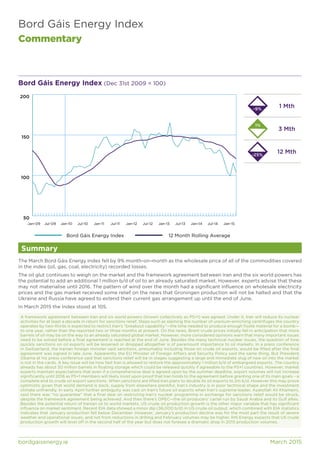
Bord Gáis Energy Index (Dec 31st 2009 = 100)
The March Bord Gáis Energy Index fell by 9% month-on-month as the wholesale price of all of the commodities covered
in the index (oil, gas, coal, electricity) recorded losses.
The oil glut continues to weigh on the market and the framework agreement between Iran and the six world powers has
the potential to add an additional 1 million b/d of oil to an already saturated market. However, experts advise that these
may not materialise until 2016. The pattern of wind over the month had a significant influence on wholesale electricity
prices and the gas market received some relief on the news that Groningen production will not be halted and that the
Ukraine and Russia have agreed to extend their current gas arrangement up until the end of June.
In March 2015 the Index stood at 105.
A framework agreement between Iran and six world powers (known collectively as P5+1) was agreed. Under it, Iran will reduce its nuclear
activities for at least a decade in return for sanctions relief. Steps such as slashing the number of uranium-enriching centrifuges the country
operates by two-thirds is expected to restrict Iran’s “breakout capability”—the time needed to produce enough fissile material for a bomb—
to one year, rather than the reported two or three months at present. On the news, Brent crude prices initially fell in anticipation that more
barrels of oil may be on the way to an already saturated global market. However, more considered opinions warn that many important issues
need to be solved before a final agreement is reached at the end of June. Besides the many technical nuclear issues, the question of how
quickly sanctions on oil exports will be lessened or dropped altogether is of paramount importance to oil markets. In a press conference
in Switzerland, the Iranian foreign minister said sanctions, presumably including those on crude oil exports, would be lifted after the final
agreement was signed in late June. Apparently the EU Minister of Foreign Affairs and Security Policy said the same thing. But President
Obama at his press conference said that sanctions relief will be in stages suggesting a large and immediate slug of new oil into the market
is not in the cards. A key issue will be how fast Iran is allowed to restore the approximately 1 million b/d of embargoed exports. The country
already has about 30 million barrels in floating storage which could be released quickly if agreeable to the P5+1 countries. However, market
experts maintain expectations that even if a comprehensive deal is agreed upon by the summer deadline, export volumes will not increase
significantly until 2016 as P5+1 members will likely insist upon proof that Iran holds to the agreement before granting one of its main goals – a
complete end to crude oil export sanctions. When sanctions are lifted Iran plans to double its oil exports to 2m b/d. However this may prove
optimistic given that world demand is slack, supply from elsewhere plentiful, Iran’s industry is in poor technical shape and the investment
climate unfriendly. In early April further ambiguity was cast on Iran’s future oil exports when Iran’s supreme leader, Ayatollah Ali Khameini,
said there was “no guarantee” that a final deal on restricting Iran’s nuclear programme in exchange for sanctions relief would be struck,
despite the framework agreement being achieved. And then there’s OPEC—the oil producers’ cartel run by Saudi Arabia and its Gulf allies.
Besides the potential return of Iranian oil to world markets, US crude oil production growth is the other major variable that has significant
influence on market sentiment. Recent EIA data showed a minor dip (36,000 b/d) in US crude oil output, which combined with EIA statistics
indicates that January production fell below December. However, January’s production decline was for the most part the result of severe
weather and operational issues, and not from reductions in drilling and February volumes may be higher. IHS Energy expects that US crude
production growth will level off in the second half of the year but does not foresee a dramatic drop in 2015 production volumes.
Summary
1 Mth
3 Mth
12 Mth
Bord Gáis Energy Index 12 Month Rolling Average
50
100
150
200
Jan-15Jul-14Jan-14Jul-13Jan-13Jul-12Jan-12Jul-11Jan-11Jul-10Jan-10Jul-09Jan-09
-25%
-9%
1%
Bord Gáis Energy Index
Commentary
bordgaisenergy.ie	 March 2015
Oil Index
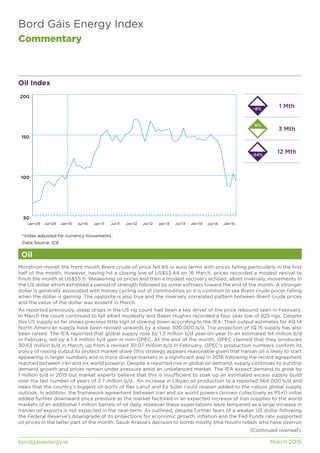
Month-on-month the front month Brent crude oil price fell 8% in euro terms with prices falling particularly in the first
half of the month. However, having hit a closing low of US$53.44 on 16 March, prices recorded a modest revival to
finish the month at US$55.11. Weakening oil prices and then a modest recovery echoed, albeit inversely, movements in
the US dollar which exhibited a period of strength followed by some softness toward the end of the month. A stronger
dollar is generally associated with money cycling out of commodities so it is common to see Brent crude prices falling
when the dollar is gaining. The opposite is also true and the inversely correlated pattern between Brent crude prices
and the value of the dollar was evident in March.
As reported previously, steep drops in the US rig count had been a key driver of the price rebound seen in February.
In March the count continued to fall albeit modestly and Baker Hughes recorded a four year low of 825 rigs. Despite
this US supply so far shows precious little sign of slowing down according to the IEA. Their output estimates for 4Q 14
North American supply have been revised upwards by a steep 300,000 b/d. The projection of 1Q 15 supply has also
been raised. The IEA reported that global supply rose by 1.3 million b/d year-on-year to an estimated 94 million b/d
in February, led by a 1.4 million b/d gain in non-OPEC. At the end of the month, OPEC claimed that they produced
30.63 million b/d in March, up from a revised 30.07 million b/d in February. OPEC’s production numbers confirm its
policy of raising output to protect market share (this strategy appears reasonable given that Iranian oil is likely to start
appearing in larger numbers and in more diverse markets in a significant way in 2016 following the recent agreement
reached between Iran and six world powers). Despite a reported rise in global oil demand, supply continues to outstrip
demand growth and prices remain under pressure amid an unbalanced market. The IEA expect demand to grow by
1 million b/d in 2015 but market experts believe that this is insufficient to soak up an estimated excess supply build
over the last number of years of 3.7 million b/d. An increase in Libyan oil production to a reported 564,000 b/d and
news that the country’s biggest oil ports of Ras Lanuf and Es Sider could reopen added to the robust global supply
outlook. In addition, the framework agreement between Iran and six world powers (known collectively as P5+1) initial
added further downward price pressure as the market factored in an expected increase of Iran supplies to the world
markets of an additional 1 million barrels of oil daily. However these expectations were tempered as a large increase in
Iranian oil exports is not expected in the near-term. As outlined, despite further fears of a weaker US dollar following
the Federal Reserve’s downgrade of its projections for economic growth, inflation and the Fed Funds rate supported
oil prices in the latter part of the month. Saudi Arabia’s decision to bomb mostly Shia Houthi rebels who have overrun
50
100
150
200
Jan-15Jul-14Jan-14Jul-13Jan-13Jul-12Jan-12Jul-11Jan-11Jul-10Jan-10Jul-09Jan-09
Oil
*Index adjusted for currency movements.
Data Source: ICE
1 Mth
3 Mth
12 Mth
-8%
-34%
8%
(Continued overleaf)
Bord Gáis Energy Index
Commentary
bordgaisenergy.ie	 March 2015
Oil Index (continued)
much of Yemen toward the end of the month highlighted the deepening sectarian conflict that is being played out
in the Middle East. The conflict in Yemen has intensified the rivalry between Saudi Arabia and Iran and the market is
concerned, as evidenced by rising oil prices, that this could destabilise global supplies if it continues.
Bord Gáis Energy Index
Commentary
bordgaisenergy.ie	 March 2015
Natural Gas Index
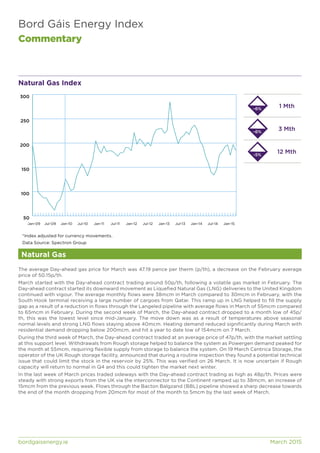
The average Day-ahead gas price for March was 47.19 pence per therm (p/th), a decrease on the February average
price of 50.15p/th.
March started with the Day-ahead contract trading around 50p/th, following a volatile gas market in February. The
Day-ahead contract started its downward movement as Liquefied Natural Gas (LNG) deliveries to the United Kingdom
continued with vigour. The average monthly flows were 38mcm in March compared to 30mcm in February, with the
South Hook terminal receiving a large number of cargoes from Qatar. This ramp up in LNG helped to fill the supply
gap as a result of a reduction in flows through the Langeled pipeline with average flows in March of 55mcm compared
to 65mcm in February. During the second week of March, the Day-ahead contract dropped to a month low of 45p/
th, this was the lowest level since mid-January. The move down was as a result of temperatures above seasonal
normal levels and strong LNG flows staying above 40mcm. Heating demand reduced significantly during March with
residential demand dropping below 200mcm, and hit a year to date low of 154mcm on 7 March.
During the third week of March, the Day-ahead contract traded at an average price of 47p/th, with the market settling
at this support level. Withdrawals from Rough storage helped to balance the system as Powergen demand peaked for
the month at 55mcm, requiring flexible supply from storage to balance the system. On 19 March Centrica Storage, the
operator of the UK Rough storage facility, announced that during a routine inspection they found a potential technical
issue that could limit the stock in the reservoir by 25%. This was verified on 26 March. It is now uncertain if Rough
capacity will return to normal in Q4 and this could tighten the market next winter.
In the last week of March prices traded sideways with the Day-ahead contract trading as high as 48p/th. Prices were
steady with strong exports from the UK via the interconnector to the Continent ramped up to 38mcm, an increase of
15mcm from the previous week. Flows through the Bacton Balgzand (BBL) pipeline showed a sharp decrease towards
the end of the month dropping from 20mcm for most of the month to 5mcm by the last week of March.
50
100
150
200
250
300
Jan-15Jul-14Jan-14Jul-13Jan-13Jul-12Jan-12Jul-11Jan-11Jul-10Jan-10Jul-09Jan-09
Natural Gas
1 Mth
3 Mth
12 Mth-5%
-6%
-6%
*Index adjusted for currency movements.
Data Source: Spectron Group
Bord Gáis Energy Index
Commentary
bordgaisenergy.ie	 March 2015
Coal Index
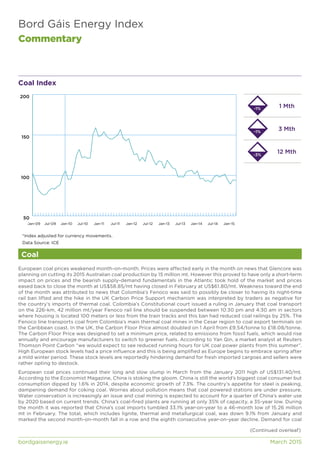
European coal prices weakened month-on-month. Prices were affected early in the month on news that Glencore was
planning on cutting its 2015 Australian coal production by 15 million mt. However this proved to have only a short-term
impact on prices and the bearish supply-demand fundamentals in the Atlantic took hold of the market and prices
eased back to close the month at US$58.85/mt having closed in February at US$61.80/mt. Weakness toward the end
of the month was attributed to news that Colombia’s Fenoco was said to possibly be closer to having its night-time
rail ban lifted and the hike in the UK Carbon Price Support mechanism was interpreted by traders as negative for
the country’s imports of thermal coal. Colombia’s Constitutional court issued a ruling in January that coal transport
on the 226-km, 42 million mt/year Fenoco rail line should be suspended between 10:30 pm and 4:30 am in sectors
where housing is located 100 meters or less from the train tracks and this ban had reduced coal railings by 25%. The
Fenoco line transports coal from Colombia’s main thermal coal mines in the Cesar region to coal export terminals on
the Caribbean coast. In the UK, the Carbon Floor Price almost doubled on 1 April from £9.54/tonne to £18.08/tonne.
The Carbon Floor Price was designed to set a minimum price, related to emissions from fossil fuels, which would rise
annually and encourage manufacturers to switch to greener fuels. According to Yan Qin, a market analyst at Reuters
Thomson Point Carbon “we would expect to see reduced running hours for UK coal power plants from this summer”.
High European stock levels had a price influence and this is being amplified as Europe begins to embrace spring after
a mild winter period. These stock levels are reportedly hindering demand for fresh imported cargoes and sellers were
rather opting to destock.
European coal prices continued their long and slow slump in March from the January 2011 high of US$131.40/mt.
According to the Economist Magazine, China is stoking the gloom. China is still the world’s biggest coal consumer but
consumption dipped by 1.6% in 2014, despite economic growth of 7.3%. The country’s appetite for steel is peaking,
dampening demand for coking coal. Worries about pollution means that coal powered stations are under pressure.
Water conservation is increasingly an issue and coal mining is expected to account for a quarter of China’s water use
by 2020 based on current trends. China’s coal-fired plants are running at only 35% of capacity, a 35-year low. During
the month it was reported that China’s coal imports tumbled 33.1% year-on-year to a 46-month low of 15.26 million
mt in February. The total, which includes lignite, thermal and metallurgical coal, was down 9.1% from January and
marked the second month-on-month fall in a row and the eighth consecutive year-on-year decline. Demand for coal
50
100
150
200
Jan-15Jul-14Jan-14Jul-13Jan-13Jul-12Jan-12Jul-11Jan-11Jul-10Jan-10Jul-09Jan-09
Coal
1 Mth
3 Mth
12 Mth-3%
-1%
-1%
*Index adjusted for currency movements.
Data Source: ICE
(Continued overleaf)
Bord Gáis Energy Index
Commentary
bordgaisenergy.ie	 March 2015
Coal (continued)
in rich countries is also waning with cheap gas displacing coal in America and renewables are eating into its market
in Europe. In 2014 the world added more generation from wind power than coal. Political pressure is also growing
against the most carbon-intensive fossil fuel. Coal provides 40% of the world’s electricity. But of the reported 1,617GW
of global capacity, 75% is of the dirtiest kind, which burns coal at low temperatures and emits 75% more carbon
dioxide than the most advanced “ultra-supercritical” plants, which burn powdered coal at high temperatures.
Campaigners estimate that 80% of the world’s coal reserves must stay in the ground if the planet is to stand a chance
of keeping global warming under 2 degrees by 2050. Despite the pressure being placed on the coal industry, demand
for coal is still expected to rise and global demand may not peak until at least the 2030’s with emerging economies
expected to burn the black stuff to fuel their modernisation. Weak global coal prices ultimately reflect investor’s fears
that China will follow the rich world to phase out coal, that India will increasingly rely on its own production and that
plentiful supply of cheap gas will keep prices low.
Bord Gáis Energy Index
Commentary
bordgaisenergy.ie	 March 2015
Electricity Index
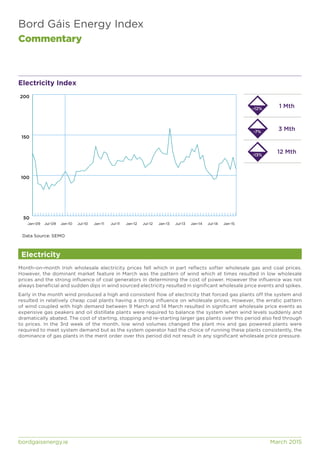
Month-on-month Irish wholesale electricity prices fell which in part reflects softer wholesale gas and coal prices.
However, the dominant market feature in March was the pattern of wind which at times resulted in low wholesale
prices and the strong influence of coal generators in determining the cost of power. However the influence was not
always beneficial and sudden dips in wind sourced electricity resulted in significant wholesale price events and spikes.
Early in the month wind produced a high and consistent flow of electricity that forced gas plants off the system and
resulted in relatively cheap coal plants having a strong influence on wholesale prices. However, the erratic pattern
of wind coupled with high demand between 9 March and 14 March resulted in significant wholesale price events as
expensive gas peakers and oil distillate plants were required to balance the system when wind levels suddenly and
dramatically abated. The cost of starting, stopping and re-starting larger gas plants over this period also fed through
to prices. In the 3rd week of the month, low wind volumes changed the plant mix and gas powered plants were
required to meet system demand but as the system operator had the choice of running these plants consistently, the
dominance of gas plants in the merit order over this period did not result in any significant wholesale price pressure.
50
100
150
200
Jan-15Jul-14Jan-14Jul-13Jan-13Jul-12Jan-12Jul-11Jan-11Jul-10Jan-10Jul-09Jan-09
Electricity
1 Mth
3 Mth
12 Mth
Data Source: SEMO
-12%
-7%
-13%
Bord Gáis Energy Index
Commentary
bordgaisenergy.ie	 March 2015
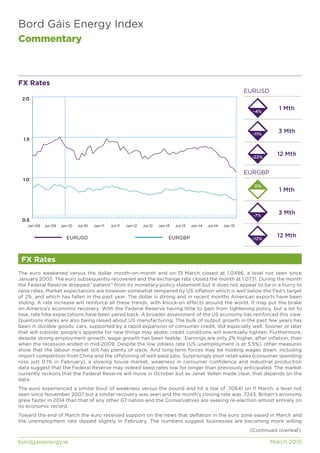
The euro weakened versus the dollar month-on-month and on 13 March closed at 1.0496, a level not seen since
January 2003. The euro subsequently recovered and the exchange rate closed the month at 1.0731. During the month
the Federal Reserve dropped “patient” from its monetary-policy statement but it does not appear to be in a hurry to
raise rates. Market expectations are however somewhat tempered by US inflation which is well below the Fed’s target
of 2%, and which has fallen in the past year. The dollar is strong and in recent months American exports have been
sliding. A rate increase will reinforce all these trends, with knock-on effects around the world. It may put the brake
on America’s economic recovery. With the Federal Reserve having little to gain from tightening policy, but a lot to
lose, rate hike expectations have been pared back. A broader assessment of the US economy has reinforced this view.
Questions marks are also being raised about US manufacturing. The bulk of output growth in the past few years has
been in durable goods: cars, supported by a rapid expansion of consumer credit, did especially well. Sooner or later
that will subside: people’s appetite for new things may abate; credit conditions will eventually tighten. Furthermore,
despite strong employment growth, wage growth has been feeble. Earnings are only 2% higher, after inflation, than
when the recession ended in mid-2009. Despite the low jobless rate (US unemployment is at 5.5%), other measures
show that the labour market still has plenty of slack. And long-term forces may be holding wages down, including
import competition from China and the offshoring of well-paid jobs. Surprisingly poor retail sales (consumer spending
rose just 0.1% in February), a slowing house market, weakness in consumer confidence and industrial production
data suggest that the Federal Reserve may indeed keep rates low for longer than previously anticipated. The market
currently reckons that the Federal Reserve will move in October but as Janet Yellen made clear, that depends on the
data.
The euro experienced a similar bout of weakness versus the pound and hit a low of .70641 on 11 March, a level not
seen since November 2007 but a similar recovery was seen and the month’s closing rate was .7243. Britain’s economy
grew faster in 2014 than that of any other G7 nation and the Conservatives are seeking re-election almost entirely on
its economic record.
Toward the end of March the euro received support on the news that deflation in the euro zone eased in March and
the unemployment rate dipped slightly in February. The numbers suggest businesses are becoming more willing
0.5
1.0
1.5
2.0
Jan-15Jul-14Jan-14Jul-13Jan-13Jul-12Jan-12Jul-11Jan-11Jul-10Jan-10Jul-09Jan-09
FX Rates
FX Rates
EURUSD
EURGBP
1 Mth
3 Mth
12 Mth
1 Mth
3 Mth
12 Mth
-4%
-11%
-22%
-12%
-7%
EURUSD EURGBP
0%
(Continued overleaf)
Bord Gáis Energy Index
Commentary
bordgaisenergy.ie	 March 2015
FX Rates (continued)
to step up hiring encouraged by low oil prices, a markedly weaker euro and a major stimulus from the European
Central Bank. Indeed, business across the region reported the strongest rise in activity in nearly four years in March.
Data from the euro zone indicate that an economic recovery is finally under way. The unemployment edged down
to 11.3% in February, the lowest since May 2012, from a revised 11.4% in January. And prices have just about stopped
falling: March’s inflation rate was -0.1%, after February’s -0.3% and January’s -0.6%. Confidence is also picking
up. The European Commission’s economic sentiment index for March was the highest since July 2011. A gauge of
output in manufacturing and services compiled by Markit, a data research firm, hit a 46-month high. Judging by
the commission’s index, the recovery is being led by consumers, who are enjoying lower energy bills. The European
Central Bank’s quantitative-easing programme is kicking in, too. Europe is scarcely roaring, but it is at least reviving.
Bord Gáis Energy Index
Commentary
bordgaisenergy.ie	 March 2015
Market Outlook
The outlook for UK gas prices could be strongly influenced by restrictions at Rough, Groningen production and
unusually heavy maintenance scheduled on Norwegian assets in Q2. During the coming summer season, storage
capacity at Rough will be reduced by 25% or a maximum of 950mcm from its current 3.7bcm. The duration of this
limitation is said to be up to six months. With less gas going into storage this summer, it is being estimated that
over the three peak winter months there may be 8mcm less gas available from Rough (assuming that 750mcm
were not injected due to the drop in capacity). Rough is by far the most important storage facility in the UK and it
is reported that the operator, Centrica, is being forced to limit maximum operating pressure for technical reasons.
The UK gas market reacted when the news broke and prices went up further when it was confirmed. Whether
a reduced Rough has an impact on prices in winter 15/16 will depend on many variables. Gas markets were
somewhat relieved on the news that the Dutch judge hearing an appeal against the government’s Groningen gas
extraction policy said he has no plans to order a complete halt to production from the field. The statement came
as the Netherlands’ top administrative court, the Council of State, heard evidence in early April from opponents
and proponents of Economic Affairs Minister Henk Kamp’s decision last December to limit Groningen production
to 39.4bcm for 2015 and 2016. The court will make a preliminary decision by 15 April on whether to halt production
from the Groningen gas field in response to the appeals. The appellants are calling for all production from
Groningen to be provisionally halted. As the UK system imports gas from the Netherlands via the BBL pipeline, the
market will await the Council of States preliminary decision. Further relief was provided on the news that Russian
President Vladimir Putin and Prime Minister Dmitry Medvedev endorsed an extension of a US$100 discount per
thousand cubic meters for Russian supplies until at least the end of the second quarter. The temporary winter
supply deal expired at the end of March. Ukraine’s energy ministry said Kiev would buy Russian gas at US$248
per thousand cubic meters during the April-June quarter while. This compares with US$329 per thousand cubic
meters which it has been paying under a “winter package”. The interim deal will provide a breathing space for
both sides in their protracted wrangle over pricing. The European Union will host the next round of gas talks
between Ukraine and Russia on 14 April in Berlin.
On oil, there is a view that prices could rise given that the rig count decline has started to slow, that US production
is under pressure, that extra Iranian oil will not appear in the market to any great extent until 2016, if at all, that
Saudi Arabia’s recent price rise for oil going to Asia reflects higher refinery demand and given the mounting
geopolitical pressures in the Middle East. However, it is not clear whether these factors are enough to dismiss the
glut of oil that currently exists which is holding global oil prices down.
Bord Gáis Energy Index
Commentary
bordgaisenergy.ie	 March 2015
The contents of this report are provided solely as an information guide. The report is presented to you “as is” and may or may not be correct, current,
accurate or complete. While every effort is made in preparing material for publication no responsibility is accepted by or on behalf of Bord Gáis
Energy Limited, the SEMO, ICE Futures Europe, the Sustainable Energy Authority of Ireland or Spectron Group Limited (together, the “Parties”) for
any errors, omissions or misleading statements within this report. No representation or warranty, express or implied, is made or liability accepted by
any of the Parties or any of their respective directors, employees or agents in relation to the accuracy or completeness of the information contained
in this report. Each of the Parties and their respective directors, employees or agents does not and will not accept any liability in relation to the
information contained in this report. Bord Gáis Energy Limited reserves the right at any time to revise, amend, alter or delete the information provided
in this report.
For more information please contact:
Bord Gáis Energy	 Pressoffice@bge.ie
				 or Alan Tyrrell at PSG Plus 086 850 8673
Re-weighting of Bord Gáis Energy Index
Following the SEAI’s 2011 review of energy consumption in
Ireland, there was a 6.4% drop in overall energy consumption.
Oil continues to be the dominant energy source with most
of the oil used in transport and the remainder being used for
thermal energy. For the purposes of the Bord Gáis Energy
Index, the total final energy consumption in Ireland fell 1,089
ktoe (toe: a tonne of oil equivalent is a unit of energy, roughly
equivalent to the energy content of one tonne of crude oil)
between 2009 and 2011. This fall was made up of a 1,022
ktoe drop in oil consumption (down 13.5%), a 20 ktoe drop in
natural gas (down 12.6%), a 7 ktoe drop in electricity (down
0.3%) and a 40 ktoe drop in coal (down 10.98%). The Bord
Gáis Energy Index has been re-weighted in January 2013 to
reflect the latest consumption data. The impact has been
minimal and has resulted in slight reductions in the share of oil
and gas and a slight increase in the weighting of electricity in
the overall Index.
Oil
61.96%
Gas
14.72%
Coal
3.1%Electricity
20.22%

Bord Gáis Energy Index March 2015

  • 1.
    MARCH 2015 Bord Gáis EnergyIndex Understanding energy BGE/EI/UE/0415
  • 2.
    Bord Gáis EnergyIndex Commentary bordgaisenergy.ie March 2015 Bord Gáis Energy Index (Dec 31st 2009 = 100) The March Bord Gáis Energy Index fell by 9% month-on-month as the wholesale price of all of the commodities covered in the index (oil, gas, coal, electricity) recorded losses. The oil glut continues to weigh on the market and the framework agreement between Iran and the six world powers has the potential to add an additional 1 million b/d of oil to an already saturated market. However, experts advise that these may not materialise until 2016. The pattern of wind over the month had a significant influence on wholesale electricity prices and the gas market received some relief on the news that Groningen production will not be halted and that the Ukraine and Russia have agreed to extend their current gas arrangement up until the end of June. In March 2015 the Index stood at 105. A framework agreement between Iran and six world powers (known collectively as P5+1) was agreed. Under it, Iran will reduce its nuclear activities for at least a decade in return for sanctions relief. Steps such as slashing the number of uranium-enriching centrifuges the country operates by two-thirds is expected to restrict Iran’s “breakout capability”—the time needed to produce enough fissile material for a bomb— to one year, rather than the reported two or three months at present. On the news, Brent crude prices initially fell in anticipation that more barrels of oil may be on the way to an already saturated global market. However, more considered opinions warn that many important issues need to be solved before a final agreement is reached at the end of June. Besides the many technical nuclear issues, the question of how quickly sanctions on oil exports will be lessened or dropped altogether is of paramount importance to oil markets. In a press conference in Switzerland, the Iranian foreign minister said sanctions, presumably including those on crude oil exports, would be lifted after the final agreement was signed in late June. Apparently the EU Minister of Foreign Affairs and Security Policy said the same thing. But President Obama at his press conference said that sanctions relief will be in stages suggesting a large and immediate slug of new oil into the market is not in the cards. A key issue will be how fast Iran is allowed to restore the approximately 1 million b/d of embargoed exports. The country already has about 30 million barrels in floating storage which could be released quickly if agreeable to the P5+1 countries. However, market experts maintain expectations that even if a comprehensive deal is agreed upon by the summer deadline, export volumes will not increase significantly until 2016 as P5+1 members will likely insist upon proof that Iran holds to the agreement before granting one of its main goals – a complete end to crude oil export sanctions. When sanctions are lifted Iran plans to double its oil exports to 2m b/d. However this may prove optimistic given that world demand is slack, supply from elsewhere plentiful, Iran’s industry is in poor technical shape and the investment climate unfriendly. In early April further ambiguity was cast on Iran’s future oil exports when Iran’s supreme leader, Ayatollah Ali Khameini, said there was “no guarantee” that a final deal on restricting Iran’s nuclear programme in exchange for sanctions relief would be struck, despite the framework agreement being achieved. And then there’s OPEC—the oil producers’ cartel run by Saudi Arabia and its Gulf allies. Besides the potential return of Iranian oil to world markets, US crude oil production growth is the other major variable that has significant influence on market sentiment. Recent EIA data showed a minor dip (36,000 b/d) in US crude oil output, which combined with EIA statistics indicates that January production fell below December. However, January’s production decline was for the most part the result of severe weather and operational issues, and not from reductions in drilling and February volumes may be higher. IHS Energy expects that US crude production growth will level off in the second half of the year but does not foresee a dramatic drop in 2015 production volumes. Summary 1 Mth 3 Mth 12 Mth Bord Gáis Energy Index 12 Month Rolling Average 50 100 150 200 Jan-15Jul-14Jan-14Jul-13Jan-13Jul-12Jan-12Jul-11Jan-11Jul-10Jan-10Jul-09Jan-09 -25% -9% 1%
  • 3.
    Bord Gáis EnergyIndex Commentary bordgaisenergy.ie March 2015 Oil Index Month-on-month the front month Brent crude oil price fell 8% in euro terms with prices falling particularly in the first half of the month. However, having hit a closing low of US$53.44 on 16 March, prices recorded a modest revival to finish the month at US$55.11. Weakening oil prices and then a modest recovery echoed, albeit inversely, movements in the US dollar which exhibited a period of strength followed by some softness toward the end of the month. A stronger dollar is generally associated with money cycling out of commodities so it is common to see Brent crude prices falling when the dollar is gaining. The opposite is also true and the inversely correlated pattern between Brent crude prices and the value of the dollar was evident in March. As reported previously, steep drops in the US rig count had been a key driver of the price rebound seen in February. In March the count continued to fall albeit modestly and Baker Hughes recorded a four year low of 825 rigs. Despite this US supply so far shows precious little sign of slowing down according to the IEA. Their output estimates for 4Q 14 North American supply have been revised upwards by a steep 300,000 b/d. The projection of 1Q 15 supply has also been raised. The IEA reported that global supply rose by 1.3 million b/d year-on-year to an estimated 94 million b/d in February, led by a 1.4 million b/d gain in non-OPEC. At the end of the month, OPEC claimed that they produced 30.63 million b/d in March, up from a revised 30.07 million b/d in February. OPEC’s production numbers confirm its policy of raising output to protect market share (this strategy appears reasonable given that Iranian oil is likely to start appearing in larger numbers and in more diverse markets in a significant way in 2016 following the recent agreement reached between Iran and six world powers). Despite a reported rise in global oil demand, supply continues to outstrip demand growth and prices remain under pressure amid an unbalanced market. The IEA expect demand to grow by 1 million b/d in 2015 but market experts believe that this is insufficient to soak up an estimated excess supply build over the last number of years of 3.7 million b/d. An increase in Libyan oil production to a reported 564,000 b/d and news that the country’s biggest oil ports of Ras Lanuf and Es Sider could reopen added to the robust global supply outlook. In addition, the framework agreement between Iran and six world powers (known collectively as P5+1) initial added further downward price pressure as the market factored in an expected increase of Iran supplies to the world markets of an additional 1 million barrels of oil daily. However these expectations were tempered as a large increase in Iranian oil exports is not expected in the near-term. As outlined, despite further fears of a weaker US dollar following the Federal Reserve’s downgrade of its projections for economic growth, inflation and the Fed Funds rate supported oil prices in the latter part of the month. Saudi Arabia’s decision to bomb mostly Shia Houthi rebels who have overrun 50 100 150 200 Jan-15Jul-14Jan-14Jul-13Jan-13Jul-12Jan-12Jul-11Jan-11Jul-10Jan-10Jul-09Jan-09 Oil *Index adjusted for currency movements. Data Source: ICE 1 Mth 3 Mth 12 Mth -8% -34% 8% (Continued overleaf)
  • 4.
    Bord Gáis EnergyIndex Commentary bordgaisenergy.ie March 2015 Oil Index (continued) much of Yemen toward the end of the month highlighted the deepening sectarian conflict that is being played out in the Middle East. The conflict in Yemen has intensified the rivalry between Saudi Arabia and Iran and the market is concerned, as evidenced by rising oil prices, that this could destabilise global supplies if it continues.
  • 5.
    Bord Gáis EnergyIndex Commentary bordgaisenergy.ie March 2015 Natural Gas Index The average Day-ahead gas price for March was 47.19 pence per therm (p/th), a decrease on the February average price of 50.15p/th. March started with the Day-ahead contract trading around 50p/th, following a volatile gas market in February. The Day-ahead contract started its downward movement as Liquefied Natural Gas (LNG) deliveries to the United Kingdom continued with vigour. The average monthly flows were 38mcm in March compared to 30mcm in February, with the South Hook terminal receiving a large number of cargoes from Qatar. This ramp up in LNG helped to fill the supply gap as a result of a reduction in flows through the Langeled pipeline with average flows in March of 55mcm compared to 65mcm in February. During the second week of March, the Day-ahead contract dropped to a month low of 45p/ th, this was the lowest level since mid-January. The move down was as a result of temperatures above seasonal normal levels and strong LNG flows staying above 40mcm. Heating demand reduced significantly during March with residential demand dropping below 200mcm, and hit a year to date low of 154mcm on 7 March. During the third week of March, the Day-ahead contract traded at an average price of 47p/th, with the market settling at this support level. Withdrawals from Rough storage helped to balance the system as Powergen demand peaked for the month at 55mcm, requiring flexible supply from storage to balance the system. On 19 March Centrica Storage, the operator of the UK Rough storage facility, announced that during a routine inspection they found a potential technical issue that could limit the stock in the reservoir by 25%. This was verified on 26 March. It is now uncertain if Rough capacity will return to normal in Q4 and this could tighten the market next winter. In the last week of March prices traded sideways with the Day-ahead contract trading as high as 48p/th. Prices were steady with strong exports from the UK via the interconnector to the Continent ramped up to 38mcm, an increase of 15mcm from the previous week. Flows through the Bacton Balgzand (BBL) pipeline showed a sharp decrease towards the end of the month dropping from 20mcm for most of the month to 5mcm by the last week of March. 50 100 150 200 250 300 Jan-15Jul-14Jan-14Jul-13Jan-13Jul-12Jan-12Jul-11Jan-11Jul-10Jan-10Jul-09Jan-09 Natural Gas 1 Mth 3 Mth 12 Mth-5% -6% -6% *Index adjusted for currency movements. Data Source: Spectron Group
  • 6.
    Bord Gáis EnergyIndex Commentary bordgaisenergy.ie March 2015 Coal Index European coal prices weakened month-on-month. Prices were affected early in the month on news that Glencore was planning on cutting its 2015 Australian coal production by 15 million mt. However this proved to have only a short-term impact on prices and the bearish supply-demand fundamentals in the Atlantic took hold of the market and prices eased back to close the month at US$58.85/mt having closed in February at US$61.80/mt. Weakness toward the end of the month was attributed to news that Colombia’s Fenoco was said to possibly be closer to having its night-time rail ban lifted and the hike in the UK Carbon Price Support mechanism was interpreted by traders as negative for the country’s imports of thermal coal. Colombia’s Constitutional court issued a ruling in January that coal transport on the 226-km, 42 million mt/year Fenoco rail line should be suspended between 10:30 pm and 4:30 am in sectors where housing is located 100 meters or less from the train tracks and this ban had reduced coal railings by 25%. The Fenoco line transports coal from Colombia’s main thermal coal mines in the Cesar region to coal export terminals on the Caribbean coast. In the UK, the Carbon Floor Price almost doubled on 1 April from £9.54/tonne to £18.08/tonne. The Carbon Floor Price was designed to set a minimum price, related to emissions from fossil fuels, which would rise annually and encourage manufacturers to switch to greener fuels. According to Yan Qin, a market analyst at Reuters Thomson Point Carbon “we would expect to see reduced running hours for UK coal power plants from this summer”. High European stock levels had a price influence and this is being amplified as Europe begins to embrace spring after a mild winter period. These stock levels are reportedly hindering demand for fresh imported cargoes and sellers were rather opting to destock. European coal prices continued their long and slow slump in March from the January 2011 high of US$131.40/mt. According to the Economist Magazine, China is stoking the gloom. China is still the world’s biggest coal consumer but consumption dipped by 1.6% in 2014, despite economic growth of 7.3%. The country’s appetite for steel is peaking, dampening demand for coking coal. Worries about pollution means that coal powered stations are under pressure. Water conservation is increasingly an issue and coal mining is expected to account for a quarter of China’s water use by 2020 based on current trends. China’s coal-fired plants are running at only 35% of capacity, a 35-year low. During the month it was reported that China’s coal imports tumbled 33.1% year-on-year to a 46-month low of 15.26 million mt in February. The total, which includes lignite, thermal and metallurgical coal, was down 9.1% from January and marked the second month-on-month fall in a row and the eighth consecutive year-on-year decline. Demand for coal 50 100 150 200 Jan-15Jul-14Jan-14Jul-13Jan-13Jul-12Jan-12Jul-11Jan-11Jul-10Jan-10Jul-09Jan-09 Coal 1 Mth 3 Mth 12 Mth-3% -1% -1% *Index adjusted for currency movements. Data Source: ICE (Continued overleaf)
  • 7.
    Bord Gáis EnergyIndex Commentary bordgaisenergy.ie March 2015 Coal (continued) in rich countries is also waning with cheap gas displacing coal in America and renewables are eating into its market in Europe. In 2014 the world added more generation from wind power than coal. Political pressure is also growing against the most carbon-intensive fossil fuel. Coal provides 40% of the world’s electricity. But of the reported 1,617GW of global capacity, 75% is of the dirtiest kind, which burns coal at low temperatures and emits 75% more carbon dioxide than the most advanced “ultra-supercritical” plants, which burn powdered coal at high temperatures. Campaigners estimate that 80% of the world’s coal reserves must stay in the ground if the planet is to stand a chance of keeping global warming under 2 degrees by 2050. Despite the pressure being placed on the coal industry, demand for coal is still expected to rise and global demand may not peak until at least the 2030’s with emerging economies expected to burn the black stuff to fuel their modernisation. Weak global coal prices ultimately reflect investor’s fears that China will follow the rich world to phase out coal, that India will increasingly rely on its own production and that plentiful supply of cheap gas will keep prices low.
  • 8.
    Bord Gáis EnergyIndex Commentary bordgaisenergy.ie March 2015 Electricity Index Month-on-month Irish wholesale electricity prices fell which in part reflects softer wholesale gas and coal prices. However, the dominant market feature in March was the pattern of wind which at times resulted in low wholesale prices and the strong influence of coal generators in determining the cost of power. However the influence was not always beneficial and sudden dips in wind sourced electricity resulted in significant wholesale price events and spikes. Early in the month wind produced a high and consistent flow of electricity that forced gas plants off the system and resulted in relatively cheap coal plants having a strong influence on wholesale prices. However, the erratic pattern of wind coupled with high demand between 9 March and 14 March resulted in significant wholesale price events as expensive gas peakers and oil distillate plants were required to balance the system when wind levels suddenly and dramatically abated. The cost of starting, stopping and re-starting larger gas plants over this period also fed through to prices. In the 3rd week of the month, low wind volumes changed the plant mix and gas powered plants were required to meet system demand but as the system operator had the choice of running these plants consistently, the dominance of gas plants in the merit order over this period did not result in any significant wholesale price pressure. 50 100 150 200 Jan-15Jul-14Jan-14Jul-13Jan-13Jul-12Jan-12Jul-11Jan-11Jul-10Jan-10Jul-09Jan-09 Electricity 1 Mth 3 Mth 12 Mth Data Source: SEMO -12% -7% -13%
  • 9.
    Bord Gáis EnergyIndex Commentary bordgaisenergy.ie March 2015 The euro weakened versus the dollar month-on-month and on 13 March closed at 1.0496, a level not seen since January 2003. The euro subsequently recovered and the exchange rate closed the month at 1.0731. During the month the Federal Reserve dropped “patient” from its monetary-policy statement but it does not appear to be in a hurry to raise rates. Market expectations are however somewhat tempered by US inflation which is well below the Fed’s target of 2%, and which has fallen in the past year. The dollar is strong and in recent months American exports have been sliding. A rate increase will reinforce all these trends, with knock-on effects around the world. It may put the brake on America’s economic recovery. With the Federal Reserve having little to gain from tightening policy, but a lot to lose, rate hike expectations have been pared back. A broader assessment of the US economy has reinforced this view. Questions marks are also being raised about US manufacturing. The bulk of output growth in the past few years has been in durable goods: cars, supported by a rapid expansion of consumer credit, did especially well. Sooner or later that will subside: people’s appetite for new things may abate; credit conditions will eventually tighten. Furthermore, despite strong employment growth, wage growth has been feeble. Earnings are only 2% higher, after inflation, than when the recession ended in mid-2009. Despite the low jobless rate (US unemployment is at 5.5%), other measures show that the labour market still has plenty of slack. And long-term forces may be holding wages down, including import competition from China and the offshoring of well-paid jobs. Surprisingly poor retail sales (consumer spending rose just 0.1% in February), a slowing house market, weakness in consumer confidence and industrial production data suggest that the Federal Reserve may indeed keep rates low for longer than previously anticipated. The market currently reckons that the Federal Reserve will move in October but as Janet Yellen made clear, that depends on the data. The euro experienced a similar bout of weakness versus the pound and hit a low of .70641 on 11 March, a level not seen since November 2007 but a similar recovery was seen and the month’s closing rate was .7243. Britain’s economy grew faster in 2014 than that of any other G7 nation and the Conservatives are seeking re-election almost entirely on its economic record. Toward the end of March the euro received support on the news that deflation in the euro zone eased in March and the unemployment rate dipped slightly in February. The numbers suggest businesses are becoming more willing 0.5 1.0 1.5 2.0 Jan-15Jul-14Jan-14Jul-13Jan-13Jul-12Jan-12Jul-11Jan-11Jul-10Jan-10Jul-09Jan-09 FX Rates FX Rates EURUSD EURGBP 1 Mth 3 Mth 12 Mth 1 Mth 3 Mth 12 Mth -4% -11% -22% -12% -7% EURUSD EURGBP 0% (Continued overleaf)
  • 10.
    Bord Gáis EnergyIndex Commentary bordgaisenergy.ie March 2015 FX Rates (continued) to step up hiring encouraged by low oil prices, a markedly weaker euro and a major stimulus from the European Central Bank. Indeed, business across the region reported the strongest rise in activity in nearly four years in March. Data from the euro zone indicate that an economic recovery is finally under way. The unemployment edged down to 11.3% in February, the lowest since May 2012, from a revised 11.4% in January. And prices have just about stopped falling: March’s inflation rate was -0.1%, after February’s -0.3% and January’s -0.6%. Confidence is also picking up. The European Commission’s economic sentiment index for March was the highest since July 2011. A gauge of output in manufacturing and services compiled by Markit, a data research firm, hit a 46-month high. Judging by the commission’s index, the recovery is being led by consumers, who are enjoying lower energy bills. The European Central Bank’s quantitative-easing programme is kicking in, too. Europe is scarcely roaring, but it is at least reviving.
  • 11.
    Bord Gáis EnergyIndex Commentary bordgaisenergy.ie March 2015 Market Outlook The outlook for UK gas prices could be strongly influenced by restrictions at Rough, Groningen production and unusually heavy maintenance scheduled on Norwegian assets in Q2. During the coming summer season, storage capacity at Rough will be reduced by 25% or a maximum of 950mcm from its current 3.7bcm. The duration of this limitation is said to be up to six months. With less gas going into storage this summer, it is being estimated that over the three peak winter months there may be 8mcm less gas available from Rough (assuming that 750mcm were not injected due to the drop in capacity). Rough is by far the most important storage facility in the UK and it is reported that the operator, Centrica, is being forced to limit maximum operating pressure for technical reasons. The UK gas market reacted when the news broke and prices went up further when it was confirmed. Whether a reduced Rough has an impact on prices in winter 15/16 will depend on many variables. Gas markets were somewhat relieved on the news that the Dutch judge hearing an appeal against the government’s Groningen gas extraction policy said he has no plans to order a complete halt to production from the field. The statement came as the Netherlands’ top administrative court, the Council of State, heard evidence in early April from opponents and proponents of Economic Affairs Minister Henk Kamp’s decision last December to limit Groningen production to 39.4bcm for 2015 and 2016. The court will make a preliminary decision by 15 April on whether to halt production from the Groningen gas field in response to the appeals. The appellants are calling for all production from Groningen to be provisionally halted. As the UK system imports gas from the Netherlands via the BBL pipeline, the market will await the Council of States preliminary decision. Further relief was provided on the news that Russian President Vladimir Putin and Prime Minister Dmitry Medvedev endorsed an extension of a US$100 discount per thousand cubic meters for Russian supplies until at least the end of the second quarter. The temporary winter supply deal expired at the end of March. Ukraine’s energy ministry said Kiev would buy Russian gas at US$248 per thousand cubic meters during the April-June quarter while. This compares with US$329 per thousand cubic meters which it has been paying under a “winter package”. The interim deal will provide a breathing space for both sides in their protracted wrangle over pricing. The European Union will host the next round of gas talks between Ukraine and Russia on 14 April in Berlin. On oil, there is a view that prices could rise given that the rig count decline has started to slow, that US production is under pressure, that extra Iranian oil will not appear in the market to any great extent until 2016, if at all, that Saudi Arabia’s recent price rise for oil going to Asia reflects higher refinery demand and given the mounting geopolitical pressures in the Middle East. However, it is not clear whether these factors are enough to dismiss the glut of oil that currently exists which is holding global oil prices down.
  • 12.
    Bord Gáis EnergyIndex Commentary bordgaisenergy.ie March 2015 The contents of this report are provided solely as an information guide. The report is presented to you “as is” and may or may not be correct, current, accurate or complete. While every effort is made in preparing material for publication no responsibility is accepted by or on behalf of Bord Gáis Energy Limited, the SEMO, ICE Futures Europe, the Sustainable Energy Authority of Ireland or Spectron Group Limited (together, the “Parties”) for any errors, omissions or misleading statements within this report. No representation or warranty, express or implied, is made or liability accepted by any of the Parties or any of their respective directors, employees or agents in relation to the accuracy or completeness of the information contained in this report. Each of the Parties and their respective directors, employees or agents does not and will not accept any liability in relation to the information contained in this report. Bord Gáis Energy Limited reserves the right at any time to revise, amend, alter or delete the information provided in this report. For more information please contact: Bord Gáis Energy Pressoffice@bge.ie or Alan Tyrrell at PSG Plus 086 850 8673 Re-weighting of Bord Gáis Energy Index Following the SEAI’s 2011 review of energy consumption in Ireland, there was a 6.4% drop in overall energy consumption. Oil continues to be the dominant energy source with most of the oil used in transport and the remainder being used for thermal energy. For the purposes of the Bord Gáis Energy Index, the total final energy consumption in Ireland fell 1,089 ktoe (toe: a tonne of oil equivalent is a unit of energy, roughly equivalent to the energy content of one tonne of crude oil) between 2009 and 2011. This fall was made up of a 1,022 ktoe drop in oil consumption (down 13.5%), a 20 ktoe drop in natural gas (down 12.6%), a 7 ktoe drop in electricity (down 0.3%) and a 40 ktoe drop in coal (down 10.98%). The Bord Gáis Energy Index has been re-weighted in January 2013 to reflect the latest consumption data. The impact has been minimal and has resulted in slight reductions in the share of oil and gas and a slight increase in the weighting of electricity in the overall Index. Oil 61.96% Gas 14.72% Coal 3.1%Electricity 20.22%