Storytelling through Visual Art and Music: An Integrative Approach to Teaching the Arts Dr. SHEI-CHAU WANG  [email_address] School of Art, Northern Illinois University Dr. JUI-CHING WANG  [email_address] School of Music, Northern Illinois University Illinois Art Education Association 2008 Conference, Galena, Illinois October 24, 2008
Rationale of the teaching project Conceptual framework A music-based sample lesson An art-based lesson Comparisons of Momotaro books A cultural study of Momotaro An extended study: Kabuki Conclusion
Interdisciplinary connections open up a possibility for comprehensive study while preserving the integrity and validity of a cultural learning experience. Music in young children’s development is an excellent carrier of information and can help children not only enhance their language arts experience but also increase their cultural awareness.
Cognitive development The combination of storytelling and music provides experiences that help children increase their attention span. For example, language arts objectives, such as prediction, sequencing, and auditory discrimination, are met through storytelling. Social-cultural development It provides opportunities that help children obtain important cultural information, such as values, taboos, and self-identity.
In an interview (Johnson, 1984), Jean E. Snyder shared her experiences in Zambia observing children’s music-making and said: “ The children learn values and taboos through story songs. Often grandmother is the storyteller, and the children participate through formalized response to the story and by singing the refrain of the song, which may be woven into the story several times. Stories warn girls not to marry a handsome stranger, teach the importance of hard work, warn future mothers not to mistreat orphans or the children of another wife, or show that the small but clever can outwit the strong.…”
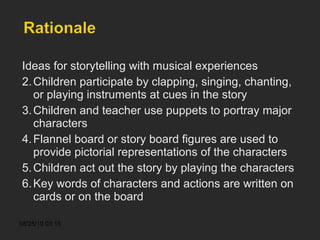
Ideas for storytelling with musical experiences Children participate by clapping, singing, chanting, or playing instruments at cues in the story Children and teacher use puppets to portray major characters Flannel board or story board figures are used to provide pictorial representations of the characters Children act out the story by playing the characters Key words of characters and actions are written on cards or on the board
Concept Mapping and the Lesson Framework Based on the Japanese folk tale Momotaro  (the Peach Boy)
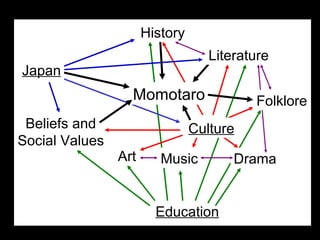
Art Music Literature Culture Education Drama History Momotaro Japan Beliefs and Social Values Folklore
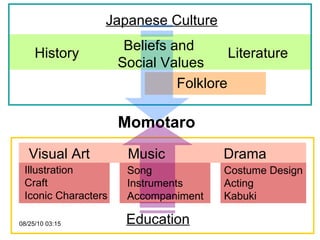
Visual Art Education Drama History Literature Japanese Culture Folklore Beliefs and  Social Values Momotaro Illustration Craft Iconic Characters Costume Design Acting Kabuki Song Instruments Accompaniment  Music
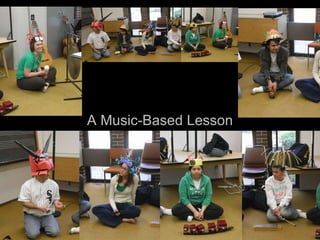
A Music-Based Lesson
Momotaro-San (peach boy) A Japanese folktale about a young boy’s adventure of fighting demons and his friendship with three creatures, the pheasant, dog, and monkey who helped him fight the demons. The origin of this story is not traceable; however, it appealed to the Samurai (the warrior) classes throughout Japanese history. Popular not only in Japan, this story is immensely popular throughout Asia.
General concepts: Courage  Cooperation Generosity  Cultural awareness Musical concepts: Functions of music in Japanese drama (Kabuki) Japanese pentatonic scale Integrated subjects: Literature/Drama Art
Objectives: Students will be able to learn the story of a courageous little warrior traditional Japanese cultural values of cooperation and generosity. a traditional Japanese children’s song. the construction of headdresses for each of the characters in the story. the integration of music, art, and drama.
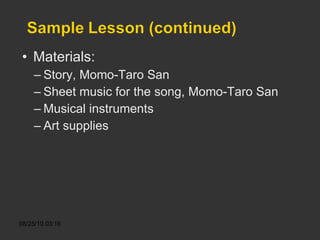
Materials: Story, Momo-Taro San Sheet music for the song, Momo-Taro San Musical instruments Art supplies
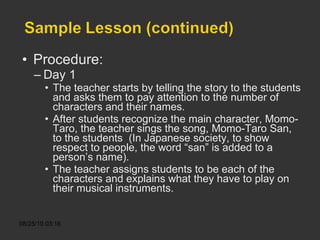
Procedure: Day 1 The teacher starts by telling the story to the students and asks them to pay attention to the number of characters and their names. After students recognize the main character, Momo-Taro, the teacher sings the song, Momo-Taro San, to the students  (In Japanese society, to show respect to people, the word “san” is added to a person’s name).  The teacher assigns students to be each of the characters and explains what they have to play on their musical instruments.
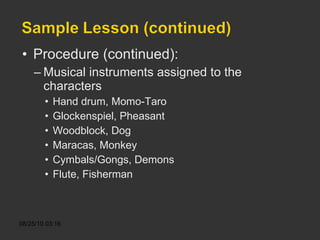
Procedure (continued): Musical instruments assigned to the characters Hand drum, Momo-Taro Glockenspiel, Pheasant Woodblock, Dog Maracas, Monkey Cymbals/Gongs, Demons Flute, Fisherman
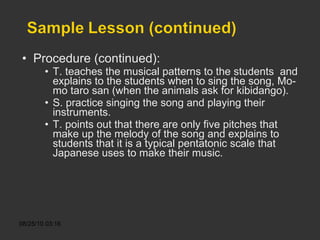
Procedure (continued): T. teaches the musical patterns to the students  and explains to the students when to sing the song, Mo-mo taro san (when the animals ask for kibidango). S. practice singing the song and playing their instruments. T. points out that there are only five pitches that make up the melody of the song and explains to students that it is a typical pentatonic scale that Japanese uses to make their music.
Day 2 T shows the students the illustrated story and asks them to make headdresses for their own characters. T asks the students to observe the illustrations of the characters and see if they can find any differences between themselves  and both the human characters and the creatures. T introduces the idea of “differences” in a multicultural society.  T encourage the students to come out with their own “creature” identity and use construction paper to make the headdresses for their creatures.
Closure T. asks students  to put on the headdresses they made to act out the story by incorporating the musical instruments  associated with each character.
Assessment: Visually check to see if students pay attention to the story Visually check to see the craftsmanship of the headdresses students make. Visually check to see if students play the instruments correctly Aurally check to see if students sing the song correctly (in tune, rhythm, and the pronunciation) Verbally check to see if students understand the concepts derived from this story
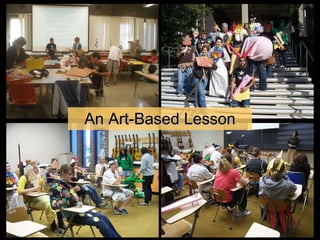
An Art-Based Lesson
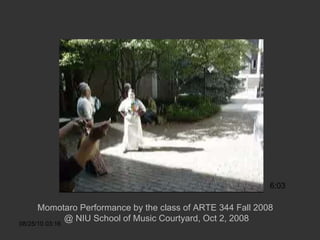
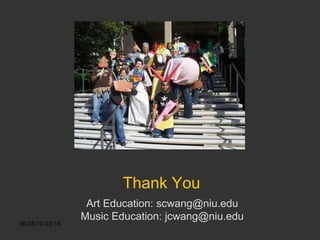
Momotaro Performance by the class of ARTE 344 Fall 2008  @ NIU School of Music Courtyard, Oct 2, 2008 6:03
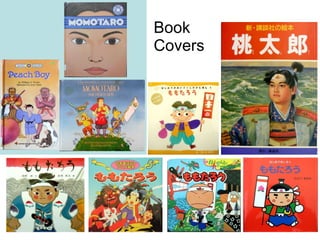
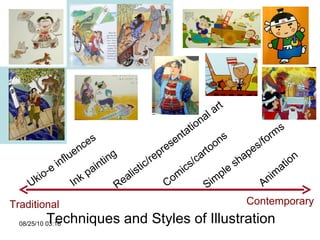
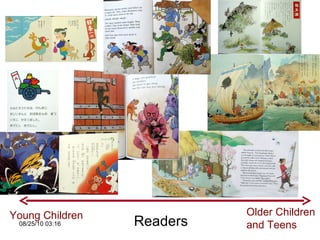
Comparisons of  Momotaro  Books American Versions   vs. Japanese Versions Book covers Scenes in the story Techniques and styles of illustration Readers
Book Covers
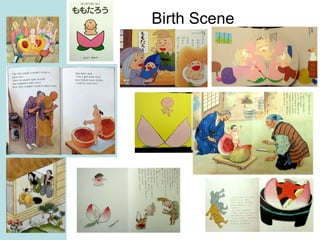
Birth Scene
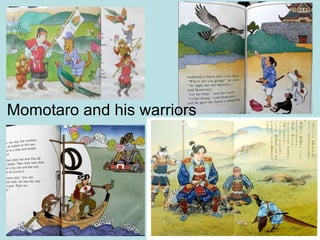
Momotaro and his warriors
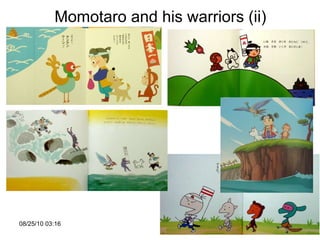
Momotaro and his warriors (ii)
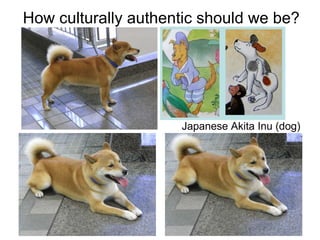
How culturally authentic should we be? Japanese Akita Inu (dog)
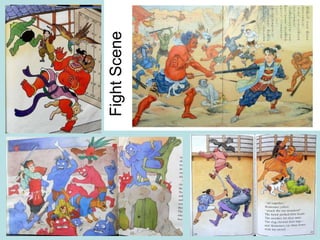
Fight Scene
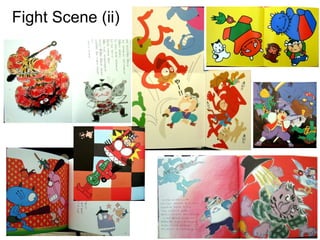
Fight Scene (ii)
Techniques and Styles of Illustration  Comics/cartoons Contemporary Traditional Simple shapes/forms Animation Ukio-e influences Ink painting Realistic/representational art
Readers  Older Children  and Teens Young Children
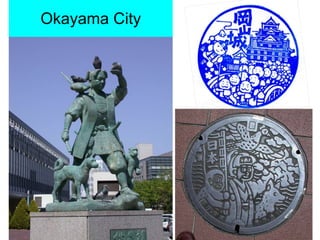
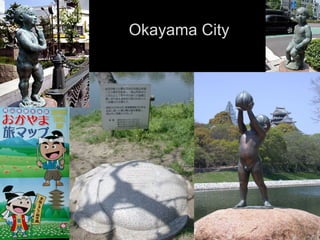
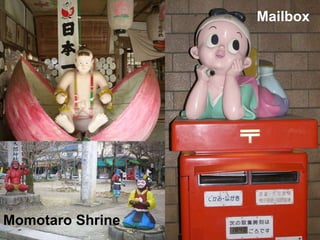
A Cultural Study of Momotaro Okayama City, Japan Food and Entertainment  Graphic Design and Illustration Art and Crafts
Okayama City
Okayama City
Momotaro Shrine Mailbox
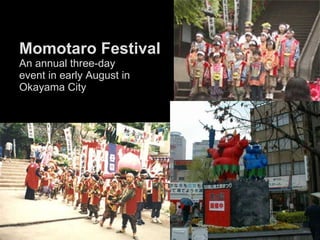
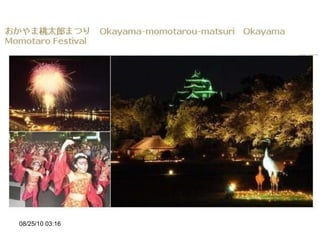
Momotaro Festival An annual three-day  event in early August in  Okayama City
 
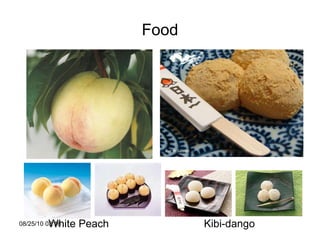
Food White Peach Kibi-dango
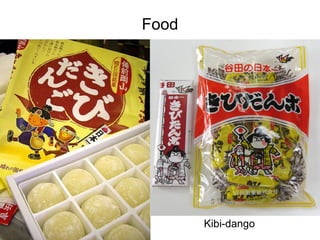
Food Kibi-dango
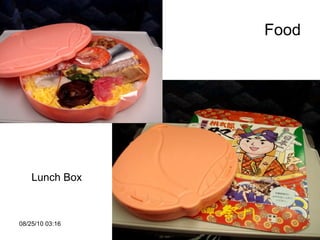
Food Lunch Box
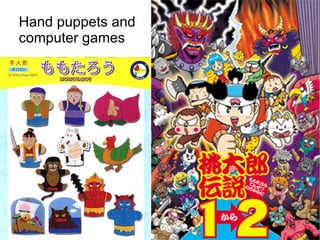
Hand puppets and  computer games
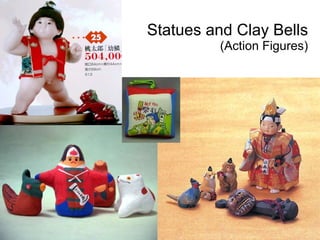
Statues and Clay Bells  (Action Figures)
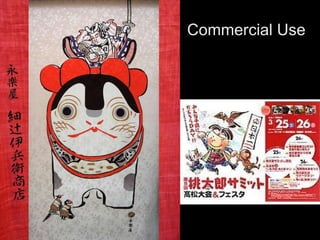
Commercial Use
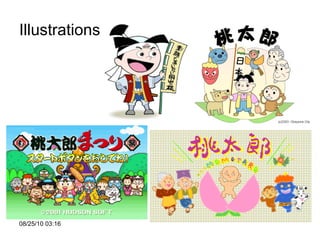
Illustrations
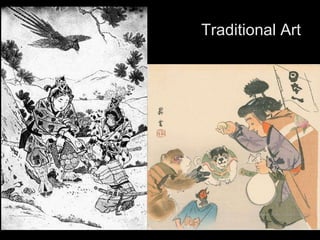
Traditional Art
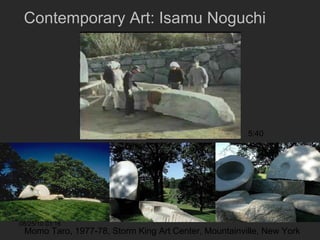
Contemporary Art: Isamu Noguchi Momo Taro, 1977-78, Storm King Art Center, Mountainville, New York 5:40
What I have learned from this project… Teachers’ points of view: Collaboration and communication Preparation and research Time management and choice of approaches Degree of cultural awareness Further development of cultural studies Students’ points of view: Teamwork and involvement  Creativity, improvisation, and enjoyment Learning unfamiliar culture through the arts
The function music plays in traditional Japanese theater, Kabuki An entertainment for the middle class in the past, it is now considered popular culture. The plays are about historical events, moral conflicts in love relationships, and the like. The actors use an old-fashioned language.  They speak in a monotonous voice and are accompanied by a traditional music ensemble.
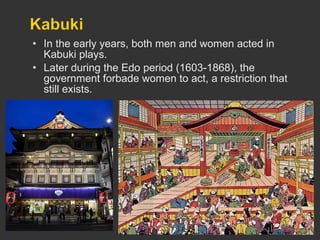
In the early years, both men and women acted in Kabuki plays. Later during the Edo period (1603-1868), the government forbade women to act, a restriction that still exists.
Male actors have to be specialized in playing female roles. 3 types of music accompaniment: Narrative music Onstage music Offstage music Narrative music Derived from the biwa lute narratives style It very flamboyant (to excite the middle class audience) The singers are usually placed downstage left.
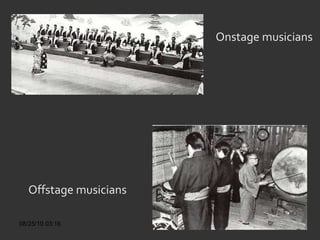
Ostage ensemble A mixture of genres depending on the play and stage setting. For example, it could be a dance accompaniment carried by the 3 drums and flute group derived from the Noh play. The music follows the text mood or topic. Thus, it is through composed, moving through sections of new music related to the words. Hayashi:  Has more drums, flutes than Noh. Has Shamisen Drummers also shout out loud Also has chorus
Offstage ensemble Musicians are placed in a room on the right back of the stage, where they are invisible from the audience (but they can see outside) The purpose of offstage music is to provide mood, set scenes, and give musical clues as to action or location. For example, the ensemble might play a pattern called “the sound of rain” as the introduction because the text says that even on rainy nights and snowy days the lovers meet.
Onstage musicians Offstage musicians
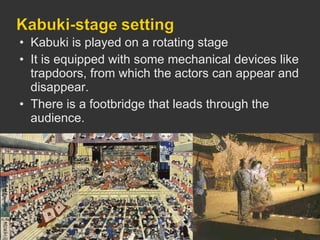
Kabuki is played on a rotating stage  It is equipped with some mechanical devices like trapdoors, from which the actors can appear and disappear. There is a footbridge that leads through the audience.
To please the middle class, Kabuki provides the following features: Colorful costumes and facial painting Realistic scenery and more visual effects Exciting musical performance with dramatic contrasts in melody, tempo, and dynamics Exaggerated gestures with singing and dancing Fanatic fans in the audience usually shout the names of their favorite actors at the right moments during short pauses
Teacher as a translator of culture Our children in the 21 st  century need to have broad music exposure early in their development. Early exposure to multiplicity of musics helps prevent closed views that often inadvertently develop when one concentrates exclusively on one musical tradition. We also would like our children to understand that there are many different but equally logical ways of making music. When students are continually involved in learning various approaches through which musical sounds of different cultures are organized, they develop a perspective that invites curious inquiry into every new music as they seek to understand the special inherent logic of each.
Guidelines for creating an interdisciplinary storytelling unit Playing Singing Creating Listening Relating to the culture
Thank You Art Education: scwang@niu.edu Music Education: jcwang@niu.edu

Momo presentation

  • 1.
    Storytelling through VisualArt and Music: An Integrative Approach to Teaching the Arts Dr. SHEI-CHAU WANG [email_address] School of Art, Northern Illinois University Dr. JUI-CHING WANG [email_address] School of Music, Northern Illinois University Illinois Art Education Association 2008 Conference, Galena, Illinois October 24, 2008
  • 2.
    Rationale of theteaching project Conceptual framework A music-based sample lesson An art-based lesson Comparisons of Momotaro books A cultural study of Momotaro An extended study: Kabuki Conclusion
  • 3.
    Interdisciplinary connections openup a possibility for comprehensive study while preserving the integrity and validity of a cultural learning experience. Music in young children’s development is an excellent carrier of information and can help children not only enhance their language arts experience but also increase their cultural awareness.
  • 4.
    Cognitive development Thecombination of storytelling and music provides experiences that help children increase their attention span. For example, language arts objectives, such as prediction, sequencing, and auditory discrimination, are met through storytelling. Social-cultural development It provides opportunities that help children obtain important cultural information, such as values, taboos, and self-identity.
  • 5.
    In an interview(Johnson, 1984), Jean E. Snyder shared her experiences in Zambia observing children’s music-making and said: “ The children learn values and taboos through story songs. Often grandmother is the storyteller, and the children participate through formalized response to the story and by singing the refrain of the song, which may be woven into the story several times. Stories warn girls not to marry a handsome stranger, teach the importance of hard work, warn future mothers not to mistreat orphans or the children of another wife, or show that the small but clever can outwit the strong.…”
  • 6.
    Ideas for storytellingwith musical experiences Children participate by clapping, singing, chanting, or playing instruments at cues in the story Children and teacher use puppets to portray major characters Flannel board or story board figures are used to provide pictorial representations of the characters Children act out the story by playing the characters Key words of characters and actions are written on cards or on the board
  • 7.
    Concept Mapping andthe Lesson Framework Based on the Japanese folk tale Momotaro (the Peach Boy)
  • 8.
    Art Music LiteratureCulture Education Drama History Momotaro Japan Beliefs and Social Values Folklore
  • 9.
    Visual Art EducationDrama History Literature Japanese Culture Folklore Beliefs and Social Values Momotaro Illustration Craft Iconic Characters Costume Design Acting Kabuki Song Instruments Accompaniment Music
  • 10.
  • 11.
    Momotaro-San (peach boy)A Japanese folktale about a young boy’s adventure of fighting demons and his friendship with three creatures, the pheasant, dog, and monkey who helped him fight the demons. The origin of this story is not traceable; however, it appealed to the Samurai (the warrior) classes throughout Japanese history. Popular not only in Japan, this story is immensely popular throughout Asia.
  • 12.
    General concepts: Courage Cooperation Generosity Cultural awareness Musical concepts: Functions of music in Japanese drama (Kabuki) Japanese pentatonic scale Integrated subjects: Literature/Drama Art
  • 13.
    Objectives: Students willbe able to learn the story of a courageous little warrior traditional Japanese cultural values of cooperation and generosity. a traditional Japanese children’s song. the construction of headdresses for each of the characters in the story. the integration of music, art, and drama.
  • 14.
    Materials: Story, Momo-TaroSan Sheet music for the song, Momo-Taro San Musical instruments Art supplies
  • 15.
    Procedure: Day 1The teacher starts by telling the story to the students and asks them to pay attention to the number of characters and their names. After students recognize the main character, Momo-Taro, the teacher sings the song, Momo-Taro San, to the students (In Japanese society, to show respect to people, the word “san” is added to a person’s name). The teacher assigns students to be each of the characters and explains what they have to play on their musical instruments.
  • 16.
    Procedure (continued): Musicalinstruments assigned to the characters Hand drum, Momo-Taro Glockenspiel, Pheasant Woodblock, Dog Maracas, Monkey Cymbals/Gongs, Demons Flute, Fisherman
  • 17.
    Procedure (continued): T.teaches the musical patterns to the students and explains to the students when to sing the song, Mo-mo taro san (when the animals ask for kibidango). S. practice singing the song and playing their instruments. T. points out that there are only five pitches that make up the melody of the song and explains to students that it is a typical pentatonic scale that Japanese uses to make their music.
  • 18.
    Day 2 Tshows the students the illustrated story and asks them to make headdresses for their own characters. T asks the students to observe the illustrations of the characters and see if they can find any differences between themselves and both the human characters and the creatures. T introduces the idea of “differences” in a multicultural society. T encourage the students to come out with their own “creature” identity and use construction paper to make the headdresses for their creatures.
  • 19.
    Closure T. asksstudents to put on the headdresses they made to act out the story by incorporating the musical instruments associated with each character.
  • 20.
    Assessment: Visually checkto see if students pay attention to the story Visually check to see the craftsmanship of the headdresses students make. Visually check to see if students play the instruments correctly Aurally check to see if students sing the song correctly (in tune, rhythm, and the pronunciation) Verbally check to see if students understand the concepts derived from this story
  • 21.
  • 22.
    Momotaro Performance bythe class of ARTE 344 Fall 2008 @ NIU School of Music Courtyard, Oct 2, 2008 6:03
  • 23.
    Comparisons of Momotaro Books American Versions vs. Japanese Versions Book covers Scenes in the story Techniques and styles of illustration Readers
  • 24.
  • 25.
  • 26.
  • 27.
    Momotaro and hiswarriors (ii)
  • 28.
    How culturally authenticshould we be? Japanese Akita Inu (dog)
  • 29.
  • 30.
  • 31.
    Techniques and Stylesof Illustration Comics/cartoons Contemporary Traditional Simple shapes/forms Animation Ukio-e influences Ink painting Realistic/representational art
  • 32.
    Readers OlderChildren and Teens Young Children
  • 33.
    A Cultural Studyof Momotaro Okayama City, Japan Food and Entertainment Graphic Design and Illustration Art and Crafts
  • 34.
  • 35.
  • 36.
  • 37.
    Momotaro Festival Anannual three-day event in early August in Okayama City
  • 38.
  • 39.
    Food White PeachKibi-dango
  • 40.
  • 41.
  • 42.
    Hand puppets and computer games
  • 43.
    Statues and ClayBells (Action Figures)
  • 44.
  • 45.
  • 46.
  • 47.
    Contemporary Art: IsamuNoguchi Momo Taro, 1977-78, Storm King Art Center, Mountainville, New York 5:40
  • 48.
    What I havelearned from this project… Teachers’ points of view: Collaboration and communication Preparation and research Time management and choice of approaches Degree of cultural awareness Further development of cultural studies Students’ points of view: Teamwork and involvement Creativity, improvisation, and enjoyment Learning unfamiliar culture through the arts
  • 49.
    The function musicplays in traditional Japanese theater, Kabuki An entertainment for the middle class in the past, it is now considered popular culture. The plays are about historical events, moral conflicts in love relationships, and the like. The actors use an old-fashioned language. They speak in a monotonous voice and are accompanied by a traditional music ensemble.
  • 50.
    In the earlyyears, both men and women acted in Kabuki plays. Later during the Edo period (1603-1868), the government forbade women to act, a restriction that still exists.
  • 51.
    Male actors haveto be specialized in playing female roles. 3 types of music accompaniment: Narrative music Onstage music Offstage music Narrative music Derived from the biwa lute narratives style It very flamboyant (to excite the middle class audience) The singers are usually placed downstage left.
  • 52.
    Ostage ensemble Amixture of genres depending on the play and stage setting. For example, it could be a dance accompaniment carried by the 3 drums and flute group derived from the Noh play. The music follows the text mood or topic. Thus, it is through composed, moving through sections of new music related to the words. Hayashi: Has more drums, flutes than Noh. Has Shamisen Drummers also shout out loud Also has chorus
  • 53.
    Offstage ensemble Musiciansare placed in a room on the right back of the stage, where they are invisible from the audience (but they can see outside) The purpose of offstage music is to provide mood, set scenes, and give musical clues as to action or location. For example, the ensemble might play a pattern called “the sound of rain” as the introduction because the text says that even on rainy nights and snowy days the lovers meet.
  • 54.
  • 55.
    Kabuki is playedon a rotating stage It is equipped with some mechanical devices like trapdoors, from which the actors can appear and disappear. There is a footbridge that leads through the audience.
  • 56.
    To please themiddle class, Kabuki provides the following features: Colorful costumes and facial painting Realistic scenery and more visual effects Exciting musical performance with dramatic contrasts in melody, tempo, and dynamics Exaggerated gestures with singing and dancing Fanatic fans in the audience usually shout the names of their favorite actors at the right moments during short pauses
  • 57.
    Teacher as atranslator of culture Our children in the 21 st century need to have broad music exposure early in their development. Early exposure to multiplicity of musics helps prevent closed views that often inadvertently develop when one concentrates exclusively on one musical tradition. We also would like our children to understand that there are many different but equally logical ways of making music. When students are continually involved in learning various approaches through which musical sounds of different cultures are organized, they develop a perspective that invites curious inquiry into every new music as they seek to understand the special inherent logic of each.
  • 58.
    Guidelines for creatingan interdisciplinary storytelling unit Playing Singing Creating Listening Relating to the culture
  • 59.
    Thank You ArtEducation: scwang@niu.edu Music Education: jcwang@niu.edu