MOLST starts with a discussion process between a
patient and their physician, resulting in the
completion of a MOLST form containing medical
orders about:
• Resuscitation
• Ventilation
• Transfer to hospital
• Plus other life‐sustaining treatments
 MOLST forms are for all healthcare
settings such as nursing homes and
hospitals as well as in the patient’s
home.
 CC/DNRs are for EMS/First
Responders only.
 CC/DNR forms are order verification
form only while the MOLST form is a
medical order form.
 A CC/DNR is an all or nothing
protocol for cardiac/respiratory
arrest only.
 EMS and First Responders either
perform full resuscitation or none at all.
 MOLST allows a patient and/or their
family to select the types of life
sustaining care that fits their wishes.
• Portable medical orders (stays with
patient).
• For very sick patients (not for
everybody).
• Used to refuse or request treatment.
• Can be honored by all health
professionals.
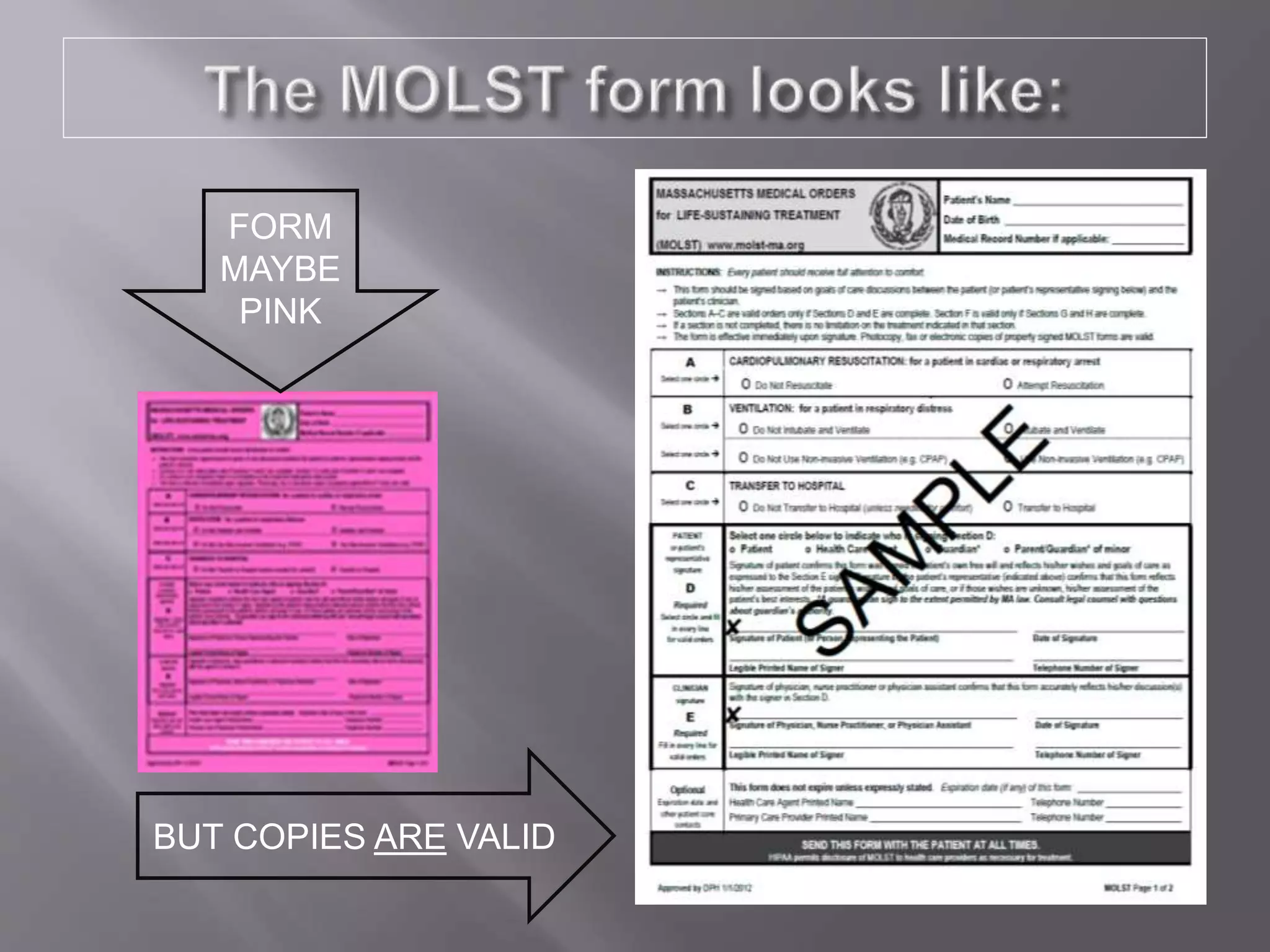
BUT COPIES ARE VALID
FORM
MAYBE
PINK
 Massachusetts Department of Public
Health and OEMS approved the use
of the MOLST form for all healthcare
settings.
 Massachusetts EMS providers are
authorized and required to follow the
medical orders on a valid MOLST form.
 The Massachusetts Comfort Care/Do
Not Resuscitate Verification form remains
valid.
 MOLST can be thought of as an
expansion of the CC/DNR form, because
it also includes management of other
medical needs.
 For cardiac or respiratory arrest,
follow the most recent (by date)
resuscitation orders from either form.
 If the patient is NOT in cardiac or
respiratory arrest follow the MOLST
form. The CC/DNR form is ONLY for
cardiac or respiratory arrest.
 Essentially in the same places as a
CC/DNR.
 Health Care professionals as well as
patients and their families are advised to
print the form out on bright (preferably
pink) paper. Remember, copies and faxes
are valid.
 Refrigerator doors are common place to
find MOLST forms as well as CC/DNR
forms and other medical information
 Ask the patient and/or family about a
CC/DNR and MOLST form OR if there
are papers about emergency medical
care.
Review the MOLST form:
 Section D – Patient Information
 Section E – Clinician Information
 If either section D or E is incomplete the
form is invalid, therefore treat per
protocols!
 If section D and E are complete
then the form is valid
 If any other section is incomplete
treat that section’s interventions
per protocols!
 If the patient can communicate their
wishes:
 Follow the patient’s wishes
 If the patient can not communicate
their wishes:
 Treat per protocol
 Physician
 Nurse Practitioner (NP)
 Physician's Assistant (PA)
 Registered Nurse (RNs) are NOT
authorized to sign a MOLST form at
this time.
 MOLST forms do NOT expire
UNLESS specified in the optional
block under section E.
 This section is for a patient in
cardiac or respiratory arrest and
one of two boxes maybe
checked:
Do Not Resuscitate
Attempt Resuscitation
 This section discusses ventilation
for patients presenting in
respiratory distress.
 There are two types of ventilation
modalities included:
 Supplemental Ventilation with BVM
and Intubation.
 Non-Invasive Ventilation (e.g. CPAP)
 There are check boxes for each
modality; Perform or don’t perform
the treatment noted.
 Two check boxes are in this
section:
Do Not Transfer to Hospital
Unless needed for comfort
Transfer to the Hospital
 Regardless of what is indicated in Section C, if
a patient receives any treatment from EMS, the
patient must be transported to the hospital per
OEMS regulation.
 This would include but is not limited to:
 Supplemental oxygen
 Pain and anti-emetic medication administration
 Simple comfort measures such as positioning are
permitted
 Yes, yes and yes!!!!!!!!
 A patient can change their mind
and request care previously
prohibited on the MOLST form if
they so desire.
 Gently explain that the form is about the
patient’s wishes.
 Inform the family that EMS and First
Responders are required to follow the
patient’s wishes as noted on the MOLST
 If the situation can not be resolved the
patient should be transported.
 MOLST forms do not have tracking
numbers.
 Document in your PCR:
• The patient’s name and second
identifier;
• The clinician signer’s name ;
• The MOLST instructions; i.e. sections
A, B, C
• What occurred/the treatment given.
 EMTs are encouraged to call Medical
Control if they have questions about
situations with MOLST or CC/DNR
instructions in the field.
 While these sections are not directed at
EMS providers is useful to be aware of
them.
 Section F includes additional information on
intubation, ventilation and non-invasive
ventilation.
 Section F also includes decisions regarding
dialysis, artificial nutrition and artificial
hydration as well as a general
 Massachusetts Statewide Treatment
Protocols; Appendix B
 OEMS advisory; MOLST & CC/DNR
dated March 6, 2013 available for
viewing on OEMS web site.
 www.molst-ma.org
Thank you
for your attention!
Fini

Molst dnr

  • 2.
    MOLST starts witha discussion process between a patient and their physician, resulting in the completion of a MOLST form containing medical orders about: • Resuscitation • Ventilation • Transfer to hospital • Plus other life‐sustaining treatments
  • 3.
     MOLST formsare for all healthcare settings such as nursing homes and hospitals as well as in the patient’s home.  CC/DNRs are for EMS/First Responders only.  CC/DNR forms are order verification form only while the MOLST form is a medical order form.
  • 4.
     A CC/DNRis an all or nothing protocol for cardiac/respiratory arrest only.  EMS and First Responders either perform full resuscitation or none at all.  MOLST allows a patient and/or their family to select the types of life sustaining care that fits their wishes.
  • 5.
    • Portable medicalorders (stays with patient). • For very sick patients (not for everybody). • Used to refuse or request treatment. • Can be honored by all health professionals.
  • 6.
    BUT COPIES AREVALID FORM MAYBE PINK
  • 7.
     Massachusetts Departmentof Public Health and OEMS approved the use of the MOLST form for all healthcare settings.  Massachusetts EMS providers are authorized and required to follow the medical orders on a valid MOLST form.
  • 8.
     The MassachusettsComfort Care/Do Not Resuscitate Verification form remains valid.  MOLST can be thought of as an expansion of the CC/DNR form, because it also includes management of other medical needs.
  • 9.
     For cardiacor respiratory arrest, follow the most recent (by date) resuscitation orders from either form.  If the patient is NOT in cardiac or respiratory arrest follow the MOLST form. The CC/DNR form is ONLY for cardiac or respiratory arrest.
  • 10.
     Essentially inthe same places as a CC/DNR.  Health Care professionals as well as patients and their families are advised to print the form out on bright (preferably pink) paper. Remember, copies and faxes are valid.
  • 11.
     Refrigerator doorsare common place to find MOLST forms as well as CC/DNR forms and other medical information  Ask the patient and/or family about a CC/DNR and MOLST form OR if there are papers about emergency medical care.
  • 12.
    Review the MOLSTform:  Section D – Patient Information  Section E – Clinician Information  If either section D or E is incomplete the form is invalid, therefore treat per protocols!
  • 13.
     If sectionD and E are complete then the form is valid  If any other section is incomplete treat that section’s interventions per protocols!
  • 14.
     If thepatient can communicate their wishes:  Follow the patient’s wishes  If the patient can not communicate their wishes:  Treat per protocol
  • 15.
     Physician  NursePractitioner (NP)  Physician's Assistant (PA)  Registered Nurse (RNs) are NOT authorized to sign a MOLST form at this time.
  • 16.
     MOLST formsdo NOT expire UNLESS specified in the optional block under section E.
  • 18.
     This sectionis for a patient in cardiac or respiratory arrest and one of two boxes maybe checked: Do Not Resuscitate Attempt Resuscitation
  • 19.
     This sectiondiscusses ventilation for patients presenting in respiratory distress.
  • 20.
     There aretwo types of ventilation modalities included:  Supplemental Ventilation with BVM and Intubation.  Non-Invasive Ventilation (e.g. CPAP)  There are check boxes for each modality; Perform or don’t perform the treatment noted.
  • 21.
     Two checkboxes are in this section: Do Not Transfer to Hospital Unless needed for comfort Transfer to the Hospital
  • 22.
     Regardless ofwhat is indicated in Section C, if a patient receives any treatment from EMS, the patient must be transported to the hospital per OEMS regulation.  This would include but is not limited to:  Supplemental oxygen  Pain and anti-emetic medication administration  Simple comfort measures such as positioning are permitted
  • 23.
     Yes, yesand yes!!!!!!!!  A patient can change their mind and request care previously prohibited on the MOLST form if they so desire.
  • 25.
     Gently explainthat the form is about the patient’s wishes.  Inform the family that EMS and First Responders are required to follow the patient’s wishes as noted on the MOLST  If the situation can not be resolved the patient should be transported.
  • 26.
     MOLST formsdo not have tracking numbers.  Document in your PCR: • The patient’s name and second identifier; • The clinician signer’s name ; • The MOLST instructions; i.e. sections A, B, C • What occurred/the treatment given.
  • 27.
     EMTs areencouraged to call Medical Control if they have questions about situations with MOLST or CC/DNR instructions in the field.
  • 28.
     While thesesections are not directed at EMS providers is useful to be aware of them.  Section F includes additional information on intubation, ventilation and non-invasive ventilation.  Section F also includes decisions regarding dialysis, artificial nutrition and artificial hydration as well as a general
  • 29.
     Massachusetts StatewideTreatment Protocols; Appendix B  OEMS advisory; MOLST & CC/DNR dated March 6, 2013 available for viewing on OEMS web site.  www.molst-ma.org
  • 30.
    Thank you for yourattention! Fini