Molecular (Gene) Cloning
Mohammed Esawie, M.D., M.S.(c)
Background
• DNA amplification techniques produce
thousands or million copies of a particular
gene
• Either: In-vitro  PCR
In-vivo  Molecular Cloning
• In short: seek and find the gene  amplify it
Molecular (Gene) Cloning
• Definition??!
• Important components:
1- Target DNA
2- Restriction Endonucleases
3- Vectors
4- Marker gene
5- Recombinant DNA
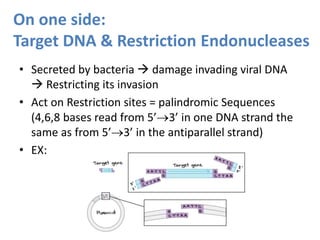
On one side:
Target DNA & Restriction Endonucleases
• Secreted by bacteria  damage invading viral DNA
 Restricting its invasion
• Act on Restriction sites = palindromic Sequences
(4,6,8 bases read from 5’3’ in one DNA strand the
same as from 5’3’ in the antiparallel strand)
• EX:
On the other side:
Vector
• A molecule of DNA
• Contains:
Restriction site  will join to the gene to be
cloned
+ Marker gene 
to trace the vector after insertion
( to know which host cell accepts the vector) e.g
antibiotic resistance gene
On the other side:
Vector
• Types:
1- Prokaryotic Plasmids: extra-chromosomal
DNA (small, circular DNA.) e.g. E-coli plasmids
2- Viruses: naturally occurring viruses that infect
bacteria (Bacteriophage)
3- Cosmids: artificial recombinant plasmid can
insert larger DNA fragment up to 50 kb
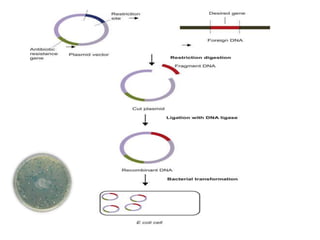
Recombinant DNA
• Target DNA + Vector DNA
• Will be transferred from test tubes into host
cell that can provide the enzymatic machinery
for DNA replication (All DNA fragments
replication)
Molecular (Gene) Cloning Uses
• Gene study
• Synthesis of human protein drugs
• Vaccine preparation e.g. Hepatitis B Vaccine
Image Credits
• Amatakoon et al, DNA cloning and Restriction
Digestion. Pharmacognosy, 2007.
• Restriction enzymes & DNA ligase,
www.Khanacademy.org
Thank You

Molecular (gene) cloning

  • 1.
    Molecular (Gene) Cloning MohammedEsawie, M.D., M.S.(c)
  • 2.
    Background • DNA amplificationtechniques produce thousands or million copies of a particular gene • Either: In-vitro  PCR In-vivo  Molecular Cloning • In short: seek and find the gene  amplify it
  • 4.
    Molecular (Gene) Cloning •Definition??! • Important components: 1- Target DNA 2- Restriction Endonucleases 3- Vectors 4- Marker gene 5- Recombinant DNA
  • 5.
    On one side: TargetDNA & Restriction Endonucleases • Secreted by bacteria  damage invading viral DNA  Restricting its invasion • Act on Restriction sites = palindromic Sequences (4,6,8 bases read from 5’3’ in one DNA strand the same as from 5’3’ in the antiparallel strand) • EX:
  • 6.
    On the otherside: Vector • A molecule of DNA • Contains: Restriction site  will join to the gene to be cloned + Marker gene  to trace the vector after insertion ( to know which host cell accepts the vector) e.g antibiotic resistance gene
  • 7.
    On the otherside: Vector • Types: 1- Prokaryotic Plasmids: extra-chromosomal DNA (small, circular DNA.) e.g. E-coli plasmids 2- Viruses: naturally occurring viruses that infect bacteria (Bacteriophage) 3- Cosmids: artificial recombinant plasmid can insert larger DNA fragment up to 50 kb
  • 8.
    Recombinant DNA • TargetDNA + Vector DNA • Will be transferred from test tubes into host cell that can provide the enzymatic machinery for DNA replication (All DNA fragments replication)
  • 10.
    Molecular (Gene) CloningUses • Gene study • Synthesis of human protein drugs • Vaccine preparation e.g. Hepatitis B Vaccine
  • 11.
    Image Credits • Amatakoonet al, DNA cloning and Restriction Digestion. Pharmacognosy, 2007. • Restriction enzymes & DNA ligase, www.Khanacademy.org
  • 12.