Mohandas K. Gandhi
By: Group 5
June 3, 2014
Biography
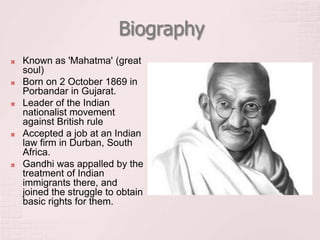
 Known as 'Mahatma' (great
soul)
 Born on 2 October 1869 in
Porbandar in Gujarat.
 Leader of the Indian
nationalist movement
against British rule
 Accepted a job at an Indian
law firm in Durban, South
Africa.
 Gandhi was appalled by the
treatment of Indian
immigrants there, and
joined the struggle to obtain
basic rights for them.
Biography
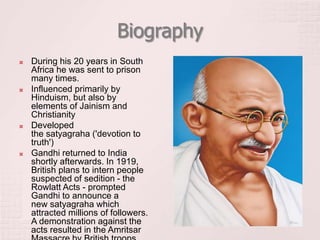
 During his 20 years in South
Africa he was sent to prison
many times.
 Influenced primarily by
Hinduism, but also by
elements of Jainism and
Christianity
 Developed
the satyagraha ('devotion to
truth')
 Gandhi returned to India
shortly afterwards. In 1919,
British plans to intern people
suspected of sedition - the
Rowlatt Acts - prompted
Gandhi to announce a
new satyagraha which
attracted millions of followers.
A demonstration against the
acts resulted in the Amritsar
Biography
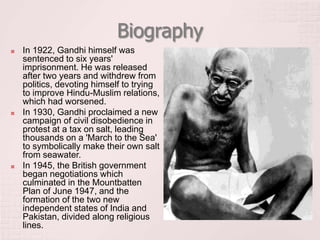
 In 1922, Gandhi himself was
sentenced to six years'
imprisonment. He was released
after two years and withdrew from
politics, devoting himself to trying
to improve Hindu-Muslim relations,
which had worsened.
 In 1930, Gandhi proclaimed a new
campaign of civil disobedience in
protest at a tax on salt, leading
thousands on a 'March to the Sea'
to symbolically make their own salt
from seawater.
 In 1945, the British government
began negotiations which
culminated in the Mountbatten
Plan of June 1947, and the
formation of the two new
independent states of India and
Pakistan, divided along religious
lines.
Biography
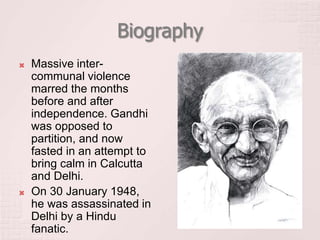
 Massive inter-
communal violence
marred the months
before and after
independence. Gandhi
was opposed to
partition, and now
fasted in an attempt to
bring calm in Calcutta
and Delhi.
 On 30 January 1948,
he was assassinated in
Delhi by a Hindu
fanatic.
References
 http://www.bbc.co.uk/history/historic_figure
s/gandhi_mohandas.shtml
 https://www.google.com.ph/search?q=mah
atma+gandhi&hl=zh-
CN&source=lnms&tbm=isch&sa=X&ei=aX
KMU6qPNsi78gW77YGoAQ&ved=0CAgQ
_AUoAQ&biw=1366&bih=621

Mohandas Gandhi

  • 1.
    Mohandas K. Gandhi By:Group 5 June 3, 2014
  • 2.
    Biography  Known as'Mahatma' (great soul)  Born on 2 October 1869 in Porbandar in Gujarat.  Leader of the Indian nationalist movement against British rule  Accepted a job at an Indian law firm in Durban, South Africa.  Gandhi was appalled by the treatment of Indian immigrants there, and joined the struggle to obtain basic rights for them.
  • 3.
    Biography  During his20 years in South Africa he was sent to prison many times.  Influenced primarily by Hinduism, but also by elements of Jainism and Christianity  Developed the satyagraha ('devotion to truth')  Gandhi returned to India shortly afterwards. In 1919, British plans to intern people suspected of sedition - the Rowlatt Acts - prompted Gandhi to announce a new satyagraha which attracted millions of followers. A demonstration against the acts resulted in the Amritsar
  • 4.
    Biography  In 1922,Gandhi himself was sentenced to six years' imprisonment. He was released after two years and withdrew from politics, devoting himself to trying to improve Hindu-Muslim relations, which had worsened.  In 1930, Gandhi proclaimed a new campaign of civil disobedience in protest at a tax on salt, leading thousands on a 'March to the Sea' to symbolically make their own salt from seawater.  In 1945, the British government began negotiations which culminated in the Mountbatten Plan of June 1947, and the formation of the two new independent states of India and Pakistan, divided along religious lines.
  • 5.
    Biography  Massive inter- communalviolence marred the months before and after independence. Gandhi was opposed to partition, and now fasted in an attempt to bring calm in Calcutta and Delhi.  On 30 January 1948, he was assassinated in Delhi by a Hindu fanatic.
  • 7.