Introduction
Historical Background India was still an English Colony Indians were very conservative. British forced them to adopt  their culture British respected their culture, but controlled the important people. Conservatism  Indian Nationalism After mid 19 th  Century, the British had more to offer Educated people tolerated better British  Indian Army rebellion, 1857 South Africa was under British control Zulu War, 1906
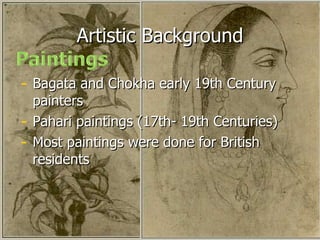
Artistic Background Bagata and Chokha early 19th Century painters Pahari paintings (17th- 19th Centuries) Most paintings were done for British residents
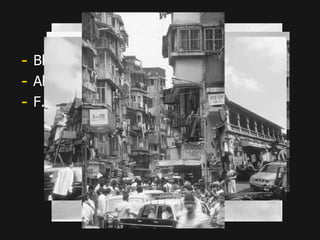
Bhau Daji Lad Sangrahalaya Allbless family F. W. Stevens
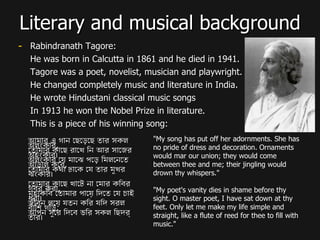
Literary and musical background Rabindranath Tagore: He was born in Calcutta in 1861 and he died in 1941. Tagore was a poet, novelist, musician and playwright. He changed completely music and literature in India. He wrote Hindustani classical music songs In 1913 he won the Nobel Prize in literature. This is a piece of his winning song: আমার এ গান ছেড়েছে তার সকল অলংকার ,  তোমার কাছে রাখে নি আর সাজের অহংকার।  অলংকার যে মাঝে পড়ে মিলনেতে আড়াল করে ,  তোমার কথা ঢাকে যে তার মুখর ঝংকার।  তোমার কাছে খাটে না মোর কবির গর্ব করা ,  মহাকবি তোমার পায়ে দিতে যে চাই ধরা।  জীবন লয়ে যতন করি যদি সরল বাঁশি গড়ি ,  আপন সুরে দিবে ভরি সকল ছিদ্র তার। "My song has put off her adornments. She has no pride of dress and decoration. Ornaments would mar our union; they would come between thee and me; their jingling would drown thy whispers."  "My poet's vanity dies in shame before thy sight. O master poet, I have sat down at thy feet. Only let me make my life simple and straight, like a flute of reed for thee to fill with music."
Music styles Folk music: Bauls Bhangra Bhavageete Dandiya Lavani Popular music Qawwali Rabindra Sangeet Rajasthan
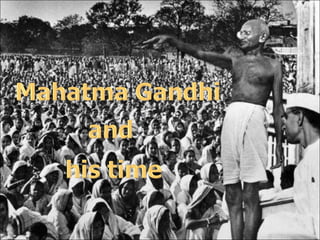
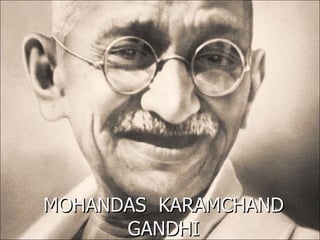
MOHANDAS  KARAMCHAND GANDHI
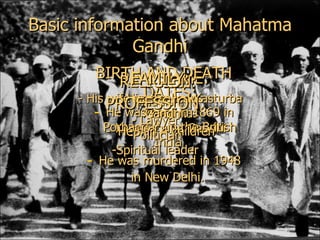
Basic information about Mahatma Gandhi REAL NAME: His name was Mohandas Karamchand Gandhi BIRTH AND DEATH DATES: He was born  in 1869 in Porbandar, in the British India  He was murdered in 1948 in New Delhi.   RELIGION: Hinduism FAMILY: - His wife was called Kasturba Gandhi. -  He had 4 children PROFESSION: - Lawyer Politician Spiritual leader
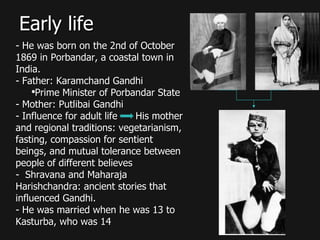
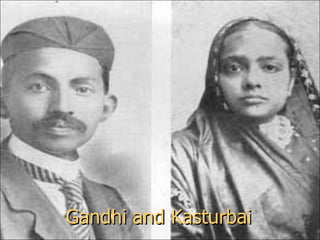
Early life He was born on the 2nd of October 1869 in Porbandar, a coastal town in India. Father: Karamchand Gandhi Prime Minister of Porbandar State Mother: Putlibai Gandhi Influence for adult life  His mother and regional traditions: vegetarianism, fasting, compassion for sentient beings, and mutual tolerance between people of different believes Shravana and Maharaja Harishchandra: ancient stories that influenced Gandhi. He was married when he was 13 to Kasturba, who was 14
Gandhi and Kasturbai
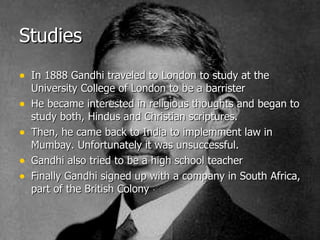
Studies In 1888 Gandhi traveled to London to study at the University College of London to be a barrister He became interested in religious thoughts and began to study both, Hindus and Christian scriptures.  Then, he came back to India to implemment law in Mumbay. Unfortunately it was unsuccessful. Gandhi also tried to be a high school teacher Finally Gandhi signed up with a company in South Africa, part of the British Colony
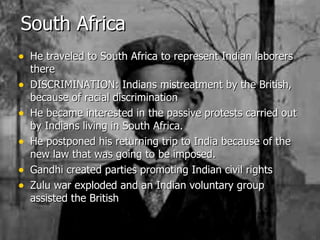
South Africa He traveled to South Africa to represent Indian laborers there DISCRIMINATION: Indians mistreatment by the British, because of racial discrimination He became interested in the passive protests carried out by Indians living in South Africa. He postponed his returning trip to India because of the new law that was going to be imposed. Gandhi created parties promoting Indian civil rights Zulu war exploded and an Indian voluntary group assisted the British
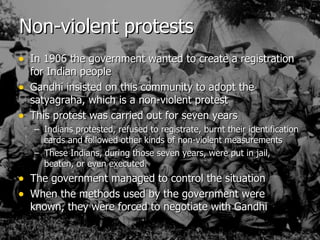
Non-violent protests In 1906 the government wanted to create a registration for Indian people Gandhi insisted on this community to adopt the satyagraha, which is a non-violent protest This protest was carried out for seven years Indians protested, refused to registrate, burnt their identification cards and followed other kinds of non-violent measurements These Indians, during those seven years, were put in jail, beaten, or even executed. The government managed to control the situation When the methods used by the government were known, they were forced to negotiate with Gandhi
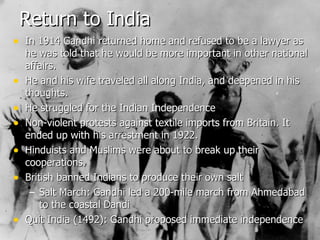
Return to India In 1914 Gandhi returned home and refused to be a lawyer as he was told that he would be more important in other national affairs. He and his wife traveled all along India, and deepened in his thoughts. He struggled for the Indian Independence Non-violent protests against textile imports from Britain. It ended up with his arrestment in 1922. Hinduists and Muslims were about to break up their cooperations. British banned Indians to produce their own salt Salt March: Gandhi led a 200-mile march from Ahmedabad to the coastal Dandi Quit India (1492): Gandhi proposed immediate independence
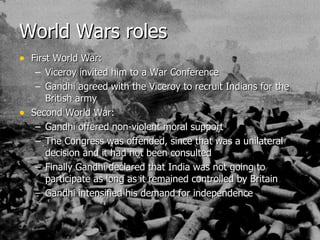
World Wars roles First World War: Viceroy invited him to a War Conference Gandhi agreed with the Viceroy to recruit Indians for the British army  Second World War: Gandhi offered non-violent moral support The Congress was offended, since that was a unilateral decision and it had not been consulted Finally Gandhi declared that India was not going to participate as long as it remained controlled by Britain Gandhi intensified his demand for independence
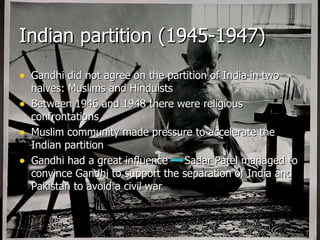
Indian partition (1945-1947) Gandhi did not agree on the partition of India in two halves: Muslims and Hinduists Between 1946 and 1948 there were religious confrontations Muslim community made pressure to accelerate the Indian partition Gandhi had a great influence  Sadar Patel managed to convince Gandhi to support the separation of India and Pakistan to avoid a civil war
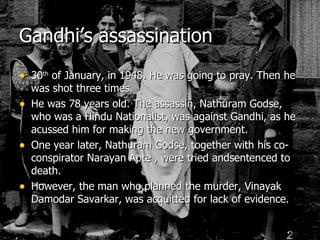
Gandhi’s assassination 30 th  of January, in 1948. He was going to pray. Then he was shot three times. He was 78 years old. The assassin, Nathuram Godse, who was a Hindu Nationalist, was against Gandhi, as he acussed him for making the new government. One year later, Nathuram Godse, together with his co-conspirator Narayan Apte , were tried andsentenced to death. However, the man who planned the murder, Vinayak Damodar Savarkar, was acquitted for lack of evidence.
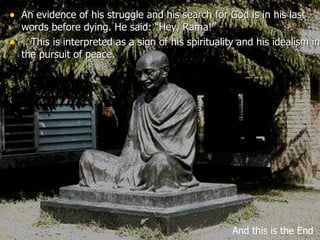
An evidence of his struggle and his search for God is in his last words before dying. He said: “Hey, Rama!”     This is interpreted as a sign of his spirituality and his idealism in the pursuit of peace. And this is the End
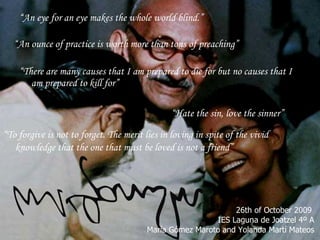
“ An eye for an eye makes the whole world blind.” “ There are many causes that I am prepared to die for but no causes that I am prepared to kill for” “ Hate the sin, love the sinner” “ An ounce of practice is worth more than tons of preaching” “ To forgive is not to forget. The merit lies in loving in spite of the vivid knowledge that the one that must be loved is not a friend” 26th of October 2009  IES Laguna de Joatzel 4º A María Gómez Maroto and Yolanda Martí Mateos

Gandhi

  • 1.
  • 2.
  • 3.
    Historical Background Indiawas still an English Colony Indians were very conservative. British forced them to adopt their culture British respected their culture, but controlled the important people. Conservatism Indian Nationalism After mid 19 th Century, the British had more to offer Educated people tolerated better British Indian Army rebellion, 1857 South Africa was under British control Zulu War, 1906
  • 4.
    Artistic Background Bagataand Chokha early 19th Century painters Pahari paintings (17th- 19th Centuries) Most paintings were done for British residents
  • 5.
    Bhau Daji LadSangrahalaya Allbless family F. W. Stevens
  • 6.
    Literary and musicalbackground Rabindranath Tagore: He was born in Calcutta in 1861 and he died in 1941. Tagore was a poet, novelist, musician and playwright. He changed completely music and literature in India. He wrote Hindustani classical music songs In 1913 he won the Nobel Prize in literature. This is a piece of his winning song: আমার এ গান ছেড়েছে তার সকল অলংকার , তোমার কাছে রাখে নি আর সাজের অহংকার। অলংকার যে মাঝে পড়ে মিলনেতে আড়াল করে , তোমার কথা ঢাকে যে তার মুখর ঝংকার। তোমার কাছে খাটে না মোর কবির গর্ব করা , মহাকবি তোমার পায়ে দিতে যে চাই ধরা। জীবন লয়ে যতন করি যদি সরল বাঁশি গড়ি , আপন সুরে দিবে ভরি সকল ছিদ্র তার। "My song has put off her adornments. She has no pride of dress and decoration. Ornaments would mar our union; they would come between thee and me; their jingling would drown thy whispers." "My poet's vanity dies in shame before thy sight. O master poet, I have sat down at thy feet. Only let me make my life simple and straight, like a flute of reed for thee to fill with music."
  • 7.
    Music styles Folkmusic: Bauls Bhangra Bhavageete Dandiya Lavani Popular music Qawwali Rabindra Sangeet Rajasthan
  • 8.
  • 9.
    Basic information aboutMahatma Gandhi REAL NAME: His name was Mohandas Karamchand Gandhi BIRTH AND DEATH DATES: He was born in 1869 in Porbandar, in the British India He was murdered in 1948 in New Delhi. RELIGION: Hinduism FAMILY: - His wife was called Kasturba Gandhi. - He had 4 children PROFESSION: - Lawyer Politician Spiritual leader
  • 10.
    Early life Hewas born on the 2nd of October 1869 in Porbandar, a coastal town in India. Father: Karamchand Gandhi Prime Minister of Porbandar State Mother: Putlibai Gandhi Influence for adult life His mother and regional traditions: vegetarianism, fasting, compassion for sentient beings, and mutual tolerance between people of different believes Shravana and Maharaja Harishchandra: ancient stories that influenced Gandhi. He was married when he was 13 to Kasturba, who was 14
  • 11.
  • 12.
    Studies In 1888Gandhi traveled to London to study at the University College of London to be a barrister He became interested in religious thoughts and began to study both, Hindus and Christian scriptures. Then, he came back to India to implemment law in Mumbay. Unfortunately it was unsuccessful. Gandhi also tried to be a high school teacher Finally Gandhi signed up with a company in South Africa, part of the British Colony
  • 13.
    South Africa Hetraveled to South Africa to represent Indian laborers there DISCRIMINATION: Indians mistreatment by the British, because of racial discrimination He became interested in the passive protests carried out by Indians living in South Africa. He postponed his returning trip to India because of the new law that was going to be imposed. Gandhi created parties promoting Indian civil rights Zulu war exploded and an Indian voluntary group assisted the British
  • 14.
    Non-violent protests In1906 the government wanted to create a registration for Indian people Gandhi insisted on this community to adopt the satyagraha, which is a non-violent protest This protest was carried out for seven years Indians protested, refused to registrate, burnt their identification cards and followed other kinds of non-violent measurements These Indians, during those seven years, were put in jail, beaten, or even executed. The government managed to control the situation When the methods used by the government were known, they were forced to negotiate with Gandhi
  • 15.
    Return to IndiaIn 1914 Gandhi returned home and refused to be a lawyer as he was told that he would be more important in other national affairs. He and his wife traveled all along India, and deepened in his thoughts. He struggled for the Indian Independence Non-violent protests against textile imports from Britain. It ended up with his arrestment in 1922. Hinduists and Muslims were about to break up their cooperations. British banned Indians to produce their own salt Salt March: Gandhi led a 200-mile march from Ahmedabad to the coastal Dandi Quit India (1492): Gandhi proposed immediate independence
  • 16.
    World Wars rolesFirst World War: Viceroy invited him to a War Conference Gandhi agreed with the Viceroy to recruit Indians for the British army Second World War: Gandhi offered non-violent moral support The Congress was offended, since that was a unilateral decision and it had not been consulted Finally Gandhi declared that India was not going to participate as long as it remained controlled by Britain Gandhi intensified his demand for independence
  • 17.
    Indian partition (1945-1947)Gandhi did not agree on the partition of India in two halves: Muslims and Hinduists Between 1946 and 1948 there were religious confrontations Muslim community made pressure to accelerate the Indian partition Gandhi had a great influence Sadar Patel managed to convince Gandhi to support the separation of India and Pakistan to avoid a civil war
  • 18.
    Gandhi’s assassination 30th of January, in 1948. He was going to pray. Then he was shot three times. He was 78 years old. The assassin, Nathuram Godse, who was a Hindu Nationalist, was against Gandhi, as he acussed him for making the new government. One year later, Nathuram Godse, together with his co-conspirator Narayan Apte , were tried andsentenced to death. However, the man who planned the murder, Vinayak Damodar Savarkar, was acquitted for lack of evidence.
  • 19.
    An evidence ofhis struggle and his search for God is in his last words before dying. He said: “Hey, Rama!”    This is interpreted as a sign of his spirituality and his idealism in the pursuit of peace. And this is the End
  • 20.
    “ An eyefor an eye makes the whole world blind.” “ There are many causes that I am prepared to die for but no causes that I am prepared to kill for” “ Hate the sin, love the sinner” “ An ounce of practice is worth more than tons of preaching” “ To forgive is not to forget. The merit lies in loving in spite of the vivid knowledge that the one that must be loved is not a friend” 26th of October 2009 IES Laguna de Joatzel 4º A María Gómez Maroto and Yolanda Martí Mateos