Digital Image Processing
MODULE V -IMAGE
ANALYSIS
Image Segmentation
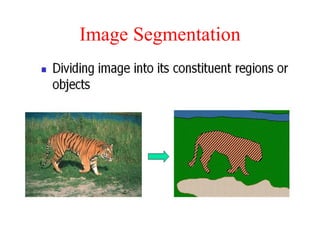
• Image analysis:
– Extracting information from an image.
• First step:
– To segment the image
– i.e. to subdivide an image into its constituent
regions or objects.
Image Segmentation
Image Segmentation
• Edge Detection
• Edge Linking
• Boundry Detection
• Region growing
• Region splitting
• Region merging
• Split and Merge
Image Segmentation
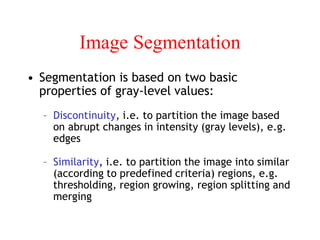
• Segmentation is based on two basic
properties of gray-level values:
– Discontinuity, i.e. to partition the image based
on abrupt changes in intensity (gray levels), e.g.
edges
– Similarity, i.e. to partition the image into similar
(according to predefined criteria) regions, e.g.
thresholding, region growing, region splitting and
merging
Detection of Discontinuities
• 3 basic types of gray-level discontinuities:
Points
Lines
Edges
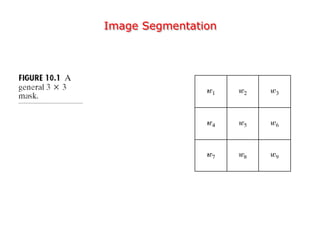
• Common method of detection: run a mask
through the image.
Image Segmentation
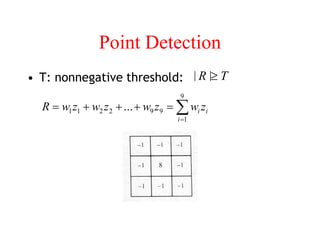
Point Detection
• T: nonnegative threshold:

=
=
+
+
+
=
9
1
9
9
2
2
1
1 ...
i
i
i z
w
z
w
z
w
z
w
R

| R | T
Point Detection
• A point has been detected at the location on
which the mask is centered if: |R|>T
• The gray level of an isolated point will be
quite different from the gray levels of its
neighbors
– measure the weighted differences between the
center point and its neighbors
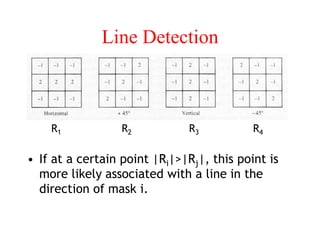
Line Detection
• If at a certain point |Ri|>|Rj|, this point is
more likely associated with a line in the
direction of mask i.
R1 R2 R3 R4
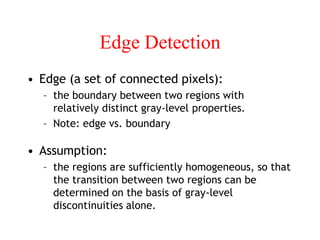
Edge Detection
• Edge (a set of connected pixels):
– the boundary between two regions with
relatively distinct gray-level properties.
– Note: edge vs. boundary
• Assumption:
– the regions are sufficiently homogeneous, so that
the transition between two regions can be
determined on the basis of gray-level
discontinuities alone.
Image Segmentation
Image Segmentation
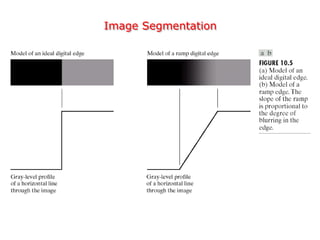
Edge Detection
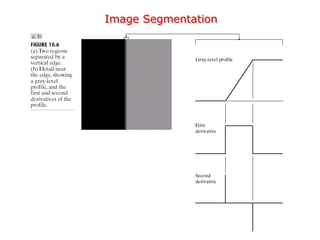
• Basic Idea:
– A profile is defined perpendicularly to the edge direction
and the results are interpreted.
– The magnitude of the first derivative is used to detect an
edge (if a point is on a ramp)
– The sign of the second derivative can determine whether
an edge pixel is on the dark or light side of an edge.
• Remarks on second derivative:
– It produces two responses for every edge
– The line that can be formed joining its positive and
negative values crosses zero at the mid point of the edge
(zero-crossing)
Edge Detection
• Computation of a local derivative operator
– A profile is defined perpendicularly to the edge
direction and the results are interpreted.
– The first derivative is obtained by using the
magnitude of the gradient at that point.
– The second derivative is obtained by using the
Laplacian.

Module-V 096.pdf

  • 1.
  • 2.
    Image Segmentation • Imageanalysis: – Extracting information from an image. • First step: – To segment the image – i.e. to subdivide an image into its constituent regions or objects.
  • 3.
  • 4.
    Image Segmentation • EdgeDetection • Edge Linking • Boundry Detection • Region growing • Region splitting • Region merging • Split and Merge
  • 5.
    Image Segmentation • Segmentationis based on two basic properties of gray-level values: – Discontinuity, i.e. to partition the image based on abrupt changes in intensity (gray levels), e.g. edges – Similarity, i.e. to partition the image into similar (according to predefined criteria) regions, e.g. thresholding, region growing, region splitting and merging
  • 6.
    Detection of Discontinuities •3 basic types of gray-level discontinuities: Points Lines Edges • Common method of detection: run a mask through the image.
  • 7.
  • 8.
    Point Detection • T:nonnegative threshold:  = = + + + = 9 1 9 9 2 2 1 1 ... i i i z w z w z w z w R  | R | T
  • 9.
    Point Detection • Apoint has been detected at the location on which the mask is centered if: |R|>T • The gray level of an isolated point will be quite different from the gray levels of its neighbors – measure the weighted differences between the center point and its neighbors
  • 10.
    Line Detection • Ifat a certain point |Ri|>|Rj|, this point is more likely associated with a line in the direction of mask i. R1 R2 R3 R4
  • 11.
    Edge Detection • Edge(a set of connected pixels): – the boundary between two regions with relatively distinct gray-level properties. – Note: edge vs. boundary • Assumption: – the regions are sufficiently homogeneous, so that the transition between two regions can be determined on the basis of gray-level discontinuities alone.
  • 12.
  • 13.
  • 14.
    Edge Detection • BasicIdea: – A profile is defined perpendicularly to the edge direction and the results are interpreted. – The magnitude of the first derivative is used to detect an edge (if a point is on a ramp) – The sign of the second derivative can determine whether an edge pixel is on the dark or light side of an edge. • Remarks on second derivative: – It produces two responses for every edge – The line that can be formed joining its positive and negative values crosses zero at the mid point of the edge (zero-crossing)
  • 15.
    Edge Detection • Computationof a local derivative operator – A profile is defined perpendicularly to the edge direction and the results are interpreted. – The first derivative is obtained by using the magnitude of the gradient at that point. – The second derivative is obtained by using the Laplacian.