CONTROL SYSTEMS
Dr. Nisha J S
Assistant Professor Senior Grade.1
School of Electronics Engineering
Vellore Institute of Technology
Text book
Norman Nise – Control System Engg.
Reference books
1.Smarajit Ghosh, “ Control Systems (Theory
And Applications)”, Pearson Education,2005
2.Benjamin C Kuo. “Automatic Control System.”
8th Edition, John Wiley &Sons,2003.
3.R.C. Dorf And R.H. Bishop, “Modern Control Systems
(Examples And Design Problems)”, Pearson Education, 2004
4. M. Gopal, “Control Systems-Principles
And Design”,
Control Engineering”,
Pearson
Tata McGrawhill – 3nd Edn. 2002.
5. K. Ogata, “Modern
Edition.
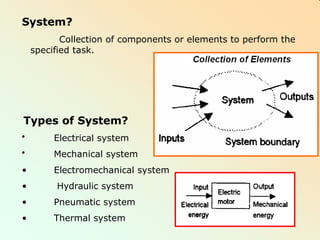
System?
Collection of components or elements to perform the
specified task.
Types of System?
• Electrical system
• Mechanical system
•
•
•
•
Electromechanical system
Hydraulic system
Pneumatic system
Thermal system
is controlled by
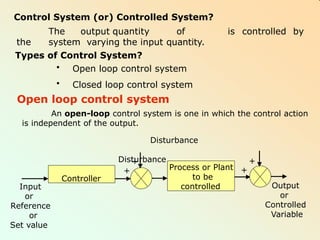
Control System (or) Controlled System?
The output quantity of
the system varying the input quantity.
Input
or
Reference
or
Set value
Controller
Process or Plant
to be
controlled
+
+
+
+
Output
or
Controlled
Variable
Types of Control System?
• Open loop control system
• Closed loop control system
Open loop control system
An open-loop control system is one in which the control action
is independent of the output.
Disturbance
Disturbance
Practical Examples of Open Loop Control System
 Electric Hand Drier – Hot air (output) comes out as long as you
keep your hand under the machine, irrespective of how much your
hand is dried.
 Automatic Washing Machine – This machine runs according to the
pre-set time irrespective of washing is completed or not.
 Bread Toaster - This machine runs as per adjusted time
irrespective
of toasting is completed or not.
 Automatic Tea/Coffee Maker – These machines also function for
pre adjusted time only.
 Light Switch – lamps glow whenever light switch is on irrespective of
light is required or not.
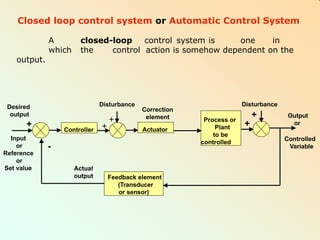
Closed loop control system or Automatic Control System
A closed-loop control system is one in
which the control action is somehow dependent on the
output.
Controller
Process or
Plant
to be
controlled
Disturbance
+
+
Disturbance
+
+
Output
or
-
Feedback element
(Transducer
or sensor)
Desired
output
+
Input
or
Reference
or
Set value Actual
output
Controlled
Variable
Actuator
Correction
element
Practical Examples of Closed
Loop Control System
Automatic Electric Iron – Heating
elements are controlled by output
temperature of the iron.
Servo Voltage Stabilizer – Voltage
controller operates depending upon
output voltage of the system.
Water Level Controller– Input
water is controlled by water level of
the reservoir.
An Air Conditioner – An air
conditioner functions depending upon
the temperature of the room.
operates depending upon
Cooling System in Car – It
the
temperature which it controls.
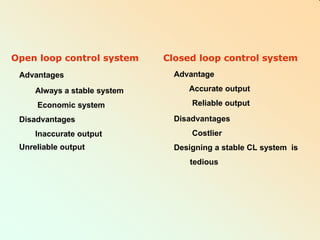
Open loop control system
Advantages
Always a stable system
Economic system
Disadvantages
Inaccurate output
Unreliable output
Closed loop control system
Advantage
Accurate output
Reliable output
Disadvantages
Costlier
Designing a stable CL system is
tedious
Classifications of
Control
System
Continuous Time Feedback
System
If the signals in all parts of a control system are continuous
functions of time, the system is classified as continuous time
feedback control system.
Classifications of
Control
System
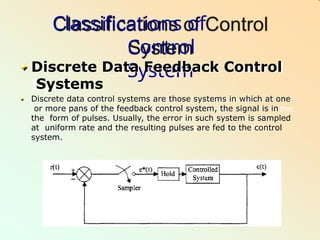
Discrete Data Feedback Control
Systems
Discrete data control systems are those systems in which at one
or more pans of the feedback control system, the signal is in
the form of pulses. Usually, the error in such system is sampled
at uniform rate and the resulting pulses are fed to the control
system.
Classifications of
Control
System
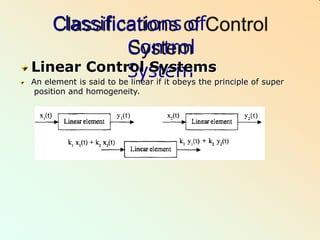
Linear Control Systems
An element is said to be linear if it obeys the principle of super
position and homogeneity.
Classifications of
Control
System
Non-Linear Control Systems
Any system which does not obey superposition principle is said to
be a non-linear system. Physical systems are in general non-linear
and analysis of such systems is very complicated. Hence these
systems are usually linearised.
Classifications of
Control
System
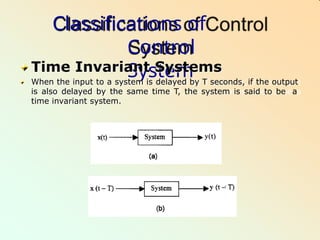
Time Invariant Systems
When the input to a system is delayed by T seconds, if the output
is also delayed by the same time T, the system is said to be a
time invariant system.
Mathematical
Modeling
if a system is composed of linear, lumped and time invariant
elements, its behaviour can be modelled by either linear algebraic
equations or linear differential equations with constant
coefficients.
If the input output relations are algebraic, the system is said to be
a static system.
if the relations are described by differential equations (the most
used) , the system is said to be a dynamic system.
Another most useful and common mathematical model is the
Transfer function' of the system.
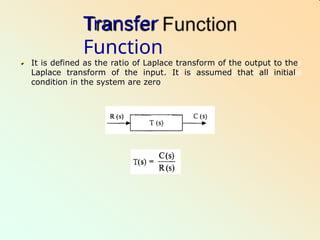
Transfer
Function
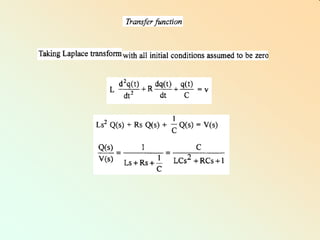
It is defined as the ratio of Laplace transform of the output to the
Laplace transform of the input. It is assumed that all initial
condition in the system are zero
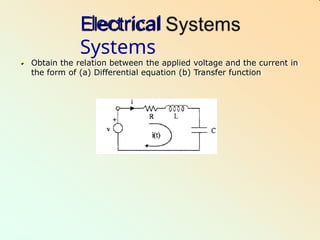
Electrical
Systems
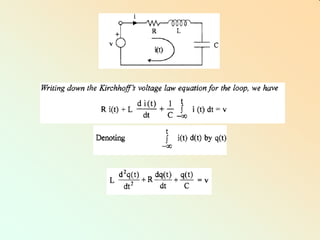
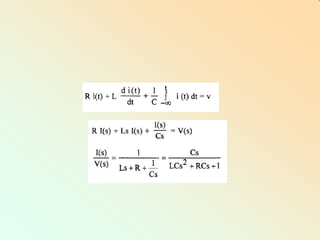
Obtain the relation between the applied voltage and the current in
the form of (a) Differential equation (b) Transfer function
1-Basic components of a control system-15-07-2024.pptx

1-Basic components of a control system-15-07-2024.pptx

  • 1.
    CONTROL SYSTEMS Dr. NishaJ S Assistant Professor Senior Grade.1 School of Electronics Engineering Vellore Institute of Technology
  • 4.
    Text book Norman Nise– Control System Engg. Reference books 1.Smarajit Ghosh, “ Control Systems (Theory And Applications)”, Pearson Education,2005 2.Benjamin C Kuo. “Automatic Control System.” 8th Edition, John Wiley &Sons,2003. 3.R.C. Dorf And R.H. Bishop, “Modern Control Systems (Examples And Design Problems)”, Pearson Education, 2004 4. M. Gopal, “Control Systems-Principles And Design”, Control Engineering”, Pearson Tata McGrawhill – 3nd Edn. 2002. 5. K. Ogata, “Modern Edition.
  • 5.
    System? Collection of componentsor elements to perform the specified task. Types of System? • Electrical system • Mechanical system • • • • Electromechanical system Hydraulic system Pneumatic system Thermal system
  • 6.
    is controlled by ControlSystem (or) Controlled System? The output quantity of the system varying the input quantity. Input or Reference or Set value Controller Process or Plant to be controlled + + + + Output or Controlled Variable Types of Control System? • Open loop control system • Closed loop control system Open loop control system An open-loop control system is one in which the control action is independent of the output. Disturbance Disturbance
  • 7.
    Practical Examples ofOpen Loop Control System  Electric Hand Drier – Hot air (output) comes out as long as you keep your hand under the machine, irrespective of how much your hand is dried.  Automatic Washing Machine – This machine runs according to the pre-set time irrespective of washing is completed or not.  Bread Toaster - This machine runs as per adjusted time irrespective of toasting is completed or not.  Automatic Tea/Coffee Maker – These machines also function for pre adjusted time only.  Light Switch – lamps glow whenever light switch is on irrespective of light is required or not.
  • 8.
    Closed loop controlsystem or Automatic Control System A closed-loop control system is one in which the control action is somehow dependent on the output. Controller Process or Plant to be controlled Disturbance + + Disturbance + + Output or - Feedback element (Transducer or sensor) Desired output + Input or Reference or Set value Actual output Controlled Variable Actuator Correction element
  • 9.
    Practical Examples ofClosed Loop Control System Automatic Electric Iron – Heating elements are controlled by output temperature of the iron. Servo Voltage Stabilizer – Voltage controller operates depending upon output voltage of the system.
  • 10.
    Water Level Controller–Input water is controlled by water level of the reservoir. An Air Conditioner – An air conditioner functions depending upon the temperature of the room. operates depending upon Cooling System in Car – It the temperature which it controls.
  • 11.
    Open loop controlsystem Advantages Always a stable system Economic system Disadvantages Inaccurate output Unreliable output Closed loop control system Advantage Accurate output Reliable output Disadvantages Costlier Designing a stable CL system is tedious
  • 12.
    Classifications of Control System Continuous TimeFeedback System If the signals in all parts of a control system are continuous functions of time, the system is classified as continuous time feedback control system.
  • 13.
    Classifications of Control System Discrete DataFeedback Control Systems Discrete data control systems are those systems in which at one or more pans of the feedback control system, the signal is in the form of pulses. Usually, the error in such system is sampled at uniform rate and the resulting pulses are fed to the control system.
  • 14.
    Classifications of Control System Linear ControlSystems An element is said to be linear if it obeys the principle of super position and homogeneity.
  • 15.
    Classifications of Control System Non-Linear ControlSystems Any system which does not obey superposition principle is said to be a non-linear system. Physical systems are in general non-linear and analysis of such systems is very complicated. Hence these systems are usually linearised.
  • 16.
    Classifications of Control System Time InvariantSystems When the input to a system is delayed by T seconds, if the output is also delayed by the same time T, the system is said to be a time invariant system.
  • 17.
    Mathematical Modeling if a systemis composed of linear, lumped and time invariant elements, its behaviour can be modelled by either linear algebraic equations or linear differential equations with constant coefficients. If the input output relations are algebraic, the system is said to be a static system. if the relations are described by differential equations (the most used) , the system is said to be a dynamic system. Another most useful and common mathematical model is the Transfer function' of the system.
  • 18.
    Transfer Function It is definedas the ratio of Laplace transform of the output to the Laplace transform of the input. It is assumed that all initial condition in the system are zero
  • 19.
    Electrical Systems Obtain the relationbetween the applied voltage and the current in the form of (a) Differential equation (b) Transfer function