KCI Education
ISO Certified Institute
Module-1
What is computer :
• History of Computers,
Concept of Hardware and Software :
• Hardware, Software,
History of Computers
• The computer as we know it today had its beginning
with a 19th century English mathematics professor
name Charles Babbage.
• He designed the Analytical Engine and it was this
design that the basic framework of the computers of
today are based on.
Charles Babbage.
• Charles Babbage was born on Dec. 26, 1791 in
England. He was a polymath and became a
mathematician, mechanical engineer, inventor, and
philosopher. He contributed to many different
scientific fields but his most famous work is
designing a programmable computing device.
• Born: Dec.26, 1791
• Died: Oct.18, 1871
• Profession: Mathematician
• Inventions: Difference engine, Pilot
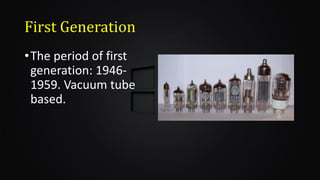
First Generation
•The period of first
generation: 1946-
1959. Vacuum tube
based.
Second Generation
•The period of second
generation: 1959-
1965. Transistor based.
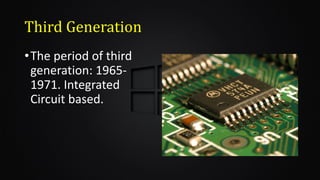
Third Generation
•The period of third
generation: 1965-
1971. Integrated
Circuit based.
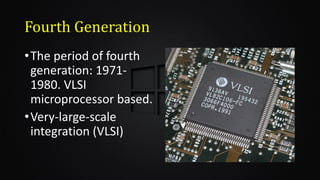
Fourth Generation
•The period of fourth
generation: 1971-
1980. VLSI
microprocessor based.
•Very-large-scale
integration (VLSI)
Fifth Generation
•The period of fifth
generation: 1980-
onwards. ULSI
microprocessor based.
•Ultra large-scale
integration (ULSI)
Computer Hardware
Description
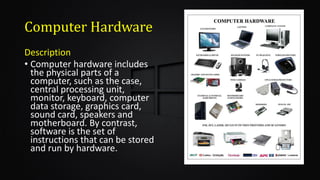
• Computer hardware includes
the physical parts of a
computer, such as the case,
central processing unit,
monitor, keyboard, computer
data storage, graphics card,
sound card, speakers and
motherboard. By contrast,
software is the set of
instructions that can be stored
and run by hardware.
Computer Software
Description
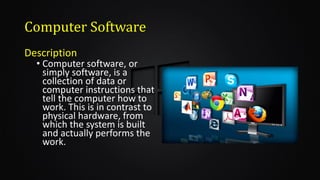
• Computer software, or
simply software, is a
collection of data or
computer instructions that
tell the computer how to
work. This is in contrast to
physical hardware, from
which the system is built
and actually performs the
work.
Memory Unit
8 Bits = Byte
1Megabyte = 1000000 Bytes
1 Megabyte = 1000 Kilobytes
Kilobyte (KB) 1 KB = 1024 Bytes
Megabyte (MB) 1 MB = 1024 KB
Giga Byte (GB) 1 GB = 1024 MB
Tera Byte (TB) 1 TB = 1024 GB
Peta Byte (PB)1 PB = 1024 TB
Floppy Memory
[3.5-floppy]
Floppy Disk 1.44 MB
[3.5-mo-disk]
Magento-Optical (MO) Disk 128 MB
[5.25-bernouilli]
Bernouilli Disk 150 MB
Compact Disc (CD)
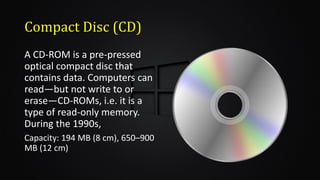
A CD-ROM is a pre-pressed
optical compact disc that
contains data. Computers can
read—but not write to or
erase—CD-ROMs, i.e. it is a
type of read-only memory.
During the 1990s,
Capacity: 194 MB (8 cm), 650–900
MB (12 cm)
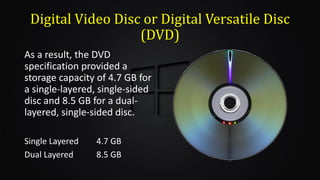
Digital Video Disc or Digital Versatile Disc
(DVD)
As a result, the DVD
specification provided a
storage capacity of 4.7 GB for
a single-layered, single-sided
disc and 8.5 GB for a dual-
layered, single-sided disc.
Single Layered 4.7 GB
Dual Layered 8.5 GB
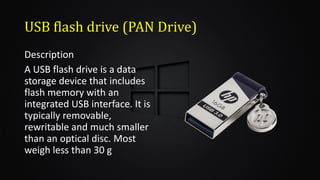
USB flash drive (PAN Drive)
Description
A USB flash drive is a data
storage device that includes
flash memory with an
integrated USB interface. It is
typically removable,
rewritable and much smaller
than an optical disc. Most
weigh less than 30 g
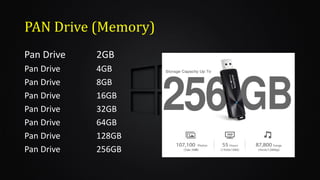
PAN Drive (Memory)
Pan Drive 2GB
Pan Drive 4GB
Pan Drive 8GB
Pan Drive 16GB
Pan Drive 32GB
Pan Drive 64GB
Pan Drive 128GB
Pan Drive 256GB

Module-1 Introduction to Computer & Basic Concepts.pdf

  • 1.
  • 2.
    Module-1 What is computer: • History of Computers, Concept of Hardware and Software : • Hardware, Software,
  • 3.
    History of Computers •The computer as we know it today had its beginning with a 19th century English mathematics professor name Charles Babbage. • He designed the Analytical Engine and it was this design that the basic framework of the computers of today are based on.
  • 4.
    Charles Babbage. • CharlesBabbage was born on Dec. 26, 1791 in England. He was a polymath and became a mathematician, mechanical engineer, inventor, and philosopher. He contributed to many different scientific fields but his most famous work is designing a programmable computing device. • Born: Dec.26, 1791 • Died: Oct.18, 1871 • Profession: Mathematician • Inventions: Difference engine, Pilot
  • 5.
    First Generation •The periodof first generation: 1946- 1959. Vacuum tube based.
  • 6.
    Second Generation •The periodof second generation: 1959- 1965. Transistor based.
  • 7.
    Third Generation •The periodof third generation: 1965- 1971. Integrated Circuit based.
  • 8.
    Fourth Generation •The periodof fourth generation: 1971- 1980. VLSI microprocessor based. •Very-large-scale integration (VLSI)
  • 9.
    Fifth Generation •The periodof fifth generation: 1980- onwards. ULSI microprocessor based. •Ultra large-scale integration (ULSI)
  • 10.
    Computer Hardware Description • Computerhardware includes the physical parts of a computer, such as the case, central processing unit, monitor, keyboard, computer data storage, graphics card, sound card, speakers and motherboard. By contrast, software is the set of instructions that can be stored and run by hardware.
  • 11.
    Computer Software Description • Computersoftware, or simply software, is a collection of data or computer instructions that tell the computer how to work. This is in contrast to physical hardware, from which the system is built and actually performs the work.
  • 12.
    Memory Unit 8 Bits= Byte 1Megabyte = 1000000 Bytes 1 Megabyte = 1000 Kilobytes Kilobyte (KB) 1 KB = 1024 Bytes Megabyte (MB) 1 MB = 1024 KB Giga Byte (GB) 1 GB = 1024 MB Tera Byte (TB) 1 TB = 1024 GB Peta Byte (PB)1 PB = 1024 TB
  • 13.
    Floppy Memory [3.5-floppy] Floppy Disk1.44 MB [3.5-mo-disk] Magento-Optical (MO) Disk 128 MB [5.25-bernouilli] Bernouilli Disk 150 MB
  • 14.
    Compact Disc (CD) ACD-ROM is a pre-pressed optical compact disc that contains data. Computers can read—but not write to or erase—CD-ROMs, i.e. it is a type of read-only memory. During the 1990s, Capacity: 194 MB (8 cm), 650–900 MB (12 cm)
  • 15.
    Digital Video Discor Digital Versatile Disc (DVD) As a result, the DVD specification provided a storage capacity of 4.7 GB for a single-layered, single-sided disc and 8.5 GB for a dual- layered, single-sided disc. Single Layered 4.7 GB Dual Layered 8.5 GB
  • 16.
    USB flash drive(PAN Drive) Description A USB flash drive is a data storage device that includes flash memory with an integrated USB interface. It is typically removable, rewritable and much smaller than an optical disc. Most weigh less than 30 g
  • 17.
    PAN Drive (Memory) PanDrive 2GB Pan Drive 4GB Pan Drive 8GB Pan Drive 16GB Pan Drive 32GB Pan Drive 64GB Pan Drive 128GB Pan Drive 256GB