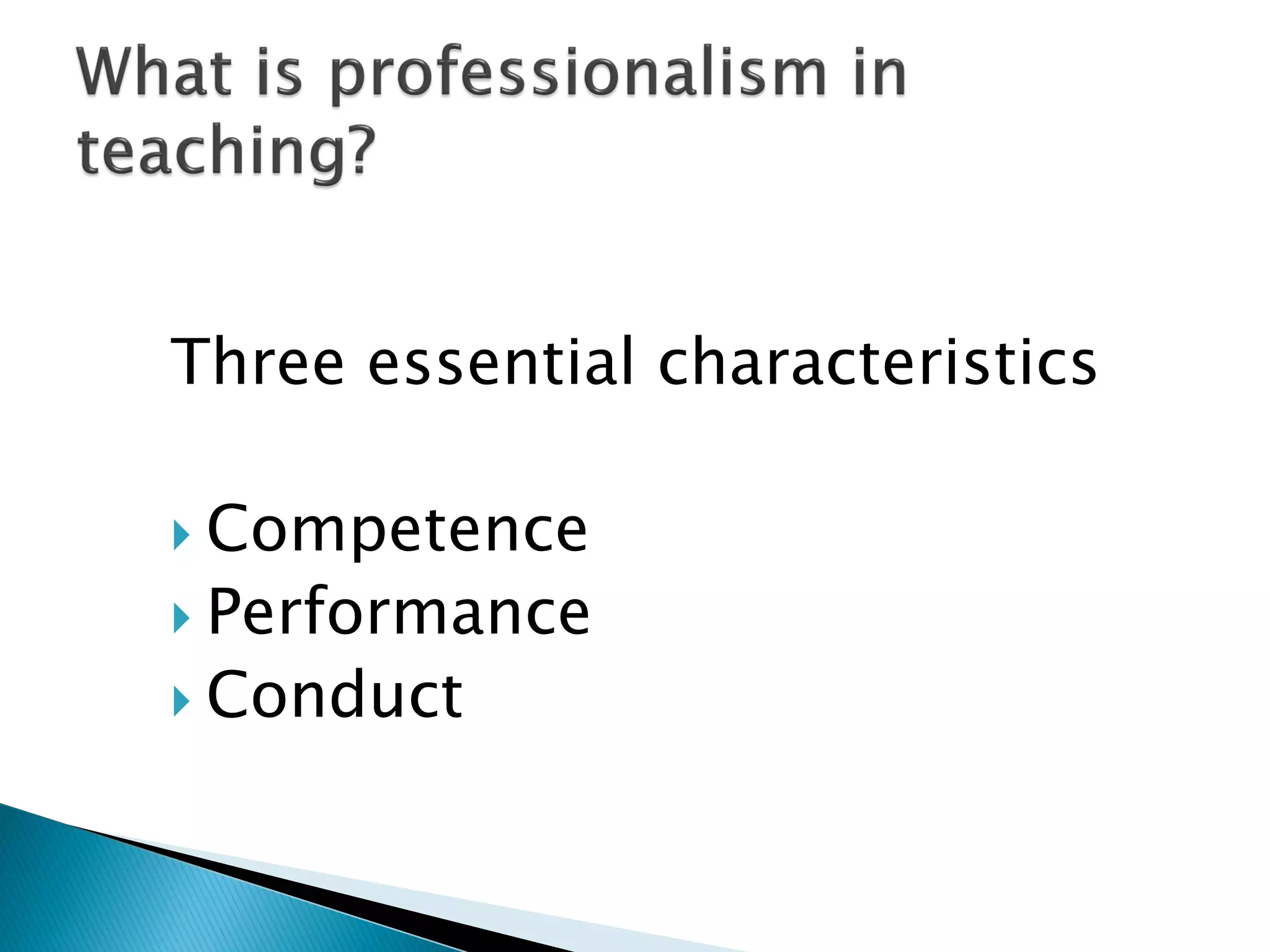
Three essential characteristics
 Competence
 Performance
 Conduct
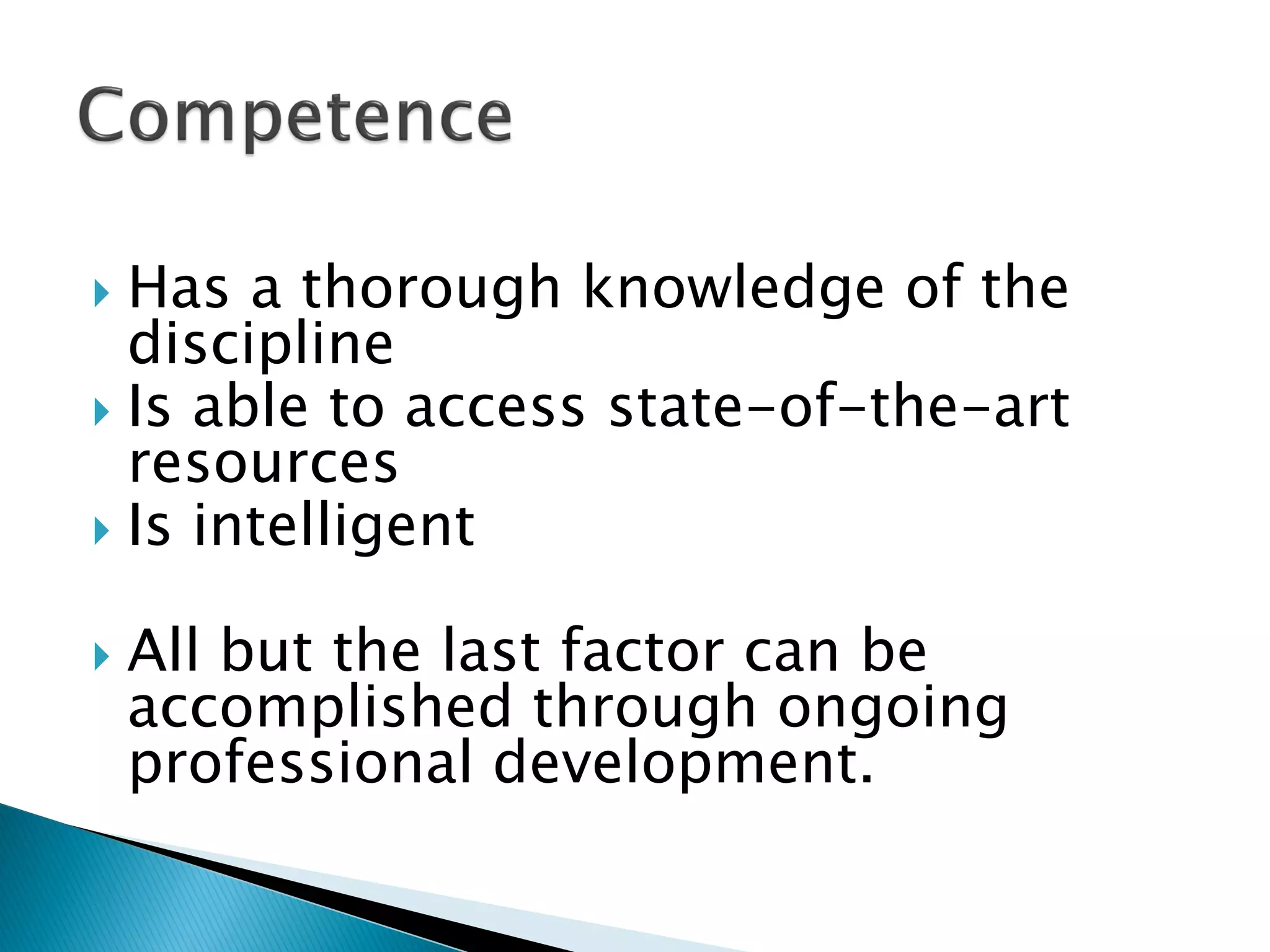
 Has a thorough knowledge of the
discipline
 Is able to access state-of-the-art
resources
 Is intelligent
 All but the last factor can be
accomplished through ongoing
professional development.
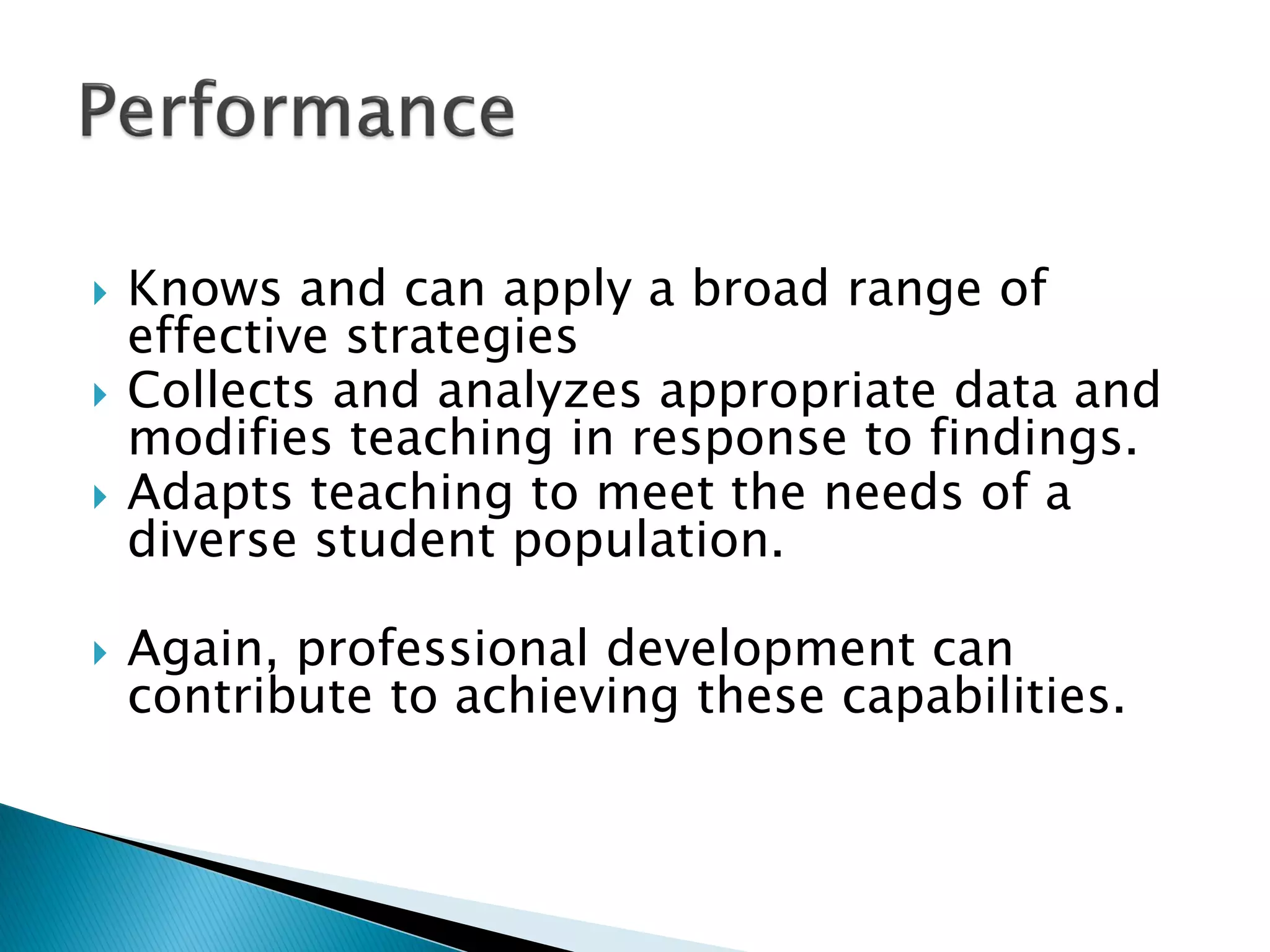
 Knows and can apply a broad range of
effective strategies
 Collects and analyzes appropriate data and
modifies teaching in response to findings.
 Adapts teaching to meet the needs of a
diverse student population.
 Again, professional development can
contribute to achieving these capabilities.
 Maintains the highest ethical
standards in all interactions with
students, colleagues, and parents.
 Seeks justice and equity for all
students.
 Reflective teaching (discussed later in
this presentation)
 Ongoing professional development
◦ Take advantage of opportunities in your
school, district, state, nationally, and
internationally for professional
development.
◦ Read professional journals
◦ Participate in professional conferences
 Stay current in your discipline
 Share with colleagues
 Be aware of new instructional strategies and
instructional resources
 Stay informed in educational research
 Have a forum for your own experiences and
research
 Have a voice (through the organization) in
political actions that affect your discipline or
education in general
 Have legal protection for school-related issues
(many organizations offer legal assistance).

 National Science Teachers Association
 http://www.nsta.org/

 American Association for the Advancement of Science
 http://www.aaas.org/

 National Association for Research in Science Teaching
 http://www.narst.org/

 Association for Supervision and Curriculum Development
 http://www.ascd.org/

 Science Teachers Association of Texas
 http://www.statweb.org/index.php
 Almost all national or state organizations
publish one or more journals. Become
familiar with these journals. The organization
website will link you to information about the
journals.
 As you grow in confidence, submit articles for
publication. As in reflective teaching, the
process of writing for publication helps you
clarify and refine your pedagagoical
knowledge and skills.
 Attend conferences. As you grow in
knowledge about the organizations, you will
be able to select which conference(s) will
provide the greatest professional
development for you.
 Volunteer to serve on local, state, or national
committees. You will learn so much from the
process and from your colleagues.
 A teaching professional never stops learning.
Your job is too important. You hold the future
in your hands.
 Teacher Reflection has been defined in a
variety of ways. The following are necessary
characteristics of self-reflection:
◦ Deliberate
◦ Open minded
◦ Seeks change
◦ Assumes responsibility for educational decisions
◦ Sincere
◦ Involves critical inquiry
Reference: Cruickshank, D., Metcalf, K., & Bainer-Jenkins, D. (2008). The act of
teaching. Boston, MA: McGraw-Hill.
 Usually includes or is prompted by some level of
uncertainty that needs to be resolved in the mind
of the teacher
 Is more than "just thinking hard about what you
do." Reflection should pose a question, pose
alternative answers, and seek deeper meaning
about what you do.
 What is the role of self-reflection in field
experience?
 Your field experience will be richer, deeper,
and more valuable the more reflective you are
about what happens.
 A model that can help us understand what
happens to us during the reflective process is
CBAM, the Concerns Based Adoption Model,
developed at the University of Texas as a
result of research in teacher education.
 Sweeney, B. (2003). CBAM: A model of the people-development process.
Retrieved from the Internet on February 26, 2010, from
http://www.mentoring-association.org/membersonly/CBAM.html
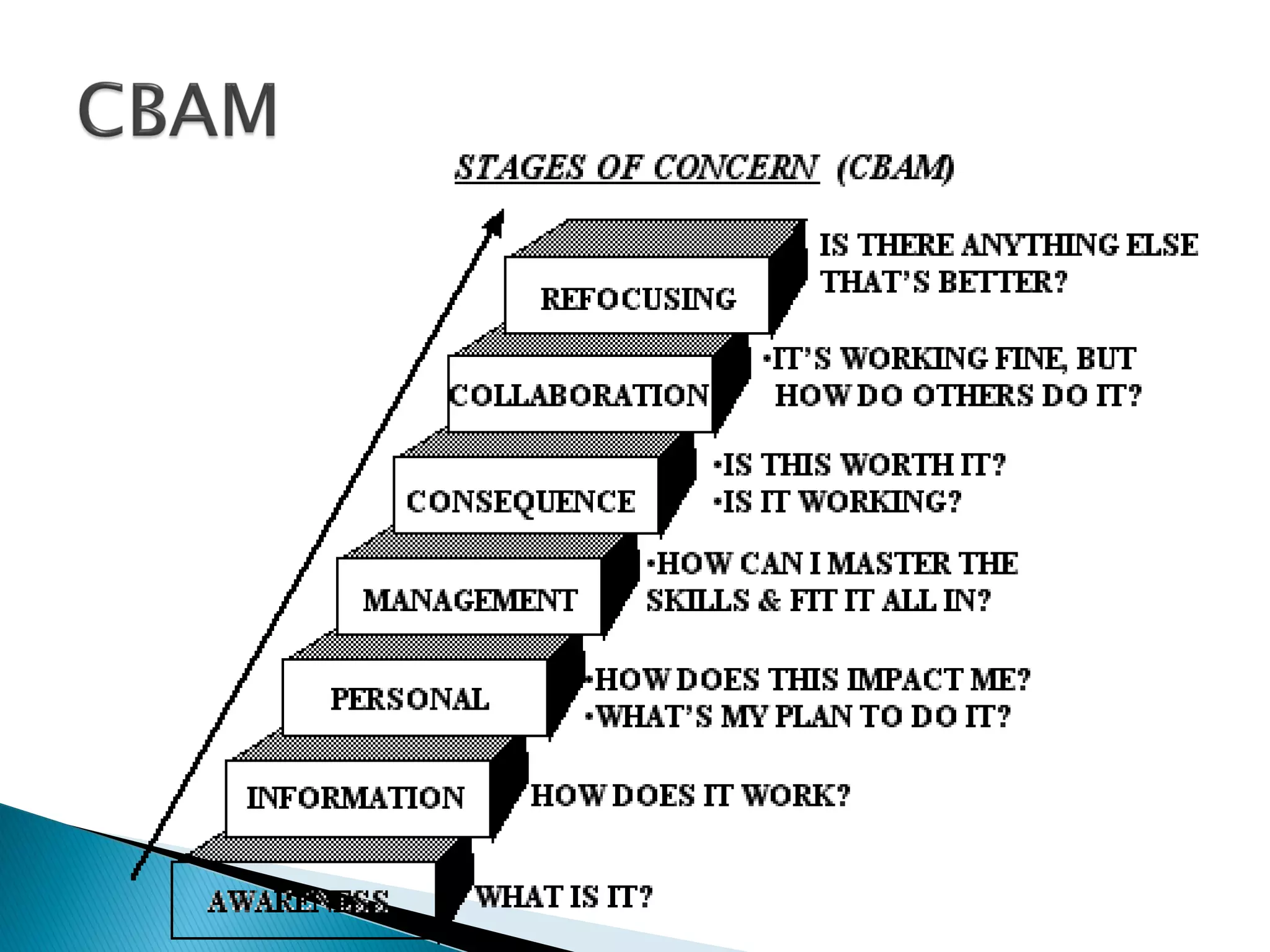
 Stages of Concern defines human learning
and development as going through 7 stages,
during which a person's focus or concern
shifts in rather predictable ways.
 To understand this process, start at the
bottom of the image with "awareness" and
read up each step plus the statement(s) next
to each step. Those statements are similar to
what people may say when they are
concerned about an innovation at that level of
development.
 The lower three stages are focused on
oneself, a clue of which might be the use of
"I" and "me", as in "I am frustrated".
 In the field, a student at these lower levels
focuses on what is happening; what
experiences she/he is having.
 The middle stage is focused on mastery of
tasks. In the field, the student may focus on
strategies the mentor is using, student
behaviors, his or her own abilities in using
different strategies.
 The upper Stages of Concern are focused on
the results and impact of the activity.
 Example statements might include, "The
students are really learning better since I
started using that strategy." or “I think that
modification helped … be more successful
with the assigned task.
 The CBAM model can help us identify where
we are in the process of learning how to
reflect.
 The next question is, “How do we present
that reflection for others to understand?”
 The process of preparing a journal is similar
in some ways to preparing a professional
portfolio. For that reason, we will examine
what researchers have said about this
process.
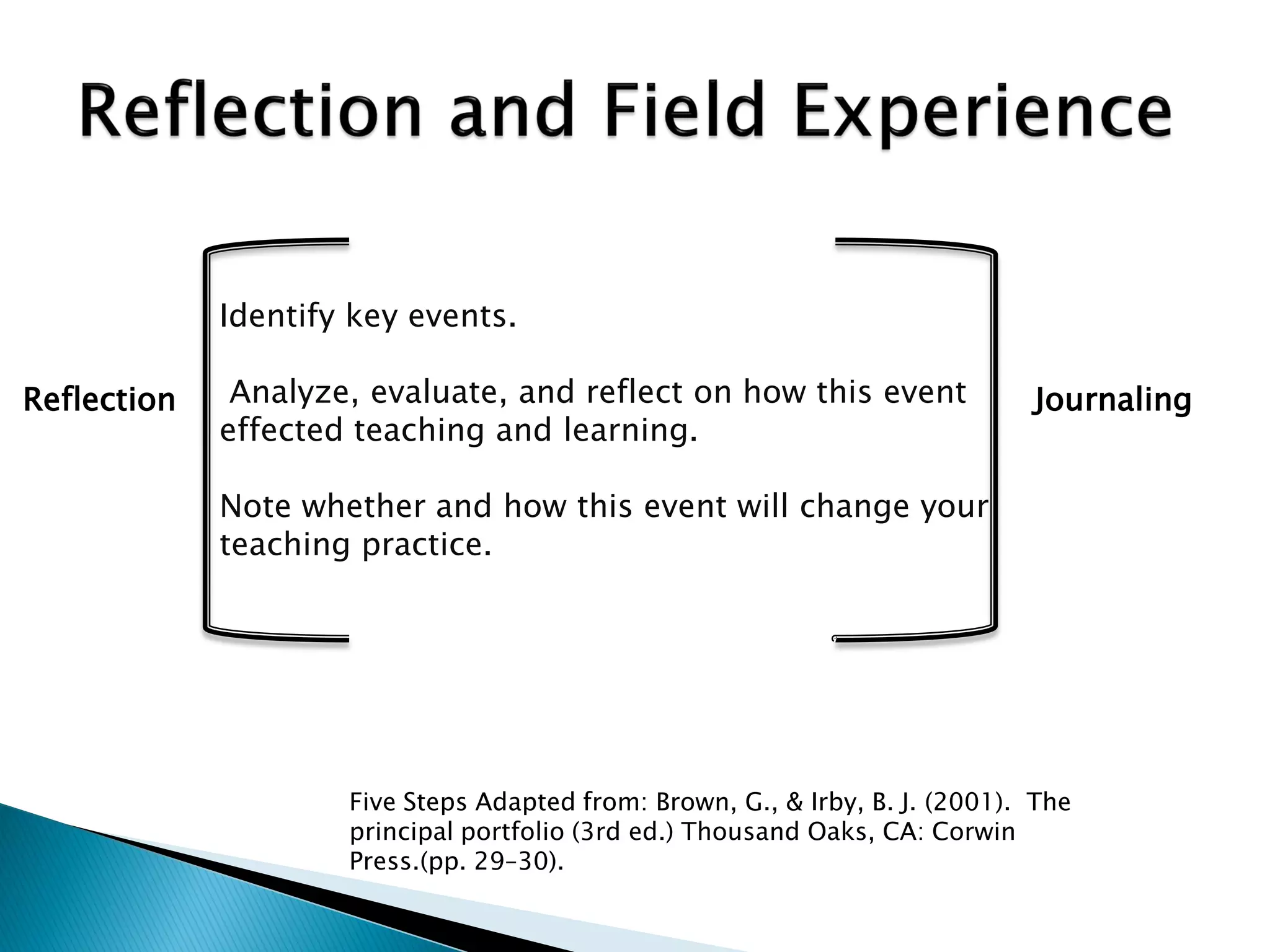
Identify key events.
Analyze, evaluate, and reflect on how this event
effected teaching and learning.
Note whether and how this event will change your
teaching practice.
JournalingReflection
Five Steps Adapted from: Brown, G., & Irby, B. J. (2001). The
principal portfolio (3rd ed.) Thousand Oaks, CA: Corwin
Press.(pp. 29–30).
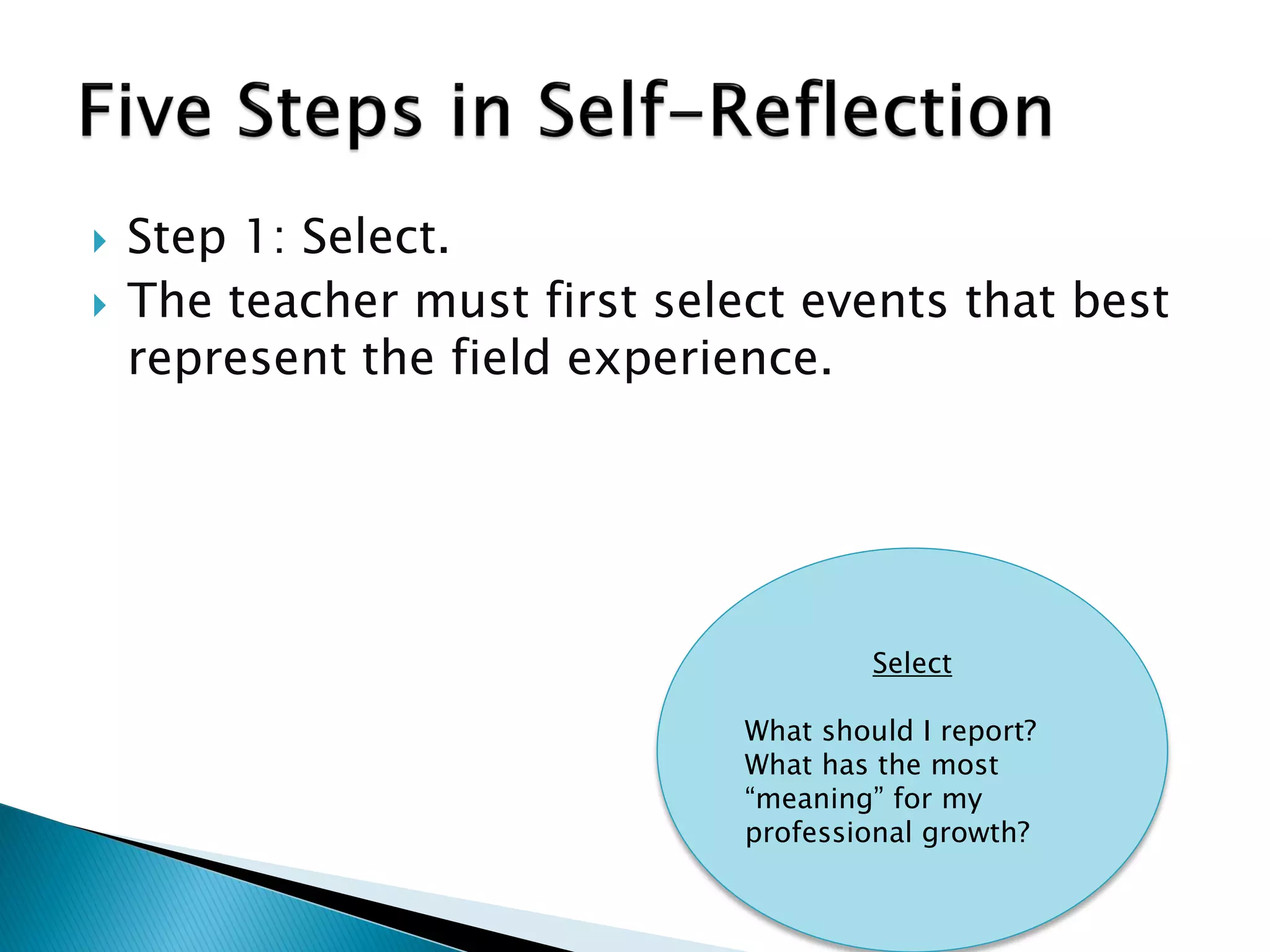
 Step 1: Select.
 The teacher must first select events that best
represent the field experience.
Select
What should I report?
What has the most
“meaning” for my
professional growth?
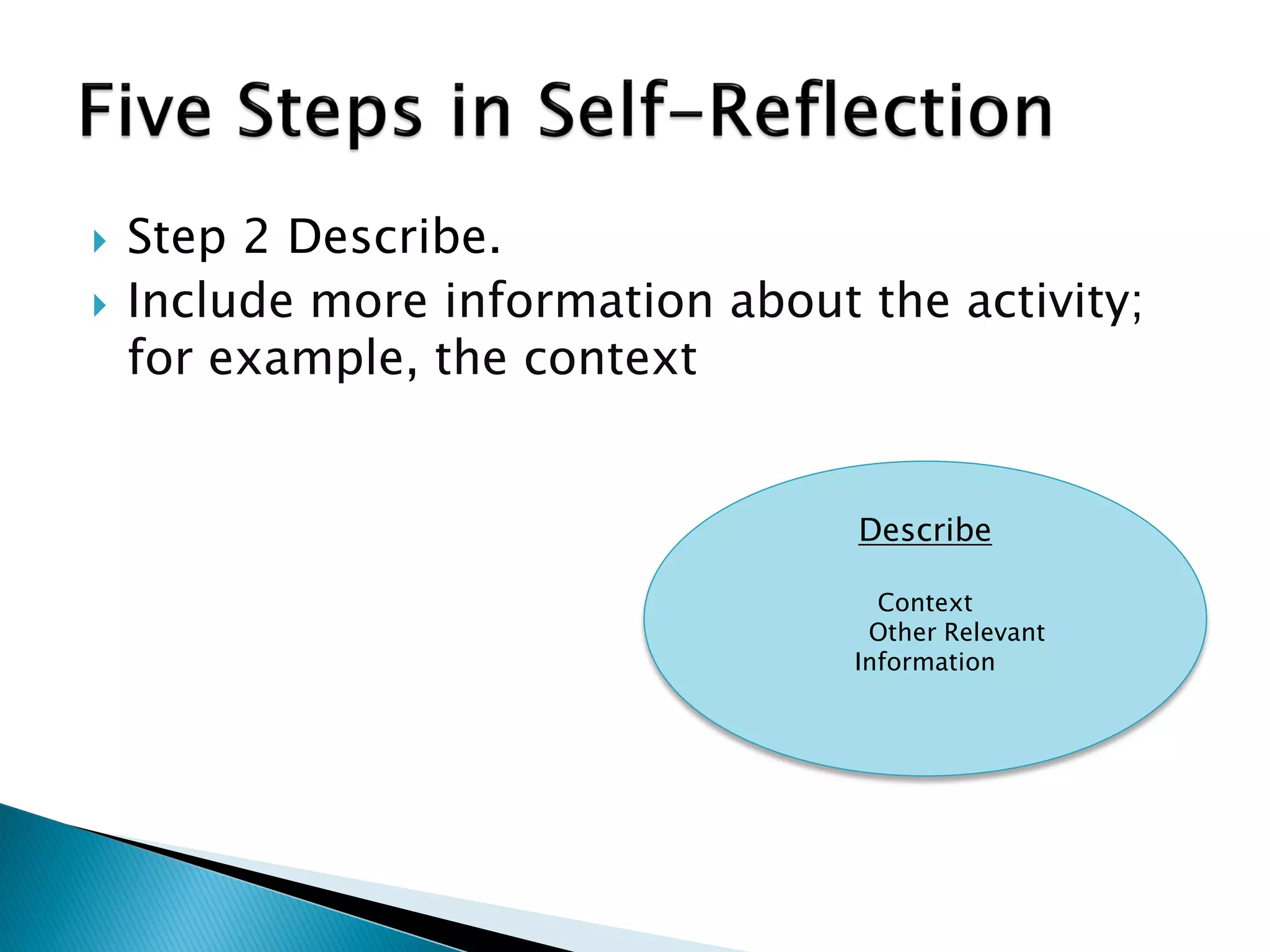
 Step 2 Describe.
 Include more information about the activity;
for example, the context
Describe
Context
Other Relevant
Information
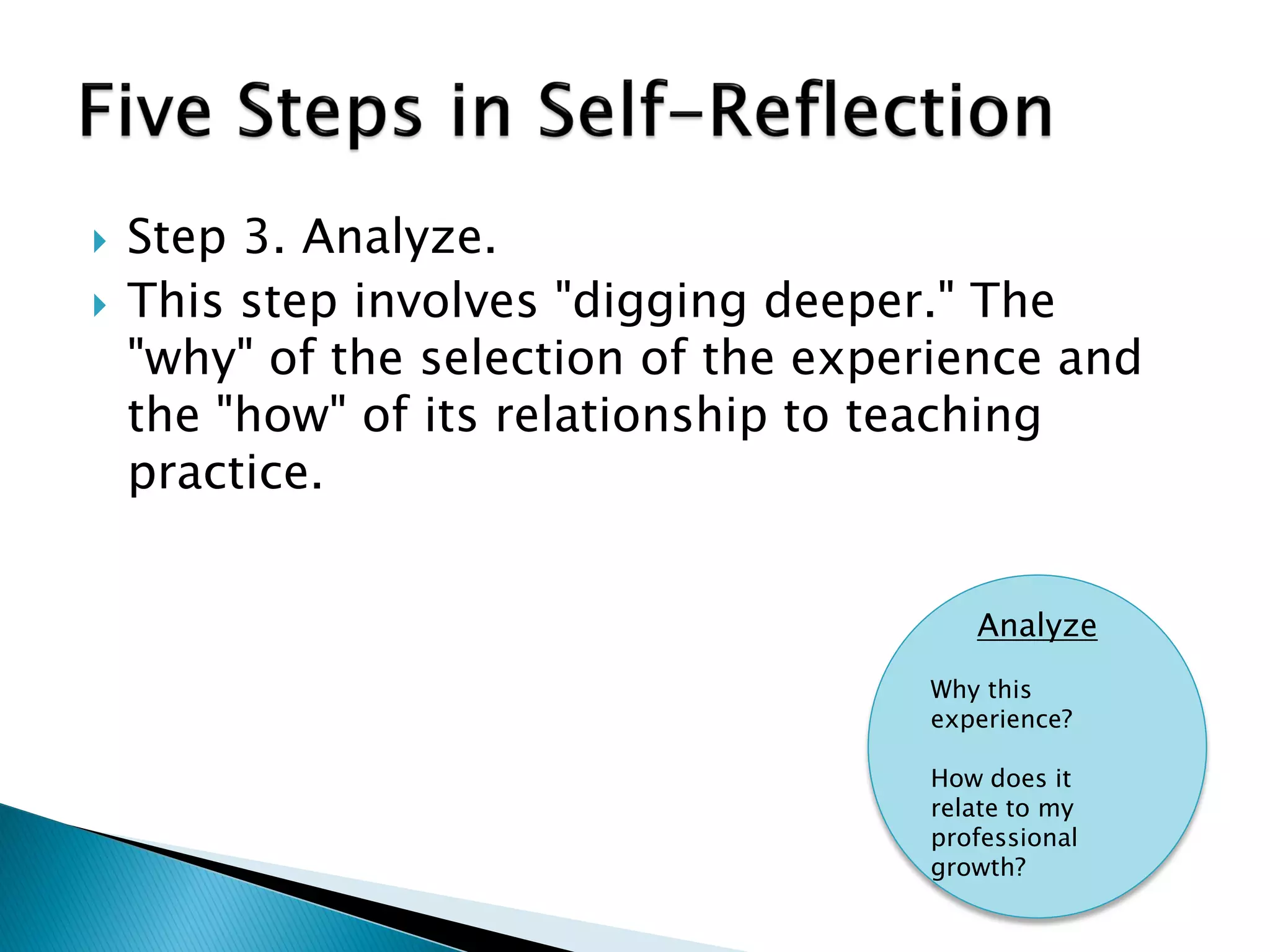
 Step 3. Analyze.
 This step involves "digging deeper." The
"why" of the selection of the experience and
the "how" of its relationship to teaching
practice.
Analyze
Why this
experience?
How does it
relate to my
professional
growth?
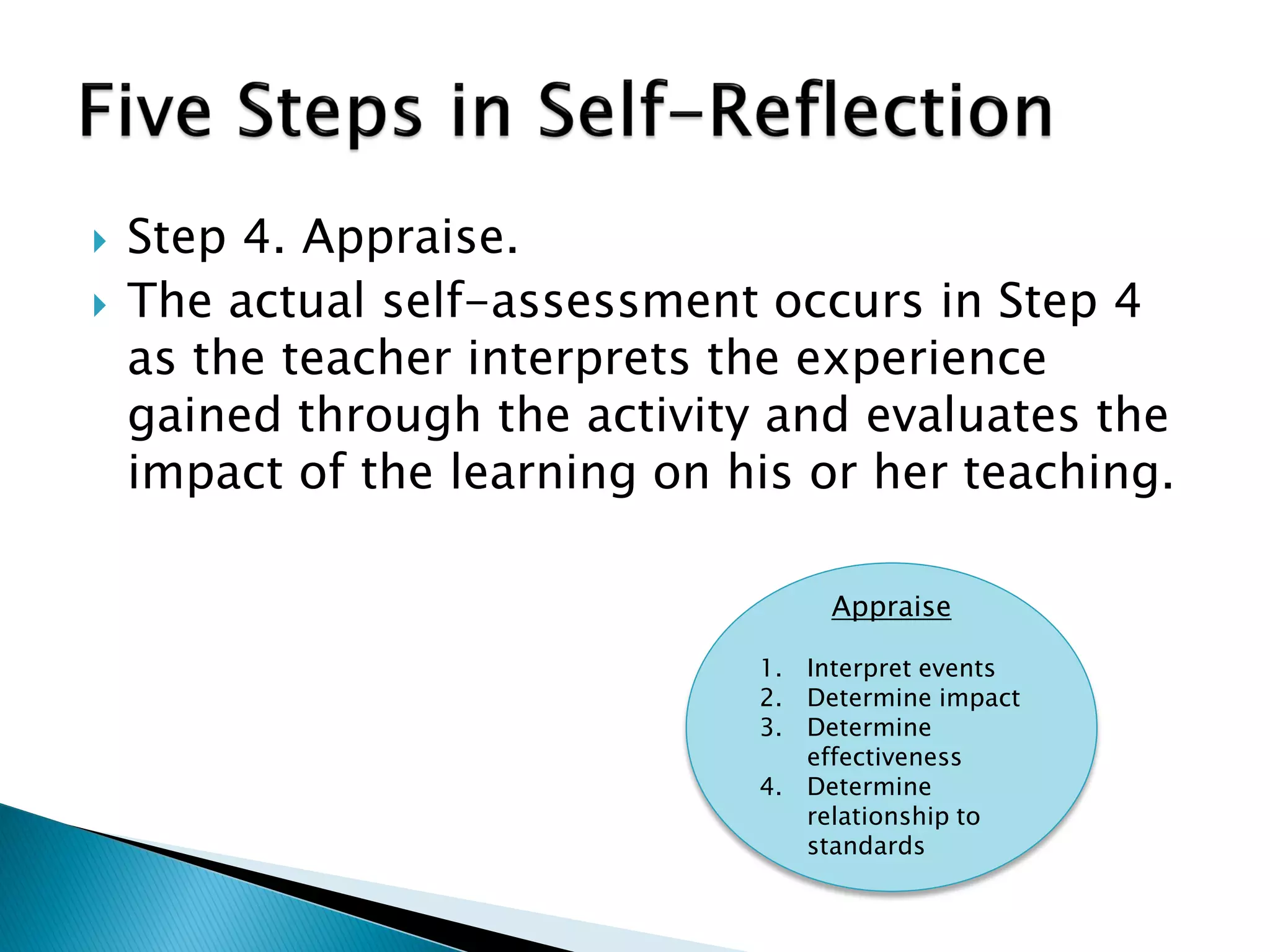
 Step 4. Appraise.
 The actual self-assessment occurs in Step 4
as the teacher interprets the experience
gained through the activity and evaluates the
impact of the learning on his or her teaching.
Appraise
1. Interpret events
2. Determine impact
3. Determine
effectiveness
4. Determine
relationship to
standards
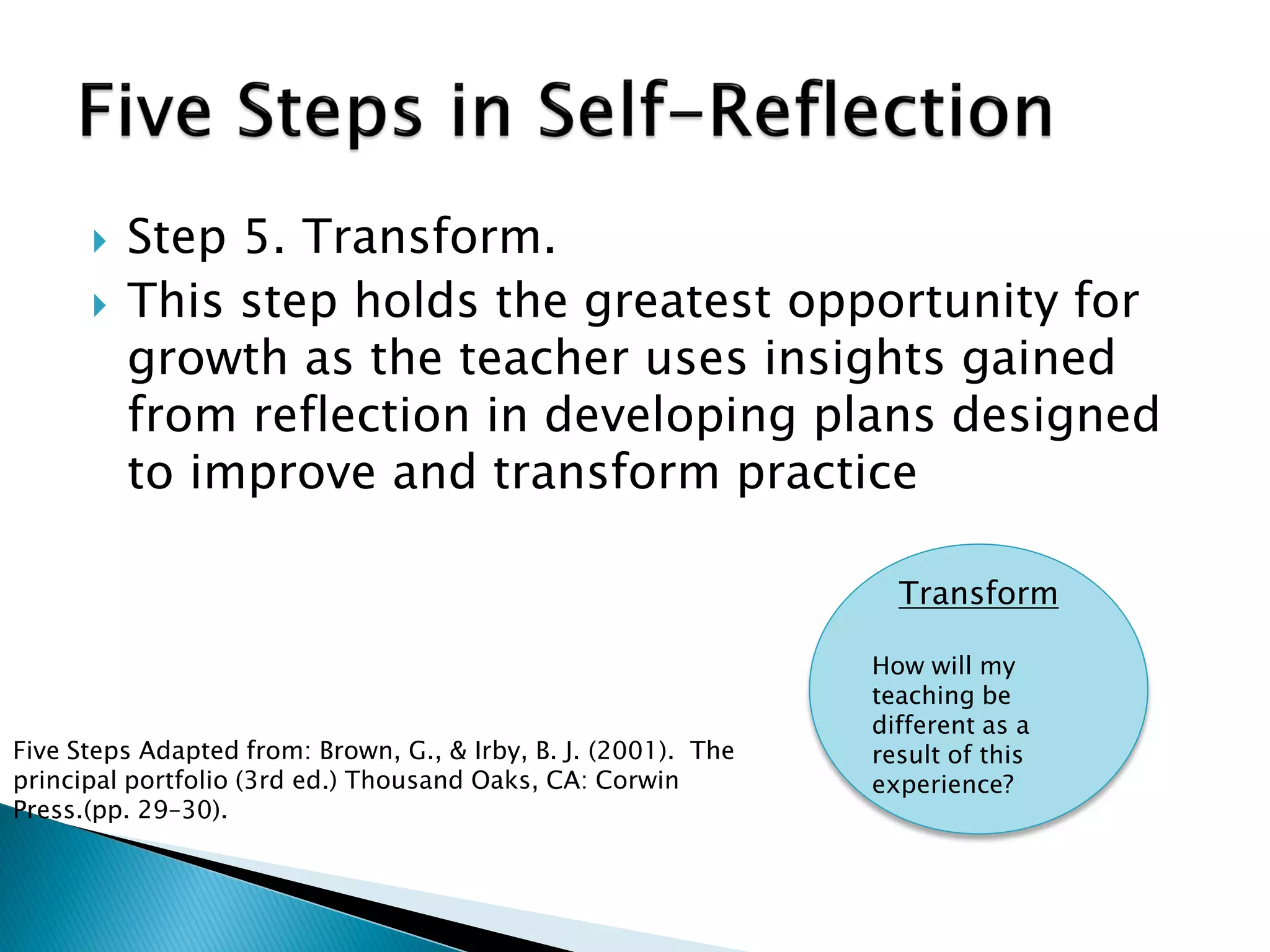
 Step 5. Transform.
 This step holds the greatest opportunity for
growth as the teacher uses insights gained
from reflection in developing plans designed
to improve and transform practice
Transform
How will my
teaching be
different as a
result of this
experience?
Five Steps Adapted from: Brown, G., & Irby, B. J. (2001). The
principal portfolio (3rd ed.) Thousand Oaks, CA: Corwin
Press.(pp. 29–30).
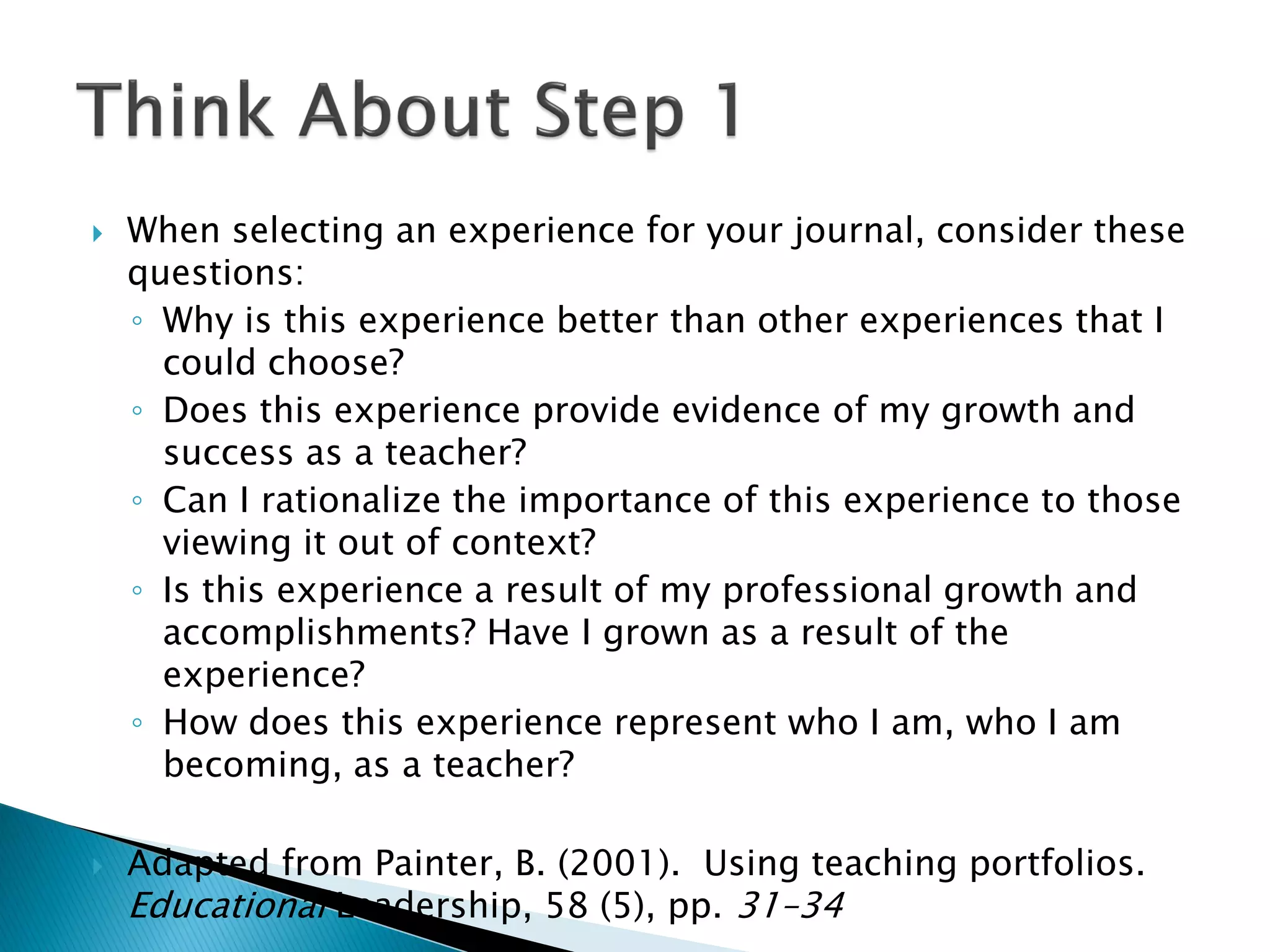
 When selecting an experience for your journal, consider these
questions:
◦ Why is this experience better than other experiences that I
could choose?
◦ Does this experience provide evidence of my growth and
success as a teacher?
◦ Can I rationalize the importance of this experience to those
viewing it out of context?
◦ Is this experience a result of my professional growth and
accomplishments? Have I grown as a result of the
experience?
◦ How does this experience represent who I am, who I am
becoming, as a teacher?
 Adapted from Painter, B. (2001). Using teaching portfolios.
Educational Leadership, 58 (5), pp. 31–34
 Your written narrative, even more than the
experience itself, tells the reader about your
growth as a teacher.
 Remember the importance of “metacognition”
in human learning.
 The reflection should basically indicate what
you learned from doing/creating the
experience.
 What happened? (What did I or someone else do?
What occurred?)
 What was the context?
 How did it effect the students?
 How did it effect my thinking about teaching and
learning?
 How did it develop me professionally?
 A reflective journal is designed to help you
grow. Like most other experiences, the more
you put into it, the more you will get out of it.
 Allow this experience to help you grow and
develop.

Module 8 professionalism_and_reflection

  • 3.
    Three essential characteristics Competence  Performance  Conduct
  • 4.
     Has athorough knowledge of the discipline  Is able to access state-of-the-art resources  Is intelligent  All but the last factor can be accomplished through ongoing professional development.
  • 5.
     Knows andcan apply a broad range of effective strategies  Collects and analyzes appropriate data and modifies teaching in response to findings.  Adapts teaching to meet the needs of a diverse student population.  Again, professional development can contribute to achieving these capabilities.
  • 6.
     Maintains thehighest ethical standards in all interactions with students, colleagues, and parents.  Seeks justice and equity for all students.
  • 7.
     Reflective teaching(discussed later in this presentation)  Ongoing professional development ◦ Take advantage of opportunities in your school, district, state, nationally, and internationally for professional development. ◦ Read professional journals ◦ Participate in professional conferences
  • 8.
     Stay currentin your discipline  Share with colleagues  Be aware of new instructional strategies and instructional resources  Stay informed in educational research  Have a forum for your own experiences and research  Have a voice (through the organization) in political actions that affect your discipline or education in general  Have legal protection for school-related issues (many organizations offer legal assistance).
  • 9.
      National ScienceTeachers Association  http://www.nsta.org/   American Association for the Advancement of Science  http://www.aaas.org/   National Association for Research in Science Teaching  http://www.narst.org/   Association for Supervision and Curriculum Development  http://www.ascd.org/   Science Teachers Association of Texas  http://www.statweb.org/index.php
  • 10.
     Almost allnational or state organizations publish one or more journals. Become familiar with these journals. The organization website will link you to information about the journals.  As you grow in confidence, submit articles for publication. As in reflective teaching, the process of writing for publication helps you clarify and refine your pedagagoical knowledge and skills.
  • 11.
     Attend conferences.As you grow in knowledge about the organizations, you will be able to select which conference(s) will provide the greatest professional development for you.  Volunteer to serve on local, state, or national committees. You will learn so much from the process and from your colleagues.
  • 12.
     A teachingprofessional never stops learning. Your job is too important. You hold the future in your hands.
  • 15.
     Teacher Reflectionhas been defined in a variety of ways. The following are necessary characteristics of self-reflection: ◦ Deliberate ◦ Open minded ◦ Seeks change ◦ Assumes responsibility for educational decisions ◦ Sincere ◦ Involves critical inquiry Reference: Cruickshank, D., Metcalf, K., & Bainer-Jenkins, D. (2008). The act of teaching. Boston, MA: McGraw-Hill.
  • 16.
     Usually includesor is prompted by some level of uncertainty that needs to be resolved in the mind of the teacher  Is more than "just thinking hard about what you do." Reflection should pose a question, pose alternative answers, and seek deeper meaning about what you do.
  • 17.
     What isthe role of self-reflection in field experience?  Your field experience will be richer, deeper, and more valuable the more reflective you are about what happens.
  • 18.
     A modelthat can help us understand what happens to us during the reflective process is CBAM, the Concerns Based Adoption Model, developed at the University of Texas as a result of research in teacher education.  Sweeney, B. (2003). CBAM: A model of the people-development process. Retrieved from the Internet on February 26, 2010, from http://www.mentoring-association.org/membersonly/CBAM.html
  • 19.
     Stages ofConcern defines human learning and development as going through 7 stages, during which a person's focus or concern shifts in rather predictable ways.
  • 21.
     To understandthis process, start at the bottom of the image with "awareness" and read up each step plus the statement(s) next to each step. Those statements are similar to what people may say when they are concerned about an innovation at that level of development.
  • 22.
     The lowerthree stages are focused on oneself, a clue of which might be the use of "I" and "me", as in "I am frustrated".  In the field, a student at these lower levels focuses on what is happening; what experiences she/he is having.
  • 23.
     The middlestage is focused on mastery of tasks. In the field, the student may focus on strategies the mentor is using, student behaviors, his or her own abilities in using different strategies.
  • 24.
     The upperStages of Concern are focused on the results and impact of the activity.  Example statements might include, "The students are really learning better since I started using that strategy." or “I think that modification helped … be more successful with the assigned task.
  • 25.
     The CBAMmodel can help us identify where we are in the process of learning how to reflect.  The next question is, “How do we present that reflection for others to understand?”
  • 26.
     The processof preparing a journal is similar in some ways to preparing a professional portfolio. For that reason, we will examine what researchers have said about this process.
  • 27.
    Identify key events. Analyze,evaluate, and reflect on how this event effected teaching and learning. Note whether and how this event will change your teaching practice. JournalingReflection Five Steps Adapted from: Brown, G., & Irby, B. J. (2001). The principal portfolio (3rd ed.) Thousand Oaks, CA: Corwin Press.(pp. 29–30).
  • 28.
     Step 1:Select.  The teacher must first select events that best represent the field experience. Select What should I report? What has the most “meaning” for my professional growth?
  • 29.
     Step 2Describe.  Include more information about the activity; for example, the context Describe Context Other Relevant Information
  • 30.
     Step 3.Analyze.  This step involves "digging deeper." The "why" of the selection of the experience and the "how" of its relationship to teaching practice. Analyze Why this experience? How does it relate to my professional growth?
  • 31.
     Step 4.Appraise.  The actual self-assessment occurs in Step 4 as the teacher interprets the experience gained through the activity and evaluates the impact of the learning on his or her teaching. Appraise 1. Interpret events 2. Determine impact 3. Determine effectiveness 4. Determine relationship to standards
  • 32.
     Step 5.Transform.  This step holds the greatest opportunity for growth as the teacher uses insights gained from reflection in developing plans designed to improve and transform practice Transform How will my teaching be different as a result of this experience? Five Steps Adapted from: Brown, G., & Irby, B. J. (2001). The principal portfolio (3rd ed.) Thousand Oaks, CA: Corwin Press.(pp. 29–30).
  • 33.
     When selectingan experience for your journal, consider these questions: ◦ Why is this experience better than other experiences that I could choose? ◦ Does this experience provide evidence of my growth and success as a teacher? ◦ Can I rationalize the importance of this experience to those viewing it out of context? ◦ Is this experience a result of my professional growth and accomplishments? Have I grown as a result of the experience? ◦ How does this experience represent who I am, who I am becoming, as a teacher?  Adapted from Painter, B. (2001). Using teaching portfolios. Educational Leadership, 58 (5), pp. 31–34
  • 34.
     Your writtennarrative, even more than the experience itself, tells the reader about your growth as a teacher.  Remember the importance of “metacognition” in human learning.
  • 35.
     The reflectionshould basically indicate what you learned from doing/creating the experience.
  • 36.
     What happened?(What did I or someone else do? What occurred?)  What was the context?  How did it effect the students?  How did it effect my thinking about teaching and learning?  How did it develop me professionally?
  • 37.
     A reflectivejournal is designed to help you grow. Like most other experiences, the more you put into it, the more you will get out of it.  Allow this experience to help you grow and develop.