University of Engineering & Technology
Peshawar, Pakistan
CE301: Structure Analysis II
Module 07:
Revision of Course ( Flexibility & Stiffness)
By:
Prof. Dr. Bashir Alam
Civil Engineering Department
UET , Peshawar
Topics to be Covered
• Revision of Flexibility & Stiffness method concept
• Analysis of beam using flexibility method ( Problem 1)
• Analysis of frame using flexibility method ( Problem 2)
• Analysis of beam using stiffness method ( Problem 3)
• Analysis of beam using stiffness method ( Problem 4)
Matrix Methods of Analysis
• Flexibility Method
In this method redundant constraints are removed and
corresponding redundant actions (forces or moment) are placed.
An equation of compatibility of deformation is written in terms of
these redundants and corresponding displacements. The
redundants are determined from these simultaneous equation.
Equations of statics are then used for calculation of designed
internal actions. In this method, actions are treated as basic
unknowns. This method will be described in detail in this lecture.
Matrix Methods of Analysis
• Flexibility Method
In this method redundant constraints are removed and
corresponding redundant actions (forces or moment) are placed.
An equation of compatibility of deformation is written in terms of
these redundants and corresponding displacements. The
redundants are determined from these simultaneous equation.
Equations of statics are then used for calculation of designed
internal actions. In this method, actions are treated as basic
unknowns.
Matrix Methods of Analysis
• Stiffness or Displacement Method
In the displacement method of analysis the equilibrium equations are
written by expressing the unknown joint displacements in terms of
loads by using load displacement relations. The unknown joint
displacements (the degrees of freedom of the structure) are calculated
by solving equilibrium equations. displacement method of analysis is
preferred to computer implementation.
Flexibility Method for Beams Analysis
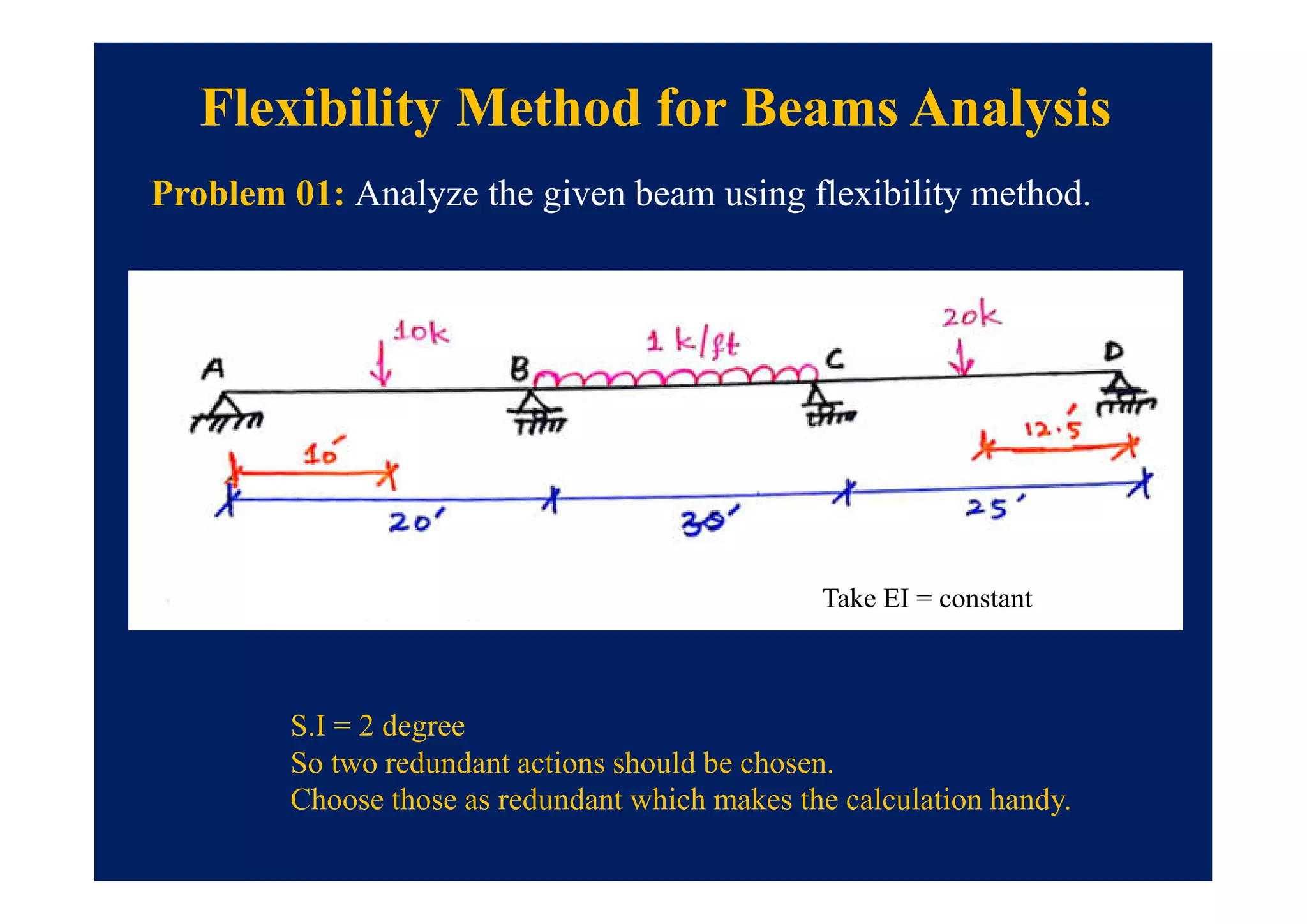
Problem 01: Analyze the given beam using flexibility method.
S.I = 2 degree
So two redundant actions should be chosen.
Choose those as redundant which makes the calculation handy.
Take EI = constant
Flexibility Method for Beams Analysis
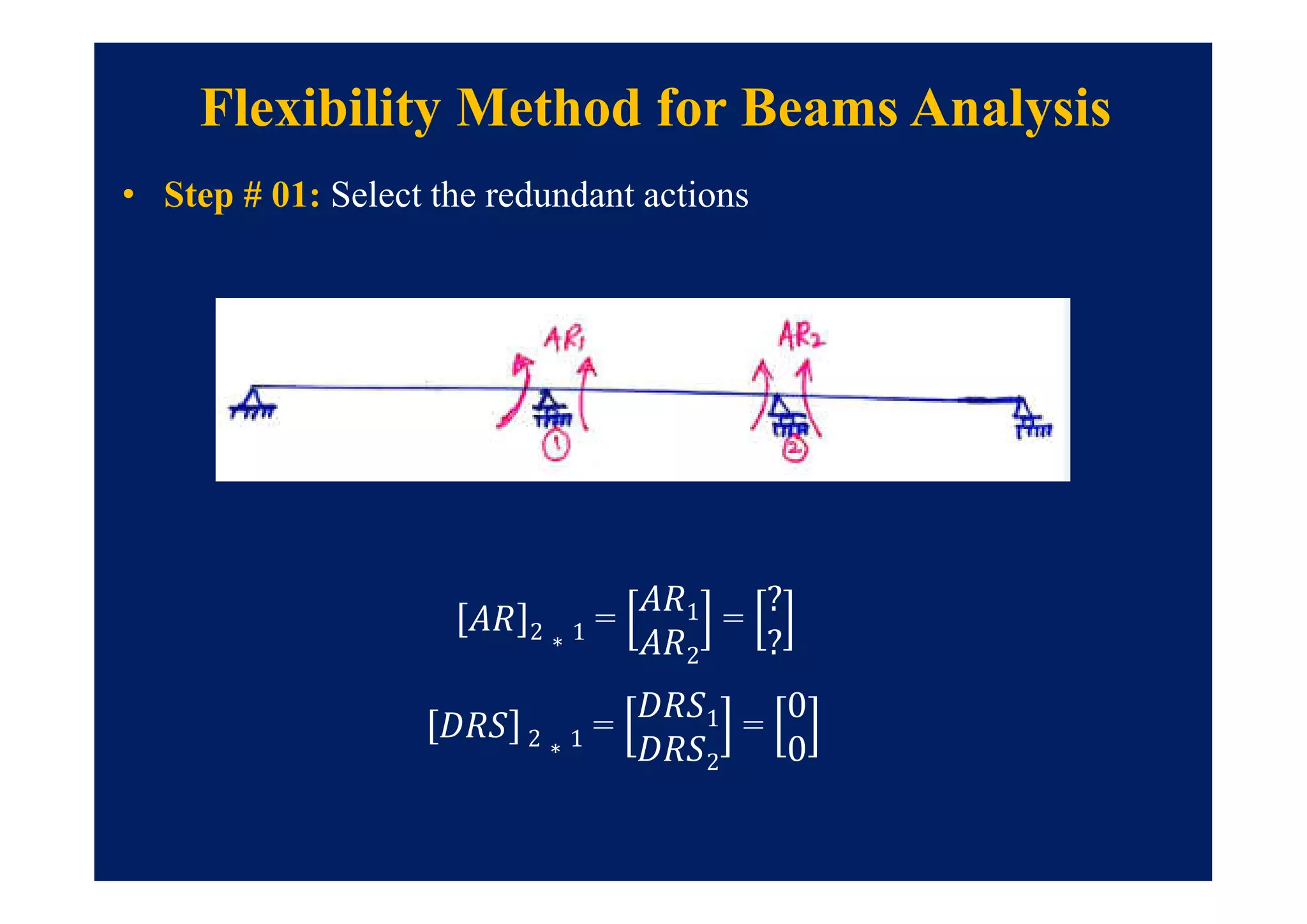
• Step # 01: Select the redundant actions
2 ∗ 1 = 1
2
=
?
?
2 ∗ 1 = 1
2
=
0
0
• Step # 02 : Compute the values of [DRL].
Flexibility Method for Beams Analysis
• Step # 02 : Compute the values of [DRL].
Flexibility Method for Beams Analysis
• Step # 03 : Compute the values of flexibility matrix [ f ].
i. 1st apply a unit value of AR1 at reference point 1
Flexibility Method for Beams Analysis
• Step # 03 : Compute the values of flexibility matrix [ f ].
i. Now apply a unit value of AR2 at reference point 2
= 11 12
21 22
=
16.67 5
5 18.33
EI = 1
Flexibility Method for Beams Analysis
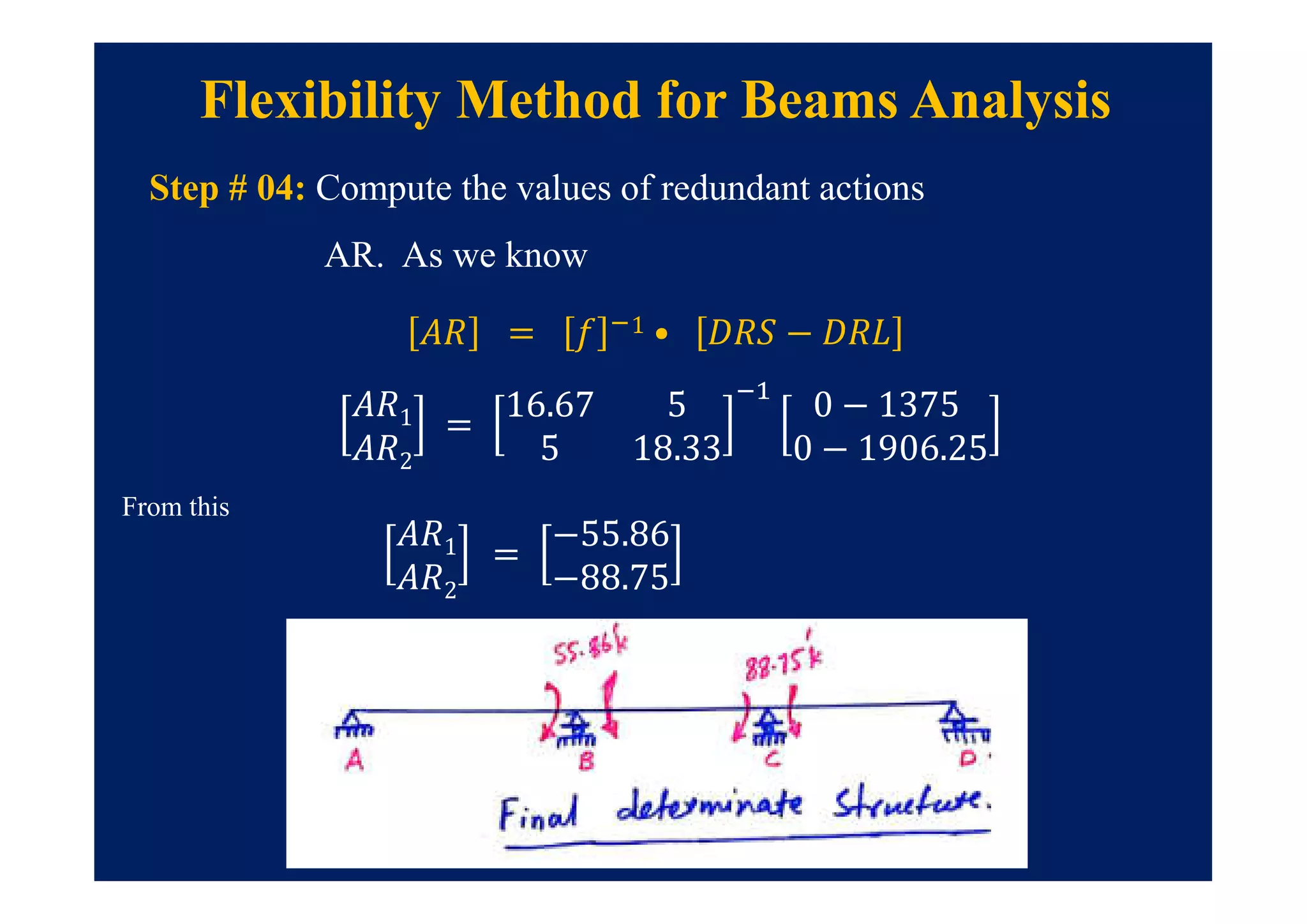
Step # 04: Compute the values of redundant actions
AR. As we know
= 1 • −
From this
1
2
=
−55.86
−88.75
1
2
=
16.67 5
5 18.33
0 − 1375
0 − 1906.25
Flexibility Method for Beams Analysis
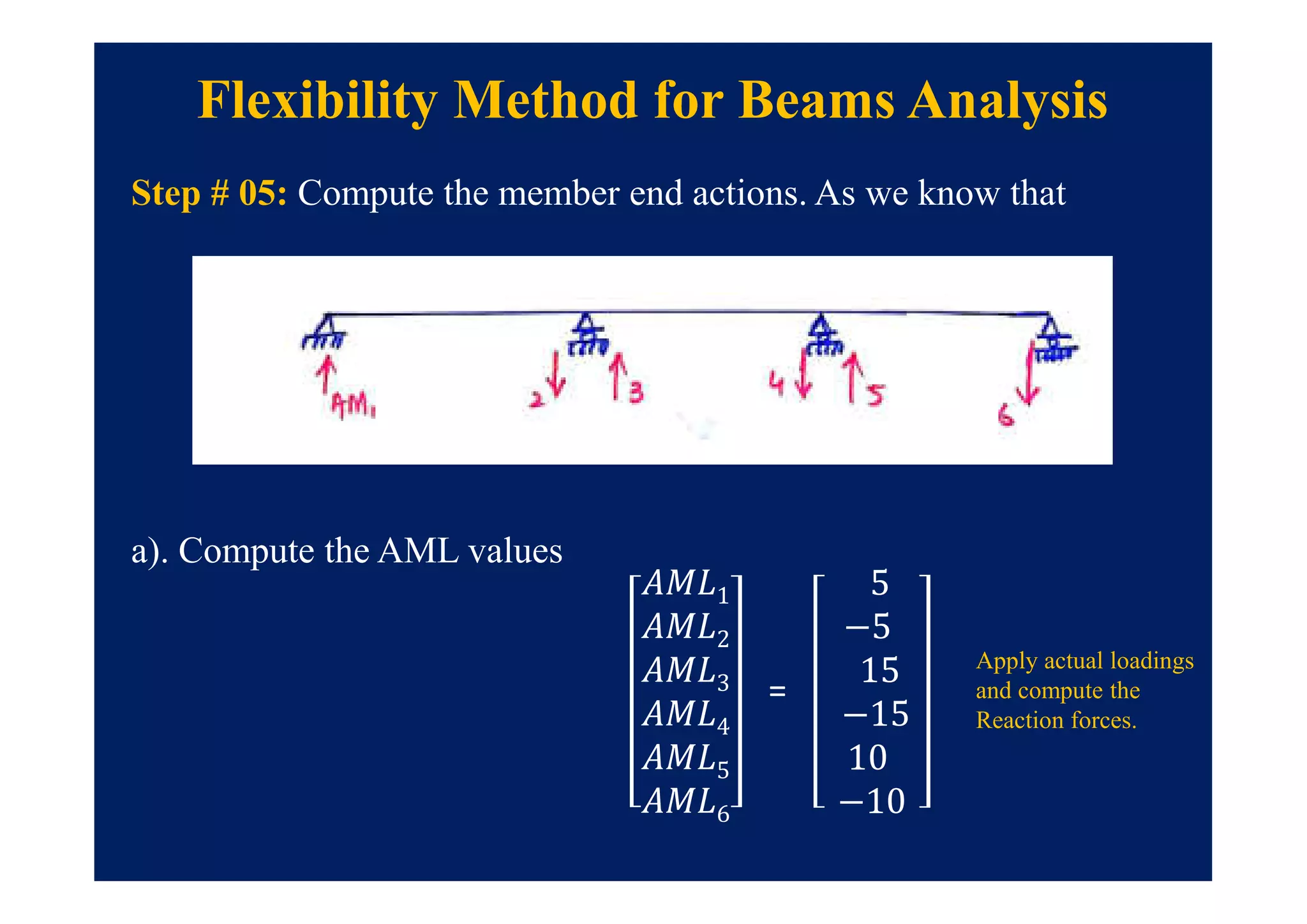
Step # 05: Compute the member end actions. As we know that
a). Compute the AML values
1
2
3
4
5
6
=
5
−5
15
−15
10
−10
Apply actual loadings
and compute the
Reaction forces.
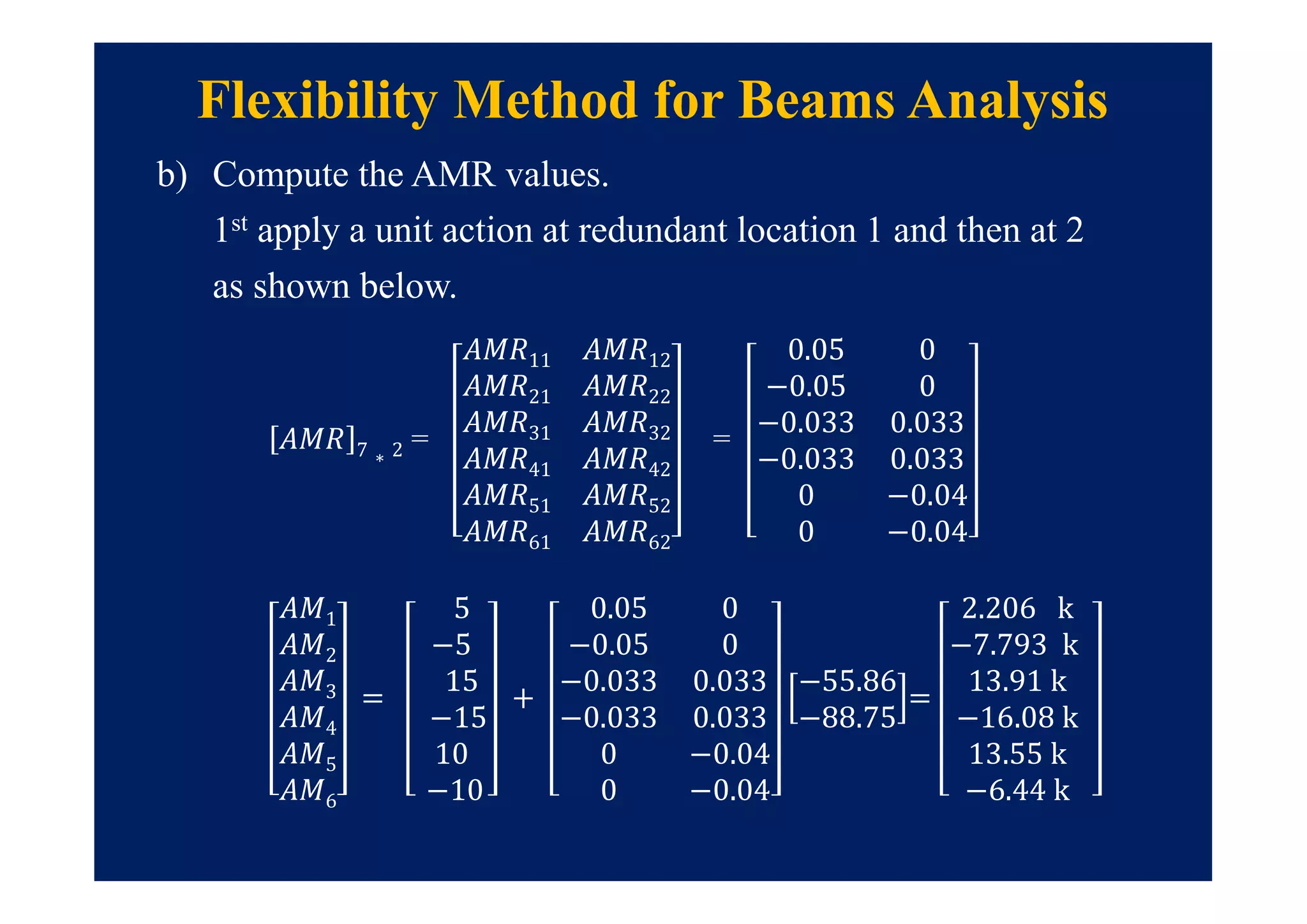
b) Compute the AMR values.
1st apply a unit action at redundant location 1 and then at 2
as shown below.
Flexibility Method for Beams Analysis
7 ∗ 2 =
11 12
21 22
31 32
41 42
51 52
61 62
=
0.05 0
−0.05 0
−0.033 0.033
−0.033 0.033
0 −0.04
0 −0.04
1
2
3
4
5
6
=
5
−5
15
−15
10
−10
+
0.05 0
−0.05 0
−0.033 0.033
−0.033 0.033
0 −0.04
0 −0.04
−55.86
−88.75
=
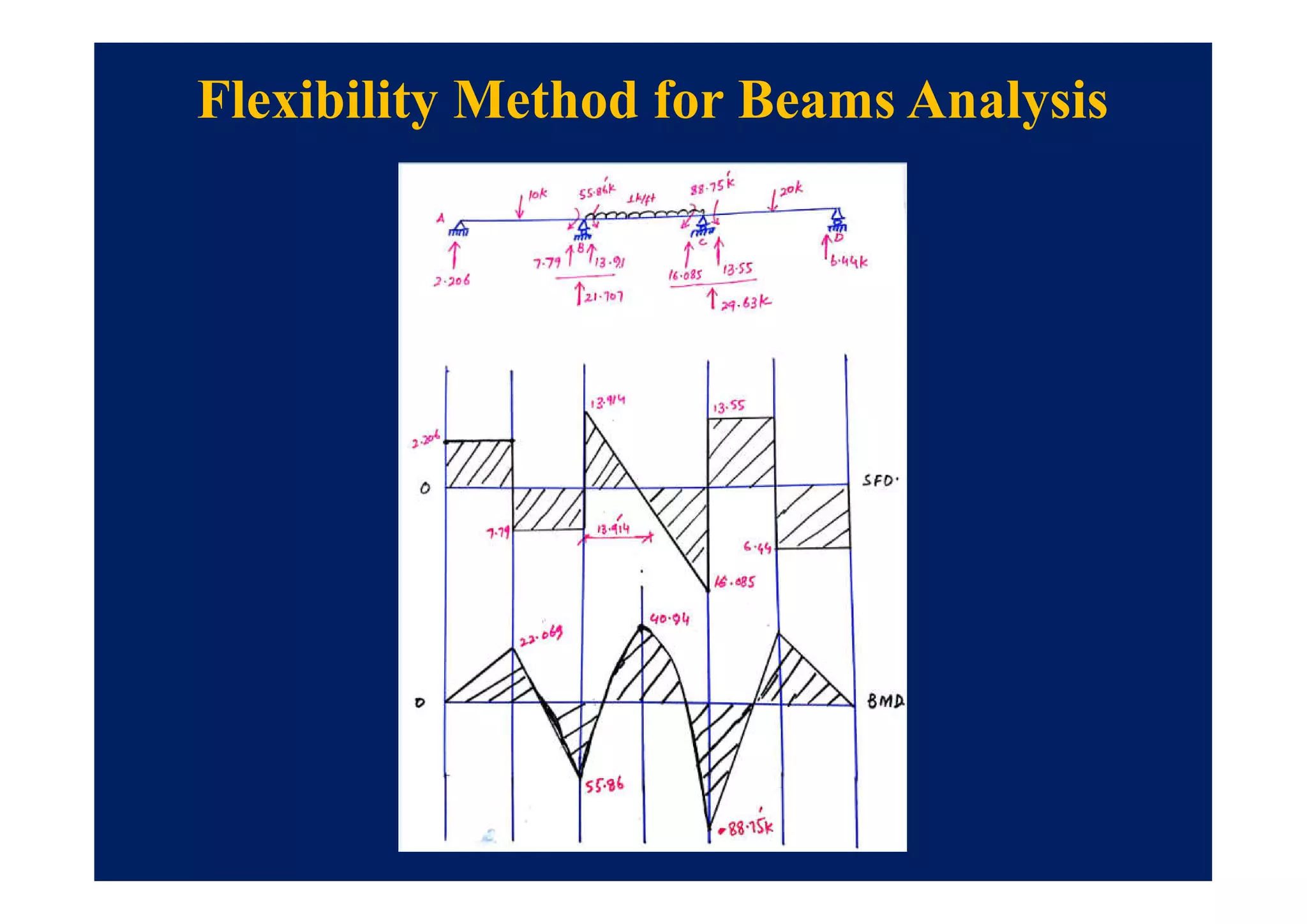
2.206 k
−7.793 k
13.91 k
−16.08 k
13.55 k
−6.44 k
Flexibility Method for Beams Analysis
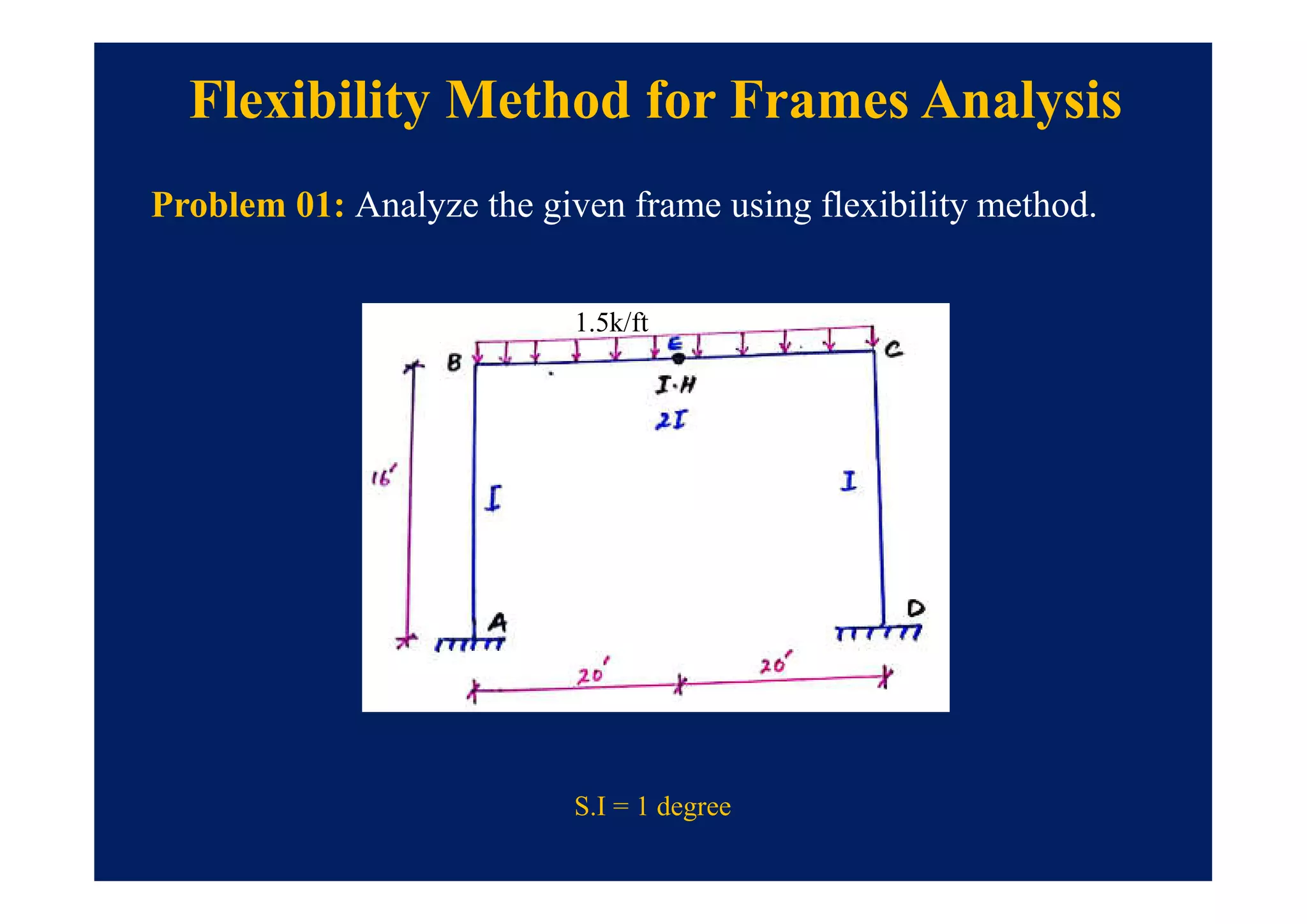
Problem 01: Analyze the given frame using flexibility method.
Flexibility Method for Frames Analysis
S.I = 1 degree
1.5k/ft
• Step # 01: Identify the redundants and obtain BDS also compute
[DRS] values.
Flexibility Method for Frames Analysis
= ?
= 0
Flexibility Method for Frames Analysis
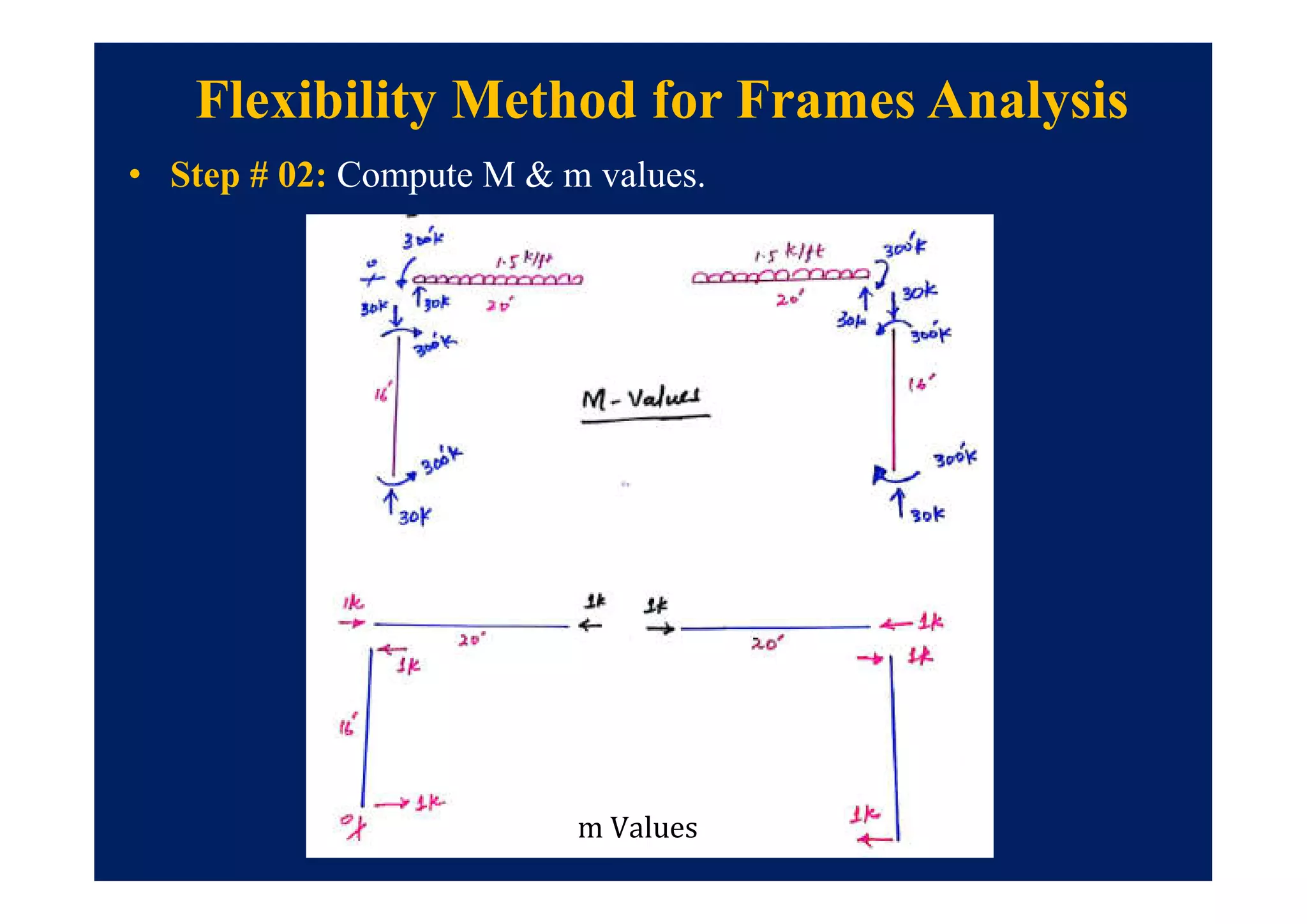
• Step # 02: Compute M & m values.
m Values
Flexibility Method for Beams Analysis
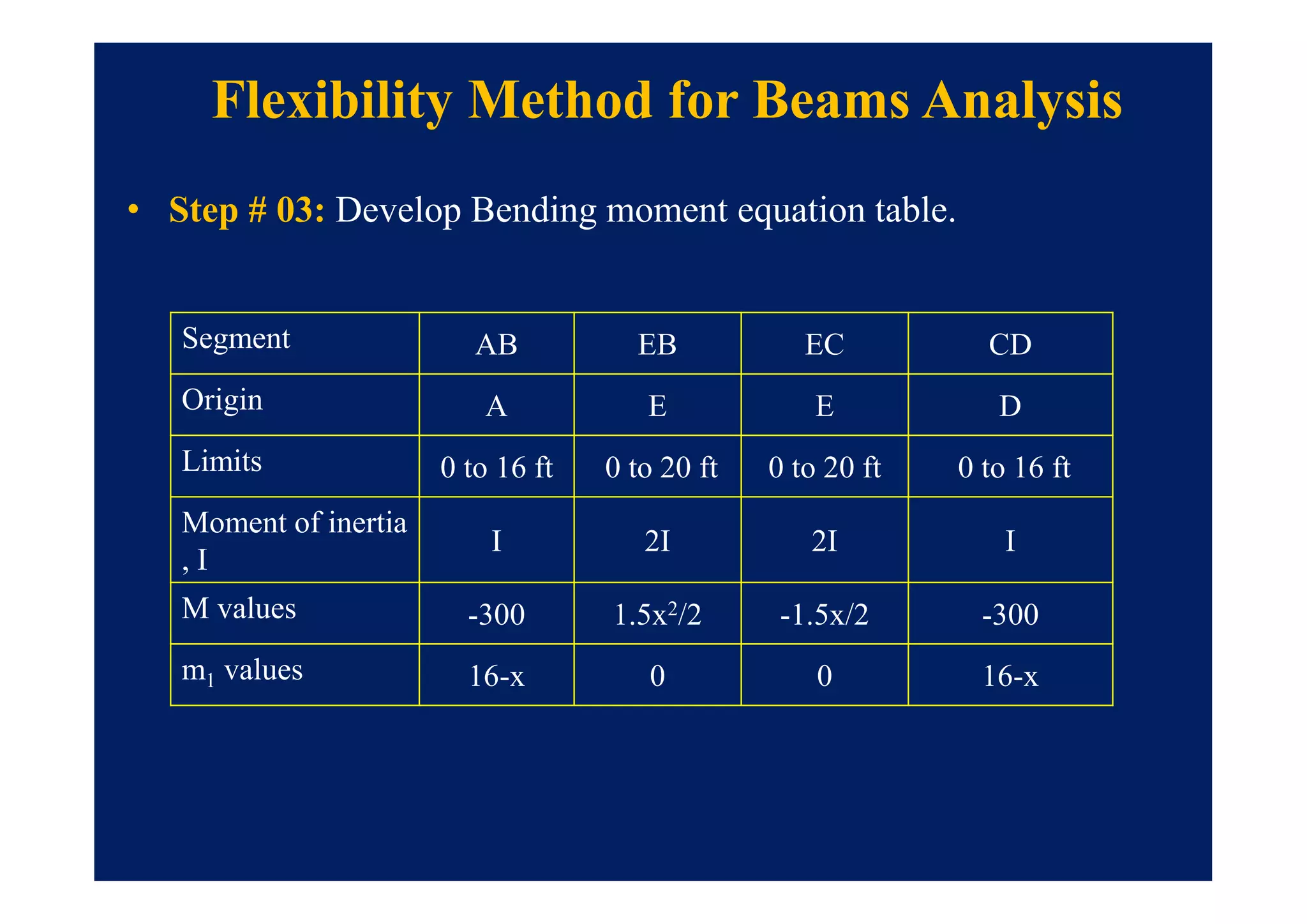
Segment AB EB EC CD
Origin A E E D
Limits 0 to 16 ft 0 to 20 ft 0 to 20 ft 0 to 16 ft
Moment of inertia
, I
I 2I 2I I
M values -300 1.5x2/2 -1.5x/2 -300
m1 values 16-x 0 0 16-x
• Step # 03: Develop Bending moment equation table.
Flexibility Method for Beams Analysis
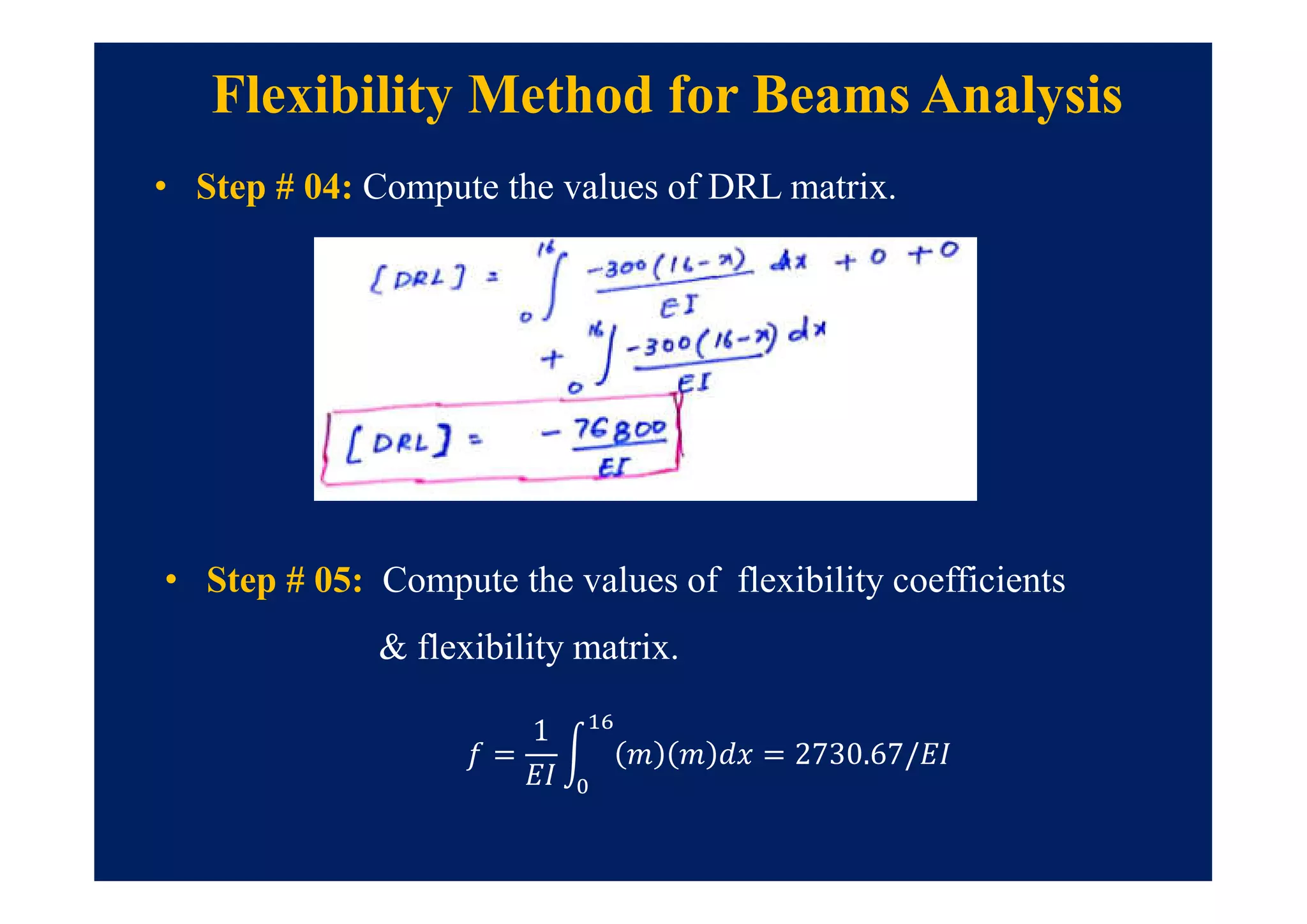
• Step # 04: Compute the values of DRL matrix.
=
1
= 2730.67/
• Step # 05: Compute the values of flexibility coefficients
& flexibility matrix.
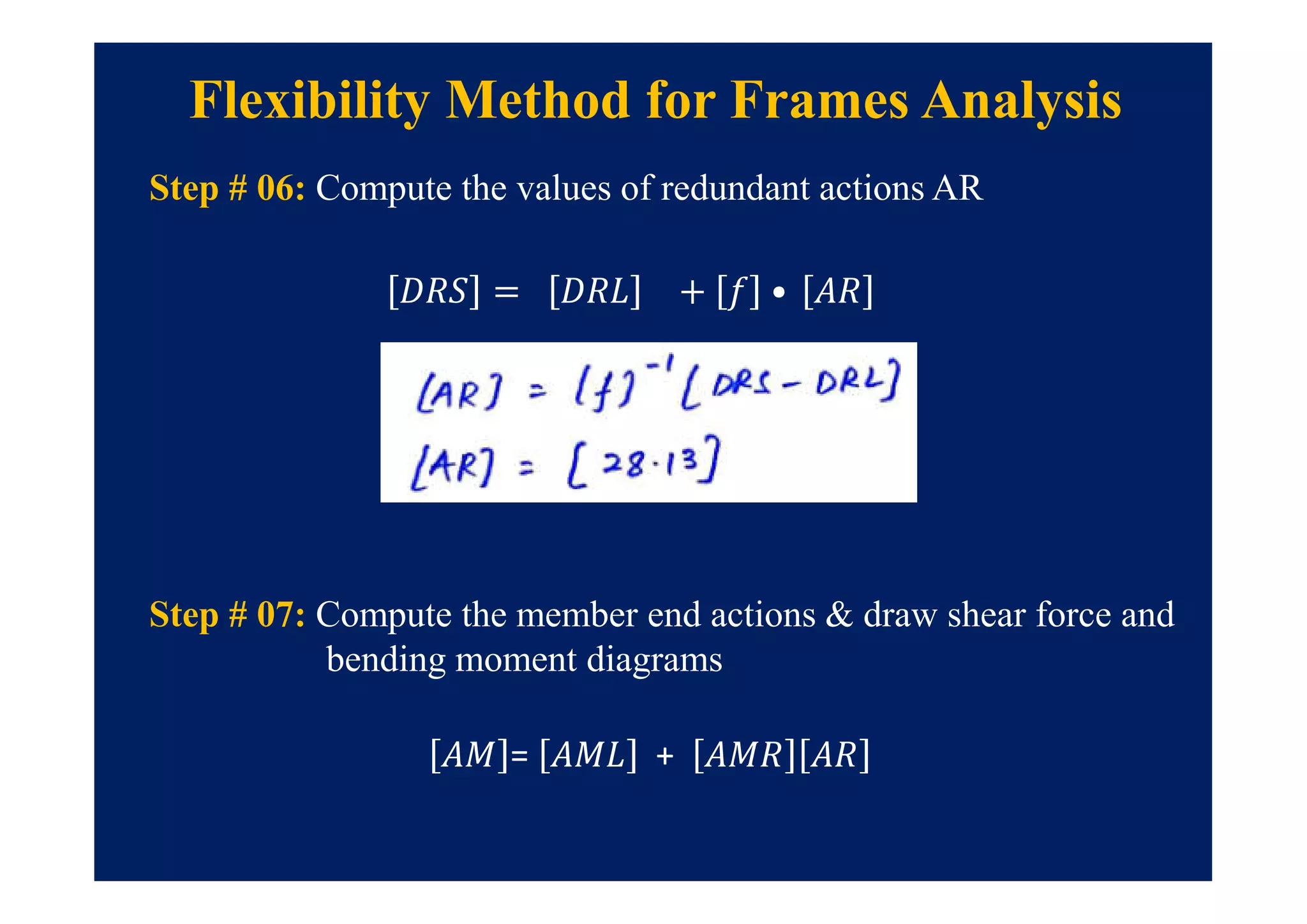
= + •
Flexibility Method for Frames Analysis
Step # 06: Compute the values of redundant actions AR
Step # 07: Compute the member end actions & draw shear force and
bending moment diagrams
= +
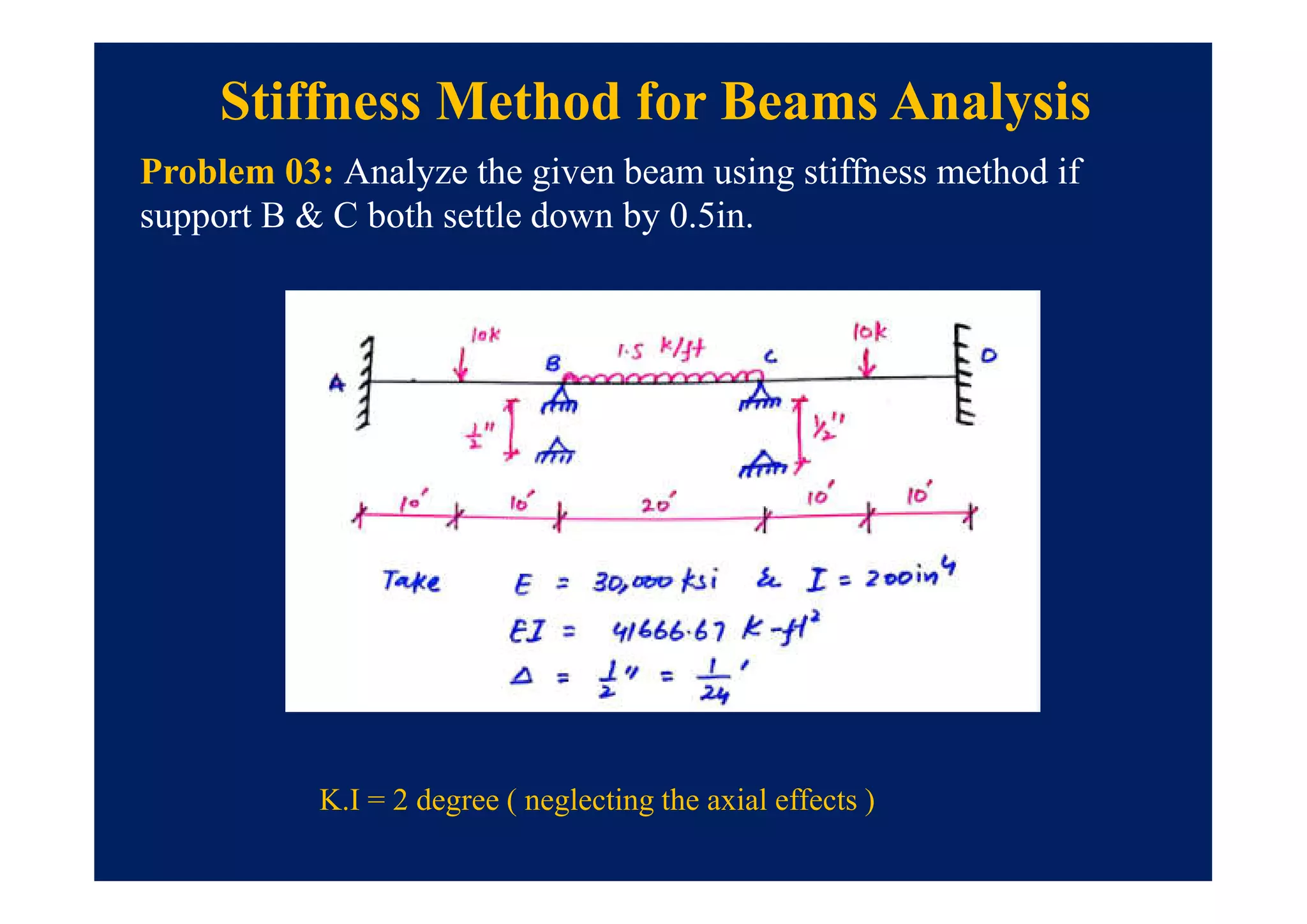
Problem 03: Analyze the given beam using stiffness method if
support B & C both settle down by 0.5in.
K.I = 2 degree ( neglecting the axial effects )
Stiffness Method for Beams Analysis
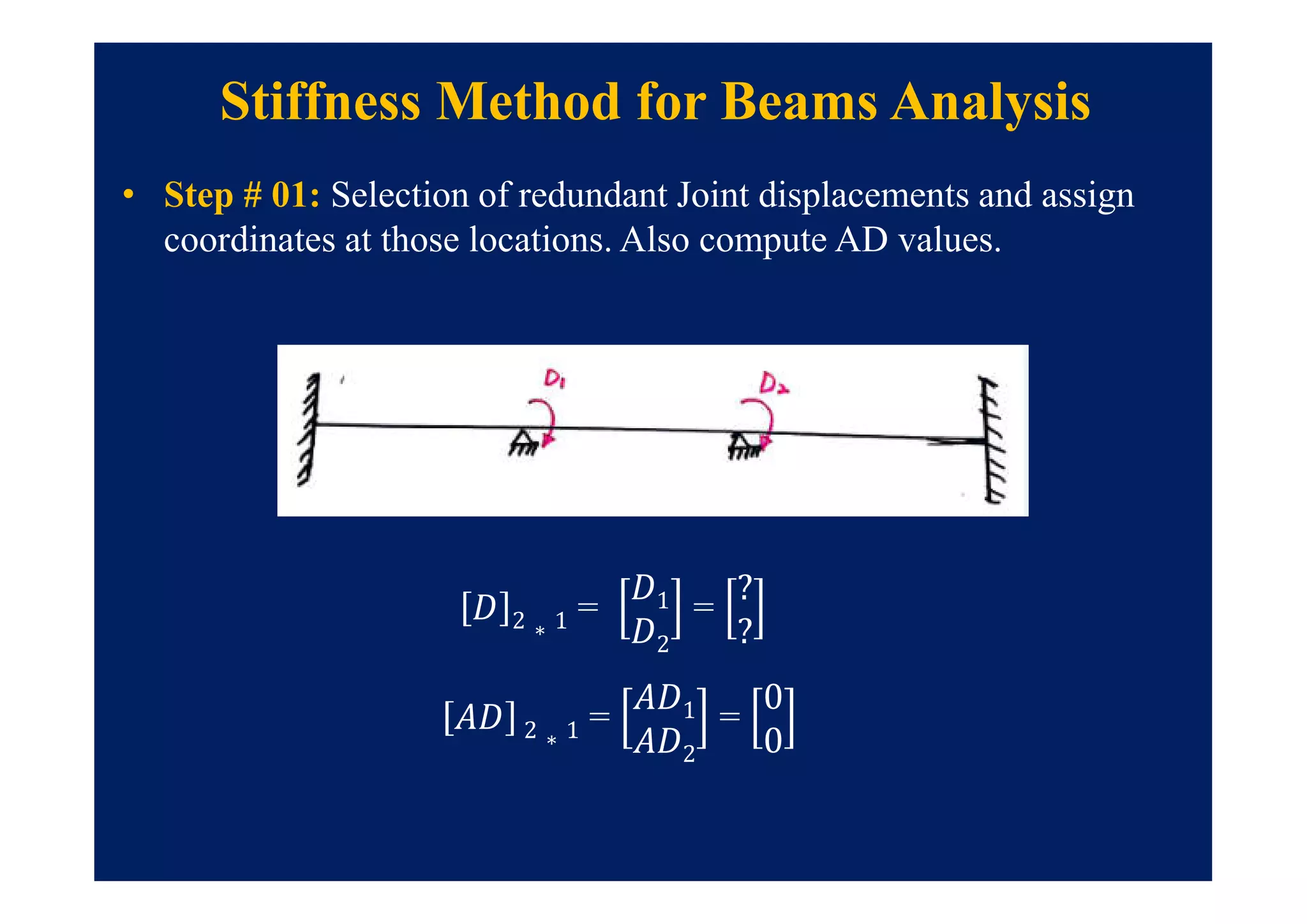
2 ∗ 1 = 1
2
=
?
?
2 ∗ 1 = 1
2
=
0
0
• Step # 01: Selection of redundant Joint displacements and assign
coordinates at those locations. Also compute AD values.
Stiffness Method for Beams Analysis
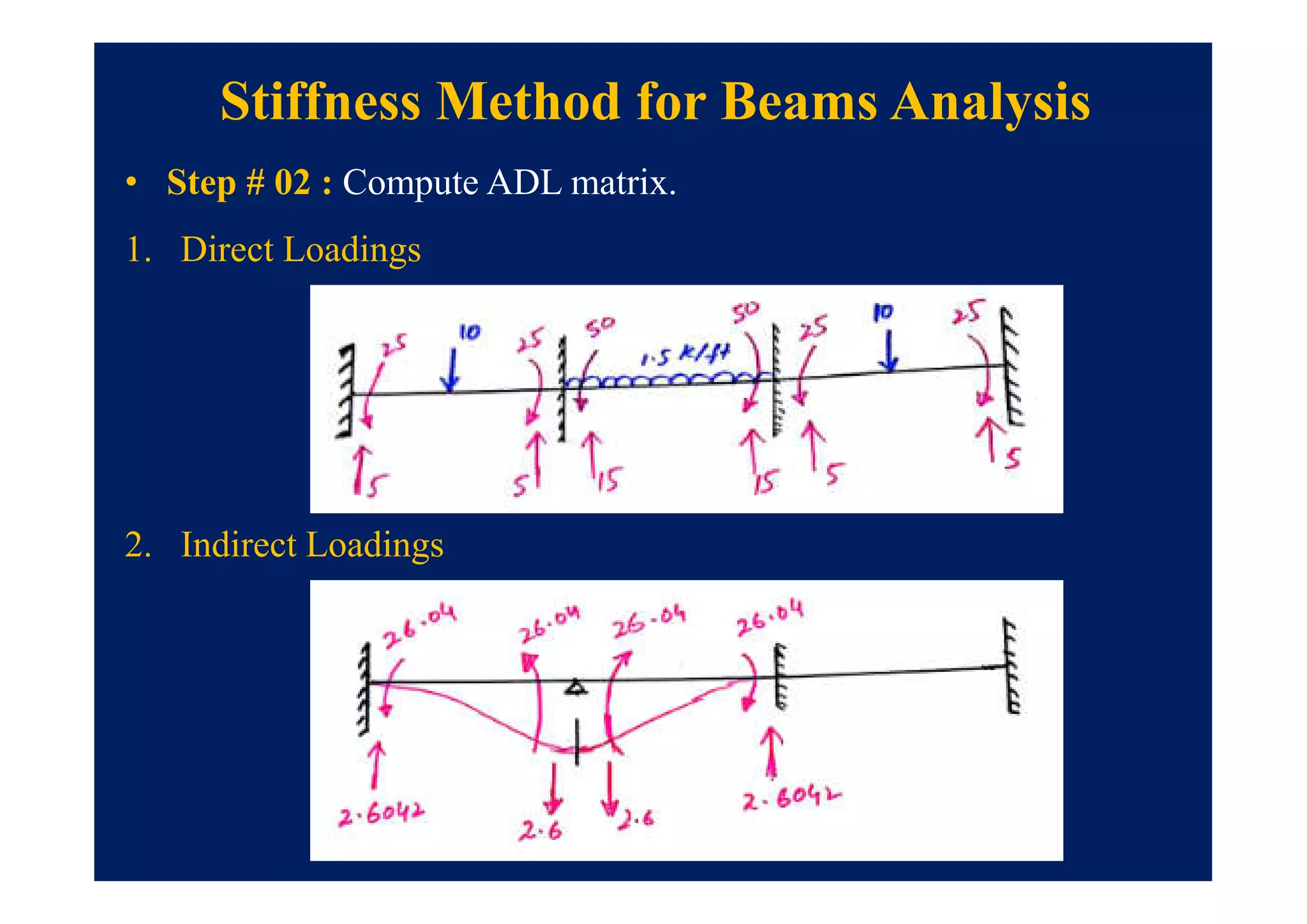
• Step # 02 : Compute ADL matrix.
1. Direct Loadings
Stiffness Method for Beams Analysis
2. Indirect Loadings
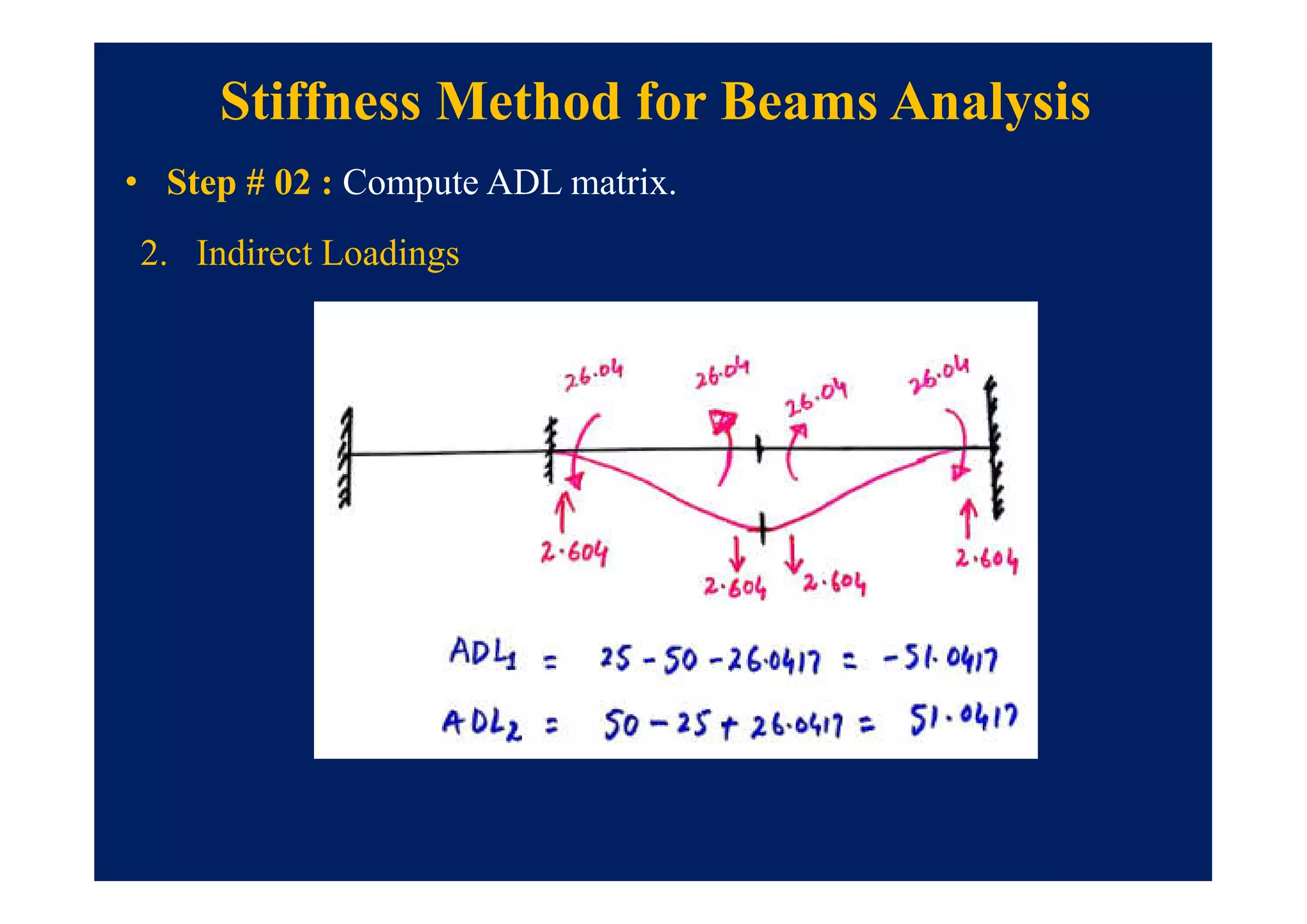
• Step # 02 : Compute ADL matrix.
Stiffness Method for Beams Analysis
2. Indirect Loadings
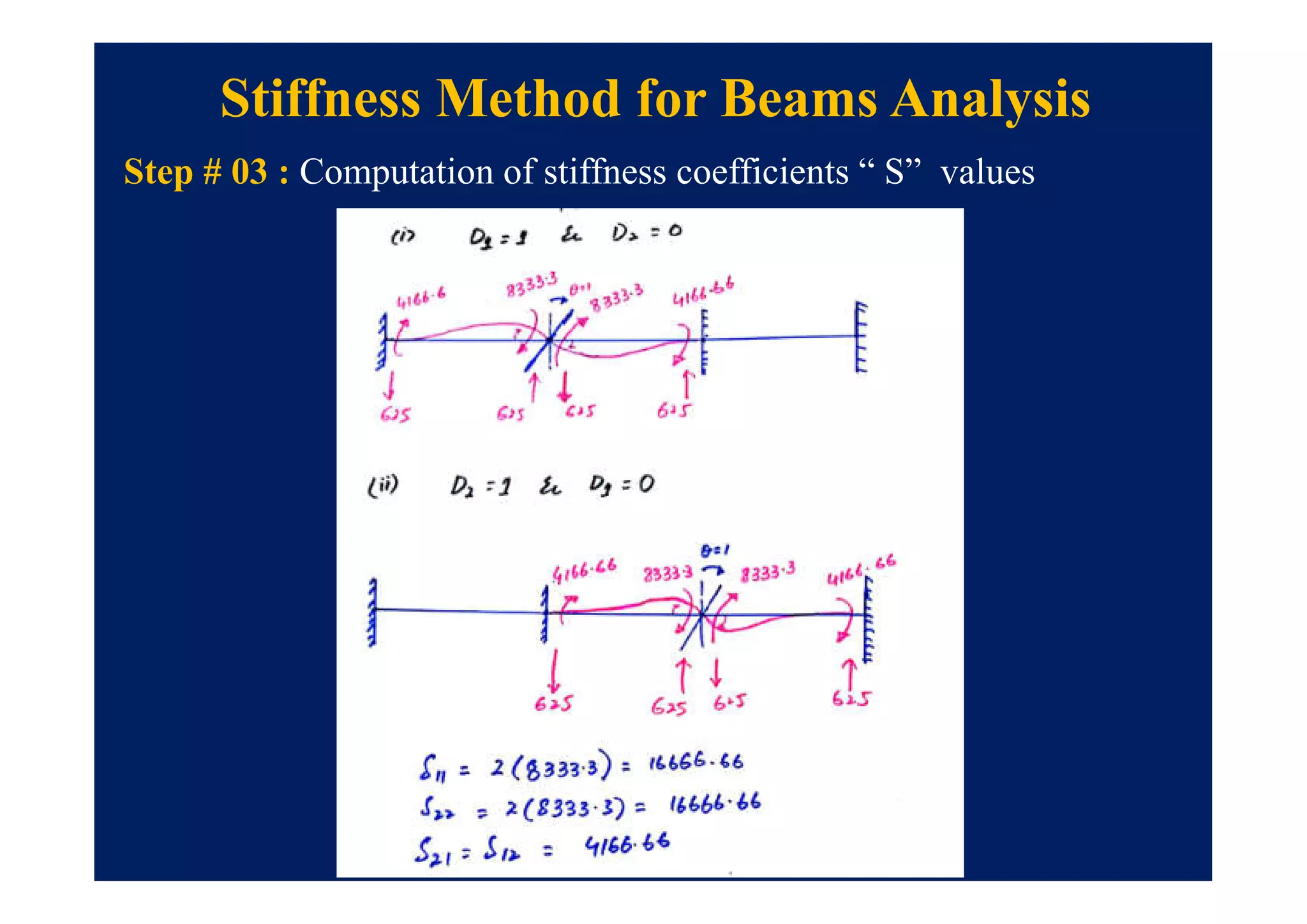
Step # 03 : Computation of stiffness coefficients “ S” values
Stiffness Method for Beams Analysis
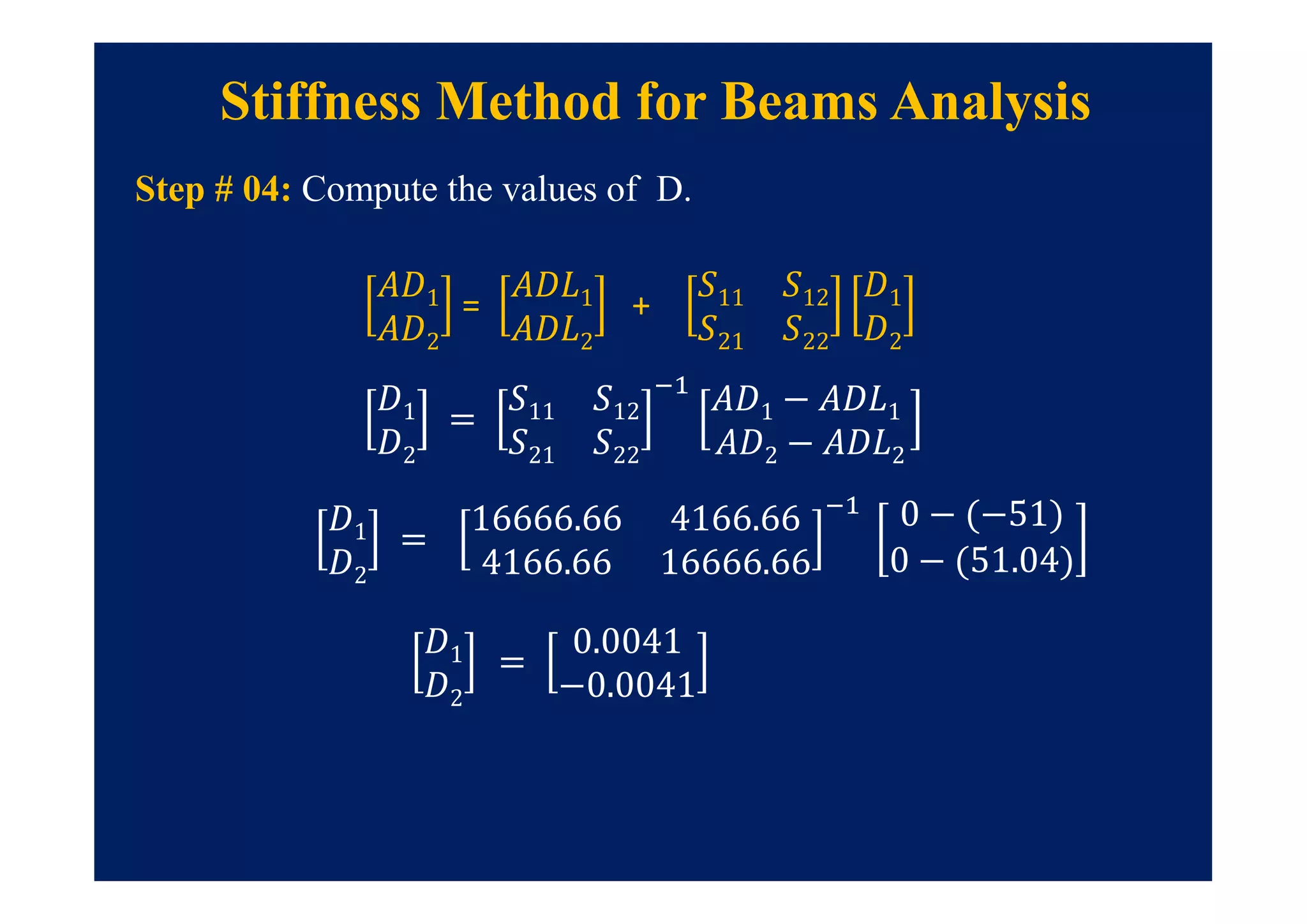
Step # 04: Compute the values of D.
1
2
= 1
2
+ 11 12
21 22
1
2
Stiffness Method for Beams Analysis
1
2
= 11 12
21 22
1 − 1
2 − 2
1
2
=
16666.66 4166.66
4166.66 16666.66
0 − (−51)
0 − (51.04)
1
2
=
0.0041
−0.0041
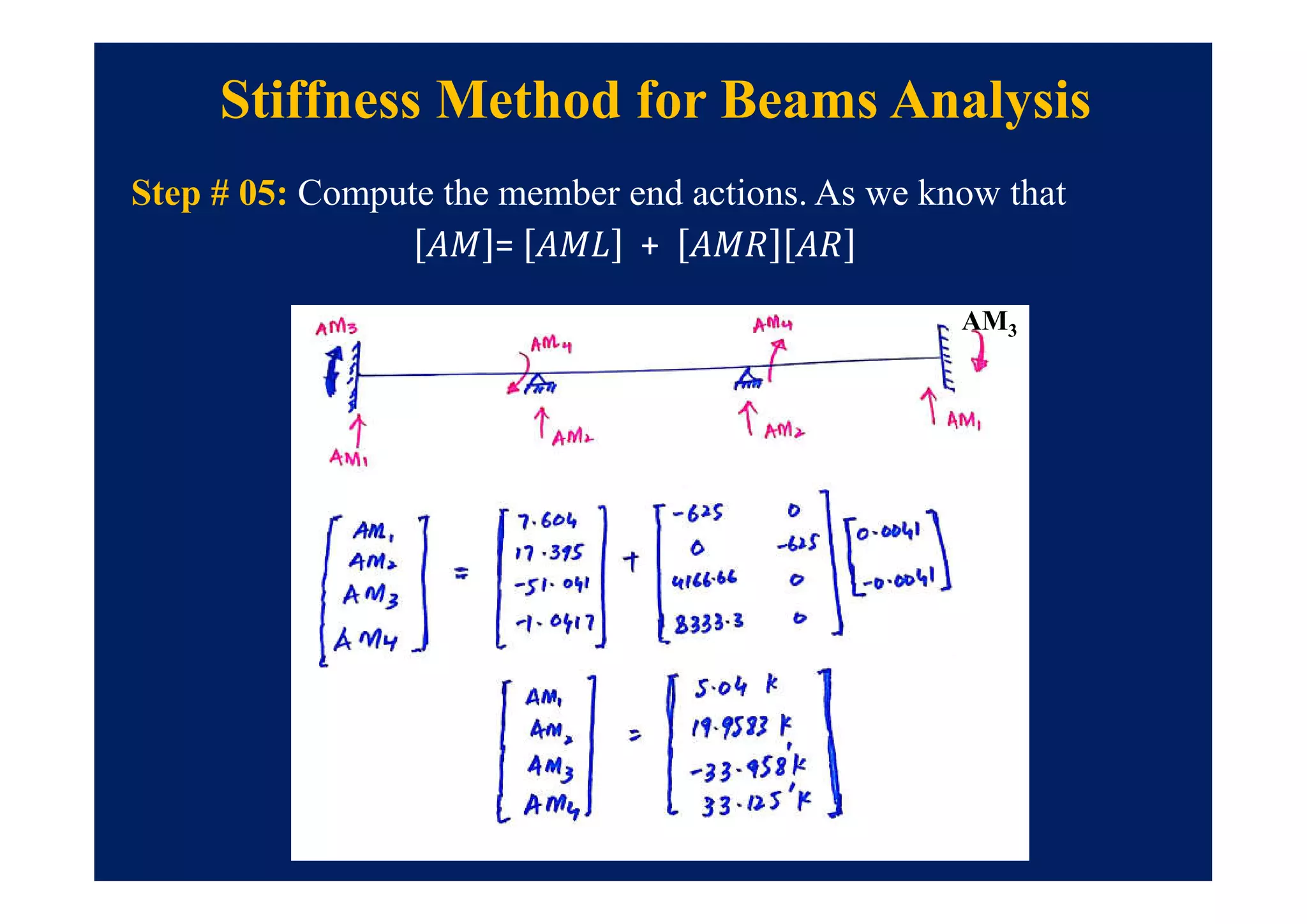
Step # 05: Compute the member end actions. As we know that
= +
Stiffness Method for Beams Analysis
AM3
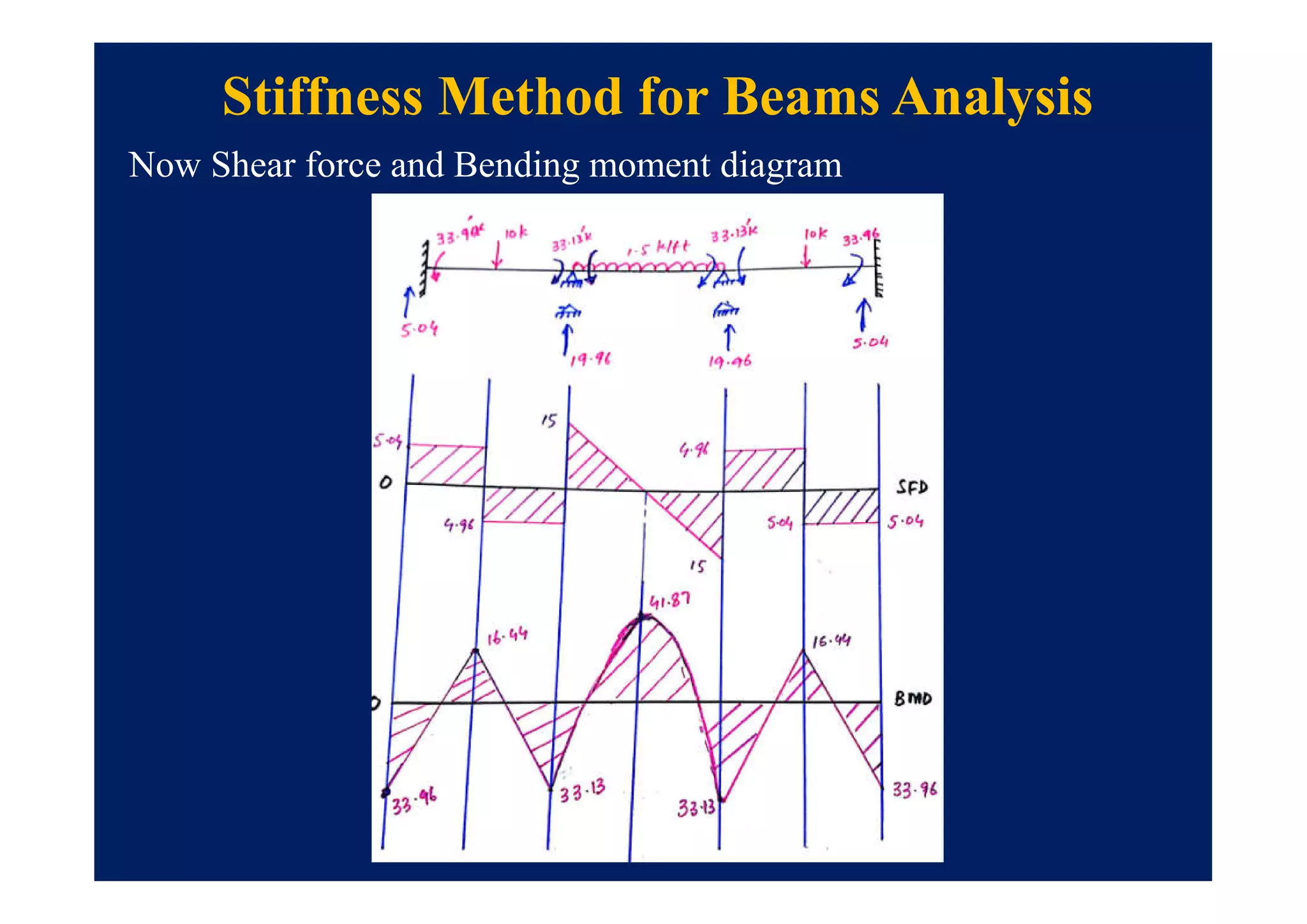
Now Shear force and Bending moment diagram
Stiffness Method for Beams Analysis
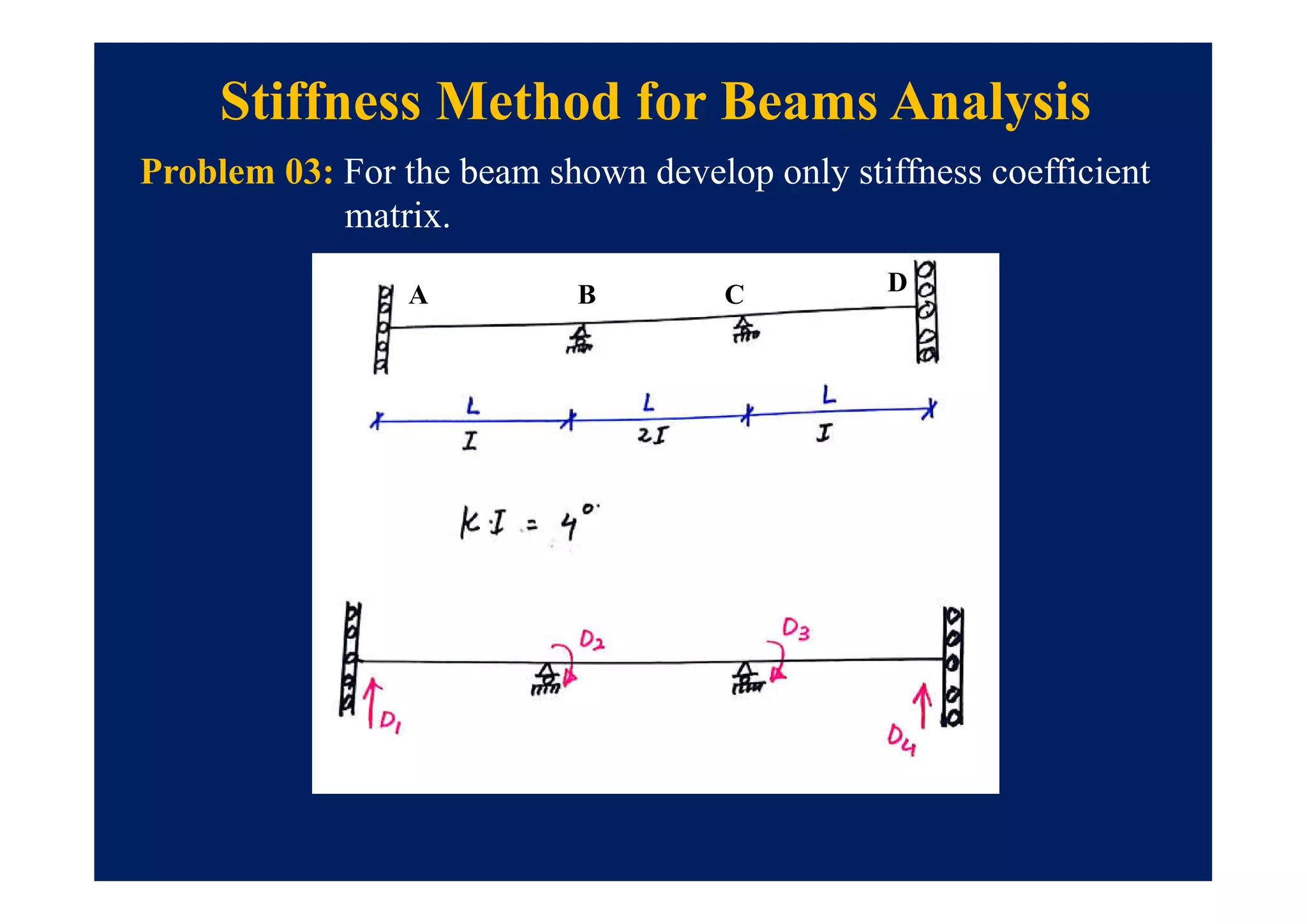
Problem 03: For the beam shown develop only stiffness coefficient
matrix.
Stiffness Method for Beams Analysis
A B C D
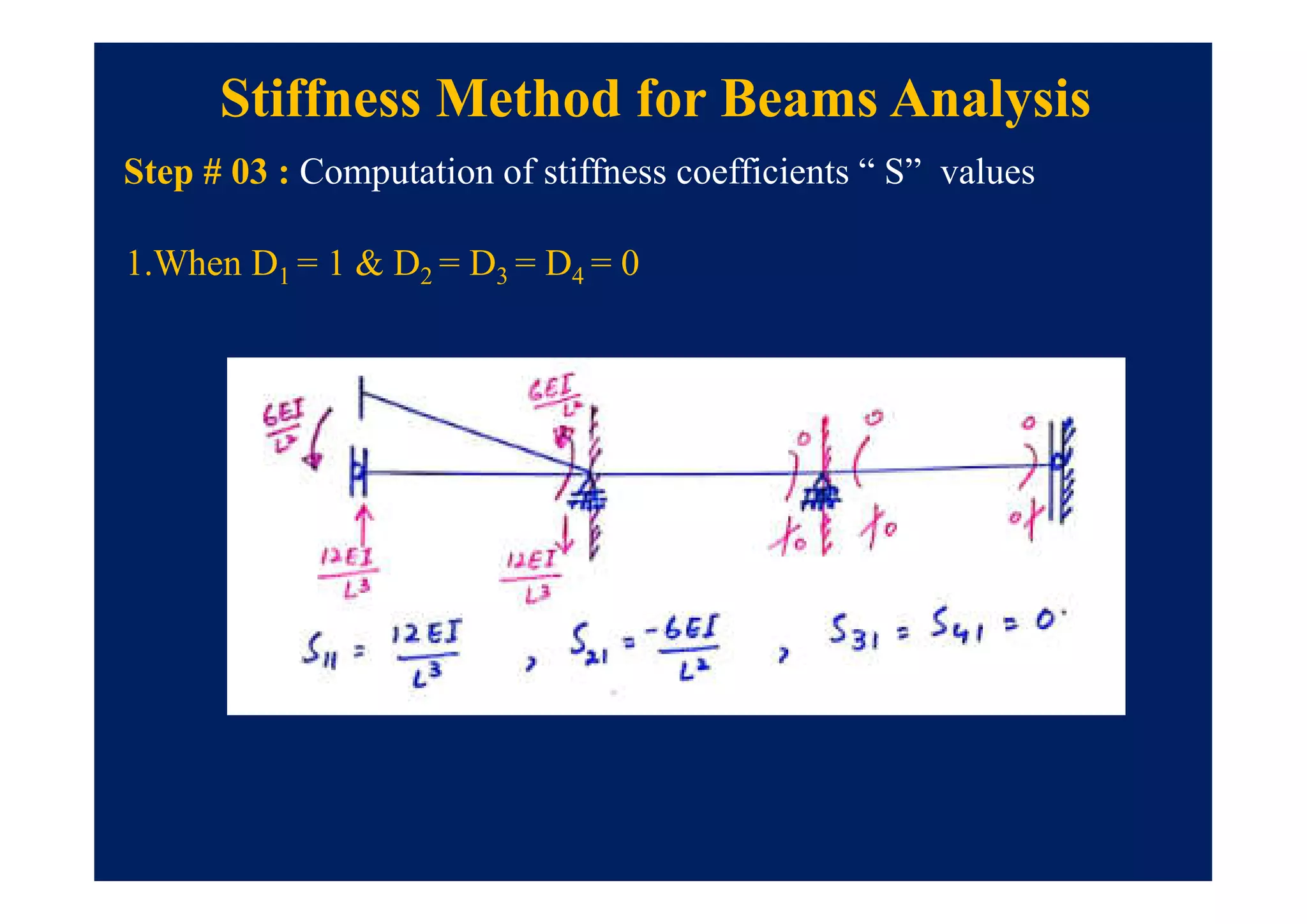
Step # 03 : Computation of stiffness coefficients “ S” values
Stiffness Method for Beams Analysis
1.When D1 = 1 & D2 = D3 = D4 = 0
Step # 03 : Computation of stiffness coefficients “ S” values
Stiffness Method for Beams Analysis
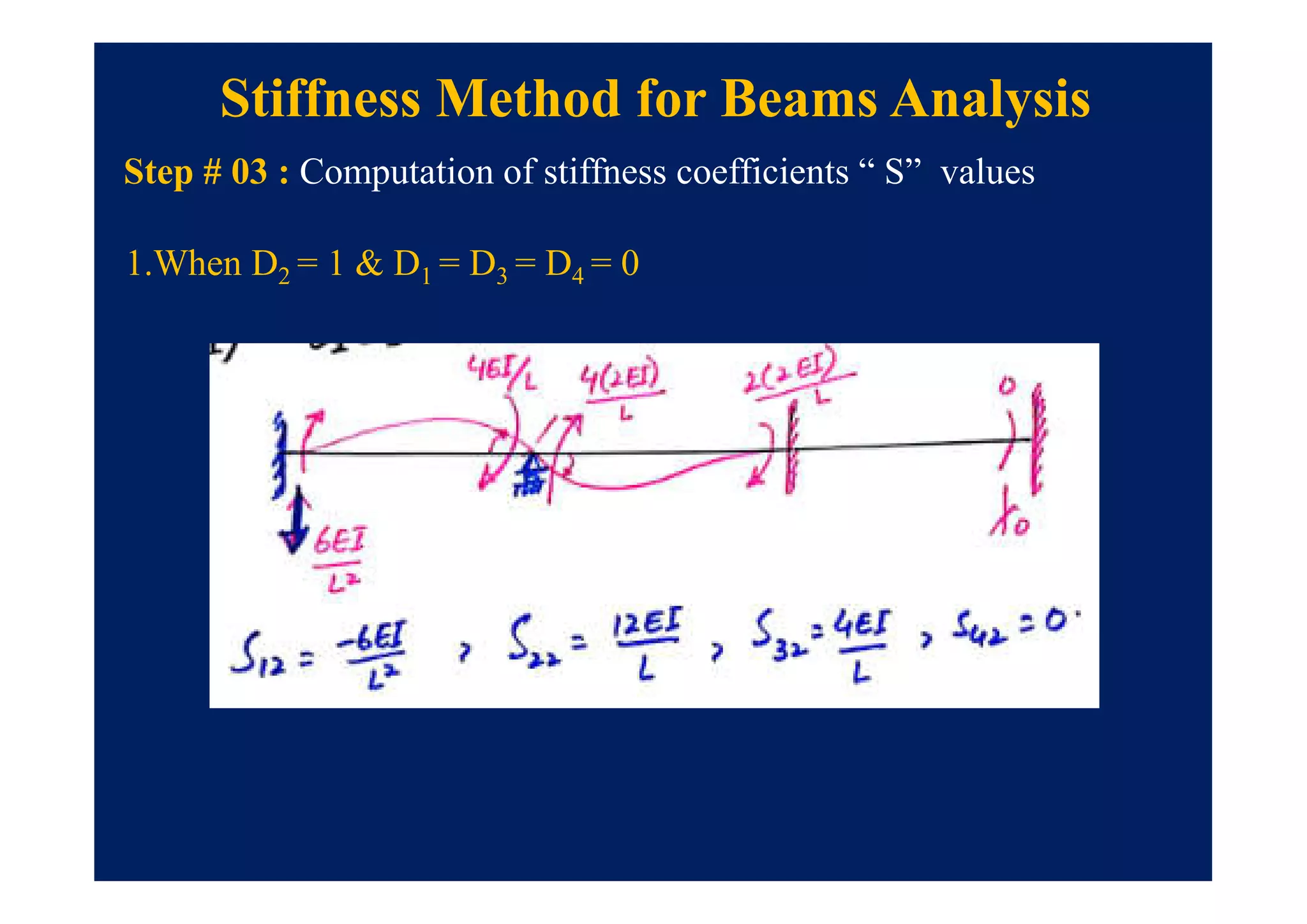
1.When D2 = 1 & D1 = D3 = D4 = 0
Step # 03 : Computation of stiffness coefficients “ S” values
Stiffness Method for Beams Analysis
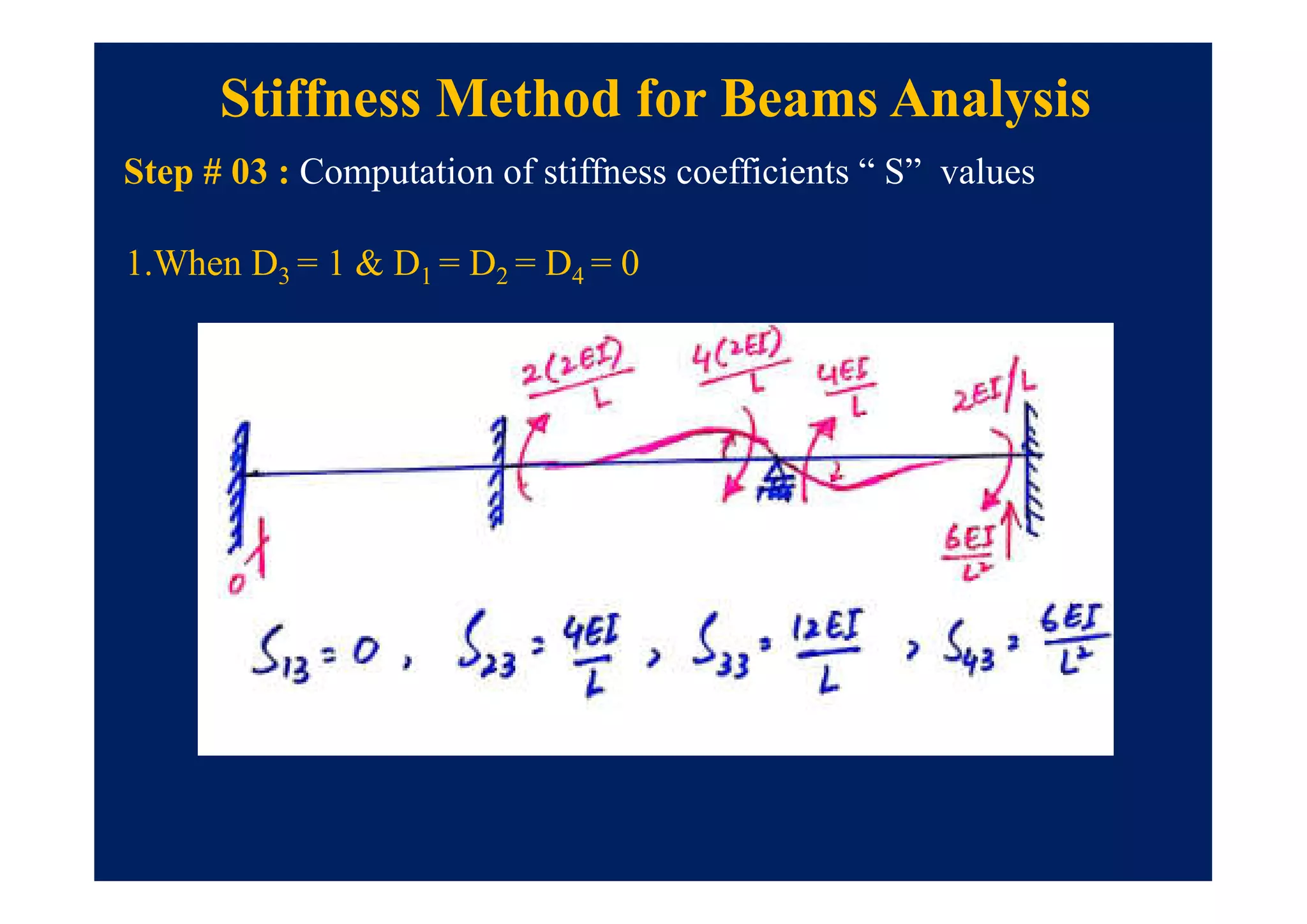
1.When D3 = 1 & D1 = D2 = D4 = 0
Step # 03 : Computation of stiffness coefficients “ S” values
Stiffness Method for Beams Analysis
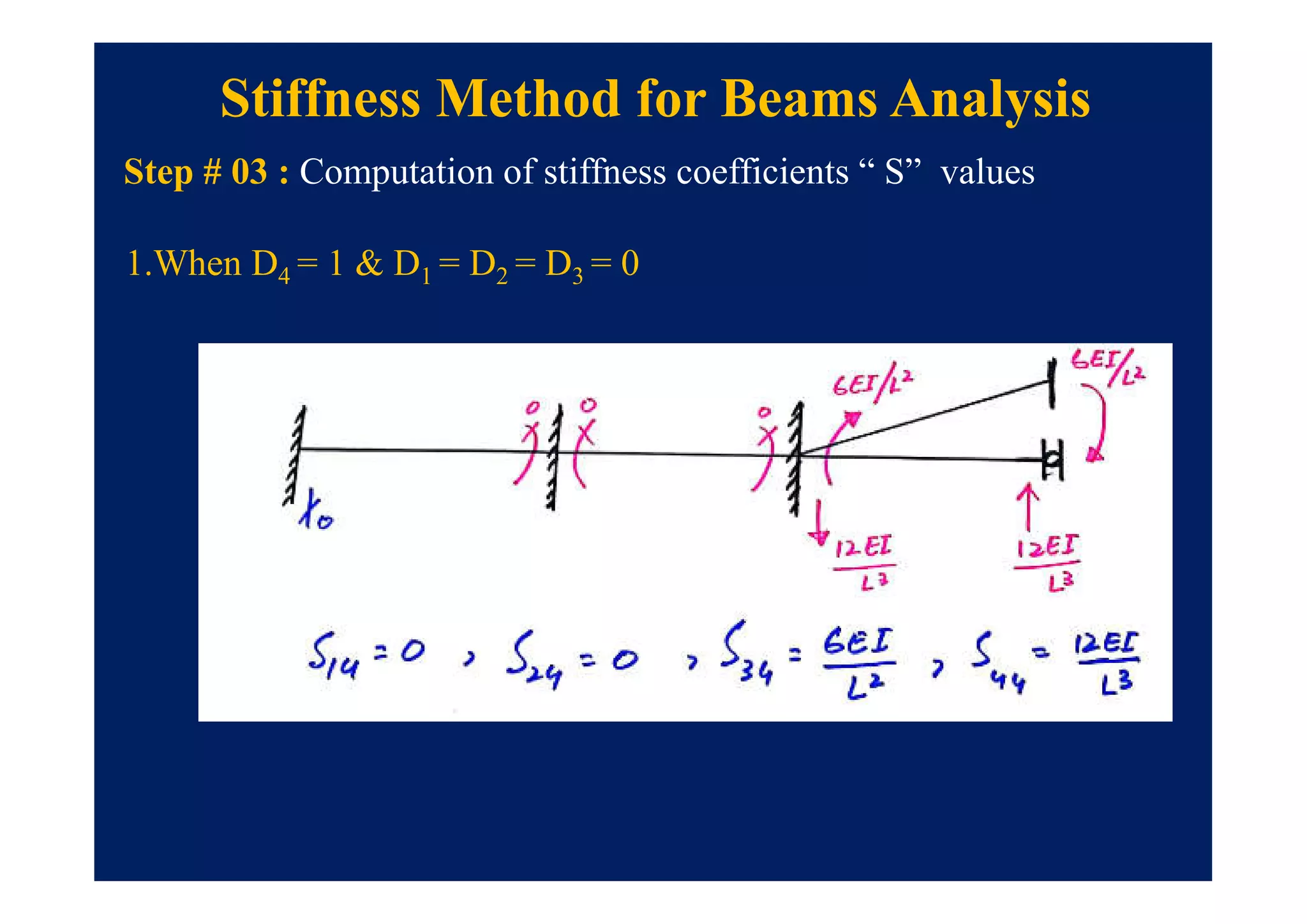
1.When D4 = 1 & D1 = D2 = D3 = 0
Step # 03 : Computation of stiffness coefficients “ S” values
Stiffness Method for Beams Analysis
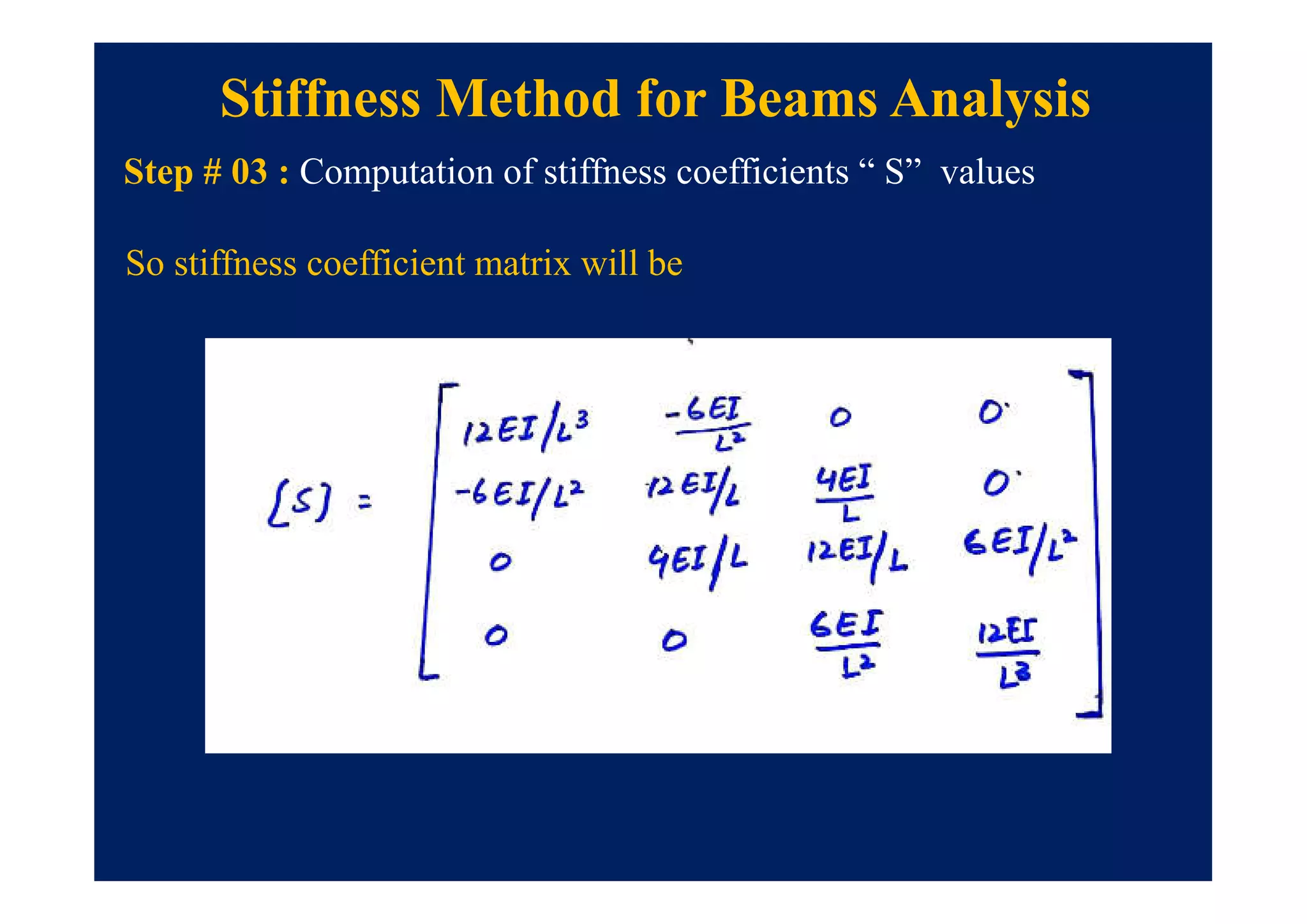
So stiffness coefficient matrix will be
References
• Structural Analysis by R. C. Hibbeler
• Matrix structural analysis by William Mc Guire
• Matrix analysis of frame structures by William Weaver
• Online Civil Engineering blogs

Module 7.pdf

  • 1.
    University of Engineering& Technology Peshawar, Pakistan CE301: Structure Analysis II Module 07: Revision of Course ( Flexibility & Stiffness) By: Prof. Dr. Bashir Alam Civil Engineering Department UET , Peshawar
  • 2.
    Topics to beCovered • Revision of Flexibility & Stiffness method concept • Analysis of beam using flexibility method ( Problem 1) • Analysis of frame using flexibility method ( Problem 2) • Analysis of beam using stiffness method ( Problem 3) • Analysis of beam using stiffness method ( Problem 4)
  • 3.
    Matrix Methods ofAnalysis • Flexibility Method In this method redundant constraints are removed and corresponding redundant actions (forces or moment) are placed. An equation of compatibility of deformation is written in terms of these redundants and corresponding displacements. The redundants are determined from these simultaneous equation. Equations of statics are then used for calculation of designed internal actions. In this method, actions are treated as basic unknowns. This method will be described in detail in this lecture.
  • 4.
    Matrix Methods ofAnalysis • Flexibility Method In this method redundant constraints are removed and corresponding redundant actions (forces or moment) are placed. An equation of compatibility of deformation is written in terms of these redundants and corresponding displacements. The redundants are determined from these simultaneous equation. Equations of statics are then used for calculation of designed internal actions. In this method, actions are treated as basic unknowns.
  • 5.
    Matrix Methods ofAnalysis • Stiffness or Displacement Method In the displacement method of analysis the equilibrium equations are written by expressing the unknown joint displacements in terms of loads by using load displacement relations. The unknown joint displacements (the degrees of freedom of the structure) are calculated by solving equilibrium equations. displacement method of analysis is preferred to computer implementation.
  • 6.
    Flexibility Method forBeams Analysis Problem 01: Analyze the given beam using flexibility method. S.I = 2 degree So two redundant actions should be chosen. Choose those as redundant which makes the calculation handy. Take EI = constant
  • 7.
    Flexibility Method forBeams Analysis • Step # 01: Select the redundant actions 2 ∗ 1 = 1 2 = ? ? 2 ∗ 1 = 1 2 = 0 0
  • 8.
    • Step #02 : Compute the values of [DRL]. Flexibility Method for Beams Analysis
  • 9.
    • Step #02 : Compute the values of [DRL]. Flexibility Method for Beams Analysis
  • 10.
    Flexibility Method forBeams Analysis • Step # 03 : Compute the values of flexibility matrix [ f ]. i. 1st apply a unit value of AR1 at reference point 1
  • 11.
    Flexibility Method forBeams Analysis • Step # 03 : Compute the values of flexibility matrix [ f ]. i. Now apply a unit value of AR2 at reference point 2 = 11 12 21 22 = 16.67 5 5 18.33 EI = 1
  • 12.
    Flexibility Method forBeams Analysis Step # 04: Compute the values of redundant actions AR. As we know = 1 • − From this 1 2 = −55.86 −88.75 1 2 = 16.67 5 5 18.33 0 − 1375 0 − 1906.25
  • 13.
    Flexibility Method forBeams Analysis Step # 05: Compute the member end actions. As we know that a). Compute the AML values 1 2 3 4 5 6 = 5 −5 15 −15 10 −10 Apply actual loadings and compute the Reaction forces.
  • 14.
    b) Compute theAMR values. 1st apply a unit action at redundant location 1 and then at 2 as shown below. Flexibility Method for Beams Analysis 7 ∗ 2 = 11 12 21 22 31 32 41 42 51 52 61 62 = 0.05 0 −0.05 0 −0.033 0.033 −0.033 0.033 0 −0.04 0 −0.04 1 2 3 4 5 6 = 5 −5 15 −15 10 −10 + 0.05 0 −0.05 0 −0.033 0.033 −0.033 0.033 0 −0.04 0 −0.04 −55.86 −88.75 = 2.206 k −7.793 k 13.91 k −16.08 k 13.55 k −6.44 k
  • 15.
    Flexibility Method forBeams Analysis
  • 16.
    Problem 01: Analyzethe given frame using flexibility method. Flexibility Method for Frames Analysis S.I = 1 degree 1.5k/ft
  • 17.
    • Step #01: Identify the redundants and obtain BDS also compute [DRS] values. Flexibility Method for Frames Analysis = ? = 0
  • 18.
    Flexibility Method forFrames Analysis • Step # 02: Compute M & m values. m Values
  • 19.
    Flexibility Method forBeams Analysis Segment AB EB EC CD Origin A E E D Limits 0 to 16 ft 0 to 20 ft 0 to 20 ft 0 to 16 ft Moment of inertia , I I 2I 2I I M values -300 1.5x2/2 -1.5x/2 -300 m1 values 16-x 0 0 16-x • Step # 03: Develop Bending moment equation table.
  • 20.
    Flexibility Method forBeams Analysis • Step # 04: Compute the values of DRL matrix. = 1 = 2730.67/ • Step # 05: Compute the values of flexibility coefficients & flexibility matrix.
  • 21.
    = + • FlexibilityMethod for Frames Analysis Step # 06: Compute the values of redundant actions AR Step # 07: Compute the member end actions & draw shear force and bending moment diagrams = +
  • 22.
    Problem 03: Analyzethe given beam using stiffness method if support B & C both settle down by 0.5in. K.I = 2 degree ( neglecting the axial effects ) Stiffness Method for Beams Analysis
  • 23.
    2 ∗ 1= 1 2 = ? ? 2 ∗ 1 = 1 2 = 0 0 • Step # 01: Selection of redundant Joint displacements and assign coordinates at those locations. Also compute AD values. Stiffness Method for Beams Analysis
  • 24.
    • Step #02 : Compute ADL matrix. 1. Direct Loadings Stiffness Method for Beams Analysis 2. Indirect Loadings
  • 25.
    • Step #02 : Compute ADL matrix. Stiffness Method for Beams Analysis 2. Indirect Loadings
  • 26.
    Step # 03: Computation of stiffness coefficients “ S” values Stiffness Method for Beams Analysis
  • 27.
    Step # 04:Compute the values of D. 1 2 = 1 2 + 11 12 21 22 1 2 Stiffness Method for Beams Analysis 1 2 = 11 12 21 22 1 − 1 2 − 2 1 2 = 16666.66 4166.66 4166.66 16666.66 0 − (−51) 0 − (51.04) 1 2 = 0.0041 −0.0041
  • 28.
    Step # 05:Compute the member end actions. As we know that = + Stiffness Method for Beams Analysis AM3
  • 29.
    Now Shear forceand Bending moment diagram Stiffness Method for Beams Analysis
  • 30.
    Problem 03: Forthe beam shown develop only stiffness coefficient matrix. Stiffness Method for Beams Analysis A B C D
  • 31.
    Step # 03: Computation of stiffness coefficients “ S” values Stiffness Method for Beams Analysis 1.When D1 = 1 & D2 = D3 = D4 = 0
  • 32.
    Step # 03: Computation of stiffness coefficients “ S” values Stiffness Method for Beams Analysis 1.When D2 = 1 & D1 = D3 = D4 = 0
  • 33.
    Step # 03: Computation of stiffness coefficients “ S” values Stiffness Method for Beams Analysis 1.When D3 = 1 & D1 = D2 = D4 = 0
  • 34.
    Step # 03: Computation of stiffness coefficients “ S” values Stiffness Method for Beams Analysis 1.When D4 = 1 & D1 = D2 = D3 = 0
  • 35.
    Step # 03: Computation of stiffness coefficients “ S” values Stiffness Method for Beams Analysis So stiffness coefficient matrix will be
  • 36.
    References • Structural Analysisby R. C. Hibbeler • Matrix structural analysis by William Mc Guire • Matrix analysis of frame structures by William Weaver • Online Civil Engineering blogs