STORY BOARD FOR STUDY SYNC MULTIMEDIA
            PRESENTATION


     EDUC 8841: DIFFUSION AND
   INTEGRATION OF EDUCATIONAL
          TECHNOLOGY

   PROFESSOR AMAR ALMASUDE

          Vaughn M. Bradley, Jr.
What is Study
     Sync
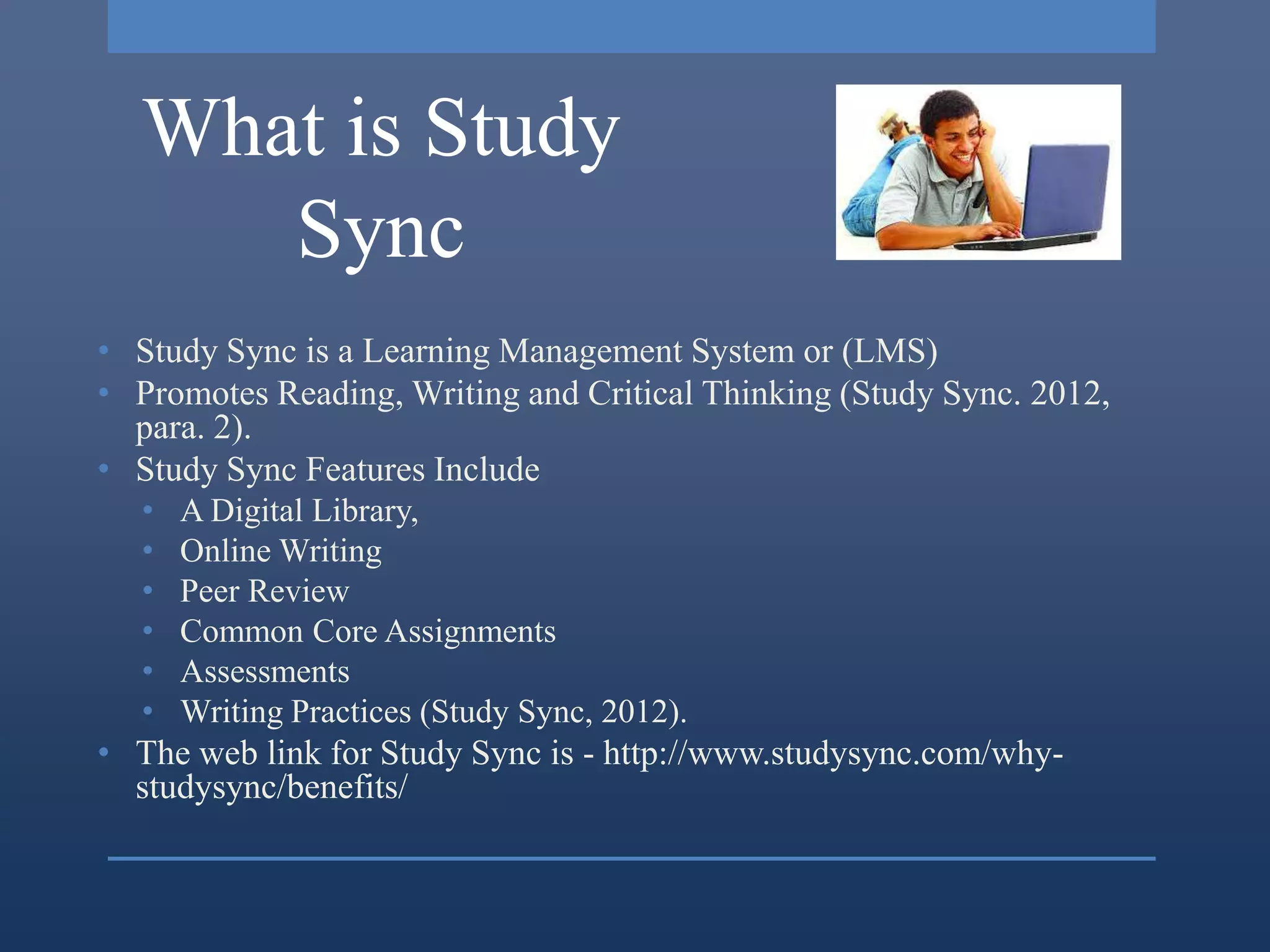
• Study Sync is a Learning Management System or (LMS)
• Promotes Reading, Writing and Critical Thinking (Study Sync. 2012,
  para. 2).
• Study Sync Features Include
  •   A Digital Library,
  •   Online Writing
  •   Peer Review
  •   Common Core Assignments
  •   Assessments
  •   Writing Practices (Study Sync, 2012).
• The web link for Study Sync is - http://www.studysync.com/why-
  studysync/benefits/
Four Stages of Innovation
Development

• Need
• Research
• Development
• Commercialization
The Need for Study
   Sync
• The Problem Giving Rise to the Innovation
  • Engages Students with the Use of
    Technology
  • Literacy Skills for the 21st Century
  • Common Core Learning Skills
  • Flexible Access to Technology
  • Provides Multiple Differentiated
    Activities
The Need for Study
Sync Continued
  • Provides Higher Level Courses
    •   Algebra 2
    •   Pre – Calculus
    •   Spanish Level 3
    •   French Level 3
  • Provides Flexible Scheduling
  • Saves the School System $40,000.00 in Transportation
    Expenses
  • Provides Teachers with Instructional Approaches to Use
    in the Classroom
The Research Behind
  the Organization
• Research or Development Behind the
  Organization
  • Study Sync is the Flagship Product of
    Book Head Ed Learning, LLC.
  • The Company’s Chief Education
    Advisor is Dr. Lawrence Baines
  • Experts on Learning Management
    Systems
     • Harvard
     • UC Berkeley
     • MIT
The Research Behind the
 Organization
• The Findings Behind the Research
  • Time Worthy Activities
  • Supports the Physical Structure of
    the Brain
     •   Sophisticated Imaging Techniques
     •   Stimulates the Intellect
     •   Helps Students Build Connections
     •   Helps Build Success on Challenging
         Tasks
The Research Behind the
Organization Continued
• Step – by – Step Tasks
  • Provides Reading Images
  • Promotes Reading and Writing
  • Promulgates Thinking
• Provides Updates to Social
  Network
• Draws from Most Current
  Studies in Pedagogy
The Research Behind the
 Organization Continued
• Schooling in a Virtual Setting
  • Engages Students
  • Sustains Intellectual Interest
  • Supports Next Stages of Education and
    Work
• Advanced Reading Ability
• Advanced Math Ability
• Greater Breadth and Depth of Skill
The Research Behind the
     Organization Continued
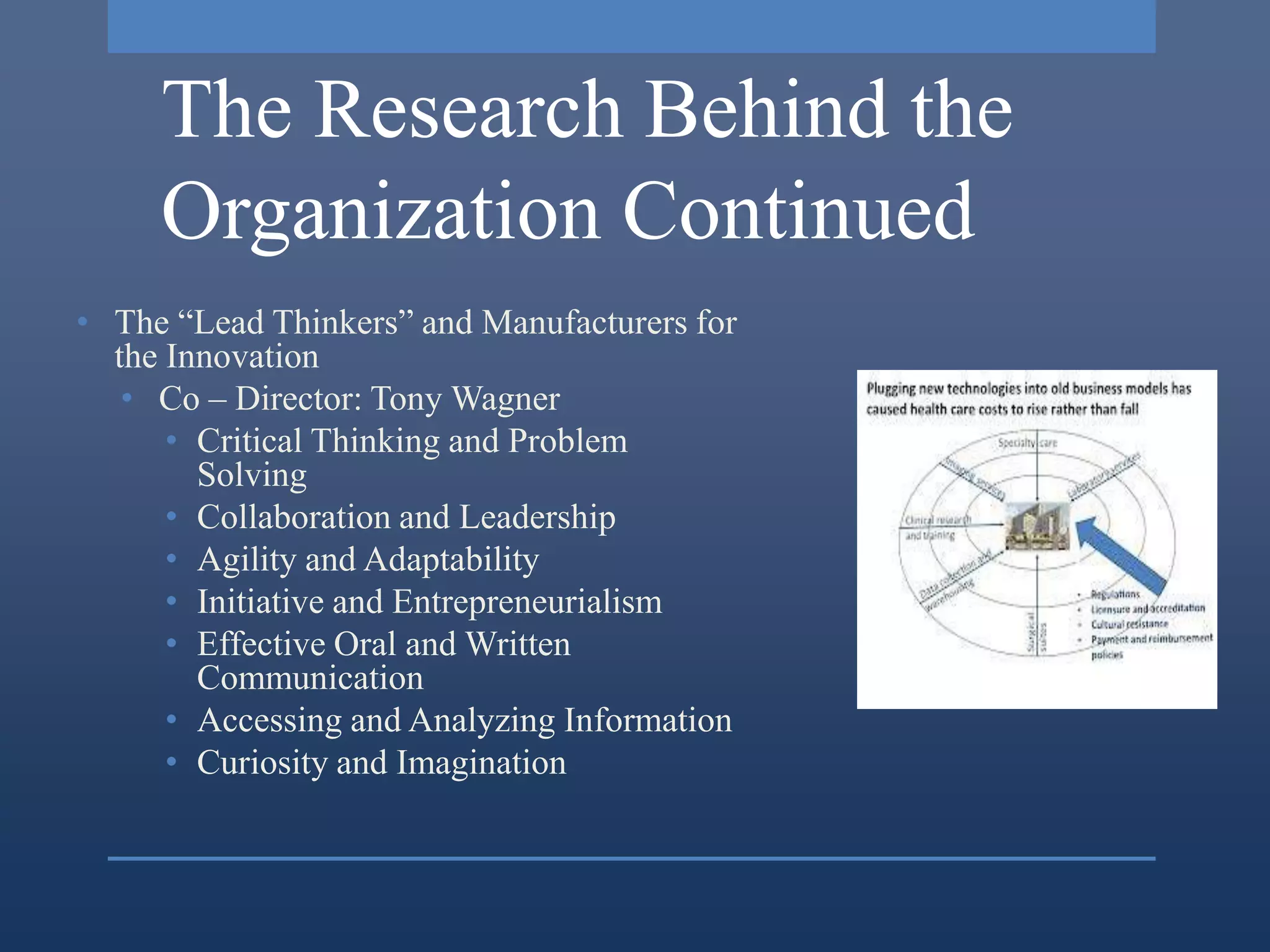
• The “Lead Thinkers” and Manufacturers for
  the Innovation
   • Co – Director: Tony Wagner
      • Critical Thinking and Problem
        Solving
      • Collaboration and Leadership
      • Agility and Adaptability
      • Initiative and Entrepreneurialism
      • Effective Oral and Written
        Communication
      • Accessing and Analyzing Information
      • Curiosity and Imagination
The Research Behind the
  Organization Continued
• Most School Programs
  • Lack Test Preparation Skills
  • Do Not Fulfill Literacy Demands
  • Do Not Provide Post – Secondary
    Preparation
• Study Sync Opportunities
  •   Create Ideas
  •   Problem Solve
  •   Connections with Friends
  •   Engages Student Learning
  •   Build Upon Current Interests
The Research Behind the
Organization Continued
• Learn Capital
  • Produces Study
    Sync
  • Provides
    Investment
    Partners
    • Robert J. Hunter
    • Greg Mauro
    • Tom Vander Ark
The Development Process
   of the Innovation
• Problems in Development Process
  • Remediation Issues
    • Comprehension
    • Thinking Critically
    • Ways of Knowing
  • Technological Need
    • Instruction
    • Collaboration
    • Information Integrity
The Development Process
    of the Innovation Continued

• Problems Innovation May Encounter During Development
  • Advance Curriculum for Diverse Learners
  • Curriculum Provides Only One Pathway
  • Providing Curriculum in Multiple Subject Areas
  • Social Networking
The Development Process
of the Innovation Continued
• Study Sync and Student
  Motivation
  • Study Sync Provides
    for Student Interests
    • Distinction
    • Success
  • Study Sync Scaffolds
    Learning
The Development Process of
the Innovation Continued
• Intended Audience for Innovation
  • Secondary Teachers
  • Middle School Students
     • Higher Level Math
       • Algebra 2
       • Calculus
     • Foreign Language Courses
       • Spanish Level 3
       • French Level 3
Commercialization of the
      Innovation
• Production, Manufacturing, Packaging, Marketing, and
  Distribution
  •   Study Sync’s Electronic Course Room
  •   Models College – Level Academic Discourse
  •   Standards – Based Online Learning Curriculum
  •   Multimodal Methods
      •   Broadcast Quality Video
      •   Animation
      •   Audio Readings
      •   Images
      •   Social Networking Tools
Commercialization of the
Innovation Continued

• Team of Online Educators
  • Designers
  • Developers
  • Programmers
• Management Team
• Academic Advisors
• Executive Advisors
Five Stages of the Innovation –
Decision Process
• Knowledge
• Persuasion
• Decision
• Implementation
• Confirmation
Knowledge Stage
•   Study Sync Motivates Student Reading
•   Study Sync Promotes Student Writing
•   Study Sync Supports Problem - Solving
•   Provides Program Supports
    • A Dynamic Digital Library
    • Multi – Media Assignments
      •   Reading
      •   Writing
      •   Peer review
      •   Discussion
Persuasion Stage
• Embedded Literacy Skills for 21st Century Learners
• Collaborative Supports to Enhance Learning Skills
• Lessons that Align with New Common Core Learning Standards
• Easy Access to Online Resources
• Provides Multiple Ways for Teachers to Differentiate Instruction
• Provides Multiple Implementation Models
• Helps Increase Student Skills in Reading, Writing and Critical
  Thinking
• Provides a Research Based Curriculum
• Encourages Middle Schools to Apply
Decision Stage

• The Board of Education Approval
• The Department of Strategic Project Management and
  Planning
  •   Coordinates Functions and Operations
  •   Implements Six Phases of Study Sync Between 2013 – 2018
  •   Selection Process for Phase Schools
  •   The First Five Phases of Study Sync to Include Five Schools
  •   The Last Phase of Study Sync to Include Ten Schools
Implementation Stage
• Coordination Between Phase Middle Schools and High
  Schools
  •   Classes in Algebra 2
  •   Classes in Pre – Calculus
  •   Classes in Spanish 3
  •   Classes in French 3
• Collaboration Teams
  • Middle School Scheduler
  • Math Resource Teacher
  • English Resource Teacher
• Student Performance Comparison Data
• Quarterly Administrative and Supervisory Board Meetings
Confirmation Stage
• Set Phase School Models Using Study Sync
• Student Performance Data Comparisons on
  Different Phase Schools with Modifications
• Learn to Define Teacher Roles and
  Responsibilities
• Utilize Data to Support Study Sync Phase
  Planning for High Schools
• Monitor Data Trends on Student Progress
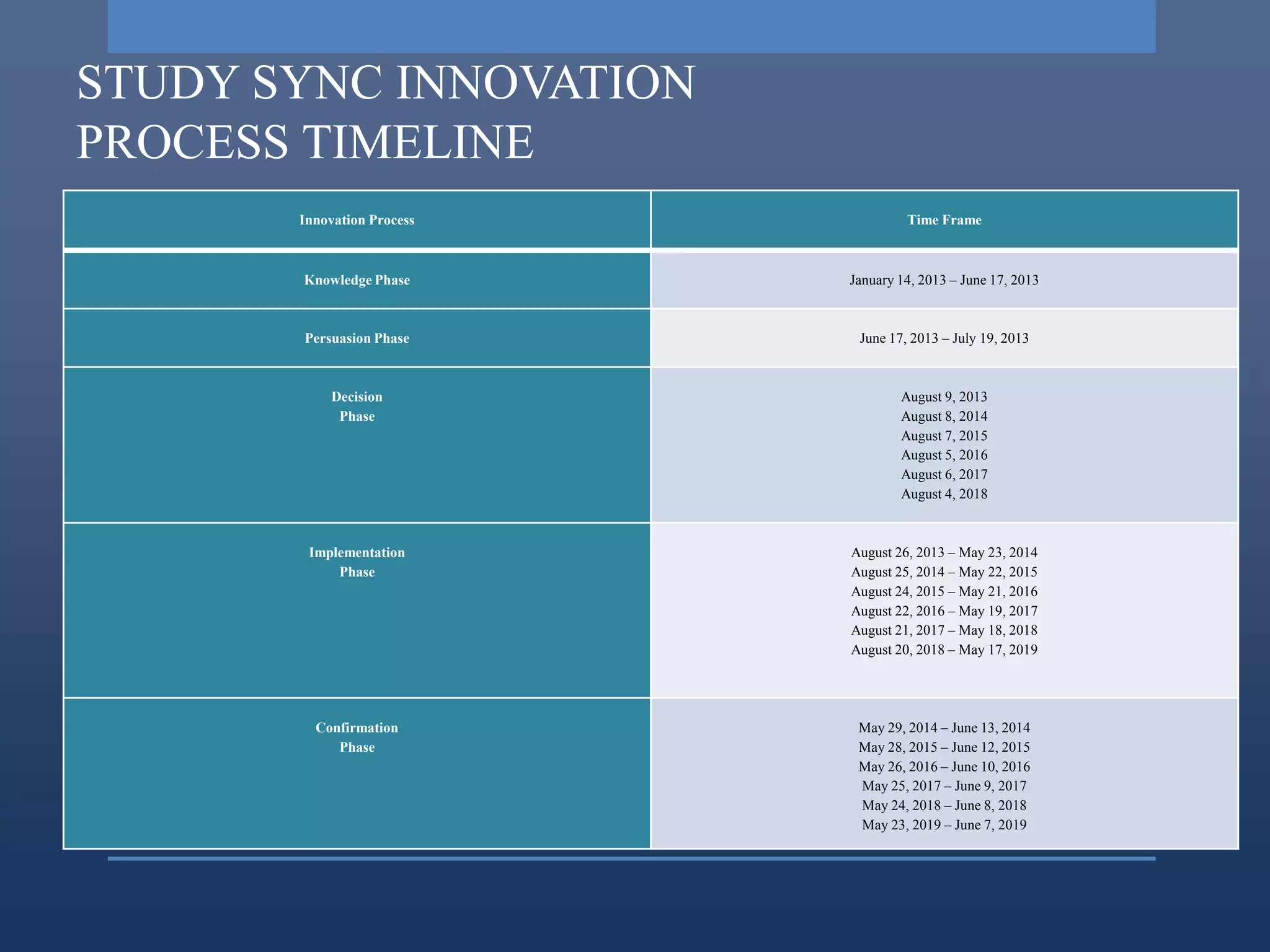
STUDY SYNC INNOVATION
PROCESS TIMELINE
       Innovation Process            Time Frame


       Knowledge Phase      January 14, 2013 – June 17, 2013


       Persuasion Phase      June 17, 2013 – July 19, 2013


           Decision                 August 9, 2013
            Phase                   August 8, 2014
                                    August 7, 2015
                                    August 5, 2016
                                    August 6, 2017
                                    August 4, 2018


        Implementation      August 26, 2013 – May 23, 2014
            Phase           August 25, 2014 – May 22, 2015
                            August 24, 2015 – May 21, 2016
                            August 22, 2016 – May 19, 2017
                            August 21, 2017 – May 18, 2018
                            August 20, 2018 – May 17, 2019


         Confirmation        May 29, 2014 – June 13, 2014
            Phase            May 28, 2015 – June 12, 2015
                             May 26, 2016 – June 10, 2016
                             May 25, 2017 – June 9, 2017
                             May 24, 2018 – June 8, 2018
                             May 23, 2019 – June 7, 2019
The S – Curve for Study Sync
• Innovators
• Early Adopters
• Early Majority
• Late Majority
• Laggards
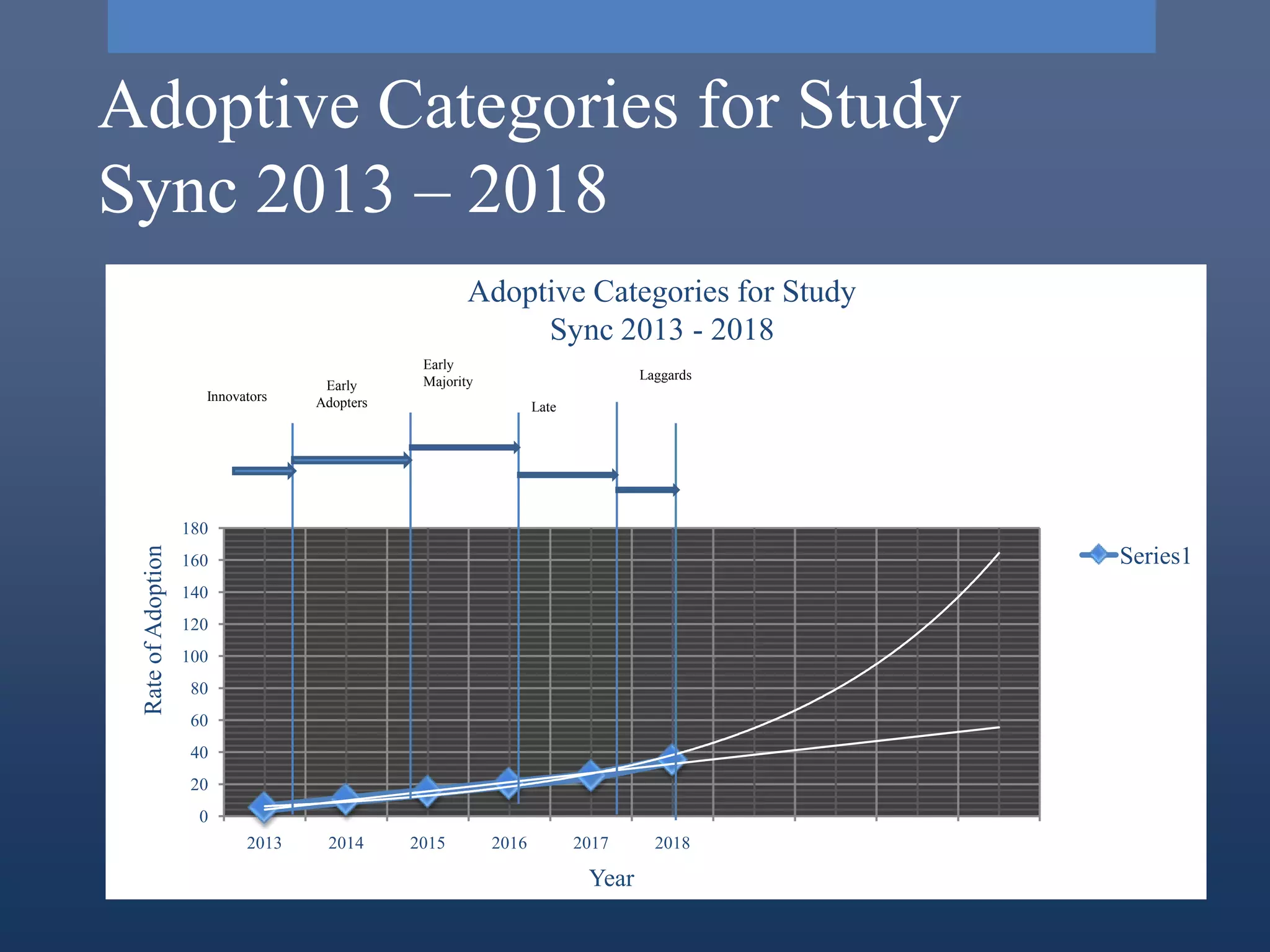
Adoptive Categories for Study
Sync 2013 – 2018
                                                      Adoptive Categories for Study
                                                           Sync 2013 - 2018
                                               Early
                                               Majority                         Laggards
                                    Early
                      Innovators   Adopters                      Late


                    180


Innovativeness and
 Rate of Adoption


                    160                                                                    Series1
                    140
                    120


Adopter categories for
                    100
                     80
                     60


Study Sync
                     40
                     20
                      0
                            2013    2014      2015        2016          2017      2018

                                                                         Year
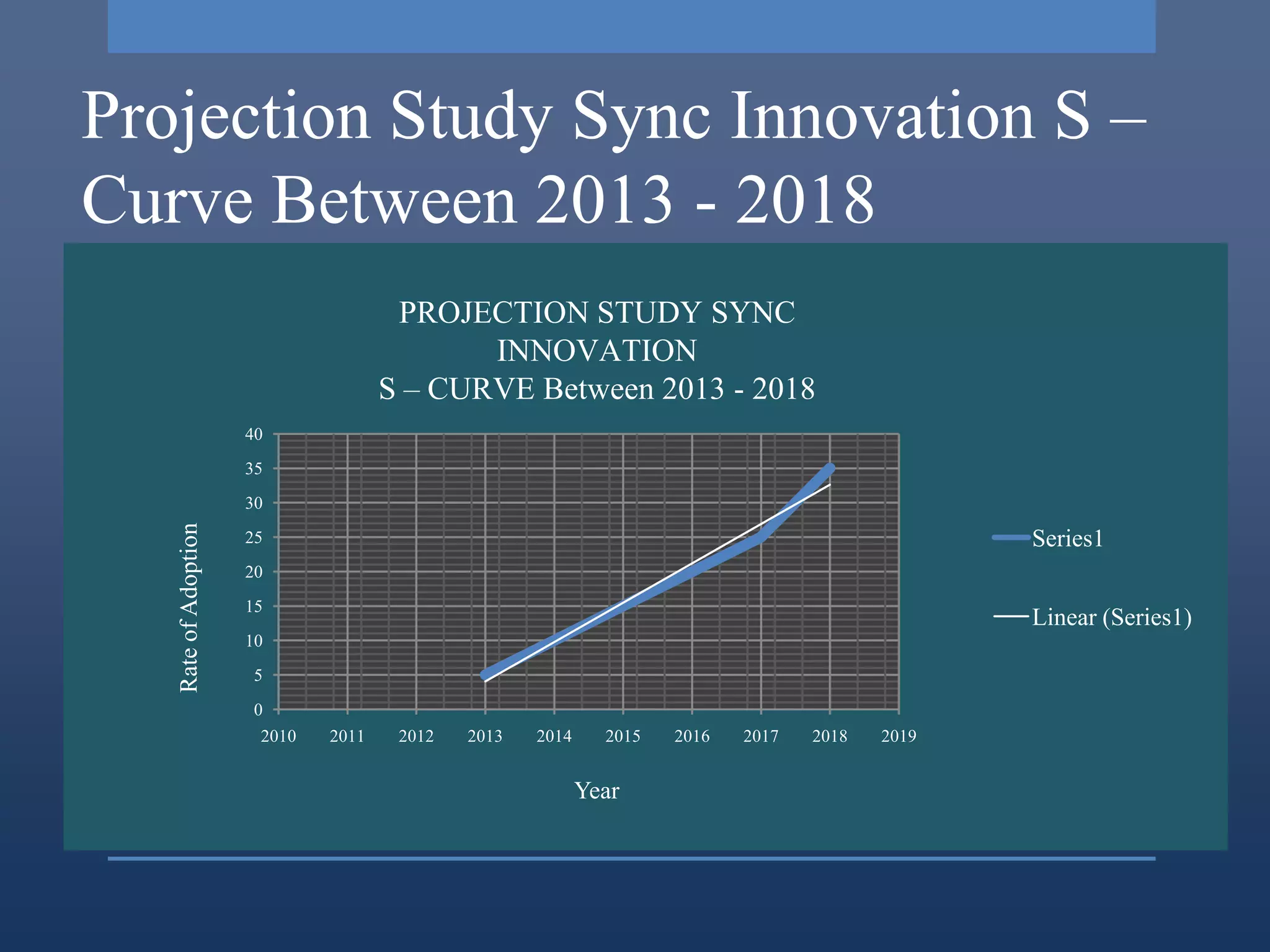
Projection Study Sync Innovation S –
Curve Between 2013 - 2018
                                      PROJECTION STUDY SYNC
                                            INNOVATION
                                     S – CURVE Between 2013 - 2018
                      40
                      35
                      30
   Rate of Adoption


                      25                                                                        Series1
                      20
                      15
                                                                                                Linear (Series1)
                      10


 Projection Study sync
                       5
                       0
                       2010   2011    2012   2013   2014     2015   2016   2017   2018   2019


 innovation s - curve                                      Year
Perceived Attributes of Innovations and
How Perceptions Relate to the Rate of
Innovation
• Variable that Affect an Innovations Rate of
  Adoption
  • Type of Innovation Decision
  • The Nature of Communication
  • The Nature of the Social System
  • The Extent of Change Agents
Perceived Attributes of Innovations and How
Perceptions Relate to the Rate of Innovation
Continued

• The Five Perceived Attributes of Innovations
  • Relative Advantage
  • Compatibility
  • Complexity
  • Trialability
  • Observability
Perceived Attributes of Innovations and
 How Perceptions Relate to the Rate of
 Innovation Continued
• Change Agent
  • Social Marginality
  • Information Overload
• The Seven Roles of Change Agents
  •   Need for Change
  •   Establish Information Exchange Relationship
  •   Diagnose Problems
  •   Create Intent to Change Client
  •   Intentions Into Actions
  •   Stabilize Adoption and Prevent Discontinuance
  •   Achieve Terminal Client Relationship
Perceived Attributes of Innovations and How
 Perceptions Relate to the Rate of Innovation
 Continued
• Key Change Agents to Implement Study Sync to Effect Positive
  Social Change
  • The Department of Strategic Project Management and Planning
  • Members from School Leadership Teams
    •   Administrators
    •   Resource Teachers
    •   Team Leaders
    •   Staff Developers
    •   Elected Faculty Representatives.
Perceived Attributes of Innovations and
How Perceptions Relate to the Rate of
Innovation Continued
• Combinations of Perceived Attributes to Achieve Critical
  Mass
  • Relative Advantage
  • Compatibility
  • Observability
• A Centralized vs. Decentralized Diffusion System
• Achieving Critical Mass
Perceived Attributes of Innovations and
 How Perceptions Relate to the Rate of
 Innovation Continued

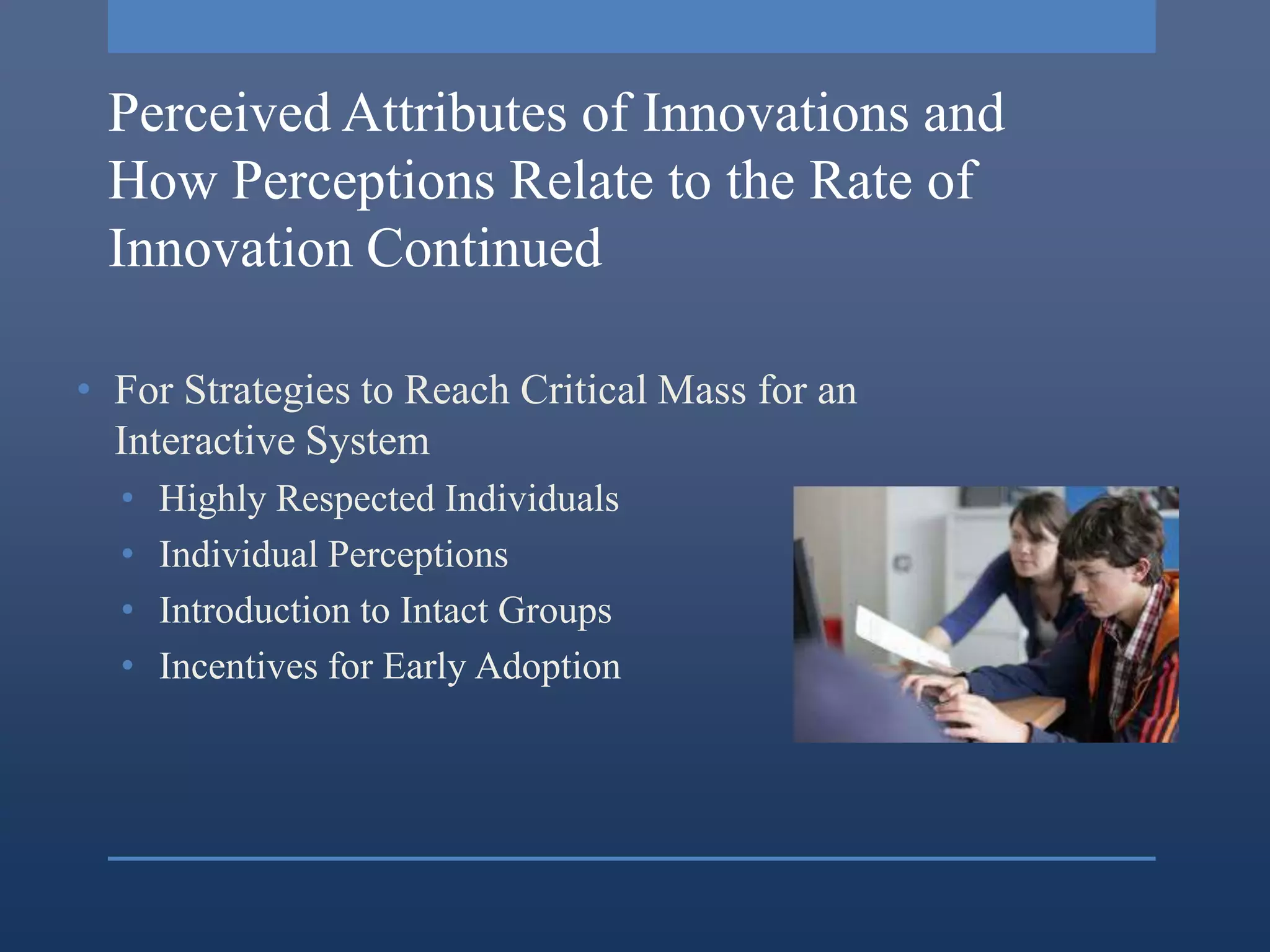
• For Strategies to Reach Critical Mass for an
  Interactive System
  •   Highly Respected Individuals
  •   Individual Perceptions
  •   Introduction to Intact Groups
  •   Incentives for Early Adoption
Perceived Attributes of Innovations and
How Perceptions Relate to the Rate of
Innovation Continued
• Strategies to Support the Use of Study Sync in
  Meeting Critical Mass
  • Adoption by Highly Respected Individuals
  • The School System’s Context for Pressures to
     Adopt Study Sync
  • Coordination Within the School System
    • The Department of Strategic Project Management and
      Planning
    • Middle School Leadership Teams
Specific Variables that Make
 Organizational Adoption Different from
 Individual Adoption
• Innovation Processes within Organizations
  • Initiation
     • Agenda
     • Matching
  • Implementation
     • Redefining/Restructuring
     • Clarifying
     • Routinization
Specific Variables that Make
  Organizational Adoption Different from
  Individual Adoption Continued
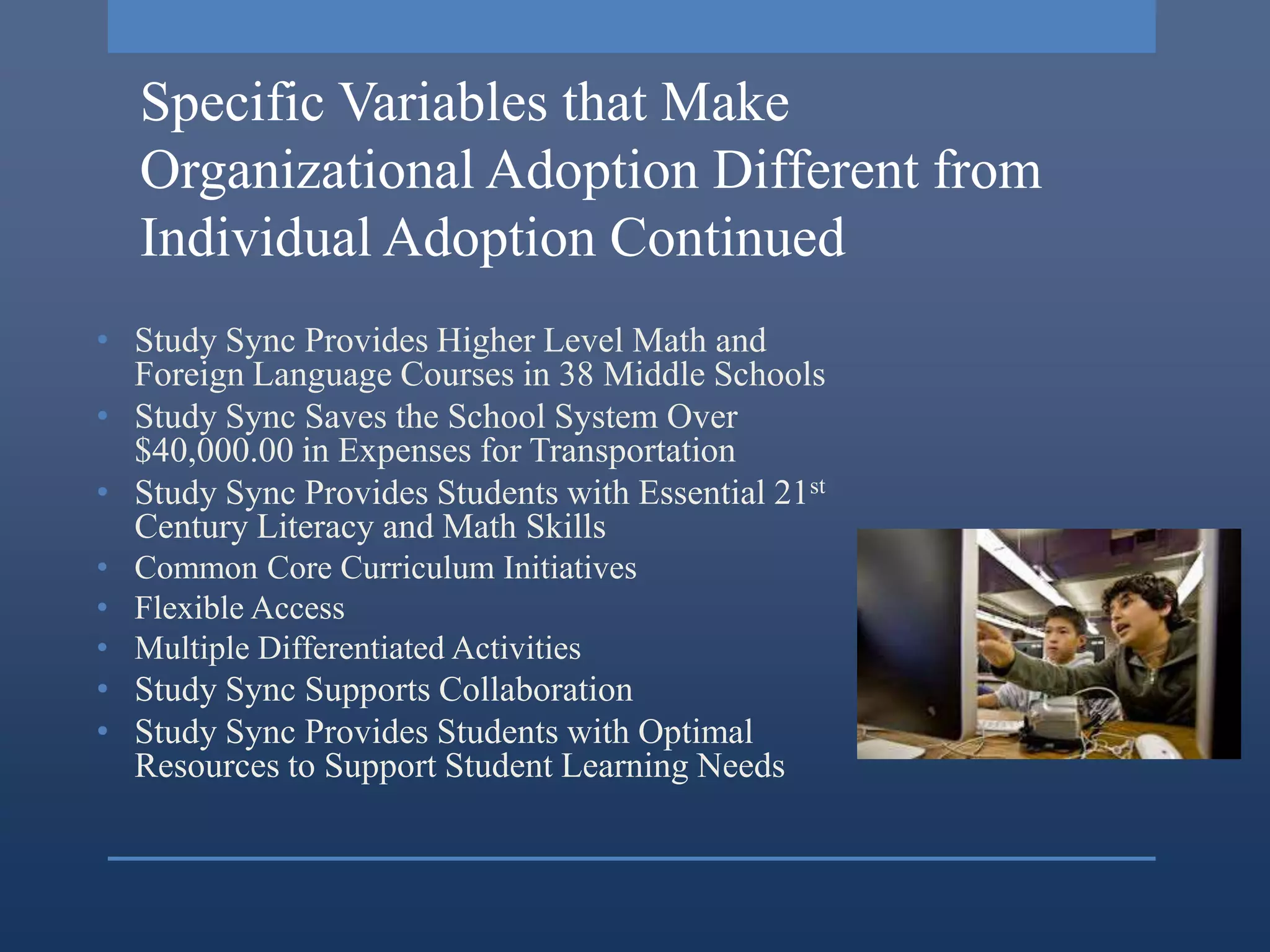
• Study Sync Provides Higher Level Math and
  Foreign Language Courses in 38 Middle Schools
• Study Sync Saves the School System Over
  $40,000.00 in Expenses for Transportation
• Study Sync Provides Students with Essential 21st
  Century Literacy and Math Skills
• Common Core Curriculum Initiatives
• Flexible Access
• Multiple Differentiated Activities
• Study Sync Supports Collaboration
• Study Sync Provides Students with Optimal
  Resources to Support Student Learning Needs
References
• References
• Rogers, E. M. (2003). Diffusion of innovations (5th ed.).
  New York, NY: Free Press.
• StudySync. (2012). What is studysync. Retrieved from
• http://www.studysync.com/our-product/what-is-
  studysync/?ga-link=explore

Module 6 story board for study sync complete presentation

  • 1.
    STORY BOARD FORSTUDY SYNC MULTIMEDIA PRESENTATION EDUC 8841: DIFFUSION AND INTEGRATION OF EDUCATIONAL TECHNOLOGY PROFESSOR AMAR ALMASUDE Vaughn M. Bradley, Jr.
  • 2.
    What is Study Sync • Study Sync is a Learning Management System or (LMS) • Promotes Reading, Writing and Critical Thinking (Study Sync. 2012, para. 2). • Study Sync Features Include • A Digital Library, • Online Writing • Peer Review • Common Core Assignments • Assessments • Writing Practices (Study Sync, 2012). • The web link for Study Sync is - http://www.studysync.com/why- studysync/benefits/
  • 3.
    Four Stages ofInnovation Development • Need • Research • Development • Commercialization
  • 4.
    The Need forStudy Sync • The Problem Giving Rise to the Innovation • Engages Students with the Use of Technology • Literacy Skills for the 21st Century • Common Core Learning Skills • Flexible Access to Technology • Provides Multiple Differentiated Activities
  • 5.
    The Need forStudy Sync Continued • Provides Higher Level Courses • Algebra 2 • Pre – Calculus • Spanish Level 3 • French Level 3 • Provides Flexible Scheduling • Saves the School System $40,000.00 in Transportation Expenses • Provides Teachers with Instructional Approaches to Use in the Classroom
  • 6.
    The Research Behind the Organization • Research or Development Behind the Organization • Study Sync is the Flagship Product of Book Head Ed Learning, LLC. • The Company’s Chief Education Advisor is Dr. Lawrence Baines • Experts on Learning Management Systems • Harvard • UC Berkeley • MIT
  • 7.
    The Research Behindthe Organization • The Findings Behind the Research • Time Worthy Activities • Supports the Physical Structure of the Brain • Sophisticated Imaging Techniques • Stimulates the Intellect • Helps Students Build Connections • Helps Build Success on Challenging Tasks
  • 8.
    The Research Behindthe Organization Continued • Step – by – Step Tasks • Provides Reading Images • Promotes Reading and Writing • Promulgates Thinking • Provides Updates to Social Network • Draws from Most Current Studies in Pedagogy
  • 9.
    The Research Behindthe Organization Continued • Schooling in a Virtual Setting • Engages Students • Sustains Intellectual Interest • Supports Next Stages of Education and Work • Advanced Reading Ability • Advanced Math Ability • Greater Breadth and Depth of Skill
  • 10.
    The Research Behindthe Organization Continued • The “Lead Thinkers” and Manufacturers for the Innovation • Co – Director: Tony Wagner • Critical Thinking and Problem Solving • Collaboration and Leadership • Agility and Adaptability • Initiative and Entrepreneurialism • Effective Oral and Written Communication • Accessing and Analyzing Information • Curiosity and Imagination
  • 11.
    The Research Behindthe Organization Continued • Most School Programs • Lack Test Preparation Skills • Do Not Fulfill Literacy Demands • Do Not Provide Post – Secondary Preparation • Study Sync Opportunities • Create Ideas • Problem Solve • Connections with Friends • Engages Student Learning • Build Upon Current Interests
  • 12.
    The Research Behindthe Organization Continued • Learn Capital • Produces Study Sync • Provides Investment Partners • Robert J. Hunter • Greg Mauro • Tom Vander Ark
  • 13.
    The Development Process of the Innovation • Problems in Development Process • Remediation Issues • Comprehension • Thinking Critically • Ways of Knowing • Technological Need • Instruction • Collaboration • Information Integrity
  • 14.
    The Development Process of the Innovation Continued • Problems Innovation May Encounter During Development • Advance Curriculum for Diverse Learners • Curriculum Provides Only One Pathway • Providing Curriculum in Multiple Subject Areas • Social Networking
  • 15.
    The Development Process ofthe Innovation Continued • Study Sync and Student Motivation • Study Sync Provides for Student Interests • Distinction • Success • Study Sync Scaffolds Learning
  • 16.
    The Development Processof the Innovation Continued • Intended Audience for Innovation • Secondary Teachers • Middle School Students • Higher Level Math • Algebra 2 • Calculus • Foreign Language Courses • Spanish Level 3 • French Level 3
  • 17.
    Commercialization of the Innovation • Production, Manufacturing, Packaging, Marketing, and Distribution • Study Sync’s Electronic Course Room • Models College – Level Academic Discourse • Standards – Based Online Learning Curriculum • Multimodal Methods • Broadcast Quality Video • Animation • Audio Readings • Images • Social Networking Tools
  • 18.
    Commercialization of the InnovationContinued • Team of Online Educators • Designers • Developers • Programmers • Management Team • Academic Advisors • Executive Advisors
  • 19.
    Five Stages ofthe Innovation – Decision Process • Knowledge • Persuasion • Decision • Implementation • Confirmation
  • 20.
    Knowledge Stage • Study Sync Motivates Student Reading • Study Sync Promotes Student Writing • Study Sync Supports Problem - Solving • Provides Program Supports • A Dynamic Digital Library • Multi – Media Assignments • Reading • Writing • Peer review • Discussion
  • 21.
    Persuasion Stage • EmbeddedLiteracy Skills for 21st Century Learners • Collaborative Supports to Enhance Learning Skills • Lessons that Align with New Common Core Learning Standards • Easy Access to Online Resources • Provides Multiple Ways for Teachers to Differentiate Instruction • Provides Multiple Implementation Models • Helps Increase Student Skills in Reading, Writing and Critical Thinking • Provides a Research Based Curriculum • Encourages Middle Schools to Apply
  • 22.
    Decision Stage • TheBoard of Education Approval • The Department of Strategic Project Management and Planning • Coordinates Functions and Operations • Implements Six Phases of Study Sync Between 2013 – 2018 • Selection Process for Phase Schools • The First Five Phases of Study Sync to Include Five Schools • The Last Phase of Study Sync to Include Ten Schools
  • 23.
    Implementation Stage • CoordinationBetween Phase Middle Schools and High Schools • Classes in Algebra 2 • Classes in Pre – Calculus • Classes in Spanish 3 • Classes in French 3 • Collaboration Teams • Middle School Scheduler • Math Resource Teacher • English Resource Teacher • Student Performance Comparison Data • Quarterly Administrative and Supervisory Board Meetings
  • 24.
    Confirmation Stage • SetPhase School Models Using Study Sync • Student Performance Data Comparisons on Different Phase Schools with Modifications • Learn to Define Teacher Roles and Responsibilities • Utilize Data to Support Study Sync Phase Planning for High Schools • Monitor Data Trends on Student Progress
  • 25.
    STUDY SYNC INNOVATION PROCESSTIMELINE Innovation Process Time Frame Knowledge Phase January 14, 2013 – June 17, 2013 Persuasion Phase June 17, 2013 – July 19, 2013 Decision August 9, 2013 Phase August 8, 2014 August 7, 2015 August 5, 2016 August 6, 2017 August 4, 2018 Implementation August 26, 2013 – May 23, 2014 Phase August 25, 2014 – May 22, 2015 August 24, 2015 – May 21, 2016 August 22, 2016 – May 19, 2017 August 21, 2017 – May 18, 2018 August 20, 2018 – May 17, 2019 Confirmation May 29, 2014 – June 13, 2014 Phase May 28, 2015 – June 12, 2015 May 26, 2016 – June 10, 2016 May 25, 2017 – June 9, 2017 May 24, 2018 – June 8, 2018 May 23, 2019 – June 7, 2019
  • 26.
    The S –Curve for Study Sync • Innovators • Early Adopters • Early Majority • Late Majority • Laggards
  • 27.
    Adoptive Categories forStudy Sync 2013 – 2018 Adoptive Categories for Study Sync 2013 - 2018 Early Majority Laggards Early Innovators Adopters Late 180 Innovativeness and Rate of Adoption 160 Series1 140 120 Adopter categories for 100 80 60 Study Sync 40 20 0 2013 2014 2015 2016 2017 2018 Year
  • 28.
    Projection Study SyncInnovation S – Curve Between 2013 - 2018 PROJECTION STUDY SYNC INNOVATION S – CURVE Between 2013 - 2018 40 35 30 Rate of Adoption 25 Series1 20 15 Linear (Series1) 10 Projection Study sync 5 0 2010 2011 2012 2013 2014 2015 2016 2017 2018 2019 innovation s - curve Year
  • 29.
    Perceived Attributes ofInnovations and How Perceptions Relate to the Rate of Innovation • Variable that Affect an Innovations Rate of Adoption • Type of Innovation Decision • The Nature of Communication • The Nature of the Social System • The Extent of Change Agents
  • 30.
    Perceived Attributes ofInnovations and How Perceptions Relate to the Rate of Innovation Continued • The Five Perceived Attributes of Innovations • Relative Advantage • Compatibility • Complexity • Trialability • Observability
  • 31.
    Perceived Attributes ofInnovations and How Perceptions Relate to the Rate of Innovation Continued • Change Agent • Social Marginality • Information Overload • The Seven Roles of Change Agents • Need for Change • Establish Information Exchange Relationship • Diagnose Problems • Create Intent to Change Client • Intentions Into Actions • Stabilize Adoption and Prevent Discontinuance • Achieve Terminal Client Relationship
  • 32.
    Perceived Attributes ofInnovations and How Perceptions Relate to the Rate of Innovation Continued • Key Change Agents to Implement Study Sync to Effect Positive Social Change • The Department of Strategic Project Management and Planning • Members from School Leadership Teams • Administrators • Resource Teachers • Team Leaders • Staff Developers • Elected Faculty Representatives.
  • 33.
    Perceived Attributes ofInnovations and How Perceptions Relate to the Rate of Innovation Continued • Combinations of Perceived Attributes to Achieve Critical Mass • Relative Advantage • Compatibility • Observability • A Centralized vs. Decentralized Diffusion System • Achieving Critical Mass
  • 34.
    Perceived Attributes ofInnovations and How Perceptions Relate to the Rate of Innovation Continued • For Strategies to Reach Critical Mass for an Interactive System • Highly Respected Individuals • Individual Perceptions • Introduction to Intact Groups • Incentives for Early Adoption
  • 35.
    Perceived Attributes ofInnovations and How Perceptions Relate to the Rate of Innovation Continued • Strategies to Support the Use of Study Sync in Meeting Critical Mass • Adoption by Highly Respected Individuals • The School System’s Context for Pressures to Adopt Study Sync • Coordination Within the School System • The Department of Strategic Project Management and Planning • Middle School Leadership Teams
  • 36.
    Specific Variables thatMake Organizational Adoption Different from Individual Adoption • Innovation Processes within Organizations • Initiation • Agenda • Matching • Implementation • Redefining/Restructuring • Clarifying • Routinization
  • 37.
    Specific Variables thatMake Organizational Adoption Different from Individual Adoption Continued • Study Sync Provides Higher Level Math and Foreign Language Courses in 38 Middle Schools • Study Sync Saves the School System Over $40,000.00 in Expenses for Transportation • Study Sync Provides Students with Essential 21st Century Literacy and Math Skills • Common Core Curriculum Initiatives • Flexible Access • Multiple Differentiated Activities • Study Sync Supports Collaboration • Study Sync Provides Students with Optimal Resources to Support Student Learning Needs
  • 38.
    References • References • Rogers,E. M. (2003). Diffusion of innovations (5th ed.). New York, NY: Free Press. • StudySync. (2012). What is studysync. Retrieved from • http://www.studysync.com/our-product/what-is- studysync/?ga-link=explore

Editor's Notes

  • #2 Transcript of Narration for Slide 1:Good Evening Board of Directors-Tonight, I will be presenting Study Sync, a learning management system, which supports our students with online services.
  • #3 Transcript of Narration for Slide 2:Study Sync is a learning management system (LMS) that promotes reading, writing, and critical thinking (Study Sync. 2012, para. 2). Some of the features include a digital library, online writing, and peer review, common core assignments, and assessments. Study Sync also provides a weekly writing practice (Study Sync, 2012).The web link for Study Sync is - http://www.studysync.com/why-studysync/benefits/
  • #4 Transcript of Narration for Slide 3:There are four stages of innovation development including - Need – the innovation development process often begins with a problem that stimulates research and development activities (Rogers, 2003, p. 137). Research – consists of basic and applied research where knowledge applies to practical problems (Rogers, 2003, p. 137). Development – the process of putting a new idea in a form that meets the needs of an audience of potential adopters (Rogers, 203, p. 146). Commercialization – the production, manufacturing, packaging, marketing and distributing of a product that embodies an innovation (Rogers, 2003, p. 152).
  • #5 Transcript of Narration for Slide 4:The need for Study Sync –What problem or need exists to give rise to the innovation?In today’s world, engaging students is becoming increasingly difficult. Teachers have a need to use technology that engages students without sacrificing key educational goals. Study Sync provides students with literacy skills for 21st century learners, skills for common core learning, flexible access, and multiple ways for teachers to provide differentiated activities.
  • #6 Transcript of Narration for Slide 5:At the Middle School level, it is becoming increasingly challenging to provide students with challenging courses in higher – level Math and Foreign Language courses. The 38 Middle Schools within the county rely on their cluster High School to provide higher level Math courses such as Algebra 2, Pre - Calculus and Foreign Language Level 3 courses in Spanish, and French. The school system spends over $40,000.00 in expenses for transportation. Study Sync provides teachers with new instructional approaches that focus on higher levels of student engagement, personalized instruction, and real life, real time experiences are essential if higher academic goals are to be realized. Study Sync is the kind of “robust and relevant to the real world” tool that will help students make the transition to “success in college and careers” (Study Sync, 2012).Schedulers at the Middle and High Schools arrange their Master Schedules so that Middle School students are able to take higher – level Math and Foreign Language courses at the cluster High School.
  • #7 Transcript of Narration for Slide 6:The Research Behind the Organization –What research organization or people developed a solution to the problem or need?Study Sync is the flagship product of Book head Ed Learning, LLC, a content development company from creators Robert Romano and Jay King, along with renowned Harvard language arts educator James Moffett, of multiple award-winning EdVantage Software (Study Sync, 2012).The Company’s chief education advisor, Dr. Lawrence Baines, is Chair of the Instructional Leadership and Academic Curriculum department at the University of Oklahoma and a consultant to the National Council of English Teachers (“NCTE”). Experts from Harvard, UC Berkeley, MIT, and other top institutions also contribute to create a product that provides the highest level of academics through text-based lessons and collegiate-modeled collaboration (Study Sync, 2012).
  • #8 Transcript of Narration of Slide 7:What were their findings behind the research?Because many adolescents today avoid reading, their experiences with books and the bundle of skills, may not be fully develop. One of the biggest challenges for teachers in the 21st century is convincing students to spend their psychic energy on activities that are worthy of their time.Neuroscientists confirm that the activities a person chooses to pursue effect not only on the development of identity, but also on the physical structure of the brain. The brain continues to evolve, the plasticity of the brain is well established, contemporary researchers have begun to pinpoint changes in the brain through sophisticated imaging techniques. The brain requires activities that stimulate the intellect, builds connections, and makes success possible for increasingly challenging tasks. If the intellect is not stimulated, then the parts of the brain associated with rational thought will weaken (Study Sync, 2012).
  • #9 Transcript of Narration for Slide 8:Study Sync involves students in anxiety free, achievable, step-by-step tasks that build toward complexity over time. Images lead to reading, reading merges into writing, and writing promulgates more thinking and deeper reading. Study Sync continually updates it’s social network, highlights breaking news and “hot button” issues that are suitable for discussion, writing, and extended projects. Students receive text updates on new articles as well as the latest, greatest peer comments as they are posted (Study Sync, 2012). Study Sync develops from a rich research base that draws from the most current studies in pedagogy, learning, technology, and student engagement. Study Sync is built with today’s learners in mind.
  • #10 Transcript of Narration for Slide 9:The purpose of schooling, in a virtual setting is to engage students deeply in learning. Study Sync helps plant seeds of intellectual interest that will carry students into their next stages of education and work (Study Sync, 2012). Research shows that students need advanced reading and math ability as the keys to the full range of ways for knowing. The global information economy now requires greater breadth and depth of skill in making meaning from what is expected of any previous American generation (Study Sync, 2012).
  • #11 Transcript of Narration for Slide 10:Who were the “lead thinkers” for the innovation, and how did they convince a manufacturer to produce it? Tony Wagner is the co – director of The Change Leadership Group, from the Harvard Graduate School of Education. He conducts a study of skills that students will need in the new global economy. The study involves asking businesses, and educational leaders what skills students will need to be good citizens. The responses from the professionals in the multiple organizations include:Critical Thinking and Problem Solving Collaboration and LeadershipAgility and AdaptabilityInitiative and EntrepreneurialismEffective Oral and Written CommunicationAccessing and Analyzing InformationCuriosity and Imagination (Study Sync, 2012).
  • #12 Transcript of Narration for Slide 11:Tony Wagner finds that most school programs only provide test preparation skills for students. His findings support other prestigious reports to suggest that students with average or greater reading ability are under prepared for the literacy demands from post – secondary work (Study Sync, 2012). Parents want their children to become excellent students. Students want to have opportunities to think, to create, to solve problems, and to find new ways to make friends. Business and nonprofit communities want schools to produce students who, upon entering their respective worlds, can think creatively (“outside the box”) and collaborate with colleagues. Study Sync designs a program to help all of this to happen. The goal is to engage students and scaffold their learning from their current interests to the many disciplines and types of communication they (Study Sync, 2012).
  • #13 Transcript of Narration for Slide 12:Learn Capital is a venture capital firm focusing exclusively on funding entrepreneurs with a vision for smarter learning. The company also provides the capital to produce Study Sync. Investment partners include Robert J. Hunter, Greg Mauro, and Tom Vander Ark (Study Sync, 2012).
  • #14 Transcript of Narration for Slide 13:The Development Process of the Innovation – What problems does the innovation encounter in the development process?There are challenges in addressing remediation issues. Several years ago, researchers Briancarosa and Snow are able to find that seventy percent of older readers require some form of remediation. The remediation needs are due to problems with comprehension, including the ability to think critically and understand ways of knowing. At the core of Study Sync is an internet technological need for instruction. The program is customized and allows students to collaborate for information integrity in a highly digitalized and connected world. The solutions help leverage students with experience and intelligence.
  • #15 Transcript of Narration for Slide 14:What problems does the innovation encounter in the development process continued?There are issues with providing advance curriculum for diverse learners. The solutions help advance students on a pathway to excellence. The advances sustain students through middle school, high school and college. The solutions include assessment, instruction, and integrated research – based lessons. The resources are able to provide students with levels of understanding, comprehension, and critical thinking across multiple subject areas. Students are able to interact with peers on Study Sync’s exclusive social network site (Study Sync, 2012).
  • #16 Transcript of Narration for Slide 15:There are issues with student motivation. Study Sync helps build student interests and prepare them for distinction and success. Study Sync engages students and helps scaffold their learning from their areas of interest to the many disciplines and areas of discourse. Study Sync supports the demands by both higher education and work – force literacy requirements (Study Sync, 2012).
  • #17 Transcript of Narration for Slide 16:Who is the intended audience for the innovation?The audience for Study Sync includes innovative secondary level teachers. The teachers are innovative in wanting to explore in communicating with their students through technological channels. Middle School students taking higher level courses in Math and Foreign Language are also part of the target audience. The students seek motivation in meeting curriculum challenges. Study Sync allows learners to engage in global conversations about topics that affect them (Study Sync, 2012).
  • #18 Transcript of Narration for Slide 17:Commercialization of the Innovation –Describe the production, manufacturing, packaging, marketing, and distribution of the innovation.Study Sync’s electronic course room models a college – level academic discourse. Study Sync uses standards – based online learning curriculum to target classic and modern literary texts in multimodal ways using a variety of digital media including broadcast quality video, animation, audio readings, and images. Study Sync helps frame writing and thinking activities by social networking tools and collaborative discussions with peers. The innovation helps motivate middle and high school students with pre – writing exercises, and review their work with others (Study Sync, 2012).
  • #19 Transcript of Narration for Slide 18:Study Sync assembles an online team of educators, designers, developers, and programmers that create a best in class offering for educators and students. The management team, academic advisors, and executive advisors support students with achieving their academic goals.
  • #20 Transcript of Narration for Slide 19:Knowledge - occurs when an individual or decision – making unit gets exposure to an innovation’s existence along with an understanding of how the innovation functions (Rogers, 2003, p. 169).Persuasion – occurs when an individual or decision – making unit forms either a favorable or unfavorable attitude towards the innovation (Rogers, 2003, p. 169). Decision – occurs when an individual or decision – making unit engages in activities that lead towards a choice to adopt or reject the innovation (Rogers, 2003, p. 169). Implementation – occurs when an individual or decision – making unit puts an idea to use (Rogers, 2003, p. 169). Confirmation – occurs when an individual or decision – making unit seeks reinforcement of an innovation – decision already made, but may reverse the previous decision if a conflicting message is given regarding the innovation (Rogers, 2003, p. 169).
  • #21 Transcript of Narration for Slide 20:Knowledge Stage – Study Sync motivates students to read, write and problem - solve at progressively higher levels. The program gives students what they need in the format they demand including: A Dynamic Digital Library Multi – Media Assignments in Reading, Writing, Peer review, and Discussion
  • #22 Transcript of Narration for Slide 21:Persuasion Stage –Study Sync provides embedded literacy skills for 21st century learners.Study Sync allows students to collaborate and enhance their learning skills. The lessons align with the new Common Core Standards of learning.Study Sync provides access for students anytime and anywhere.Study Sync provides multiple ways for teachers to differentiate instruction in order to develop appropriate responses to intervention.Study Sync provides multiple implementation models where teachers can integrate Study Sync with their existing lesson plans. Study Sync helps increase student skills in Reading, Writing and Critical Thinking.Study Sync provides a research based curriculum to support students with learning goals. All Middle School staff are interested in having students utilize technology .The school systems Department of Strategic Project Management and planning encourages Middle Schools to apply as a Phase School to implement Study Sync.
  • #23 Transcript of Narration for Slide 22:Decision Stage –The Board approves decision for the school systems Department of Strategic Project Management and Planning to coordinate the functions and operations to implement Six Phases of Study Sync between 2013 – 2018.The Department of Strategic Project Management and Planning selects five Middle Schools every school year to implement the first five phases of Study Sync each year. The Department of Strategic Project Management and Planning selects ten Middle School to implement the last phase of Study Sync.
  • #24 Transcript of Narration for Slide 23:Implementation Stage – Each Phase Middle School coordinates with the cluster High School to offer Study Sync classes in – (a) Algebra 2, (b) Pre – Calculus, (c) Spanish 3, and French 3. The Middle School Scheduler works with the Math and English Resource teachers to designates a room setting where the Middle School students taking the higher – level Math or Foreign Language Courses have access to a computer.Student performance comparison data on formative assessments using Study Sync and traditional methods will take place. Present quarterly findings on assessments during quarterly Administrative and Supervisory Board meetings.
  • #25 Transcript of Narration for Slide 24:Confirmation Stage –The Department of Strategic Project Management and Planning will continue to set Phase models with Middle Schools that offer Study Sync. Continuous student performance with Study Sync comparisons will take place with modifications. Teacher roles and responsibilities will evolve and change with the use of Study Sync.The Department of Strategic Project Management and Planning will use results data from the Middle School Phase Models to develop Study Sync Phase models to implement at different High Schools. Continuous data trends will take place to monitor student progress with students who continuously receive Study Sync.
  • #26 Transcript of Narration for Slide 25:Study Sync Innovation Process Timeline – Innovation Process  Time Frame Knowledge Phase  January 14, 2013 – June 17, 2013 Persuasion Phase  June 17, 2013 – July 19, 2013 DecisionPhase  August 9, 2013August 8, 2014August 7, 2015August 5, 2016August 6, 2017August 4, 2018  ImplementationPhase  August 26, 2013 – May 23, 2014August 25, 2014 – May 22, 2015August 24, 2015 – May 21, 2016August 22, 2016 – May 19, 2017August 21, 2017 – May 18, 2018August 20, 2018 – May 17, 2019   ConfirmationPhase  May 29, 2014 – June 13, 2014May 28, 2015 – June 12, 2015May 26, 2016 – June 10, 2016May 25, 2017 – June 9, 2017May 24, 2018 – June 8, 2018May 23, 2019 – June 7, 2019
  • #27 Transcript of Narration for Slide 26:The S – Curve for Study Sync –The time element of the diffusion process allows adopters to classify categories and to draw diffusion curves. The categories include (a) Innovators, (b) Early Adopters, (c) Early Majority, (d) Late Majority, and (e) Laggards (Rogers, 2003, p. 280). Innovators – are venturesome where their interests are in new ideas out of a local circle of peer networks (Rogers, 2003, p. 282).Early Adopters – are an integral part of the local social system (Rogers, 2003, p. 283). Early Majority – are members who adopt new ideas just before the average member of a system (Rogers, 2003, p. 283). Late Majority – are members who adopt new ideas after the average member of a system (Rogers, 2003, p. 234).Laggards – are the last member in a social system to adopt an innovation (Rogers, 2003, p. 284).
  • #28 Transcript of Narration for Slide 27:Adoptive Categories for Study Sync 2013 – 2018 –The graph displays the S – Curve of Adoptive Categories for Study Sync between years 2013 – 2018.
  • #29 Transcript of Narration for Slide 28:Projection Study Sync Innovation S – Curve Between 2013 – 2018 –The slide displays a projection on the Rates of Adoption between 2013 – 2018.
  • #30 Transcript of Narration for Slide 29:Perceived Attributes of Innovations and How Perceptions Relate to the Rate of Innovation – The rate of adoption is the relative speed where members of a social system learn to adopt an innovation. The perceived attributes of an innovation include variables that affect the rate of adoption such as (a) the type of innovation – decision, (b) the nature of communication, (c) the nature of the social system, and (d) the extent of change agents’ efforts in diffusing the innovation (Rogers, 2003, p. 265).
  • #31 Transcript of Narration for Slide 30:There are five perceived attributes of innovations that concentrate on predicting Study Sync’s rate of adoption.Relative advantage – the degree to which an innovation is perceived as better than the idea it supersedes (Rogers, 2003, p. 265). Compatibility – the degree to which an innovation is perceived as consistent with existing values past experiences, and needs of potential adopters (Rogers, 2003, p. 266).Complexity – the degree to which an innovation is perceived as relatively difficult to understand and to use (Rogers, 2003, p. 266). Trialability – the degree to which an innovation may be experimented with on a limited basis (Rogers, 2003, p. 266).Observability - the degree to which the results of an innovation are visible to others (Rogers, 2003, p. 266).
  • #32 Transcript of Narration for Slide 31:A change agent is an individual who influences a clients innovation – decisions in a direction deemed desirable by a change agency. Change agents face two main obstacles including (a) their social marginality due to the change agent’s position between a change agency and a client system, and (b) information overload due to the state of an individual or system in which excessive communication inputs cannot be processed and used which leads to breakdown (Rogers, 2003, p. 400). The seven roles of change agents include (a) to develop a need for change on the part of clients, (b) to establish and information – exchange relationship, (c) to diagnose problems, (d) to create and intent to change in the client, (e) to translate intentions into action, (f) to stabilize adoption and prevent discontinuance, and (g) to achieve a terminal client relationship (Rogers, 2003, p. 400).
  • #33 Transcript of Narration for Slide 32:Who will be the recommended key change agents to implement Study Sync within your organization, and how can the seven roles of a change agent be used in your organization to effect positive social change? The key change agents to implement Study Sync within each middle school include members from the school system’s Department of Strategic Project Management and Planning, and members from each selected middle schools leadership team. The members include administrators, resource teachers including math resource teachers and English resource teachers, team leaders, staff developers and elected faculty representatives. Members from the Department of Strategic Project Management and Planning work with math and English resource teachers and staff developers to establish a need for implementing Study Sync. Each middle school is responsible for providing higher – level math and foreign language courses for middle school students.Each math and English resource teacher provides a role and develops an information exchange process. They work with their school’s scheduler to establish a room assignment for setting up a computer lab assignment for Study Sync implementation. They collaborate among High School math teachers for getting students into the higher – level math and foreign language courses. They collaborate among members of the leadership team, as well as their discipline and grade – level teams.The math and English resource teachers convene monthly to diagnose and discuss problems or concerns that may arise during middle school resource teacher meetings. There are quarterly progress meetings with the leadership team where the math resource teacher and English resource teacher present data on student progress with the Study Sync LMS. To stabilize adoption, the school system’s Department of Strategic Project Management and Planning coordinates with middle school leadership teams that are to begin the Study Sync implementation process during the summer before the school year begins. The math and English resource teachers will already have some knowledge of the Study Sync implementation from testimony given from colleagues during previous resource teacher meetings. The order of operations with the implementation process of Study Sync helps establish a terminal relationship among clients.
  • #34 Transcript of Narration for Slide 33:Which combination of perceived attributes would be best for helping your innovation meet critical mass in your industry?Relative advantage will play a role among the Early Adopters who implement Study Sync. Advantages include less expenses to implement, and no lost instructional time with students having to travel from the middle school to the high school.Compatibility also plays a role in that Study Sync aligns with each middle school student’s schedule. The program implementation is asynchronous for students so there is no loss of instructional time. Observability is another factor that plays among Early Majority and Late adopters. The clients within the two categories will be able to observe and hear testimony among Early Adopters with the implementation process of Study Sync. A centralized diffusion system is held by government officials and technical subject – matter experts. The flow of decisions is from top to bottom (Rogers, 2003, p.401).A decentralized diffusion system allows local units to decide which innovations should diffuse through horizontal systems and allow a high degree of re – invention (Rogers, 2003, p. 401). Is a Centralized or Decentralized approach best for the adoption of the innovation you are proposing to the Board of Directors?Study Sync starts as Centralized approach in the diffusion process. However, local users may use a Decentralized approach in order to increase local adaptation among adopters. The school system’s Department of Strategic Project Management and Planning coordinates with middle school leadership teams that are to begin the Study Sync implementation process during the summer before the school year begins.Study Sync supports the needs of students taking higher - level math and foreign language courses. However, there is relatively a low degree of re – invention of the innovation as the diffusion process takes place among users. Critical mass occurs at the point where enough individuals in a system adopt an innovation so that the innovation’s further rate of adoption becomes self – sustaining (Rogers, 2003, p. 363).
  • #35 Transcript of Narration for Slide 34:There are four strategies that can be used in order to reach critical mass for an interactive system – The system has highly – respected individuals for initial adoption that are targeted. The system’s context for the critical mass can be important in providing pressures to adopt Study Sync (Rogers, 2003, p. 361).The system allows individuals perceptions of an innovation such as Study Sync to be shaped (Rogers, 2003, p. 361).The innovation is introduced to intact groups in the system where members are likely to be innovative (Rogers, 2003, p. 361). There are incentives for early adoption of Study Sync that are provided such as services and resources (Rogers, 2003, pp. 361 – 362).
  • #36 Transcript of Narration for Slide 35:Has the Study Sync proposal to the Board already met critical mass in society? If it has not met critical mass, which of the four strategies for achieving critical mass do you recommend to the Board for your innovation? Study Sync as a proposal is in the process of meeting critical mass within society. The system has highly – respected individuals for initial adoption that are targeted. The system’s context for the critical mass can be important in providing pressures to adopt Study Sync. The school system’s Department of Strategic Project Management and Planning coordinates with middle school leadership teams that are to begin the Study Sync implementation process during the summer before the school year begins. Study Sync is an LMS to help promote an online learning community for the 21st century.
  • #37 Transcript of Narration for Slide 36:Specific Variables that Make Organizational Adoption Different from Individual Adoption –Innovation Processes within Organizations Initiation is where all of the information gathering, conceptualizing, and planning for the adoption of an innovation leading to the decision to adopt Agenda – setting occurs when a general organization problem creates a perceived need for an innovationMatching is where an organization’s agenda is fit with an innovation (Rogers, 2003, p. 434). Implementation which is all of the events, actions, and decisions towards putting an innovation to use Redefining/restructuring occurs when an innovation is re – invented to accommodate the organizations needs and structure more closely and when the organizations structure is modified to fit with the innovation Clarifying occurs when the innovation is put into more widespread use within an organizationRoutinization occurs when an innovation becomes incorporated into the regular activities of the organization and loses its separate identity (Rogers, 2003, p. 434).
  • #38 Transcription of Narration for Slide 37:Study Sync allows the 38 Middle Schools within the county to provide higher level Math and Foreign Language coursesStudy Sync saves the school system over $40,000.00 in expenses for transportation Study Sync provides students with literacy and math skills for 21st century learners, skills for common core learning, flexible access, and multiple ways for teachers to provide differentiated activities Study Sync supports collaborationStudy Sync provides students with optimal resources to support student learning needs