Prepositions
Introduction
 Prepositions are fundamental elements of language that
help us express relationships between different words in a
sentence.
 A preposition is a word that shows the relationship
between a noun or pronoun and other words in a
sentence. It indicates aspects like location, time,
direction, manner, or possession, helping to establish the
spatial, temporal, and logical connections within
language.
Common Prepositions
Examples of common prepositions: in, on, under,
over, with, by, between, among, beside, at, from,
to, for, after, before.
Prepositions can be single words or phrases.
Types of Prepositions
1. Prepositions of Place and Location
 Show where something is located.
 Examples: in, on, under, above, beside, between,
behind, near.
 The cat was sitting near the table.
 Newton was sitting under the tree when the apple fell
on his head.
 The book was placed on the bookshelf.
Types of Prepositions
2. Prepositions of Time
Indicate when an action occurs.
Examples: in, on, at, during, before, after, since, for.
She has been living in Karachi since 2003.
He was late for the meeting.
The seminar was held in the auditorium.
Types of Prepositions
3. Prepositions of Direction and Movement
Indicate the direction of movement.
Examples: to, from, across, through, into, out of.
He moved across the city for his new job.
The bullet went through his shoulder.
The cat jumped out of the box.
Types of Prepositions
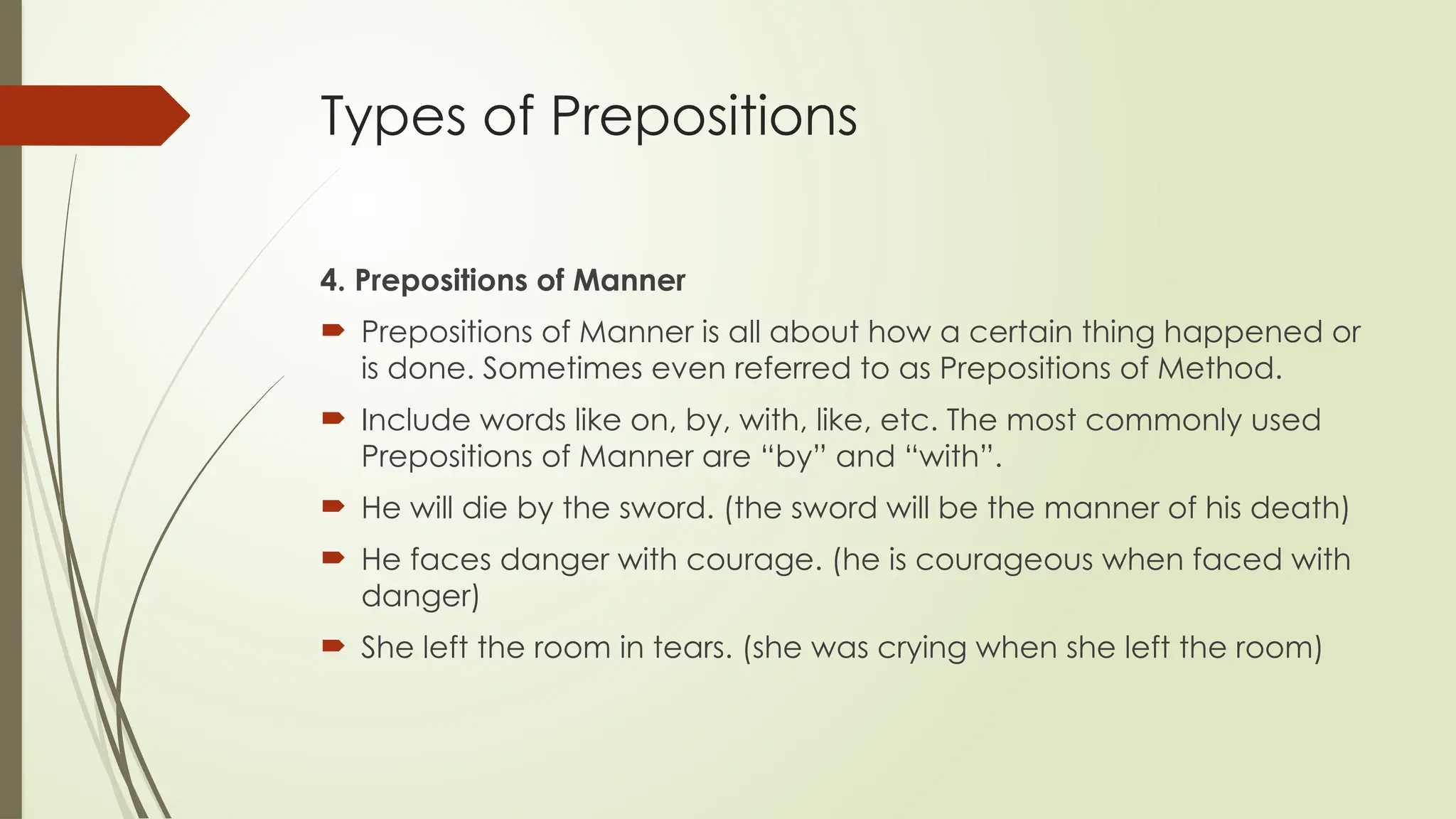
4. Prepositions of Manner
 Prepositions of Manner is all about how a certain thing happened or
is done. Sometimes even referred to as Prepositions of Method.
 Include words like on, by, with, like, etc. The most commonly used
Prepositions of Manner are “by” and “with”.
 He will die by the sword. (the sword will be the manner of his death)
 He faces danger with courage. (he is courageous when faced with
danger)
 She left the room in tears. (she was crying when she left the room)
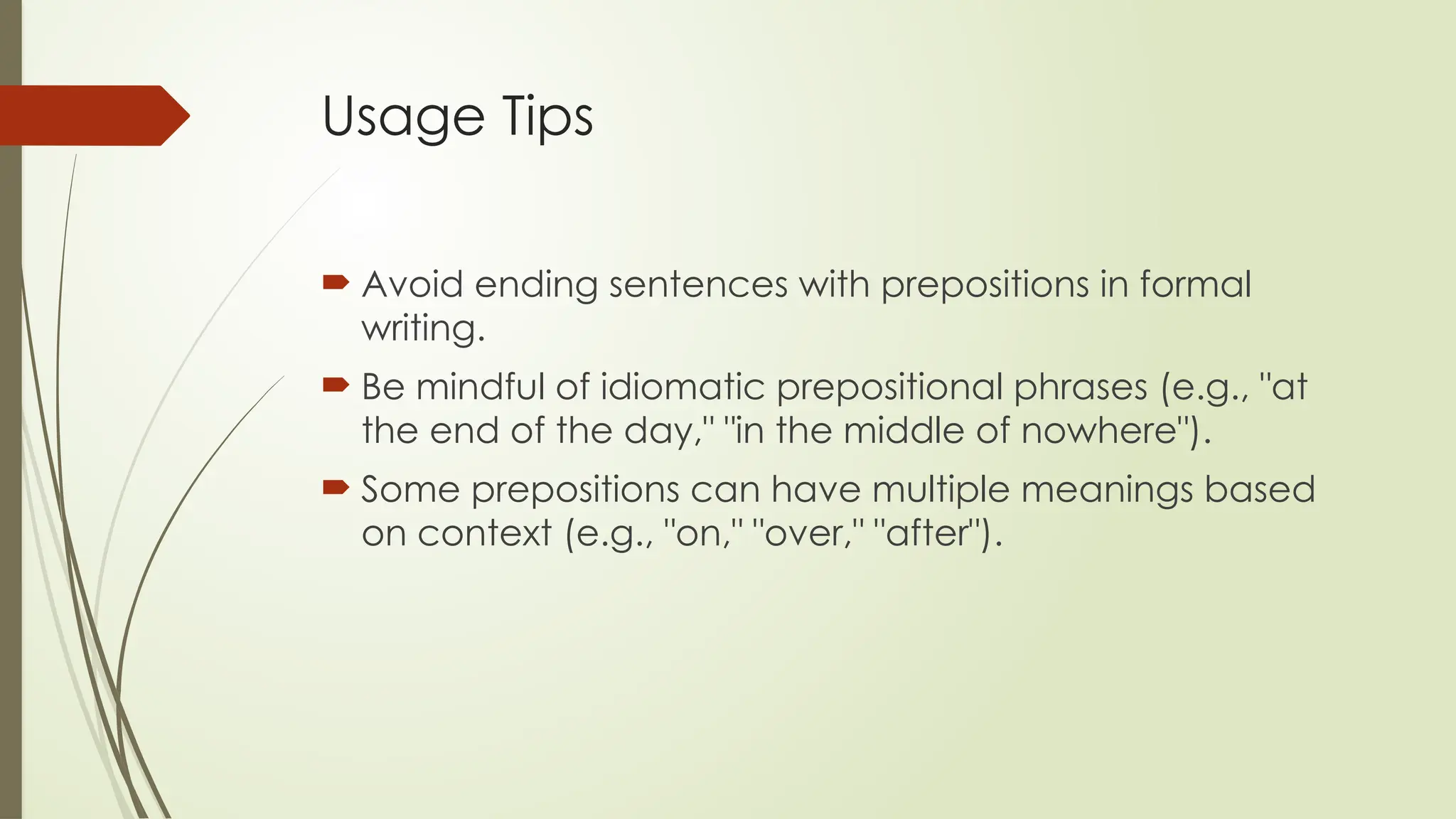
Usage Tips
 Avoid ending sentences with prepositions in formal
writing.
 Be mindful of idiomatic prepositional phrases (e.g., "at
the end of the day," "in the middle of nowhere").
 Some prepositions can have multiple meanings based
on context (e.g., "on," "over," "after").
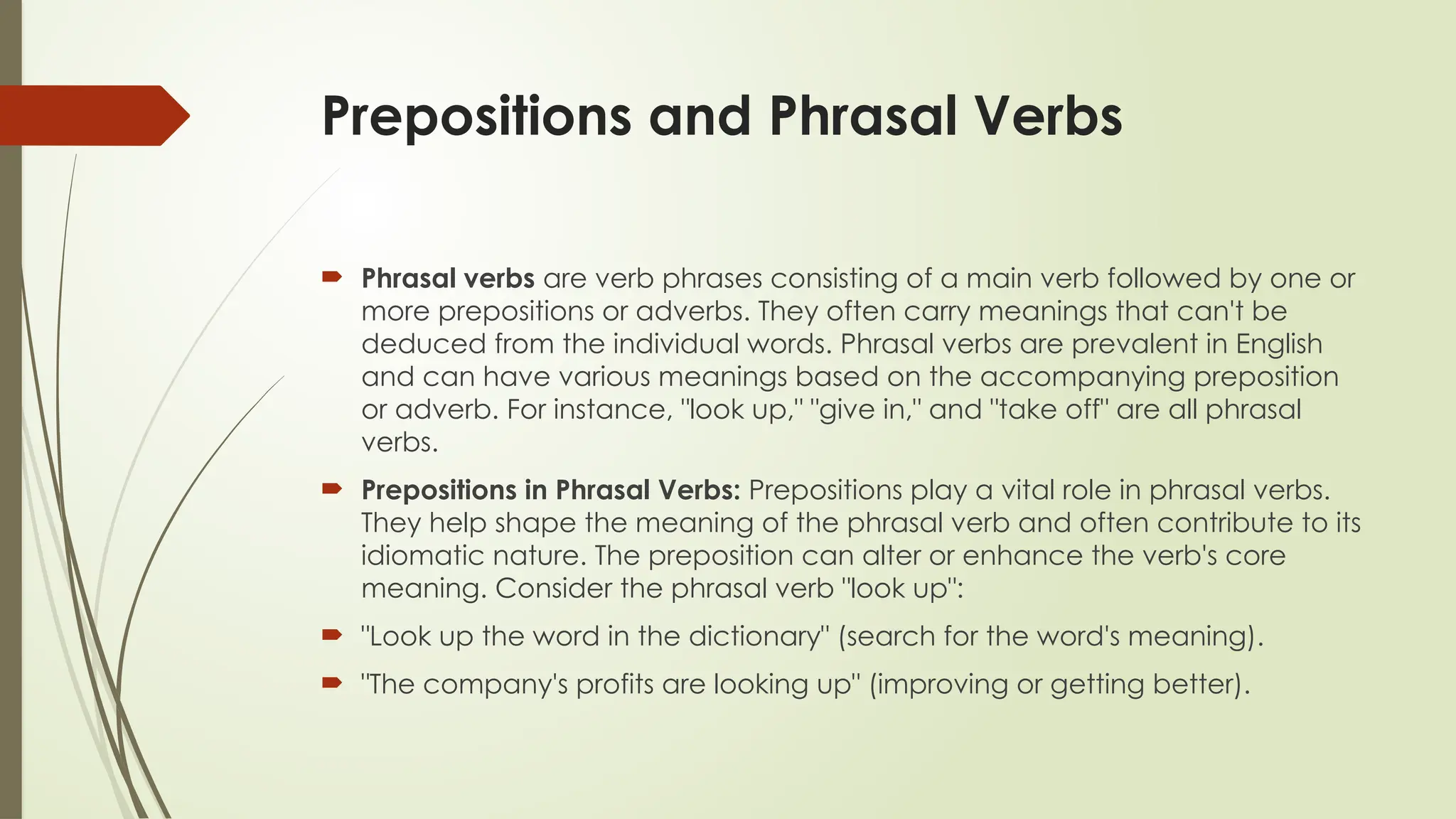
Prepositions and Phrasal Verbs
 Phrasal verbs are verb phrases consisting of a main verb followed by one or
more prepositions or adverbs. They often carry meanings that can't be
deduced from the individual words. Phrasal verbs are prevalent in English
and can have various meanings based on the accompanying preposition
or adverb. For instance, "look up," "give in," and "take off" are all phrasal
verbs.
 Prepositions in Phrasal Verbs: Prepositions play a vital role in phrasal verbs.
They help shape the meaning of the phrasal verb and often contribute to its
idiomatic nature. The preposition can alter or enhance the verb's core
meaning. Consider the phrasal verb "look up":
 "Look up the word in the dictionary" (search for the word's meaning).
 "The company's profits are looking up" (improving or getting better).
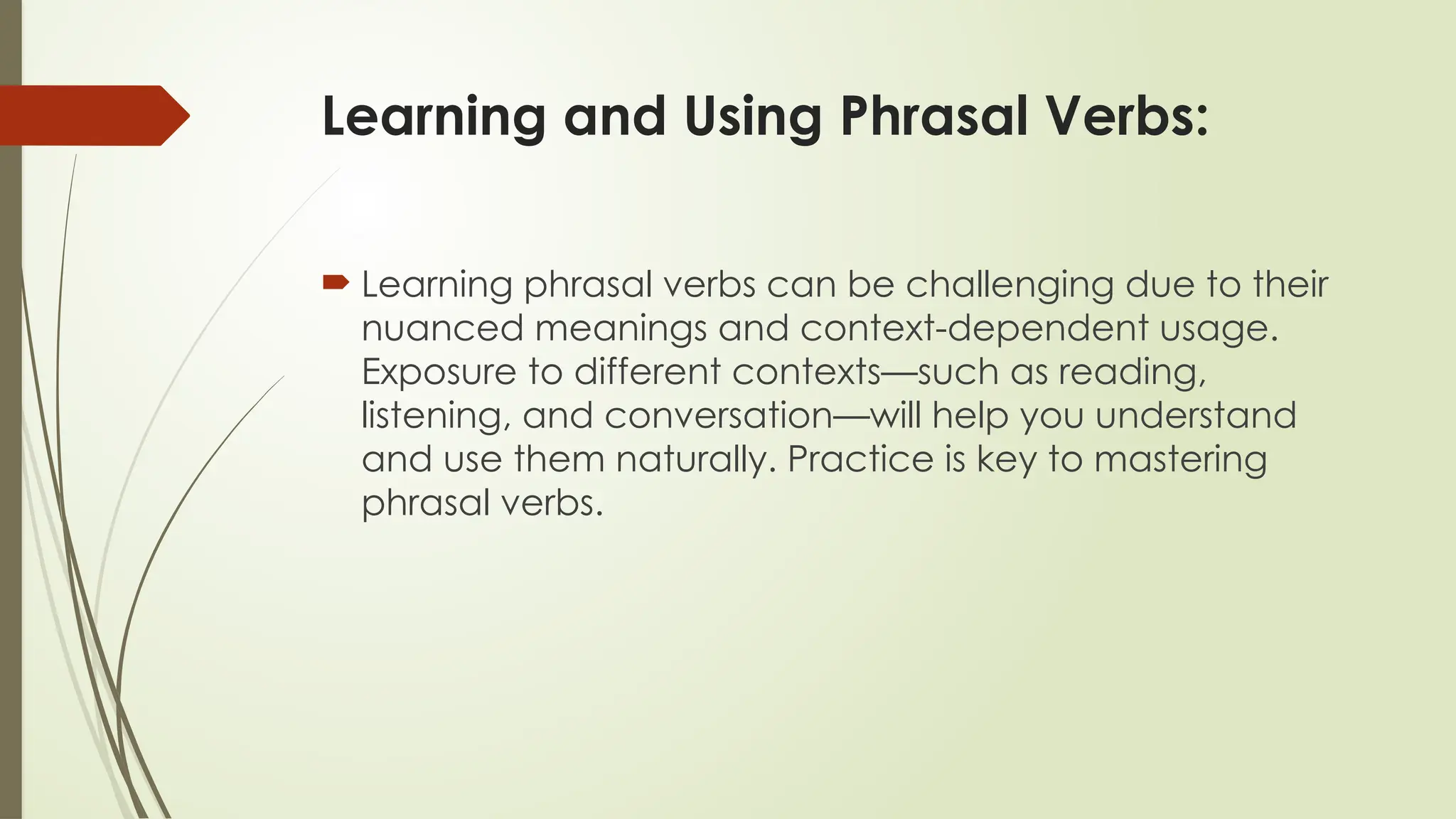
Learning and Using Phrasal Verbs:
 Learning phrasal verbs can be challenging due to their
nuanced meanings and context-dependent usage.
Exposure to different contexts—such as reading,
listening, and conversation—will help you understand
and use them naturally. Practice is key to mastering
phrasal verbs.
Common Preposition Mistakes
 Ending Sentences with Prepositions: While this is often acceptable in
informal speech, in formal writing, it's preferable to rephrase sentences to
avoid ending with prepositions. For instance, "What are you talking about?"
can be revised to "About what are you talking?“
 Confusing "In" and "Into": "In" indicates location within a space, while "into"
indicates movement toward the inside of a space. Mistaking these can
lead to confusion. For example, "She walked in the room" (correct) vs. "She
walked into the room" (correct).
 Misusing "Between" and "Among": "Between" is used for relationships
involving two items, while "among" is used when there are three or more
items. For instance, "Between you and me" (correct) vs. "Among you, him,
and her" (correct).
Common Preposition Mistakes
 Confusing "To" and "Too": "To" is a preposition indicating direction, while
"too" means "also" or "excessively." Mixing them up can lead to sentences
like "I want to go too the park" instead of "I want to go to the park.“
 Misusing "At," "In," and "On" for Time: These prepositions have specific time-
related uses. "At" is used for specific times, "in" for longer periods, and "on"
for specific days. For example, "I'll meet you at 3 PM" (correct), "In the
summer, I enjoy swimming" (correct), and "We'll meet on Friday" (correct).
Conclusion
 Prepositions play a crucial role in conveying accurate
meaning and context in language.
 Understanding and using prepositions correctly
enhances your communication skills.
 Practice and exposure to different contexts will help you
master prepositions.
Let’s practice!

Prepositions.ppt powerpoint presentation

  • 1.
  • 2.
    Introduction  Prepositions arefundamental elements of language that help us express relationships between different words in a sentence.  A preposition is a word that shows the relationship between a noun or pronoun and other words in a sentence. It indicates aspects like location, time, direction, manner, or possession, helping to establish the spatial, temporal, and logical connections within language.
  • 3.
    Common Prepositions Examples ofcommon prepositions: in, on, under, over, with, by, between, among, beside, at, from, to, for, after, before. Prepositions can be single words or phrases.
  • 4.
    Types of Prepositions 1.Prepositions of Place and Location  Show where something is located.  Examples: in, on, under, above, beside, between, behind, near.  The cat was sitting near the table.  Newton was sitting under the tree when the apple fell on his head.  The book was placed on the bookshelf.
  • 5.
    Types of Prepositions 2.Prepositions of Time Indicate when an action occurs. Examples: in, on, at, during, before, after, since, for. She has been living in Karachi since 2003. He was late for the meeting. The seminar was held in the auditorium.
  • 6.
    Types of Prepositions 3.Prepositions of Direction and Movement Indicate the direction of movement. Examples: to, from, across, through, into, out of. He moved across the city for his new job. The bullet went through his shoulder. The cat jumped out of the box.
  • 7.
    Types of Prepositions 4.Prepositions of Manner  Prepositions of Manner is all about how a certain thing happened or is done. Sometimes even referred to as Prepositions of Method.  Include words like on, by, with, like, etc. The most commonly used Prepositions of Manner are “by” and “with”.  He will die by the sword. (the sword will be the manner of his death)  He faces danger with courage. (he is courageous when faced with danger)  She left the room in tears. (she was crying when she left the room)
  • 8.
    Usage Tips  Avoidending sentences with prepositions in formal writing.  Be mindful of idiomatic prepositional phrases (e.g., "at the end of the day," "in the middle of nowhere").  Some prepositions can have multiple meanings based on context (e.g., "on," "over," "after").
  • 9.
    Prepositions and PhrasalVerbs  Phrasal verbs are verb phrases consisting of a main verb followed by one or more prepositions or adverbs. They often carry meanings that can't be deduced from the individual words. Phrasal verbs are prevalent in English and can have various meanings based on the accompanying preposition or adverb. For instance, "look up," "give in," and "take off" are all phrasal verbs.  Prepositions in Phrasal Verbs: Prepositions play a vital role in phrasal verbs. They help shape the meaning of the phrasal verb and often contribute to its idiomatic nature. The preposition can alter or enhance the verb's core meaning. Consider the phrasal verb "look up":  "Look up the word in the dictionary" (search for the word's meaning).  "The company's profits are looking up" (improving or getting better).
  • 10.
    Learning and UsingPhrasal Verbs:  Learning phrasal verbs can be challenging due to their nuanced meanings and context-dependent usage. Exposure to different contexts—such as reading, listening, and conversation—will help you understand and use them naturally. Practice is key to mastering phrasal verbs.
  • 11.
    Common Preposition Mistakes Ending Sentences with Prepositions: While this is often acceptable in informal speech, in formal writing, it's preferable to rephrase sentences to avoid ending with prepositions. For instance, "What are you talking about?" can be revised to "About what are you talking?“  Confusing "In" and "Into": "In" indicates location within a space, while "into" indicates movement toward the inside of a space. Mistaking these can lead to confusion. For example, "She walked in the room" (correct) vs. "She walked into the room" (correct).  Misusing "Between" and "Among": "Between" is used for relationships involving two items, while "among" is used when there are three or more items. For instance, "Between you and me" (correct) vs. "Among you, him, and her" (correct).
  • 12.
    Common Preposition Mistakes Confusing "To" and "Too": "To" is a preposition indicating direction, while "too" means "also" or "excessively." Mixing them up can lead to sentences like "I want to go too the park" instead of "I want to go to the park.“  Misusing "At," "In," and "On" for Time: These prepositions have specific time- related uses. "At" is used for specific times, "in" for longer periods, and "on" for specific days. For example, "I'll meet you at 3 PM" (correct), "In the summer, I enjoy swimming" (correct), and "We'll meet on Friday" (correct).
  • 13.
    Conclusion  Prepositions playa crucial role in conveying accurate meaning and context in language.  Understanding and using prepositions correctly enhances your communication skills.  Practice and exposure to different contexts will help you master prepositions.
  • 14.