Basic Concept Of
Philippine
Administrative
System
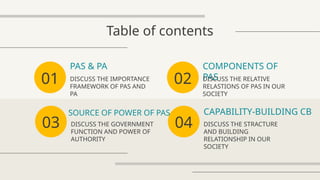
Table of contents
PAS & PA
DISCUSS THE IMPORTANCE
FRAMEWORK OF PAS AND
PA
01
SOURCE OF POWER OF PAS
DISCUSS THE GOVERNMENT
FUNCTION AND POWER OF
AUTHORITY
03
COMPONENTS OF
PAS
DISCUSS THE RELATIVE
RELASTIONS OF PAS IN OUR
SOCIETY
02
CAPABILITY-BUILDING CB
DISCUSS THE STRACTURE
AND BUILDING
RELATIONSHIP IN OUR
SOCIETY
04
Philippine
Administrative
System (PAS)
ARADILLOS JAMES PATRICK P.
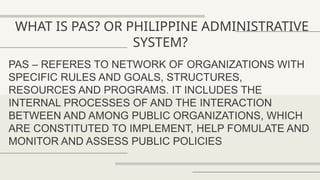
WHAT IS PAS? OR PHILIPPINE ADMINISTRATIVE
SYSTEM?
PAS – REFERES TO NETWORK OF ORGANIZATIONS WITH
SPECIFIC RULES AND GOALS, STRUCTURES,
RESOURCES AND PROGRAMS. IT INCLUDES THE
INTERNAL PROCESSES OF AND THE INTERACTION
BETWEEN AND AMONG PUBLIC ORGANIZATIONS, WHICH
ARE CONSTITUTED TO IMPLEMENT, HELP FOMULATE AND
MONITOR AND ASSESS PUBLIC POLICIES
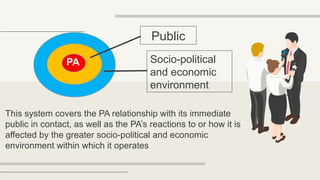
Public
Socio-political
and economic
environment
This system covers the PA relationship with its immediate
public in contact, as well as the PA’s reactions to or how it is
affected by the greater socio-political and economic
environment within which it operates
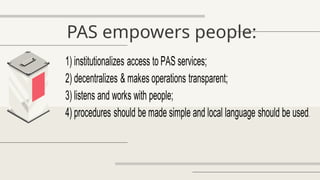
PAS empowers people:
COMPONENTS OF
PAS
01
COMPONENTS OF PAS
• Public organization - legal mandates, major functions and structures,
etc.
• Internal procedures and interactive efforts - perform public functions thru
defined rules and procedures internal to the org.
• Responsible for implementing public policies – formulated jointly by the
legislative and executive branches
• Conscious of the different kinds of clientele that it deals with
• Socio-political, economic environment – PAS as part of the bigger social
system with competing claims to limited resources and, institutions play
a role in determining the utilization of resources
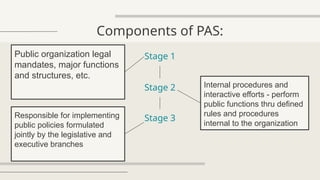
Components of PAS:
Stage 1
Stage 2
Stage 3
Public organization legal
mandates, major functions
and structures, etc.
Internal procedures and
interactive efforts - perform
public functions thru defined
rules and procedures
internal to the organization
Responsible for implementing
public policies formulated
jointly by the legislative and
executive branches
Components of PAS:
• Conscious of the different kinds of clientele that it deals with
• Socio-political, economic environment – PAS as part of the
bigger social system with competing claims to limited
resources and, institutions play a role in determining the
utilization of resources
Sources of Power of the PAS
• Instrument of the state – government functions are
exercised legitimately, supported by enabling state policies
and authority
• Enforcer and implementor of public policy – discretion in
policy implementation
• Service delivery system – discretion to determine quantity,
quality, adequacy and timeliness of services it provides
Sources of Power of the PAS
• Participant in policy formulation – advice is sought on
legislation and policy-making
• Technical expertise –professional training of civil servants in
areas of competence on policy issues
• Nationwide presence – expansive reach to mobilize support
for programs all over the country
CAPABILITY
BUILDING
(CB)
-JUVALYN BAGA-AN
CAPABILITY BUILDING (CB)
CB – refers to the “building of people-based structures and institutions
which is the real essence of the concept. It means enabling people
to organize themselves around common needs and to work
together towards common ends. It is addressed to policy
makers, program implementor, and program beneficiary”.
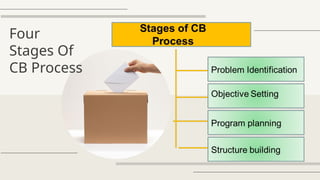
Four
Stages of
CB
Process
Four
Stages Of
CB Process
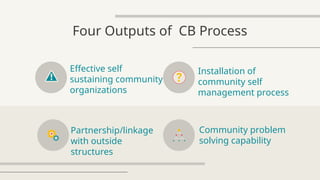
Four Outputs of CB Process
Effective self
sustaining community
organizations
Installation of
community self
management process
Partnership/linkage
with outside
structures
Community problem
solving capability
Political Administrative
& Accountability
-EDROWIN MEJORADA
Political and Administrative
Accountability
• Accountability is defined as a condition in which individuals who
exercise power are constrained by external means and by internal
norms.
• It refers to the institution of checks and balances in an organization
thru which an administrator accounts for his stewardship of
resources or authority.
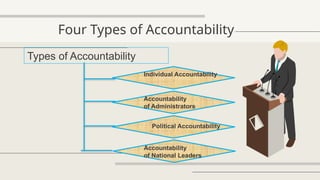
Four Types of Accountability
Types of Accountability
Individual Accountability
Accountability
of Administrators
Political Accountability
Accountability
of National Leaders
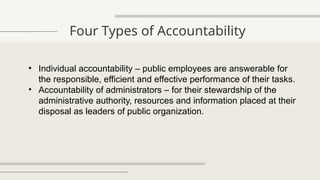
Four Types of Accountability
• Individual accountability – public employees are answerable for
the responsible, efficient and effective performance of their tasks.
• Accountability of administrators – for their stewardship of the
administrative authority, resources and information placed at their
disposal as leaders of public organization.
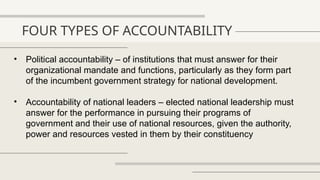
FOUR TYPES OF ACCOUNTABILITY
• Political accountability – of institutions that must answer for their
organizational mandate and functions, particularly as they form part
of the incumbent government strategy for national development.
• Accountability of national leaders – elected national leadership must
answer for the performance in pursuing their programs of
government and their use of national resources, given the authority,
power and resources vested in them by their constituency
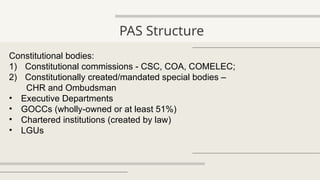
PAS Structure
Constitutional bodies:
1) Constitutional commissions - CSC, COA, COMELEC;
2) Constitutionally created/mandated special bodies –
CHR and Ombudsman
• Executive Departments
• GOCCs (wholly-owned or at least 51%)
• Chartered institutions (created by law)
• LGUs
Administrative Relationships
If an office is under the supervision and control of another
unit, it means that the higher office:
 Has authority to act directly, whenever specific function
is entrusted by law or regulation to a subordinate
 Directs the performance of a duty
 Restrains the commission of acts
 Reviews, approves, reverses or modified acts or
decision of subordinate officials and units
 Determines priorities in executing plans and programs
 Prescribes standards, guidelines, plans and programs
Administrative Supervision and
Attachment
Administrative supervision:
 Oversee the operations of such agencies to insure these are
managed effectively, efficiently and economically; no
interference in day to day activities
 Require submission of reports; cause the conduct of mgt
audit, performance evaluation and inspection to determine
rectification of violations, abuses, etc.
 Review and pass upon budget proposal of such agencies,
but may not increase or add to them.
GOVERNMENT
REORGANIZATION
(GR) Lovely Joy Canete R. &
ARADILLOS JAMES PATRICK P.
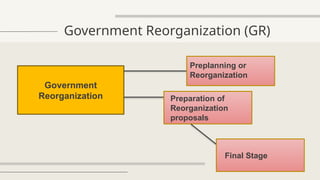
Government Reorganization (GR)
Government
Reorganization Preparation of
Reorganization
proposals
Preplanning or
Reorganization
Final Stage
Government Reorganization (GR)
GR - planned deliberate efforts to systematically alter the
existing organizational structure usually for the purpose of
achieving government objectives with more economy,
efficiency and effectiveness.
Pre-planning or reorganization:
1) how reorganization is initiated;
2) who is the authority vested with reorganization;
3) setting goals and tasks;
4) defining the powers to reorganize & outline the scope;
5) setting resources
Government Reorganization (GR)
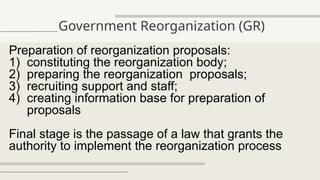
Preparation of reorganization proposals:
1) constituting the reorganization body;
2) preparing the reorganization proposals;
3) recruiting support and staff;
4) creating information base for preparation of
proposals
Final stage is the passage of a law that grants the
authority to implement the reorganization process
Budget Cycle: Budget Preparation
Budgetary parameters is determined by the Department
Budget Coordination Committee (DBCC) composed of DBM,
NEDA, DOF, BSP and OP. DBCC recommends:
level of annual government expenditure program and ceiling for
government spending for economic and social development, national
defense, general government and debt service
proper allocation of expenditures for each development activity between
current operating expenditures and capital outlay
amount set to be allocated for capital outlay under each development's
activity for the various capital or infra projects. Sets budget ceiling
consistent with macro-economic targets as presented in the MTPDP
Budget Cycle: Budget Preparation
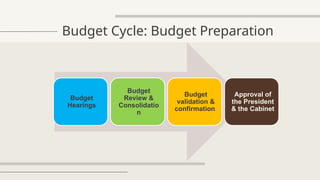
Budget
Hearings
Budget
Review &
Consolidatio
n
Budget
validation &
confirmation
Approval of
the President
& the Cabinet
Budget Cycle: Budget Preparation
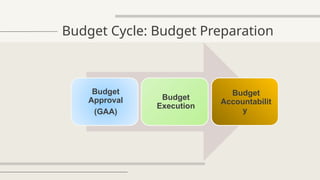
Budget
Approval
(GAA)
Budget
Execution
Budget
Accountabilit
y
Budget Cycle: Budget Preparation
After budget parameters are approved, DBM issues the budget call
(National Budget Circular), defining the budget framework.
Budget hearings. Upon receipt of the budget call, agencies issue their
own internal office guidelines to prepare budgetary estimates along the
broad framework of the policy guidelines.
Budget review and consolidation. After agency hearings, modifications
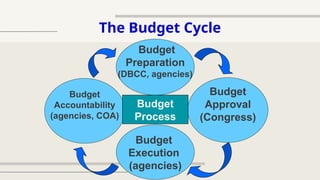
and revisions of agency budget proposals may be made. DBM
consolidates results of these changes and clears with the President thru
DBCC. President then authorized DBM to estimate total expenditures &
reconcile with revenue estimates.
Budget Cycle: Budget Preparation
Budget validation and confirmation. After consolidation into a
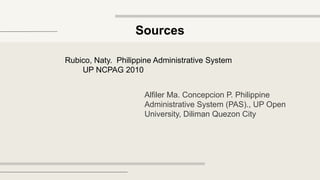
national budget, this is subjected to further evaluation/validation,
by DBM thru comprehensive policy review of all agency and
special purpose fund budgets, then to DBCC for examination.

Approval by the President and Cabinet. The approved budget is
forwarded to Congress, together with the President’s budget
message and other documents, i.e. Budget of Expenditure and
Sources of Financing, the National Expenditure Program, and the
Regional Expenditure Program.
The Budget Cycle
Budget
Preparation
(DBCC, agencies)
Budget
Approval
(Congress)
Budget
Execution
(agencies)
Budget
Accountability
(agencies, COA)
Budget
Process
Sources
Rubico, Naty. Philippine Administrative System
UP NCPAG 2010
Alfiler Ma. Concepcion P. Philippine
Administrative System (PAS)., UP Open
University, Diliman Quezon City
THANK YOU FOR LISTINING
DEPARTMENT OF PUBLIC
ADMINISTRATION
REPORTERS :
ARADILLOS JAMES PATRICK P.
JUVALYN BAGA-AN
EDROWIN MEJORADA
Lovely Joy Canete R.

PAS-PHILIPPINE-ADMINISTRATIVE-SYSTEM (1).pptx

  • 1.
  • 2.
    Table of contents PAS& PA DISCUSS THE IMPORTANCE FRAMEWORK OF PAS AND PA 01 SOURCE OF POWER OF PAS DISCUSS THE GOVERNMENT FUNCTION AND POWER OF AUTHORITY 03 COMPONENTS OF PAS DISCUSS THE RELATIVE RELASTIONS OF PAS IN OUR SOCIETY 02 CAPABILITY-BUILDING CB DISCUSS THE STRACTURE AND BUILDING RELATIONSHIP IN OUR SOCIETY 04
  • 3.
  • 4.
    WHAT IS PAS?OR PHILIPPINE ADMINISTRATIVE SYSTEM? PAS – REFERES TO NETWORK OF ORGANIZATIONS WITH SPECIFIC RULES AND GOALS, STRUCTURES, RESOURCES AND PROGRAMS. IT INCLUDES THE INTERNAL PROCESSES OF AND THE INTERACTION BETWEEN AND AMONG PUBLIC ORGANIZATIONS, WHICH ARE CONSTITUTED TO IMPLEMENT, HELP FOMULATE AND MONITOR AND ASSESS PUBLIC POLICIES
  • 5.
    Public Socio-political and economic environment This systemcovers the PA relationship with its immediate public in contact, as well as the PA’s reactions to or how it is affected by the greater socio-political and economic environment within which it operates
  • 6.
  • 7.
  • 8.
    COMPONENTS OF PAS •Public organization - legal mandates, major functions and structures, etc. • Internal procedures and interactive efforts - perform public functions thru defined rules and procedures internal to the org. • Responsible for implementing public policies – formulated jointly by the legislative and executive branches • Conscious of the different kinds of clientele that it deals with • Socio-political, economic environment – PAS as part of the bigger social system with competing claims to limited resources and, institutions play a role in determining the utilization of resources
  • 9.
    Components of PAS: Stage1 Stage 2 Stage 3 Public organization legal mandates, major functions and structures, etc. Internal procedures and interactive efforts - perform public functions thru defined rules and procedures internal to the organization Responsible for implementing public policies formulated jointly by the legislative and executive branches
  • 10.
    Components of PAS: •Conscious of the different kinds of clientele that it deals with • Socio-political, economic environment – PAS as part of the bigger social system with competing claims to limited resources and, institutions play a role in determining the utilization of resources
  • 11.
    Sources of Powerof the PAS • Instrument of the state – government functions are exercised legitimately, supported by enabling state policies and authority • Enforcer and implementor of public policy – discretion in policy implementation • Service delivery system – discretion to determine quantity, quality, adequacy and timeliness of services it provides
  • 12.
    Sources of Powerof the PAS • Participant in policy formulation – advice is sought on legislation and policy-making • Technical expertise –professional training of civil servants in areas of competence on policy issues • Nationwide presence – expansive reach to mobilize support for programs all over the country
  • 13.
  • 14.
    CAPABILITY BUILDING (CB) CB– refers to the “building of people-based structures and institutions which is the real essence of the concept. It means enabling people to organize themselves around common needs and to work together towards common ends. It is addressed to policy makers, program implementor, and program beneficiary”.
  • 15.
  • 16.
  • 17.
    Four Outputs ofCB Process Effective self sustaining community organizations Installation of community self management process Partnership/linkage with outside structures Community problem solving capability
  • 18.
  • 19.
    Political and Administrative Accountability •Accountability is defined as a condition in which individuals who exercise power are constrained by external means and by internal norms. • It refers to the institution of checks and balances in an organization thru which an administrator accounts for his stewardship of resources or authority.
  • 20.
    Four Types ofAccountability Types of Accountability Individual Accountability Accountability of Administrators Political Accountability Accountability of National Leaders
  • 21.
    Four Types ofAccountability • Individual accountability – public employees are answerable for the responsible, efficient and effective performance of their tasks. • Accountability of administrators – for their stewardship of the administrative authority, resources and information placed at their disposal as leaders of public organization.
  • 22.
    FOUR TYPES OFACCOUNTABILITY • Political accountability – of institutions that must answer for their organizational mandate and functions, particularly as they form part of the incumbent government strategy for national development. • Accountability of national leaders – elected national leadership must answer for the performance in pursuing their programs of government and their use of national resources, given the authority, power and resources vested in them by their constituency
  • 23.
    PAS Structure Constitutional bodies: 1)Constitutional commissions - CSC, COA, COMELEC; 2) Constitutionally created/mandated special bodies – CHR and Ombudsman • Executive Departments • GOCCs (wholly-owned or at least 51%) • Chartered institutions (created by law) • LGUs
  • 24.
    Administrative Relationships If anoffice is under the supervision and control of another unit, it means that the higher office:  Has authority to act directly, whenever specific function is entrusted by law or regulation to a subordinate  Directs the performance of a duty  Restrains the commission of acts  Reviews, approves, reverses or modified acts or decision of subordinate officials and units  Determines priorities in executing plans and programs  Prescribes standards, guidelines, plans and programs
  • 25.
    Administrative Supervision and Attachment Administrativesupervision:  Oversee the operations of such agencies to insure these are managed effectively, efficiently and economically; no interference in day to day activities  Require submission of reports; cause the conduct of mgt audit, performance evaluation and inspection to determine rectification of violations, abuses, etc.  Review and pass upon budget proposal of such agencies, but may not increase or add to them.
  • 26.
    GOVERNMENT REORGANIZATION (GR) Lovely JoyCanete R. & ARADILLOS JAMES PATRICK P.
  • 27.
    Government Reorganization (GR) Government ReorganizationPreparation of Reorganization proposals Preplanning or Reorganization Final Stage
  • 28.
    Government Reorganization (GR) GR- planned deliberate efforts to systematically alter the existing organizational structure usually for the purpose of achieving government objectives with more economy, efficiency and effectiveness. Pre-planning or reorganization: 1) how reorganization is initiated; 2) who is the authority vested with reorganization; 3) setting goals and tasks; 4) defining the powers to reorganize & outline the scope; 5) setting resources
  • 29.
    Government Reorganization (GR) Preparationof reorganization proposals: 1) constituting the reorganization body; 2) preparing the reorganization proposals; 3) recruiting support and staff; 4) creating information base for preparation of proposals Final stage is the passage of a law that grants the authority to implement the reorganization process
  • 30.
    Budget Cycle: BudgetPreparation Budgetary parameters is determined by the Department Budget Coordination Committee (DBCC) composed of DBM, NEDA, DOF, BSP and OP. DBCC recommends: level of annual government expenditure program and ceiling for government spending for economic and social development, national defense, general government and debt service proper allocation of expenditures for each development activity between current operating expenditures and capital outlay amount set to be allocated for capital outlay under each development's activity for the various capital or infra projects. Sets budget ceiling consistent with macro-economic targets as presented in the MTPDP
  • 31.
    Budget Cycle: BudgetPreparation Budget Hearings Budget Review & Consolidatio n Budget validation & confirmation Approval of the President & the Cabinet
  • 32.
    Budget Cycle: BudgetPreparation Budget Approval (GAA) Budget Execution Budget Accountabilit y
  • 33.
    Budget Cycle: BudgetPreparation After budget parameters are approved, DBM issues the budget call (National Budget Circular), defining the budget framework. Budget hearings. Upon receipt of the budget call, agencies issue their own internal office guidelines to prepare budgetary estimates along the broad framework of the policy guidelines. Budget review and consolidation. After agency hearings, modifications and revisions of agency budget proposals may be made. DBM consolidates results of these changes and clears with the President thru DBCC. President then authorized DBM to estimate total expenditures & reconcile with revenue estimates.
  • 34.
    Budget Cycle: BudgetPreparation Budget validation and confirmation. After consolidation into a national budget, this is subjected to further evaluation/validation, by DBM thru comprehensive policy review of all agency and special purpose fund budgets, then to DBCC for examination. Approval by the President and Cabinet. The approved budget is forwarded to Congress, together with the President’s budget message and other documents, i.e. Budget of Expenditure and Sources of Financing, the National Expenditure Program, and the Regional Expenditure Program.
  • 35.
    The Budget Cycle Budget Preparation (DBCC,agencies) Budget Approval (Congress) Budget Execution (agencies) Budget Accountability (agencies, COA) Budget Process
  • 36.
    Sources Rubico, Naty. PhilippineAdministrative System UP NCPAG 2010 Alfiler Ma. Concepcion P. Philippine Administrative System (PAS)., UP Open University, Diliman Quezon City
  • 37.
    THANK YOU FORLISTINING DEPARTMENT OF PUBLIC ADMINISTRATION REPORTERS : ARADILLOS JAMES PATRICK P. JUVALYN BAGA-AN EDROWIN MEJORADA Lovely Joy Canete R.