E-COMMERCE
MODULE III
LECTURE-IV
BRANDING ON WEB
ARVIND BANGER
ASSISTANT PROFESSOR
DEPARTMENT OF MANAGEMENT
FACULTY OF SOCIAL SCIENCES
DEI
ARVIND BANGER 1
Branding
‘an identifiable product or service augmented in
such a way that the buyer or user perceives
relevant unique added values which match their
needs most closely. Furthermore, its success
results from being able to sustain these added
values in the face of competition’.
Leslie de Chernatony and Malcolm McDonald in
their classic 1992 book, Creating Powerful
Brands, define a brand as
Branding
 Brand
◦ Typically defined as a name, logo or symbol that helps
one identify a company’s products or services
◦ Customers’ experience can be considered part of its
brand
 Brand equity
◦ Includes the value of tangible and intangible items,
such as a brand and its monetary value over time,
customer perceptions and customer loyalty to a
company and its products or services
 Internet-only businesses must develop a brand that
customers trust and value
 Brand uniformity will increase brand recognition
Branding
 The Internet makes it difficult to protect a brand from
misuse
◦ Rumors and customer dissatisfaction can spread
quickly
◦ It is not difficult for people to use other companies’
logos on their sites or products illegally
 Companies can attempt to protect their brands
◦ Hiring people to surf the Web and look for news,
rumors and other instances of brand abuse
◦ Brand monitoring activities can be outsourced to
companies such as eWatch and NetCurrents
What is Brand Identity?
• A promise that gets kept consistently
• Defines your organization
• It creates a personality and a life for your
products/services
• A unique and consistent look, feel, tone and
voice for all communications
• Conveys-at a-glance the distinctive attributes
of your organization
• Over time, it builds awareness of and an
attitude towards your organization
What is Brand Identity?
• Strengthens the impact of all messages
• Paves the way for new customer relationships
• Provides employees with a greater sense of
commitment
• It’s essential to your success in the
marketplace
• No business is too small and no product too
generic to develop a brand identity
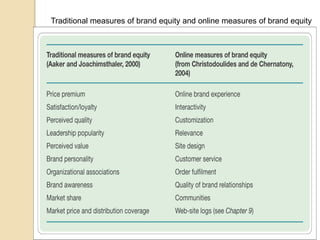
Aaker and Joachimsthaler –
brand equity
 Brand awareness.
 Perceived quality.
 Brand associations.
 Brand loyalty.
How can these be enhanced online for the B2C Company?
Traditional measures of brand equity and online measures of brand equity
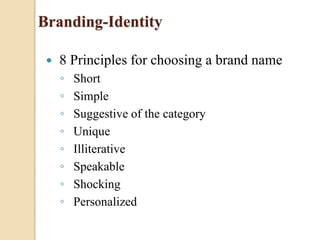
Branding-Identity
 8 Principles for choosing a brand name
◦ Short
◦ Simple
◦ Suggestive of the category
◦ Unique
◦ Illiterative
◦ Speakable
◦ Shocking
◦ Personalized
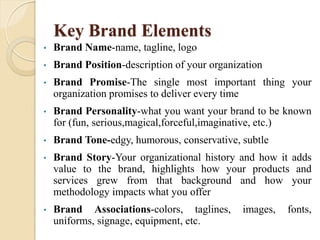
Key Brand Elements
• Brand Name-name, tagline, logo
• Brand Position-description of your organization
• Brand Promise-The single most important thing your
organization promises to deliver every time
• Brand Personality-what you want your brand to be known
for (fun, serious,magical,forceful,imaginative, etc.)
• Brand Tone-edgy, humorous, conservative, subtle
• Brand Story-Your organizational history and how it adds
value to the brand, highlights how your products and
services grew from that background and how your
methodology impacts what you offer
• Brand Associations-colors, taglines, images, fonts,
uniforms, signage, equipment, etc.
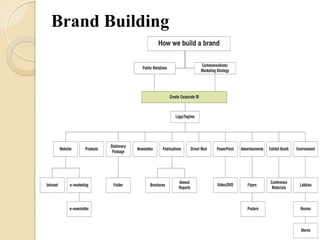
Brand Building
Branding Steps
Step One
• Learn marketing objectives and strategy
• Prioritize projects
• Audit existing and competitive materials and
strategies
• Interviews/focus group
• Write creative brief and define messages
• Create timelines and budgets
Branding Steps (continued)
Step Two
• Develop concepts/taglines/site
architecture
• Start visual research
• Present initial creative approaches
Branding Steps (continued)
Step Three
• Develop outline and copy points per
selected concept
• Develop media strategy
• Explore layout options
• Begin creating visual materials
(photos/illustrations)
Branding Steps (continued)
Step Four
• Write full copy draft
• Revise and write final copy as per client
comments
• Start layouts
Branding Steps (continued)
Step Five
• Create and present full layout and/or e-
design
Step Six
• Develop final electronic files for print,
or
coding for web
• Final execution and management of
products (website launch, launch media
campaign, exhibit built, print pieces to
printer, ads placed, press releases sent,
etc.)
Keys to building successful
brands
 Find the right advertising/branding agency
 Top management must be committed to this effort
 Assign one point person to work with the agency
 Do not make decisions by committee
 Keep brand consistent internally and externally
 Don’t rush the process-make sure you have enough time
budgeted
 Give the brand time to work
 Create a brand style guide and give to every employee
 Refresh/update brand after a few years
What a good brand does
 Strengthens employees loyalty
 Attracts clients/customers
 Keeps current relationships strong
 Builds confidence
 Builds feelings of security and trust
 Creates a memorable, positive experience
Time to create!
Now that you have solid messaging, it’s time to
create.
 Consistency is the #1 rule
 Repetition, repetition, repetition
Did you know it takes 7-9 times of being exposed
to your company name for a potential client to
remember it?
We get exposed to over 4000 messages a day.
How can you break through that clutter?
Creating and Maintaining Brands
on the Web
 Elements of branding include:
◦ Differentiation: How is our product unique?
◦ Relevance: How does our product fit into our
customers’ lives?
◦ Perceived value: What is value of our product
to a potential customer?
Emotional Branding vs. Rational
Branding
 Emotional branding is the norm; let’s make customers feel
good about our product, themselves as users of our product, or
others affective paths to persuasion
◦ Coca Cola video game ad (1st QTR)
 Rational branding relies on the cognitive appeal of the specific
service offered, not purely on a broad emotional appeal
◦ Toyota Tundra truck ad (1st QTR)
 Brand Leveraging is done to extend the image or value of a
successful brand to other product offerings
◦ Sprint Broadband ad (2nd QTR)
◦ Nationwide Insurance ad (3rd QTR)
END OF LECTURE

Module 3-lec4-4

  • 1.
    E-COMMERCE MODULE III LECTURE-IV BRANDING ONWEB ARVIND BANGER ASSISTANT PROFESSOR DEPARTMENT OF MANAGEMENT FACULTY OF SOCIAL SCIENCES DEI ARVIND BANGER 1
  • 2.
    Branding ‘an identifiable productor service augmented in such a way that the buyer or user perceives relevant unique added values which match their needs most closely. Furthermore, its success results from being able to sustain these added values in the face of competition’. Leslie de Chernatony and Malcolm McDonald in their classic 1992 book, Creating Powerful Brands, define a brand as
  • 3.
    Branding  Brand ◦ Typicallydefined as a name, logo or symbol that helps one identify a company’s products or services ◦ Customers’ experience can be considered part of its brand  Brand equity ◦ Includes the value of tangible and intangible items, such as a brand and its monetary value over time, customer perceptions and customer loyalty to a company and its products or services  Internet-only businesses must develop a brand that customers trust and value  Brand uniformity will increase brand recognition
  • 4.
    Branding  The Internetmakes it difficult to protect a brand from misuse ◦ Rumors and customer dissatisfaction can spread quickly ◦ It is not difficult for people to use other companies’ logos on their sites or products illegally  Companies can attempt to protect their brands ◦ Hiring people to surf the Web and look for news, rumors and other instances of brand abuse ◦ Brand monitoring activities can be outsourced to companies such as eWatch and NetCurrents
  • 5.
    What is BrandIdentity? • A promise that gets kept consistently • Defines your organization • It creates a personality and a life for your products/services • A unique and consistent look, feel, tone and voice for all communications • Conveys-at a-glance the distinctive attributes of your organization • Over time, it builds awareness of and an attitude towards your organization
  • 6.
    What is BrandIdentity? • Strengthens the impact of all messages • Paves the way for new customer relationships • Provides employees with a greater sense of commitment • It’s essential to your success in the marketplace • No business is too small and no product too generic to develop a brand identity
  • 7.
    Aaker and Joachimsthaler– brand equity  Brand awareness.  Perceived quality.  Brand associations.  Brand loyalty. How can these be enhanced online for the B2C Company?
  • 8.
    Traditional measures ofbrand equity and online measures of brand equity
  • 9.
    Branding-Identity  8 Principlesfor choosing a brand name ◦ Short ◦ Simple ◦ Suggestive of the category ◦ Unique ◦ Illiterative ◦ Speakable ◦ Shocking ◦ Personalized
  • 10.
    Key Brand Elements •Brand Name-name, tagline, logo • Brand Position-description of your organization • Brand Promise-The single most important thing your organization promises to deliver every time • Brand Personality-what you want your brand to be known for (fun, serious,magical,forceful,imaginative, etc.) • Brand Tone-edgy, humorous, conservative, subtle • Brand Story-Your organizational history and how it adds value to the brand, highlights how your products and services grew from that background and how your methodology impacts what you offer • Brand Associations-colors, taglines, images, fonts, uniforms, signage, equipment, etc.
  • 11.
  • 12.
    Branding Steps Step One •Learn marketing objectives and strategy • Prioritize projects • Audit existing and competitive materials and strategies • Interviews/focus group • Write creative brief and define messages • Create timelines and budgets
  • 13.
    Branding Steps (continued) StepTwo • Develop concepts/taglines/site architecture • Start visual research • Present initial creative approaches
  • 14.
    Branding Steps (continued) StepThree • Develop outline and copy points per selected concept • Develop media strategy • Explore layout options • Begin creating visual materials (photos/illustrations)
  • 15.
    Branding Steps (continued) StepFour • Write full copy draft • Revise and write final copy as per client comments • Start layouts
  • 16.
    Branding Steps (continued) StepFive • Create and present full layout and/or e- design
  • 17.
    Step Six • Developfinal electronic files for print, or coding for web • Final execution and management of products (website launch, launch media campaign, exhibit built, print pieces to printer, ads placed, press releases sent, etc.)
  • 18.
    Keys to buildingsuccessful brands  Find the right advertising/branding agency  Top management must be committed to this effort  Assign one point person to work with the agency  Do not make decisions by committee  Keep brand consistent internally and externally  Don’t rush the process-make sure you have enough time budgeted  Give the brand time to work  Create a brand style guide and give to every employee  Refresh/update brand after a few years
  • 19.
    What a goodbrand does  Strengthens employees loyalty  Attracts clients/customers  Keeps current relationships strong  Builds confidence  Builds feelings of security and trust  Creates a memorable, positive experience
  • 20.
    Time to create! Nowthat you have solid messaging, it’s time to create.  Consistency is the #1 rule  Repetition, repetition, repetition Did you know it takes 7-9 times of being exposed to your company name for a potential client to remember it? We get exposed to over 4000 messages a day. How can you break through that clutter?
  • 21.
    Creating and MaintainingBrands on the Web  Elements of branding include: ◦ Differentiation: How is our product unique? ◦ Relevance: How does our product fit into our customers’ lives? ◦ Perceived value: What is value of our product to a potential customer?
  • 22.
    Emotional Branding vs.Rational Branding  Emotional branding is the norm; let’s make customers feel good about our product, themselves as users of our product, or others affective paths to persuasion ◦ Coca Cola video game ad (1st QTR)  Rational branding relies on the cognitive appeal of the specific service offered, not purely on a broad emotional appeal ◦ Toyota Tundra truck ad (1st QTR)  Brand Leveraging is done to extend the image or value of a successful brand to other product offerings ◦ Sprint Broadband ad (2nd QTR) ◦ Nationwide Insurance ad (3rd QTR)
  • 23.