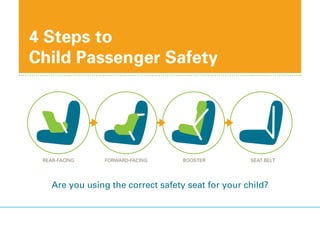
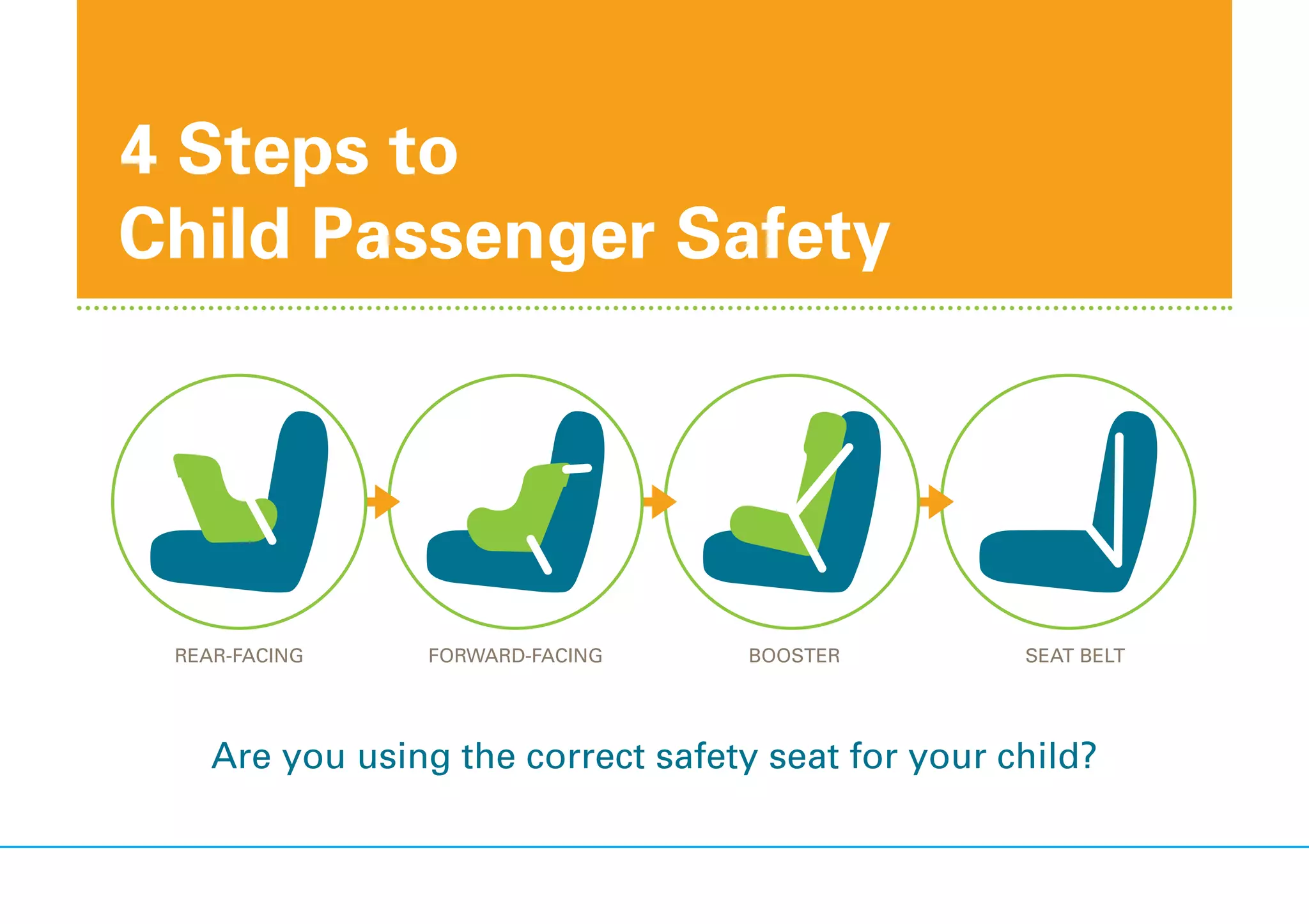
Are you using the correct safety seat for your child?
Rear-Facing Forward-Facing Booster Seat Belt
4 Steps to
Child Passenger Safety
Where to start?
Where to start?
This quick reference tool
will help you learn more
about properly securing
your child in a vehicle
at every stage of their
development. Be sure to
review the “Resources”
tab to learn about available
resources that can assist
you in making sure your
child is as safe as possible
in a vehicle.
Birth	 1	 2	 3	 4	 5	 6	 7	 8	 Beyond
Rear-Facing
Forward-Facing
Booster
Seat Belt
[Age]
Choosing the type of safety seat or booster seat for your child can sometimes seem
like an overwhelming task. Every child is an individual and develops at a different
rate. Safety seats from various manufacturers can also differ in size requirements.
This can make selecting a safety seat difficult because some children at the same
age can be in different types of safety seats. That is why it is important to think
about the needs and developmental stages of each child individually.
STEP 1
Rear-Facing
0-2 Years
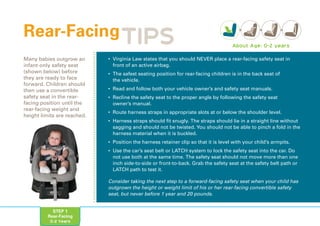
Rear-Facing
Many babies outgrow an
infant-only safety seat
(shown below) before
they are ready to face
forward. Children should
then use a convertible
safety seat in the rear-
facing position until the
rear-facing weight and
height limits are reached.
TIPS
• Virginia Law states that you should NEVER place a rear-facing safety seat in
front of an active airbag.
• The safest seating position for rear-facing children is in the back seat of
the vehicle.
• Read and follow both your vehicle owner’s and safety seat manuals.
• Recline the safety seat to the proper angle by following the safety seat
owner’s manual.
• Route harness straps in appropriate slots at or below the shoulder level.
• Harness straps should fit snugly. The straps should lie in a straight line without
sagging and should not be twisted. You should not be able to pinch a fold in the
harness material when it is buckled.
• Position the harness retainer clip so that it is level with your child’s armpits.
• Use the car’s seat belt or LATCH system to lock the safety seat into the car. Do
not use both at the same time. The safety seat should not move more than one
inch side-to-side or front-to-back. Grab the safety seat at the safety belt path or
LATCH path to test it.
About Age: 0-2 years
Consider taking the next step to a forward-facing safety seat when your child has
outgrown the height or weight limit of his or her rear-facing convertible safety
seat, but never before 1 year and 20 pounds.
STEP 2
Forward-Facing
1-5 Years
• The safest seating position for children is in the back seat.
• If your child has to ride in the front seat, slide the seat back as far as possible
from the dash and make sure the harness straps are snug to prevent the child
from leaning up near the dash.
• Read and follow both your vehicle owner’s and safety seat manuals.
• Refer to both your vehicle owner’s and safety seat manuals for guidance on
using the top tether.
• Use the car’s seat belt or LATCH system to lock the safety seat into the car. Do
not use both at the same time. The safety seat should not move more than one
inch side-to-side or front-to-back. Grab the safety seat at the safety belt path or
LATCH path to test it.
• Position the harness retainer clip so that it is level with your child’s armpits.
• Harness straps should be threaded through slots at or above your child’s
shoulders (this is a change from rear-facing).
• Harness straps should fit snugly. The straps should lie in a straight line without
sagging and should not be twisted. You should not be able to pinch a fold in the
harness material when it is buckled.
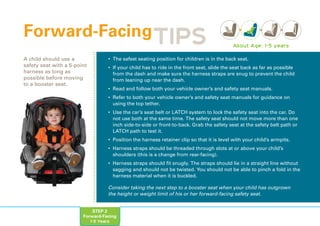
Forward-Facing
A child should use a
safety seat with a 5-point
harness as long as
possible before moving
to a booster seat.
About Age: 1-5 years
TIPS
Consider taking the next step to a booster seat when your child has outgrown
the height or weight limit of his or her forward-facing safety seat.
STEP 3
Booster Seat
4-8 Years
• Read and follow both your vehicle owner’s and safety seat manuals.
• The safest seating position for children is in the back seat.
• If your child has to ride in the front seat, slide the seat back as far as possible
from the dash and make sure they do not lean up near the dash.
• Always use the belt-positioning booster seat with the vehicle lap and shoulder
belt and never with just a lap belt.
• It is important to use a high back booster if the vehicle seating position has no
head rest.
• Never put the shoulder belt behind your child’s back or under their arm.
• Allow a child to remain in a booster seat beyond the age of 8 if the vehicle lap
and shoulder belt does not fit properly.
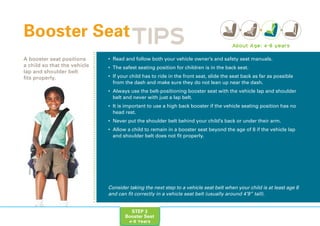
Booster Seat
A booster seat positions
a child so that the vehicle
lap and shoulder belt
fits properly.
About Age: 4-8 years
TIPS
Consider taking the next step to a vehicle seat belt when your child is at least age 8
and can fit correctly in a vehicle seat belt (usually around 4’9” tall).
STEP 4
Seat Belt
8 Years +
• The safest seating position for children under age 13 is in the back seat.
• If your child needs to ride in the front seat, slide the seat back as far as possible
from the dash and make sure they do not lean up near the dash.
• Never allow children to put the shoulder belt behind their back or under their
arm. You can use shoulder belt height adjusters built into the vehicle to make
the shoulder belt fit better.
Here is how you can tell if a child is ready for a seat belt:
1. The child is tall enough to sit against the vehicle’s seat back with their knees
bent comfortably over the edge of the seat and their feet touching the floor.
2. The shoulder belt lies across their chest, not on the neck or face.
3. The lap belt is low and snug across their thighs, not across the belly.
4. They can ride in this position for the duration of the car ride.
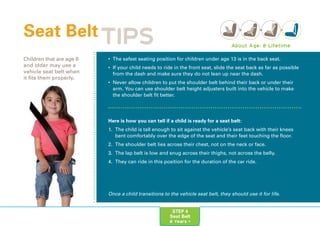
Seat Belt
Children that are age 8
and older may use a
vehicle seat belt when
it fits them properly.
About Age: 8-Lifetime
TIPS
Once a child transitions to the vehicle seat belt, they should use it for life.
(Code of Virginia Article 13 - Section 46.2-1095)
Child safety seats and booster seats are required for all children until their 8th
birthday. Safety seats must be properly used and approved by Department of
Transportation standards. This law is based solely on age, with no weight or height
requirements. The child restraint law is primary enforcement—no other violation
need be committed prior to ticketing for failure to have a child in an approved seat.
(Code of Virginia Article 12 - Section 46.2-1095)
Rear-facing child restraint devices must be placed in the back seat of a vehicle. In
the event the vehicle does not have a back seat, the child restraint device may be
placed in the front passenger seat only if the vehicle is either not equipped with a
passenger side airbag or the passenger side airbag has been deactivated. The child
restraint law is primary enforcement—no other violation need be committed prior
to ticketing for failure to have a child in an approved seat.
(Code of Virginia Section 46.2-1156.1)
Children age 8 through age 17 (until age 18) must be belted correctly in vehicle
safety belts, in vehicles manufactured after January 1, 1968. This safety belt law
is primary enforcement—no other violation need be committed prior to ticketing
for failure to have a child correctly buckled up. No person under age 16 shall be
transported in the rear cargo area of a pickup truck. There are exemptions for
certain parades and farming operations.
As this information about the law is subject to change, visit www.preventinjuriesva.com for
the most current version of the law and additional details regarding fines and exemptions.
Virginia Laws
Virginia
Laws
New safety seats are best, but if you have to use a used safety seat, make sure
it: has not expired, is not damaged, has no missing parts, has not been involved
in a crash, has all the labeling intact, and has the instruction manual.
Safety seats expire! Make sure to read the labeling on your child safety seat to
learn of the expiration date. Most manufacturers allow a safety seat to be used for
up to 5 years after the date of manufacture. If your safety seat does not have an
expiration date, contact the manufacturer.
A safety seat that has been involved in a crash may need to be replaced.
The forces in a crash may cause unseen damage to the seat and it may not work
properly in a future crash. Visit www.preventinjuriesva.com to read the guidelines
to determine if a safety seat should be replaced after a crash.
Has your safety seat been recalled? Sometimes a defect shows up after a
safety seat has been sold, resulting in a recall. To be alerted for safety seat
recalls, register your contact information with the manufacturer by completing
the registration card that you received with your safety seat or by visiting the
manufacturer’s Web site. View a full listing of all safety seat recalls by visiting
www.preventinjuriesva.com.
Other Considerations
Other
Considerations
www.preventinjuriesva.com
1-800-732-8333
The Virginia Department of Health’s Injury, Suicide and Violence Prevention
Program provides the following free resources to assist parents and caregivers
with properly securing children in safety seats on every ride:
• Income eligible families can apply for a free safety seat through the Low-Income
Safety Seat Distribution and Education Program.
• Visit one of Virginia’s Child Safety Seat Check Stations for free hands-on
assistance from a Certified Child Passenger Safety Technician.
• Call Virginia’s Child Passenger Safety Information Line [1-800-732-8333] to
speak to a Certified Child Passenger Safety Technician.
• Visit our Web site [www.preventinjuriesva.com] to learn more information
about child passenger safety and other tips for keeping your child safe.
Free Resources
Free
Resources
Virginia Department of Health
Office of Family Health Services
Injury, Suicide and Violence Prevention Program
109 Governor Street, 8th Floor
Richmond, VA 23219
www.preventinjuriesva.com
1-800-732-8333

4 steps to child passenger safety

  • 1.
    Are you usingthe correct safety seat for your child? Rear-Facing Forward-Facing Booster Seat Belt 4 Steps to Child Passenger Safety
  • 2.
    Where to start? Whereto start? This quick reference tool will help you learn more about properly securing your child in a vehicle at every stage of their development. Be sure to review the “Resources” tab to learn about available resources that can assist you in making sure your child is as safe as possible in a vehicle. Birth 1 2 3 4 5 6 7 8 Beyond Rear-Facing Forward-Facing Booster Seat Belt [Age] Choosing the type of safety seat or booster seat for your child can sometimes seem like an overwhelming task. Every child is an individual and develops at a different rate. Safety seats from various manufacturers can also differ in size requirements. This can make selecting a safety seat difficult because some children at the same age can be in different types of safety seats. That is why it is important to think about the needs and developmental stages of each child individually.
  • 3.
    STEP 1 Rear-Facing 0-2 Years Rear-Facing Manybabies outgrow an infant-only safety seat (shown below) before they are ready to face forward. Children should then use a convertible safety seat in the rear- facing position until the rear-facing weight and height limits are reached. TIPS • Virginia Law states that you should NEVER place a rear-facing safety seat in front of an active airbag. • The safest seating position for rear-facing children is in the back seat of the vehicle. • Read and follow both your vehicle owner’s and safety seat manuals. • Recline the safety seat to the proper angle by following the safety seat owner’s manual. • Route harness straps in appropriate slots at or below the shoulder level. • Harness straps should fit snugly. The straps should lie in a straight line without sagging and should not be twisted. You should not be able to pinch a fold in the harness material when it is buckled. • Position the harness retainer clip so that it is level with your child’s armpits. • Use the car’s seat belt or LATCH system to lock the safety seat into the car. Do not use both at the same time. The safety seat should not move more than one inch side-to-side or front-to-back. Grab the safety seat at the safety belt path or LATCH path to test it. About Age: 0-2 years Consider taking the next step to a forward-facing safety seat when your child has outgrown the height or weight limit of his or her rear-facing convertible safety seat, but never before 1 year and 20 pounds.
  • 4.
    STEP 2 Forward-Facing 1-5 Years •The safest seating position for children is in the back seat. • If your child has to ride in the front seat, slide the seat back as far as possible from the dash and make sure the harness straps are snug to prevent the child from leaning up near the dash. • Read and follow both your vehicle owner’s and safety seat manuals. • Refer to both your vehicle owner’s and safety seat manuals for guidance on using the top tether. • Use the car’s seat belt or LATCH system to lock the safety seat into the car. Do not use both at the same time. The safety seat should not move more than one inch side-to-side or front-to-back. Grab the safety seat at the safety belt path or LATCH path to test it. • Position the harness retainer clip so that it is level with your child’s armpits. • Harness straps should be threaded through slots at or above your child’s shoulders (this is a change from rear-facing). • Harness straps should fit snugly. The straps should lie in a straight line without sagging and should not be twisted. You should not be able to pinch a fold in the harness material when it is buckled. Forward-Facing A child should use a safety seat with a 5-point harness as long as possible before moving to a booster seat. About Age: 1-5 years TIPS Consider taking the next step to a booster seat when your child has outgrown the height or weight limit of his or her forward-facing safety seat.
  • 5.
    STEP 3 Booster Seat 4-8Years • Read and follow both your vehicle owner’s and safety seat manuals. • The safest seating position for children is in the back seat. • If your child has to ride in the front seat, slide the seat back as far as possible from the dash and make sure they do not lean up near the dash. • Always use the belt-positioning booster seat with the vehicle lap and shoulder belt and never with just a lap belt. • It is important to use a high back booster if the vehicle seating position has no head rest. • Never put the shoulder belt behind your child’s back or under their arm. • Allow a child to remain in a booster seat beyond the age of 8 if the vehicle lap and shoulder belt does not fit properly. Booster Seat A booster seat positions a child so that the vehicle lap and shoulder belt fits properly. About Age: 4-8 years TIPS Consider taking the next step to a vehicle seat belt when your child is at least age 8 and can fit correctly in a vehicle seat belt (usually around 4’9” tall).
  • 6.
    STEP 4 Seat Belt 8Years + • The safest seating position for children under age 13 is in the back seat. • If your child needs to ride in the front seat, slide the seat back as far as possible from the dash and make sure they do not lean up near the dash. • Never allow children to put the shoulder belt behind their back or under their arm. You can use shoulder belt height adjusters built into the vehicle to make the shoulder belt fit better. Here is how you can tell if a child is ready for a seat belt: 1. The child is tall enough to sit against the vehicle’s seat back with their knees bent comfortably over the edge of the seat and their feet touching the floor. 2. The shoulder belt lies across their chest, not on the neck or face. 3. The lap belt is low and snug across their thighs, not across the belly. 4. They can ride in this position for the duration of the car ride. Seat Belt Children that are age 8 and older may use a vehicle seat belt when it fits them properly. About Age: 8-Lifetime TIPS Once a child transitions to the vehicle seat belt, they should use it for life.
  • 7.
    (Code of VirginiaArticle 13 - Section 46.2-1095) Child safety seats and booster seats are required for all children until their 8th birthday. Safety seats must be properly used and approved by Department of Transportation standards. This law is based solely on age, with no weight or height requirements. The child restraint law is primary enforcement—no other violation need be committed prior to ticketing for failure to have a child in an approved seat. (Code of Virginia Article 12 - Section 46.2-1095) Rear-facing child restraint devices must be placed in the back seat of a vehicle. In the event the vehicle does not have a back seat, the child restraint device may be placed in the front passenger seat only if the vehicle is either not equipped with a passenger side airbag or the passenger side airbag has been deactivated. The child restraint law is primary enforcement—no other violation need be committed prior to ticketing for failure to have a child in an approved seat. (Code of Virginia Section 46.2-1156.1) Children age 8 through age 17 (until age 18) must be belted correctly in vehicle safety belts, in vehicles manufactured after January 1, 1968. This safety belt law is primary enforcement—no other violation need be committed prior to ticketing for failure to have a child correctly buckled up. No person under age 16 shall be transported in the rear cargo area of a pickup truck. There are exemptions for certain parades and farming operations. As this information about the law is subject to change, visit www.preventinjuriesva.com for the most current version of the law and additional details regarding fines and exemptions. Virginia Laws Virginia Laws
  • 8.
    New safety seatsare best, but if you have to use a used safety seat, make sure it: has not expired, is not damaged, has no missing parts, has not been involved in a crash, has all the labeling intact, and has the instruction manual. Safety seats expire! Make sure to read the labeling on your child safety seat to learn of the expiration date. Most manufacturers allow a safety seat to be used for up to 5 years after the date of manufacture. If your safety seat does not have an expiration date, contact the manufacturer. A safety seat that has been involved in a crash may need to be replaced. The forces in a crash may cause unseen damage to the seat and it may not work properly in a future crash. Visit www.preventinjuriesva.com to read the guidelines to determine if a safety seat should be replaced after a crash. Has your safety seat been recalled? Sometimes a defect shows up after a safety seat has been sold, resulting in a recall. To be alerted for safety seat recalls, register your contact information with the manufacturer by completing the registration card that you received with your safety seat or by visiting the manufacturer’s Web site. View a full listing of all safety seat recalls by visiting www.preventinjuriesva.com. Other Considerations Other Considerations
  • 9.
    www.preventinjuriesva.com 1-800-732-8333 The Virginia Departmentof Health’s Injury, Suicide and Violence Prevention Program provides the following free resources to assist parents and caregivers with properly securing children in safety seats on every ride: • Income eligible families can apply for a free safety seat through the Low-Income Safety Seat Distribution and Education Program. • Visit one of Virginia’s Child Safety Seat Check Stations for free hands-on assistance from a Certified Child Passenger Safety Technician. • Call Virginia’s Child Passenger Safety Information Line [1-800-732-8333] to speak to a Certified Child Passenger Safety Technician. • Visit our Web site [www.preventinjuriesva.com] to learn more information about child passenger safety and other tips for keeping your child safe. Free Resources Free Resources
  • 10.
    Virginia Department ofHealth Office of Family Health Services Injury, Suicide and Violence Prevention Program 109 Governor Street, 8th Floor Richmond, VA 23219 www.preventinjuriesva.com 1-800-732-8333