Child Safety Seminar
1
Hosted by Taylor Gosson (Girl Scout Gold Award Project Summer 2017)
Child Safety Seminar for New Parents and Grandparents
Agenda:
● House Hold Safety and S.I.D.S.
● Car Seat Safety
● 911 Telecommunications
2
Basic Child Care Standards
3
Child Care Standards
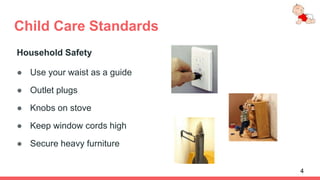
Household Safety
● Use your waist as a guide
● Outlet plugs
● Knobs on stove
● Keep window cords high
● Secure heavy furniture
4
Child Care Standards
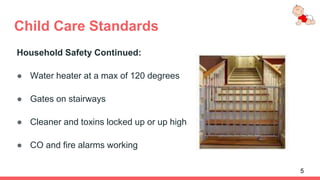
Household Safety Continued:
● Water heater at a max of 120 degrees
● Gates on stairways
● Cleaner and toxins locked up or up high
● CO and fire alarms working
5
S.I.D.S
Sudden Infant Death Syndrome
6
S.I.D.S
What is S.I. D. S. ?
● Sudden Infant Death Syndrome
● Leading cause of death for babies
○ Commonly occurs between 1 month and 1 year of age.
7
S.I.D.S
Some common questions about S.I.D.S.
8
S.I.D.S
What is the most common age for S.I.D.S to occur?
9
S.I.D.S.
1-4 months
The majority of deaths (90%) will happen before a child
reaches 6 months of age. However S.I.D.S. can occur at
anytime during an infant’s first year
10
S.I.D.S.
What gender is most likely to be affected by S.I.D.S. ?
11
S.I.D.S.
Boys
Boys of all ethnicities are about 30 to 50
percent more likely than girls to suffer
from S.I.D.S.
12
S.I.D.S
Why is S.I.D.S. also referred to as “crib death” or “cot death”?
13
S.I.D.S.
● It is associated with when an infant is sleeping.
● The crib does not cause the death, but the baby’s
environment does.
14
S.I.D.S.
What position should an infant be in to prevent S.I.D.S.?
15
S.I.D.S.
On their backs
● Infants are not able to control their head movements at a
young age.
● When they are on their stomach the can suffocate
because they are not able to lift their heads up off of the
mattress.
16
S.I.D.S
● Premature or low birth weight
● Mother’s under the age of 20
● Many siblings close in age
● Skipping vaccinations
● Being a boy
● Crib Bumpers
● Existing medical issues
● Prenatal stressors
● Ethnic backgrounds
17
Why are some children at a higher risk than others?
S.I.D.S.
DO’s
● “BACK’ to sleep
● Pacifier when putting them to sleep
● Swaddling
● Have their cradle in your room
● Crib mattress is firm and a tight fitting
sheet
18
DON’TS
● Keep blankets or toys in the crib
● Smoke while pregnant (or let others
smoke around your infant)
● Let them sleep on their side
● Share a bed with your baby
● Overdress your child or put them near
heat source
How can I reduce the risk of S.I.D.S. ?
Sources
Baby Center: https://www.babycenter.com/0_sids-keeping-your-baby-safe-during-
sleep_419.bc
Romper: https://www.romper.com/p/9-sids-risks-you-may-not-be-aware-of-19311
19
Car Seat Basics for the parents
Hard Facts:
Motor Vehicle crashes are the leading cause
of death for children 3-14 years. 74-90% of
car seats are misused.
Motor Vehicle crashes are the leading cause
of accidental death among teenagers,
representing over 1/3 of all deaths to
teenagers.
We, ALL of us, need to work together to
make a change.
What does New Jersey Law state about
Car Seats?
 Infant to 2 years old AND 30 pounds = Rear
facing car seat with a 5 point harness or
until the child outgrows the car seat
 3-4 years old AND 40 pounds = Forward
facing car seat with a 5 point harness or
until the child outgrows the car seat.
 Up to 8 years old AND 4 feet 9 inches
=Booster Seat; its ALL ABOUT FIT.
What do Car Seats, Booster Seats and
Seat Belts do?
 Keep people in the vehicle
 Contact the strongest parts of the body
 Spread forces over a wide area of the body
 Help the body to slow or ride down the
crash force
 Protect the head, brain, and spinal cord
Car seats and booster seats come in all
sizes but which is the BEST?
All car seats and booster seats meet the minimal
National Highway Traffic Safety administration
requirements.
MUST:
Fit your child
Fit in your car
You can use it correctly every time
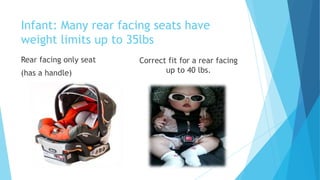
Infant: Many rear facing seats have
weight limits up to 35lbs
Rear facing only seat
(has a handle)
Correct fit for a rear facing
up to 40 lbs.
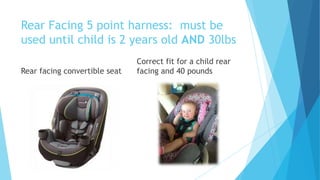
Rear Facing 5 point harness: must be
used until child is 2 years old AND 30lbs
Rear facing convertible seat
Correct fit for a child rear
facing and 40 pounds
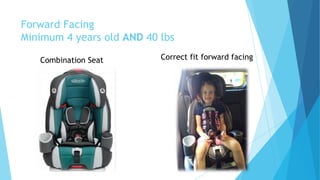
Forward Facing
Minimum 4 years old AND 40 lbs
Combination Seat Correct fit forward facing
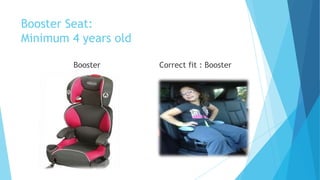
Booster Seat:
Minimum 4 years old
Correct fit : BoosterBooster
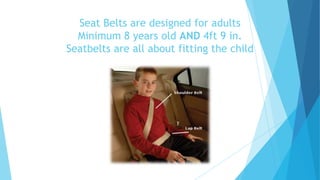
Seat Belts are designed for adults
Minimum 8 years old AND 4ft 9 in.
Seatbelts are all about fitting the child
What does misuse look like?
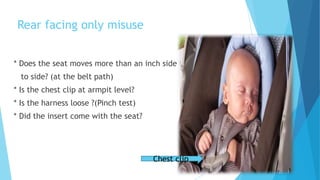
Rear facing only misuse
* Does the seat moves more than an inch side to side
to side? (at the belt path)
* Is the chest clip at armpit level?
* Is the harness loose ?(Pinch test)
* Did the insert come with the seat?
Chest clip
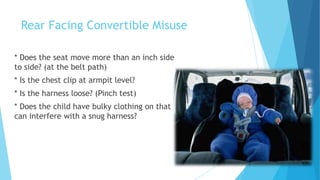
Rear Facing Convertible Misuse
* Does the seat move more than an inch side
to side? (at the belt path)
* Is the chest clip at armpit level?
* Is the harness loose? (Pinch test)
* Does the child have bulky clothing on that
can interfere with a snug harness?
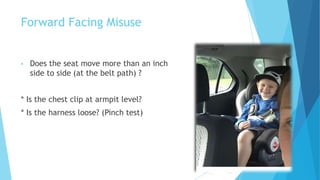
Forward Facing Misuse
• Does the seat move more than an inch
side to side (at the belt path) ?
* Is the chest clip at armpit level?
* Is the harness loose? (Pinch test)
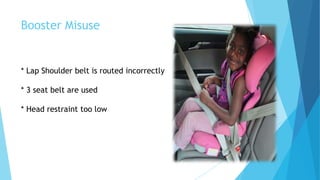
Booster Misuse
* Lap Shoulder belt is routed incorrectly
* 3 seat belt are used
* Head restraint too low
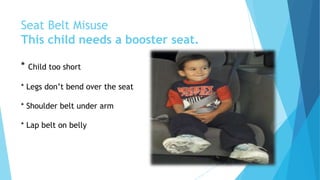
Seat Belt Misuse
This child needs a booster seat.
* Child too short
* Legs don’t bend over the seat
* Shoulder belt under arm
* Lap belt on belly
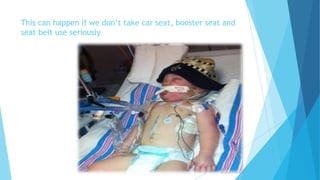
This can happen if we don’t take car seat, booster seat and
seat belt use seriously
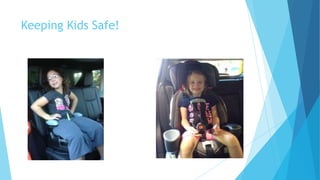
Keeping Kids Safe!
Resources
Preventionworks-nj.org: Northern NJ Safe Kids
Safekids.org: National Child Passenger Safety
NJSaferoads.com NJ Resources for occupant
protection
Preventinjury.org: Resources for children with
special needs
Healthychildren.org: Up to date car seats
available each year
AAP.org: American Academy for Pediatrics
Introduction to the
9-1-1 System
▶ Public Safety Answering Point
◦ Answer 9-1-1 calls and allocate appropriate resources
◦ Call takers/dispatchers must be 9-1-1 Officer and NJ
EMD Certified
▶ Non-PSAP Dispatch
◦ Receive 9-1-1 calls through third party agencies
◦ Still may receive emergency calls via landline or radio
communications
◦ Some non-PSAP agencies still require certifications
PSAP vs Non-PSAP
▶ Police UHF Ch.1
▶ Police UHF Ch.2
▶ Wanaque PD Ch.1
▶ SPEN 1
▶ Fire Ch.1
▶ Fire Lowband
▶ Passaic County
▶ OEM
Radio Channels
▶ Pro-Phoenix Computer-aided Dispatch
▶ Criminal Justice Information System (CJIS)
▶ National Crime Information Center (NCIC)
▶ National Law Enforcement Telecommunication
System (NLETS)
▶ Internet Resources
◦ Google Maps
◦ Tax Records
Various Technology
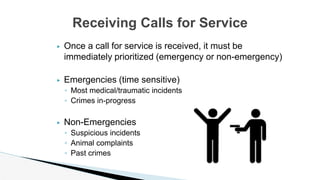
▶ Once a call for service is received, it must be
immediately prioritized (emergency or non-emergency)
▶ Emergencies (time sensitive)
◦ Most medical/traumatic incidents
◦ Crimes in-progress
▶ Non-Emergencies
◦ Suspicious incidents
◦ Animal complaints
◦ Past crimes
Receiving Calls for Service
▶ Headquarters Walk-in
◦ Police headquarters is open 24/7
◦ Anyone can enter at any time to inquire about a situation
they may have, drop off documents, satisfy an outstanding
warrant, or report an emergency.
▶ Radio Communication
◦ Surrounding towns may call via SPEN 1
◦ Patrol unit may call out with an emergency or other
incident
◦ Fire department or EMS may report an incident
Receiving Calls for Service
▶ Landline
◦ Pompton Lakes PD has four separate landlines
◦ Some calls on the landline are true emergencies, but the
caller did not use 9-1-1 for various reasons.
▶ 9-1-1 Call
◦ Pompton Lakes PD has two emergency lines and one
admin line for making call backs to recent calls
◦ Some 9-1-1 calls are not emergencies and are dealt with
accordingly
Receiving Calls for Service
▶ Medical Calls
◦ Patient or by-stander recognizes emergency and dials 9-1-1
from their cell phone or landline
◦ Call is answered with “9-1-1, where is your emergency?”
◦ Location of incident and chief complaint is provided to the call
taker
◦ Information is entered into the CAD, patrol units are
dispatched, and EMS is paged
◦ Pre-arrival instructions are given while officers respond.
Screening 9-1-1 Emergency Calls
▶ Crime In-Progress
◦ Caller witnesses or is a victim of a crime and immediately
dials 9-1-1
◦ Call is answered with “9-1-1, where is your emergency?”
◦ Location of crime and a brief description of the incident is
given
◦ Information is immediately entered into the CAD and
adequate amount of officers are dispatched
◦ Contact with the caller is maintained until officers arrive
on scene.
OFFICER SAFETY IS OF THE UTMOST IMPORTANTANCE
Screening 9-1-1 Emergency Calls
▶ Non-Emergency
◦ Caller requires a police response and dials 9-1-1
◦ Call is answered with “9-1-1, where is your EMERGENCY?”
◦ Caller provides the location, but states it is not an emergency
◦ Call taker inquires about the issue and determines the call is
no longer an emergency
◦ Caller advised to contact their local police department via
their ten-digit landline
◦ Caller is transferred to non-emergency voice prompt and call
is terminated
Screening 9-1-1 Emergency Calls
▶ Two simultaneous 9-1-1 calls are received
◦ Call 1 is answered and rapidly screened then placed on
hold
◦ Call 2 is answered, rapidly screened, and determined to
have a higher priority than Call 1
◦ Call 2 is entered into CAD, appropriate resources are
dispatched, and call is terminated
◦ Call 1 is resumed and information is entered into CAD
⚫Resources are dispatched if available or as soon as possible
Multiple Emergency Calls
▶ Emergency
◦ Remain calm and make sure you are SAFE!
◦ Dial 9-1-1 if you have a true emergency
◦ Once the call is answered, listen very carefully to the call
taker and answered his/her questions as best as you can
Calling for Help
▶ Non-Emergencies
◦ Save local police department’s ten-digit landline on your
cell phone so you can call with ease
⚫Riverdale PD 973-835-0034
⚫Pompton Lakes PD 973-835-0400
⚫Bloomingdale PD 973-838-0158
◦ Use if you require a police response, but it is not an
emergency
◦ Someone will still respond as soon as possible
Calling for Help
▶ “Call takers can track calls from cell phones”
▶ Know where you are.
▶ “Help won’t come if I’m still on the phone with the
dispatcher”
▶ “When I call 9-1-1, it goes directly to my local
police department”
▶ “Help will come faster if I call 9-1-1”
Misconceptions
Thank You
53

Gold Award Presentation: Child Safety

  • 1.
    Child Safety Seminar 1 Hostedby Taylor Gosson (Girl Scout Gold Award Project Summer 2017)
  • 2.
    Child Safety Seminarfor New Parents and Grandparents Agenda: ● House Hold Safety and S.I.D.S. ● Car Seat Safety ● 911 Telecommunications 2
  • 3.
    Basic Child CareStandards 3
  • 4.
    Child Care Standards HouseholdSafety ● Use your waist as a guide ● Outlet plugs ● Knobs on stove ● Keep window cords high ● Secure heavy furniture 4
  • 5.
    Child Care Standards HouseholdSafety Continued: ● Water heater at a max of 120 degrees ● Gates on stairways ● Cleaner and toxins locked up or up high ● CO and fire alarms working 5
  • 6.
  • 7.
    S.I.D.S What is S.I.D. S. ? ● Sudden Infant Death Syndrome ● Leading cause of death for babies ○ Commonly occurs between 1 month and 1 year of age. 7
  • 8.
  • 9.
    S.I.D.S What is themost common age for S.I.D.S to occur? 9
  • 10.
    S.I.D.S. 1-4 months The majorityof deaths (90%) will happen before a child reaches 6 months of age. However S.I.D.S. can occur at anytime during an infant’s first year 10
  • 11.
    S.I.D.S. What gender ismost likely to be affected by S.I.D.S. ? 11
  • 12.
    S.I.D.S. Boys Boys of allethnicities are about 30 to 50 percent more likely than girls to suffer from S.I.D.S. 12
  • 13.
    S.I.D.S Why is S.I.D.S.also referred to as “crib death” or “cot death”? 13
  • 14.
    S.I.D.S. ● It isassociated with when an infant is sleeping. ● The crib does not cause the death, but the baby’s environment does. 14
  • 15.
    S.I.D.S. What position shouldan infant be in to prevent S.I.D.S.? 15
  • 16.
    S.I.D.S. On their backs ●Infants are not able to control their head movements at a young age. ● When they are on their stomach the can suffocate because they are not able to lift their heads up off of the mattress. 16
  • 17.
    S.I.D.S ● Premature orlow birth weight ● Mother’s under the age of 20 ● Many siblings close in age ● Skipping vaccinations ● Being a boy ● Crib Bumpers ● Existing medical issues ● Prenatal stressors ● Ethnic backgrounds 17 Why are some children at a higher risk than others?
  • 18.
    S.I.D.S. DO’s ● “BACK’ tosleep ● Pacifier when putting them to sleep ● Swaddling ● Have their cradle in your room ● Crib mattress is firm and a tight fitting sheet 18 DON’TS ● Keep blankets or toys in the crib ● Smoke while pregnant (or let others smoke around your infant) ● Let them sleep on their side ● Share a bed with your baby ● Overdress your child or put them near heat source How can I reduce the risk of S.I.D.S. ?
  • 19.
    Sources Baby Center: https://www.babycenter.com/0_sids-keeping-your-baby-safe-during- sleep_419.bc Romper:https://www.romper.com/p/9-sids-risks-you-may-not-be-aware-of-19311 19
  • 20.
    Car Seat Basicsfor the parents
  • 21.
    Hard Facts: Motor Vehiclecrashes are the leading cause of death for children 3-14 years. 74-90% of car seats are misused. Motor Vehicle crashes are the leading cause of accidental death among teenagers, representing over 1/3 of all deaths to teenagers. We, ALL of us, need to work together to make a change.
  • 22.
    What does NewJersey Law state about Car Seats?  Infant to 2 years old AND 30 pounds = Rear facing car seat with a 5 point harness or until the child outgrows the car seat  3-4 years old AND 40 pounds = Forward facing car seat with a 5 point harness or until the child outgrows the car seat.  Up to 8 years old AND 4 feet 9 inches =Booster Seat; its ALL ABOUT FIT.
  • 23.
    What do CarSeats, Booster Seats and Seat Belts do?  Keep people in the vehicle  Contact the strongest parts of the body  Spread forces over a wide area of the body  Help the body to slow or ride down the crash force  Protect the head, brain, and spinal cord
  • 24.
    Car seats andbooster seats come in all sizes but which is the BEST? All car seats and booster seats meet the minimal National Highway Traffic Safety administration requirements. MUST: Fit your child Fit in your car You can use it correctly every time
  • 25.
    Infant: Many rearfacing seats have weight limits up to 35lbs Rear facing only seat (has a handle) Correct fit for a rear facing up to 40 lbs.
  • 26.
    Rear Facing 5point harness: must be used until child is 2 years old AND 30lbs Rear facing convertible seat Correct fit for a child rear facing and 40 pounds
  • 27.
    Forward Facing Minimum 4years old AND 40 lbs Combination Seat Correct fit forward facing
  • 28.
    Booster Seat: Minimum 4years old Correct fit : BoosterBooster
  • 29.
    Seat Belts aredesigned for adults Minimum 8 years old AND 4ft 9 in. Seatbelts are all about fitting the child
  • 30.
    What does misuselook like?
  • 31.
    Rear facing onlymisuse * Does the seat moves more than an inch side to side to side? (at the belt path) * Is the chest clip at armpit level? * Is the harness loose ?(Pinch test) * Did the insert come with the seat? Chest clip
  • 32.
    Rear Facing ConvertibleMisuse * Does the seat move more than an inch side to side? (at the belt path) * Is the chest clip at armpit level? * Is the harness loose? (Pinch test) * Does the child have bulky clothing on that can interfere with a snug harness?
  • 33.
    Forward Facing Misuse •Does the seat move more than an inch side to side (at the belt path) ? * Is the chest clip at armpit level? * Is the harness loose? (Pinch test)
  • 34.
    Booster Misuse * LapShoulder belt is routed incorrectly * 3 seat belt are used * Head restraint too low
  • 35.
    Seat Belt Misuse Thischild needs a booster seat. * Child too short * Legs don’t bend over the seat * Shoulder belt under arm * Lap belt on belly
  • 36.
    This can happenif we don’t take car seat, booster seat and seat belt use seriously
  • 37.
  • 38.
    Resources Preventionworks-nj.org: Northern NJSafe Kids Safekids.org: National Child Passenger Safety NJSaferoads.com NJ Resources for occupant protection Preventinjury.org: Resources for children with special needs Healthychildren.org: Up to date car seats available each year AAP.org: American Academy for Pediatrics
  • 39.
  • 40.
    ▶ Public SafetyAnswering Point ◦ Answer 9-1-1 calls and allocate appropriate resources ◦ Call takers/dispatchers must be 9-1-1 Officer and NJ EMD Certified ▶ Non-PSAP Dispatch ◦ Receive 9-1-1 calls through third party agencies ◦ Still may receive emergency calls via landline or radio communications ◦ Some non-PSAP agencies still require certifications PSAP vs Non-PSAP
  • 41.
    ▶ Police UHFCh.1 ▶ Police UHF Ch.2 ▶ Wanaque PD Ch.1 ▶ SPEN 1 ▶ Fire Ch.1 ▶ Fire Lowband ▶ Passaic County ▶ OEM Radio Channels
  • 42.
    ▶ Pro-Phoenix Computer-aidedDispatch ▶ Criminal Justice Information System (CJIS) ▶ National Crime Information Center (NCIC) ▶ National Law Enforcement Telecommunication System (NLETS) ▶ Internet Resources ◦ Google Maps ◦ Tax Records Various Technology
  • 43.
    ▶ Once acall for service is received, it must be immediately prioritized (emergency or non-emergency) ▶ Emergencies (time sensitive) ◦ Most medical/traumatic incidents ◦ Crimes in-progress ▶ Non-Emergencies ◦ Suspicious incidents ◦ Animal complaints ◦ Past crimes Receiving Calls for Service
  • 44.
    ▶ Headquarters Walk-in ◦Police headquarters is open 24/7 ◦ Anyone can enter at any time to inquire about a situation they may have, drop off documents, satisfy an outstanding warrant, or report an emergency. ▶ Radio Communication ◦ Surrounding towns may call via SPEN 1 ◦ Patrol unit may call out with an emergency or other incident ◦ Fire department or EMS may report an incident Receiving Calls for Service
  • 45.
    ▶ Landline ◦ PomptonLakes PD has four separate landlines ◦ Some calls on the landline are true emergencies, but the caller did not use 9-1-1 for various reasons. ▶ 9-1-1 Call ◦ Pompton Lakes PD has two emergency lines and one admin line for making call backs to recent calls ◦ Some 9-1-1 calls are not emergencies and are dealt with accordingly Receiving Calls for Service
  • 46.
    ▶ Medical Calls ◦Patient or by-stander recognizes emergency and dials 9-1-1 from their cell phone or landline ◦ Call is answered with “9-1-1, where is your emergency?” ◦ Location of incident and chief complaint is provided to the call taker ◦ Information is entered into the CAD, patrol units are dispatched, and EMS is paged ◦ Pre-arrival instructions are given while officers respond. Screening 9-1-1 Emergency Calls
  • 47.
    ▶ Crime In-Progress ◦Caller witnesses or is a victim of a crime and immediately dials 9-1-1 ◦ Call is answered with “9-1-1, where is your emergency?” ◦ Location of crime and a brief description of the incident is given ◦ Information is immediately entered into the CAD and adequate amount of officers are dispatched ◦ Contact with the caller is maintained until officers arrive on scene. OFFICER SAFETY IS OF THE UTMOST IMPORTANTANCE Screening 9-1-1 Emergency Calls
  • 48.
    ▶ Non-Emergency ◦ Callerrequires a police response and dials 9-1-1 ◦ Call is answered with “9-1-1, where is your EMERGENCY?” ◦ Caller provides the location, but states it is not an emergency ◦ Call taker inquires about the issue and determines the call is no longer an emergency ◦ Caller advised to contact their local police department via their ten-digit landline ◦ Caller is transferred to non-emergency voice prompt and call is terminated Screening 9-1-1 Emergency Calls
  • 49.
    ▶ Two simultaneous9-1-1 calls are received ◦ Call 1 is answered and rapidly screened then placed on hold ◦ Call 2 is answered, rapidly screened, and determined to have a higher priority than Call 1 ◦ Call 2 is entered into CAD, appropriate resources are dispatched, and call is terminated ◦ Call 1 is resumed and information is entered into CAD ⚫Resources are dispatched if available or as soon as possible Multiple Emergency Calls
  • 50.
    ▶ Emergency ◦ Remaincalm and make sure you are SAFE! ◦ Dial 9-1-1 if you have a true emergency ◦ Once the call is answered, listen very carefully to the call taker and answered his/her questions as best as you can Calling for Help
  • 51.
    ▶ Non-Emergencies ◦ Savelocal police department’s ten-digit landline on your cell phone so you can call with ease ⚫Riverdale PD 973-835-0034 ⚫Pompton Lakes PD 973-835-0400 ⚫Bloomingdale PD 973-838-0158 ◦ Use if you require a police response, but it is not an emergency ◦ Someone will still respond as soon as possible Calling for Help
  • 52.
    ▶ “Call takerscan track calls from cell phones” ▶ Know where you are. ▶ “Help won’t come if I’m still on the phone with the dispatcher” ▶ “When I call 9-1-1, it goes directly to my local police department” ▶ “Help will come faster if I call 9-1-1” Misconceptions
  • 53.