METHODS FOR COLLECTINGDATA
Scientific Observation
• requires the researcher to record behavior
systematically and objectively.
• May be done in a naturalistic setting such as a
home, school, or other public place.
• May be done in a laboratory.
3.
The Survey andInterview
• Information is collected from a large number of
people by interview, questionnaire, or some
other means.
• Acquiring valid survey data is not easy.
METHODS FOR COLLECTING DATA
4.
Standardized Test
• Astandardized test has uniform procedures for
administration and scoring.
• One criticism of standardized tests is that they
assume a person’s behavior is consistent and
stable, yet personality and intelligence—two
primary targets of standardized testing—can
vary with the situation.
METHODS FOR COLLECTING DATA
5.
Case Study
• Acase study is an in-depth look at a single
individual.
• A case study provides information about one
person’s experiences; it may focus on nearly
any aspect of the subject’s life that helps the
researcher understand the person’s mind,
behavior, or other attributes.
METHODS FOR COLLECTING DATA
6.
Physiological Measures
• Researchersare increasingly using
physiological measures when they study
development at different points in the life span.
METHODS FOR COLLECTING DATA
RESEARCH DESIGNS
Correlational Research
•In correlational research, the goal is to
describe the strength of the relationship between
two or more events or characteristics.
• A correlation exists between two variables if
one variable is more (or less) likely to occur
when the other does.
9.
RESEARCH DESIGNS
Correlational Research(cont.)
Correlation and Causation
• A correlation is positive if both variables tend to
increase together or decrease together.
• A correlation is negative if one variable tends to
increase while the other decreases.
• A correlation is zero if no connection is evident.
• Correlation is not causation
10.
Experimental Research
The Experimentestablishes causal relationships
among variables.
• independent variable- the variable that is
introduced to see what effect it has on the
dependent variable.
• dependent variable- the variable that may
change as a result of whatever new condition or
situation the experimenter adds.
RESEARCH DESIGNS
11.
USING THE SCIENTIFICMETHOD
Experimental & Control Groups
•experimental group- gets a particular
treatment (the independent variable).
•comparison group (also called a control
group), which does not get the treatment.
12.
TIME SPAN OFRESEARCH
Cross-sectional Research
• Groups of people of one age are compared with
people of another age.
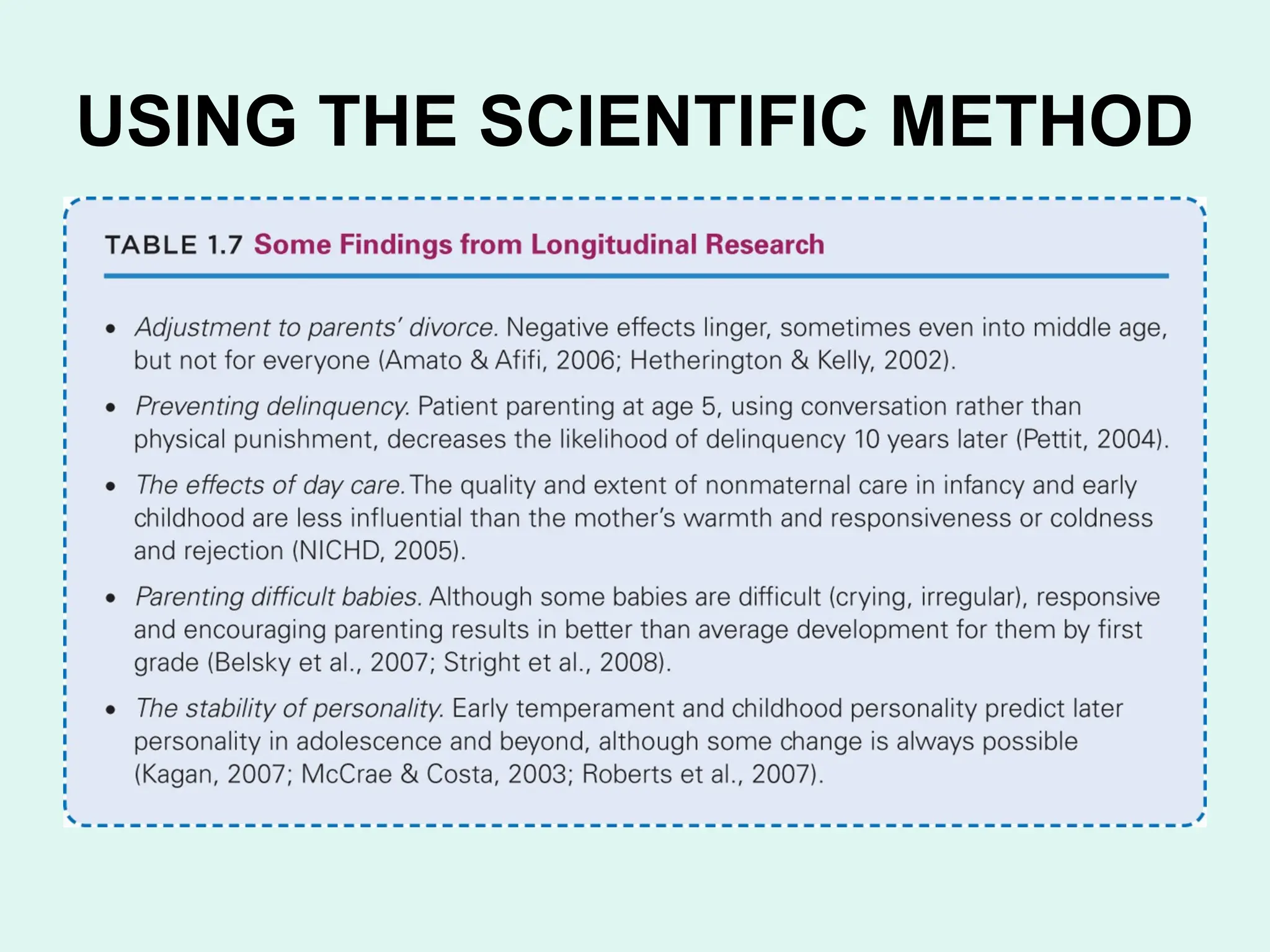
Longitudinal Research
• Collecting data repeatedly on the same
individuals as they age.
Cross-sequential Research
• Study several groups of people of different ages
(a cross-sectional approach) and follow them
over the years (a longitudinal approach).
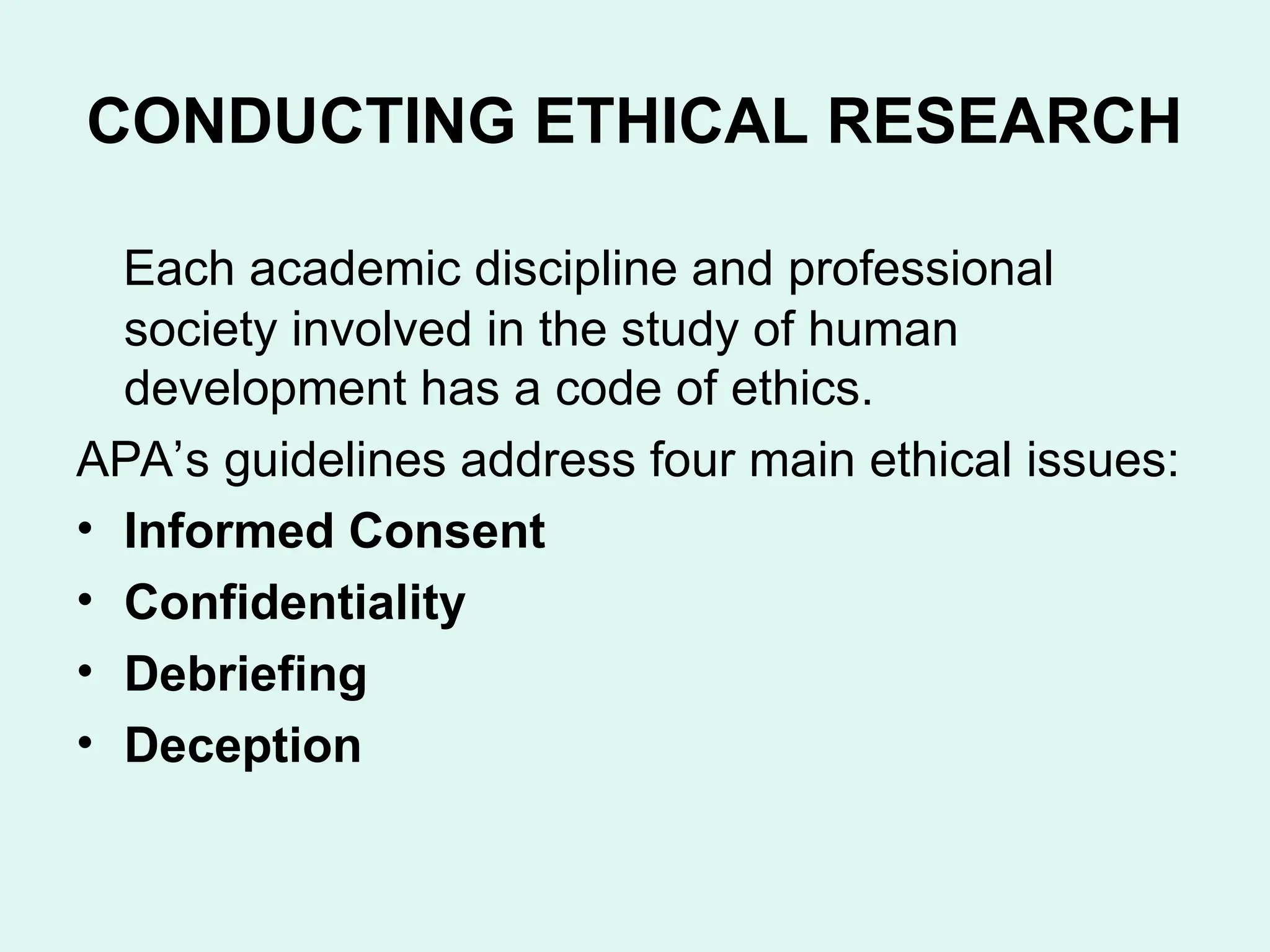
CONDUCTING ETHICAL RESEARCH
Eachacademic discipline and professional
society involved in the study of human
development has a code of ethics.
APA’s guidelines address four main ethical issues:
• Informed Consent
• Confidentiality
• Debriefing
• Deception
15.
CONDUCTING ETHICAL RESEARCH
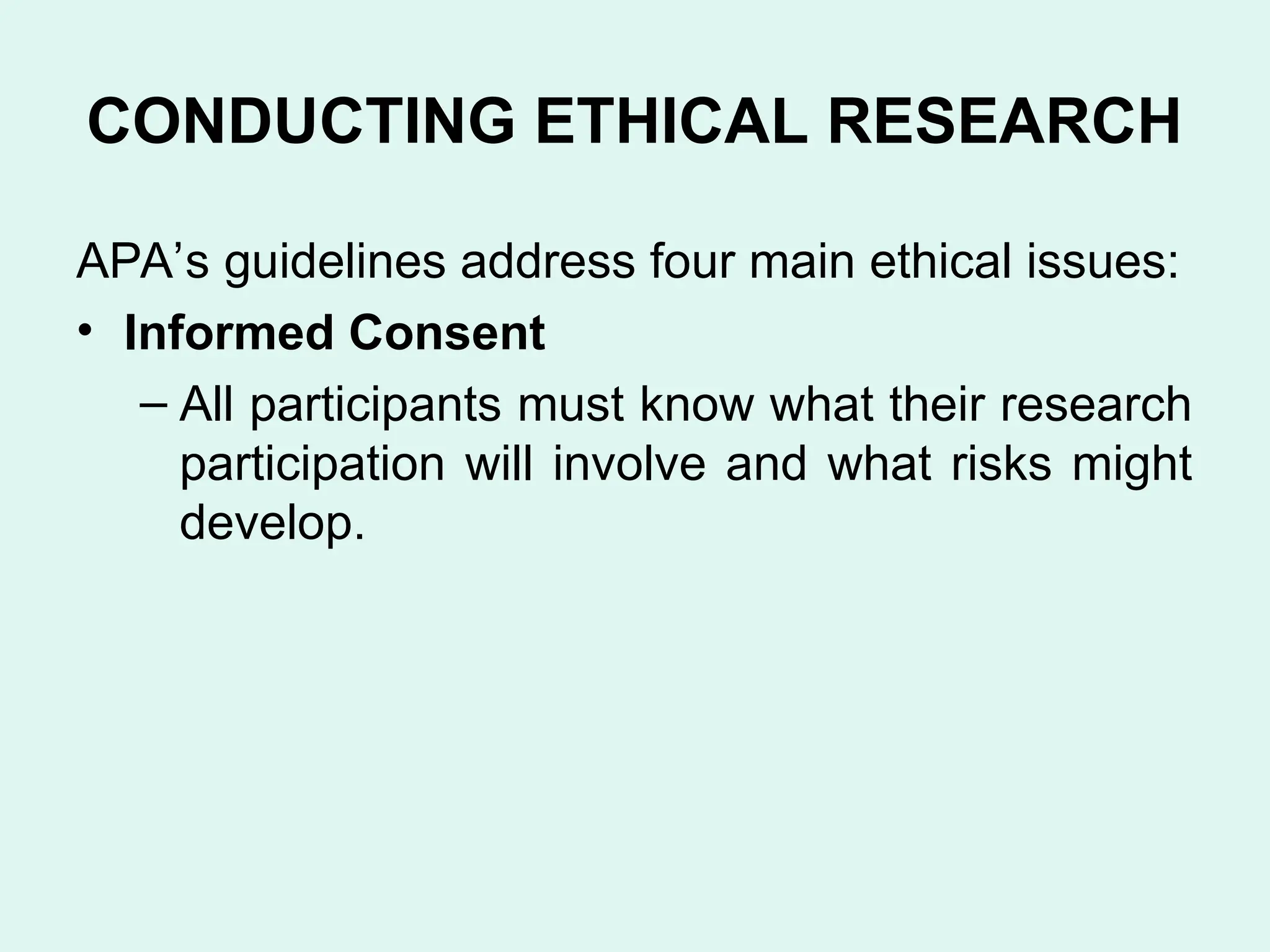
APA’sguidelines address four main ethical issues:
• Informed Consent
– All participants must know what their research
participation will involve and what risks might
develop.
16.
CONDUCTING ETHICAL RESEARCH
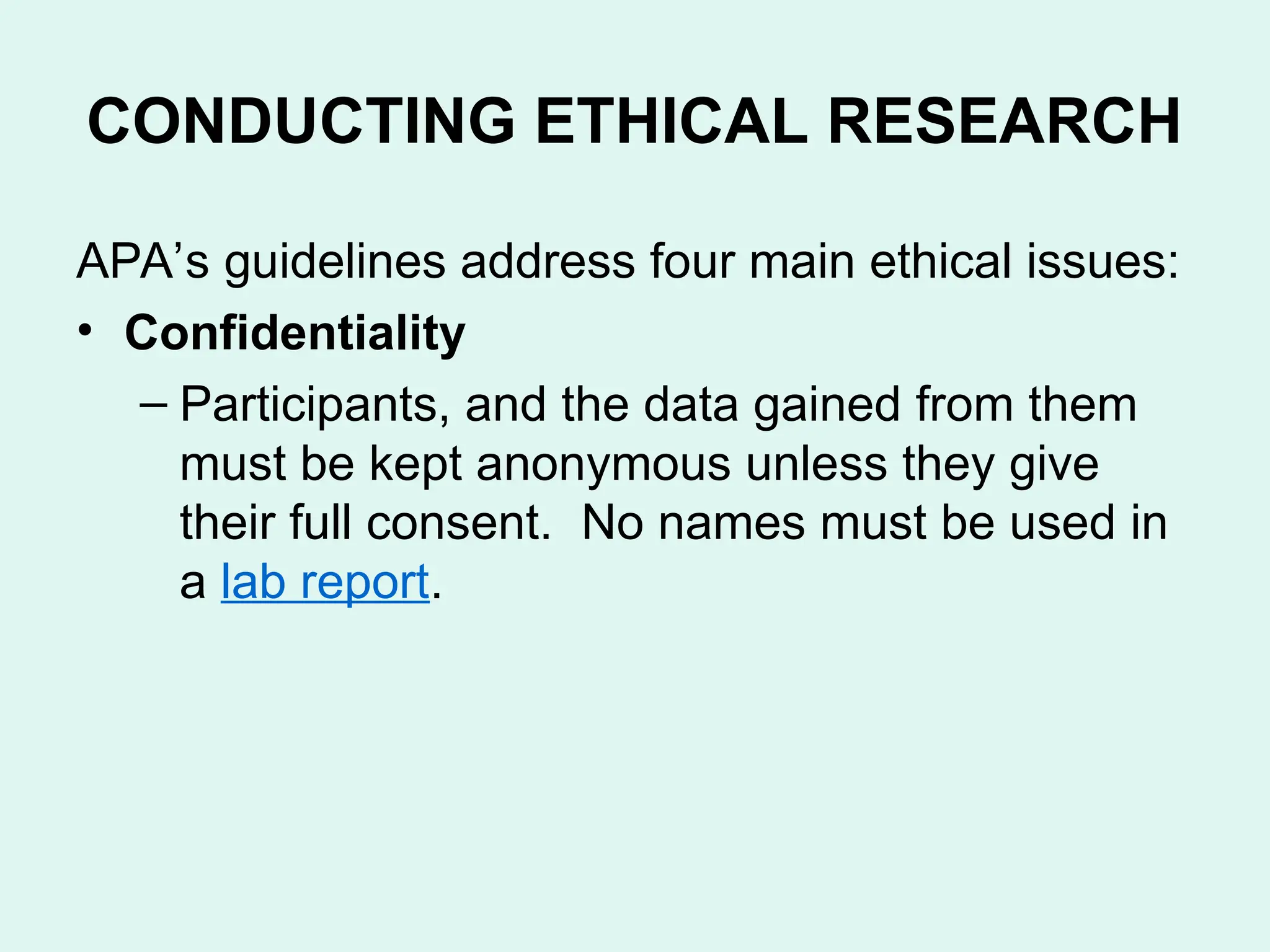
APA’sguidelines address four main ethical issues:
• Confidentiality
– Participants, and the data gained from them
must be kept anonymous unless they give
their full consent. No names must be used in
a lab report.
17.
CONDUCTING ETHICAL RESEARCH
APA’sguidelines address four main ethical issues:
• Debriefing
– “The purpose of debriefing is to remove any
misconceptions and anxieties that the
participants have about the research and to
leave them with a sense of dignity,
knowledge, and a perception of time not
wasted” (Harris, 1998).
18.
CONDUCTING ETHICAL RESEARCH
APA’sguidelines address four main ethical issues:
• Deception
– This is where participants are misled or wrongly
informed about the aims of the research. Types
of deception include
• (i) deliberate misleading, e.g. using confederates,
staged manipulations in field settings, deceptive
instructions;
• (ii) deception by omission, e.g., failure to disclose full
information about the study, or creating ambiguity.