01/31/2026 1
Introduction to
Agribusiness Management
(ABVM 211)
Osman c.
01/31/2026 2
contents
• Topic one: introduction to Agribusiness
• Topic two: Agribusiness management overview
• Topic three: managing agribusiness
• Topic four: strategic planning in agribusiness
• Topic five: decision making in agribusiness
• Topic six: agribusiness environment
01/31/2026 3
Topic one:
introduction to
Agribusiness
4
Definitions of Agribusiness
• Agribusiness is a combination of two words agriculture and
business.
• In simple words, “business means the state of being busy”.
• Broadly, business involves activities connected with the
production of wealth.
• Business is an organized and systematized human activity
involving buying and selling goods, manufacturing goods
or providing services in order to earn profit.
• The word agriculture indicates plowing a field, planting
seed, harvesting a crop, milking cows, or feeding livestock.
• Until recently, this was a accurate picture.
• Nevertheless, today’s’ agriculture is radically different.
01/31/2026
01/31/2026 5
• Agriculture has evolved into agribusiness and has become a
vast and complex system that reaches far beyond the farm to
include all those who are involved in providing food and fiber
to consumers.
• Agribusiness includes not only those farms or the land but
also
The people and firms that provide the inputs (for example seed,
chemicals, credit etc.),
Process the output (e.g. milk, grain, meat etc.),
Manufacture the food products (for example: ice cream, bread,
breakfast cereals etc.), and
Transport and sell the food products to consumers (for ex.
restaurants, supermarkets).
• Literally, agribusiness refers to the industry concerned with
the production, processing, and distribution of agricultural
products or with farm machinery and services.
6
• It is apparent that the definition of agriculture has to be expanded to include
concepts more than production.
• Farmers rely on the input industries to provide products and service; they
need to produce agricultural commodities.
• They also rely on commodity processors, food manufactures, and ultimately
food distributors and retailers to purchase their raw agricultural
commodities and to process and deliver them to the consumer for final sale.
• The result is the food and fiber system. The food and fiber system is
increasingly being referred to as “agribusiness
• Davis and Goldberg first introduced the term agribusiness in 1957. It
represents three part systems made up of
1) The agricultural input sector
2) The production sector and
3) The processing-manufacturing sector.
 To capture the full meaning of the term “agribusiness” it is important to
visualize these three sectors as interrelated parts of a system in which the
success of each part depends heavily on the proper functioning of the
other two.
01/31/2026
01/31/2026 7
Scope of Agribusiness
• It has already indicated that agribusiness is a complex system
of input sector, production sector, processing manufacturing
sector and transport and marketing sector.
• Therefore, it is directly related to industry, commerce and
trade.
• Industry is concerned with the production of commodities
and materials while commerce and trade are concerned with
their distribution.
• Agribusiness may encompass the primary production
activities, the processing sectors and the tertiary activities too.
It has a broader scope.
• The modern definition of agribusiness calls for more of an
industry. Let us explain what an industry is then.
01/31/2026 8
Types of Industry
• Industry: refers to the processes of extraction and production of goods meant
for final consumption or use buy individual or buy another industry for its
production.
• Thus, goods used by the final or ultimate consumers are called “consumer goods”
such as edible oils, fruit jams, papaya, pickles etc.
• Types of industries: Based on their nature, industries are broadly classified into
following types:
1. Extractive industries: These industries are concerned with the extraction; and
utilization of natural resources. Example: fishing, fruit gathering, agro-based
industries, forestation.
2. Genetic industries: These industries include breeding of plants, seeds, cattle
breeding farm, fish hatcheries, and poultry farms.
3. Manufacturing industries: These industries are engaged in the conversion of
raw material or semi finished goods produced in the extractive industries. Some
prominent examples are: cotton textile industry, spinning and weaving mills etc.
 Manufacturing industries can further be classified into five types:
 (i) Analytical industry (ii) Processing industry (iii) Synthetic industry,
(iv) Service industry (v) Assembly industry.
01/31/2026 9
The Nature of Successful Agribusiness
• Today, the business has become very competitive and
complex.
• This is mainly due to changing taste and fashion of the
consumers on one hand, and introduction of substitutes
and cheaper and better competitive goods, on the other
hand.
• The old dictum “produce and sells has changed
overtime into produce only what customers want”.
• In fact, knowing what customers want is never simple.
• Nevertheless, a farmer operator or farmer manager has
to give proper thought to this consideration in order to
make his/her business a successful one.
10
The important requisites for success in a modern business are:
1. Clear objectives: it is one of the most essential prerequisite for the success of
business.
The objectives set forth should be realistic and clearly defined.
Then, all the business efforts should be geared to achieve the set
objectives.
2. Planning: In simple words, planning is a pre-determined line of
action. The accomplishment of objectives set, largely, depends
upon planning itself. Planning is a proposal based on part of
experience and present trends for future actions.
3. Sound organization: An organization is the art or science of
building up systematical whole by a number of but related parts.
Just as human frame is built up of various parts like heart, liver,
brain, legs etc. similarly, organization of business is a harmonies
combination of men, machine material, money management etc.
so that all these could work jointly as one unit, i.e. “business "or
“the agribusiness” 01/31/2026
01/31/2026 11
3. Research: As indicated earlier, today the agricultural
production philosophy “produces what the consumer wants”.
“Consumers” behavior is influenced by variety of factors like
cultural, social, personal and psychological factors.
The knowledge of these factors is acquired through market
research.
Research is a systematic search for new knowledge.
Market research enables a business in finding out new methods
of production, improving the quality of product and developing
new products as per the changing tastes and wants if the
consumers.
4. Finance: Finance is said to be the life-blood of
business enterprise.
 It brings together the land, labor, machine and raw
materials into production.
01/31/2026 12
5. Proper plant location, layout and size: The success of
agribusiness depends largely on the location where it is set
up.
– Location of the business should be convenient from various points
of view such as availability of required infrastructure facilities,
availability of inputs like raw materials, skill labor, nearer to the
market etc.
6. Efficient management: One of the reasons for failure of
business often attributed to the poor management or
inefficient management.
7. Harmonious relations with the workers: for successful
operation of business, there should be cordial and
harmonious relations maintained with the workers or
labors to get their full cooperation in achieving business
activities.
01/31/2026 13
Scaling Agribusiness
• Taking successful development interventions to scale is critical if the
world is to achieve the Millennium Development Goals and make
essential gains in the fight for improved agricultural productivity, rural
incomes, and nutrition.
• How to support scaling up in agriculture, rural development, and
nutrition, however, is a major challenge.
• There are many examples of successful scaling up.
– The Green Revolution dramatically raised the productivity of farmers in many
parts of the world;
– the microcredit schemes of Grameen Bank and (Bangladesh Rural Advancement
Committee) BRAC in Bangladesh helped millions of poor improve their
livelihoods;
– the multi donor River Blindness Eradication Program controlled a debilitating
disease affecting millions of people in Western Africa; and
– the conditional cash transfer program Progresa-Oportunidades improved the lives
of millions of poor households in Mexico by offering them cash payments in
exchange for sending their children to school and health clinics—a success story
that has been replicated in many other developing countries.
01/31/2026 14
• Scaling up is especially important for agriculture, rural
development, and nutrition because of the global challenges of
food security and rural poverty.
• Moreover, if the obstacles to reducing rural poverty and
malnutrition are to be overcome, and if extensive, deep, and
productive value chains for specific commodities are to be
created, then appropriate institutional, policy, and investment
strategies are required.
• Their goals must be to help successful interventions take hold,
expand, and be sustained.
• Scaling up expands, replicates, adapts, and sustains successful
policies, programs, or projects to reach a greater number of
people.
01/31/2026 15
• Scaling up is means expanding ,replicating, adapting
and sustaining successful policies , programs or
projects to reach a greater number of people
• It is part of a broader process of innovation and
learning.
• A new idea, model, or approach is typically embodied
in a pilot project of limited impact; with monitoring
and evaluation (M&E), the knowledge acquired from
the pilot experience can be used to scale up the model
to create larger impacts.
01/31/2026 16
Agribusiness Formation: Legal Forms of
Agribusiness
• An agribusiness may be a firm with billions of dollars of
sales that employs thousands of people, or it may be as
small as an individual who is a part-time seed corn
salesperson.
• Agribusinesses may engage in a variety of activities that
are related to the production, processing, marketing, and
distribution of food and fiber products.
• Though the one-person or one-family agribusiness is not
uncommon, most of the actual business volume in
agribusiness is conducted by enterprises that employ
hundreds or even thousands of people.
01/31/2026 17
• Every agribusiness is owned by someone, and
it is the circumstances of ownership that give
an organization its specific legal form.
• There are four basic business forms:
Sole proprietorship,
Partnership,
Corporation,
Cooperative.
01/31/2026 18
Factors Influencing Choice Of Business Form
1. What type of business is it, where will it be
conducted, and what are the owners’ objectives and
philosophies for the agribusiness?
2. How much capital is available for the firm’s start-up?
3. How much capital is needed to support the
agribusiness?
4. How easy is it to secure additional capital for the
agribusiness?
5. What tax liabilities will be incurred and what tax
options are available?
01/31/2026 19
1. The sole proprietorship
• The oldest and simplest form of business organization is the
sole or individual proprietorship, an organization owned
and controlled by one person or family.
• It is the most popular business organization.
• All profits and losses, all liability to creditors and liability
from other business activities are vested in the proprietor.
• The legal requirements necessary to organize as a sole
proprietorship are minimal.
• The proprietorship gives the individual owner complete
control over the business, subject only to government
regulations that are applicable to all businesses of that
particular type.
01/31/2026 20
• The owner exerts complete control over plans, programs, policies, and
other management decisions.
• Perhaps the most important disadvantage of the proprietorship is the
owner’s personal liability for all debts and liabilities of the business,
which can extend even to the owner’s personal estate.
• In a proprietorship, there is no separation between business assets and
personal assets.
• Consequently, this form of business organization is characterized by
what is called unlimited liability.
• The owner’s liability does not stop with business assets; it also extends
to personal assets.
• Another important disadvantage relates to the generally limited
amount of capital funds that one person can contribute.
• Lenders are also somewhat reluctant to lend to an individual owner
unless the owner’s personal equity can guarantee the loan.
• Proprietorships often find that they are starved for capital, and this
serious disadvantage may do more than stunt growth.
01/31/2026 21
2. Partnerships
• A partnership is the association of two or more people
as owners of a business.
• There is no limit to the number of people who may join
a partnership.
• Apart from the fact that a partnership involves more
than one person, it is similar to the proprietorship.
• Partnerships can be based upon written or oral
agreements, or on formal contracts between the parties
involved.
• There are basically two kinds of partnership:
general partnerships
limited partnerships
01/31/2026 22
General partnerships
• In a general partnership , each individual partner
regardless of the percentage of capital contributed has equal
rights and liabilities, unless stated otherwise in a
partnership agreement.
• A general partner has the authority to act as an agent for the
partnership, and normally participates in the management
and operation of the business.
• Each general partner is liable for all partnership debts, and
may share in profits, in equal proportion with all other
partners.
• If the partnership struggles and has financial problems, all
liabilities are shared equally among the partners for as long
as sufficient personal resources exist.
01/31/2026 23
Limited partnership
• All partnerships are required by law to have at least
one general partner who is responsible for the
operation and activities of the business, but it is
possible for other partners to be involved in the
business on a limited basis.
• A limited partnership permits individuals to
contribute money or other ownership capital without
incurring the full legal liability of a general partner.
• A limited partner’s liability is generally limited to the
amount that the individual has personally invested in
the business.
24
Advantages of Partnership
• The following, are the advantages of partnership:
I. Greater Financial Resources: Unlike a one-man, business between two and twenty
persons forms the partnership.
II. Combined Abilities and Skills: In partnership, there are various partners, with
various ideas, i.e. accountants, marketers, bankers, historians, managers etc.
III. Greater Continuity: Relative to the sole proprietorship, the partnership has a very
great tendency of continuity even in death.
IV. Ease of Formation: Like-one-man business, the partnership is fairly easy to organize
as there are few governmental regulations, governing the formation of partnerships.
V. Joint and Better Decision: That two good heads are better than one and this is
applicable to partnership business where joint and better decisions are taken.
VI. Creation of Employment Opportunities: The large size partnership is in a vantage
position to employ more in their business because of its huge financial resources.
VII. Tax Advantage: Partnership enjoys tax advantage. Taxes are therefore, levied upon
the individual owners rather than upon the firm as it are not recognized as a legal
entity.
VIII.Application of Division of Labour: This is applicable in its managerial and
administrative hierarchy.
01/31/2026
25
Disadvantages of Partnership
 Unlimited Liability: If the business fails in the process, assets will
be sold to offset their liabilities. In a situation where the assets can
not pay for the debt, the owners’ personal belongings could be sold to
offset such debts.
 The Business is not a Legal Entity: Most of the partnership
business has no legal backing.
 Disagreement and Resignation: Death of a partner can lead to the
death of a business especially the active partner.
 Decline in Pride of Ownership: Since the partnership is owned by
at least two people the pride and joy associated with ownership is
reduced.
 Bureaucracy Leads to Slow Decision and Policy Making: Meeting
that require quorum/required No, may not always be formed.
 Restriction on Sale of Interest: There is a difficulty in affecting
transfer of ownership. The interest of operation is not transferable
without the consent of other partners.
01/31/2026
01/31/2026 26
3. The Corporation
• A corporation is a special legal entity endowed by law with
the powers, rights, liabilities, and duties of a person (in fact a
corporation is sometimes referred to as an “artificial”
person).
• The corporate form of business organization typically
facilitates the accumulation of greater amounts of capital
when compared to proprietorships and partnerships.
• Most corporations are formed for profit-making purposes;
however, there are thousands of nonprofit corporations in
existence.
• These nonprofit corporations embrace many areas of
activity, including those of religious, governmental, labor,
and charitable organizations.
01/31/2026 27
Stock of the corporation
• When corporations are formed, shares of stock are sold to those
who are interested in investing and risking their money in the
enterprise.
• A share of stock is a piece of paper, in prescribed legal form,
which represents each person’s amount of ownership in the
corporation.
• Thus, there are two specific types of stockholders in a for-profit
corporation.
• Common stock normally carries the privilege of voting for the
board of directors that oversees the activities of the corporation.
• Preferred stock differs from common stock in that it is usually
nonvoting, and has a preferred position in receiving dividends and
in redemption in the case of liquidation.
01/31/2026 28
• Common stockholders are willing to take risk. They invest in
the corporation typically because they believe the value of their
stock will increase over time.
– At the annual meeting, common stockholders are the ones that
vote for the board of directors of the corporation.
– Each common stockholder has one vote per share of common
stock.
• In contrast, preferred stockholders tend to take less risk on their
investment in the corporation.
– The price of preferred stock typically fluctuates less than common stock in
publicly traded corporations.
– Also, preferred stockholders often invest for the dividends granted by the
corporation.
01/31/2026 29
Advantage and Disadvantage of Corporation
• The major Advantages of corporations as a form of business are
– Limited liability of shareholders,
– Large capital formation,
– Ease of transfer of ownership,
– Continuity of existence.
• The Disadvantages of corporations are:
– Double taxation of profits,
– Possible conflicts between management and shareholders
– Government regulations.
01/31/2026 30
4. Cooperatives
• Owned, operated and controlled by members, a
cooperative is a distinct form of the corporate form of
business.
• Cooperatives are committed to helping members
improve the prices they receive for the products they
produce and/or reduce the prices paid for the inputs
necessary to grow those products.
• Cooperatives also exist to help members find markets,
and/or improve the negotiating position of members.
• Cooperatives provide economic and/or operational
benefits to member-owners, and then return the profit to
the member-owners based on each member’s use of the
cooperative.
01/31/2026 31
• Three specific features delineate cooperatives from
non-cooperative businesses:
– Member owned, member controlled
– Operation at cost (In most cases, a cooperative’s net
income is distributed to individual members in
proportion to the volume of business that they have
done with the cooperative.)
– Limited returns on capital (Limiting returns on member
equity to a nominal amount helps to ensure that
members holding stock in the cooperative are not
tempted to view the cooperative as an investment in and
of itself, but rather as a service to their own business.)
01/31/2026 32
Topic Two
Agribusiness management:
overview
01/31/2026 33
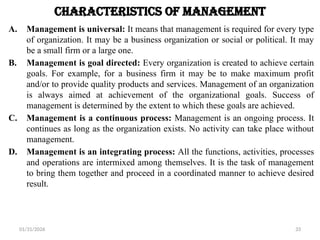
Characteristics of Management
A. Management is universal: It means that management is required for every type
of organization. It may be a business organization or social or political. It may
be a small firm or a large one.
B. Management is goal directed: Every organization is created to achieve certain
goals. For example, for a business firm it may be to make maximum profit
and/or to provide quality products and services. Management of an organization
is always aimed at achievement of the organizational goals. Success of
management is determined by the extent to which these goals are achieved.
C. Management is a continuous process: Management is an ongoing process. It
continues as long as the organization exists. No activity can take place without
management.
D. Management is an integrating process: All the functions, activities, processes
and operations are intermixed among themselves. It is the task of management
to bring them together and proceed in a coordinated manner to achieve desired
result.
34
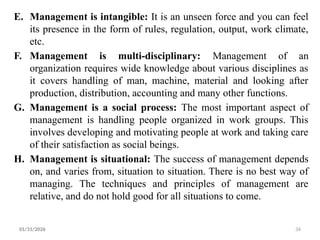
E. Management is intangible: It is an unseen force and you can feel
its presence in the form of rules, regulation, output, work climate,
etc.
F. Management is multi-disciplinary: Management of an
organization requires wide knowledge about various disciplines as
it covers handling of man, machine, material and looking after
production, distribution, accounting and many other functions.
G. Management is a social process: The most important aspect of
management is handling people organized in work groups. This
involves developing and motivating people at work and taking care
of their satisfaction as social beings.
H. Management is situational: The success of management depends
on, and varies from, situation to situation. There is no best way of
managing. The techniques and principles of management are
relative, and do not hold good for all situations to come.
01/31/2026
01/31/2026 35
Functions of Management
• In every organization, the managers perform certain basic functions.
• These are broadly divided into six categories viz., planning, organizing,
staffing, directing, coordinating and controlling.
a) Planning
 Planning is deciding in advance what is to be done, when it is to be done, how
it is to be done.
 It is basically concerned with the selection of goals to be achieved and
determining the effective course of action from among the various alternatives.
 This involves forecasting, establishing targets, developing the policies and
programming and scheduling the action, procedure, etc.,
b) Organizing
– After the plans have been drawn, management has to organize the activities,
and physical resources of the firm to carry out the selected programmes
successfully.
– It also involves determining the authority and responsibility relationships
among functions, departments and personnel at various levels to ensure smooth
and effective function together in accomplishing the objective.
01/31/2026 36
c) Staffing
 Staffing is concerned with employing people for the various activities to be performed.
 The objective of staffing is to ensure that suitable people have been appointed for different
positions.
 It includes the functions of recruitment, training and development, placement and remuneration,
and performance appraisal of the employees.
d) Directing
 The directing function of management includes guiding the subordinates, supervising their
performance, communicating effectively and motivating them.
 A manager should be a good leader. He should be able to command and issue instruction without
arousing any resentment among the subordinates.
e) Coordinating
 Management has to ensure that all the activities contribute to the achievement of the objectives
of the business as a whole. This requires integration of activities and synchronization of efforts.
f) Controlling
 This function of management consists of the steps taken to ensure that the performance of work
is in accordance with the plans.
 It involves establishing performance standards and measuring the actual performance with the
standards set.
 If differences are noticed, corrective steps are taken which may include revision of standards,
regulate operations, remove deficiencies and improve performance.
01/31/2026 37
Role and Importance of Management
• Management is indispensable for the successful functioning of every
organization.
• It is all the more important in business enterprises.
• Every business needs repeated stimulus which can only be provided by
management.
• According to Peter Drucker,“ management is a dynamic life-giving element in
an organization, without it the resources of production remain mere resources
and never become production”.
The importance of management has been highlighted clearly
in the following points:
i. Achievement of group goals:
ii. Optimum utilization of resources: Managers forecast the need for materials,
machinery, money and manpower. They ensure that the organization has
adequate resources and at the same time does not have idle resources.
iii. Minimization of cost: to supply the required goods and services at the lowest
possible cost per unit. Management directs day-to-day operations in such a
manner that all wastage and extravagance are avoided.
01/31/2026 38
iv. Survival and growth: Changes in business
environment create risks as well as opportunities.
 Managers enable the enterprise to minimize the risks and
maximize the benefits of opportunities.
v. Generation of employment: By setting up and
expanding business enterprises, managers create jobs
for the people.
vi. Development of the nation: Efficient management is
equally important at the national level.
 Management is the most crucial factor in economic and social
development.
 The development of a country largely depends on the quality
of the management of its resources.
01/31/2026 39
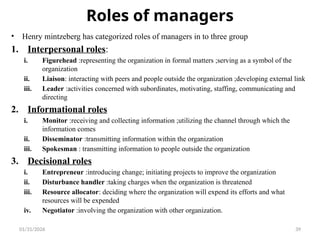
Roles of managers
• Henry mintzeberg has categorized roles of managers in to three group
1. Interpersonal roles:
i. Figurehead :representing the organization in formal matters ;serving as a symbol of the
organization
ii. Liaison: interacting with peers and people outside the organization ;developing external link
iii. Leader :activities concerned with subordinates, motivating, staffing, communicating and
directing
2. Informational roles
i. Monitor :receiving and collecting information ;utilizing the channel through which the
information comes
ii. Disseminator :transmitting information within the organization
iii. Spokesman : transmitting information to people outside the organization
3. Decisional roles
i. Entrepreneur :introducing change; initiating projects to improve the organization
ii. Disturbance handler :taking charges when the organization is threatened
iii. Resource allocator: deciding where the organization will expend its efforts and what
resources will be expended
iv. Negotiator :involving the organization with other organization.
Skills of Management
• skills of managers have been classified into four categories,
namely technical, human, conceptual and diagnostic skills.
i. Technical Skills
Technical skills refer to the ability and knowledge in using
the equipment, technique and procedures involved in
performing specific tasks.
These skills require specialized knowledge and proficiency
in the mechanics of particular job.
Ability in programming and operating computers is, for
instance, a technical skill.
ii. Human Skills
Human skills consists of the ability to work effectively with
other people both as individual and as members of a group.
While technical skills involve mastery of ‘things’ human
skills are concerned with understanding of ‘People’ 40
01/31/2026
01/31/2026 41
III.Conceptual Skills
Conceptual skills comprise the ability to see the whole
organization and the interrelationships between its parts.
These skills refer to the ability to visualize the entire picture
and take a broad and farsighted view of the organization.
IV. Diagnostic Skills
Diagnostic skills include the ability to determine by analysis
and examination the nature and circumstances of particular
conditions.
It is not only the ability to specify why something happened
but also the ability to develop certain possible outcomes.
Thus technical skills deal with jobs, human skills with
persons, conceptual skills with ideas and diagnostic
Skills with investigation. These types of skills are
interrelated
01/31/2026 42
Levels of Management
• Broadly speaking, an organization has two important
levels of management, namely functional and operative.
1. The functional level is concerned with the process of
determining primary objectives, formulating basic
policies, making vital decisions and controlling and
coordinating activities of personnel.
2. The operative level of management is related to
implementation of plans and decisions, and pursuit of
basic policies for achieving the objectives of the
organization.
• Usually, managerial personnel may be placed in three
levels, that is, top, middle and lower or supervisory level.
01/31/2026 43
• The top level determines the objectives of the business
as a whole and lays down policies to achieve these
objectives (making of policy means providing
guidelines for actions and decision).
The top management also exercises an overall control
over the organization.
• The middle-level management includes heads of
various departments, e.g., production, sales, etc., and
other departmental managers.
Middle level managers are particularly concerned
with the activities of their respective departments.
01/31/2026 44
• The lower-level management consists of foremen and
supervisors who look after the operative workers, and
ensure that the work is carried out properly and on time.
 Thus, they have the primary responsibility for the actual
production of goods and services in the organization.
• These three levels of management taken together form the
‘hierarchy of management’.
• It indicates the ranks and positions of managers in the
hierarchy.
• It shows that the middle level management is subordinate
to the top-level and that the lower-level is subordinate to
the middle-level management.
01/31/2026 45
Topic Three:
Managing Agribusiness
01/31/2026 46
3.1. Financial Management
• Financial management seeks to ensure the right amount and
type of funds to business at the right time and at reasonable cost.
• It comprises the following activities:
o Estimating the volume of funds required for both long-term and short-
term needs of business
o Selecting the appropriate source of funds
o Raising the required funds at the right time
o Ensuring proper utilization and allocation of raised funds so as to
maintain safety and liquidity of funds and the creditworthiness and
profitability of business, and
o Administration of earnings
• Thus, financial management involves the planning, organizing
and controlling of the financial resources.
01/31/2026 47
• The capital of a business consists of those funds used to
start and run the business.
• Capital may be of two types: fixed and working.
• Fixed capital refers to items bought once and used for a
long period of time.
• This includes such things as land building, fixtures and
equipment.
• Working capital is the type of funds, which is needed
for carrying out day to day operations of the business
smoothly.
01/31/2026 48
Planning financial needs
• Planning the financial needs of a business is very important.
• The owner or manager needs to be able to ask the following
questions.
1) Why do I need the money?
• The general area of need for money is: (a) starting a new
business, (b) inventory, (c) expansion, (d) remodeling, and (e)
improving working capital.
2) How much money will I need?
• It is important to be able to specify how much money you will
need.
3) When I will be able to repay the money?
• Friends, bankers, and business associates are always interested in
knowing when and how you anticipate repaying the loans.
Sourcing of capital for business
• There are two major forms of financing any business; equity
financing and debt financing.
• Equity capital (ownership) may come from personal savings, from
partnership or by selling stock in a corporation.
• Equity financing involves giving up ownership to the investors of
the business.
• It also involves dividing of the business ownership among the
various investors.
• That is instead of repaying an investor or one is giving money to
the business, the investor now becomes an owner and receives
money from business primarily through dividend or profit sharing
system.
49
01/31/2026
01/31/2026 50
• Debt financing involves the funds that the
entrepreneur has borrowed and must repay with
interest.
• Typically, debt financing requires some assets such as
car, house, plant, machine or land which may be used
as collateral.
• Source of debt capital are commercial banks, co-
operative banks, mutual funds, vendors, equipment
manufacturers and distributors, factors, private
investors, special type of finance lending institutions.
01/31/2026 51
Financial Analysis
• Financial analysis is one of the roots of management used to
carry out its controlling function.
• Proper interpretation of data presented by the financial statement
helps in
© In judging the profitability of operations during given time
periods,
© In determining the soundness of financial condition at a specific
date,
© In determining future potential to meet existing or anticipated
credit obligations and
© In developing performance trends to be used as a basis for future
decision making.
The term financial statement refers to two basic statements that
an accountant prepares at the end of a specified period of time
for a business enterprise.
01/31/2026 52
3.2. Production/Operations Management
• In general, operations management refers to management of
all operations of a production unit.
• So it may be interchanged with production management.
• Production is a system for converting inputs into finished
products.
• The production often refers to manufacturing industries.
• Yet, in reality, production can be defined as the creation of
value or wealth by producing goods and services.
• Production management refers to planning, organization,
direction, co-ordination and control of the production
functions carried out in such a way that the desired goods or
services could be produced at the right time, in right quantity
and at the optimum cost.
01/31/2026 53
• The production management involves the following activities:
 Developing the product/service
 Establishment of proper organization structure
 Selection of personnel
 Establishment and maintenance of factory building, plant and
equipment
 Management of purchases, storage, and transportation of raw
materials
 Ensuring effective control
• In production management decisions to be taken consist of
a) What to produce
b) When to produce
c) How much to produce and
d) How to produce
• Production includes a) manufacturing of commodity (physical output)
and b) creation of services
01/31/2026 54
3.3. Marketing Management
• Marketing management refers to distribution of the firm’s
product or service to the customers in order to satisfy their needs
and to accomplish the firm’s objectives.
• Marketing includes developing the product or service, pricing,
distribution, advertisement, merchandising, doing personal
selling, promoting and directing sales and service to customers.
• on the importance of customers to a firm.
A. Determine what are the customer’s needs and how those needs can
be satisfied.
B. Decide what advantage that will give a competitive edge over
other firms.
• Meeting customer’s needs
• Learning customer’s needs
• Conscious about the firm’s image
• Looking for danger signals
01/31/2026 55
• Marketing management refers to the identification of consumers needs and
supplying them the goods and services which can satisfy these wants.
How to do Marketing Strategies
• This is also called Means of Strategies and It involves the following activities
a) Marketing research to determine the needs and expectation of consumers
b) Planning and developing suitable products
c) Setting appropriate prices
d) Selecting the right channel of distribution, and
e) Promotional activities like advertising and salesmanship to communicate
with the customers
Steps in Market Research
a) Recognition of a problem
b) Preliminary investigation and planning
c) Gathering factual information
d) Classifying and interpreting the information
e) Reaching a conclusion
01/31/2026 56
Market Segmentation
• Market Segmentation means identifying the market in terms of various
characteristics such as economic status, age, education, occupation and
location.
• The best opportunity is to identify a market segment that is not well served
by other firms.
• In determining the firm’s market segment, the fundamental aspects to be
considered are:
a) What is the place of the firm in the industry and how it can compete with others?
b) Whether the firm is known for its quality or price.
c) Image of the firm among the customers.
d) If the firm has limited number of customers the reasons for it.
• A common error found in many retailing firms is ‘ overlapping the market’
or attempting to sell both high quality and low quality goods.
• As a result, the retailer has a limited inventory of everything but does not
have a good selection of anything.
• In sum, the firm should assess its share in the market.
• This perception is possible only when the firm stresses quality, reliability,
integrity and service rather than low prices.
01/31/2026 57
The Marketing Mix
• In considering the needs of their customers, companies must think in terms
of the product itself, the price of the product and the place where the
customers needs it, while making sure that the existence of the product is
known through effective promotion.
• These various components are described in more detail below
Product
• The product is the focus of marketing.
• factors include quality, appearance and performance.
Price
• Price creates sales revenue and is therefore important in determining the
total value of the sales made.
• Price is really determined by what customers perceive as the value of a
commodity or service.
• It is important to understand how customers value commodity or service as
well as how much they are prepared to pay in relation to the benefit they
expect to earn.
01/31/2026 58
Place
• The place factor deals with the various methods of transporting and
storing commodities and then making them available to the customer.
• Getting the product to the right place at the right time depends on the
distribution system.
• The choice of distribution method will depend on market
circumstances and the nature of both the commodity and the
customer.
Promotion
• Promotion is the business of communicating with and influencing the
customer.
• Although the cost associated with promotion can be a significant
element in the overall cost of a product, successful product promotion
increases sales so that costs are spread over a larger output.
59
3.4 Human Resource Management
• The process of planning, organizing, directing (motivating), and
controlling the procurement, development, compensation,
integration, maintenance, and separation of organizational
human resources to the end that organizational, individual, and
societal needs are satisfied.
• HRM includes all activities used to attract & retain employees
and to ensure they perform at a high level in meeting
organizational goals.
• These activities are made up of
1. Recruitment & selection.
2. Training and development.
3. Performance appraisal and feedback.
4. Pay and benefits.
5. Labor relations.
01/31/2026
HRM Components
 Component should be consistent with the others, organization
structure, and strategy.
Recruitment: develop a pool of qualified applicants.
Selection: determine relative qualifications & potential for a job.
Training & Development: ongoing process to develop worker’s abilities
and skills.
Performance appraisal & feedback: provides information about how to
train, motivate, and reward workers.
Managers can evaluate and then give feedback to enhance worker performance.
Pay and Benefits: high performing employees should be rewarded with
raises, bonuses.
Increased pay provides additional incentive.
Benefits, such as health insurance, reward membership in firm.
Labor relations: managers need an effective relationship with labor unions
that represent workers.
• Unions help establish pay, and working conditions.
 If management moves to a decentralized structure, HRM should be
adjusted as well 60
01/31/2026
01/31/2026 61
Human Resource Planning
• HR Planning includes all activities managers do to
forecast current and future HR needs.
Must be done prior to recruitment and selection
Demand forecasts made by managers estimate the
number & qualifications the firm will need.
Supply forecasts estimate the availability and
qualifications of current workers and those in the
labor market.
01/31/2026 62
Topic Four :
Strategic Planning In
Agribusiness
63
What is strategic planning?
• Strategic planning is a process in which an organization's
leaders define their vision for the future and identify their
organization's goals and objectives.
• The process includes establishing the sequence in which those
goals should be realized so that the organization can reach its
stated vision.
• Strategic planning typically represents mid- to long-term goals
with a life span of three to five years, though it can go longer.
• These plans can be easily shared, understood and followed by
various people including employees, customers, business
partners and investors.
• A strategic plan may be updated and revised at that time to
reflect any strategic changes.
01/31/2026
01/31/2026 64
Why is strategic planning important?
• Businesses need direction and organizational goals to work toward.
• Strategic planning offers that type of guidance.
• Essentially, a strategic plan is a roadmap to get to business goals.
• Without such guidance, there is no way to tell whether a business
is on track to reach its goals.
• The following four aspects of strategy development are worth
attention:
1. The mission. Strategic planning starts with a mission that offers a
company a sense of purpose and direction.
 The organization's mission statement describes who it is, what it does
and where it wants to go.
 Missions are typically broad but actionable.
 For example, a business in the education industry might seek to be a
leader in online virtual educational tools and services.
01/31/2026 65
2. The goals. Strategic planning involves selecting goals.
 Most planning uses SMART goals-- specific, measurable,
achievable, realistic and time-bound -- or other objectively
measurable goals.
 Measurable goals are important to determine how well the business is
performing against goals and the overall mission.
 Goal setting for the fictitious educational business might include
releasing the first version of a virtual classroom platform within two
years.
3. Alignment with short-term goals. Strategic planning relates
directly to short-term, tactical business planning and can help
business leaders with everyday decision-making that better
aligns with business strategy.
 For the fictitious educational business, leaders might choose to make
strategic investments in communication and collaboration
technologies, such as virtual classroom software and services but
decline opportunities to establish physical classroom facilities.
01/31/2026 66
4. Evaluation and revision. Strategic planning helps
business leaders periodically evaluate progress against
the plan and make changes or adjustments in response
to changing conditions.
 For example, a business may seek a global presence, but
legal and regulatory restrictions could emerge that affect its
ability to operate in certain geographic regions.
 As result, business leaders might have to revise the strategic
plan to redefine objectives or change progress metrics.
01/31/2026 67
Steps In The Strategic Planning Process?
• There are myriad different ways to approach strategic
planning depending on the type of business and the
granularity required.
• Most strategic planning cycles can be summarized in these
five steps:
1) Identify. A strategic planning cycle starts with the
determination of a business's current strategic position.
o This is where stakeholders use the existing strategic plan --
including the mission statement and long-term strategic goals --
to perform assessments of the business and its environment.
o These assessments can include a needs assessment or a SWOT
analysis to understand the state of the business and the path
ahead.
01/31/2026 68
2) Prioritize. Next, strategic planners set objectives and
initiatives that line up with the company mission and goals
and will move the business toward achieving its goals.
 There may be many potential goals, so planning
prioritizes the most important, relevant and urgent ones.
3) Develop. This is the main thrust/lunge of strategic
planning in which stakeholders collaborate to formulate
the steps or tactics necessary to attain a stated strategic
objective.
 This may involve creating numerous short-term tactical
business plans that fit into the overarching strategy.
 Stakeholders involved in plan development use various
tools such as a strategy map to help visualize and tweak the
plan.
01/31/2026 69
4) Implement. Once the strategic plan is
developed, it's time to put it in motion.
 This requires clear communication across the
organization to set responsibilities, make
investments, adjust policies and processes, and
establish measurement and reporting.
5) Update. A strategic plan is periodically reviewed and
revised to adjust priorities and reevaluate goals as
business conditions change and new opportunities
emerge.
– Quick reviews of metrics can happen quarterly, and
adjustments to the strategic plan can occur annually.
– Stakeholders may use balanced scorecards and other
tools to assess performance against goals.
01/31/2026 70
Topic Five :
Decision Making in
Agribusiness
01/31/2026 71
What is decision making ?
• Decision making is required of everyone, individuals as
well as managers, and applies to taking advantage of
opportunities as well as solving problems.
• Each of us make many decisions every day.
• We have decide whether and when to get up, what
clothes to wear, what to eat, where to go, and how to get
there, in addition to the countless job or school decisions
we face.
• Most of these decisions fall into the “routine” category
and don’t require a great deal of analytical effort.
• Occasionally, though, a choice comes along that involves
much greater stakes.
01/31/2026 72
• Managerial Decision Making can be defined as the
conscious selection of a course of action from available
alternatives to produce a desired result.
• Notice several aspects of this definition.
 First, decision making involves a conscious choice, not an
unconscious or involuntary reaction.
 Second, there must be two or more available alternatives;
otherwise there is no decision to be made.
 Third, the course of action selected leads to a desired result.
• Decision making is a way of life for managers, and the
quality of the decisions made is a predominant factor in
how upper management views a lower manager’s
performance.
01/31/2026 73
7 Seven Common Challenges Of Agribusiness Management
• As the world’s population continues to grow, so does the
demand for food.
• This increased demand has created challenges for those
in the agribusiness industry, as they must find ways to
increase production while still maintaining profitability.
• Some of the biggest challenges faced by agribusinesses
include:
74
#1 Agribusiness Sustainability
• One of the biggest challenges to sustainability in agribusiness is the need
to produce food for a growing population.
• The world’s population is projected to reach 9.8 billion by 2050, and the
demand for food is expected to increase by 70%.
• This will put pressure on already strained resources and make it even
more difficult to produce food sustainably.
• In addition, climate change is already having an impact on
agriculture and is expected to become an even greater threat in the
future.
• Extreme weather events, such as droughts and floods, are becoming
more frequent and intense.
• However, there are many steps that can be taken to make agriculture
more sustainable. These include improving agricultural practices,
investing in research and development, and creating policies that support
sustainability.
01/31/2026
75
#2 Failed Biosecurity
• The term “biosecurity” is often used in relation to agriculture
and
• Biosecurity refers to the measures taken to protect crops and
livestock from diseases.
• Agricultural biosecurity is therefore a vital part of ensuring food
security, as well as safeguarding the livelihoods of farmers and
other people involved in the sector.
• Threats to biosecurity include pests like large birds, small
insects, and microorganisms which affect the healthy growth of
crops and livestock.
• Viruses, bacteria, and other microorganisms which attack
livestock are also challenges in agribusiness management.
• A very simple outbreak of a virus can cause the death of every
single animal that is reared on that farm because of the
contagious nature of viruses.
01/31/2026
01/31/2026 76
#3 No or Limited Access to Innovation and Technology
• Technological advancement occurs consistently and the
inability of agribusiness owners to join the technological
transition is a major challenge of agribusiness management.
• To maximize profit, a business must be producing at a
higher level, especially where there is competition among
those producing the same products.
• While agribusiness has become increasingly dependent on
technology, access to technology is still a challenge in
many parts of the world.
• This is due to a number of factors, including the high cost
of technology, lack of infrastructure, and lack of skilled
personnel.
77
#4 Natural or Man-Made Disasters
• Disasters can have a significant impact on agribusinesses, both in terms of
the damage they cause to crops and infrastructure, and in terms of the
disruption to supply chains.
• In addition, agribusinesses are often located in regions that are particularly
vulnerable to natural disasters such as floods, hurricanes, and earthquakes.
• There are a number of ways in which agribusinesses can mitigate the risks
posed by disasters.
• These include investing in robust physical infrastructure, such as raised
storage facilities and flood-proof buildings; investing in risk management
and insurance products; and developing contingency plans for how to
maintain production in the event of a disaster.
• Despite these mitigation strategies, disasters will continue to pose a
challenge to agribusinesses.
• In the face of increasingly severe weather events, it is crucial that
businesses have robust plans in place to deal with the consequences of a
disaster.
01/31/2026
01/31/2026 78
#5 Unfavorable Government Policies
• There are a number of reasons why unfavorable government
policies present a challenge in agribusiness.
• First, the sector is highly regulated, and changes in government
policy can have a significant impact on business operations.
• Second, the sector is also heavily dependent on government
subsidies and other forms of support, which can be reduced or
eliminated if government policies change.
• Finally, the agribusiness sector is often politically sensitive, and
companies may face pressure to conform to changing
government policies or risk losing access to important markets.
• As a result, agribusinesses must carefully monitor changes in
government policy and adapt their operations accordingly.
79
#6 Low or No Financial Support
• Agricultural businesses are typically small businesses, which
can make it difficult to secure loans from banks or other
traditional sources of financing.
• In addition, the agricultural sector is subject to volatile
market conditions that can make it difficult for farmers and
ranchers to repay loans.
• As a result, agricultural businesses often rely on government
programs and subsidies to provide financial support.
• However, these programs are not always well-funded or
well-designed, which can create challenges for agricultural
businesses.
01/31/2026
01/31/2026 80
#7 Unfavorable Market Conditions and Competition
• The current state of the economy is putting pressure
on businesses in the agricultural industry.
• Unfavorable market conditions and increased
competition are making it difficult for companies to
turn a profit.
• In addition, the high cost of inputs such as seeds,
fertilizer, and equipment is also eating into profits.
• Global factors such as weather patterns and trade
tariffs are also having an impact on farmers around
the world.
81
Kinds of Decisions
• The broader and modern types of managerial decisions are
A. Decisions whether - This is the yes/no, either/or decision
that must be made before we proceed with the selection
of an alternative.
 Should I buy a new business? Should I travel this summer?
 Decisions whether are made by weighing reasons, problems
and constraints.
B. Decisions which - These decisions involve a choice of
one or more alternatives from among a set of
possibilities, the choice being based on how well each
alternative measures up to a set of predefined criteria.
C. Contingent decisions - These are decisions that have
been made but put on hold until some condition is met.
01/31/2026
01/31/2026 82
STEPS INVOLVED IN DECISION MAKING PROCESS
• The entire decision-making process is dependent upon the
right information being available to the right people at the
right times.
• The decision-making process involves the following steps:
1. Define the problem. The accurate definition of the
problem affects all the steps that follow; if the problem is
inaccurately defined, every step in the decision-making
process will be based on an incorrect starting point.
2. Identify limiting factors:-managers need to have the ideal
resources information, time, personnel, equipment, and
supplies — and identify any limiting factors.
3. Develop potential alternatives:-a manager should think
through and investigate several alternative solutions to a
single problem before making a quick decision.
01/31/2026 83
4. Analyze the alternatives:-The purpose of this step is to
decide the relative merits of each idea. Managers must
identify the advantages and disadvantages of each
alternative solution before making a final decision.
5. Select the best alternative:-The best alternative is the one
that produces the most advantages and the fewest serious
disadvantages.
6. Implement the decision:-Managers are paid to make
decisions, but they are also paid to get results from these
decisions.
7. Establish a control and evaluation system:-Ongoing
actions need to be monitored.
01/31/2026 84
What is Business Performance Analysis?
• Business performance analysis refers to a variety of
techniques used to quantify the performance of a company
over a given period of time.
• A performance analysis could be done on just about any
area of a business, provided the correct key performance
indicators are factored in the analysis.
• A key performance indicator, or KPI, is a metric that
best depicts the performance of a particular area of a
business, regardless of other factors.
• KPIs allow for a proper review to be done independently
of external circumstances and drills down to the actual
performance of a particular unit.
01/31/2026 85
Topic Six:
Agribusiness
Environment
Internal And External Business
Environment
Internal Environment
• These are factors from inside the firm that could
affect performance.
1. Finance Available – without money the firm may
not be able to do what they wish.
2. Ability of Staff – the more capable staff are the
more productive they will be.
3. Information Available – the better the
information the better the decisions made.
4. ICT Availability – this can influence the
quality and quantity of what is produced
5. Ability of Management – good managers
will make good decisions
6. Changes in Costs – increases in wages or
raw materials can affect the profitability
of the firm
External Environment
• This is summarised as:
• Political
• Economic
• Social
• Technological
• Environmental
• Competitive
POLITICAL
• Laws passed by government can affect the what a
business does.
• E.g. shops are not allowed to sell alcohol on
Sunday mornings or the smoking ban in public
places.
• Failure to follow laws will result in fines.
• Other ways the government can influence is
through setting taxation rates and investment in
infrastructure.
ECONOMIC
• This includes changes in interest rates,
exchange rates, inflation and the economic
cycle.
• If interest rates are high this could stop
firms from borrowing money also
customers are less likely to borrow or use
credit cards to make purchases.
• If the pound is high against other currencies this
makes it hard to export goods abroad, reducing the
number of sales.
• If inflation is high, the prices of raw materials can
be expensive which can reduce profits.
• If the economy is in recession, people tend to be
unemployed or worried about losing their job,
therefore not spending money on luxury goods.
SOCIAL
• DEMOGRAPHIC CHANGES
• This is to do with the size and distribution of the population
of a country.
• SOCIO-CULTURAL CHANGES
• This is about changes in lifestyle and attitude.
• E.g. More women working has seen a rise in ready meal and
later opening hours
• More concern about the environment, forcing firms to
maybe use recycled products.
TECHNOLOGICAL
• Firms need to keep up-to-date with the latest
technology in order to remain competitive.
• Have seen a huge growth in e-commerce (buying and
selling online)
• Use of machinery in the production process – more
efficient and cheaper.
ENVIRONMENTAL
• Firms are aware that they have to be more
environmentally friendly, not only because that
is what customers want, but can be forced by
the government to do so.
• It can also include storms, floods, noise.
• All these can affect how a business operates.
COMPETITIVE
• What the competition is doing can affect how
a business operates.
• Firms now not only face domestic competition
but also foreign.
• Have to keep up or be better than your
competition to keep your customers.

ABVM 211 Introduction to ABM FULL.pptxs4$./

  • 1.
    01/31/2026 1 Introduction to AgribusinessManagement (ABVM 211) Osman c.
  • 2.
    01/31/2026 2 contents • Topicone: introduction to Agribusiness • Topic two: Agribusiness management overview • Topic three: managing agribusiness • Topic four: strategic planning in agribusiness • Topic five: decision making in agribusiness • Topic six: agribusiness environment
  • 3.
  • 4.
    4 Definitions of Agribusiness •Agribusiness is a combination of two words agriculture and business. • In simple words, “business means the state of being busy”. • Broadly, business involves activities connected with the production of wealth. • Business is an organized and systematized human activity involving buying and selling goods, manufacturing goods or providing services in order to earn profit. • The word agriculture indicates plowing a field, planting seed, harvesting a crop, milking cows, or feeding livestock. • Until recently, this was a accurate picture. • Nevertheless, today’s’ agriculture is radically different. 01/31/2026
  • 5.
    01/31/2026 5 • Agriculturehas evolved into agribusiness and has become a vast and complex system that reaches far beyond the farm to include all those who are involved in providing food and fiber to consumers. • Agribusiness includes not only those farms or the land but also The people and firms that provide the inputs (for example seed, chemicals, credit etc.), Process the output (e.g. milk, grain, meat etc.), Manufacture the food products (for example: ice cream, bread, breakfast cereals etc.), and Transport and sell the food products to consumers (for ex. restaurants, supermarkets). • Literally, agribusiness refers to the industry concerned with the production, processing, and distribution of agricultural products or with farm machinery and services.
  • 6.
    6 • It isapparent that the definition of agriculture has to be expanded to include concepts more than production. • Farmers rely on the input industries to provide products and service; they need to produce agricultural commodities. • They also rely on commodity processors, food manufactures, and ultimately food distributors and retailers to purchase their raw agricultural commodities and to process and deliver them to the consumer for final sale. • The result is the food and fiber system. The food and fiber system is increasingly being referred to as “agribusiness • Davis and Goldberg first introduced the term agribusiness in 1957. It represents three part systems made up of 1) The agricultural input sector 2) The production sector and 3) The processing-manufacturing sector.  To capture the full meaning of the term “agribusiness” it is important to visualize these three sectors as interrelated parts of a system in which the success of each part depends heavily on the proper functioning of the other two. 01/31/2026
  • 7.
    01/31/2026 7 Scope ofAgribusiness • It has already indicated that agribusiness is a complex system of input sector, production sector, processing manufacturing sector and transport and marketing sector. • Therefore, it is directly related to industry, commerce and trade. • Industry is concerned with the production of commodities and materials while commerce and trade are concerned with their distribution. • Agribusiness may encompass the primary production activities, the processing sectors and the tertiary activities too. It has a broader scope. • The modern definition of agribusiness calls for more of an industry. Let us explain what an industry is then.
  • 8.
    01/31/2026 8 Types ofIndustry • Industry: refers to the processes of extraction and production of goods meant for final consumption or use buy individual or buy another industry for its production. • Thus, goods used by the final or ultimate consumers are called “consumer goods” such as edible oils, fruit jams, papaya, pickles etc. • Types of industries: Based on their nature, industries are broadly classified into following types: 1. Extractive industries: These industries are concerned with the extraction; and utilization of natural resources. Example: fishing, fruit gathering, agro-based industries, forestation. 2. Genetic industries: These industries include breeding of plants, seeds, cattle breeding farm, fish hatcheries, and poultry farms. 3. Manufacturing industries: These industries are engaged in the conversion of raw material or semi finished goods produced in the extractive industries. Some prominent examples are: cotton textile industry, spinning and weaving mills etc.  Manufacturing industries can further be classified into five types:  (i) Analytical industry (ii) Processing industry (iii) Synthetic industry, (iv) Service industry (v) Assembly industry.
  • 9.
    01/31/2026 9 The Natureof Successful Agribusiness • Today, the business has become very competitive and complex. • This is mainly due to changing taste and fashion of the consumers on one hand, and introduction of substitutes and cheaper and better competitive goods, on the other hand. • The old dictum “produce and sells has changed overtime into produce only what customers want”. • In fact, knowing what customers want is never simple. • Nevertheless, a farmer operator or farmer manager has to give proper thought to this consideration in order to make his/her business a successful one.
  • 10.
    10 The important requisitesfor success in a modern business are: 1. Clear objectives: it is one of the most essential prerequisite for the success of business. The objectives set forth should be realistic and clearly defined. Then, all the business efforts should be geared to achieve the set objectives. 2. Planning: In simple words, planning is a pre-determined line of action. The accomplishment of objectives set, largely, depends upon planning itself. Planning is a proposal based on part of experience and present trends for future actions. 3. Sound organization: An organization is the art or science of building up systematical whole by a number of but related parts. Just as human frame is built up of various parts like heart, liver, brain, legs etc. similarly, organization of business is a harmonies combination of men, machine material, money management etc. so that all these could work jointly as one unit, i.e. “business "or “the agribusiness” 01/31/2026
  • 11.
    01/31/2026 11 3. Research:As indicated earlier, today the agricultural production philosophy “produces what the consumer wants”. “Consumers” behavior is influenced by variety of factors like cultural, social, personal and psychological factors. The knowledge of these factors is acquired through market research. Research is a systematic search for new knowledge. Market research enables a business in finding out new methods of production, improving the quality of product and developing new products as per the changing tastes and wants if the consumers. 4. Finance: Finance is said to be the life-blood of business enterprise.  It brings together the land, labor, machine and raw materials into production.
  • 12.
    01/31/2026 12 5. Properplant location, layout and size: The success of agribusiness depends largely on the location where it is set up. – Location of the business should be convenient from various points of view such as availability of required infrastructure facilities, availability of inputs like raw materials, skill labor, nearer to the market etc. 6. Efficient management: One of the reasons for failure of business often attributed to the poor management or inefficient management. 7. Harmonious relations with the workers: for successful operation of business, there should be cordial and harmonious relations maintained with the workers or labors to get their full cooperation in achieving business activities.
  • 13.
    01/31/2026 13 Scaling Agribusiness •Taking successful development interventions to scale is critical if the world is to achieve the Millennium Development Goals and make essential gains in the fight for improved agricultural productivity, rural incomes, and nutrition. • How to support scaling up in agriculture, rural development, and nutrition, however, is a major challenge. • There are many examples of successful scaling up. – The Green Revolution dramatically raised the productivity of farmers in many parts of the world; – the microcredit schemes of Grameen Bank and (Bangladesh Rural Advancement Committee) BRAC in Bangladesh helped millions of poor improve their livelihoods; – the multi donor River Blindness Eradication Program controlled a debilitating disease affecting millions of people in Western Africa; and – the conditional cash transfer program Progresa-Oportunidades improved the lives of millions of poor households in Mexico by offering them cash payments in exchange for sending their children to school and health clinics—a success story that has been replicated in many other developing countries.
  • 14.
    01/31/2026 14 • Scalingup is especially important for agriculture, rural development, and nutrition because of the global challenges of food security and rural poverty. • Moreover, if the obstacles to reducing rural poverty and malnutrition are to be overcome, and if extensive, deep, and productive value chains for specific commodities are to be created, then appropriate institutional, policy, and investment strategies are required. • Their goals must be to help successful interventions take hold, expand, and be sustained. • Scaling up expands, replicates, adapts, and sustains successful policies, programs, or projects to reach a greater number of people.
  • 15.
    01/31/2026 15 • Scalingup is means expanding ,replicating, adapting and sustaining successful policies , programs or projects to reach a greater number of people • It is part of a broader process of innovation and learning. • A new idea, model, or approach is typically embodied in a pilot project of limited impact; with monitoring and evaluation (M&E), the knowledge acquired from the pilot experience can be used to scale up the model to create larger impacts.
  • 16.
    01/31/2026 16 Agribusiness Formation:Legal Forms of Agribusiness • An agribusiness may be a firm with billions of dollars of sales that employs thousands of people, or it may be as small as an individual who is a part-time seed corn salesperson. • Agribusinesses may engage in a variety of activities that are related to the production, processing, marketing, and distribution of food and fiber products. • Though the one-person or one-family agribusiness is not uncommon, most of the actual business volume in agribusiness is conducted by enterprises that employ hundreds or even thousands of people.
  • 17.
    01/31/2026 17 • Everyagribusiness is owned by someone, and it is the circumstances of ownership that give an organization its specific legal form. • There are four basic business forms: Sole proprietorship, Partnership, Corporation, Cooperative.
  • 18.
    01/31/2026 18 Factors InfluencingChoice Of Business Form 1. What type of business is it, where will it be conducted, and what are the owners’ objectives and philosophies for the agribusiness? 2. How much capital is available for the firm’s start-up? 3. How much capital is needed to support the agribusiness? 4. How easy is it to secure additional capital for the agribusiness? 5. What tax liabilities will be incurred and what tax options are available?
  • 19.
    01/31/2026 19 1. Thesole proprietorship • The oldest and simplest form of business organization is the sole or individual proprietorship, an organization owned and controlled by one person or family. • It is the most popular business organization. • All profits and losses, all liability to creditors and liability from other business activities are vested in the proprietor. • The legal requirements necessary to organize as a sole proprietorship are minimal. • The proprietorship gives the individual owner complete control over the business, subject only to government regulations that are applicable to all businesses of that particular type.
  • 20.
    01/31/2026 20 • Theowner exerts complete control over plans, programs, policies, and other management decisions. • Perhaps the most important disadvantage of the proprietorship is the owner’s personal liability for all debts and liabilities of the business, which can extend even to the owner’s personal estate. • In a proprietorship, there is no separation between business assets and personal assets. • Consequently, this form of business organization is characterized by what is called unlimited liability. • The owner’s liability does not stop with business assets; it also extends to personal assets. • Another important disadvantage relates to the generally limited amount of capital funds that one person can contribute. • Lenders are also somewhat reluctant to lend to an individual owner unless the owner’s personal equity can guarantee the loan. • Proprietorships often find that they are starved for capital, and this serious disadvantage may do more than stunt growth.
  • 21.
    01/31/2026 21 2. Partnerships •A partnership is the association of two or more people as owners of a business. • There is no limit to the number of people who may join a partnership. • Apart from the fact that a partnership involves more than one person, it is similar to the proprietorship. • Partnerships can be based upon written or oral agreements, or on formal contracts between the parties involved. • There are basically two kinds of partnership: general partnerships limited partnerships
  • 22.
    01/31/2026 22 General partnerships •In a general partnership , each individual partner regardless of the percentage of capital contributed has equal rights and liabilities, unless stated otherwise in a partnership agreement. • A general partner has the authority to act as an agent for the partnership, and normally participates in the management and operation of the business. • Each general partner is liable for all partnership debts, and may share in profits, in equal proportion with all other partners. • If the partnership struggles and has financial problems, all liabilities are shared equally among the partners for as long as sufficient personal resources exist.
  • 23.
    01/31/2026 23 Limited partnership •All partnerships are required by law to have at least one general partner who is responsible for the operation and activities of the business, but it is possible for other partners to be involved in the business on a limited basis. • A limited partnership permits individuals to contribute money or other ownership capital without incurring the full legal liability of a general partner. • A limited partner’s liability is generally limited to the amount that the individual has personally invested in the business.
  • 24.
    24 Advantages of Partnership •The following, are the advantages of partnership: I. Greater Financial Resources: Unlike a one-man, business between two and twenty persons forms the partnership. II. Combined Abilities and Skills: In partnership, there are various partners, with various ideas, i.e. accountants, marketers, bankers, historians, managers etc. III. Greater Continuity: Relative to the sole proprietorship, the partnership has a very great tendency of continuity even in death. IV. Ease of Formation: Like-one-man business, the partnership is fairly easy to organize as there are few governmental regulations, governing the formation of partnerships. V. Joint and Better Decision: That two good heads are better than one and this is applicable to partnership business where joint and better decisions are taken. VI. Creation of Employment Opportunities: The large size partnership is in a vantage position to employ more in their business because of its huge financial resources. VII. Tax Advantage: Partnership enjoys tax advantage. Taxes are therefore, levied upon the individual owners rather than upon the firm as it are not recognized as a legal entity. VIII.Application of Division of Labour: This is applicable in its managerial and administrative hierarchy. 01/31/2026
  • 25.
    25 Disadvantages of Partnership Unlimited Liability: If the business fails in the process, assets will be sold to offset their liabilities. In a situation where the assets can not pay for the debt, the owners’ personal belongings could be sold to offset such debts.  The Business is not a Legal Entity: Most of the partnership business has no legal backing.  Disagreement and Resignation: Death of a partner can lead to the death of a business especially the active partner.  Decline in Pride of Ownership: Since the partnership is owned by at least two people the pride and joy associated with ownership is reduced.  Bureaucracy Leads to Slow Decision and Policy Making: Meeting that require quorum/required No, may not always be formed.  Restriction on Sale of Interest: There is a difficulty in affecting transfer of ownership. The interest of operation is not transferable without the consent of other partners. 01/31/2026
  • 26.
    01/31/2026 26 3. TheCorporation • A corporation is a special legal entity endowed by law with the powers, rights, liabilities, and duties of a person (in fact a corporation is sometimes referred to as an “artificial” person). • The corporate form of business organization typically facilitates the accumulation of greater amounts of capital when compared to proprietorships and partnerships. • Most corporations are formed for profit-making purposes; however, there are thousands of nonprofit corporations in existence. • These nonprofit corporations embrace many areas of activity, including those of religious, governmental, labor, and charitable organizations.
  • 27.
    01/31/2026 27 Stock ofthe corporation • When corporations are formed, shares of stock are sold to those who are interested in investing and risking their money in the enterprise. • A share of stock is a piece of paper, in prescribed legal form, which represents each person’s amount of ownership in the corporation. • Thus, there are two specific types of stockholders in a for-profit corporation. • Common stock normally carries the privilege of voting for the board of directors that oversees the activities of the corporation. • Preferred stock differs from common stock in that it is usually nonvoting, and has a preferred position in receiving dividends and in redemption in the case of liquidation.
  • 28.
    01/31/2026 28 • Commonstockholders are willing to take risk. They invest in the corporation typically because they believe the value of their stock will increase over time. – At the annual meeting, common stockholders are the ones that vote for the board of directors of the corporation. – Each common stockholder has one vote per share of common stock. • In contrast, preferred stockholders tend to take less risk on their investment in the corporation. – The price of preferred stock typically fluctuates less than common stock in publicly traded corporations. – Also, preferred stockholders often invest for the dividends granted by the corporation.
  • 29.
    01/31/2026 29 Advantage andDisadvantage of Corporation • The major Advantages of corporations as a form of business are – Limited liability of shareholders, – Large capital formation, – Ease of transfer of ownership, – Continuity of existence. • The Disadvantages of corporations are: – Double taxation of profits, – Possible conflicts between management and shareholders – Government regulations.
  • 30.
    01/31/2026 30 4. Cooperatives •Owned, operated and controlled by members, a cooperative is a distinct form of the corporate form of business. • Cooperatives are committed to helping members improve the prices they receive for the products they produce and/or reduce the prices paid for the inputs necessary to grow those products. • Cooperatives also exist to help members find markets, and/or improve the negotiating position of members. • Cooperatives provide economic and/or operational benefits to member-owners, and then return the profit to the member-owners based on each member’s use of the cooperative.
  • 31.
    01/31/2026 31 • Threespecific features delineate cooperatives from non-cooperative businesses: – Member owned, member controlled – Operation at cost (In most cases, a cooperative’s net income is distributed to individual members in proportion to the volume of business that they have done with the cooperative.) – Limited returns on capital (Limiting returns on member equity to a nominal amount helps to ensure that members holding stock in the cooperative are not tempted to view the cooperative as an investment in and of itself, but rather as a service to their own business.)
  • 32.
  • 33.
    01/31/2026 33 Characteristics ofManagement A. Management is universal: It means that management is required for every type of organization. It may be a business organization or social or political. It may be a small firm or a large one. B. Management is goal directed: Every organization is created to achieve certain goals. For example, for a business firm it may be to make maximum profit and/or to provide quality products and services. Management of an organization is always aimed at achievement of the organizational goals. Success of management is determined by the extent to which these goals are achieved. C. Management is a continuous process: Management is an ongoing process. It continues as long as the organization exists. No activity can take place without management. D. Management is an integrating process: All the functions, activities, processes and operations are intermixed among themselves. It is the task of management to bring them together and proceed in a coordinated manner to achieve desired result.
  • 34.
    34 E. Management isintangible: It is an unseen force and you can feel its presence in the form of rules, regulation, output, work climate, etc. F. Management is multi-disciplinary: Management of an organization requires wide knowledge about various disciplines as it covers handling of man, machine, material and looking after production, distribution, accounting and many other functions. G. Management is a social process: The most important aspect of management is handling people organized in work groups. This involves developing and motivating people at work and taking care of their satisfaction as social beings. H. Management is situational: The success of management depends on, and varies from, situation to situation. There is no best way of managing. The techniques and principles of management are relative, and do not hold good for all situations to come. 01/31/2026
  • 35.
    01/31/2026 35 Functions ofManagement • In every organization, the managers perform certain basic functions. • These are broadly divided into six categories viz., planning, organizing, staffing, directing, coordinating and controlling. a) Planning  Planning is deciding in advance what is to be done, when it is to be done, how it is to be done.  It is basically concerned with the selection of goals to be achieved and determining the effective course of action from among the various alternatives.  This involves forecasting, establishing targets, developing the policies and programming and scheduling the action, procedure, etc., b) Organizing – After the plans have been drawn, management has to organize the activities, and physical resources of the firm to carry out the selected programmes successfully. – It also involves determining the authority and responsibility relationships among functions, departments and personnel at various levels to ensure smooth and effective function together in accomplishing the objective.
  • 36.
    01/31/2026 36 c) Staffing Staffing is concerned with employing people for the various activities to be performed.  The objective of staffing is to ensure that suitable people have been appointed for different positions.  It includes the functions of recruitment, training and development, placement and remuneration, and performance appraisal of the employees. d) Directing  The directing function of management includes guiding the subordinates, supervising their performance, communicating effectively and motivating them.  A manager should be a good leader. He should be able to command and issue instruction without arousing any resentment among the subordinates. e) Coordinating  Management has to ensure that all the activities contribute to the achievement of the objectives of the business as a whole. This requires integration of activities and synchronization of efforts. f) Controlling  This function of management consists of the steps taken to ensure that the performance of work is in accordance with the plans.  It involves establishing performance standards and measuring the actual performance with the standards set.  If differences are noticed, corrective steps are taken which may include revision of standards, regulate operations, remove deficiencies and improve performance.
  • 37.
    01/31/2026 37 Role andImportance of Management • Management is indispensable for the successful functioning of every organization. • It is all the more important in business enterprises. • Every business needs repeated stimulus which can only be provided by management. • According to Peter Drucker,“ management is a dynamic life-giving element in an organization, without it the resources of production remain mere resources and never become production”. The importance of management has been highlighted clearly in the following points: i. Achievement of group goals: ii. Optimum utilization of resources: Managers forecast the need for materials, machinery, money and manpower. They ensure that the organization has adequate resources and at the same time does not have idle resources. iii. Minimization of cost: to supply the required goods and services at the lowest possible cost per unit. Management directs day-to-day operations in such a manner that all wastage and extravagance are avoided.
  • 38.
    01/31/2026 38 iv. Survivaland growth: Changes in business environment create risks as well as opportunities.  Managers enable the enterprise to minimize the risks and maximize the benefits of opportunities. v. Generation of employment: By setting up and expanding business enterprises, managers create jobs for the people. vi. Development of the nation: Efficient management is equally important at the national level.  Management is the most crucial factor in economic and social development.  The development of a country largely depends on the quality of the management of its resources.
  • 39.
    01/31/2026 39 Roles ofmanagers • Henry mintzeberg has categorized roles of managers in to three group 1. Interpersonal roles: i. Figurehead :representing the organization in formal matters ;serving as a symbol of the organization ii. Liaison: interacting with peers and people outside the organization ;developing external link iii. Leader :activities concerned with subordinates, motivating, staffing, communicating and directing 2. Informational roles i. Monitor :receiving and collecting information ;utilizing the channel through which the information comes ii. Disseminator :transmitting information within the organization iii. Spokesman : transmitting information to people outside the organization 3. Decisional roles i. Entrepreneur :introducing change; initiating projects to improve the organization ii. Disturbance handler :taking charges when the organization is threatened iii. Resource allocator: deciding where the organization will expend its efforts and what resources will be expended iv. Negotiator :involving the organization with other organization.
  • 40.
    Skills of Management •skills of managers have been classified into four categories, namely technical, human, conceptual and diagnostic skills. i. Technical Skills Technical skills refer to the ability and knowledge in using the equipment, technique and procedures involved in performing specific tasks. These skills require specialized knowledge and proficiency in the mechanics of particular job. Ability in programming and operating computers is, for instance, a technical skill. ii. Human Skills Human skills consists of the ability to work effectively with other people both as individual and as members of a group. While technical skills involve mastery of ‘things’ human skills are concerned with understanding of ‘People’ 40 01/31/2026
  • 41.
    01/31/2026 41 III.Conceptual Skills Conceptualskills comprise the ability to see the whole organization and the interrelationships between its parts. These skills refer to the ability to visualize the entire picture and take a broad and farsighted view of the organization. IV. Diagnostic Skills Diagnostic skills include the ability to determine by analysis and examination the nature and circumstances of particular conditions. It is not only the ability to specify why something happened but also the ability to develop certain possible outcomes. Thus technical skills deal with jobs, human skills with persons, conceptual skills with ideas and diagnostic Skills with investigation. These types of skills are interrelated
  • 42.
    01/31/2026 42 Levels ofManagement • Broadly speaking, an organization has two important levels of management, namely functional and operative. 1. The functional level is concerned with the process of determining primary objectives, formulating basic policies, making vital decisions and controlling and coordinating activities of personnel. 2. The operative level of management is related to implementation of plans and decisions, and pursuit of basic policies for achieving the objectives of the organization. • Usually, managerial personnel may be placed in three levels, that is, top, middle and lower or supervisory level.
  • 43.
    01/31/2026 43 • Thetop level determines the objectives of the business as a whole and lays down policies to achieve these objectives (making of policy means providing guidelines for actions and decision). The top management also exercises an overall control over the organization. • The middle-level management includes heads of various departments, e.g., production, sales, etc., and other departmental managers. Middle level managers are particularly concerned with the activities of their respective departments.
  • 44.
    01/31/2026 44 • Thelower-level management consists of foremen and supervisors who look after the operative workers, and ensure that the work is carried out properly and on time.  Thus, they have the primary responsibility for the actual production of goods and services in the organization. • These three levels of management taken together form the ‘hierarchy of management’. • It indicates the ranks and positions of managers in the hierarchy. • It shows that the middle level management is subordinate to the top-level and that the lower-level is subordinate to the middle-level management.
  • 45.
  • 46.
    01/31/2026 46 3.1. FinancialManagement • Financial management seeks to ensure the right amount and type of funds to business at the right time and at reasonable cost. • It comprises the following activities: o Estimating the volume of funds required for both long-term and short- term needs of business o Selecting the appropriate source of funds o Raising the required funds at the right time o Ensuring proper utilization and allocation of raised funds so as to maintain safety and liquidity of funds and the creditworthiness and profitability of business, and o Administration of earnings • Thus, financial management involves the planning, organizing and controlling of the financial resources.
  • 47.
    01/31/2026 47 • Thecapital of a business consists of those funds used to start and run the business. • Capital may be of two types: fixed and working. • Fixed capital refers to items bought once and used for a long period of time. • This includes such things as land building, fixtures and equipment. • Working capital is the type of funds, which is needed for carrying out day to day operations of the business smoothly.
  • 48.
    01/31/2026 48 Planning financialneeds • Planning the financial needs of a business is very important. • The owner or manager needs to be able to ask the following questions. 1) Why do I need the money? • The general area of need for money is: (a) starting a new business, (b) inventory, (c) expansion, (d) remodeling, and (e) improving working capital. 2) How much money will I need? • It is important to be able to specify how much money you will need. 3) When I will be able to repay the money? • Friends, bankers, and business associates are always interested in knowing when and how you anticipate repaying the loans.
  • 49.
    Sourcing of capitalfor business • There are two major forms of financing any business; equity financing and debt financing. • Equity capital (ownership) may come from personal savings, from partnership or by selling stock in a corporation. • Equity financing involves giving up ownership to the investors of the business. • It also involves dividing of the business ownership among the various investors. • That is instead of repaying an investor or one is giving money to the business, the investor now becomes an owner and receives money from business primarily through dividend or profit sharing system. 49 01/31/2026
  • 50.
    01/31/2026 50 • Debtfinancing involves the funds that the entrepreneur has borrowed and must repay with interest. • Typically, debt financing requires some assets such as car, house, plant, machine or land which may be used as collateral. • Source of debt capital are commercial banks, co- operative banks, mutual funds, vendors, equipment manufacturers and distributors, factors, private investors, special type of finance lending institutions.
  • 51.
    01/31/2026 51 Financial Analysis •Financial analysis is one of the roots of management used to carry out its controlling function. • Proper interpretation of data presented by the financial statement helps in © In judging the profitability of operations during given time periods, © In determining the soundness of financial condition at a specific date, © In determining future potential to meet existing or anticipated credit obligations and © In developing performance trends to be used as a basis for future decision making. The term financial statement refers to two basic statements that an accountant prepares at the end of a specified period of time for a business enterprise.
  • 52.
    01/31/2026 52 3.2. Production/OperationsManagement • In general, operations management refers to management of all operations of a production unit. • So it may be interchanged with production management. • Production is a system for converting inputs into finished products. • The production often refers to manufacturing industries. • Yet, in reality, production can be defined as the creation of value or wealth by producing goods and services. • Production management refers to planning, organization, direction, co-ordination and control of the production functions carried out in such a way that the desired goods or services could be produced at the right time, in right quantity and at the optimum cost.
  • 53.
    01/31/2026 53 • Theproduction management involves the following activities:  Developing the product/service  Establishment of proper organization structure  Selection of personnel  Establishment and maintenance of factory building, plant and equipment  Management of purchases, storage, and transportation of raw materials  Ensuring effective control • In production management decisions to be taken consist of a) What to produce b) When to produce c) How much to produce and d) How to produce • Production includes a) manufacturing of commodity (physical output) and b) creation of services
  • 54.
    01/31/2026 54 3.3. MarketingManagement • Marketing management refers to distribution of the firm’s product or service to the customers in order to satisfy their needs and to accomplish the firm’s objectives. • Marketing includes developing the product or service, pricing, distribution, advertisement, merchandising, doing personal selling, promoting and directing sales and service to customers. • on the importance of customers to a firm. A. Determine what are the customer’s needs and how those needs can be satisfied. B. Decide what advantage that will give a competitive edge over other firms. • Meeting customer’s needs • Learning customer’s needs • Conscious about the firm’s image • Looking for danger signals
  • 55.
    01/31/2026 55 • Marketingmanagement refers to the identification of consumers needs and supplying them the goods and services which can satisfy these wants. How to do Marketing Strategies • This is also called Means of Strategies and It involves the following activities a) Marketing research to determine the needs and expectation of consumers b) Planning and developing suitable products c) Setting appropriate prices d) Selecting the right channel of distribution, and e) Promotional activities like advertising and salesmanship to communicate with the customers Steps in Market Research a) Recognition of a problem b) Preliminary investigation and planning c) Gathering factual information d) Classifying and interpreting the information e) Reaching a conclusion
  • 56.
    01/31/2026 56 Market Segmentation •Market Segmentation means identifying the market in terms of various characteristics such as economic status, age, education, occupation and location. • The best opportunity is to identify a market segment that is not well served by other firms. • In determining the firm’s market segment, the fundamental aspects to be considered are: a) What is the place of the firm in the industry and how it can compete with others? b) Whether the firm is known for its quality or price. c) Image of the firm among the customers. d) If the firm has limited number of customers the reasons for it. • A common error found in many retailing firms is ‘ overlapping the market’ or attempting to sell both high quality and low quality goods. • As a result, the retailer has a limited inventory of everything but does not have a good selection of anything. • In sum, the firm should assess its share in the market. • This perception is possible only when the firm stresses quality, reliability, integrity and service rather than low prices.
  • 57.
    01/31/2026 57 The MarketingMix • In considering the needs of their customers, companies must think in terms of the product itself, the price of the product and the place where the customers needs it, while making sure that the existence of the product is known through effective promotion. • These various components are described in more detail below Product • The product is the focus of marketing. • factors include quality, appearance and performance. Price • Price creates sales revenue and is therefore important in determining the total value of the sales made. • Price is really determined by what customers perceive as the value of a commodity or service. • It is important to understand how customers value commodity or service as well as how much they are prepared to pay in relation to the benefit they expect to earn.
  • 58.
    01/31/2026 58 Place • Theplace factor deals with the various methods of transporting and storing commodities and then making them available to the customer. • Getting the product to the right place at the right time depends on the distribution system. • The choice of distribution method will depend on market circumstances and the nature of both the commodity and the customer. Promotion • Promotion is the business of communicating with and influencing the customer. • Although the cost associated with promotion can be a significant element in the overall cost of a product, successful product promotion increases sales so that costs are spread over a larger output.
  • 59.
    59 3.4 Human ResourceManagement • The process of planning, organizing, directing (motivating), and controlling the procurement, development, compensation, integration, maintenance, and separation of organizational human resources to the end that organizational, individual, and societal needs are satisfied. • HRM includes all activities used to attract & retain employees and to ensure they perform at a high level in meeting organizational goals. • These activities are made up of 1. Recruitment & selection. 2. Training and development. 3. Performance appraisal and feedback. 4. Pay and benefits. 5. Labor relations. 01/31/2026
  • 60.
    HRM Components  Componentshould be consistent with the others, organization structure, and strategy. Recruitment: develop a pool of qualified applicants. Selection: determine relative qualifications & potential for a job. Training & Development: ongoing process to develop worker’s abilities and skills. Performance appraisal & feedback: provides information about how to train, motivate, and reward workers. Managers can evaluate and then give feedback to enhance worker performance. Pay and Benefits: high performing employees should be rewarded with raises, bonuses. Increased pay provides additional incentive. Benefits, such as health insurance, reward membership in firm. Labor relations: managers need an effective relationship with labor unions that represent workers. • Unions help establish pay, and working conditions.  If management moves to a decentralized structure, HRM should be adjusted as well 60 01/31/2026
  • 61.
    01/31/2026 61 Human ResourcePlanning • HR Planning includes all activities managers do to forecast current and future HR needs. Must be done prior to recruitment and selection Demand forecasts made by managers estimate the number & qualifications the firm will need. Supply forecasts estimate the availability and qualifications of current workers and those in the labor market.
  • 62.
    01/31/2026 62 Topic Four: Strategic Planning In Agribusiness
  • 63.
    63 What is strategicplanning? • Strategic planning is a process in which an organization's leaders define their vision for the future and identify their organization's goals and objectives. • The process includes establishing the sequence in which those goals should be realized so that the organization can reach its stated vision. • Strategic planning typically represents mid- to long-term goals with a life span of three to five years, though it can go longer. • These plans can be easily shared, understood and followed by various people including employees, customers, business partners and investors. • A strategic plan may be updated and revised at that time to reflect any strategic changes. 01/31/2026
  • 64.
    01/31/2026 64 Why isstrategic planning important? • Businesses need direction and organizational goals to work toward. • Strategic planning offers that type of guidance. • Essentially, a strategic plan is a roadmap to get to business goals. • Without such guidance, there is no way to tell whether a business is on track to reach its goals. • The following four aspects of strategy development are worth attention: 1. The mission. Strategic planning starts with a mission that offers a company a sense of purpose and direction.  The organization's mission statement describes who it is, what it does and where it wants to go.  Missions are typically broad but actionable.  For example, a business in the education industry might seek to be a leader in online virtual educational tools and services.
  • 65.
    01/31/2026 65 2. Thegoals. Strategic planning involves selecting goals.  Most planning uses SMART goals-- specific, measurable, achievable, realistic and time-bound -- or other objectively measurable goals.  Measurable goals are important to determine how well the business is performing against goals and the overall mission.  Goal setting for the fictitious educational business might include releasing the first version of a virtual classroom platform within two years. 3. Alignment with short-term goals. Strategic planning relates directly to short-term, tactical business planning and can help business leaders with everyday decision-making that better aligns with business strategy.  For the fictitious educational business, leaders might choose to make strategic investments in communication and collaboration technologies, such as virtual classroom software and services but decline opportunities to establish physical classroom facilities.
  • 66.
    01/31/2026 66 4. Evaluationand revision. Strategic planning helps business leaders periodically evaluate progress against the plan and make changes or adjustments in response to changing conditions.  For example, a business may seek a global presence, but legal and regulatory restrictions could emerge that affect its ability to operate in certain geographic regions.  As result, business leaders might have to revise the strategic plan to redefine objectives or change progress metrics.
  • 67.
    01/31/2026 67 Steps InThe Strategic Planning Process? • There are myriad different ways to approach strategic planning depending on the type of business and the granularity required. • Most strategic planning cycles can be summarized in these five steps: 1) Identify. A strategic planning cycle starts with the determination of a business's current strategic position. o This is where stakeholders use the existing strategic plan -- including the mission statement and long-term strategic goals -- to perform assessments of the business and its environment. o These assessments can include a needs assessment or a SWOT analysis to understand the state of the business and the path ahead.
  • 68.
    01/31/2026 68 2) Prioritize.Next, strategic planners set objectives and initiatives that line up with the company mission and goals and will move the business toward achieving its goals.  There may be many potential goals, so planning prioritizes the most important, relevant and urgent ones. 3) Develop. This is the main thrust/lunge of strategic planning in which stakeholders collaborate to formulate the steps or tactics necessary to attain a stated strategic objective.  This may involve creating numerous short-term tactical business plans that fit into the overarching strategy.  Stakeholders involved in plan development use various tools such as a strategy map to help visualize and tweak the plan.
  • 69.
    01/31/2026 69 4) Implement.Once the strategic plan is developed, it's time to put it in motion.  This requires clear communication across the organization to set responsibilities, make investments, adjust policies and processes, and establish measurement and reporting. 5) Update. A strategic plan is periodically reviewed and revised to adjust priorities and reevaluate goals as business conditions change and new opportunities emerge. – Quick reviews of metrics can happen quarterly, and adjustments to the strategic plan can occur annually. – Stakeholders may use balanced scorecards and other tools to assess performance against goals.
  • 70.
    01/31/2026 70 Topic Five: Decision Making in Agribusiness
  • 71.
    01/31/2026 71 What isdecision making ? • Decision making is required of everyone, individuals as well as managers, and applies to taking advantage of opportunities as well as solving problems. • Each of us make many decisions every day. • We have decide whether and when to get up, what clothes to wear, what to eat, where to go, and how to get there, in addition to the countless job or school decisions we face. • Most of these decisions fall into the “routine” category and don’t require a great deal of analytical effort. • Occasionally, though, a choice comes along that involves much greater stakes.
  • 72.
    01/31/2026 72 • ManagerialDecision Making can be defined as the conscious selection of a course of action from available alternatives to produce a desired result. • Notice several aspects of this definition.  First, decision making involves a conscious choice, not an unconscious or involuntary reaction.  Second, there must be two or more available alternatives; otherwise there is no decision to be made.  Third, the course of action selected leads to a desired result. • Decision making is a way of life for managers, and the quality of the decisions made is a predominant factor in how upper management views a lower manager’s performance.
  • 73.
    01/31/2026 73 7 SevenCommon Challenges Of Agribusiness Management • As the world’s population continues to grow, so does the demand for food. • This increased demand has created challenges for those in the agribusiness industry, as they must find ways to increase production while still maintaining profitability. • Some of the biggest challenges faced by agribusinesses include:
  • 74.
    74 #1 Agribusiness Sustainability •One of the biggest challenges to sustainability in agribusiness is the need to produce food for a growing population. • The world’s population is projected to reach 9.8 billion by 2050, and the demand for food is expected to increase by 70%. • This will put pressure on already strained resources and make it even more difficult to produce food sustainably. • In addition, climate change is already having an impact on agriculture and is expected to become an even greater threat in the future. • Extreme weather events, such as droughts and floods, are becoming more frequent and intense. • However, there are many steps that can be taken to make agriculture more sustainable. These include improving agricultural practices, investing in research and development, and creating policies that support sustainability. 01/31/2026
  • 75.
    75 #2 Failed Biosecurity •The term “biosecurity” is often used in relation to agriculture and • Biosecurity refers to the measures taken to protect crops and livestock from diseases. • Agricultural biosecurity is therefore a vital part of ensuring food security, as well as safeguarding the livelihoods of farmers and other people involved in the sector. • Threats to biosecurity include pests like large birds, small insects, and microorganisms which affect the healthy growth of crops and livestock. • Viruses, bacteria, and other microorganisms which attack livestock are also challenges in agribusiness management. • A very simple outbreak of a virus can cause the death of every single animal that is reared on that farm because of the contagious nature of viruses. 01/31/2026
  • 76.
    01/31/2026 76 #3 Noor Limited Access to Innovation and Technology • Technological advancement occurs consistently and the inability of agribusiness owners to join the technological transition is a major challenge of agribusiness management. • To maximize profit, a business must be producing at a higher level, especially where there is competition among those producing the same products. • While agribusiness has become increasingly dependent on technology, access to technology is still a challenge in many parts of the world. • This is due to a number of factors, including the high cost of technology, lack of infrastructure, and lack of skilled personnel.
  • 77.
    77 #4 Natural orMan-Made Disasters • Disasters can have a significant impact on agribusinesses, both in terms of the damage they cause to crops and infrastructure, and in terms of the disruption to supply chains. • In addition, agribusinesses are often located in regions that are particularly vulnerable to natural disasters such as floods, hurricanes, and earthquakes. • There are a number of ways in which agribusinesses can mitigate the risks posed by disasters. • These include investing in robust physical infrastructure, such as raised storage facilities and flood-proof buildings; investing in risk management and insurance products; and developing contingency plans for how to maintain production in the event of a disaster. • Despite these mitigation strategies, disasters will continue to pose a challenge to agribusinesses. • In the face of increasingly severe weather events, it is crucial that businesses have robust plans in place to deal with the consequences of a disaster. 01/31/2026
  • 78.
    01/31/2026 78 #5 UnfavorableGovernment Policies • There are a number of reasons why unfavorable government policies present a challenge in agribusiness. • First, the sector is highly regulated, and changes in government policy can have a significant impact on business operations. • Second, the sector is also heavily dependent on government subsidies and other forms of support, which can be reduced or eliminated if government policies change. • Finally, the agribusiness sector is often politically sensitive, and companies may face pressure to conform to changing government policies or risk losing access to important markets. • As a result, agribusinesses must carefully monitor changes in government policy and adapt their operations accordingly.
  • 79.
    79 #6 Low orNo Financial Support • Agricultural businesses are typically small businesses, which can make it difficult to secure loans from banks or other traditional sources of financing. • In addition, the agricultural sector is subject to volatile market conditions that can make it difficult for farmers and ranchers to repay loans. • As a result, agricultural businesses often rely on government programs and subsidies to provide financial support. • However, these programs are not always well-funded or well-designed, which can create challenges for agricultural businesses. 01/31/2026
  • 80.
    01/31/2026 80 #7 UnfavorableMarket Conditions and Competition • The current state of the economy is putting pressure on businesses in the agricultural industry. • Unfavorable market conditions and increased competition are making it difficult for companies to turn a profit. • In addition, the high cost of inputs such as seeds, fertilizer, and equipment is also eating into profits. • Global factors such as weather patterns and trade tariffs are also having an impact on farmers around the world.
  • 81.
    81 Kinds of Decisions •The broader and modern types of managerial decisions are A. Decisions whether - This is the yes/no, either/or decision that must be made before we proceed with the selection of an alternative.  Should I buy a new business? Should I travel this summer?  Decisions whether are made by weighing reasons, problems and constraints. B. Decisions which - These decisions involve a choice of one or more alternatives from among a set of possibilities, the choice being based on how well each alternative measures up to a set of predefined criteria. C. Contingent decisions - These are decisions that have been made but put on hold until some condition is met. 01/31/2026
  • 82.
    01/31/2026 82 STEPS INVOLVEDIN DECISION MAKING PROCESS • The entire decision-making process is dependent upon the right information being available to the right people at the right times. • The decision-making process involves the following steps: 1. Define the problem. The accurate definition of the problem affects all the steps that follow; if the problem is inaccurately defined, every step in the decision-making process will be based on an incorrect starting point. 2. Identify limiting factors:-managers need to have the ideal resources information, time, personnel, equipment, and supplies — and identify any limiting factors. 3. Develop potential alternatives:-a manager should think through and investigate several alternative solutions to a single problem before making a quick decision.
  • 83.
    01/31/2026 83 4. Analyzethe alternatives:-The purpose of this step is to decide the relative merits of each idea. Managers must identify the advantages and disadvantages of each alternative solution before making a final decision. 5. Select the best alternative:-The best alternative is the one that produces the most advantages and the fewest serious disadvantages. 6. Implement the decision:-Managers are paid to make decisions, but they are also paid to get results from these decisions. 7. Establish a control and evaluation system:-Ongoing actions need to be monitored.
  • 84.
    01/31/2026 84 What isBusiness Performance Analysis? • Business performance analysis refers to a variety of techniques used to quantify the performance of a company over a given period of time. • A performance analysis could be done on just about any area of a business, provided the correct key performance indicators are factored in the analysis. • A key performance indicator, or KPI, is a metric that best depicts the performance of a particular area of a business, regardless of other factors. • KPIs allow for a proper review to be done independently of external circumstances and drills down to the actual performance of a particular unit.
  • 85.
  • 86.
    Internal And ExternalBusiness Environment
  • 87.
    Internal Environment • Theseare factors from inside the firm that could affect performance. 1. Finance Available – without money the firm may not be able to do what they wish. 2. Ability of Staff – the more capable staff are the more productive they will be. 3. Information Available – the better the information the better the decisions made.
  • 88.
    4. ICT Availability– this can influence the quality and quantity of what is produced 5. Ability of Management – good managers will make good decisions 6. Changes in Costs – increases in wages or raw materials can affect the profitability of the firm
  • 89.
    External Environment • Thisis summarised as: • Political • Economic • Social • Technological • Environmental • Competitive
  • 90.
    POLITICAL • Laws passedby government can affect the what a business does. • E.g. shops are not allowed to sell alcohol on Sunday mornings or the smoking ban in public places. • Failure to follow laws will result in fines. • Other ways the government can influence is through setting taxation rates and investment in infrastructure.
  • 91.
    ECONOMIC • This includeschanges in interest rates, exchange rates, inflation and the economic cycle. • If interest rates are high this could stop firms from borrowing money also customers are less likely to borrow or use credit cards to make purchases.
  • 92.
    • If thepound is high against other currencies this makes it hard to export goods abroad, reducing the number of sales. • If inflation is high, the prices of raw materials can be expensive which can reduce profits. • If the economy is in recession, people tend to be unemployed or worried about losing their job, therefore not spending money on luxury goods.
  • 93.
    SOCIAL • DEMOGRAPHIC CHANGES •This is to do with the size and distribution of the population of a country. • SOCIO-CULTURAL CHANGES • This is about changes in lifestyle and attitude. • E.g. More women working has seen a rise in ready meal and later opening hours • More concern about the environment, forcing firms to maybe use recycled products.
  • 94.
    TECHNOLOGICAL • Firms needto keep up-to-date with the latest technology in order to remain competitive. • Have seen a huge growth in e-commerce (buying and selling online) • Use of machinery in the production process – more efficient and cheaper.
  • 95.
    ENVIRONMENTAL • Firms areaware that they have to be more environmentally friendly, not only because that is what customers want, but can be forced by the government to do so. • It can also include storms, floods, noise. • All these can affect how a business operates.
  • 96.
    COMPETITIVE • What thecompetition is doing can affect how a business operates. • Firms now not only face domestic competition but also foreign. • Have to keep up or be better than your competition to keep your customers.