Development, deployment and maintenance of today’s web-applications
Modern web-applications
Andrea Tino
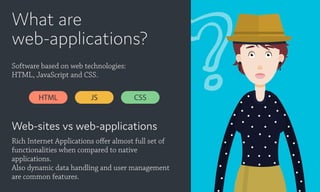
What are
web-applications?
Software based on web technologies:
HTML, JavaScript and CSS.
Web-sites vs web-applications
Rich Internet Applications offer almost full set of
functionalities when compared to native
applications.
Also dynamic data handling and user management
are common features.
HTML JS CSS
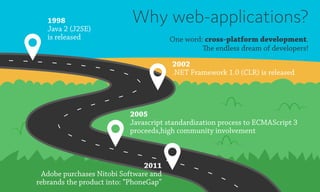
Why web-applications?
One word: cross-platform development.
The endless dream of developers!
1998
Java 2 (J2SE)
is released
2002
.NET Framework 1.0 (CLR) is released
2005
Javascript standardization process to ECMAScript 3
proceeds,high community involvement
2011
Adobe purchases Nitobi Software and
rebrands the product into: “PhoneGap”
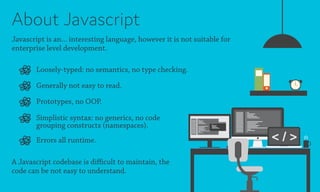
About Javascript
Javascript is an... interesting language, however it is not suitable for
enterprise level development.
A Javascript codebase is difficult to maintain, the
code can be not easy to understand.
Loosely-typed: no semantics, no type checking.
Generally not easy to read.
Prototypes, no OOP.
Simplistic syntax: no generics, no code
grouping constructs (namespaces).
Errors all runtime.
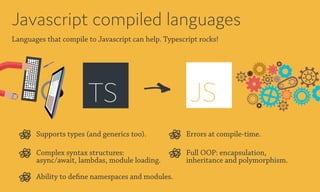
Javascript compiled languages
Languages that compile to Javascript can help. Typescript rocks!
Supports types (and generics too).
Full OOP: encapsulation,
inheritance and polymorphism.
Ability to define namespaces and modules.
Complex syntax structures:
async/await, lambdas, module loading.
Errors at compile-time.
TS JS
About CSS
CSS is very important for styling your web application, however it is
not suitable for being used in an enterprise level codebase.
CSS is very low level, too much! The final codebase
is hard to maintain and scale.
Selector syntax causes redundancy in the code.
No variables: hardcoded values, duplication.
No code grouping or organization.
No support for code reuse.
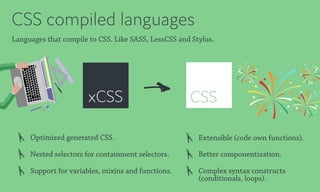
CSS compiled languages
Languages that compile to CSS. Like SASS, LessCSS and Stylus.
xCSS CSS
Nested selectors for containment selectors.
Optimized generated CSS.
Support for variables, mixins and functions.
Extensible (code own functions).
Better componentization.
Complex syntax constructs
(conditionals, loops).
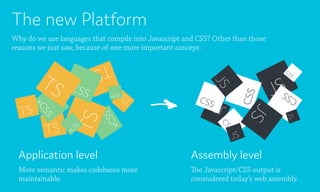
The new Platform
Why do we use languages that compile into Javascript and CSS? Other than those
reasons we just saw, because of one more important concept.
Application level
More semantic makes codebases more
maintainable.
TS
xCSS
xCSS JS
CSS
TS
TS TS
xCSS
TS
TS
xCSS
CSS
JS
JS
CSS
CSS
JS
CSS
JS
JS
xCSS
Assembly level
The Javascript/CSS output is
consiudered today’s web assembly.
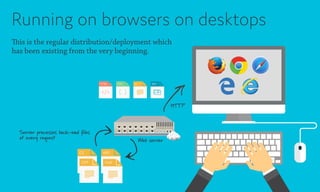
Running on browsers on desktops
This is the regular distribution/deployment which
has been existing from the very beginning.
RESRESCSSCSSHTMLHTML JSJS
CSCS
CPPCPP
ASPASP
PHPPHP
Server processes back-end files
at every request
HTTP
Web server
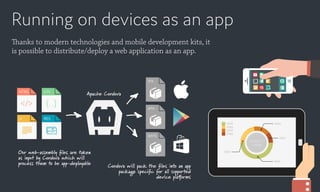
Running on devices as an app
Thanks to modern technologies and mobile development kits, it
is possible to distribute/deploy a web application as an app.
Our web-assembly files are taken
as input by Cordova which will
process them to be app-deployable
RESRES
CSSCSSHTMLHTML
JSJS
IPAIPA
HTTPAPKAPK
APPXAPPX
Apache Cordova
Cordova will pack the files into an app
package specific for all supported
device platforms
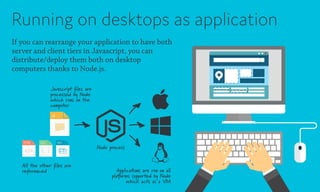
Running on desktops as application
If you can rearrange your application to have both
server and client tiers in Javascript, you can
distribute/deploy them both on desktop
computers thanks to Node.js.
Javascript files are
processed by Node
which runs on the
computer
Node process
RESRESCSSCSSHTMLHTML
JSJS
All the other files are
referenced Applications are run on all
platforms supported by Node
which acts as a VM
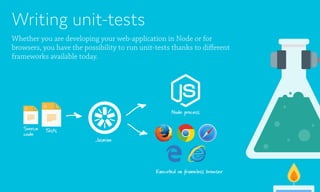
Writing unit-tests
Whether you are developing your web-application in Node or for
browsers, you have the possibility to run unit-tests thanks to different
frameworks available today.
Node process
JSJS
Jasmine
Tests
Executed on frameless browser
JSJS
Source
code
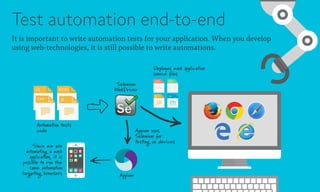
Test automation end-to-end
It is important to write automation tests for your application. When you develop
using web-technologies, it is still possible to write automations.
CSCS
CPPCPP
RUBYRUBY
JSJS
RESRES
CSSCSSHTMLHTML
JSJS
Automation tests
code
Selenium
WebDriver
Deployes web application
source files
Appium
Appium uses
Selenium for
testing on devices
Since we are
automating a web
application, it is
possible to run the
same automation
targeting browsers
Twitter: @_atino
E-Mail: andrea.tino@microsoft.com
This work is distributed under the Creative
Commons
Attribution-NonCommercial-ShareAlike 4.0
International license.
Cover: Connecting the pieces This work includes artworks
designed by Graphic River.
This work includes artworks
designed by Freepik.com.
Dec 2016
v1.0
Keywords
#agile #scrum
#microsoft
#development-process
#kanban
Presentation info
Duration: 30 mins.
Background: Non technical
Audience: All (6th grade+)
Branched from original
Andrea Tino
Software Development Engineer

Modern web applications

  • 1.
    Development, deployment andmaintenance of today’s web-applications Modern web-applications Andrea Tino
  • 2.
    What are web-applications? Software basedon web technologies: HTML, JavaScript and CSS. Web-sites vs web-applications Rich Internet Applications offer almost full set of functionalities when compared to native applications. Also dynamic data handling and user management are common features. HTML JS CSS
  • 3.
    Why web-applications? One word:cross-platform development. The endless dream of developers! 1998 Java 2 (J2SE) is released 2002 .NET Framework 1.0 (CLR) is released 2005 Javascript standardization process to ECMAScript 3 proceeds,high community involvement 2011 Adobe purchases Nitobi Software and rebrands the product into: “PhoneGap”
  • 4.
    About Javascript Javascript isan... interesting language, however it is not suitable for enterprise level development. A Javascript codebase is difficult to maintain, the code can be not easy to understand. Loosely-typed: no semantics, no type checking. Generally not easy to read. Prototypes, no OOP. Simplistic syntax: no generics, no code grouping constructs (namespaces). Errors all runtime.
  • 5.
    Javascript compiled languages Languagesthat compile to Javascript can help. Typescript rocks! Supports types (and generics too). Full OOP: encapsulation, inheritance and polymorphism. Ability to define namespaces and modules. Complex syntax structures: async/await, lambdas, module loading. Errors at compile-time. TS JS
  • 6.
    About CSS CSS isvery important for styling your web application, however it is not suitable for being used in an enterprise level codebase. CSS is very low level, too much! The final codebase is hard to maintain and scale. Selector syntax causes redundancy in the code. No variables: hardcoded values, duplication. No code grouping or organization. No support for code reuse.
  • 7.
    CSS compiled languages Languagesthat compile to CSS. Like SASS, LessCSS and Stylus. xCSS CSS Nested selectors for containment selectors. Optimized generated CSS. Support for variables, mixins and functions. Extensible (code own functions). Better componentization. Complex syntax constructs (conditionals, loops).
  • 8.
    The new Platform Whydo we use languages that compile into Javascript and CSS? Other than those reasons we just saw, because of one more important concept. Application level More semantic makes codebases more maintainable. TS xCSS xCSS JS CSS TS TS TS xCSS TS TS xCSS CSS JS JS CSS CSS JS CSS JS JS xCSS Assembly level The Javascript/CSS output is consiudered today’s web assembly.
  • 9.
    Running on browserson desktops This is the regular distribution/deployment which has been existing from the very beginning. RESRESCSSCSSHTMLHTML JSJS CSCS CPPCPP ASPASP PHPPHP Server processes back-end files at every request HTTP Web server
  • 10.
    Running on devicesas an app Thanks to modern technologies and mobile development kits, it is possible to distribute/deploy a web application as an app. Our web-assembly files are taken as input by Cordova which will process them to be app-deployable RESRES CSSCSSHTMLHTML JSJS IPAIPA HTTPAPKAPK APPXAPPX Apache Cordova Cordova will pack the files into an app package specific for all supported device platforms
  • 11.
    Running on desktopsas application If you can rearrange your application to have both server and client tiers in Javascript, you can distribute/deploy them both on desktop computers thanks to Node.js. Javascript files are processed by Node which runs on the computer Node process RESRESCSSCSSHTMLHTML JSJS All the other files are referenced Applications are run on all platforms supported by Node which acts as a VM
  • 12.
    Writing unit-tests Whether youare developing your web-application in Node or for browsers, you have the possibility to run unit-tests thanks to different frameworks available today. Node process JSJS Jasmine Tests Executed on frameless browser JSJS Source code
  • 13.
    Test automation end-to-end Itis important to write automation tests for your application. When you develop using web-technologies, it is still possible to write automations. CSCS CPPCPP RUBYRUBY JSJS RESRES CSSCSSHTMLHTML JSJS Automation tests code Selenium WebDriver Deployes web application source files Appium Appium uses Selenium for testing on devices Since we are automating a web application, it is possible to run the same automation targeting browsers
  • 14.
    Twitter: @_atino E-Mail: andrea.tino@microsoft.com Thiswork is distributed under the Creative Commons Attribution-NonCommercial-ShareAlike 4.0 International license. Cover: Connecting the pieces This work includes artworks designed by Graphic River. This work includes artworks designed by Freepik.com. Dec 2016 v1.0 Keywords #agile #scrum #microsoft #development-process #kanban Presentation info Duration: 30 mins. Background: Non technical Audience: All (6th grade+) Branched from original Andrea Tino Software Development Engineer