Proof of Concept in Aeronautic
OSMOSE - Proof of Concept in Aeronautic 2
Trial Introduction
Aeronautic
Test Case
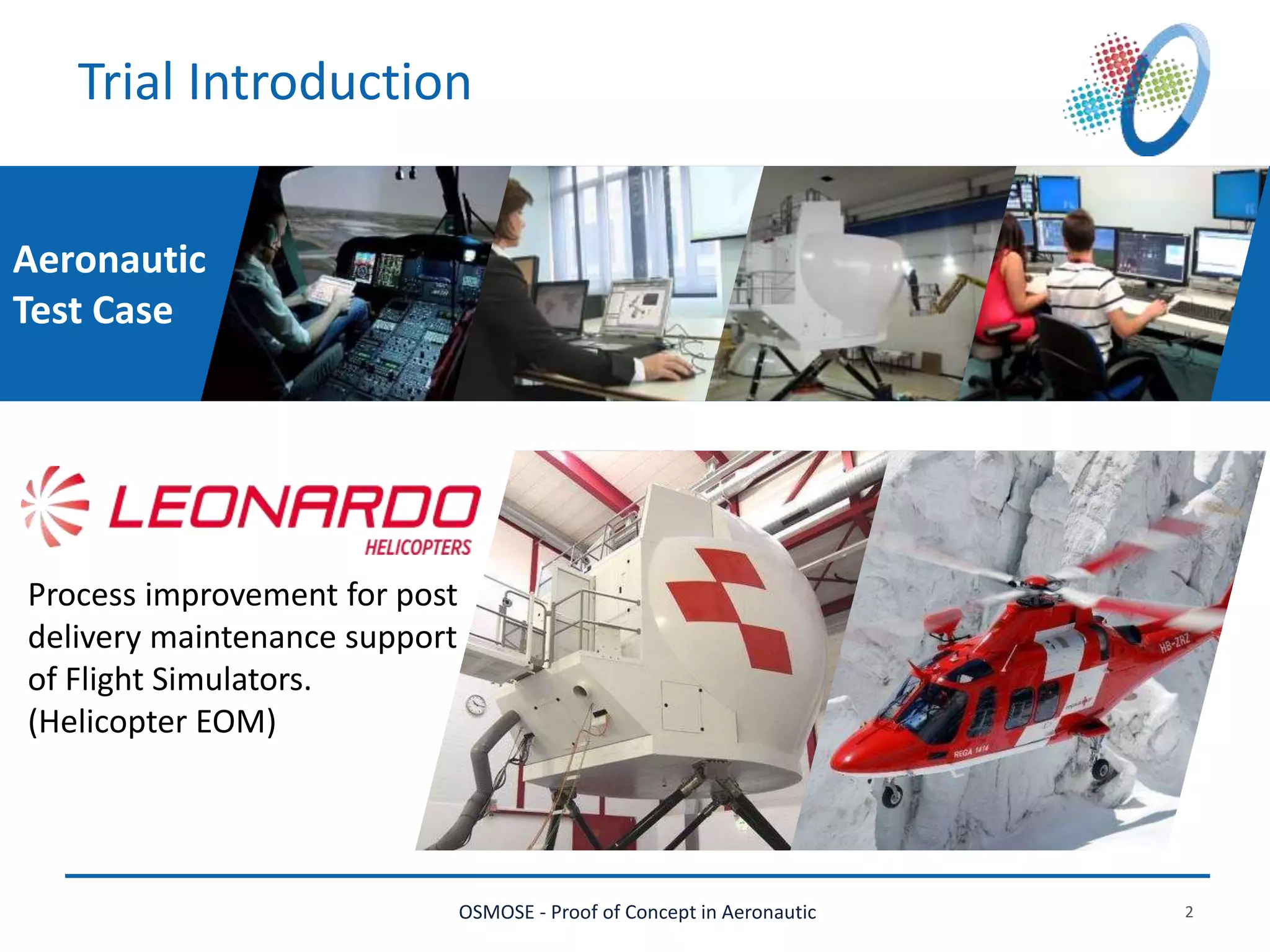
Process improvement for post
delivery maintenance support
of Flight Simulators.
(Helicopter EOM)
OSMOSE - Proof of Concept in Aeronautic 3
Challenges for Effective Operation
• Simulator based training services are gaining popularity, reducing pilot training cost and time
resulting in operational efficiency for airline companies. Therefore it is important to ensure their
availability D7/7 H24 minimizing the downtime due to maintenance or failures, as a consequence
the availability of an efficient technical support service is mandatory to guaranty the continuity of
service.
• Leonardo Helicopters has the capability to offer to its Customers a variety of training aids in the
simulation field with a tailored post-delivery product support service. three main standard product
support strategies, the basic is identified as “Remote Assistance”, the medium complexity one is
called “Standard Annual Support” and, finally, the holistic one identified as “Full Turn Key”. In the
“as is” situation the support service is carried out by means of traditional processes and standard
tools.
• The objective is to adopt the OSMOSE methodology and architecture to improve the performances
of the actual product support strategies in terms of:
o speed up the detection of snags and malfunctions supporting the SW developers in fixing them;
o maximize the predictive maintenance against corrective maintenance;
o schedule maintenance activities as not to impact on training;
o support the technicians on the field during maintenance activity (remove/install components).
OSMOSE - Proof of Concept in Aeronautic 4
Trial Environment
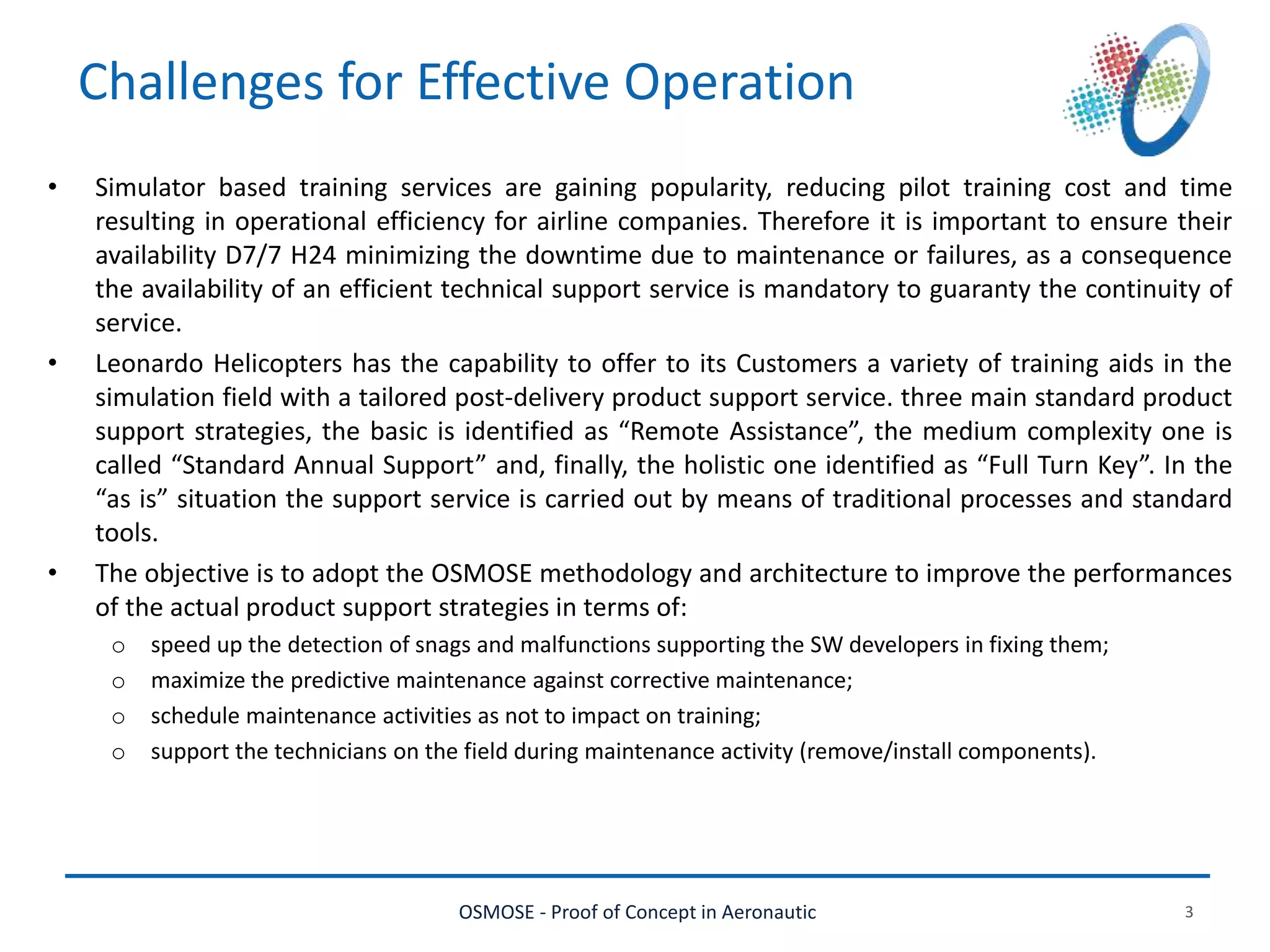
Helicopter Flight Simulators are cost effective devices that attempt to recreate the
overall flying experience so as to efficiently hone the skills of a pilot. A Flight
Simulator consists in a perfect reproduction of a specific helicopter model. It
includes replica of the cabin (mechanical and electrical) and computers and
equipment (displays, devices with their related S/W). For the experimentation the
AW169 and the AW139 Flight Training Devices were used.
The site involved during the trial was:
• Leonardo Helicopters A. Marchetti Training Academy
(Sesto Calende Italy)
The stakeholders involved during the trial were:
• Pilot Instructors
• Support System Manager
• Support System Maintainers
• FFS Developers
OSMOSE - Proof of Concept in Aeronautic 5
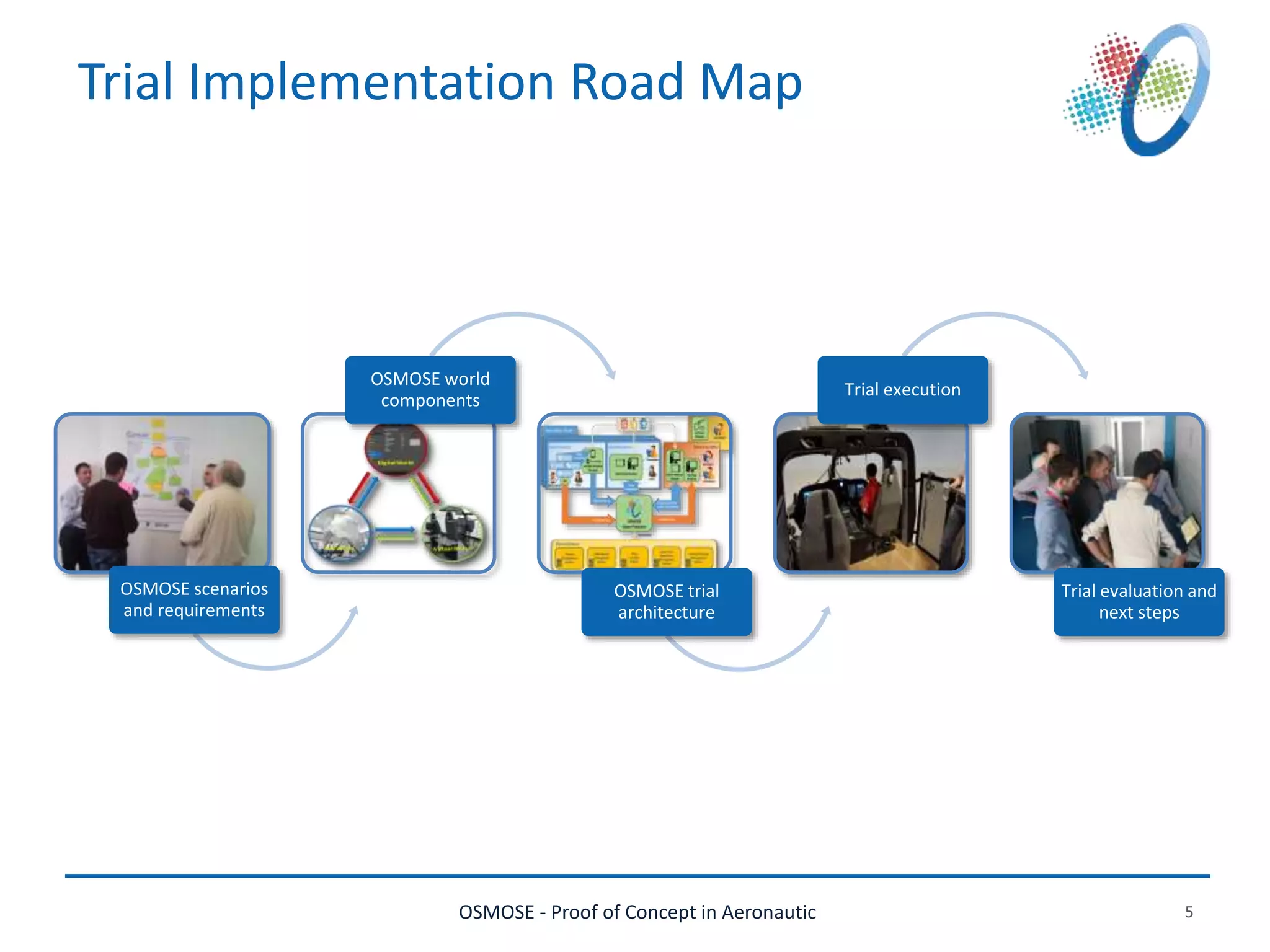
Trial Implementation Road Map
OSMOSE scenarios
and requirements
OSMOSE world
components
OSMOSE trial
architecture
Trial execution
Trial evaluation and
next steps
OSMOSE - Proof of Concept in Aeronautic 6
Trial Implementation Scenarios
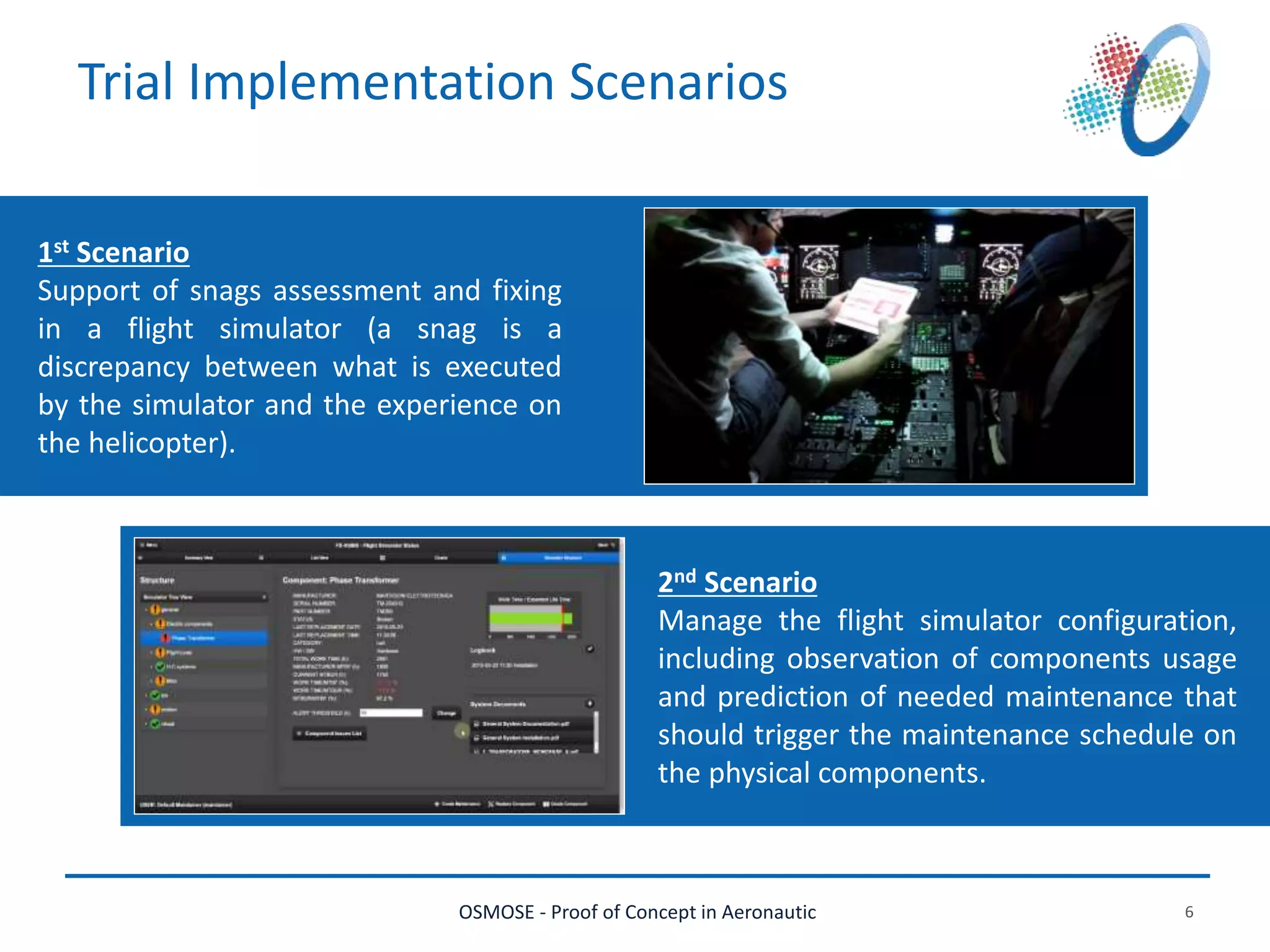
1st Scenario
Support of snags assessment and fixing
in a flight simulator (a snag is a
discrepancy between what is executed
by the simulator and the experience on
the helicopter).
2nd Scenario
Manage the flight simulator configuration,
including observation of components usage
and prediction of needed maintenance that
should trigger the maintenance schedule on
the physical components.
OSMOSE - Proof of Concept in Aeronautic 7
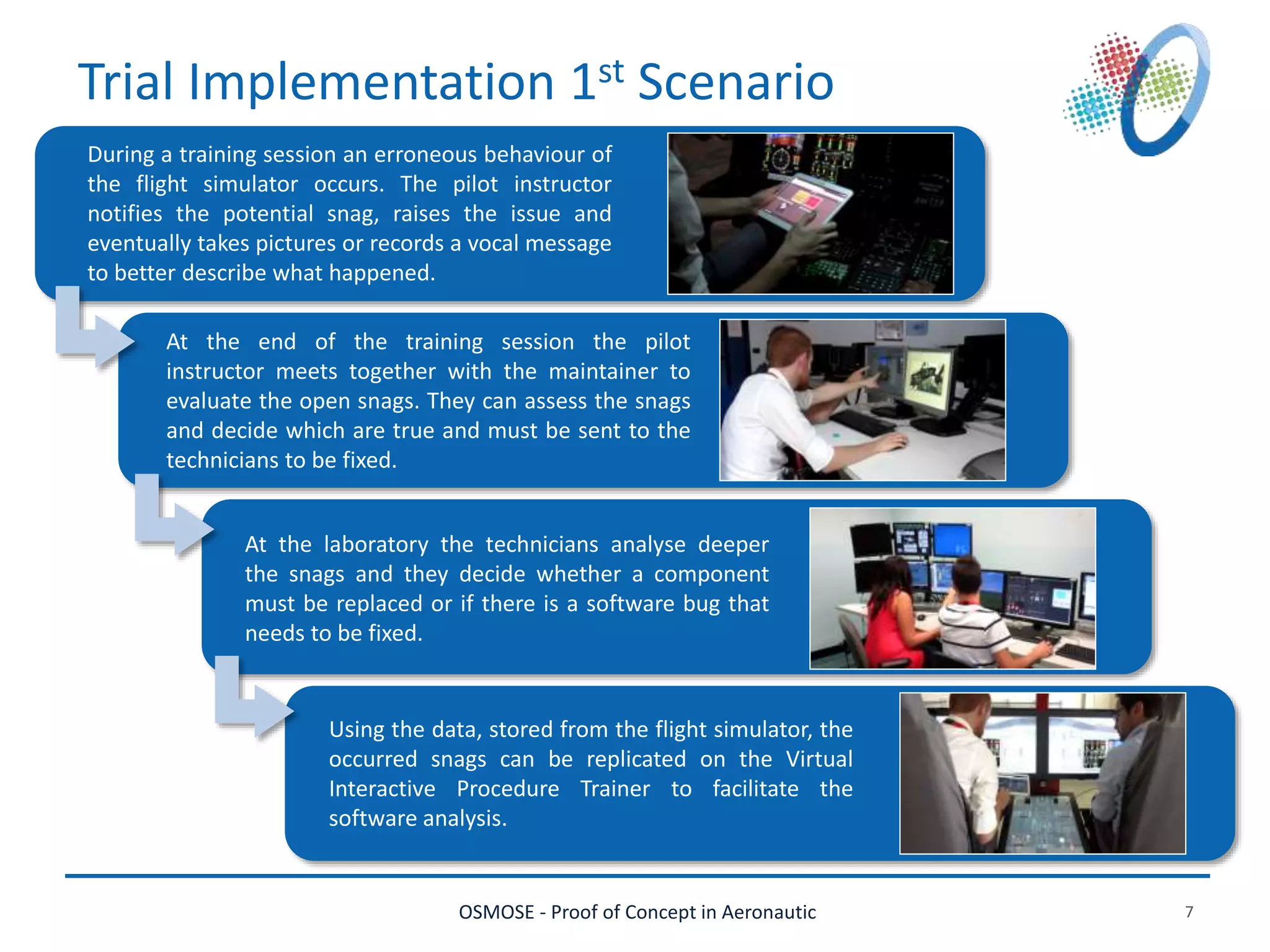
Trial Implementation 1st Scenario
During a training session an erroneous behaviour of
the flight simulator occurs. The pilot instructor
notifies the potential snag, raises the issue and
eventually takes pictures or records a vocal message
to better describe what happened.
At the end of the training session the pilot
instructor meets together with the maintainer to
evaluate the open snags. They can assess the snags
and decide which are true and must be sent to the
technicians to be fixed.
At the laboratory the technicians analyse deeper
the snags and they decide whether a component
must be replaced or if there is a software bug that
needs to be fixed.
Using the data, stored from the flight simulator, the
occurred snags can be replicated on the Virtual
Interactive Procedure Trainer to facilitate the
software analysis.
OSMOSE - Proof of Concept in Aeronautic 8
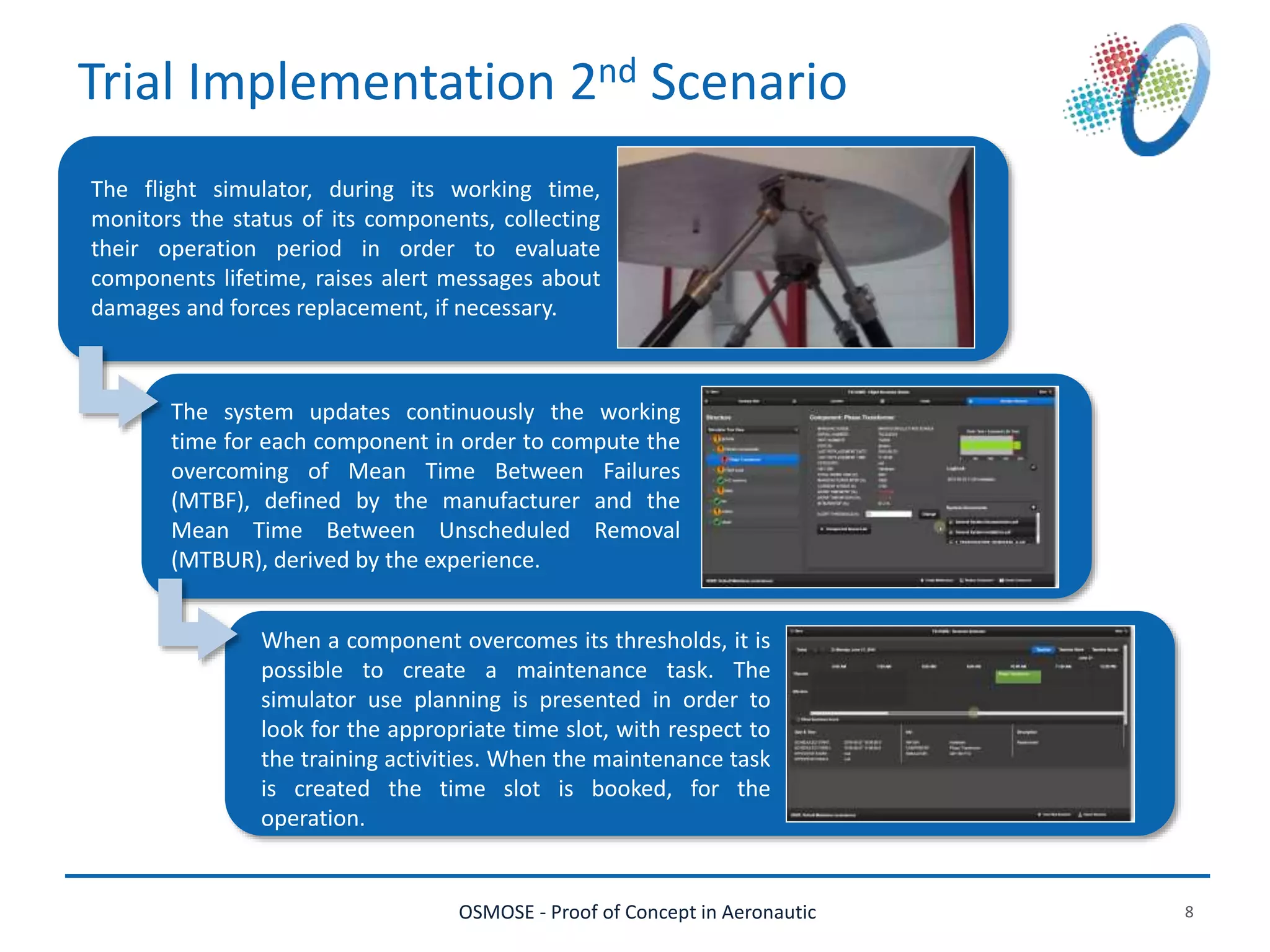
Trial Implementation 2nd Scenario
The flight simulator, during its working time,
monitors the status of its components, collecting
their operation period in order to evaluate
components lifetime, raises alert messages about
damages and forces replacement, if necessary.
The system updates continuously the working
time for each component in order to compute the
overcoming of Mean Time Between Failures
(MTBF), defined by the manufacturer and the
Mean Time Between Unscheduled Removal
(MTBUR), derived by the experience.
When a component overcomes its thresholds, it is
possible to create a maintenance task. The
simulator use planning is presented in order to
look for the appropriate time slot, with respect to
the training activities. When the maintenance task
is created the time slot is booked, for the
operation.
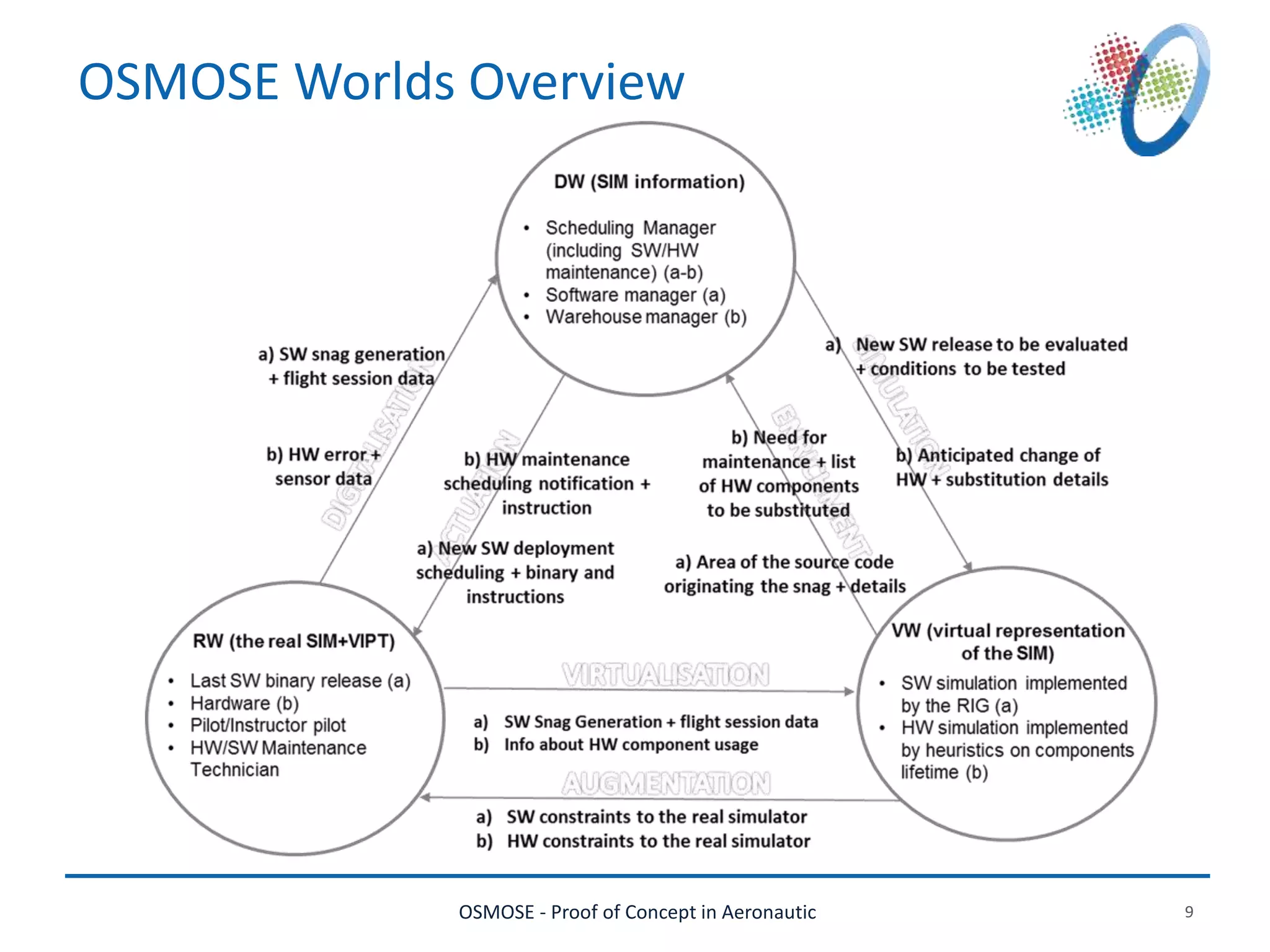
OSMOSE - Proof of Concept in Aeronautic 9
OSMOSE Worlds Overview
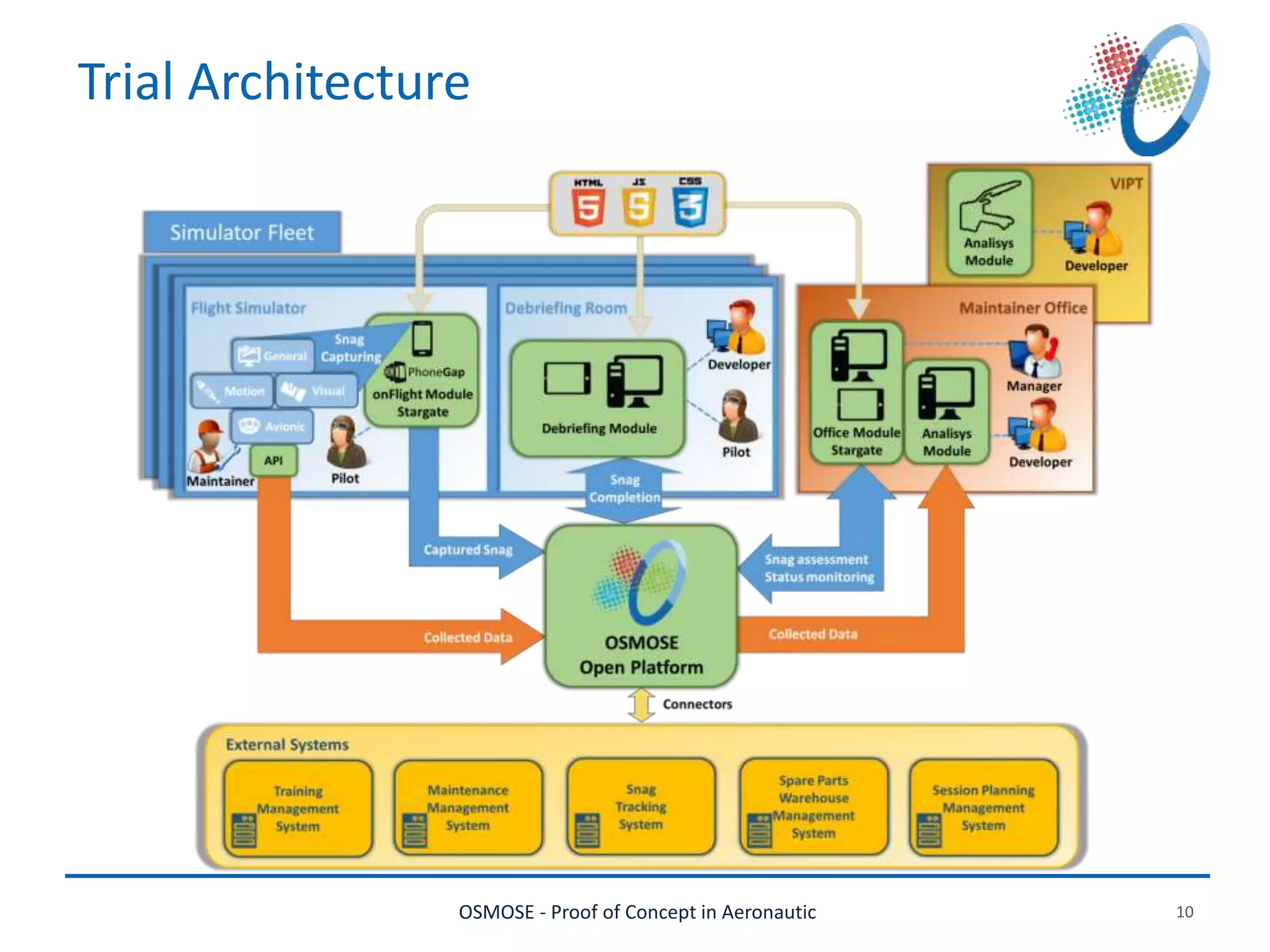
OSMOSE - Proof of Concept in Aeronautic 10
Trial Architecture
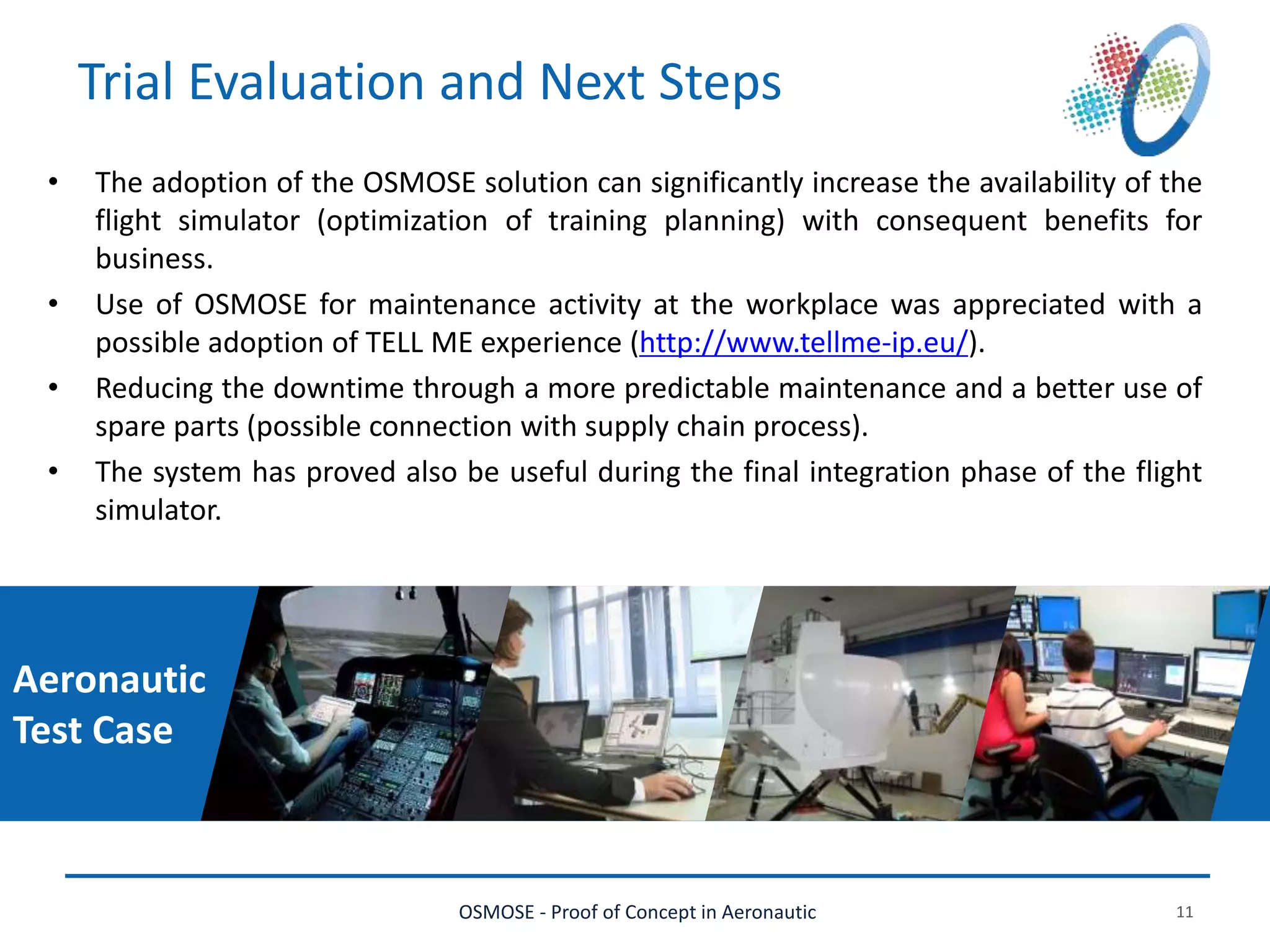
OSMOSE - Proof of Concept in Aeronautic 11
Trial Evaluation and Next Steps
• The adoption of the OSMOSE solution can significantly increase the availability of the
flight simulator (optimization of training planning) with consequent benefits for
business.
• Use of OSMOSE for maintenance activity at the workplace was appreciated with a
possible adoption of TELL ME experience (http://www.tellme-ip.eu/).
• Reducing the downtime through a more predictable maintenance and a better use of
spare parts (possible connection with supply chain process).
• The system has proved also be useful during the final integration phase of the flight
simulator.
Aeronautic
Test Case
OSMOSE - Proof of Concept in Aeronautic
Fore more information contact:
12
Dr. Roberto Sanguini
roberto.sanguini@leonardocompany.com
www.leonardocompany.com
Ing. Michele Sesana
michele.sesana@txtgroup.com
www.txtgroup.com

OSMOSE proof of concept in Aeronautics - Leonardo

  • 1.
    Proof of Conceptin Aeronautic
  • 2.
    OSMOSE - Proofof Concept in Aeronautic 2 Trial Introduction Aeronautic Test Case Process improvement for post delivery maintenance support of Flight Simulators. (Helicopter EOM)
  • 3.
    OSMOSE - Proofof Concept in Aeronautic 3 Challenges for Effective Operation • Simulator based training services are gaining popularity, reducing pilot training cost and time resulting in operational efficiency for airline companies. Therefore it is important to ensure their availability D7/7 H24 minimizing the downtime due to maintenance or failures, as a consequence the availability of an efficient technical support service is mandatory to guaranty the continuity of service. • Leonardo Helicopters has the capability to offer to its Customers a variety of training aids in the simulation field with a tailored post-delivery product support service. three main standard product support strategies, the basic is identified as “Remote Assistance”, the medium complexity one is called “Standard Annual Support” and, finally, the holistic one identified as “Full Turn Key”. In the “as is” situation the support service is carried out by means of traditional processes and standard tools. • The objective is to adopt the OSMOSE methodology and architecture to improve the performances of the actual product support strategies in terms of: o speed up the detection of snags and malfunctions supporting the SW developers in fixing them; o maximize the predictive maintenance against corrective maintenance; o schedule maintenance activities as not to impact on training; o support the technicians on the field during maintenance activity (remove/install components).
  • 4.
    OSMOSE - Proofof Concept in Aeronautic 4 Trial Environment Helicopter Flight Simulators are cost effective devices that attempt to recreate the overall flying experience so as to efficiently hone the skills of a pilot. A Flight Simulator consists in a perfect reproduction of a specific helicopter model. It includes replica of the cabin (mechanical and electrical) and computers and equipment (displays, devices with their related S/W). For the experimentation the AW169 and the AW139 Flight Training Devices were used. The site involved during the trial was: • Leonardo Helicopters A. Marchetti Training Academy (Sesto Calende Italy) The stakeholders involved during the trial were: • Pilot Instructors • Support System Manager • Support System Maintainers • FFS Developers
  • 5.
    OSMOSE - Proofof Concept in Aeronautic 5 Trial Implementation Road Map OSMOSE scenarios and requirements OSMOSE world components OSMOSE trial architecture Trial execution Trial evaluation and next steps
  • 6.
    OSMOSE - Proofof Concept in Aeronautic 6 Trial Implementation Scenarios 1st Scenario Support of snags assessment and fixing in a flight simulator (a snag is a discrepancy between what is executed by the simulator and the experience on the helicopter). 2nd Scenario Manage the flight simulator configuration, including observation of components usage and prediction of needed maintenance that should trigger the maintenance schedule on the physical components.
  • 7.
    OSMOSE - Proofof Concept in Aeronautic 7 Trial Implementation 1st Scenario During a training session an erroneous behaviour of the flight simulator occurs. The pilot instructor notifies the potential snag, raises the issue and eventually takes pictures or records a vocal message to better describe what happened. At the end of the training session the pilot instructor meets together with the maintainer to evaluate the open snags. They can assess the snags and decide which are true and must be sent to the technicians to be fixed. At the laboratory the technicians analyse deeper the snags and they decide whether a component must be replaced or if there is a software bug that needs to be fixed. Using the data, stored from the flight simulator, the occurred snags can be replicated on the Virtual Interactive Procedure Trainer to facilitate the software analysis.
  • 8.
    OSMOSE - Proofof Concept in Aeronautic 8 Trial Implementation 2nd Scenario The flight simulator, during its working time, monitors the status of its components, collecting their operation period in order to evaluate components lifetime, raises alert messages about damages and forces replacement, if necessary. The system updates continuously the working time for each component in order to compute the overcoming of Mean Time Between Failures (MTBF), defined by the manufacturer and the Mean Time Between Unscheduled Removal (MTBUR), derived by the experience. When a component overcomes its thresholds, it is possible to create a maintenance task. The simulator use planning is presented in order to look for the appropriate time slot, with respect to the training activities. When the maintenance task is created the time slot is booked, for the operation.
  • 9.
    OSMOSE - Proofof Concept in Aeronautic 9 OSMOSE Worlds Overview
  • 10.
    OSMOSE - Proofof Concept in Aeronautic 10 Trial Architecture
  • 11.
    OSMOSE - Proofof Concept in Aeronautic 11 Trial Evaluation and Next Steps • The adoption of the OSMOSE solution can significantly increase the availability of the flight simulator (optimization of training planning) with consequent benefits for business. • Use of OSMOSE for maintenance activity at the workplace was appreciated with a possible adoption of TELL ME experience (http://www.tellme-ip.eu/). • Reducing the downtime through a more predictable maintenance and a better use of spare parts (possible connection with supply chain process). • The system has proved also be useful during the final integration phase of the flight simulator. Aeronautic Test Case
  • 12.
    OSMOSE - Proofof Concept in Aeronautic Fore more information contact: 12 Dr. Roberto Sanguini roberto.sanguini@leonardocompany.com www.leonardocompany.com Ing. Michele Sesana michele.sesana@txtgroup.com www.txtgroup.com