www.etwinning.net
ONLINE MODERATION 101
- BE A SUCCESSFUL
ETWINNING GROUP
MODERATOR
eTwinning Online Event
March 11th, 2021
BLOCK 1. Planning Groups
11-03-21 1
www.etwinning.net
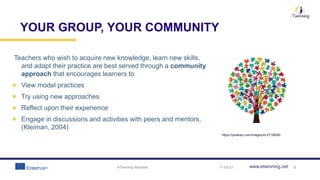
YOUR GROUP, YOUR COMMUNITY
Teachers who wish to acquire new knowledge, learn new skills,
and adapt their practice are best served through a community
approach that encourages learners to
View model practices
Try using new approaches
Reflect upon their experience
Engage in discussions and activities with peers and mentors,
(Kleiman, 2004)
11-03-21
eTwinning template 2
https://pixabay.com/images/id-2718836/
www.etwinning.net
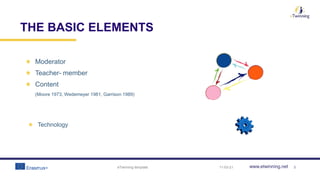
THE BASIC ELEMENTS
11-03-21
eTwinning template 3
Moderator
Teacher- member
Content
(Moore 1973, Wedemeyer 1981, Garrison 1989)
Technology
www.etwinning.net
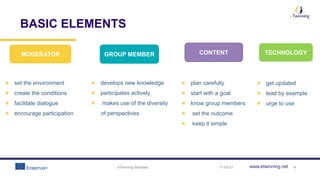
BASIC ELEMENTS
11-03-21
eTwinning template 4
set the environment
create the conditions
facilitate dialogue
encourage participation
MODERATOR GROUP MEMBER CONTENT TECHNOLOGY
develops new knowledge
participates actively
makes use of the diversity
of perspectives
plan carefully
start with a goal
know group members
set the outcome
keep it simple
get updated
lead by example
urge to use
www.etwinning.net
11-03-21
eTwinning template 5
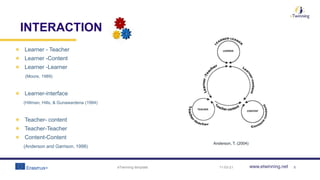
INTERACTION
Learner - Teacher
Learner -Content
Learner -Learner
(Moore, 1989)
Learner-interface
(Hillman, Hills, & Gunawardena (1994)
Teacher- content
Teacher-Teacher
Content-Content
(Anderson and Garrison, 1998)
Anderson, T. (2004)
www.etwinning.net
KEEP YOUR GROUP VIVID
11-03-21
eTwinning template 6
Give a reason to return
Encourage interaction
Make the environment friendly and safe
Humanise your workspace
https://pixabay.com/images/id-578897/
www.etwinning.net
11-03-21
eTwinning template 7
ONLINE MODERATION 101
- BE A SUCCESSFUL ETWINNING GROUP MODERATOR
glyki_g@yahoo.gr @glykeria6 Glyki Gouvatsou
Glykeria Gouvatsou
Glykeria Gkouvatsou
EFL Secondary State Sch Teacher
Med in e-Learning
GBC group moderator
https://groups.etwinning.net/7622/home
www.etwinning.net
REFERENCES
Anderson, T. (2004). Towards a Theory of Online Learning. In T. Anderson & F. Elloumni, (eds.) Theory and Practice of Online
Learning. (pp 33-60). Athabasca: Athabasca University Press. Available http://cde.athabascau.ca/online_book/
Anderson, T., & Garrison, D. R. (1998). Learning in a networked world: New roles and responsibilities. In C. Gibson (Ed.), Distance
learners in higher education (pp. 97-112). Madison, WI: Atwood Publishing
Daniel C. A. Hillman, Deborah J. Willis & Charlotte N. Gunawardena (1994) Learner‐interface interaction in distance education: An
extension of contemporary models and strategies for practitioners, American Journal of Distance Education, 8:2, 30-
42, DOI: 10.1080/08923649409526853
Kleiman, G. (2004). Meeting the need for high quality teachers: E-learning solutions. Retrieved March 1, 2021, from
https://www.researchgate.net/publication/252961774_Meeting_the_Need_for_High_Quality_Teachers_e-Learning_Solutions
Moore, M. G. 1973. Toward a theory of independent learning and teaching. Journal of Higher Education 44(12): 661-79.
Wedemeyer, C. A. (1981). Learning at the back door: Reflections on non-traditional learning in the lifespan. Madison, WI: University of
Wisconsin.
Garrison, D. R. (1989). Understanding Distance Education: A Framework for the Future. London: Routledge.
http://www.communityofpractice.ca/background/what-is-a-community-of-practice/
11-03-21
eTwinning template 8

Moderation workshop block 1

  • 1.
    www.etwinning.net ONLINE MODERATION 101 -BE A SUCCESSFUL ETWINNING GROUP MODERATOR eTwinning Online Event March 11th, 2021 BLOCK 1. Planning Groups 11-03-21 1
  • 2.
    www.etwinning.net YOUR GROUP, YOURCOMMUNITY Teachers who wish to acquire new knowledge, learn new skills, and adapt their practice are best served through a community approach that encourages learners to View model practices Try using new approaches Reflect upon their experience Engage in discussions and activities with peers and mentors, (Kleiman, 2004) 11-03-21 eTwinning template 2 https://pixabay.com/images/id-2718836/
  • 3.
    www.etwinning.net THE BASIC ELEMENTS 11-03-21 eTwinningtemplate 3 Moderator Teacher- member Content (Moore 1973, Wedemeyer 1981, Garrison 1989) Technology
  • 4.
    www.etwinning.net BASIC ELEMENTS 11-03-21 eTwinning template4 set the environment create the conditions facilitate dialogue encourage participation MODERATOR GROUP MEMBER CONTENT TECHNOLOGY develops new knowledge participates actively makes use of the diversity of perspectives plan carefully start with a goal know group members set the outcome keep it simple get updated lead by example urge to use
  • 5.
    www.etwinning.net 11-03-21 eTwinning template 5 INTERACTION Learner- Teacher Learner -Content Learner -Learner (Moore, 1989) Learner-interface (Hillman, Hills, & Gunawardena (1994) Teacher- content Teacher-Teacher Content-Content (Anderson and Garrison, 1998) Anderson, T. (2004)
  • 6.
    www.etwinning.net KEEP YOUR GROUPVIVID 11-03-21 eTwinning template 6 Give a reason to return Encourage interaction Make the environment friendly and safe Humanise your workspace https://pixabay.com/images/id-578897/
  • 7.
    www.etwinning.net 11-03-21 eTwinning template 7 ONLINEMODERATION 101 - BE A SUCCESSFUL ETWINNING GROUP MODERATOR glyki_g@yahoo.gr @glykeria6 Glyki Gouvatsou Glykeria Gouvatsou Glykeria Gkouvatsou EFL Secondary State Sch Teacher Med in e-Learning GBC group moderator https://groups.etwinning.net/7622/home
  • 8.
    www.etwinning.net REFERENCES Anderson, T. (2004).Towards a Theory of Online Learning. In T. Anderson & F. Elloumni, (eds.) Theory and Practice of Online Learning. (pp 33-60). Athabasca: Athabasca University Press. Available http://cde.athabascau.ca/online_book/ Anderson, T., & Garrison, D. R. (1998). Learning in a networked world: New roles and responsibilities. In C. Gibson (Ed.), Distance learners in higher education (pp. 97-112). Madison, WI: Atwood Publishing Daniel C. A. Hillman, Deborah J. Willis & Charlotte N. Gunawardena (1994) Learner‐interface interaction in distance education: An extension of contemporary models and strategies for practitioners, American Journal of Distance Education, 8:2, 30- 42, DOI: 10.1080/08923649409526853 Kleiman, G. (2004). Meeting the need for high quality teachers: E-learning solutions. Retrieved March 1, 2021, from https://www.researchgate.net/publication/252961774_Meeting_the_Need_for_High_Quality_Teachers_e-Learning_Solutions Moore, M. G. 1973. Toward a theory of independent learning and teaching. Journal of Higher Education 44(12): 661-79. Wedemeyer, C. A. (1981). Learning at the back door: Reflections on non-traditional learning in the lifespan. Madison, WI: University of Wisconsin. Garrison, D. R. (1989). Understanding Distance Education: A Framework for the Future. London: Routledge. http://www.communityofpractice.ca/background/what-is-a-community-of-practice/ 11-03-21 eTwinning template 8