1 
Leading the way in Agriculture and Rural Research, Education and Consulting 
Modelling macro- parasite risk in a changing climate 
Naomi.Fox@sruc.ac.uk Disease Systems Team, Animal and Veterinary Sciences Group, SRUC,Edinburgh, UK
2 
Background 
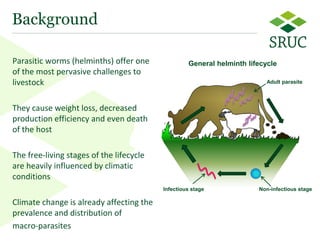
General helminth lifecycle 
Non-infectious stage 
Infectious stage 
Parasitic worms (helminths) offer one of the most pervasive challenges to livestock 
They cause weight loss, decreased production efficiency and even death of the host 
The free-living stages of the lifecycle are heavily influenced by climatic conditions 
Climate change is already affecting the prevalence and distribution of 
macro-parasites 
Adult parasite
3 
Need to understand the potential impacts of future climate change to prepare for changing risk, implement control measures and set up long term management strategies. 
Aim: 
To determine how changes in climate sensitive parameters affect parasite dynamics 
Background
4 
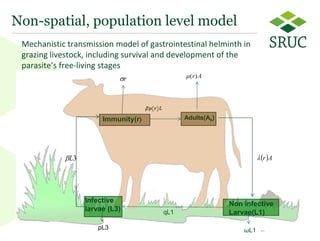
Adults(AkImmunity(r) ) 
Infective 
larvae (L3) 
Non infective 
qL1 Larvae(L1) 
ωL1 
ρL3 
 rA 
r  (r)A 
Non-spatial, population level model 
L3 
Mechanistic transmission model of gastrointestinal helminth in 
grazing livestock, including survival and development of the 
parasite’s free-living stages
5 
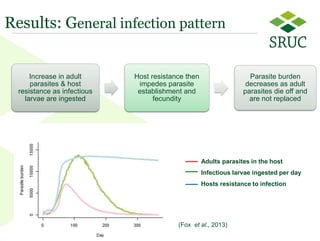
Results: General infection pattern 
Adults parasites in the host 
Infectious larvae ingested per day 
Hosts resistance to infection 
Increase in adult parasites & host resistance as infectious larvae are ingested 
Host resistance then impedes parasite establishment and fecundity 
Parasite burden decreases as adult parasites die off and are not replaced 
(Fox et al., 2013)
6 
Results: Impacts of climate 
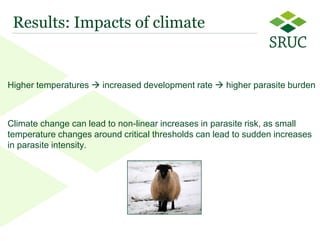
Higher temperatures  increased development rate  higher parasite burden Climate change can lead to non-linear increases in parasite risk, as small temperature changes around critical thresholds can lead to sudden increases in parasite intensity.
7 
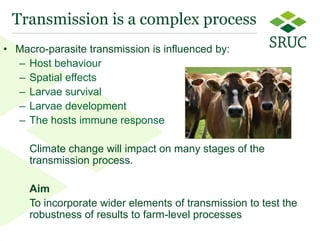
Transmission is a complex process 
•Macro-parasite transmission is influenced by: 
–Host behaviour 
–Spatial effects 
–Larvae survival 
–Larvae development 
–The hosts immune response 
Climate change will impact on many stages of the transmission process. 
Aim 
To incorporate wider elements of transmission to test the robustness of results to farm-level processes
8 
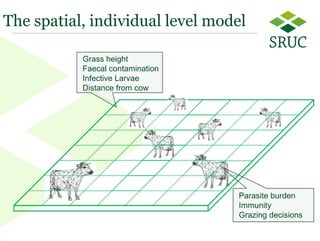
Grass height 
Faecal contamination 
Infective Larvae 
Distance from cow 
Parasite burden 
Immunity 
Grazing decisions 
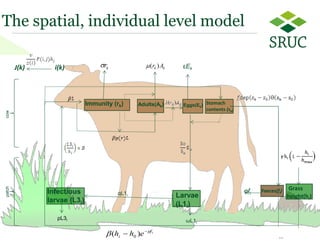
The spatial, individual level model
9 
i(k) 
Stomach 
contents (sk) 
Faeces(fi) 
J(k) 
Adults(AkImmunity (r ) k) 
Infectious 
larvae (L3i) 
Larvae 
(L1i) 
Eggs(Ek) 
qL1i 
ωL1i 
patch cow 
φfi 
ρL3i 
fi 
i h h e    (  ) 0 
k r k k (r )A εEk 
Grass 
height(hi) 
The spatial, individual level model
10 
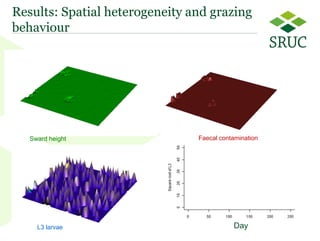
Results: Spatial heterogeneity and grazing behaviour 
Day 
Faecal contamination 
L3 larvae 
Sward height
11 
Influence of other factors 
•Our model outputs are robust to the inclusion of more complex, farm level processes. 
•These farm-level factors (e.g. spatial heterogeneity in infection risk and resource distributions, host grazing behaviour, host immunity) influence outbreak intensity under different temperature change scenarios.
12 
Conclusions 
•Climate influences parasite risk e.g. by changing development rates of the free-living stages 
•Small changes in climate around critical thresholds can lead to sudden increases in parasite intensity 
•Climate change will affect broader elements of the system, and there will be farm level variation in the response to climate change 
•This model can be used to predict the impacts of climate change on parasite risk, and asses the efficiency of different control strategies
13 
Thanks 
Mike Hutchings (SRUC) 
Ross Davidson (SRUC) 
Glenn Marion (Biomathematics & Statistics Scotland) 
Piran White (University of York) 
This work was funded by the Scottish Government 
Questions? 
Naomi.Fox@sruc.ac.uk

Modelling macro-parasite risk in a changing climate_Naomi Fox

  • 1.
    1 Leading theway in Agriculture and Rural Research, Education and Consulting Modelling macro- parasite risk in a changing climate Naomi.Fox@sruc.ac.uk Disease Systems Team, Animal and Veterinary Sciences Group, SRUC,Edinburgh, UK
  • 2.
    2 Background Generalhelminth lifecycle Non-infectious stage Infectious stage Parasitic worms (helminths) offer one of the most pervasive challenges to livestock They cause weight loss, decreased production efficiency and even death of the host The free-living stages of the lifecycle are heavily influenced by climatic conditions Climate change is already affecting the prevalence and distribution of macro-parasites Adult parasite
  • 3.
    3 Need tounderstand the potential impacts of future climate change to prepare for changing risk, implement control measures and set up long term management strategies. Aim: To determine how changes in climate sensitive parameters affect parasite dynamics Background
  • 4.
    4 Adults(AkImmunity(r) ) Infective larvae (L3) Non infective qL1 Larvae(L1) ωL1 ρL3  rA r  (r)A Non-spatial, population level model L3 Mechanistic transmission model of gastrointestinal helminth in grazing livestock, including survival and development of the parasite’s free-living stages
  • 5.
    5 Results: Generalinfection pattern Adults parasites in the host Infectious larvae ingested per day Hosts resistance to infection Increase in adult parasites & host resistance as infectious larvae are ingested Host resistance then impedes parasite establishment and fecundity Parasite burden decreases as adult parasites die off and are not replaced (Fox et al., 2013)
  • 6.
    6 Results: Impactsof climate Higher temperatures  increased development rate  higher parasite burden Climate change can lead to non-linear increases in parasite risk, as small temperature changes around critical thresholds can lead to sudden increases in parasite intensity.
  • 7.
    7 Transmission isa complex process •Macro-parasite transmission is influenced by: –Host behaviour –Spatial effects –Larvae survival –Larvae development –The hosts immune response Climate change will impact on many stages of the transmission process. Aim To incorporate wider elements of transmission to test the robustness of results to farm-level processes
  • 8.
    8 Grass height Faecal contamination Infective Larvae Distance from cow Parasite burden Immunity Grazing decisions The spatial, individual level model
  • 9.
    9 i(k) Stomach contents (sk) Faeces(fi) J(k) Adults(AkImmunity (r ) k) Infectious larvae (L3i) Larvae (L1i) Eggs(Ek) qL1i ωL1i patch cow φfi ρL3i fi i h h e    (  ) 0 k r k k (r )A εEk Grass height(hi) The spatial, individual level model
  • 10.
    10 Results: Spatialheterogeneity and grazing behaviour Day Faecal contamination L3 larvae Sward height
  • 11.
    11 Influence ofother factors •Our model outputs are robust to the inclusion of more complex, farm level processes. •These farm-level factors (e.g. spatial heterogeneity in infection risk and resource distributions, host grazing behaviour, host immunity) influence outbreak intensity under different temperature change scenarios.
  • 12.
    12 Conclusions •Climateinfluences parasite risk e.g. by changing development rates of the free-living stages •Small changes in climate around critical thresholds can lead to sudden increases in parasite intensity •Climate change will affect broader elements of the system, and there will be farm level variation in the response to climate change •This model can be used to predict the impacts of climate change on parasite risk, and asses the efficiency of different control strategies
  • 13.
    13 Thanks MikeHutchings (SRUC) Ross Davidson (SRUC) Glenn Marion (Biomathematics & Statistics Scotland) Piran White (University of York) This work was funded by the Scottish Government Questions? Naomi.Fox@sruc.ac.uk