Semester : 5 [2051-CH]
Gas Absorption & Adsorption
Prepared by: Guided by:
Raut Krish(216470305008) Mr. K. S. Chavda
Patra Swarnlata(216470305013 )
Ambaliya Owaish(216470305014)
Gas Absorption
• Definition : Gas absorption is an operation in which a gas
mixture is contacted with an liquid for the purpose of
preferably dissolving one or more component of the gas
an to provide a solution of them into the liquid.
• Example :
1. Gas from by product of cock oven wash with water to
remove ammonia & washed with oil to remove benzene
, toluene & aromatic vapor.
2. H2S remove from gas(naturally occurring hydrocarbon
gas) by washing with various alkali solution.
Requirement of Gas Absorption :
 This operation required mass transfer of one substance from gas
to liquid.
 Mass transfer liquid to gas, this operation is known as
desorption/stripping.
 Example : Benzene & toluene remove from the absorption oil by
contacting the liquid solution(oil) with steam. By this operation,
we can reuse the oil.
 The most important use of solute recovery or solute remove.
Equilibrium Solubility of Gas in Liquid :
1. Effect of Pressure :
 Concentration of dissolve gas in the liquid at prevailing temperature
& pressure is known as gas solubility in liquid.
2. Effect of Temperature :
d(lnk)/dT = H/RT2
 To understand the effect of temperature & solubility(equilibrium),
Van’t Hoff law is useful.
 When we increase the temperature, generally the molecules will be
expand so that dissolution (absorption) will be decrease.
 Low molecular weight of molecules(gas) like H2, O2, N2, CH4 &
many more in water, the solubility will be increase with temperature
above the 100⸰C & acts specific pressure.
Selection Criteria of Solvent :
1. Gas Solubility :
 Absorption of benzene from cock oven gas always hydrocarbon
oil is used & water dose not used.
 Because solubility of benzene in water is very low like to be
insoluble.
 H2S remove from gas mixture using Ethanolamine is used, caustic
soda is not used because caustic soda only absorb H2S during the
absorption & does not release again in stripping.
2. Solubility :
 If gas mixture & solvent are readily exchanging the solute.
 Use another less volatile solvent to recover first solvent.
 Example : Hydrocarbon absorption used relatively volatile solvent
oil & volatilized solvent recovered from gas by using non-volatile
oil.
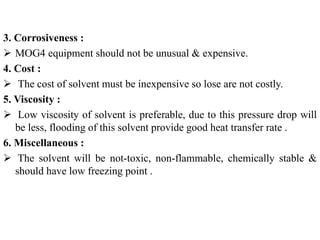
3. Corrosiveness :
 MOG4 equipment should not be unusual & expensive.
4. Cost :
 The cost of solvent must be inexpensive so lose are not costly.
5. Viscosity :
 Low viscosity of solvent is preferable, due to this pressure drop will
be less, flooding of this solvent provide good heat transfer rate .
6. Miscellaneous :
 The solvent will be not-toxic, non-flammable, chemically stable &
should have low freezing point .
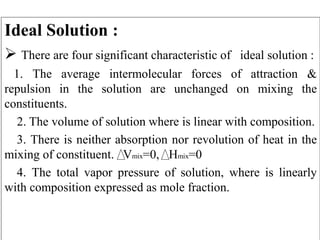
Ideal Solution :
 There are four significant characteristic of ideal solution :
1. The average intermolecular forces of attraction &
repulsion in the solution are unchanged on mixing the
constituents.
2. The volume of solution where is linear with composition.
3. There is neither absorption nor revolution of heat in the
mixing of constituent. Vmix=0, Hmix=0
4. The total vapor pressure of solution, where is linearly
with composition expressed as mole fraction.
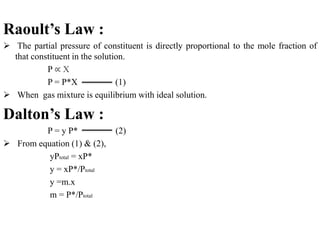
Raoult’s Law :
 The partial pressure of constituent is directly proportional to the mole fraction of
that constituent in the solution.
P ∝ X
P = P*X (1)
 When gas mixture is equilibrium with ideal solution.
Dalton’s Law :
P = y P* (2)
 From equation (1) & (2),
yPtotal = xP*
y = xP*/Ptotal
y =m.x
m = P*/Ptotal
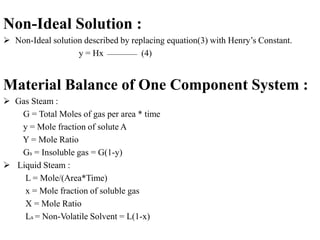
Non-Ideal Solution :
 Non-Ideal solution described by replacing equation(3) with Henry’s Constant.
y = Hx (4)
Material Balance of One Component System :
 Gas Steam :
G = Total Moles of gas per area * time
y = Mole fraction of solute A
Y = Mole Ratio
Gs = Insoluble gas = G(1-y)
 Liquid Steam :
L = Mole/(Area*Time)
x = Mole fraction of soluble gas
X = Mole Ratio
Ls = Non-Volatile Solvent = L(1-x)
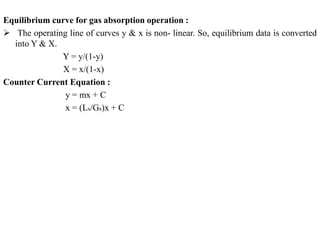
Equilibrium curve for gas absorption operation :
 The operating line of curves y & x is non- linear. So, equilibrium data is converted
into Y & X.
Y = y/(1-y)
X = x/(1-x)
Counter Current Equation :
y = mx + C
x = (Ls/Gs)x + C
Thank You

Gas Absorption & Adsorption.pptx

  • 1.
    Semester : 5[2051-CH] Gas Absorption & Adsorption Prepared by: Guided by: Raut Krish(216470305008) Mr. K. S. Chavda Patra Swarnlata(216470305013 ) Ambaliya Owaish(216470305014)
  • 2.
    Gas Absorption • Definition: Gas absorption is an operation in which a gas mixture is contacted with an liquid for the purpose of preferably dissolving one or more component of the gas an to provide a solution of them into the liquid. • Example : 1. Gas from by product of cock oven wash with water to remove ammonia & washed with oil to remove benzene , toluene & aromatic vapor. 2. H2S remove from gas(naturally occurring hydrocarbon gas) by washing with various alkali solution.
  • 3.
    Requirement of GasAbsorption :  This operation required mass transfer of one substance from gas to liquid.  Mass transfer liquid to gas, this operation is known as desorption/stripping.  Example : Benzene & toluene remove from the absorption oil by contacting the liquid solution(oil) with steam. By this operation, we can reuse the oil.  The most important use of solute recovery or solute remove.
  • 4.
    Equilibrium Solubility ofGas in Liquid : 1. Effect of Pressure :  Concentration of dissolve gas in the liquid at prevailing temperature & pressure is known as gas solubility in liquid. 2. Effect of Temperature : d(lnk)/dT = H/RT2  To understand the effect of temperature & solubility(equilibrium), Van’t Hoff law is useful.  When we increase the temperature, generally the molecules will be expand so that dissolution (absorption) will be decrease.  Low molecular weight of molecules(gas) like H2, O2, N2, CH4 & many more in water, the solubility will be increase with temperature above the 100⸰C & acts specific pressure.
  • 5.
    Selection Criteria ofSolvent : 1. Gas Solubility :  Absorption of benzene from cock oven gas always hydrocarbon oil is used & water dose not used.  Because solubility of benzene in water is very low like to be insoluble.  H2S remove from gas mixture using Ethanolamine is used, caustic soda is not used because caustic soda only absorb H2S during the absorption & does not release again in stripping. 2. Solubility :  If gas mixture & solvent are readily exchanging the solute.  Use another less volatile solvent to recover first solvent.  Example : Hydrocarbon absorption used relatively volatile solvent oil & volatilized solvent recovered from gas by using non-volatile oil.
  • 6.
    3. Corrosiveness : MOG4 equipment should not be unusual & expensive. 4. Cost :  The cost of solvent must be inexpensive so lose are not costly. 5. Viscosity :  Low viscosity of solvent is preferable, due to this pressure drop will be less, flooding of this solvent provide good heat transfer rate . 6. Miscellaneous :  The solvent will be not-toxic, non-flammable, chemically stable & should have low freezing point .
  • 7.
    Ideal Solution : There are four significant characteristic of ideal solution : 1. The average intermolecular forces of attraction & repulsion in the solution are unchanged on mixing the constituents. 2. The volume of solution where is linear with composition. 3. There is neither absorption nor revolution of heat in the mixing of constituent. Vmix=0, Hmix=0 4. The total vapor pressure of solution, where is linearly with composition expressed as mole fraction.
  • 8.
    Raoult’s Law : The partial pressure of constituent is directly proportional to the mole fraction of that constituent in the solution. P ∝ X P = P*X (1)  When gas mixture is equilibrium with ideal solution. Dalton’s Law : P = y P* (2)  From equation (1) & (2), yPtotal = xP* y = xP*/Ptotal y =m.x m = P*/Ptotal
  • 9.
    Non-Ideal Solution : Non-Ideal solution described by replacing equation(3) with Henry’s Constant. y = Hx (4) Material Balance of One Component System :  Gas Steam : G = Total Moles of gas per area * time y = Mole fraction of solute A Y = Mole Ratio Gs = Insoluble gas = G(1-y)  Liquid Steam : L = Mole/(Area*Time) x = Mole fraction of soluble gas X = Mole Ratio Ls = Non-Volatile Solvent = L(1-x)
  • 10.
    Equilibrium curve forgas absorption operation :  The operating line of curves y & x is non- linear. So, equilibrium data is converted into Y & X. Y = y/(1-y) X = x/(1-x) Counter Current Equation : y = mx + C x = (Ls/Gs)x + C
  • 26.