Model Driven Architecture
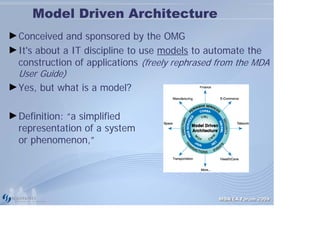
► Conceived and sponsored by the OMG
► It's about a IT discipline to use models to automate the
  construction of applications (freely rephrased from the MDA
  User Guide)
► Yes, but what is a model?

► Definition: “a simplified
  representation of a system
  or phenomenon,”


                                                 MDA/EA Forum 2009
The Code is a Model
► It represents high level logical structure
   ► “Repeat until” or “JNE x00ef, x003F” ?


► It hides irrelevant details
   ► Which processors is there beneath?


► Code has always about abstraction:
   ► Machine code -> Assembly -> 3GL -> OO -> Java ->

      WSDL->UML->RuleML->XBRL.. and still proceeding


                                           MDA/EA Forum 2009
A Model is a Code
► Services can be represented by a model
   ► WSDL, language classes..


► Applications can be represented by models
   ► UI, services, components, data model, object model,

     deployment...
► A Model can be run now
   ► Action semantics, BPMN, OCL

   ► OCL is code .. or is it a model?

   ► There are many commercial tools outside there (and

     here too) which this capability
► Models can be checked and transformed … as code
► Models can be tested and debugged … as code
                                              MDA/EA Forum 2009
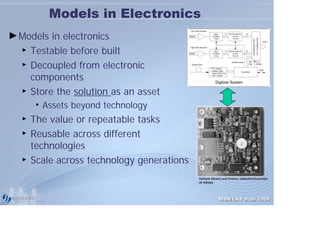
Models in Electronics
► Models in electronics
  ► Testable before built

  ► Decoupled from electronic

    components
  ► Store the solution as an asset


        • Assets beyond technology
   ►   The value or repeatable tasks
   ►   Reusable across different
       technologies
   ►   Scale across technology generations
                                             Nathalie Moreno and Antonio VallecilloUniversidad
                                             de Málaga


                                                           MDA/EA Forum 2009
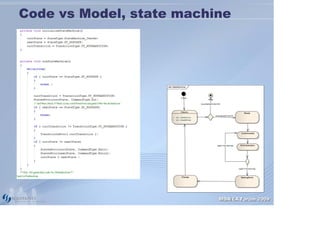
Code vs Model, state machine


                          MDA/EA Forum 2009
Code vs Model

[omissis]

try{

if (System.getSecurityManager() == null) {

        System.setSecurityManager(new RMISecurityManager());
                                                        sd Class Model
        }

} catch {/*tech Error handling*/}                          ReqT ype:M yRequester              S ervice:PowerService


try {

PowerService service = (PowerService) Naming.lookup("rmi://" + serverIp+ "/PowerService");

} catch {/*tech Error handling*/}
                                                                          doSom ething(context, 123)
try {

        System.transactionMon(IN, context);

        context=service.doSomething(contex, 123);

        System.transactionMon(OUT, context);

} catch {/* tech and behavioral error handling*/}

[omissis]


                                                                                             MDA/EA Forum 2009
Demystifying modelling approach
► Models do not execute                  ► No MDA projects are in
   ►   False, many solutions exists        productions
► Models generate slow code
                                            ►   False: there are many, check
                                                the OMG web page, ask here
   ►   False: depends only on quality
                                                around
       of the transformations
                                         ► No MDA development tools are
► It's a heavy weight approach
                                           available:
   ►   False, it depends on the             ►   False: check OMG web page
       development process: adopt
                                                or ask here around
       shorter cycles
                                         ► MDA is only for embedded
   ►   False: ”Divide et impera”
                                           systems:
       vertically (functional
       components), horizontally
                                            ►   False: check the OMG web
       (tiers), cross cutting concerns          site for success stories
► The generated code is messy and        ► UML is very large:
  hard to be read                           ►   True: but there is no need to
   ►   Meaningless: there is no                 use all of it's semantics. There
       need to look at the code                 are other languages Forum 2009
                                                                  MDA/EA
Why this general scepticism?
► It due to the mindset of IT software practitioners, it's a matter of:
   ►   Different Viewpoint on the development
   ►   Different Habits
   ►   Late Maturity
   ►   No Confidentiality
   ► Not enough Experience
► Q: "If I do not see a code I feel uncomfortable"
   ►  A: “Have you ever seen the ASM generated by the C++
      compiler? No, right? But you still feel comfortable, and you don't
      debate the quality of the generated code, how comes?
► There shall be no difference if the generated application has not
  introduced any bug and it's adequately fast


                                                           MDA/EA Forum 2009
Agility
► Adjective: “quick and well-coordinated in movement”
   ► Quick: be light, do not have unnecessary load

   ► Well-coordinated: well connected and in-sync


► [..close collaboration between the programmer team and
  business experts; face-to-face communication (as more
  efficient than written documentation); frequent delivery
  of new deployable business value..]
► Quick, assumes the iteration process to be short and lite
► Coordinated: assumes parts are well connected and in
  sync
► How to be agile depends on local capabilities and skills,
  it's a relative term
                                                MDA/EA Forum 2009
Agility in Modelling
► Focus on capturing and fulfilling the functional specifications
  as a runnable application
   ► In MDA, technicalities can be tuned afterwards


► Do not search for the optimal technical architecture right
  from the beginning, accept compromises "the optimum is the
  killer of good"
► Short deployment cycles
   ► Feedbacks have be incorporated back into models quickly

   ► Three weeks for an iteration

   ► New requirement are welcome, but trace them


► Avoid round-trip code<->model, it jeopardizes the agility
► Go for a consistent and integrated MDA tool, avoid spaghetti
  frameworks
                                                     MDA/EA Forum 2009
What to keep in mind
► Model life cycle management
   ►   Models has to drive the development
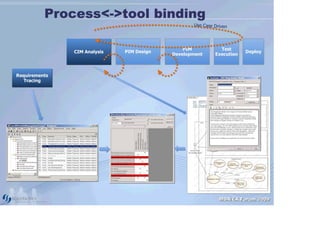
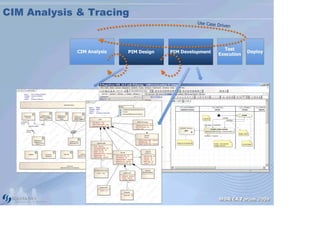
   ►From requirement to execution in a traced continuum
► What can be done with code has to be, and CAN be done with
  models as well
   ►   Debugging
   ►   Testing
   ►   Validation
   ►   Execution
   ►   Versioning
   ►Deployment
► Models are your assets
   ► Take good care of them
► There is a price to pay...                        MDA/EA Forum 2009
Hurdles
► DO NOT UNDERSTIMATE THE IMPORTANCE OF A
  SOUND FUNCTIONAL MODEL
   ► If a model is a code ...

   ► ...be careful in defining your functional reference

     model, you could soon fall under a messy functional
     model: aka “Spaghetti Model”
► 100% models interoperability across MDA tools is yet to
  be a "default"
   ► An old story: as for C++ compilers


► Re-think the organization of the software re-factory:
   ► People, Processes, Tools


► Bootstrapping the software factory...
                                               MDA/EA Forum 2009
Agile Modelling Architecture

Agile Modelling Architecture

  • 2.
    Model Driven Architecture ►Conceived and sponsored by the OMG ► It's about a IT discipline to use models to automate the construction of applications (freely rephrased from the MDA User Guide) ► Yes, but what is a model? ► Definition: “a simplified representation of a system or phenomenon,” MDA/EA Forum 2009
  • 3.
    The Code isa Model ► It represents high level logical structure ► “Repeat until” or “JNE x00ef, x003F” ? ► It hides irrelevant details ► Which processors is there beneath? ► Code has always about abstraction: ► Machine code -> Assembly -> 3GL -> OO -> Java -> WSDL->UML->RuleML->XBRL.. and still proceeding MDA/EA Forum 2009
  • 4.
    A Model isa Code ► Services can be represented by a model ► WSDL, language classes.. ► Applications can be represented by models ► UI, services, components, data model, object model, deployment... ► A Model can be run now ► Action semantics, BPMN, OCL ► OCL is code .. or is it a model? ► There are many commercial tools outside there (and here too) which this capability ► Models can be checked and transformed … as code ► Models can be tested and debugged … as code MDA/EA Forum 2009
  • 5.
    Models in Electronics ►Models in electronics ► Testable before built ► Decoupled from electronic components ► Store the solution as an asset • Assets beyond technology ► The value or repeatable tasks ► Reusable across different technologies ► Scale across technology generations Nathalie Moreno and Antonio VallecilloUniversidad de Málaga MDA/EA Forum 2009
  • 6.
    Code vs Model,state machine MDA/EA Forum 2009
  • 7.
    Code vs Model [omissis] try{ if(System.getSecurityManager() == null) { System.setSecurityManager(new RMISecurityManager()); sd Class Model } } catch {/*tech Error handling*/} ReqT ype:M yRequester S ervice:PowerService try { PowerService service = (PowerService) Naming.lookup("rmi://" + serverIp+ "/PowerService"); } catch {/*tech Error handling*/} doSom ething(context, 123) try { System.transactionMon(IN, context); context=service.doSomething(contex, 123); System.transactionMon(OUT, context); } catch {/* tech and behavioral error handling*/} [omissis] MDA/EA Forum 2009
  • 8.
    Demystifying modelling approach ►Models do not execute ► No MDA projects are in ► False, many solutions exists productions ► Models generate slow code ► False: there are many, check the OMG web page, ask here ► False: depends only on quality around of the transformations ► No MDA development tools are ► It's a heavy weight approach available: ► False, it depends on the ► False: check OMG web page development process: adopt or ask here around shorter cycles ► MDA is only for embedded ► False: ”Divide et impera” systems: vertically (functional components), horizontally ► False: check the OMG web (tiers), cross cutting concerns site for success stories ► The generated code is messy and ► UML is very large: hard to be read ► True: but there is no need to ► Meaningless: there is no use all of it's semantics. There need to look at the code are other languages Forum 2009 MDA/EA
  • 9.
    Why this generalscepticism? ► It due to the mindset of IT software practitioners, it's a matter of: ► Different Viewpoint on the development ► Different Habits ► Late Maturity ► No Confidentiality ► Not enough Experience ► Q: "If I do not see a code I feel uncomfortable" ► A: “Have you ever seen the ASM generated by the C++ compiler? No, right? But you still feel comfortable, and you don't debate the quality of the generated code, how comes? ► There shall be no difference if the generated application has not introduced any bug and it's adequately fast MDA/EA Forum 2009
  • 12.
    Agility ► Adjective: “quickand well-coordinated in movement” ► Quick: be light, do not have unnecessary load ► Well-coordinated: well connected and in-sync ► [..close collaboration between the programmer team and business experts; face-to-face communication (as more efficient than written documentation); frequent delivery of new deployable business value..] ► Quick, assumes the iteration process to be short and lite ► Coordinated: assumes parts are well connected and in sync ► How to be agile depends on local capabilities and skills, it's a relative term MDA/EA Forum 2009
  • 13.
    Agility in Modelling ►Focus on capturing and fulfilling the functional specifications as a runnable application ► In MDA, technicalities can be tuned afterwards ► Do not search for the optimal technical architecture right from the beginning, accept compromises "the optimum is the killer of good" ► Short deployment cycles ► Feedbacks have be incorporated back into models quickly ► Three weeks for an iteration ► New requirement are welcome, but trace them ► Avoid round-trip code<->model, it jeopardizes the agility ► Go for a consistent and integrated MDA tool, avoid spaghetti frameworks MDA/EA Forum 2009
  • 14.
    What to keepin mind ► Model life cycle management ► Models has to drive the development ►From requirement to execution in a traced continuum ► What can be done with code has to be, and CAN be done with models as well ► Debugging ► Testing ► Validation ► Execution ► Versioning ►Deployment ► Models are your assets ► Take good care of them ► There is a price to pay... MDA/EA Forum 2009
  • 18.
    Hurdles ► DO NOTUNDERSTIMATE THE IMPORTANCE OF A SOUND FUNCTIONAL MODEL ► If a model is a code ... ► ...be careful in defining your functional reference model, you could soon fall under a messy functional model: aka “Spaghetti Model” ► 100% models interoperability across MDA tools is yet to be a "default" ► An old story: as for C++ compilers ► Re-think the organization of the software re-factory: ► People, Processes, Tools ► Bootstrapping the software factory... MDA/EA Forum 2009